Numerical methods for
radiation
and
resonance
problems
KAKO, Takashi (加古 孝) $*$
KANO, Tomotoshi (加納悶悶)
Department ofComputer Science
The University ofElectro-Communications
Chofu, Tokyo 182-8585, JAPAN
1
Introduction
The main purpose of this paper is to investigate some typical problems ofwave motion in
unbounded region which are related to radiation or scattering phenomena. The Helmholtz
equation is one of the most important mathematical models which is used to describe the
time harmonic behavior of various vibration and wave propagation phenomena.
The motivation of research is to understand main characteristics of wave propagation
phenomena in obstacle scattering $\mathrm{a}\mathrm{n}\mathrm{d}/\mathrm{o}\mathrm{r}$ wave radiation process through its numerical
computation based on its mathematical analysis.
The importance of the wavepropagation resides in the fact that it transmits information
and transports energy. Some examples of research fields related to the wave
propaga-tion include acoustics, elasticity, electromagnetism withvarious applications such as sound
emission from a speaker, human speech production, sound production of musical
instru-ments, noise reduction, diagnostics or detection by ultrasonic wave, propagation ofwaves
in optical fiber of fiber scope, heating by wave for various kinds of materials and others.
Some of the characteristic quantities to be calculated in these problems include scattering
amplitudes, transmission and reflection coefficients,
resonance
frequencies.To investigate numerically the wave propagation phenomena in unbounded region using
computers, we have to approximate the original problem which is formulated in some
infinite dimensional function space by the one in an appropriate finite dimensional linear
space. For this purpose, we first use the knowledge of the analytical properties of the
solution to the original problem such as the radiation condition at infinity $\mathrm{a}\mathrm{n}\mathrm{d}/\mathrm{o}\mathrm{r}$ the
expression of the solution byaseries of specialfunctions or byan integral involving Green’s
function. Wethen reduce the problem intotheboundaryvalue problemin abounded region
with some truncation errorforitssolution and applya finite element discretization method to get the $\underline{1\mathrm{i}_{11}}\epsilon \mathrm{a}\mathrm{r}$ equation in a finite
dimensional
approximation space.Especially, we will show the effectiveness of the radiation condition at infinity which
describes the asymptotic behavior of the solution and singles out the physical solution.
We then use the domain decomposition method which divides the original problem in an
unbounded region into the problem in a bounded region and the one in an outer region
with simple shape.
More specifically, we treat a two-dimensional wave-guide problem where we use the
exact boundary condition given by the Diriclet to Neumann map on the boundary between
a bounded region and
an
outer unbounded region which is cylindrical with a boundedcross section. We also consider a one-dimensional problem related to this original
two-dimensional problem.
We
will show some numerical examples, and discuss the relationship between $2\mathrm{D}$ and1D cases and show
some
numerical examples which indicate the efficiency of the 1D modelas the good approximation of the $2\mathrm{D}$ problem in the sense that it gives similar frequency
response
curves.
2
Mathematical
Formulation
The main mathematical framework of the study consists of the scattering theory based
on
the perturbation theory for linear operators and the finite element method for partialdifferential. equations.
The first difficulty in
studyi.ng
the $\mathrm{r}\mathrm{a}.\mathrm{d}\mathrm{i}\mathrm{a}\mathrm{t}\mathrm{i}_{0}\mathrm{n}$ or scattering problem comes from theun-boundedness of the region where we consider the partial differential $\mathrm{e}\mathrm{q}\mathrm{u}\mathrm{a}\mathrm{t}\grave{\mathrm{i}}_{\mathrm{o}\mathrm{n}}$and
we
haveto choose an appropriate function space. The second problem we have to $\dot{\mathrm{t}}\mathrm{r}\mathrm{e}\mathrm{a}\mathrm{t}$
appropri-ately is the indefiniteness of$\mathrm{t}\mathrm{h}\dot{\mathrm{e}}$
bilinear form which appears in the weak formulation used
for the finite element method in the artificial bounded region and we
hav.e
to consider theproblem with non-real variables as well.
In this paper, werestrict ourstudytothe two-dimensional casealthoughthereal physical
phenomena occur in three-dimensional space. However, at least the theoretical part ofour
study can be extended to the three-dimensional case without any essential difficulty.
The
main problem we may have to solve is the practical computational complexity due to the
large number of unknowns in $3\mathrm{D}$ caseand the shortage ofmemoryand speed of the present
computers together with the human resources in programming.
2.1
Two-dimensional
Wave
Propagation
Problem
The wave propagation phenomena in two-dimensional space $R^{2}$ can be described by the
following mathematical model ofthe wave equation in $\Omega\subset R^{2}$:
$( \alpha\frac{\partial}{\partial n}+\beta)u(t,x, y)$ $=g(t,x,y)$
on
$(-\infty, \infty)\mathrm{x}\partial\Omega$,(2)
where
$\frac{\partial}{\partial n}$ denotesthe
outward normal derivativeon
the boundary $\partial\Omega$ of $\Omega$.
In the following,
we consider
a stationarytime
harmonic solution of theproblem: ,$u(t,x,y)=$$e^{i\omega t}u(x, y)$ for
inhomogeneous
data: $f(t,x,y)=e^{i\omega l}f(x,y)$ and $g(t, x,y)=e^{i\omega t}g(x, y)$ fromwhich
we
can
calculate almostevery
important quantity.Then
$u$ satisfies theHelmholtz
equation:
$(-\Delta-\omega^{2})u(X,y)$ $=f(x,y)$ in $\Omega$
,
(3)
$( \alpha\frac{\partial}{\partial n}+\beta)u(x,y)$ $=g(x,y)$
on
$\partial\Omega$ (4)with
some radiation
condition at infinity $(r=(x^{2}+y^{2})^{1/2}arrow+\infty)$.
We
assume
that the boundary $\partial\Omega$consists oftwo mutuallydistinct parts:$\partial\Omega=\Gamma_{H}\cup\Gamma s$
where $g=g_{S}$
on
thesource
boundary $\Gamma_{S}$ and $g=0$on
the
homogeneous boundary$\Gamma_{H}$.
The existence and uniqueness of the
solution
to thisradiation
or
scattering problemcan beproved by the limiting absorption principle
which
claims that the physical solution is thelimit
of the solution for the problem with positive absorptionwhen
the absorption tendsto
zero.
In case thatwe
knowGreen’s function of
the corresponding free space problemwhich satisfies the radiation condition at infinity,
we
can construct the solution solvingtheintegral equation
on
the boundary.2.2
Reduction
to
a
Problem
in a
Bounded Region
We introduce
an artificial
boundary in $\Omega$ which includes thesource
boundary$\Gamma_{S}$ and we
assume
that the shape of the outside the boundary issimple. Forexample, it is the outsideof a disk or a cylindrical region. The, using the knowledge of the solution outside the
boundary we impose the boundary condition
on
theartificial
boundary which may theDiriclet to
Neumann
($\mathrm{D}\mathrm{t}\mathrm{N}$ in short) mapor
its approximation. We sometimes callit a
radiation boundary
condition
(or artificial boundary condition).In the $2\mathrm{D}$ wave-guide problem with a cylindrical unbounded
semi-infinite
channel, the
radiation condition in the cylindrical is
written as:
$\frac{\partial p}{\partial n}(=\frac{\partial p}{\partial x})=\Lambda p$ on
$\Gamma_{R}$
,
(5)where
$\Gamma_{R}$ isan
artificial boundary which is across
section of the cylindrical regionand A
is the Dirichlet to
Neumann
nap in the outer cylindricalregion
given as$\Lambda p=\sum_{\overline{\sim}^{0}}^{\infty}\gamma nCn(p)\mathrm{c}n\mathrm{o}\mathrm{s}(\frac{n\pi}{L}y)$ (6)
with
$C_{n}(p\rangle=\{$
$\frac{1}{L}\int_{0}^{L}p(x,y)dy$ $(n=0)$
$\frac{2}{L}\int_{0}^{L}p(x_{7}y)\cos(\frac{n\pi}{L}y)dy$ $(n\geq 1)$,
$\gamma_{n}=\{$ $i\zeta_{n}$, $-\eta_{n}$, $\zeta_{n}=\{\omega^{2}-(\frac{n\pi}{L})2\}^{1/}2$, $0< \frac{n\pi}{L}<\omega$ $\eta_{n}=\{(\frac{n\pi}{L})2-\omega 2\}^{1}/2$, $\omega\leq\frac{n\pi}{L}$. (8)
Then the Helmholtz equation in the inner domain $\Omega_{i}$ is given as:
$(-\omega^{2}-\Delta)p=0$ in $\Omega_{i}$ (9)
$\frac{\partial p}{\partial n}=0$ on
$\Gamma_{H}$, $\frac{\partial p}{\partial n}$
$=g_{S}$ on $\Gamma_{S}$
,
$\frac{\partial p}{\partial n}=\Lambda p$ on $\Gamma_{R}$Related to
this
$2\mathrm{D}$ wave-guide problem, we can consider the corresponding1D
Webster’shorn equation given as:
$- \frac{\partial v}{\partial t}=\frac{A(x)}{\rho}\frac{\partial p}{\partial x’}$ $- \frac{\partial p}{\partial t}=\frac{\rho c^{2}}{A(x)}\frac{\partial v}{\partial x’}$ (10)
where$p$ is the pressureand $v$is the velocity, and$A(x)$ denotes the areaof the cross section.
Eliminating $v$, we have the 1D approximation model called Webster’s horn equation:
$\frac{\partial^{2}p}{\partial t^{2}}-\frac{1}{A(x)}c^{2_{\frac{\partial}{\partial x}(()\frac{\partial p}{\partial x})0}}AX=$, (11)
3
Week Formulation and
Discretization
In this paper, we use the finite element method to dicretize the problem in the artificially
truncated region with an artificial boundary condition. We start with a weak formulation
of the problem in an appropriate closed subspace $\mathcal{V}$ of the Sobolev space $H^{1}(\Omega_{i})$ defined
through the boundary condition and then restrict the problem into a finite dimensional
subspace of $\mathcal{V}$ which is a set of all piece-wise linear continuous functions in $\mathcal{V}$ with respect
to a regulartriangulation of$\Omega_{i}$
.
We note that we haveto introduce an appropriateapprox-imation of the boundary integral which corresponds to the non-local boundary condition
such as the higher order radiation boundary condition or the Dirichlet to Neumann map.
In the following, we show the case of the $2\mathrm{D}$ wave-guide problem in some detail.
The weak formulation for theHelmholtz problem (3) and (4) with the artificial boundary
condition is given as:
Find $p\in \mathcal{V}\subset H^{1}(\Omega)$ :
$a(p, q)=(f, q)(=a0(g, q))$ $\forall q\in \mathcal{V}$
where, together with its approximation $a_{N}(\cdot, \cdot)$,
$a(p, q)$ $=$ $a_{0}(p, q)+b_{1}(p, q)+b_{2}(p, q)$,
with
$a_{0\backslash }p,$$q’\backslash )$ $=$ $J_{\Omega}^{[_{\nabla_{\mathrm{v}}}}p\cdot\overline{\nabla q}|\perp p\overline{q}.d\tau_{U\prime}"\prime \mathrm{J}y$
$o(\iota_{1}p, q)$ $=$ $-/( \infty’+^{1}\perp)2\int_{\Omega}p\overline{q}dxdy$
$b_{2}(_{\sim^{\wedge}}p, q)$ $=$ $-(\Lambda p(_{X_{B}},$$\cdot \mathrm{I},$$q(xR, \cdot \mathrm{I})=b_{2}.;(p,$
$q\mathrm{I}+b_{\underline{?},r}\infty(p,$ $q\mathrm{I}$
$U_{2,i(P,q}l/\backslash J$ $=$ $-i \omega LC_{0}(p)C_{0}(q)-\prime i0<\frac{\sum_{n\pi}}{L}<\omega\zeta_{n}(\frac{L}{2}JCn(p\backslash /)c_{n}(q)$
$b_{2,r}^{\infty}(p, q)$ $= \sum_{\omega\leq\frac{n\pi}{L}}\eta_{n}(\frac{L}{2})c_{n}(\mathrm{P})c_{n}(q)$,
where $\zeta_{n}$ and $\eta_{n}$ are all
nonnegative
constants in (8), and$b_{2}^{N}(_{\backslash }\mathrm{P}, q)$
, $=$ $-(\Lambda^{N}p(_{\backslash }xR*\cdot 1.q(x_{P}\text{ノ}/J\backslash ’\cdot)),=b_{2},\dot{\tau}\vee(_{\backslash }p_{\mathit{1}}.\mathrm{x}_{/}1\mathit{0}+b^{N}2,\gamma(p,$$q,1$,
$b_{2,r}^{N\prime}(p, q \grave{)} = \frac{L}{}.\omega\leq n\leq Lr/n(^{\frac{L}{2}}rightarrow N/\grave{j}C_{n}(p)Cn(q)\backslash .$
Now the finite element method is formulated as:
Find $p_{h}\in \mathcal{V}_{h}\subset H^{1}(\Omega)$ :
$a(ph, qh)=(f, qh)(=a0(g, qh))$ $\forall q_{h}\in \mathcal{V}_{h}$.
4
Error Analysis
Wedevelop theerroranalysis for the finite element discretization for theHelmholtzequation
with the $\mathrm{D}\mathrm{t}\mathrm{N}$ boundary condition. We give rather abstract results which is essentially
known but inanoperator theoretical formulation. In application to $2\mathrm{D}$wave-guide problem,
we use the result of Mikhlin [2] and the results of compact perturbation theory as well as
the uniqueness of the analytic solution.
4.1
Abstract Error Analysis for
Finite
Element Method
We consider the following four problems:
1: $(\mathrm{E})_{\mathrm{w}}$: Find $u\in \mathcal{V}$ such that
$a(u,$$v\rangle$ $=(.f,$$v1$
. for all $v\in \mathcal{V}$.
2: $(\mathrm{E}_{\mathrm{h}})_{\mathrm{w}}$: Find $u_{h}\in \mathcal{V}_{h}$ such that
$a(.u_{h}, v_{h_{-}})=(.f,$$v_{h}1$
3:
$(\mathrm{E}^{\mathrm{N}})_{\mathrm{W}}\vee$: Find $u^{N}\in \mathcal{V}$ such that$a^{N}(u^{N}, v)=(f, v,)$ for all $v\in \mathcal{V}$.
4: $(\mathrm{E}_{\mathrm{h}}^{\mathrm{N}})_{\mathrm{W}}$: Find $u_{h}^{N}\in \mathcal{V}_{h}$ such that
$a^{N}(u_{h}^{N}, v_{h})=(f, v_{h})$ for all $v_{h}\in \mathcal{V}_{h}$.
By Riesz’s representation theorem, two operators $A$ and $A_{N}$ are defined as:
$a(u, v)=(Au, v)$ and $a^{N}(u, v)=(A^{N}u, v)$ for all $v\in \mathcal{V}$.
Then, we have the above four equations are equivalent to the following operator equations
respectively:
1. $(\mathrm{E})_{\mathrm{o}\mathrm{p}}$ : $Au=f$
2. $(\mathrm{E}_{\mathrm{h}})_{\mathrm{o}\mathrm{p}}$: $A_{h}u_{h}=f_{h}$ with $A_{h}=P_{h}A$, $f_{h}=P_{h}f$
3. $(\mathrm{E}^{\mathrm{N}})_{0}\mathrm{P}$ : $A^{N}u^{N}=f$
4. $(\mathrm{E}_{\mathrm{h}}^{\mathrm{N}})_{\mathrm{o}\mathrm{p}}$
:
$A_{h}^{N}u_{h}^{N}=f_{h}$ with $A_{h}^{N}=P_{h}A^{N}$, $f_{h}=P_{h}f$Using the relations $Au=A^{N}u^{N}=f$ and
$P_{h}Au_{h}=A_{h}u_{h}=f_{h}=A_{h}^{N}u_{h}^{N}=P_{h}f=P_{h}Au=P_{h}A^{N}u^{N}$,
we can transform the expression of the error $u-u_{h}^{N}$ as follows:
$u-u_{h}^{N}$ $=u-v_{h}+v_{h}-u_{h}^{N}$ $=u-v_{h}+(A_{h}^{N})^{-}1ANvh-hNu_{h}$ $=u-v_{h}+(A_{h}^{N})^{-1}A_{hh^{-}}^{N}v(A_{h}^{N})^{-1}fh$ $=$ $u-v_{h}+(A_{h}^{N})^{-1}A^{N}hv_{h}-(A_{h}^{N})^{-1}P_{h}f$ $=u-v_{h}+(A_{h}^{N})^{-1}A^{N}v_{h}-h(A_{h}^{N})^{-1}P_{h}Au$ $=u-v_{h}+(A_{h}^{N})^{-1}\{A_{h}^{N}v_{h}-P_{h}Au\}$ $=$ $u-v_{h}+(A_{h}^{N})^{-1}\{P_{h}A^{N}v_{h}-P_{h}Au\}$ $=u-v_{h}+(A_{h}^{N})^{-1}\{PhAN(v_{h}-u)+P_{h}A^{N}u-P_{h}Au\}$ $=$ $\{I-(A_{h/}^{N}\backslash -1P_{h}AN)\}(u-v_{h})+(A_{h}^{N})^{-1}P_{h}(AN-A)u$.
Hence we can estimate the above difference as:
$||u-u_{h}^{N}|| \leq(I+||(A_{h}^{N})^{-1}||||A^{N}||)\inf_{\in v_{h}h}||u-v_{h}||+||(A_{h}^{N})^{-1}||||(A^{N}-A)u||$
1. $\mathrm{T}\mathrm{h}\mathrm{e}\mathit{1}^{\mathrm{h}}\mathrm{v}^{r}.\cdot$
uniform $\mathrm{b}_{0}\mathrm{u}\mathrm{n}.\mathrm{d}\mathrm{e}\mathrm{d}\mathrm{n}\mathrm{e}\mathrm{s}\mathrm{s}$ of$||(A_{h}^{N})-1||:||(A_{h}^{N})^{-1}||\leq M<+\infty$with respect to $h$ and
2. The truncation error estimate: $||(A^{N}-A)u|| \leq\frac{c}{N^{\alpha}}||u||_{w}$ under the regularity
condi-tion for $u:u\in \mathcal{W}\subset \mathcal{V}$
.
In the next section, we apply the results to the wave-guide problem.
4.2
Application
to Wave-Guide
Problem
We can apply the abstract error estimation based on the following observations:
1. The sesquilinearform $b_{2,r}^{\infty}(p, q)$ is bounded and nonnegative in $\mathcal{V}$. Hence $a_{0,DN}(p, q)\equiv$
$a_{0’}(p, q)+b_{2,r}^{\infty}(p, q)$ is an inner product in $\mathcal{V}$
2. The form $b_{1}(p, q)+b_{2_{\tau}i}(p, q)$ is compact with respect to $a_{0,DN}(p, q)$ in $\mathcal{V}$.
3. We can then apply the results by Mikhlin [2] (see also Kako [1]) and we can prove
the convergence ofthe finite element method undersome additional condition on the
$\mathrm{n}\mathrm{o}\mathrm{n}arrow \mathrm{e}\mathrm{x}\mathrm{i}\mathrm{s}\mathrm{t}\mathrm{e}\mathrm{n}\mathrm{c}\mathrm{e}$ ofa positive eigenvalue $\mathrm{f}\mathrm{o}\mathrm{r}-\triangle$ in $\Omega$.
4. The difference between $a(p, q)$ and $a^{N}(p, q)$ is written as:
$a(p, q)-a(Np, q)= \sum_{N<n}\eta n(\frac{L}{2})c_{n}(p)Cn(q)=(\{\Lambda-\Lambda N\}p, q)$ ,
and $||\{\Lambda-\Lambda^{N}\}p||_{L^{2}(L)}0$, tends to zeroexponentially with respect to $N$ or is estimated
$\mathrm{f}\mathrm{r}\mathrm{o}\mathrm{m}\mathcal{W}$
.
above by$\frac{c}{N^{\alpha}}||u||_{\mathcal{W}}$ with any $\alpha$ and a corresponding higher order Sobolev space
5
Some
Numerical
Examples
In this section, we show some numerical examples calculated by using the methods
intro-duced in the previous sections.
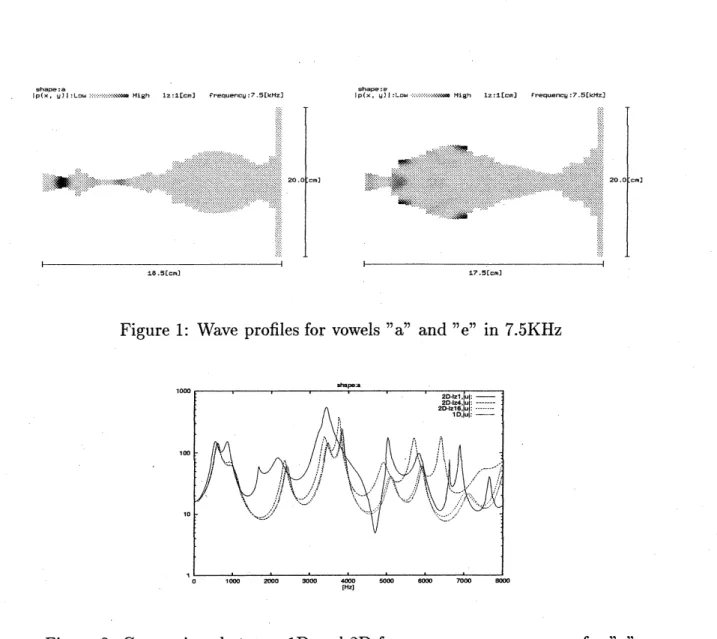
We show a numerical example of $2\mathrm{D}$ wave propagation in the vocal tract open to an
infinite cylinder. The Fig.1 shows a wave profile with$\cdot$
a time frequency 7.5 $\mathrm{k}\mathrm{H}\mathrm{z}$ for the
shapes of vowels ”
$\mathrm{a}$
”
(left) and ”e”(right). The source is placed on the left edge and the
right side is a radiation boundary. The next Fig.
2
shows a frequency response curve for$,,\mathrm{a}$”measured at the mid point on the radiation boundary. We can see that, as the shape
of the vocal tract becomes flatter, the response curve approaches nearer to the one of 1D
$|\mathrm{p}(\mathrm{X}\mathrm{s}\mathrm{m}.\mathrm{a}9^{)}\mathrm{I}\llcorner_{\circ \mathrm{W}}:.\cdot\cdot.\cdot.\cdot\cdot.\cdot\cdot.\cdot\cdot.\cdot\cdot.\cdot\cdot-\mathrm{H}\mathrm{l}\mathrm{s}h1\mathrm{z}:1\mathrm{R}\mathrm{f}r\epsilon \mathrm{q}-75\mathrm{r}M3$
$\mathrm{s}-\cdot \mathrm{e}$
I$\mathrm{p}\mathrm{t}\mathrm{x}$. $Q’|\mathrm{L}\mathrm{m}..\cdot.\cdot.\cdot\cdot..\cdot.\cdot\cdot..\cdot...\backslash \backslash \backslash \infty \mathrm{H}_{1}\mathrm{g}\mathrm{h}$ $1\mathrm{z}:\iota[\epsilon-1$ $F$requency75$[\mathrm{k}\mathrm{H}_{\mathrm{Z}}]$
Figure 1: Wave profilesfor vowels ”
$\mathrm{a}$” and
”
$\mathrm{e}$
” in
7.
$5\mathrm{K}\mathrm{H}\mathrm{z}$Figure
2:
Comparison between 1D and $2\mathrm{D}$ frequency responsecurves
for ”$\mathrm{a}$”
6
Concluding Remarks
We have developed a methodology to calculate problems in unbounded regions by use of
the $\mathrm{D}\mathrm{t}\mathrm{N}$ mapping or its approximations. Error analysis is given as an extension of the
standard method. Application to a problem having resonance phenomena is presented and
some typical phenomena have been captured inthese
numerical
experiments. Applicationsto more realistic problems are future subject of study.
References
[1] Kako, T.
:
Approximation of the scatteringstate by means ofthe radiation boundarycondition, Math. Meth. in the Appl. Sci.,
3
(1981)506-515.
[2] Mikhlin, S.G.: Variational Methods in Mathematical Physics, Oxford, Pergamon