JAIST Repository
https://dspace.jaist.ac.jp/Title
A new electrospinning method to control the number and a diameter of uniaxially aligned polymer fibers
Author(s) Ishii, Yuya; Sakai, Heisuke; Murata, Hideyuki Citation Materials Letters, 62(19): 3370-3372
Issue Date 2008-07-15
Type Journal Article
Text version author
URL http://hdl.handle.net/10119/4957
Rights
NOTICE: This is the author's version of a work accepted for publication by Elsevier. Yuya Ishii, Heisuke Sakai and Hideyuki Murata, Materials Letters, 62(19), 2008, 3370-3372,
http://dx.doi.org/10.1016/j.matlet.2008.03.038 Description
Materials Letters 62, 3370–3372(2008)
A new electrospinning method to control the number and
a diameter of uniaxially aligned polymer fibers
Yuya Ishii, Heisuke Sakai, Hideyuki Murata*
School of Materials Science, Japan Advanced Institute of Science and Technology (JAIST) 1-1 Asahidai, Nomi, Ishikawa 923-1292, Japan
* Corresponding author. Tel.: +81 761 51 1531; fax: +81 761 51 1149.
E-mail address: [email protected];
Abstract
A novel electrospinning process of uniaxially aligned submicron fibers was developed. The number of the fibers was precisely controlled by changing biased collector, and the diameter of the fiber was varied by post-deposition stretching process. This method realized the formation of number-controlled aligned poly[2-methoxy-5-(2´-ethyl-hexyloxy)-1,4-phenylenevinylene] (MEH-PPV)/poly(ethylene oxide) (PEO) fibers with the systematic control of the diameter ranging from micrometer to submicrometer. Significant improvement of the uniformity of the fiber diameter was also observed by the stretching process.
1. Introduction
Electrospinning is a simple and cost-effective method of producing polymeric fibers with diameters ranging from nanometers to a few micrometers and it has attracted much attention in the past decade [1]. Since these fibers form the rapidly whipping jet, they are generally collected in the form of randomly oriented mats. Although these mats are useful for applications such as composite reinforcement [2], sensors [3], bioscaffolds [4], and electrochemical photovoltaic electrodes [5], well-aligned and highly ordered structures of conducting polymers are often required for enhancing the performance of electrical devices. In addition, a single or number-controlled fiber is required to measure polymer characteristics. However, it is difficult to produce number-controlled and uniaxially aligned fibers by conventional electrospinning setups. Several techniques have been proposed to realize the orientation of electrospun fibers [6-9]. Although these methods enable to prepare uniaxially aligned fibers, it is quite difficult to produce uniaxially aligned electrospun fibers with controlling the number of fibers. Another important challenge in electrospinning process is to regulate the diameters of fibers. In general, the diameter of the fiber is adjusted by optimizing process parameters, such as concentration of polymer solution, voltage and/or distance between needle and collector electrode, and rotation speed in the case of that drum collectors are used. In this letter, we have successfully developed a simple method to produce electrospun fibers with controlling their number and diameter.
2. Experimental
The electrospinning setup in our experiments is shown in Fig. 1. Poly[2-methoxy-5-(2´-ethyl-hexyloxy)-1,4-phenylene vinylene] (MEH-PPV, Mn = 150,000 - 250,000, Aldrich) and poly(ethylene oxide) (PEO, Mv = 400,000, Aldrich) were used for electrospinning in this study. MEH-PPV was dissolved in chloroform with a concentration of 0.4 wt%. PEO was added to this solution at a concentration of 3 wt% [10,11]. The solution of PEO/MEH-PPV was then loaded to a glass syringe equipped with a stainless steel needle (0.3 mm of diameter). The needle was connected to a high-voltage power supply 1 (HVPS1, CN-30-MHVP, Matsusada Precision Inc.). The voltage used for electrospinning was 6 kV, and the distance between the needle and collectors was 10 cm. The solution was continuously supplied using a syringe pump at a rate of 0.5 ml/h.
Figure 1
Different from most commonly used electrospinning configurations, our setup includes two pieces of stainless steel collectors, collector 1 (C1) and collector 2 (C2), which were selectively
connected to high voltage power supply 2 (HVPS2, MEPM-3R5, Matsusada Precision Inc.). A mechanical switch allows to bias one of the collectors at -500 V with keeping another electrically grounded via a resistor (R = 1.7 MΩ). When C1 is selected to be biased, the fibers are only deposited on C1. By switching a biased collector from C1 to C2, a single straight fiber forms between C1 and C2 (Fig. 1, STEP1). The diameter of electrospun fibers was on the order of a few micrometers. The number of the fibers formed between C1 and C2 is precisely controlled by the number of switching times. After the formation of the number-controlled fibers, the fibers were stretched by increasing the gap between collectors (Fig. 1, STEP2). This procedure reduced the diameter of the fibers from micrometer to the submicron range and the diameter was adjusted by controlling the stretching ratio. No drying procedure to remove residual solvents was employed in this study.
3. Results and discussion
Figure 2
Figure 2 shows the fiber diameter as a function of fiber length after the stretching. A single fiber was prepared across a 5-mm gap between C1 and C2 and then stretched to 10 mm, 20 mm, 30 mm and 50 mm by increasing the gap. The average diameters of the fibers decreased from 1,350 nm to 531 nm with the increase in the fiber length.
Figure 3
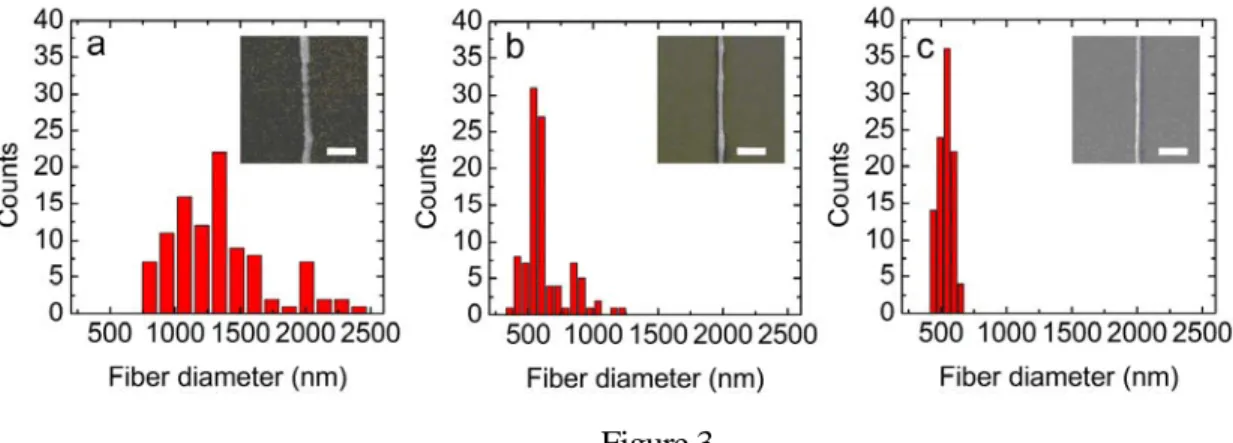
Figure 3 shows histograms of the fiber diameters of the fibers with different stretching ratio. The scanning electron microscope (SEM) images of the corresponding fibers were inserted in the figure. As shown in Fig. 3a, an as-deposited fiber has micrometer size diameter with irregular shape, which results in the large average diameter and wide distribution. By stretching the fiber to 20 mm, the diameter of the fiber becomes half of the unstretched fiber and the surface of the fiber become smoother. (Fig. 3b) Further stretching the fiber to 50 mm, fiber diameter is decreased to submicron size and the uniformity of the diameter is greatly improved (Fig. 3c). In the case of unstretched fibers (fiber length = 5 mm), standard deviation of the fiber diameter was 370 nm. On the other hand, the standard deviation significantly decreased to 55.2 nm by stretching to 50 mm.
These results clearly indicate that we can control the diameter by the stretching process. The uniformity of the fiber diameters improved from micrometer to nanometer range.
Comparing conventional approaches to control the fiber diameter such as adjusting a concentration of polymer solution, changing a speed of a rotating disk collector [12,13] and addition of ionic species [14], present method has clear advantages such that the control of the fiber diameter is independent from the preparation condition for the continuous fibers. In other words, systematic control of the diameter and the uniformity can be achieved by a single parameter: the stretching ratio.
Figure 4
Figures 4a - c show optical micrographs of number-controlled MEH-PPV/PEO fibers deposited on Au electrodes (STEP3 in Fig. 1). After the number controlled fibers were formed between C1 and C2 electrodes, the fibers were stretched. Then, they were transferred to a glass
substrate coated with two Au electrodes with a 100−μm to 200−μm gaps in order to take optical microscope images. These images clearly indicate that by using the switching method it is easy to fabricate straight submicron fibers with controlling the number of fibers. In general, a drum or a disc collector which rotate at high speed or an electrically grounded collector with a gap is used to prepare uniaxially aligned fibers. However, these methods hardly to control the number of fibers, since a large amount of electrospun fibers are deposited in a moment [6-9]. In the present method, direction of electrospun fibers is dictated by electrostatic force between the two collectors and the number of fibers is determined by the switching ratio. Figure 4d shows a SEM image of a sheet of MEH-PPV/PEO submicron fibers fabricated by 5000-times switching with post stretching process. Since polymer chains in the electrospun fibers are more oriented compared to those in the spin-coated polymer film [15], a sheet of well-aligned fibers would be suitable for the application in electronic devices.
4. Conclusion
In summary, we have presented a simple technique that enables to form uniaxially aligned submicron fibers with the control of their numbers and diameters. The number of electrospun fibers was precisely regulated by switching times from single to several thousands. The diameter of the produced fibers was adjusted from a few micrometers to submicrometer range by stretching. The uniformity of the diameter was significantly improved by the stretching process and went into the nanometer range.
Acknowledgements
The authors thank Dr. Mariano Campoy-Quiles for helpful discussions. This work has been supported in part by Grant-in-Aids for Scientific Research (No. 16310098 to H. M.) from the Japan Society for the Promotion of Science. H. S. is a research fellow (doctoral course) of the Japan Society for the Promotion of Science.
FIGURE CAPTIONS
Figure 1. Schematic illustration of the electrospinning setup and preparation processes of uniaxially aligned polymer fibers.
Figure 2. Dependence of the fiber diameter as a function of fiber length after stretching. A filled circle shows average diameter of the fiber after the stretching. A vertical line indicates variation of the fiber diameter measured on the different position of the fibers.
Figure 3. Histograms of the fiber diameters and the scanning electron microscope (SEM) images (inset) with different fiber length after the stretching; (a) an unstretched fiber, (b) a 20-mm fiber and (c) a 50-mm fiber. The total number of data counts was 100 for each plot. The scale bar in the inset was 5 μm respectively.
Figure 4. Optical microscope images of number-controlled MEH-PPV/PEO fibers; (a) – (c). A SEM image of a sheet of MEH-PPV/PEO nanofibers fabricated by 5000-times switching and post stretching process; (d).
References
[1] D.H. Reneker, I. Chun, Nanotechnology 7 (1996) 216.
[2] M.M. Bergshoef, G.J. Vancso, Adv. Mater. 11 (1999) 1362.
[3] X. Wang, Y.-G. Kim, C. Drew, B.-C. Ku, J. Kumar, L.A. Samuelson, Nano Lett. 4 (2004) 331.
[4] K. Sombatmankhong, N. Sanchavanakit, P. Pavasant, P. Supaphol, Polymer 48 (2007) 1419.
[5] M.Y. Song, D.K. Kim, S.M. Jo, D.Y. Kim, Synth Met. 155 (2005) 635.
[6] J. Doshi, D.H. Reneker, J. Electrost. 35 (1995) 151.
[7] A. Theron, E. Zussman, A.L. Yarin, Nanotechnology 12 (2001) 384.
[8] D. Li, Y. Wang, Y. Xia, Nano Lett. 3 (2003) 1167.
[9] W.E. Teo, W. S. Ramakrishna, Nanotechnology 16 (2005) 1878.
[10] W.K. Son, J.H. Youk, T.S. Lee, W.H. Park, Polymer 45 (2004) 2959.
[11] Q. Zhao, Z. Huang, C. Wang, Q. Zhao, H. Sun, D. Wang, Mater. Lett. 61 (2007) 2159.
[12] J.M. Deitzel, J. Kleinmeyer, D. Harris, N.C. Beck Tan, Polymer 42 (2001) 261.
[13] G. Mathew, J.P. Hong, J.M. Rhee, D.J. Leo, C. Nah, J. Appl. Polym. Sci. 101 (2006) 2017.