Japan Advanced Institute of Science and Technology
JAIST Repository
https://dspace.jaist.ac.jp/
Title
Optical second harmonic generation at
heterojunction interfaces of a molybdenum
trioxide layer and an organic layer
Author(s)
Basaty, A. B. EL; Miyauchi, Y.; Mizutani, G.;
Matsushima, T.; Murata, H.
Citation
Applied Physics Letters, 97(19):
193302-1-193302-3
Issue Date
2010-11-08
Type
Journal Article
Text version
publisher
URL
http://hdl.handle.net/10119/9825
Rights
Copyright 2010 American Institute of Physics.
This article may be downloaded for personal use
only. Any other use requires prior permission of
the author and the American Institute of Physics.
The following article appeared in A. B. EL
Basaty, Y. Miyauchi, G. Mizutani, T. Matsushima,
and H. Murata, Applied Physics Letters, 97(19),
193302 (2010) and may be found at
http://link.aip.org/link/doi/10.1063/1.3513297
Optical second harmonic generation at heterojunction interfaces of a
molybdenum trioxide layer and an organic layer
A. B. El Basaty,1,2Y. Miyauchi,1G. Mizutani,1,a兲T. Matsushima,1and H. Murata1,a兲
1School of Materials Science, Japan Advanced Institute of Science and Technology (JAIST),
Ishikawa 923-1292, Japan
2Department of Physics, Faculty of Science, Helwan University, Cairo 11795, Egypt
共Received 14 August 2010; accepted 17 October 2010; published online 8 November 2010兲 We have observed optical second harmonic generation 共SHG兲 from a space charge layer 共SCL兲 in a stacked indium tin oxide 共ITO兲/molybdenum trioxide 共MoO3兲/N−N
⬘
-diphenyl-N − N⬘
-bis共1-naphthly兲-1,1⬘
-biphenyl-4 , 4⬘
-diamine 共␣-NPD兲 system. When the MoO3 thicknesses were increased, the SHG signals from this system decreased sharply at smaller MoO3 thicknesses, and were saturated at MoO3 thicknesses larger than 1 nm. These results prove the vital role of SCL in improvement of drive voltages of organic light-emitting diodes. © 2010 American Institute ofPhysics. 关doi:10.1063/1.3513297兴
Recently, the space charge layer 共SCL兲 at interfaces in organic light-emitting diodes 共OLEDs兲 has been studied to improve the performance of the devices.1 Matsushima and Murata reported current density-voltage 共J−V兲 characteris-tics of hole-only devices with various thicknesses of molyb-denum trioxide 共MoO3兲 buffer layers and showed that a space-charge-limited current of N − N
⬘
-diphenyl-N − N⬘
-bis共1-naphthly兲-1,1⬘
-biphenyl-4 , 4⬘
-diamine 共␣-NPD兲 can be observed at a specific MoO3 thickness of 0.75 nm due to a negligible hole injection barrier caused by efficient interfa-cial charge generation.1 The interfacial charge generation mechanism consists of charge transfer from␣-NPD to MoO3 to form electron-hole pairs共SCL兲 and separation of the pairs under an external electric field. The charge transfer 共SCL兲 was detected indirectly by fluorescence 共FL兲 spectroscopy. Due to quenching of ␣-NPD excitons by SCL, FL peaks of ␣-NPD decrease in intensity in stacked films of␣-NPD and MoO3.1However, by this method, if materials cannot exhibit FL, SCLs are impossible to be detected. In order to measure accurate amount of SCLs for a wide variety of materials, a direct method for observing SCLs has to be established.In this study, we have observed optical second harmonic generation 共SHG兲 from a stacked indium tin oxide 共ITO兲/ MoO3/␣-NPD system in order to monitor the SCL formation at the MoO3/␣-NPD interfaces directly. The SHG is a well established technique used to investigate electronic states at surfaces and interfaces.2,3
The glass/ITO共150 nm兲/MoO3 共X nm兲/␣-NPD共60 nm兲 samples were fabricated as previously reported.4,5The MoO3 layer thickness was varied from 0 to 5 nm. We also prepared glass/ITO/MoO3 samples with different MoO3 thicknesses from 0.25 to 5 nm using the same procedure in order to investigate SHG characteristics at the MoO3/ITO interface.
The experimental setup for the SH intensity measure-ments has been reported elsewhere.6,7As the excitation light of SHG, we used the fundamental light of Nd3+ doped Yttrium Aluminum Garnet 共Nd3+: YAG兲 laser 共EKSPLA PL2143兲 with a photon energy of 1.17 eV, a pulse duration of 30 ps, and a repetition rate of 10 Hz. The pulse energy and the spot size on the sample and the incident angle were set at
50⫾5 J/pulse, ⬇1 mm, and 45°, respectively. In order to correct for the fluctuation of the incident light, the SH light intensities of the samples were normalized by that obtained from a GaAs共001兲 substrate. In order to take SH spectra, we used tunable IR light output from an optical parametric gen-erator and amplifier system as the incident light. The pulse energy was ⬇27 J/pulse. The incident angle was ⬇67°. The band width of the IR light was⬇0.8 meV. All experi-ments were performed at room temperature. We used ␣-SiO2共0001兲 as a reference sample in order to correct for the wavelength dependence of the sensitivity of the optical system.8
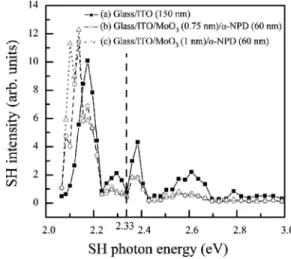
Figure 1 shows the SH spectra of 共a兲 glass/ITO 共150 nm兲, 共b兲 glass/ITO 共150 nm兲/MoO3 共0.75 nm兲/␣-NPD 共60 nm兲, and 共c兲 glass/ITO 共150 nm兲/MoO3 共1 nm兲/␣-NPD 共60 nm兲 systems. In the spectrum 共a兲 in Fig.1, there are a strong peak at ⬇2.17 eV and some fine structures above 2.2 eV. The peaks originate from the electronic transition in the ITO bulk, since the SH intensity of an ITO substrate with the thickness 30 nm is significantly lower than that with 150 nm 共see the dot 共c兲 in Fig. 2兲. In density functional theory
cal-a兲Electronic addresses: [email protected] and [email protected].
FIG. 1. SH spectra of共a兲 glass/ITO 共150 nm兲, 共b兲 glass/ITO 共150 nm兲/MoO3 共0.75 nm兲/␣-NPD 共60 nm兲, and 共c兲 glass/ITO 共150 nm兲/MoO3 共1 nm兲/
␣-NPD共60 nm兲 systems. All spectra are normalized by the SH spectra of
␣-SiO2共0001兲. Dashed line represents SH photon energy used in studying SH intensity as a function of MoO3layer thickness.
APPLIED PHYSICS LETTERS 97, 193302共2010兲
0003-6951/2010/97共19兲/193302/3/$30.00 97, 193302-1 © 2010 American Institute of Physics
culation of an ITO substrate, the optical band gap was found to range from 1.7 to 2.6 eV as a function of the percentage of the tin content.9,10Thus, we suggest that there are some do-mains with different percentage of the tin content in the ITO bulk, and these peaks correspond to the band gaps of the domains.
Spectra 共b兲 and 共c兲 in Fig. 1 have a strong peak at ⬇2.14 eV with the width ⬇0.05 eV, and this peak did not appear in spectrum共a兲 in Fig.1. This is not due to electronic transition between highest occupied molecular orbital 共HOMO兲 and lowest unoccupied molecular orbital 共LUMO兲 states in ␣-NPD since the energy difference between them should be larger than⬇2.6 eV.11,12The electronic transition in the MoO3layer is not feasible, either, since the widths of the relevant bands of O 2p, Mo 4d, and gap states are far broader than 0.05 eV.12 Thus, we suggest that it is contrib-uted by electronic transition inter-hetero-materials.
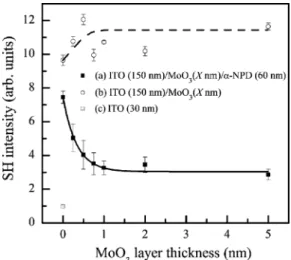
There are several peaks above 2.2 eV in spectra共b兲 and 共c兲 in Fig. 1, and their shapes are similar to those of the spectrum 共a兲 but the intensities of 共b兲 and 共c兲 are reduced significantly when compared with that of 共a兲. In order to understand the weaker SH intensities from the samples ITO/MoO3/␣-NPD than that from ITO only in Fig. 1, we studied the dependency of the SH intensities on the thick-nesses of the MoO3 layer ranging from 0 to 5 nm in the ITO/MoO3/␣-NPD system as shown in sample共a兲 in Fig.2. In this measurement, we selected the fundamental photon energy as 1.17 eV due to the good stability of the light source. This is because the static electric field from SCLs modulates SH spectra uniformly, and thus one can select probe light with any photon energy.
In the line共a兲 in Fig.2we see the strongest SH signal at the MoO3thickness of 0 nm, which originates from the bulk ITO layer. With the increase in the MoO3 thicknesses from 0.25 to 1 nm, the SH intensities decrease remarkably. The SH intensities are found to remain constant at the MoO3 thicknesses greater than 1 nm. It is known that the topology of MoO3changes from island to film structures at the thick-ness of 0.75 nm on the interface of the ITO layer.5 The change in SH signal intensities of the samples 共a兲 in Fig.2
suggests a growth of SCL at the interfaces of MoO3/␣-NPD
with the increase in the MoO3molecules till its topology has a uniform film structure.
We propose three candidate origins of the SH signal re-duction. They are 共1兲 a change in the Fresnel factor of the system due to the absorption of the incident or SH light in the MoO3layer,共2兲 a change in an electronic structure at the ITO/MoO3 interface, and 共3兲 a negative interference be-tween the SH signals generated at the MoO3/␣-NPD inter-face and at the bulk ITO layer.
In order to investigate the first candidate, we measured linear transmission and reflection spectra of the ITO/ MoO3/␣-NPD systems with different MoO3 thicknesses ranging from 0 to 5 nm共the data not shown兲. The transmit-tance of light at the photon energy of 1.17 eV and the reflec-tivity of light at 2.33 eV are important because these photon energies correspond to those of the input and output light in our SHG measurement. The transmittance of the ITO/MoO3/␣-NPD system at 1.17 eV is increased by ⬇10% with the increase in MoO3 thicknesses from 0 to 5 nm. This result indicates that the absorption of the incident light under the SHG measurements is not effective. The re-flection at 2.33 eV in the MoO3thickness range from 0 to 5 nm is increased by⬇10% with fluctuation. This result shows that the absorption of the SH light in the MoO3 layer is negligible. Thus, the first candidate origin is ruled out.
As the second candidate origin, the change in the elec-tronic structure at the ITO/MoO3 interface is discussed. At this interface, electrons transfer from ITO to MoO3, so that the electron density is lowered in the surface of the ITO layer. Lee et al.11 observed a remarkable SCL at this inter-face. Thus, the SHG from the ITO/MoO3 interface or the ITO bulk might be modulated by the formation of the SCL in our samples. In order to check this possibility, we measured the SH intensities from the ITO/MoO3system as a function of the MoO3 thicknesses as shown in Fig.2共b兲. Comparing SH intensity of samples共b兲 with that of samples 共a兲 in Fig.2, the effect of the MoO3layer on the SHG from the ITO layer can be regarded as small. Thus this second candidate is also ruled out.
The remaining candidate origin is a negative interference between the SH signals generated at the MoO3/␣-NPD in-terface and at the bulk ITO layer. The SH light generated at the interface is supposed to be induced by the broken sym-metry by an electric field in the SCL. A coherently emitted light wave like optical SH light has a definite phase and the phase value depends on the source nonlinear polarization. When optical second harmonic waves from two different sources with a phase difference of are superposed with each other, there should occur a negative interference in the output light intensity. Such is considered to be the case of the SH intensities in Fig. 2. Here the SHG from the MoO3/␣-NPD interface and the bulk ITO layer has a nega-tive interference and the total SH intensities decrease as a function of the MoO3thicknesses.
The SH signal’s behavior seen in Fig.2 is explained by the schematic diagram shown in Fig. 3. In Fig.3共b兲, charge transfers from ITO to MoO3 in the ITO/MoO3 systems, so that the dipole moment at the interfaces points to the ITO layer. The SH signals generated at the ITO/MoO3 interfaces constructively interferes with the signals from the ITO bulk. Thus, the SH intensities increased slightly after the MoO3 deposition in the line 共b兲 of Fig. 2. On the other hand, the dipole moment of the SCLs at the MoO3/␣-NPD interfaces FIG. 2. SH intensities of共a兲 glass/ITO 共150 nm兲/MoO3共X nm兲 /␣-NPD共60
nm兲 system, 共b兲 glass/ITO 共150 nm兲/MoO3共X nm兲 system, and 共c兲 glass/ITO 共30 nm兲 sample, as function of MoO3thicknesses关normalized by SH inten-sity from GaAs共001兲兴. Solid and dotted lines are guide to eyes.
193302-2 El Basaty et al. Appl. Phys. Lett. 97, 193302共2010兲
is oriented in the opposite direction as shown in Fig. 3共c兲. Thus, the SH signals generated from the MoO3/␣-NPD in-terfaces interfere destructively with the signals from under-layers, so that the intensities are dramatically reduced with the increase in MoO3thickness in the line共a兲 of Fig.2.
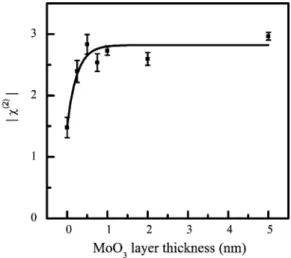
The nonlinear susceptibility 共2兲 at the MoO3/␣-NPD interfaces is modulated by the electrostatic field in the SCLs, and thus it is proportional to the strength of the dipole mo-ment. Since the modulated共2兲is proportional to the square root of the difference of the SH intensities,12 we subtracted the SH intensities in the line共b兲 of Fig.2from that in the line 共a兲, and then plotted the square root of the absolute values in Fig. 4. Thus, Fig. 4 represents the strengths of SCLs as a function of the MoO3 layer thicknesses. In correlation with the result in the line 共a兲 of Fig.2, the共2兲increases remark-ably with the increase in the MoO3 thicknesses from 0.25 to 1 nm. The SH intensities are found to remain constant at the MoO3thicknesses greater than 1 nm. This is consistent with a result obtained using FL spectra in the previous study.1The results show that SHG measurement has a potential for quan-titative analysis of the amount of the space charges.
We would like to notice that many necessary information for the quantitative determination of SCL, such as the dielec-tric functions of the materials, the band bending depth, and the third-order nonlinear susceptibility of MoO3and the re-sulting phases of the SH light fields, are still unknown. We could calibrate our data referring to the SCL parameters
ob-tained by other techniques. However, we can find no such other works so far. Thus, the quantitative investigation of SCLs is not realistic at the present stage.
It has been known that electron transfer occurs from lower-ionization-energy ␣-NPD to higher-work-function MoO3to induce formation of a SCL.13Strength of the SCL is expected to depend on the coverage of the ITO layer with MoO3 because incomplete coverage reduces a contact area between␣-NPD and MoO3. Thus, we assume that the initial increase in共2兲shown in Fig.4 is attributable to the growth of the SCL because the coverage of the ITO layer with MoO3 is increased.5Moreover, since the ITO surface is completely covered by the MoO3 layer in the larger MoO3 thickness region,5 the growth of the SCL is stopped, resulting in the unchanged SH intensities. The growth of the SCL can be monitored by our SHG measurement, and the results are con-sistent with the exciton quenching characteristics previously reported.1 Thus, we can conclude that SHG is a versatile technique to obtain information on the electronic states of stacked organic layers and to clarify operation mechanisms of organic electronic devices.
As further applications, SHG can be used for evaluating the doping effect in the organic layer. For instance, due to the MoO3 doping in an ␣-NPD layer on a metal substrate, the Fermi level position with respect to the HOMO edge is modulated,14 and then the static electric field in the SCLs should change. Thus, SHG should be sensitive to the doping in the ␣-NPD interfaces. However, SH signals from a doped three-dimensional matrix共an amorphous bulk兲 are expected to be very weak, since dipoles are randomly oriented in the bulk and thus cancels each other. We also note that it is possible to perform similar measurements on the cathode side of the OLEDs, and to investigate the relevant metal-organic reaction or gap state formation.
1T. Matsushima and H. Murata,Appl. Phys. Lett. 95, 203306共2009兲. 2Y. R. Shen, The Principles of Nonlinear Optics共Wiley, New York, 1984兲. 3W. K. Zhang, H. F. Wang, and D. S. Zhengw,Phys. Chem. Chem. Phys.8,
4041共2006兲.
4T. Matsushima, Y. Kinoshita, and H. Murata,Appl. Phys. Lett.91, 253504 共2007兲.
5T. Matsushima, G. He Jin, and H. Murata,J. Appl. Phys. 104, 054501 共2008兲.
6M. Takebayashi, G. Mizutani, and S. Ushioda, Opt. Commun. 133, 116 共1997兲.
7T. Kitahara, A. Sugwara, H. Sano, and G. Mizutani,Appl. Surf. Sci. 219, 271共2003兲.
8Y. Maeda, T. Iwai, Y. Sayake, K. Fujuu, S. Miyatake, D. Miyazaki, and G. Mizutani,Phys. Rev. B 78, 075440共2008兲.
9S. H. Brewer and S. Franzen,Chem. Phys. 300, 285共2004兲. 10S. H. Brewer and S. Franzen,J. Phys. Chem. B 106, 12986共2002兲. 11H. Lee, S. W. Cho, K. Han, P. E. Jeon, C.-N. Whang, K. Jeong, K. Cho,
and Y. Yi,Appl. Phys. Lett. 93, 043308共2008兲.
12O. A. Aktsipetrov, A. A. Fedyanin, E. D. Mishina, A. N. Rubtsov, C. W. van Hasselt, M. A. C. Devillers, and T. Rasing,Phys. Rev. B 54, 1825
共1996兲.
13K. Kanai, K. Koizumi, S. Ouchi, Y. Tsukamoto, K. Sakanoue, Y. Ouchi, and K. Seki,Org. Electron. 11, 188共2010兲.
14M. Kröger, S. Hamwi, J. Meyer, T. Riedl, W. Kowalsky, and A. Kahn,
Org. Electron. 10, 932共2009兲.
FIG. 3. Schematic diagram showing induced SH polarization in three cases, 共a兲 ITO layer, 共b兲 ITO/MoO3system, and共c兲 ITO/MoO3/␣-NPD system.
FIG. 4. Change in nonlinear susceptibility共2兲at MoO3/␣-NPD interfaces as function of MoO3layer thickness. Solid line is guide to eyes.
193302-3 El Basaty et al. Appl. Phys. Lett. 97, 193302共2010兲