On
the Local
Connectivity
of the Boundary of
Unbounded
Periodic Fatou Components
of
Transcendental Functions
Masashi KISAKA
(木坂正史)Department of Mathematics and information Science, College of
Integrated Arts and Science, Osaka Prefecture University
(大阪府立大学・総合科学部・数理情報科学講座)
Gakuen-cho 1-1, Sakai 593, Japan
$\mathrm{e}$-mail address : [email protected].
$\mathrm{a}\mathrm{c}$.jp
1
Definitions,
Notations
and
Results
Let $f$ be a transcendental entire function, $F_{f}\subset \mathbb{C}$ the Fatou set of $f$
and $J_{f}:=\mathbb{C}\backslash F_{f}$ the Julia set of $f$. We call a connected component of $F_{f}$
a Fatou component. It is well known that a Fatou component $U$ is either
eventually periodic (i.e. there exists a $k_{0}$ such that $f^{k_{0}}(U)$ is periodic) or $a$
wandering domain (i.e. $f^{m}(U)\cap f^{n}(U)=\emptyset$ for every $m,$ $n\in \mathrm{N}(m\neq n)$)
and if it is periodic (i.e. there exists an $n_{0}\in \mathrm{N}$ with $f^{n_{0}}(U)\subseteq U$), there are
four possibilities;
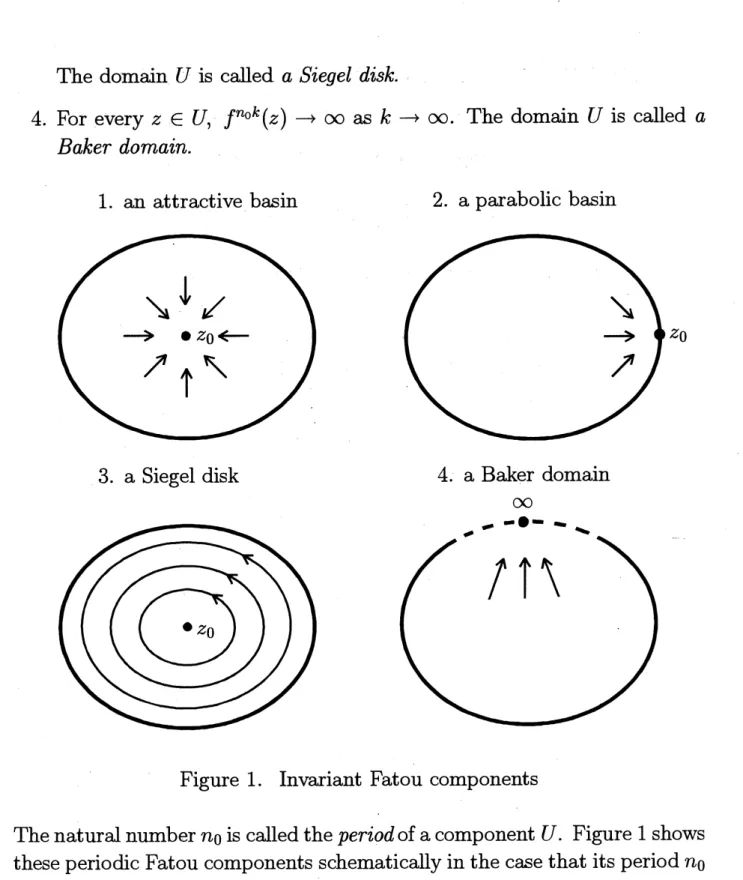
1. There exists a point $z_{0}\in U$ with $f^{n_{0}}(z\mathrm{o})=z_{0}$ and $|(f^{n_{0}})’(Z\mathrm{o})|<1$
and every point $z\in U$ satisfies $f^{n_{0}k}(z)arrow z_{0}$ as $karrow\infty$. The point
$z_{0}$ is called an attracting periodic point and the domain $U$ is called $an$
attractive basin.
2. There exists a point $z_{0}\in\partial U$ with $f^{n_{0}}(z\mathrm{o})=z_{0}$ (it is possible that
$f^{n_{1}}(z\mathrm{o})=z_{0}$ for an $n_{1}$ with $n_{1}|n_{0}$) and $(f^{n_{0}})’(z0)=1$ and every point
$z\in U$ satisfies $f^{n_{0}k}(z)arrow z_{0}$ as $karrow\infty$. The point $z_{0}$ is called $a$
parabolic periodic point and the domain $U$ is called a parabolic basin.
3. There exists a point $z_{0}\in U$ with $f^{n_{0}}(z0)=z0$ and $(f^{n_{0}})’(z_{0})=e^{2i}\pi\theta(\theta\in$
The domain $U$ is called a Siegel disk.
4. For every $z\in U,$ $f^{n_{0}k}(z)arrow\infty$ as $karrow\infty$
.
The domain $U$ is called $a$Baker domain.
1. an attractive basin 2. a parabolic basin
3. a Siegel disk 4. a Baker domain
$\sim\tau$
Figure 1. Invariant Fatou components
Thenaturalnumber$n_{0}$ is called the period of acomponent $U$. Figure 1 shows
these periodic Fatou components schematically inthe casethat its period $n_{0}$
is equal to one. In particular in this case, $U$is called
an
invariant component.By definition Baker domains are unbounded but attractive basins, parabolic
bains and even Siegel disks can be unbounded as follows:
Example 1. Consider the exponential family $E_{\lambda}(z):=\lambda ez$.
(3) If there is a Siegel disk on which $E_{\lambda}$ is conjugate to a irrational rotation
$z-arrow e^{2\pi i\theta}z$ and $\theta$ satisfies the Diophantine condition, then it is unbounded
$([\mathrm{H}])$.
So throughout this paper we assume that $f$ has an unbounded periodic
Fatou component $U$ with period $n_{0}$.
Then when is $\partial U\subset \mathbb{C}$ (or $\partial U\cup\{\infty\}\subset\hat{\mathbb{C}}$) locally connected? For this
problem we have the following result:
Theorem A. If $U$ is either
(i) an attractive basin, (ii) a parabolic basin, (iii) a Siegel disk, or
(iv) a Baker domain on which $f^{n_{0}}|U$ is a $d$ to 1 mapping $(2\leq d<\infty)$,
then $\partial U\cup\{\infty\}\subset\hat{\mathbb{C}}$ is not locally connected. Also $\partial U\subset \mathbb{C}$ is not locally
connected.
The local connectivity of $\partial U$ is intimately related to the local
connec-tivity of $J_{f}$ by the following proposition:
Proposition 2. $([\mathrm{W}])$ A compact set $K\subset\hat{\mathbb{C}}$ is locally connected if and
only if the following two conditions are satisfied:
1. The boundary of each connected component of $K^{c}(:=\mathrm{c}\mathrm{o}\mathrm{m}\mathrm{p}\mathrm{l}\mathrm{e}\mathrm{m}\mathrm{e}\mathrm{n}\mathrm{t}$ of
$K)$ is locally connected.
2. For any$\epsilon>0$ the numberof connected components of$K^{c}$ with diameter
(with respect to the spherical metric) greater than $\epsilon$ is finite.
From this proposition and Theorem A we can prove the following result:
Theorem B. Assume that a transcendental entire function $f$ has an
un-bounded periodic Fatou component $U$ with period $n_{0}$. If $U$ is either
(i) an attractive basin, (ii) a parabolic basin, (iii) a Siegel disk, or
(iv) a Baker domain on which $f^{n_{0}}\{U$ is a $d$ to 1 mapping $(1 \leq d<\infty)$,
then $J_{f}\cup\{\infty\}\subset\hat{\mathbb{C}}$ is not locally connected. Also $J_{f}\subset \mathbb{C}$ is not locally
2
Outline of the
proof
of
Theorem A
In what follows we shall
assume
that $n_{0}=1$, that is, $U$ is an invariantcomponent for simplicity. In general cases similar arguements are valid if
we consider $f^{n_{0}}$ instead of $f$.
Since $U$ is an unbounded component, it is simply connected $([\mathrm{E}\mathrm{L}])$. So
let $\varphi$ : $\mathrm{D}(:=\{|z|<1\})arrow U$ be a Riemann map of $U$. Then the following
theorem is well known:
Theorem 3 (Carath\’eodory). Let $U\subset\hat{\mathbb{C}}$ be a
simply connected domain.
(1) There is one to one correspondence between $\partial \mathrm{D}$ and the set of prime
ends: $e^{i\theta}\vdasharrow \mathrm{a}$ prime
end $P(e^{i\theta})$ of $U$.
(2) Let $I(P(e^{i\theta}))$ be the impression of a prime end $P(e^{i\theta})$. Then the
fol-lowing three conditions are equivalent:
1. The Riemann map $\varphi$ : $\mathrm{D}arrow U$ extends to a continuous map $\overline{\varphi}$ :
$\overline{\mathrm{D}}$
$:=$
$\{|z|\leq 1\}arrow\overline{U}$.
2. $\partial U$ is locally connected.
3. For any prime end $P(e^{i\theta})$ the impression $I(P(e^{i\theta}))$ is reduced to a single
point.
Remark 4. (1) For the definitions of the prime end, its impression and
the proof of Theorem 3, see, for example, [CL].
(2) Since $U\subset \mathbb{C}$ is unbounded in our case, we should write $\partial U\cup\{\infty\}\subset\hat{\mathbb{C}}$
in the above theorem.
We also
use
the following result:Theorem 5 $([\mathrm{B}\mathrm{a}\mathrm{W}])$
.
Let $f$ and $U$ be as above. Suppose that $U$ is nota Baker domain then
every
impression $I(P(e^{i\theta}))$ of a prime end $P(e^{i\theta})$ of $U$contains the point $\infty$.
First let us consider the case (i), (ii) and (iii). Suppose that $\partial U\cup\{\infty\}\subset$
$\hat{\mathbb{C}}$
is locally connected. Then by Theorem 3, the Riemann map $\varphi$ extends
to a continuous map $\overline{\varphi}$ and moreover by Theorem 5 we have $\overline{\varphi}|\partial \mathrm{D}\equiv\infty$,
.
every point the radial limit$\lim_{r\nearrow 1\varphi}(re^{i})\theta$ exists and is nonconstant. Moreover for each
$p\in\partial U$ the
capacity of the set
$\{e^{i\theta}|\lim_{r\nearrow 1}\varphi(re^{i\theta})=p\}\subset\partial \mathrm{D}$
is equal to zero.
This completes the proof for the case (i), (ii) and (iii).
In the case (iv), define
$I_{\infty}:=\{e^{i\theta}|I(P(e^{i\theta}))\ni\infty\}\subset\partial \mathrm{D}$, $V:=\partial \mathrm{D}\backslash I_{\infty}$.
Then since $U$ is unbounded, we have $I_{\infty}\neq\emptyset$. lt is easy to see that $V$ is
open.
in $\partial \mathrm{D}$ and$V\neq\partial \mathrm{D}$. Consider the following commutative diagram:
$U\underline{f}U$
$\varphi\uparrow$ $\uparrow\varphi$
$\mathrm{D}\overline{g\cdot.=\varphi^{-1}\mathrm{o}f\mathrm{o}\varphi}\mathrm{D}$
Bythe assumption that $f|U$ is a$d$to 1 mapping $(2\leq d<\infty),$ $g:=\varphi^{-1}\mathrm{o}f\mathrm{o}\varphi$
is a finite Blaschke product. It can be shown that $g(V)\subseteq V$. On the other
hand we can consider the Julia set $J_{g}$ and it is easy to see that $J_{g}\subset\partial \mathrm{D}$.
Suppose that $V\cap J_{g}\neq\emptyset$. Then from an elementary property of Julia sets
of rational maps, we have $g^{n}(V)=\partial \mathrm{D}$ for sufficiently large $n\in \mathrm{N}$ and
since $g(V)\subseteq V$, it follows that $V=\partial \mathrm{D}$, which contradicts the fact that
$V\neq\partial \mathrm{D}$. Consequently we have $V\cap J_{g}=\emptyset$, that is,
$J_{g}\subset I_{\infty}$. Suppose
here that $\partial U\cup\{\infty\}\subset\hat{\mathbb{C}}$ is locally connected.
Then from Theorem 3 $\varphi$
has a continuous extension $\overline{\varphi}$ and we must have $\overline{\varphi}\equiv\infty$ on the set $I_{\infty}$. In
particular $\overline{\varphi}\equiv\infty$ on $J_{g}$. But on the contrary since the Hausdorff dimension
of the Julia set ofa rational map is always positive ($[\mathrm{B}\mathrm{e}\mathrm{a}$, Theorem 10.3.1]),
$J_{g}$ has positive Hausdorff dimension. In particular its capacity is positive.
Then it follows that the set
$\{e^{i\theta}|\lim_{r\nearrow 1}\varphi(re)i\theta\}=\infty$
has positive capacity, which contradicts Proposition 6. This completes the
The non-local connectivity of $\partial U\subset \mathbb{C}$follows from the following
propo-sition, since $U$ is simply connected, $\partial U\cup\{\infty\}$ is closed and connected.
Proposition C. Let $K\subset\hat{\mathbb{C}}$ be
a closed connected subset and $p\in K$. If
$K$ is not locally connected, then $K\backslash \{p\}$ is also not locally connected.
We shall omit the proof of this proposition. $\square$
Remark 7. lt is known that the boundary of a Baker domain $U$ on
which $f$ is 1 to 1 mapping (i.e. univalent) can be a Jordan curve (i.e.
$\partial U\cup\{\infty\}\subset\hat{\mathbb{C}}$ is a Jordan
curve
and $\partial U\subset \mathbb{C}$ is a Jordan arc). Thefunction $f(z):=2-\log 2+2z-e^{z}$ is such an example ([$\mathrm{B}\mathrm{e}\mathrm{r}$, Theorem
2]). In particular in this case both $\partial U\cup\{\infty\}\subset\hat{\mathbb{C}}$ and $\partial U\subset \mathbb{C}$ are locally
connected. So we cannot drop the assumption $2\leq d$ in Theorem A. It is
also known that if $\partial U\cup\{\infty\}\mathrm{i}_{\mathrm{S}}$ a Jordan curve in
$\hat{\mathbb{C}}$
, then $f|U$ is univalent
($[\mathrm{B}\mathrm{a}\mathrm{W}$, Theorem 4]).
3
Proof of Theorem
$\mathrm{B}$By definition $J_{f}\cup\{\infty\}$ is a compact subset of $\hat{\mathbb{C}}$
so we can apply
Proposition 2. In the case (i), (ii) and (iii), the set $\partial U\cup\{\infty\}\subset\hat{\mathbb{C}}$ is not
locally connected from Theorem A. So by Proposition 2 $J_{f}\cup\{\infty\}$ is not
locally connected.
Next let
us
consider the case (iv). If $2\leq d$, the proof is completely thesame as the previous cases. If $d=1$, take a point $w_{0}\neq\infty\in\partial U\cup\{\infty\}$ and
$z_{0}\in U$. Then from an elementary property of complex dynamical systems
there exist $n_{k}\in \mathrm{N}$ with $n_{k}\nearrow\infty$ and $z_{n_{k}}\in f^{-n_{k}}(z\mathrm{o})$ with $z_{n_{k}}arrow w_{0}$. Since
$f|U$ is univalent we can take $z_{0},$ $\{z_{n_{k}}\}$ and $w_{0}$ satisfying $z_{n_{k}}\not\in U$. Let $U_{n_{k}}$ be
the Fatou component containing $z_{n_{k}}$. Then it follows that $U_{n_{k}}(k=1,2, \ldots)$
are mutually disjoint and also we have $U_{n_{k}}\cap U=\emptyset$. Since $z_{n_{k}}arrow w_{0},$ $z_{n_{k}}\in$
$U_{n_{k}}$ and $U_{n_{k}}$ is unbounded, it follows that the condition 2 in Proposition 2
is not satisfied. Hence again $J_{f}\cup\{\infty\}\subset\hat{\mathbb{C}}$ is not locally connected.
For the non-local connectivity of $J_{f}\subset \mathbb{C}$ itself, we can again apply
Proposition $\mathrm{C}$, since $J_{f}\cup\{\infty\}\subset\hat{\mathbb{C}}$ is compact and connected in this case
($[\mathrm{K}$, Corollary 1]). This completes the proof.
References
[BaW] I. N. Baker and J. Weinreich, Boundaries which arise in the
dynam-ics of entire functions, Revue Roumaine de Math. Pures et $Appliqu\acute{e}es_{f}$
36 (1991),
413-420.
[Bea] A. F. Beardon, Iteration
of
Rational Functions, Springer-Verlag, NewYork, Berlin and Heiderberg, 1991.
[Ber] W. Bergweiler, Invariant domains and singularities, Math. Proc.
Camb. Phil. Soc. 117 (1995), 525-532.
[CL] E. F. Collingwood and A. J. Lohwater, The theorey
of
cluster sets,Cambridge University Press, 1966.
[EL] A. E. Eremenko and M. Yu. Lyubich, The dynamics of analytic
trans-formations, Leningrad Math. J. 1 No.3 (1990),
563-634.
[H] M. R. Herman, Are there critical points on the boundaries of singular
domains?, Commun. Math. Phys. 99 (1985), 593-612.
[K] M. Kisaka, On the Connectivity of Julia Sets of $\mathrm{n}_{\mathrm{a}\mathrm{n}\mathrm{S}\mathrm{C}\mathrm{e}}\mathrm{n}\mathrm{d}\mathrm{e}\mathrm{n}\mathrm{t}\mathrm{a}1$ Entire
Functions, to appear in Erg. Th. $\mathcal{E}\mathit{9}$ Dynam. Sys.
[W] G. T. Whyburn, Analytic Topology, AMS ColloquiumPublications, 28,