Lipopolysaccharide-Induced CXCL10 mRNA
Level and Six Stimulant-mRNA Combinations
in Whole Blood: Novel Biomarkers for
Bortezomib Responses Obtained from a
Prospective Multicenter Trial for Patients with
Multiple Myeloma
Takashi Watanabe
1¤*, Masato Mitsuhashi
2, Morihiko Sagawa
3, Masaki Ri
4,
Kenshi Suzuki
5, Masahiro Abe
6, Ken Ohmachi
7, Yasunori Nakagawa
5,
Shingen Nakamura
6, Mizuki Chosa
1, Shinsuke Iida
4, Masahiro Kizaki
31 Hematology Division, National Cancer Center Hospital, Tokyo, Japan, 2 Hitachi Chemical Research Center, Inc., Irvine, California, United States of America, 3 Department of Hematology, Saitama Medical Center, Saitama Medical University, Kawagoe, Japan, 4 Department of Medical Oncology and Immunology, Nagoya City University Graduate School of Medical Sciences, Nagoya, Japan, 5 Department of Hematology, Japanese Red Cross Medical Center, Tokyo, Japan, 6 Department of Hematology, Endocrinology and Metabolism Instutute of Biomedical Sciences, Tokushima University Graduate School, Tokushima, Japan, 7 Division of Hematology/Oncology, Department of Internal Medicine, Tokai University School of Medicine, Isehara, Japan
¤ Current address: Department of Hematology, Komaki City Hospital, Komaki, Japan *[email protected]
Abstract
To identify predictive biomarkers for clinical responses to bortezomib treatment, 0.06 mL of
each whole blood without any cell separation procedures was stimulated ex vivo using five
agents, and eight mRNAs were quantified. In six centers, heparinized peripheral blood was
prospectively obtained from 80 previously treated or untreated, symptomatic multiple
mye-loma (MM) patients with measurable levels of M-proteins. The blood sample was procured
prior to treatment as well as 2-3 days and 1-3 weeks after the first dose of bortezomib,
which was intravenously administered biweekly or weekly, during the first cycle. Six
stimu-lant-mRNA combinations; that is, lipopolysaccharide (LPS)-granulocyte-macrophage
col-ony-stimulating factor (GM-CSF), LPS-CXCL chemokine 10 (CXCL10), LPS-CCL
chemokine 4 (CCL4), phytohemagglutinin-CCL4, zymosan A (ZA)-GMCSF and ZA-CCL4
showed significantly higher induction in the complete and very good partial response group
than in the stable and progressive disease group, as determined by both parametric (t-test)
and non-parametric (unpaired Mann-Whitney test) tests. Moreover, LPS-induced CXCL10
mRNA expression was significantly suppressed 2-3 days after the first dose of bortezomib
in all patients, as determined by both parametric (t-test) and non-parametric (paired
Wil-coxon test) tests, whereas the complete and very good partial response group showed
sus-tained suppression 1-3 weeks after the first dose. Thus, pretreatment LPS-CXCL10 mRNA
a11111
OPEN ACCESS
Citation: Watanabe T, Mitsuhashi M, Sagawa M, Ri M, Suzuki K, Abe M, et al. (2015) Lipopolysaccharide-InducedCXCL10 mRNA Level and Six Stimulant-mRNA Combinations in Whole Blood: Novel Biomarkers for Bortezomib Responses Obtained from a Prospective Multicenter Trial for Patients with Multiple Myeloma. PLoS ONE 10(6): e0128662. doi:10.1371/journal.pone.0128662 Editor: David L. McCormick, IIT Research Institute, UNITED STATES
Received: November 29, 2014 Accepted: April 29, 2015 Published: June 26, 2015
Copyright: © 2015 Watanabe et al. This is an open access article distributed under the terms of the
Creative Commons Attribution License, which permits unrestricted use, distribution, and reproduction in any medium, provided the original author and source are credited.
Data Availability Statement: All relevant data are within the paper.
Funding: National Cancer Center Research and Development Fund in Japan (21-8-5) and Hitachi Chemical Research Center, Inc. provided support in the form of salaries for MM and research support of his mRNA analysis, but did not have any additional role in the study design, analysis of data, decision to publish, and preparation of the manuscript.
and/or the six combinations may serve as potential biomarkers for the response to
bortezo-mib treatment in MM patients.
Introduction
The proteasome inhibitor bortezomib (VELCADE; Millennium Pharmaceuticals and Johnson
& Johnson Pharmaceutical Research & Development) has revolutionized the treatment of
mul-tiple myeloma (MM) patients and has become a mainstay in the standard of care for both
pre-viously untreated [
1
] and relapsed [
2
,
3
] patients with MM. A number of clinical and
laboratory features provide prognostic information for patients with MM, such as hypodipoidy
[
4
] and chromosomal translocations and deletions [
5
–
7
].
The gene expression profiles of plasma cells isolated from the bone marrow of MM patients
can predict the response to treatment with bortezomib [
8
,
9
]. However, peripheral blood (PB)
biomarkers able to predict the response to bortezomib have not yet been identified, although
some factors are known to correlate with such responses, including hepatocyte growth factor
[
10
], thrombospondin [
10
], XBP-1 [
11
] and absolute lymphocyte counts [
12
].
In our previous study [
13
], we reported that phytohemagglutinin (PHA)-induced
interleu-kin-2 (IL2) mRNA levels in ex vivo whole blood obtained prior to bortezomib treatment could
predict the incidence of bortezomib-induced peripheral neuropathy. In this study, we used the
same assay to predict the efficacy of bortezomib treatment in an expanded patient population.
Subjects and Methods
Patients
Eligible patients in this multicenter prospective study consisted of previously treated MM
patients or untreated patients with symptomatic MM, as described in our previous study [
13
].
All patients had to have measurable levels of M-proteins. The study was approved by the
insti-tutional review board or independent ethics committee at all participating institutions and was
conducted according to the principles of the Declaration of Helsinki and the International
Conference on Harmonization Guidelines of Good Clinical Practice. All patients provided
written informed consent for sample procurement. The following institutions participated in
this study: National Cancer Center Hospital; Saitama Medical Center, Saitama Medical
Univer-sity; Nagoya City University, Graduate School of Medical Sciences; Japanese Red Cross Medical
Center; University of Tokushima, Graduate School of Medical Sciences and Tokai University
School of Medicine (Acknowledgement section of the ms.). Clinical responses were assessed
according to the International Uniform Response Criteria [
14
].
Measurements
Eight-well strips containing 1.2
μL each of PHA (2 mg/mL), heat-aggregated immunoglobulin
G (HAG) (10 mg/mL), lipopolysaccharide (LPS) (0.5 mg/mL), zymosan A (ZA) (75 mg/mL) or
solvent phosphate-buffered saline (PBS) were delivered to each institution on dry ice. These
strips were kept frozen at -80°C. A 2 mL sample of heparinized PB was obtained from each
patient prior to treatment as well as 2
–3 days (D2-3) and 1–3 weeks (W1-3) after intravenous
administration of the first dose of bortezomib during the first cycle. The blood was
immedi-ately delivered to the designated laboratory, 0.06 mL of PB was added to each well containing 3
strips (that is, in triplicate), and the strips were incubated for 4 hours at 37°C. The total blood
Competing Interests: TW received honorarium from Takeda Pharmaceutical Co., Ltd. MA received honoraria from Janssen Pharmaceutical Co., Ltd. and Takeda Pharmaceutical Co., Ltd. SI received research funding and honorarium from Janssen Pharmaceutical Co., Ltd. MM was an employee of Hitachi Chemical Research Center, Inc. Both this company and MM do not have any consultancy, patent, products in development or marketed products relevant to the results. This does not alter the authors' adherence to all PLOS ONE policies on sharing data and materials.
volume required was 0.9 mL (0.06 mL/well x 5 wells/strip x 3 strips). After incubation, the
sam-ples were stored at -80°C.
mRNA analysis
Purification of mRNA and cDNA synthesis were performed as described previously using
leu-kocyte capture filter plates and oligo(dT)-immobilized microplates [
15
,
16
] The cDNA was
used for real-time PCR [
15
,
16
]. Melting curves were analyzed to confirm that the PCR signals
were derived from a single PCR product, and the cycle threshold (Ct) value was determined
using analytical software (SDS, Thermo Fisher Scientific, Carlsbad, CA). The Ct values of the
treated samples were subtracted individually from the mean Ct values of the control samples to
calculate the
ΔCt, and the fold increase was calculated as 2^(-ΔCt), as described previously
[
15
,
16
]. The mRNAs analyzed included
β-actin (ACTB), IL2 and interleukin-6 (IL6),
granulo-cyte-macrophage colony-stimulating factor (GMCSF), interferon-γ (IFNG), tumour necrosis
fac-tor-α (TNFSF2), CCL chemokine 4 (CCL4) and CXCL chemokine 10 (CXCL10) [
16
]. mRNA
analysis and clinical data collection were performed separately at the different centers.
Statistical analyses
Parametric (t-test) and non-parametric (unpaired Mann-Whitney and paired Wilcoxon tests)
tests were used to compare mRNA levels between the two groups. p
<0.05 were considered
sig-nificant. The statistical analyses were performed using Excel (Microsoft, Redmond, WA) and
Prism 6 (GraphPad Software, La Jolla, CA).
Results
Patients
’ charasteristics
Between March 2010 and March 2012, a total of 83 patients (44 male and 39 female) were
enrolled from six centers. The median age of all patients was 63 years (
Table 1
). Fifty patients
were previously treated, and 33 patients were untreated. After excluding one patient who
died early from progressive disease, another who received additional treatment and another
who committed suicide, 80 patients were eligible for response analysis. The numbers of
patients who demonstrated complete response (CR), very good partial response (VGPR),
partial response (PR), stable disease (SD) and progressive disease (PD) were 5, 7, 33, 33 and
2, respectively.
mRNA analysis
Overall, 3,600 mRNA preparations and cDNA synthesis reactions were carried out (80 patients
x 5 stimulants x 3 time points x 3 [triplicate]). A total of 28,800 PCR reactions were performed
(3,600 cDNA samples x 8 genes).
Pretreatment higher induction of LPS/ZA-induced GMCSF, LPS-induced
CXCL10, and LPS/PHA/ZA-induced CCL4 mRNA in CR/VGPR
responders to bortezomib
The fold increase in LPS-induced GMCSF, CXCL10 and CCL4, PHA-induced CCL4 and
ZA-induced GMCSF and CCL4 were significantly higher in the CR and VGPR groups than in the
SD and PD groups, as determined by both parametric t-tests and non-parametric
Mann-Whit-ney tests, whereas the PR group exhibited an intermediate value (
Fig 1
). Moreover, 100, 67, 56,
42 and 0% of patients showed more than 3-fold increases in LPS-induced CXCL10 (dotted line
in
Fig 1
).
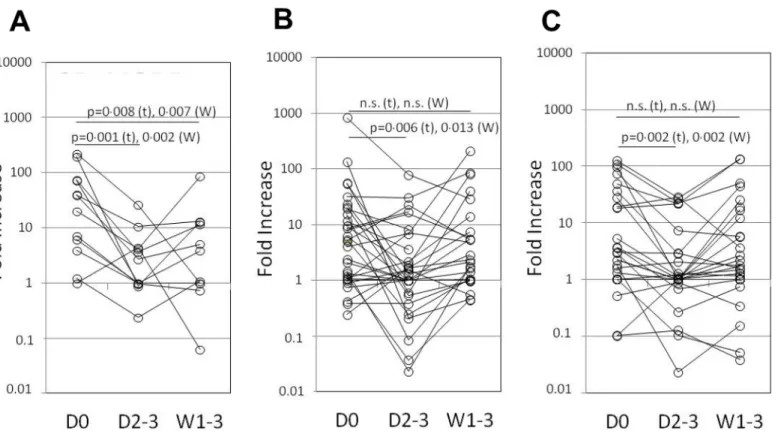
Sustained suppression of LPS-induced CCCL10 mRNA in CR/VGPR
responders to bortezomib
As shown in
Fig 2
, LPS-induced CXCL10 mRNA expression was significantly suppressed 2
–3
days after the first dose of bortezomib in all groups, as determined by both parametric (t-test)
Table 1. Patients Demographic and Baseline Characteristics.
Characteristics Number of patients(%)
Age, years Median 63 Range 37–79 Male sex 44(53) Prior therapy Yes 50(60) No 33(40) M component IgG 48(58) IgA 9(11) IgD 3(4)
Light chain only 23(28)
ISS stage I 25(30) II 29(35) III 29(35) Follow-up*, days Median 151 Range 26–666 Bortezomib administration Twice-weekly 63(76) Weekly 20(24) Concurrent dexamethasone Yes 74(89) No 9(11)
Best response to treatment†
CR 5(6) VGPR 7(8) PR 33(40) SD 33(40) PD 2(2) NE 3(4)‡
CR, complete response; ISS, International Staging System; NE, not evaluable; PD, progressive disease; SD, stable disease; VGPR, very good partial response.
*Excluded were three patients not evaluable for response.
†According to the International Uniform Response Criteria (Durie et al, 2006).
‡One patient died of progressive disease early, another received additional chemotherapy, and the third
committed suicide.
and non-parametric (paired Wilcoxon test) tests, while the CR+VGPR group showed sustained
suppression even 1–3 weeks after treatment. This significant level of inhibition was only
observed for LPS-induced CXCL10.
Discussion
Currently, triple drug combinations are believed to be very effective for MM treatment based
on the results of several randomised clinical trials [
1
,
17
–
23
] and phase I/II studies [
24
,
25
].
However, in some studies, the daily dose of bortezomib [
1
,
26
–
28
] and the bortezomib
admin-istration schedule (namely, the dose density) [
29
–
31
] are reduced to avoid toxicity, despite the
fact that bortezomib accumulation is important for achieving improved survival [
32
]. Although
MM patients still experience relapse or progression even after triple drug combination therapy,
it is clear that better responses to initial therapy result in longer survival [
33
–
36
]. If we could
predict which patients will respond to bortezomib, we would be able to give priority to
bortezo-mib dose, rather than the other drugs, in combination regimens. Thus, it is important to
pre-dict whether patients will respond to bortezomib before initiation and whether bortezomib can
be used in consolidation [
1
,
37
] or maintenance [
29
,
30
,
38
,
39
] therapy.
This is the first report demonstrating the use of LPS-induced CXCL10 mRNA levels as a
bio-marker for assessing the clinical response to bortezomib treatment in PB. We showed that
higher induction of CXCL10 mRNA corresponded to very good responses (CR+VGPR),
whereas lower induction corresponded to poor responses (SD+PD); the values in the PR group
Fig 1.Ex vivo mRNA induction in blood obtained prior to bortezomib treatment. The fold increase in (A) LPS-induced GMCSF, (B) ZA-induced GMCSF, (C) LPS-induced CXCL10 (top panel), (D) PHA-induced CCL4, (E) LPS-induced CCL4 and (F) ZA-induced CCL4 (lower panel) mRNA in the CR, VGPR, PR, SD and PD groups is shown. The statistically significant difference between the CR+VGPR and SD+PD groups is shown. t: Student’s t-test, M: Mann-Whitney test. Dotted line: fold increase = 3. Samples showing a fold increase in ACTB (which was> 3) were removed from the analysis. Horizontal bars: the mean values.
were variable. Moreover, LPS-induced CXCL10 mRNA was significantly and continuously
sup-pressed in the good response group even 1–3 weeks after treatment, whereas in the other
groups, the suppressive activity was transient and CXCL10 mRNA levels returned to the
origi-nal values. It could be argued that the best biomarker may be ZA-induced GMCSF because the
mean mRNA levels appeared to be higher in both the CR and VGPR groups than those in
other response groups. The range of LPS-induced CXCL10 expression in the CR group was
within the ranges of LPS-induced CXCL10 expression in both PR and SD groups, and lack of
overlap was seen in only the patients with CR versus the two patients with PD, although the
lat-ter was a small number. Similarly, LPS-induced CXCL10 expression in the VGPR group
gener-ally fell within the ranges seen in the patients with PR and those with SD. However, the
majority of MM patients will respond to bortezomib especially in case used as the first-line
treatment. Therefore, it is more important to distinguish the patients with PD after treatment
with bortezomib, which may have the mutations as to the proteasome pathway [
40
], from
responders to bortezomib rather than finding the difference in the response.
CXCL10, which was previously referred to as interferon
γ-inducible 10 kDa protein (IP-10),
belongs to the C-X-C family of chemokines that cluster on human chromosome 4 (q12-21).
CXCL10 acts as a chemoattractant for human monocytes, activates T cells through binding to
the CXCR3 receptor and promotes T cell adhesion to endothelial cells [
41
]. CXCL10 also elicits
a Th1 cell-dominated anti-tumour inflammatory response that can inhibit plasmacytoma
growth [
42
]. Moreover, activated tumour-specific T cells that express CXCR3 were shown to
infiltrate CXCL10-expressing myeloma cells more efficiently than non-CXCL10-expressing
Fig 2. LPS-inducedCXCL10 expression before and after bortezomib treatment. Each point/line represents the fold increase in LPS-induced CXCL10 expression in each patient in the (A) CR+VGPR, (B) PR and (C) SD+PD groups. The statistically significant difference between the pretreatment (D0) and 2–3 days (D2-3) or 1–3 weeks (W1-3) after intravenous administration of the first dose of bortezomib during the first cycle groups is shown. t: Student’s t-test, W: Wilcoxon test.
myeloma cells [
43
]. CCL4 is another chemotactic factor, and GMCSF is a growth factor for
antigen-presenting cells. Thus, the higher induction of CXCL10, CCL4 and GMCSF mRNA
exhibited by the good responder group (
Fig 1
) was not unexpected and suggests that these
patients may have greater anti-tumour immunity.
However, after bortezomib was administered to MM patients, CXCL10 mRNA induction
was significantly suppressed, and sustained suppression correlated with good responses to
treatment (
Fig 2
). Usually bortezomib may be administerd to MM patients in combination
with dexamethasone (the same day as that of bortezomib administration and the subsequent
day) as used in the SUMMIT trial [
44
]. Actually the majority of the patients enrolled in this
study received dexamethasone (
Table 1
) in the above-mentioned way, although detailed data
were collected but not shown. In case of dexamethasone-naïve patients with MM, they can
still respond to dexamethasone. Consequently, we may not be able to distinguish the
responders to bortezomib from the responders to dexamethasone in 2
–3 days after the first
dose of bortezomib. Therefore, the induced mRNA that caused demonstrable sustained
sup-pression may indicate more meaningful predictor of bortezomib responders. In addition, as
mentioned above, such triple combination as bortezomib, melphalan, and prednisone is
believed to be best among double to quadruple combinations and therefore used commonly,
and melphalan and prednisone will be given days 1–4 of each cycle [
1
,
17
]. In those cases,
afore-mentioned, sustained suppression might become powerful tool of prediction although
further studies in this approach in combination trials is essential as a validation exercise for
theses assays to go forward.
This observation was likely not explained by the immunological activity of CXCL10, as
CXCL10 is also expressed in human myeloma cell lines [
45
] and is known to stimulate
mye-loma cell migration [
46
] and adhesion to bone marrow stromal cells [
47
]. Thus, MM cells may
be more susceptible to the bortezomib-induced inhibition of CXCL10 mRNA expression than
immune cells. Moreover, when bortezomib was added to whole blood prior to LPS stimulation
Fig 3. Bortezomib-induced inhibition of LPS-inducedCXCL10 mRNA ex vivo. Peripheral blood obtained from 3 healthy volunteers was pre-treated with various concentrations of bortezomib for 1 h and then further stimulated with LPS or PBS (as the control) for an additional 4 h. The fold increase in (A) ACTB and (B) CXCL10 expression is shown. Each symbol represents a single individual.
ex vivo, CXCL10 mRNA induction was inhibited in a dose-dependent manner (
Fig 3
). Thus,
LPS-induced CXCL10 expression in ex vivo blood samples could serve as a surrogate marker
for the effect of bortezomib in vivo.
Acknowledgments
The authors would like to thank the patients, physicians, nurses and staff members who
partic-ipated in the study for their excellent cooperation. The following institutions particpartic-ipated in
this study: National Cancer Center Hospital; Saitama Medical Center, Saitama Medical
Univer-sity; Nagoya City University, Graduate School of Medical Sciences; Japanese Red Cross Medical
Center; University of Tokushima, Graduate School of Medical Sciences and Tokai University
School of Medicine. We would like to thank Ms. Mieko Ogura (Hitachi Chemical Research
Center, Inc.), Ms. Chiori Fukuyama (Nagoya City University Graduate School of Medical
Sci-ences), Ms. Chika Nakabayashi (Saitama Medical Center, Saitama Medical University) and the
Department of Transfusion, Japanese Red Cross Medical Center for sample handling and
shipment.
Author Contributions
Conceived and designed the experiments: TW MM. Performed the experiments: MM.
Ana-lyzed the data: MM. Contributed reagents/materials/analysis tools: TW MS MR KS MA KO
YN SN SI MK. Wrote the paper: TW MM. Provided administrative support: MK. Collected
clinical data: TW MC. Handled and shipped samples: SN MC.
References
1. San Miguel JF, Schlag R, Khuageva NK, Dimopoulos MA, Shpilberg O, Kropff M, et al. (2008) Bortezo-mib plus melphalan and prednisone for initial treatment of multiple myeloma. N Engl J Med 359: 906– 917. doi:10.1056/NEJMoa0801479PMID:18753647
2. Richardson PG, Sonneveld P, Schuster MW, Irwin D, Stadtmauer EA, Facon T, et al. (2005) Bortezo-mib or high-dose dexamethasone for relapsed multiple myeloma. N Engl J Med 352: 2487–2498. PMID:15958804
3. Richardson PG, Sonneveld P, Schuster M, Irwin D, Stadtmauer E, Facon T, et al. (2007) Extended fol-low-up of a phase 3 trial in relapsed multiple myeloma: final time-to-event results of the APEX trial. Blood 110: 3557–3560. PMID:17690257
4. Smadja NV, Bastard C, Brigaudeau C, Leroux D, Fruchart C. Groupe Français de Cytogénétique Hématologique. (2001) Hypodiploidy is a major prognostic factor in multiple myeloma. Blood 98: 2229– 2238. PMID:11568011
5. Facon T, Avet-Loiseau H, Guillerm G, Moreau P, Geneviéve F, Zandecki M, et al. (2001) Chromosome 13 abnormalities identified by FISH analysis and serum beta2-microglobulin produce a powerful mye-loma staging system for patients receiving high-dose therapy. Blood 97: 1566–1571. PMID:11238092
6. Fonseca R, Blood E, Rue M, Harrington D, Oken MM, Kyle RA, et al. (2003) Clinical and biologic impli-cations of recurrent genomic aberrations in myeloma. Blood 101: 4569–4575. PMID:12576322
7. Fonseca R, Barlogie B, Bataille R, Bastard C, Bergsagel PL, Chesi M, et al. (2004) Genetics and cyto-genetics of multiple myeloma: a workshop report. Cancer Res 64: 1546–1558. PMID:14989251
8. Mulligan G, Mitsiades C, Bryant B, Zhan F, Chng WJ, Roels S, et al. (2007) Gene expression profiling and correlation with outcome in clinical trials of the proteasome inhibitor bortezomib. Blood 109: 3177– 3188. PMID:17185464
9. Richardson PG, Xie W, Mitsiades C, Chanan-Khan AA, Lonial S, Hassoun H, et al. (2009) Single-agent bortezomib in previously untreated multiple myeloma: efficacy, characterization of peripheral neuropa-thy, and molecular correlations with response and neuropathy. J Clin Oncol 27: 3518–3525. doi:10. 1200/JCO.2008.18.3087PMID:19528374
10. Ludek P, Hana S, Zdenek A, Martina A, Dana K, Tomas B, et al. (2010) Treatment response to bortezo-mib in multiple myeloma correlates with plasma hepatocyte growth factor concentration and bone mar-row thrombospondin concentration. Eur J Haematol 84: 332–336. doi:10.1111/j.1600-0609.2009. 01396.xPMID:20015241
11. Ling SC, Lau EK, Al-Shabeeb A, Nikolic A, Catalano A, Iland H, et al. (2012) Response of myeloma to the proteasome inhibitor bortezomib is correlated with the unfolded protein response regulator XBP-1. Haematologica 97: 64–72. doi:10.3324/haematol.2011.043331PMID:21993678
12. Song MK, Chung JS, Joo YD, Lee SM, Lee GW, Lee HS, et al. (2010) Clinical value of absolute lympho-cyte counts before bortezomib-dexamethasone therapy in relapsed multiple myeloma patients. Acta Haematol 124: 34–39. doi:10.1159/000313654PMID:20606414
13. Watanabe T, Mitsuhashi M, Sagawa M, Ri M, Suzuki K, Abe M, et al. (2013) Phytohemagglutinin-induced IL2 mRNA in whole blood can predict bortezomib-Phytohemagglutinin-induced peripheral neuropathy for multiple myeloma patients. Blood Cancer J, Oct 4; 3:e150. doi:10.1038/bcj.2013.47PMID:24096714
14. Durie BG, Harousseau JL, Miguel JS, Bladé J, Barlogie B, Anderson K, et al. International Myeloma Working Group. (2006) International uniform response criteria for multiple myeloma. Leukemia 20: 1467–1473. PMID:16855634
15. Mitsuhashi M, Tomozawa S, Endo K, Shinagawa A. (2006) Quantification of mRNA in whole blood by assessing recovery of RNA and efficiency of cDNA synthesis. Clin Chem 52: 634–642. PMID:
16497944
16. Mitsuhashi M. (2010) Ex vivo simulation of leukocyte function: stimulation of specific subset of leuko-cytes in whole blood followed by the measurement of function-associated mRNAs. J Immunol Methods 363: 95–100. doi:10.1016/j.jim.2010.10.002PMID:20951704
17. Mateos MV, Richardson PG, Schlag R, Khuageva NK, Dimopoulos MA, Shpilberg O, et al. (2010) Bor-tezomib plus melphalan and prednisone compared with melphalan and prednisone in previously untreated multiple myeloma: updated follow-up and impact of subsequent therapy in the phase III VISTA trial. J Clin Oncol 28: 2259–2266. doi:10.1200/JCO.2009.26.0638PMID:20368561
18. Cavo M, Tacchetti P, Patriarca F, Petrucci MT, Pantani L, Galli M, et al. GIMEMA Italian Myeloma Net-work. (2010) Bortezomib with thalidomide plus dexamethasone compared with thalidomide plus dexa-methasone as induction therapy before, and consolidation therapy after, double autologous stem-cell transplantation in newly diagnosed multiple myeloma: a randomised phase 3 study. Lancet 376: 2075– 2085. doi:10.1016/S0140-6736(10)61424-9PMID:21146205
19. Moreau P, Avet-Loiseau H, Facon T, Attal M, Tiab M, Hulin C, et al. (2011) Bortezomib plus dexametha-sone versus reduced-dose bortezomib, thalidomide plus dexamethadexametha-sone as induction treatment prior to autologous stem cell transplantation in newly diagnosed multiple myeloma. Blood 118: 5752–5758. doi:10.1182/blood-2011-05-355081PMID:21849487
20. Palumbo A, Bringhen S, Caravita T, Merla E, Capparella V, Callea V, et al. (2006) Oral melphalan and prednisone chemotherapy plus thalidomide compared with melphalan and prednisone alone in elderly patients with multiple myeloma: randomised controlled trial. Lancet 367: 825–831. PMID:16530576
21. Facon T, Mary JY, Hulin C, Benboubker L, Attal M, Pegourie B, et al. (2007) Melphalan and prednisone plus thalidomide versus melphalan and prednisone alone or reduced-intensity autologous stem cell transplantation in elderly patients with multiple myeloma (IFM 99–06): a randomised trial. Lancet 370: 1209–1218. PMID:17920916
22. Hulin C, Facon T, Rodon P, Pegourie B, Benboubker L, Doyen C, et al. (2009) Efficacy of melphalan and prednisone plus thalidomide in patients older than 75 years with newly diagnosed multiple mye-loma: IFM 01/01 trial. J Clin Oncol 27: 3664–3670. doi:10.1200/JCO.2008.21.0948PMID:19451428
23. Garderet L, Iacobelli S, Moreau P, Dib M, Lafon I, Niederwieser D, et al. (2012) Superiority of the triple combination of bortezomib-dexamethasone over the dual combination of thalidomide-dexamethasone in patients with multiple myeloma progressing or relapsing after autologous transplan-tation: the MMVAR/IFM 2005–04 Randomized Phase III Trial from the Chronic Leukemia Working Party of the European Group for Blood and Marrow Transplantation. J Clin Oncol 30: 2475–2482. doi:
10.1200/JCO.2011.37.4918PMID:22585692
24. Kropff M, Liebisch P, Knop S, Weisel K, Wand H, Gann CN, et al. (2009) DSMM XI study: dose defini-tion for intravenous cyclophosphamide in combinadefini-tion with bortezomib/dexamethasone for remission induction in patients with newly diagnosed myeloma. Ann Hematol 88: 1125–1130. doi:10.1007/ s00277-009-0726-6PMID:19274460
25. Richardson PG, Weller E, Lonial S, Jakubowiak AJ, Jagannath S, Raje NS, et al. (2010) Lenalidomide, bortezomib, and dexamethasone combination therapy in patients with newly diagnosed multiple mye-loma. Blood 116: 679–686. doi:10.1182/blood-2010-02-268862PMID:20385792
26. Popat R, Oakervee HE, Hallam S, Curry N, Odeh L, Foot N, et al. (2008) Bortezomib, doxorubicin and dexamethasone (PAD) front-line treatment of multiple myeloma: updated results after long-term follow-up. Br J Haematol 141: 512–516. doi:10.1111/j.1365-2141.2008.06997.xPMID:18371113
27. Mateos MV, Hernández JM, Hernández MT, Gutiérrez NC, Palomera L, Fuertes M, et al. (2008) Borte-zomib plus melphalan and prednisone in elderly untreated patients with multiple myeloma: updated
time-to-events results and prognostic factors for time to progression. Haematologica 93: 560–565. doi:
10.3324/haematol.12106PMID:18322252
28. Richardson PG, Weller E, Jagannath S, Avigan DE, Alsina M, Schlossman, et al. (2009) Multicenter, phase I, dose-escalation trial of lenalidomide plus bortezomib for relapsed and relapsed/refractory mul-tiple myeloma. J Clin Oncol 27: 5713–5719. doi:10.1200/JCO.2009.22.2679PMID:19786667
29. Palumbo A, Bringhen S, Rossi D, Cavalli M, Larocca A, Ria R, et al. (2010) Bortezomib-melphalan-prednisone-thalidomide followed by maintenance with bortezomib-thalidomide compared with bortezo-mib-melphalan-prednisone for initial treatment of multiple myeloma: a randomized controlled trial. J Clin Oncol 28: 5101–5109. doi:10.1200/JCO.2010.29.8216PMID:20940200
30. Mateos MV, Oriol A, Martínez-López J, Gutiérrez N, Teruel AI, de Paz R, et al. (2010) Bortezomib, mel-phalan, and prednisone versus bortezomib, thalidomide, and prednisone as induction therapy followed by maintenance treatment with bortezomib and thalidomide versus bortezomib and prednisone in elderly patients with untreated multiple myeloma: a randomised trial. Lancet Oncol 11: 934–941. doi:
10.1016/S1470-2045(10)70187-XPMID:20739218
31. Bringhen S, Larocca A, Rossi D, Cavalli M, Genuardi M, Ria R, et al. (2010) Efficacy and safety of once weekly bortezomib in multiple myeloma patients. Blood 116: 4745–4753. doi: 10.1182/blood-2010-07-294983PMID:20807892
32. van Rhee F, Szymonifka J, Anaissie E, Nair B, Waheed S, Alsayed Y, et al. (2010) Total Therapy 3 for multiple myeloma: prognostic implications of cumulative dosing and premature discontinuation of VTD maintenance components, bortezomib, thalidomide, and dexamethasone, relevant to all phases of therapy. Blood 116: 1220–1227. doi:10.1182/blood-2010-01-264333PMID:20501894
33. Chanan-Khan AA, Giralt S (2010) Importance of achieving a complete response in multiple myeloma, and the impact of novel agents. J Clin Oncol 28: 2612–2624. doi:10.1200/JCO.2009.25.4250PMID:
20385994
34. Moreau P, Attal M, Pégourié B, Planche L, Hulin C, Facon T, et al. (2011) Achievement of VGPR to induction therapy is an important prognostic factor for longer PFS in the IFM 2005–01 trial. Blood 117: 3041–3044. doi:10.1182/blood-2010-08-300863PMID:21098740
35. Martinez-Lopez J, Blade J, Mateos MV, Grande C, Alegre A, Garcia-Larana J, et al. (2011) Long-term prognostic significance of response in multiple myeloma after stem cell transplantation. Blood 118: 529–534. doi:10.1182/blood-2011-01-332320PMID:21482708
36. Gay F, Larocca A, Wijermans P, Cavallo F, Rossi D, Schaafsma R, et al. (2011) Complete response correlates with long-term progression-free and overall survival in elderly myeloma treated with novel agents: analysis of 1175 patients. Blood 117: 3025–3031. doi:10.1182/blood-2010-09-307645PMID:
21228328
37. Cavo M, Pantani L, Petrucci MT, Patriarca F, Zamagni E,Donnarumma D, et al. (2012) Bortezomib-tha-lidomide-dexamethasone is superior to thaBortezomib-tha-lidomide-dexamethasone as consolidation therapy after autologous hematopoietic stem cell transplantation in patients with newly diagnosed multiple myeloma. Blood 120: 9–19. doi:10.1182/blood-2012-02-408898PMID:22498745
38. Sonneveld P, Schmidt-Wolf IG, van der Holt B, El Jarari L, Bertsch U, Salwender H, et al. (2012) Borte-zomib induction and maintenance treatment in patients with newly diagnosed multiple myeloma: results of the randomized phase III HOVON-65/ GMMG-HD4 trial. J Clin Oncol 30: 2946–2955. doi:10.1200/ JCO.2011.39.6820PMID:22802322
39. Mateos MV, Oriol A, Martínez-López J, Gutiérrez N, Teruel AI, López de la Guía A, et al. (2012) Mainte-nance therapy with bortezomib plus thalidomide or bortezomib plus prednisone in elderly multiple mye-loma patients included in the GEM2005MAS65 trial. Blood 120: 2581–2588. PMID:22889759
40. Ri M, Iida S, Nakashima T, Miyazaki H, Mori F, Ito A, et al. (2010) Bortezomib-resistant myeloma cell lines: a role for mutated PSMB5 in preventing the accumulation of unfolded proteins and fatal ER stress. Leukemia Aug 24: 1506–1512. doi:10.1038/leu.2010.137PMID:20555361
41. Taub DD, Lloyd AR, Conlon K, Wang JM, Ortaldo JR, Harada A, et al. (1993) Recombinant human interferon-inducible protein 10 is a chemoattractant for human monocytes and T lymphocytes and pro-motes T cell adhesion to endothelial cells. J Exp Med 177, 1809–1814. PMID:8496693
42. Issekutz TB, Stoltz JM, vd Meide P (1988) Lymphocyte recruitment in delayed-type hypersensitivity. The role of IFN-gamma. J Immunol 140: 2989–2993. PMID:3129506
43. Huang H, Liu Y, Xiang J (2002) Synergistic effect of adoptive T-cell therapy and intratumoral interferon gamma-inducible protein-10 transgene expression in treatment of established tumors. Cell Immunol 217: 12–22. PMID:12425997
44. Richardson PG, Barlogie B, Berenson J, Singhal S, Jagannath S, Irwin D, et al. (2003) A phase 2 study of bortezomib in relapsed, refractory myeloma. N Engl J Med 348: 2609–2617. PMID:12826635
45. Giuliani N, Bonomini S, Romagnani P, Lazzaretti M, Morandi F, Colla S, et al. (2006) CXCR3 and its binding chemokines in myeloma cells: expression of isoforms and potential relationships with myeloma cell proliferation and survival. Haematologica, 91, 1489–1497. PMID:17082008
46. Pellegrino A, Antonaci F, Russo F, Merchionne F, Ribatti D, Vacca A, et al. (2004) CXCR3-binding che-mokines in multiple myeloma. Cancer Lett 207: 221–227. PMID:15072832
47. Nguyen AN, Stebbins EG, Henson M, O'Young G, Choi SJ, Quon D, et al. (2006) Normalizing the bone marrow microenvironment with p38 inhibitor reduces multiple myeloma cell proliferation and adhesion and suppresses osteoclast formation. Exp Cell Res 312: 1909–1923. PMID:16600214