UMBRAL
MOONSHINE
AND
LINEAR
CODES
John
F.
R.
Duncan*
7 June 2013
Abstract
We exhibit each of the finite groups of umbral moonshine
as
a distinguished subgroup ofthe automorphismgroupofa distinguishedlinear code,eachcode beingdefined
over
a differentquotient of the ring of integers. These codeconstructions entail permutation representations
which
we
use
togivea
descriptionof themultiplier systemsof the vector-valued mock modularformsattached to theconjugacyclasses of the umbral
groups
byumbral moonshine.1
Introduction
In
2010
Eguchi-Ooguri-Tachikawa made a remarkableobservation [1] relating the ellipticgenusof
a
$K3$surfaceto the largestMathieugroup
$M_{24}$viaa
decomposition of theformerintoa linearcombination of characters of irreducible representations ofthe small $N=4$ superconformal
algebra. The ellipticgenus isatopological invariant and for any $K3$surface it is given by the
weakJacobiform
$Z_{K3}( \tau, z)=8((\frac{\theta_{2}(\tau,z)}{\theta_{2}(\tau,0)})^{2}+(\frac{\theta_{3}(\tau,z)}{\theta_{3}(\tau,0)})^{2}+(\frac{\theta_{4}(\tau,z)}{\theta_{4}(\tau,0)})^{2})$ (1.1)
ofweight $0$ and index 1. The $\theta_{i}$ here denote Jacobithetafunctions (cf. ($B$.3)). The$decomp\infty$
sition into$N=4$charactersleads to
an
expression$Z_{K3}( \tau, z)=\frac{\theta_{1}(\tau,z)^{2}}{\eta(\tau)^{3}}(24\mu(\tau, z)+q^{-1/8}(-2+\sum_{n=1}^{\infty}t_{n}q^{n}))$ (1.2)
forsome$t_{n}\in \mathbb{Z}$ (cf. [2]) where $\theta_{1}(\tau, z)$ and$\mu(\tau, z)$ are defined in ($B$.3-B.4). By inspection,the
firstfive$t_{n}$
are
given by$t_{1}=90,$ $t_{2}=462,$$t_{3}=1540,$ $t_{4}=4554$, and$t_{5}=11592$; theobservation*DepartmentofMathematics, Case Western ReserveUniversity, Cleveland, $OH$44106,U.S.A.
of[1] is that each ofthese $t_{n}$ is twicethe dimension ofan irreduciblerepresentationof$M_{24}$ (cf.
[3]$)$
.
Experience withmonstrousmoonshine [4,5,6],for example, leads
us
toconjecturethatevery$t_{n}$ maybe interpreted asthe dimension ofan$M_{24}$-module $K^{(2)}$
$n-1/8$, and that, assuming such a
modulestructureto be known,we mayobtain interestingfunctionsby replacing$t_{n}=$tr$|_{K_{n-1/8}^{(2)}}1$
withtr$|_{K_{n-1/8}^{(2)}}g$for non-identity elements$g\in M_{24}$
.
Ifwe define $H^{(2)}(\tau)$by requiring$Z_{K3}(\tau, z)\eta(\tau)^{3}=\theta_{1}(\tau, z)^{2}(a\mu(\tau, z)+H^{(2)}(\tau))$, (1.3)
then$a=24$ and
$H^{(2)}( \tau)=q^{-1/8}(-2+\sum_{n>0}t_{n}q^{n})$ (1.4)
is aslight modification ofthe generatingfunction of the $t_{n}$
.
The inclusion oftheterm-2
andthe factor $q^{-1/8}=e^{-2\pi i\tau/8}$ has the effect of improving the modularity: $H^{(2)}(\tau)$ is $a$ (weak)
mock modular
fonn
for$SL_{2}(\mathbb{Z})$ with multiplier $\epsilon^{-3}$ (cf. ($B$.2)), weight 1/2, and shadow$24\eta^{3}$ (cf.($B$.1)$)$, meaningthat ifwedefine the completion$\hat{H}^{(2)}(\tau)$ of the holomorphic function $H^{(2)}(\tau)$
by setting
$\hat{H}^{(2)}(\tau)=H^{(2)}(\tau)+24(4i)^{-1/2}\int_{-\overline{\tau}}^{\infty}(z+\tau)^{-1/2}\overline{\eta(-\overline{z})^{3}}dz$, (1.5)
then $\hat{H}^{(2)}(\tau)$ transforms
as
a modular form of weight 1/2 on$SL_{2}(\mathbb{Z})$ with multiplier system
conjugatetothat of$\eta(\tau)^{3}$,
so
thatwe have$\epsilon(\gamma)^{-3}\hat{H}^{(2)}(\gamma\tau)j(\gamma,\tau)^{1/2}=\hat{H}^{(2)}(\tau)$
for $\gamma\in SL_{2}(\mathbb{Z})$ where$j(\gamma, \tau)=(c\tau+d)^{-1}$when $(c, d)$ is the lowerrowof$\gamma.$
The $McKay$-Thompson series$H_{g}^{(2)}$ for$g\in M_{24}$is now defined–assuming knowledge of the
$M_{24}$-modulestructure
on
$K^{(2)}=\oplus_{n}$$K_{n-1/8}^{(2)}$–bysetting$H_{g}^{(2)}( \tau)=-2q^{-1/8}+\sum_{n=1}^{\infty}$tr$|_{K_{n-1/8}}(g)q^{n-1/8}$ (1.6)
where$q=e(\tau)=e^{2\pi i\tau}$
.
Actually the functions$H_{g}^{(2)}$are
moreaccessible than $M_{24}$-module$K^{(2)}$(forwhich no concrete construction is yet known) since oneonlyneedsto know tr$|_{K_{n-1/8}}g$ for
a few valuesof$n$if
one assumes
thefunction $H_{g}^{(2)}$ to have good modularproperties. Concreteproposals made in [7, 8, 9, 10] entail the prediction that $H_{g}^{(2)}$ should be a certain concretely
where$n_{g}$ is the
order
of$g\in M_{24}$,
and the existence ofa
compatible$M_{24}$
-module
$K^{(2)}$has now
beenestablishedby Gannon [11].
In [12] it
was
shown that theobservation of$Egucharrow Ooguri$-Tachikawabelongstoa
familyofrelationships–umbral moonshine betweenfinitegroups$G^{(\ell)}$ and vector-valued mock modular
forms $H_{g}^{(\ell)}=(H_{g,1}^{(\ell)}, \ldots, H_{g,\ell-1}^{(\ell)})$ for$g\in G^{(\ell)}$, that support the existence of
infinite-dimensional
bi-graded $G^{(l)}$-modules
$K^{(\ell)}= \bigoplus_{0<r<\ell}\bigoplus_{n}K_{r,n-r^{2}/4\ell}^{(\ell)}$, (1.7)
where the$G^{(\ell)}$-module structure
on
$K^{(\ell)}$ is conjectured to be related to thevector-valuedmockmodular form$H_{g}^{(\ell)}=(H_{g,r}^{(\ell)})$ via
$H_{g,r}^{(\ell)}( \tau)=-2\delta_{r,1}q^{-1/4\ell}+r^{2}-4n\ell<0\sum_{n\in Z}tr|_{K_{r,n-r^{2}/4\ell}^{(\ell)}}(g)q^{n-r^{2}/4\ell}$
.
(1.8)The
cases
of umbral moonshine presented in [12]are
indexed by the positive integers $\ell$such that $\ell-1$ divides 12. In this note we give constructions of the umbral
groups
$G^{(\ell)}$as
automorphisms of linear codes
over
rings$\mathbb{Z}/\ell$, and weshow,as
an
application, how touse
theresulting permutation representations to describe the multiplier systems of theumbral
McKay-Thompsonseries $H_{g}^{(\ell)}.$
Table 1: The
groups
of umbral moonshine.
$\underline{\frac{\ell|2345713}{G^{(\ell)}|M_{24}2.M_{12}2.AGL_{3}(2)GL_{2}(5)/2SL_{2}(3)\mathbb{Z}/4\mathbb{Z}}}$
It is striking that the codes arising all appear in thearticle [13] written in connectionwith
the Leech lattice. One
consequence
is that each of the umbral groups $G^{(\ell)}$ may be regardedas
a subgroup of the Conwaygroup
$Co_{0}$, this being the automorphismgroup
of the Leechlattice. Another consequence is the suggestion that there might be analogous
cases
of umbralmoonshine for the remaining17codes(orequivalently, Niemeier root systems) appearing in [13].
2
Codes
Inthis section we review thenotionof linear codeover
a
ring $\mathbb{Z}/m$ and define adistinguishedlinearcode$\mathcal{G}^{(\ell)}$ over
$\mathbb{Z}/\ell$for each$\ell$such that$\ell-1$ divides 12.
$A$ (linear) code over $\mathbb{Z}/m$ of length $n$ is a $\mathbb{Z}/m$-submodule of $(\mathbb{Z}/m)^{n}$
.
Let $\{e_{i}|i\in\Omega\}$denote thestandard basisfor $(\mathbb{Z}/m)^{n}$, the indexset$\Omega$ having cardinality
$n$
.
Weequip $(\mathbb{Z}/m)^{n}$witha$\mathbb{Z}/m$-valued$\mathbb{Z}/m$-bilinear formby setting$(C, C’)= \sum_{i\in\Omega}c_{i}d_{i}$in
case
$C= \sum_{i\in\Omega}c_{\tau}e_{i}$ and$C’= \sum_{i\in\Omega}d_{i}e_{i}$, and given $S\subset(\mathbb{Z}/m)^{n}$we define $S^{\perp}=\{D\in(\mathbb{Z}/m)^{n}|(C, D)=0, \forall C\in S\}.$
We say thatacode$C<(\mathbb{Z}/m)^{n}$isself-orthogonalin
case
$C\subset C^{\perp}$ andwesay that$C$isself-dual
ifitis maximally self-orthogonal, meaning that$C=C^{\perp}$
.
Given acode$C$of length$n$over$\mathbb{Z}/m$wedefineAut$(C)$ to be the subgroup of$GL_{n}(\mathbb{Z}/m)$ that stabilizes the subspace$C<(\mathbb{Z}/m)^{n}$, and
we define Aut$\pm(C)$to bethe subgroup ofAut$(C)$ consistingofsignedcoordinatepermutations,
meaning that
Aut$\pm(C)=\{\gamma\in GL_{n}(\mathbb{Z}/m)|\gamma(C)\subset C$and$\gamma(B)\subset B\}$ (2.1)
where $B$ denotes the set $\{\pm e_{i}|i\in\Omega\}$
.
Observe that Aut$(C)$ and Aut$\pm(C)$ coincide when$m\in\{2,3,4\}$, but aregenerally different otherwise.
We
now
identifyadistinguishedlinearcode $\mathcal{G}^{(\ell)}$ over $\mathbb{Z}/\ell$for each$P$such that$\ell-1$ divides12. The code $\mathcal{G}^{(\ell)}$
will have length $24/(\ell-1)$ and the construction we give will be either a
rephrasingordirect reproduction ofaconstructiongiven (much earlier) in[13]. In particular, it
willdevelop that $\mathcal{G}^{(2)}$ is the extended binary Golay code and$\mathcal{G}^{(3)}$ isthe extended ternary Golay
code. Theremaining $\mathcal{G}^{(\ell)}$
are
visible,ina certain sense, inside the Leechlattice (cf. [13]) and
may be regarded
as
natural analoguesoftheextended binary and ternary Golay codes definedoverlarger quotients of the ring of integers.
To define$\mathcal{G}^{(2)}$ equip $(\mathbb{Z}/2)^{24}$withthe standard basis $\{e_{i}\}$ and index this basis with theset
$\Omega^{(2)}=\{\infty\}\cup \mathbb{Z}/23$
.
Let$N$be the subset of$\Omega^{(2)}$ consistingof the elements of$\mathbb{Z}/23$that
are
notsquares in$\mathbb{Z}/23$,
so
that $N=\{5,7,10,11,14,15,17,19,20,21,22\}$, and define$C_{i}=e_{\infty}+ \sum_{n\in N}e_{n+i}\in(\mathbb{Z}/2)^{24}$ (2.2)
for $i\in \mathbb{Z}/23$
.
Then the subspace of$(\mathbb{Z}/2)^{24}$generated by the set $\{C_{i}|i\in \mathbb{Z}/23\}$ is a self-duallinear codeover$\mathbb{Z}/2$ of length 24 whichwedenote $\mathcal{G}^{(2)}$
.
In fact, $\mathcal{G}^{(2)}$ isacopy of the extendedbinary Golay code (seevariouschapters in [15] for
more
details) and the automorphismgroupof$\mathcal{G}^{(2)}$
isomorphicto $M_{24}$
so
we
have Aut$\pm(\mathcal{G}^{(2)})=$Aut$(\mathcal{G}^{(2)})\simeq G^{(2)}.$To define $\mathcal{G}^{(3)}$ equip $(\mathbb{Z}/3)^{12}$ with the
standard
basis $\{e_{i}\}$and
take the index set to be$\Omega^{(3)}=\{\infty\}\cup \mathbb{Z}/11$
.
The set of non-squares in $\mathbb{Z}/11$ is $N=\{2,6,7,8,10\}$.
Let $Q$ be thecomplementof$N$in$\mathbb{Z}/11$,
so
that $Q=\{0,1,3,4,5,9\}$, and define$C_{i}\in(\mathbb{Z}/3)^{12}$ for$i\in \mathbb{Z}/11$ bysetting
$C_{i}=2e_{\infty}+ \sum_{n\in N}2e_{n+i}+\sum_{n\in Q}e_{n+t}\in(\mathbb{Z}/3)^{12}$
.
(2.3)Then the code $\mathcal{G}^{(3)}$ generated by the $C_{i}$ is a copy of the extended ternary Golay code (cf.
[15]$)$ and the automorphism group of
$\mathcal{G}^{(3)}$ is isomorphic to
a
group $2.M_{12}$, being the unique(up to isomorphism) non-trivial double
cover
ofthe Mathieu group $M_{12}$ (cf. [3]). Again wehave Aut$\pm(\mathcal{G}^{(3)})=$Aut$(\mathcal{G}^{(3)})$ and the
group
$G^{(3)}$ definedin [12] is also isomorphic to$2.M_{12}$,so
Aut$\pm(\mathcal{G}^{(3)})\simeq G^{(3)}.$
For$\ell=4$equip $(\mathbb{Z}/4)^{8}$with the
standard
basis, indexed by$\Omega_{(4)}=\{\infty\}\cup \mathbb{Z}/7$, let $N$denotethe set
{3,
5,6}
ofnon-squaresin$\mathbb{Z}/7$, anddefine$C_{i}\in(\mathbb{Z}/4)^{8}$ for $i\in \mathbb{Z}/7$by setting$C_{i}=3e_{\infty}+2e_{i}+ \sum_{n\in N}e_{n+}. \in(\mathbb{Z}/4)^{8}$. (2.4)
Define$\mathcal{G}^{(4)}$ to be the$\mathbb{Z}/$ -submodule of $(\mathbb{Z}/4)^{8}$generatedbythe set $\{C_{t}|i\in \mathbb{Z}/7\}$
.
Then$\mathcal{G}^{(4)}$
isa copy oftheoctacode[16] (seealso [17,
\S 3.2]).
The automorphismgroup
of$\mathcal{G}^{(4)}$ hasa
centralsubgroup oforder 2, generated by the symmetry $C=(c_{2})\mapsto(-c_{2})$, and modulo this central
subgroupwe obtain the affine generalhneargroup ofdegree3
over
a fieldwith 2elements,whichis the
same
as
the stabihzer in $GL_{4}(2)$ of a line in $(\mathbb{Z}/2)^{4}$.
Comparingwith the definition of $G^{(4)}$ givenin [12] we find thatAut$\pm(\mathcal{G}^{(4)})=$Aut$(\mathcal{G}^{(4)})\simeq G^{(4)}.$Now consider the
case
that $\ell=5$.
Index thestandard basis of $(\mathbb{Z}/5)^{6}$with the set $\Omega^{(5)}=$$\{\infty\}\cup\{0,1,2,3,4\}$ and define
$C_{t}=e_{\infty}+e_{1+i}+4e_{2+i}+4e_{3+i}+e_{4+i}\in(\mathbb{Z}/5)^{6}$ (2.5)
for $i\in \mathbb{Z}/5$
.
Then the $C_{1}$ generate a self-dualcode $\mathcal{G}^{(5)}<(\mathbb{Z}/5)^{6}$.
Wesee
thatAut$\pm(\mathcal{G}^{(5)})$is
a
propersubgroup ofAut$(\mathcal{G}^{(5)})$ since the latter contains the central element$e_{i}\mapsto 2e_{i}$, for example,
which does not preserve $B=\{\pm e_{i}\}$
.
The group Aut$\pm(\mathcal{G}^{(5)})$ is adoublecover
of$S_{5}$, regardedas
apermutationgroup on 6 points via the isomorphism$S_{5}\simeq PGI_{\lrcorner Q}(5)$.
The particulardoublecover
arising is perhapsalittleunfamiliarinthat it does notcontain theSchur doublecover
ofsubgroup of order 2. (Note that the centre of $GL_{2}(5)$ is cyclic of order 4.) Upon comparison
with [12] weconclude thatAut$\pm(\mathcal{G}^{(5)})\simeq G^{(5)}.$
For$\ell=7$wetake$\Omega^{(7)}=\{\infty\}\cup \mathbb{Z}/3$as
an
indexset for the standard basis of$(\mathbb{Z}/7)^{4}$andwedefine$C_{i}\in(\mathbb{Z}/7)^{4}$ by setting
$C_{i}=e_{\infty}+2e_{i}+e_{1+i}+6e_{2+i}\in(\mathbb{Z}/7)^{4}$ (2.6)
for $i\in \mathbb{Z}/3$. We define $\mathcal{G}^{(7)}$ to be the $\mathbb{Z}/7$-submodule generated by the $C_{i}$ for $i\in \mathbb{Z}/3$ and
observe that $\mathcal{G}^{(7)}$ is
a
self-dual codeover
$\mathbb{Z}/7$withAut$\pm(\mathcal{G}^{(7)})$a
doublecover
of$PSL_{2}(3)\simeq A_{4}.$Infact the double
cover
arising is $SL_{2}(3)$ andwehave Aut$\pm(\mathcal{G}^{(7)})\simeq G^{(7)}.$The remaining code is $\mathcal{G}^{(13)}$ which has length $2=24/(13-1)$ and
which
we
may take tobe generated by $e_{\infty}+5e_{0}\in(\mathbb{Z}/13)^{2}$
.
(In this case we set $\Omega^{(13)}=\{\infty\}\cup \mathbb{Z}/1.$) The code$\mathcal{G}^{(13)}$ isself-dual $($since $1^{2}+5^{2}\equiv 0(mod 13))$ and Aut$\pm(\mathcal{G}^{(13)})$ is cyclic of order 4, generated
explicitly by $(c_{\infty}, c_{0})\mapsto(c_{0}, -c_{\infty})$. Once againwe find Aut$\pm(\mathcal{G}^{(13)})\simeq G^{(13)}$ and weconclude
thatAut$\pm(\mathcal{G}^{(\ell)})\simeq G^{(\ell)}$ forall$\ell$(such that$\ell-1$ divides 12).
3
Automorphy
We nowtake $G^{(\ell)}=$Aut$\pm(\mathcal{G}^{(\ell)})$ for
$\ell\in\{2,3,4,5,7,13\}$ and giveanexplanation of howthese
constructions
may
be used to describe theautomorphyof the vector-valued mock modular forms$H_{g}^{(\ell)}$ attached(in [12]) to the
elements of$G^{(\ell)}$ via umbral moonshine.
Observe that $\mathcal{G}^{(\ell)}$ is a code
of length $24/(\ell-1)$ over $\mathbb{Z}/\ell$ for each $\ell$
.
Thus we obtain apermutation representation of degree24 for $G^{(\ell)}$ by considering its actiononthe
set
$\{ce_{i}|i\in\Omega^{(\ell)}, c\in \mathbb{Z}/\ell, c\neq 0\}$ (3.1)
of
non-zero
multiplies of the basis vectors $e_{i}$.
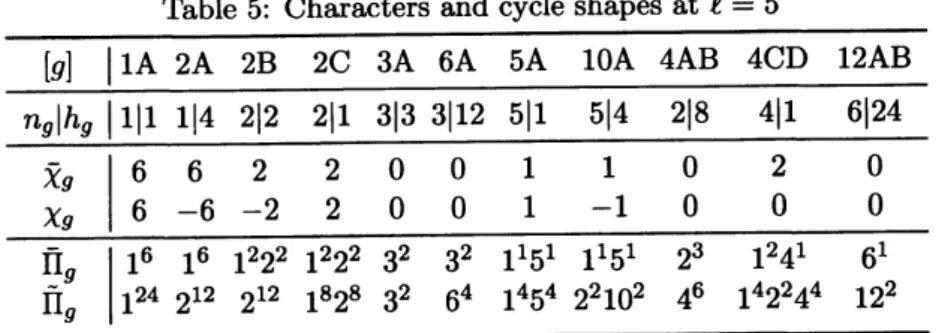
Write$\tilde{\Pi}_{g}$ for the cycle shape attached to$g\in G^{(\ell)}$arisingfrom thispermutation representationand write$g\mapsto\tilde{\chi}_{g}$ for the corresponding character
of$G^{(\ell)}$
.
Then, for example,$\tilde{\Pi}_{g}=2^{12}$ if$g$isthe central involution in$G^{(\ell)}$ and$\ell\neq 4$
.
(For each$\ell$thegroup $G^{(\ell)}$ containsthe transformation
$e_{i}\mapsto-e_{i}$, which is the unique central involution of
$G^{(\ell)}$ if
$\ell>2.)$ In the
case
that $\ell=4$and$g$isthecentral involution of$G^{(4)}$ wehave $\tilde{\Pi}_{g}=1^{8}2^{8}.$Define a secondpermutation representationof degree$24/(\ell-1)$ for$G^{(\ell)}$ by considering the
action of$G^{(\ell)}$
on
the sets$E_{i}=\{ce_{i}|c\in \mathbb{Z}/\ell, c\neq 0\}$ for $i\in\Omega^{(\ell)}$, whichconstitute
a
system ofimprimitivity for the degree 24 permutation representation of$G^{(\ell)}$ just defined. Write $\overline{\Pi}_{g}$ for
representation is generally not faithful, for the central involution $e_{i}\mapsto-e_{i}$ acts trivially. We
write$g\mapsto\overline{g}$forthenatural map from
$G^{(\ell)}$ toits quotient$\overline{G}^{(\ell)}$ bythe centralsubgroupgenerated
by$e_{i}\mapsto-e_{i}$
.
(Wehave$G^{(\ell)}\simeq\overline{G}^{(\ell)}$when$\ell=2$since
$e_{i}=-e_{i}$ for $i\in\Omega^{(2)}.$)
Observe that thesmaller permutation representation$\overline{\chi}$ is
an
irreducible constituent ofthelarger
one
$\tilde{\chi}$.
Indeed, the lattercontains $\lfloor\ell/2\rfloor$ copies of the former, and$\lfloor(P-1)/2\rfloor$ copiesof
afaithfulrepresentation of degree$24/(\ell-1)$, whosecharacter we denote$g\mapsto\chi_{g}$, whichisjust
that whichyou obtain by taking thematrices representing theaction of$G^{(\ell)}=$ Aut$\pm(\mathcal{G}^{(\ell)})$
as
elements of$GL_{n}(\mathbb{Z}/\ell)$–these matriceshaving exactly
one non zero
entry $\pm 1$ in each row andcolumn–and regarding them
as
elements of$GL_{n}(\mathbb{C})$.
$($Here$n=24/(\ell-1).)$$\tilde{\chi}_{g}=\lfloor\ell/2\rfloor\overline{\chi}_{g}+\lfloor(\ell-1)/2\rfloor\chi_{g}$ (3.2)
Itis now easytodescribe the shadow of the
vector-valued
mock modular form$H_{g}^{(\ell)}=(H_{g,r}^{(\ell)})$,for it is given by $S_{g}^{(\ell)}=(S_{g,r}^{(\ell)})$where $S_{g,r}^{(\ell)}=\overline{\chi}_{g}S\ell_{r}$ for $r$ odd, and $S_{g,r}^{(\ell)}=\chi_{g}Sp_{r}$ for $r$ even,
where $S_{m,r}$denotes theunarythetaseries
$S_{m,r}( \tau)=\sum_{k\in Z}(2km+r)q^{(2km+r)^{2}/4m}$
.
(3.3)Note that$S_{m}=(S_{m,r})$isa vector-valued cuspform of weight3/2forthe modulargroup$SL_{Q}(\mathbb{Z})$
.
Given a cycleshape $\Pi=m_{1}^{n_{1}}\cdots m_{k}^{n_{k}}$ with$n_{i}>0$ for $1\leq i\leq k$ and $m_{1}<m_{2}<\cdots<m_{k}$ call$m_{k}$ thelargest
factor
of$\Pi$and
call $m_{1}$ the smallestfactor.
Foreach$g\in G^{(\ell)}$ define$n_{g}$ tobe the largest factor of$\overline{\Pi}_{g}$ (this turns out to be thesame asthe order ofg) and define $N_{g}$ to
be the product of the smallest and largest factors of$\tilde{\Pi}_{g}$. The significance of these values for
theautomorphy of $H_{g}^{(\ell)}$ is that
$n_{g}$ is the level of
$H_{g}^{(\ell)}-i.e.$, the smallest positive integer such
that the vector-valuedmock modularform $H_{g}^{(\ell)}$ is a mock modular form for $\Gamma_{0}(n_{g})$–and $N_{g}$
is thesmallest positive integer such that the multiplier system for $H_{g}^{(\ell)}$ coincideswith that of
$S_{\ell}=(S_{\ell,\tau})$ whenrestricted to$\Gamma_{0}(N_{g})$
.
The expression for$S_{g}^{(\ell)}$ just given determines the multiplier system of$H_{g}^{(\ell)}$–since the
mul-tiplier system of
a
mock modular form is the inverse of the multiplier system of itsshadow (cf.$[18])$–in the case that $\overline{\chi}_{g}$ and $\chi_{g}$
are
bothnon-zero.
The multiplier system of$H_{g}^{(\ell)}$ may be
described as
followsin thecase
that $\overline{\chi}_{g}\chi_{g}=0.$Define$v^{(\ell)}=\ell+2$ in
case
$\ell$isodd $(i.e. \ell\in\{3,5,7,13\})$, and set$v^{(\ell)}=\ell-1$ when$\ell$is
even
and define$\psi_{n|h}^{(\ell)}$ : $\Gamma_{0}(n)arrow GL_{l-1}(\mathbb{C})$for positiveintegers
$n$and$h$by setting
$\psi_{n|h}^{(\ell)}(\begin{array}{ll}a bc d\end{array})= e(-v^{(\ell)}\frac{cd}{nh})\sigma^{(\ell)}(\begin{array}{ll}a bc d\end{array})$ (3.4)
in
case
$h$ divides$n$, andotherwise$\psi_{n|h}^{(\ell)}(\begin{array}{ll}a bc d\end{array})= e(-v^{(\ell)}\frac{cd}{nh}\frac{(n,h)}{n})\sigma^{(\ell)}(\begin{array}{ll}a bc d\end{array})J^{c(d+1)/n}K^{c/n}$ (3.5)
where $J$ is the diagonal matrix $J=$diag$(1, -1,1, \cdots)$ withalternating $\pm 1$
along the diagonal,
and$K$isthe
“reverse
shuffle” permutationmatrixcorrespondingto thepermutation$(1, \ell-1)(2,\ell-2)(3, \ell-3) \cdots$ (3.6)
of the standard basis $\{e_{1}, \ldots, e\ell-1\}$ of$\mathbb{C}^{\ell-1}$
.
Now the multiplier system of$H_{g}^{(\ell)}$ is given by$\psi_{n|h}^{(\ell)}$for$n=n_{g}$ and $h=h_{g}=N_{g}/n_{g}$ when $\overline{\chi}_{g}\chi_{g}=0.$
Note thatthefactor$(n, h)/n$
can
usually be ignored in practice,for there is justone case
inwhich $\overline{\chi}_{g}\chi_{g}=0$ and $h=h_{g}$ does not divide
$n=n_{g}$ and $(n, h)\neq n$; viz., thecaee that $\ell=3$
and$g\in G^{(3)}$ satisfies $\overline{\Pi}_{g}=2^{1}10^{1}$and$\tilde{\Pi}_{g}=4^{1}20^{1}.$
Acknowledgement
The author thanks RIMS and theorganizers of theRIMS workshop Research on
finite
groupsand their representations, vertex operator algebras, and algebraic combinatorics, Kyoto, Japan,
January 2013, for support and hospitality. The author’s understanding of umbral moonshine,
and the content of this note in particular, has developed from manyconversations withmany
people,butthe greatestburden hasfallen upon hiscoauthorsMiranda Cheng and Jeffrey Harvey,
to whom the author is extremely grateful. We
are
indebted to George Glauberman for the$\underline{\frac{Tabe5yp}{}\frac{[g]|1A2A2B2C3A6A5A10A4AB4CD12AB1:Charactersandcc1eshaesat\ell=5}{n_{g}|h_{g}|1|11|42|22|13|33|125|15|42|84|16|24}}$
$\frac{x_{g}\overline{x}_{g1_{6-6-22001-1000}^{66220011020}}}{\Pi_{g},\Pi_{g}-\sim 1_{1^{24}2^{12}2^{12}1^{8}2^{8}3^{2}6^{4}1^{4}5^{4}2^{2}10^{2}4^{6}1^{4}2^{2}4^{4}12^{2}}^{1^{6}1^{6}1^{2}2^{2}1^{2}2^{2}3^{2}3^{2}1^{1}5^{1}1^{1}5^{1}2^{3}1^{2}4^{1}6^{1}}}$
Table
6:
Characters and
cycle shapesat
$\ell=7$$[g] | IA 1A 2A 4A 3AB 6AB$
$\frac{g}{}\frac{n|h11|42|833|4\overline{\chi}_{g}44011\chi_{g}4-401-1}{\Pi_{g}-1^{4}1^{4}2^{2}1^{1}3^{1}1^{1}3^{1},\Pi_{g}24^{6}1^{6}3^{6}2^{3}6^{3}\sim}$
Table
7:
Characters and
cycle shapesat
$\ell=13$$[g]|1A 2A 4AB$
B
Special
Functions
The Dedekind $eta$ function, denoted $\eta(\tau)$, is a holomorphic function onthe upper half-plane
defined by the infinite product
$\eta(\tau)=q^{1/24}\prod_{n>0}(1-q^{n})$ ($B$.1)
where $q=e(\tau)=e^{2\pi i\tau}$
.
Itis a modular form ofweight 1/2forthe modulargroup$SL_{2}(\mathbb{Z})$ withmultiplier $\epsilon$:$SL_{2}(\mathbb{Z})arrow \mathbb{C}$ sothat
$\eta(\gamma\tau)\epsilon(\gamma)j(\gamma, \tau)^{1/2}=\eta(\tau)$ ($B$.2)
for all$\gamma\in SL_{2}(\mathbb{Z})$, where$j(\gamma, \tau)=(c\tau+d)^{-1}$ in
case
$(c, d)$ is the lowerrow
of$\gamma.$
Setting$q=e(\tau)$ and$y=e(z)$ we use the following conventions for the four standard Jacobi
theta
functions.
$\theta_{1}(\tau, z)=-iq^{1/8}y^{1/2}\prod_{n=1}^{\infty}(1-q^{n})(1-yq^{n})(1-y^{-1}q^{n-1})$ $\theta_{2}(\tau, z)=q^{1/8}y^{1/2}\prod_{n=1}^{\infty}(1-q^{n})(1+yq^{n})(1+y^{-1}q^{n-1})$ ($B$.3) $\theta_{3}(\tau, z)=\prod_{n=1}^{\infty}(1-q^{n})(1+yq^{n-1/2})(1+y^{-1}q^{n-1/2})$ $\theta_{4}(\tau, z)=\prod_{n=1}^{\infty}(1-q^{n})(1-yq^{n-1/2})(1-y^{-1}q^{n-1/2})$We write$\mu(\tau, z)$ for the Appdl-Lerchsumdefined by setting
References
[1] T. Eguchi, H. Ooguri, and Y. Tachikawa, “Notes
on
the K3 Surface and the Mathieugroup
$M_{24},$” Exper.Math. 20 (2011) 91-96, arXiv:1004. 0956 [hep-th].[2] M. C. N. Chengand J. F.R. Duncan, “The LargestMathieuGroupand (Mock)
Automorphic Forms,” 1201.4140.
[3] J. Conway,R. Curtis, S. Norton, R.Parker, and R. Wilson, Atlas
of finite
groups.Maximalsubgroups andordinary characters
for
simplegroups. With comput. assist.from
J. G. Thackray. Oxford:
Clarendon
Press,1985.
[4] J. H. Conwayand S. P. Norton, “Monstrous Moonshine,” Bull. LondonMath. Soc. 11
(1979)
308339.
[5] J.
G.
Thompson, “Finitegroups
and modularfUnctions,” Bull. London Math. Soc. 11(1979)
no.
3,347-351.
[6] J. G. Thompson, “Somenumerology between theFischer-Griess Monsterandthe elliptic
modular fUnction,” Bull. London Math. Soc. 11 (1979) no. 3,
352-353.
[7] M. C. N. Cheng, K3 Surfaces, N$=4$ Dyons, and the Mathieu Group $M_{24}$, 1005.5415.
[8] M. R. Gaberdiel, S. Hohenegger, and R. Volpato, “Mathieutwining characters for K3,”
JHEP 1009(2010) 058, arXiv:1006.0221 [hep-th].
19
pages.[9] M. R.Gaberdiel, S. Hohenegger,andR. Volpato, “Mathieu Moonshine in the elliptic
genusof K3,” JHEP 1010 (2010) 062, arXiv:1008.3778 [hep-th].
[10] T. Eguchi andK. Hikami, “Note
on
Twisted EllipticGenus ofK3 Surface,” Phys.Lett.B694 (2011) 446-455, arXiv:
1008.4924
[hep-th].[11] T. Gannon, “Muchado about Mathieu,” November,
2012.
[12] M. C. N. Cheng,J. F. R. Duncan,and J. A. Harvey, “UmbralMoonshine,”
arXiv:1204. 2779 [math.
RTl.
[13] J. H. ConwayandN. J. A. Sloane, “Twenty-threeconstructions for the Leechlattice,”
Proc. Roy. Soc. London Ser. A 381 (1982)
no.
1781,275-283.
http:$//dx$
.
doi. $org/10.1098/rspa$.
1982. 0071.[14] M. C. N. Cheng,J. F. R. Duncan, and J.A. Harvey, “Umbral Moonshine and the
NiemeierLattices,”
[15] J. H. Conway and N. J. A. Sloane, Sphere Packings, Lattices and Groups.
[16] J. H. Conway and N. J. A. Sloane, “Self-dualcodes
over
the integers modulo4,” J.Combin. Theory Ser. A 62 (1993) no. 1,
30-45.
http:$//dx$
.
doi.$org/10.1016/0097-3165(93)90070-0.$[17] E. M. Rainsand N. J. A. Sloane, “Self-dualcodes,” in Handbook
of
coding theory, Vol. I,II,pp. 177-294. North-Holland, Amsterdam,1998.
[18] M. C. ChengandJ. F. Duncan, “Rademacher Sums and RademacherSeries,”