1
(14
Constrained Guided
Spiral
Transition Curves
Zulfiqar
Habib
*and Manabu Sakai
\daggerKagoshima
University, Japan
$\mathrm{I}$Abstract
A method for drawing a guided $G^{2}$ continuous cubic spiral spline curve that falls within a closed
boundary is presented. The boundary is composed of straight line segments and circular arcs. Spiral
segments consist oftransitionsfrom straight line to straight line or circle. Guidedcurve can easily be
controlledby shape controlparameter. Our scheme has better smoothness and moredegree of&aedom
thanany previous method. Alsoourscheme iscompletelylocal and hencemoresuitable andcomfortable
for practicaluse.
Keywords: cubic,guided,$G^{2}$spiral, constrained spline
1
Introduction
A method for drawing
a
guided $G^{2}$ continuous cubic spiral splinecurve
that falls withina
closed boundaryis presented. Theboundaryis composed of straight line segments and circulararcs.
Wediscuss cubic $G^{2}$ spiral transition from straight line to circle. Thenwe
extend it for transition between twonon-parallel straight lines andfinally make it suitablefor constrained guided
curve.
Our constrainedcurve
can easily be controlledby shapecontrol parameter. Any change in this shapecontrol parameter does not effect the continuity and neighborhoodparts of thecurve.
Thereare
several problems whosesolutionrequiresthesetypesofmethods. Forexample
.
Auser
may wish todesignacurve
thatfitsinsideagivenregion as,forexample, whenone
is designinga
.
shapeto be cut from aflatsheetofmaterial.A
user
may wishtodesigna
smooth paththat avoids obstacles as, forexample, whenone
is designingarobot
or
auto drivecar
path..
For applications suchas
the design of highwaysor
railways it is desirable thatcurve
be fair. Inthe discussion about geometric design standards in AASHO (American Association of State Highway
Officials), Hickerson [6] (p. 17) states that “Sudden changes between
curves
ofwidely different radiiorbetween long tangents and sharp
curves
shouldbe avoided by theuse
ofcurves
ofgradually increasingor decreasing radii without at the
same
time introducing an appearance of forced alignment”. Theimportance of this design feature is highlighted in [3] that links vehicle accidents to inconsistency in highwaygeometricdesign.
Parametric cubic
curves
arepopularinCADapplications because theyare
the lowest degree polynomialcurves
that allowinflection points (wherecurvature is zero), sotheyare
suitablefor the composition of $G^{2}$ splines. Tobe visually pleasing it isdesirablethat the spline befair. TheBezierformofa
parametric cubiccurve
is usually usedin $\mathrm{C}\mathrm{A}\mathrm{D}/\mathrm{C}\mathrm{A}\mathrm{M}$ andCAGD (ComputerAidedGeometricDesign) applicationsbecause of its geometric and numerical properties. Many authors have advocatedtheir
use
in different applicationslikedata fitting and fontdesigning. Theimportanceofusingfaircurves
inthe design process is well documented in the literature [2]. Cubic curves, althoughsmoother,are
not always helpful sincetheymight haveunwanted inflectionpointsand singularities(See[10]). Spirals haveseveral advantages of containingneitherinflectionpoints, singularities norcurvature extrema (See [5]). Such
curves are
usefulfor transitionbetween two circles
or
straight lines.$\mathrm{E}$mail: [email protected] Web: $\mathrm{h}\mathrm{t}\mathrm{t}\mathrm{p}://\mathrm{z}\mathrm{u}\mathrm{l}\mathrm{f}\mathrm{i}\mathrm{q}\mathrm{a}\mathrm{r}.8\mathrm{m}.\mathrm{c}\mathrm{o}\mathrm{m}$
$\uparrow \mathrm{E}$-mail:[email protected]–u.ac.jp, Department of Mathematics and Computer Science
tGraduateSchoolofScience and Engineering, Korimoto1-21-35, Kagoshima University, Kagoshima890-0065,Japan.
185
Many authors have discussed the problem of drawing constrained curves. In [4], a $G^{2}$ continuous,shape-preserving curve made of rational cubics that interpolates to given points and that lies on one
side of
a
line, orseveral lines, is described. In [8], fair Beziercurves
withfixed cross-sectional area areproduced. In [1], a $C^{1}$ continuous non-parametric interpolation rational (cubic numerator and linear denominator) that lies above, below, or between polylines is discussed. In [9],
a
$G^{2}$ continuouscurve
made of non-parametric rational cubics that lies ononesideofaline, or onesideofaquadratic curveis found.Inour paper,the boundaryconsistsofstraight linesegmentsandcircular arcs, whichisdifferent than
boundariesconsidered by above mentionedpapers. Recently, Meek [7]presented amethodfor drawinga
guided$G^{1}$ continuous planar spline
curve
that falls within a closed boundarycomposedof straight linesegmentsand circles. $G^{1}$ continuity is not suitable for manypractical applications where high degreeof smoothness is required, for example, high way designing. Our guided
curve
has better smoothness thanMeek [7] scheme which has $G^{1}$ continuity. Theobjectives andshapefeaturesof
our
scheme inthispaperare
.
Toobtain $G^{2}$ cubicspiral transition fromstraight line tocircle and make it moreflexible than Walton scheme in [11].
.
Toobtaincubic spiraltransitionbetweentwo non-parallelstraightlines.
.
To obtain guided $G^{2}$ continuous cubic spiral spline that falls withina
closed boundary composed ofstraight linesegmentsand circles.
.
To discuss and proveshapefeaturesof cubic spiral..
Toachievemore
degreesoffreedom and flexibleconstraints for easyuse
inpractical applications..
Anychangeinshape parameterdoes not effectcontinuityandneighborhoodpartsofour
guided spline.So,our scheme is completely local.
Inthispaper, $\mathrm{x}$ standsforthetwodimensional
cross
product$(x_{0},y\mathrm{o})\mathrm{x}(x_{1},y_{1})=x_{0}y_{1}-x_{1}y_{0}$ and $||\cdot||$means
the Euclidean norm. Let $L$bea
straightline throughorigin$O$andacircle 0of radius$r$centered at $C$.
Considerthe planarcurve$z(t)=(x(t),\mathrm{u}(\mathrm{t})$$0\leq t\leq 1$and for later use, consider$\mathrm{u}(\mathrm{t})=u_{0}(1-t)^{2}+2u_{1}t(1-t)+u_{2}t^{2}$, $\mathrm{u}(\mathrm{t})=v_{0}(1-t)^{2}+2v_{1}t(1-t)+v_{2}t^{2}$ (1.1)
Aspiral isa
curve
whose curvature does notchangesignand whose curvatureis monotone. $G^{2}$ (Geometric continuity ofsecond order)means
continuity in position, in unit tangent, and in signed curvature. Acurve is said to match $G^{2}$ Hermite data ifit passes from
one
given point to another given point, if itsunit tangentmatchesgiven unit tangentsatthe two given points, and its signed curvature matches given signed curvatures at the two given points.
This paperdoes not include discussion on PH quintic spiral due to page limitation, however it will
appear
soon
inour
next paper. The organization ofour paper is as follows. We start from $G^{2}$ cubicBezier function, then description of methodfor spiral transition from straightlineto circle,its extension
for transition between nonparallel straight lines and finally application to constrained guided spline.
Numericalexamples, analysis, comparison and conclusions
are
given in last section.2
Spiral
Transition
From Straight
Line to Circle
Weconsider
a
cubic transition$z(t)$ (seeFigure 1)of theform$\mathrm{z}’(\mathrm{t})=(u(t),v(t))$.
Itssignedcurvature$\kappa o)$ isgiven by
$\kappa(t)(=’\frac{z(t)\mathrm{x}z(\prime t)}{||z\zeta t)||^{s}},’)=\frac{u(t)v’(t)-u’(t)v(t)}{\{u(t)^{2}+v^{2}(t)\}^{3/2}}$ (1.1)
Forlateruse, consider
$\{u^{2}(t)+v^{2}(t)\}^{5/2}\mathrm{z}’(\mathrm{t})=$ $\{u(t)v’’(t)- u"(t)\mathrm{z}\mathrm{r}(t)\}$$\{u^{2}(t)+v^{2}(t)\}$ (2.2)
-3$\{u(t)v’(t)-u’(t)v(t)\}\{u(t)u’(t)+v(t)v’(t)\}(=$u(t)
Here, werequirefor $0<\theta<\pi/2$
166
Figure 1: Cubicspiral transition from straight line to circle.
Then, the above conditionsrequire
Lemma 2.1. With apositive parameter$d$
$u_{1}= \frac{d^{2}}{2r\sin\theta}$, $u_{2}=d\cos\theta$, $v_{0}=0,$ $v_{1}=0,$ $v_{2}=d\sin\theta$ (2.4)
where$\mathrm{z}’(0)=(\mathrm{u}\mathrm{o}, 0)$ and$\mathrm{z}’(0)$ $=d(\cos\theta,\sin\theta)$
.
We introducea pairofparameters $(m,q)$for $(\mathrm{u}\mathrm{o}, d)$
as
$u_{0}=mui,$$d=qr$, Then$u_{0}= \frac{mrq^{2}}{2\sin\theta}$, $u_{1}= \frac{rq^{2}}{2\sin\theta}$,
$u_{2}=qr\cos\theta$, $v_{0}=v_{1}=0,$ $v_{2}=qr\sin\theta$
from which
(2.5)
from which
$x(t)= \frac{qrt}{6\sin\theta}[q\{(3-2t)t+m(3-3t+t^{2})\}+t^{2}\sin 2\theta]$ , $y(t)= \frac{qrt^{\delta}\sin\theta}{3}$ (2.5)
Walton ([11]) consideredacubic
curve
$z(t)$($=$ v(t))$y(t)))$,$0\leq t\leq 1$ofthe form$z(t)=$bo$(1-t)^{3}+3b_{1}t(1-t)^{2}+362(1-t)t^{2}+b_{3}t^{3}$
where B\’ezierpoints $b_{\dot{l}}$,$0\leq i\leq 3$
are
definedas
follows(2.7)
where B\’ezierpoints $b_{\dot{l}}$,$0\leq i\leq 3$
are
definedas
follows$b_{1}-b_{0}=b_{2}-b_{1}= \frac{25r\tan\theta}{54\cos\theta}(1,0)$, $b_{3}-b_{2}= \frac{5r\tan\theta}{9}(\cos\theta,\sin\theta)$ (2.8)
Simplecalculation gives
$x’(t)$($=$v(t)) $=$vo$(\mathrm{l}-t)^{2}1$ $2u_{1}t(1-t)+u_{2}t^{2}$, $y’(t)(=v(t))=$vo$(\mathrm{l}-t)^{2}+2v_{1}t(1-t)+v_{2}t^{2}$ (2.9)
where
$u_{0}=u_{1}= \frac{25r\tan\theta}{18\cos\theta}$, $u_{2}= \frac{5r\sin\theta}{3}$, $v_{0}=v_{1}=0,$ $v_{2}= \frac{5r\tan\theta\sin\theta}{3}$ (2.4)
Hence, notethat theirmethod isour specialcasewith $m=1$ and $q= \frac{5}{3}\tan\theta$.
With help ofa symbolic manipulator, weobtain
$\kappa$
’(
$\frac{1}{1+s})=\frac{8(1+s)^{6}(\sum_{=0}^{5}a_{i}s^{i})\sin^{3}\theta}{r\{q^{2}s^{2}(2+ms)^{2}+2qs(2+ms)\sin 2\theta+4\sin^{2}\theta\}^{5/2}}.\cdot$
(2.4)
where
$a_{0}=4\{3q\mathrm{c}o\mathrm{s}\theta-(4+m)\sin\theta\}\sin$J9, $a_{1}=2\{6q-2q(5-4m)\sin 2\theta-10m \sin 2 \theta\}$
$a_{2}=2q$
{
$(-2+$13m)g$-2m(4-m)\sin 2\theta$}
, a3 $=2mq${
$(-3+$10m)g$-2m\sin 2\theta$}
$a_{4}=5m^{3}q^{2}$, $a_{6}=n^{3}q^{2}$
Hence, wehavea sufficient spiralconditionforatransition curve$\mathrm{z}(t)$,$0\leq t\leq 1,$i.e.,$a_{\mathrm{i}}\geq 0,0\leq i\leq 5$
167
Lemma 2.2. The cubic segment$z(t)$,$0\leq t\leq 1$of
theform
(1.1) is aspiral satisfying (2.4)if
$m>3/10$and
$q\geq q(m, \theta)(={\rm Max}\{$$\frac{(4+m)\tan\theta}{3}$, $\frac{2m(4-m)\sin 2\theta}{13m-2}$, $\frac{2m\sin 2\theta}{10m-3}$,
$\frac{1}{6}\{(5-4m)\cos\theta+$ cosO$+(5-4\mathrm{r}\mathrm{n})^{2}$
cos2
$\theta\}\sin$$\theta])$ (2.12)Theorem 2.1. The cubic segment $z(t),0<t\leq 1$
of
thefor
$rm(\mathit{1}.\mathit{1})$ is a spiral satisfying (1.1) and$\kappa’(1)=0$
for
$\theta\in(0, \pi/2]$if
$m\geq$ 2(-l $+\sqrt{6}$)$\overline{/}5(=c_{0})(\approx$ 0.5797$)$Proof.
Letting$z$$=\tan\theta(>0)$, we only have tonotethat thetermsinbrackets of(2.11) reduce$\frac{(4+m)z}{3}(=A_{1})$,$\frac{4m(4-m)z}{(13m-2)(1+z^{2})}(=A_{2})$,$\frac{4mz}{(10m-3)(1+z^{2})}(=A_{3})$, $\frac{z\{5-4m+\sqrt{25+16m^{2}+20m(1+3z^{2})}\}}{6(1+z^{2})}(=A_{4})$
Here, wehave tocheck that the firstquantity is not less than the remainingthreeones where
$A_{1}\geq A_{2}$ $(m \geq\frac{1}{25}(-1+\sqrt{201})(\approx 0.5270))$
$A_{1}\geq A_{3}$ $(m \geq\frac{1}{20}(-25+\sqrt{1105})(\mathrm{z} 0.4120))$, $A_{1}\geq A_{4}$ $(m\geq c_{0})$
口
3
Family of
Spiral
Transitions
Between Two Straight
Lines
Figure2: Cubic spiraltransitionbetweentwo straight lines.
Here,wehave extended the idea of straight line to circle transition andderived
a
method forBezierspiraltransitionbetween two nonparallel straight lines (seeFigure 2). We note the followingresult that isof
use
for joining two lines. For$0<\theta<$ $\mathrm{r}/2$, weconsidera
cubiccurvesatisfying$\mathrm{z}(0)=(0,0)$, $z’(0)||(1.1)$, $\kappa(0)=$ l/r, $z’(1)||(\cos\theta,\sin\theta)$, $\kappa(1)=0$ (3.1)
Since B\’ezier
curves are
affine invariant,a
cubic B\’ezier spiral can be used ina
coordinate freeman-ner. Thereforetransformation, i.e., rotation, translation, reflectionwith respect to$y$-axis andchange of variable$t$with $1-t$to (2.6)gives $z(t)(=\mathrm{x}(\mathrm{t})\mathrm{y}(\mathrm{t})$by
$\mathrm{x}(\mathrm{t})=\frac{qrt}{6\sin\theta}[qt\{3-(2-m)t\}\cos\theta+2(3-3t+t^{2})\sin\theta]$
188
Now,$\mathrm{z}(\mathrm{t},\mathrm{m},\mathrm{O})(- (x(t,m,\theta),y(t,m, \theta))),0\leq t\leq 1$ denotes the cubicsplinesatisfying (3.1). Assumethat
the anglebetween two lines is7 $(<\pi)$
.
Then, $(x(t,m,\theta_{0}),y(t,m,\theta_{0}))$ of the form (3.2) with $q=q_{0}(\geq$$\mathrm{q}\{\mathrm{m}$,Qo)) and $(-x(t,n,\theta_{1}),y(t, n,\theta_{1}))$of the form (3.2) with $q_{1}$($\geq$ q{m,Qo)$)$ with$\theta_{0}+\theta_{1}=\pi$$-\gamma$is
a
pairofspiral transition
curves.
Figures $3(\mathrm{a}, \mathrm{b})$ shows the graphs of the family of$G^{2}$ cubic spiral transitioncurves
between two straight linesfor $(\gamma,\theta_{0},\theta_{1})=(5\pi/12, \pi/4,\pi/3)$, (a) $(m_{0},m_{1})=(3,0.8)$ (shaded) and$(1, 1)$ (bold), (b) $r=0.1$ (shaded) and 0.2 (bold). Here start and end points of straight lines arenot fixedanduser has
no
controlover
them. This situation is not suitable forsome
practical applications.3.1
Scheme
For Fixed
End
Points
When $\theta_{0}=\theta_{1}$ ($=\theta=(\pi-$y)/2)
are
fixed and $m,n\geq$ Cg (then, note $q_{0}=(4+m)/3\tan\theta$ and$q_{1}=(4+n)/3\tan\theta)$, the distances between the intersection $O$ of the two lines and the end points
$P_{i},i=0,1$ofthe transition
curves
aregiven by $d(m,n,r,\theta)$ and $d(n,m,r, \theta)$ where$\mathrm{d}\{\mathrm{m},\mathrm{n},\mathrm{r},\mathrm{O}$) $=(r/c)$$\{4+(3+m)^{3}+3(3+n)\}$
,
$c$$=54$cos2
$\theta/\sin\theta$ (3.3)Here
we
derivea
conditionon
$r$for whichthe followingsystem ofequations hasthe solutions$m$,$n$($\geq$ q)for given nonnegative$d_{0},d_{1}$
$d(m,n, r,\theta)=d_{0}$, $\mathrm{d}\{\mathrm{m},\mathrm{n},\mathrm{r},0$) $=d_{1}$ (3.4)
Let (a ) $=(3+m,3+n)$ reduce the abovesystemto
$\alpha^{3}+3\beta$$=\lambda$($=$ch/r-4), $\beta^{3}+3\alpha=\mu(=cd_{1}/r-4)$ (3.5)
where require $m,n\geq c_{0}$ to note$\mathrm{a},\#\geq c_{1}$$(=c_{0}+3)$ and $\lambda$,$\mu\geq c_{2}$($=c_{1}^{3}+$3ci). Delete$\alpha$ from (1.23) to
get aquarticequation $\mathrm{f}(/3)=0$
$f(\beta)=\beta^{9}$-$3\mu\beta^{6}+3\mu^{2}\beta^{\theta}-81\beta+27\lambda-\mu^{3}$ (3.6)
Restrictions: $\alpha,$$\beta\geq c_{1}$ requirethat at least
one
root $\beta$of$f(\beta)=0$must satisfy$c_{1}\leq\beta\leq(\mu-3c_{1})^{1/3}$ (3.7)
Intermediate valueof theoremgives
a
sufficientcondition: $f(c_{1})\leq 0$and$f((\mu-3c_{1})^{1/3})2$ $0$ where$f(c_{1})=-7^{\mathrm{i}}’+$$3c7\mu^{2}-3c\mathrm{j}\mu$ $+$$27\lambda$$+$ $c_{1}^{9}-81c_{1}$ $=-$$\{\mu-c\mathit{1}$ $-3(\lambda-3\mathrm{C}1)1/3\}$ $\mathrm{x}$
$[(\mu-c_{2})^{2}+3$$\{2c_{1}+$$(\lambda-3c_{1})^{1/}\mathrm{i}$$(\mu-c_{2})+9\{c_{1}^{2}+$Cl$(\lambda-3c_{1})^{1/3}+$$(\lambda-3\mathrm{C}1)1/3\}$
(3.8)
$f((\mu-3c_{1})^{1/3})=27\{\lambda-c_{1}^{3}-3(\mu-3c_{1})^{1/3}\}$
Sincethe quantity in bracketsis positivefor $\mu\geq c_{2}$, the sufficient
one
reduces to$\lambda-c_{1}^{3}\geq 3(\mu-3c_{1})^{1/3}$, $\mu-c_{1}^{3}\geq 3(\lambda-3c_{1})^{1/3}$ (3.9)
Note$\lambda,\mu 2$$c_{2}$ to obtain
Lemma3.1. Given$h$,$d_{1}$,
assume
that$r$satisfies
$\lambda-c_{1}^{3}\geq 3(\mu-3c_{1})^{1/3}\geq 0,\mu-$$\mathrm{c}’\geq 3(\lambda- 3\mathrm{c}_{1})^{1/3}$ $\geq 0.$Then the system
of
(3.5) has the reqgeiredsolutions $\alpha,\beta(\geq c_{1})$.
Note $\lambda,\mu=$ O(l/r),$\mathrm{r}arrow \mathrm{t}$$0$ toobtain that asmall value of$r$ makestheinequalities (3.9) be valid for
any $h$,$d_{1}$
.
Next, foran
upperbound for $r$,werequireLemma3.2.
If
42
$d_{1}$, then$\mu-c_{1}^{l}=3(\lambda-3c_{1})^{1/3}$ and$\lambda$,$\mu\geq c_{2}$ by (S. 5) hasauniquepositive solution$r^{*}$
.
Restrictions: $\alpha$,$\beta\geq c_{1}$ requirethat at least
one
root $\beta$of$f(\beta)=0$must satisfy$c_{1}\leq\beta\leq(\mu-3c_{1})^{1/3}$ (3.7)
Intemediatevalueof theoremgives
a
sufficientcondition: $f(c_{1})\leq 0$and$f((\mu-3c_{1})^{1/\theta})\geq 0$ where $f(c_{1})=-\mu^{3}+3c_{1}^{\theta}\mu^{2}-3c_{1}^{6}\mu+27\lambda+c_{1}^{9}-81c_{1}=-\{\mu-c_{1}^{3}-3(\lambda-3c_{1})^{1/3}\}\mathrm{x}$$[(\mu-c_{2})^{2}+3\{2c_{1}+(\lambda-3c_{1})^{1/3}\}(\mu-c_{2})+9\{c_{1}^{2}+c_{1}(\lambda-3c_{1})^{1/3}+(\lambda-3c_{1})^{2/3}\}]$
(3.8)
$f((\mu-3c_{1})^{1/3})=27\{\lambda-c_{1}^{3}-3(\mu-3c_{1})^{1/3}\}$
Sincethe quantity in bracketsis positivefor $\mu\geq c_{2}$, the sufficient
one
reduces to$\lambda-c_{1}^{3}\geq 3(\mu-3c_{1})^{1/3}$, $\mu-c_{1}^{S}\geq 3(\lambda-3c_{1})^{1/3}$ (3.9)
Note$\lambda,\mu\geq c_{2}$ to obtain
Lemma3.1. Given$h$,$d_{1}$,
assume
that$r$satisfies
$\lambda-c_{1}^{3}\geq 3(\mu-3c_{1})^{1/3}\geq 0,\mu-c_{1}^{3}\geq 3(\lambda-3c_{1})^{1/3}\geq 0.$Then the system
of
(3.5) has the $[] rquired$solutions $\alpha,\beta(\geq c_{1})$.
Note $\lambda$,
$\mu=O(1/r)$,$rarrow 0$toobtain that asmallvalueof$r$ makestheinequalities (3.9) be valid for
any $h$,$d_{1}$
.
Next, foran
upperbound for $r$,werequireLemma3.2.
If
$h$ $\geq d_{1}$, then$\mu-c_{1}^{l}=3(\lambda-3c_{1})^{1/3}$ and$\lambda,\mu\geq c_{2}$ by (3.5) hasauniquepositive solution1
$6\theta$Proof.
Let $t=$ 1/r toreduce$\mu-c_{1}^{3}=3(\lambda-3c_{1})^{1/3}$ to$f(t)$ $(=(edit-4-c_{1}^{3})^{3}-27(\mathrm{c}\mathrm{d}\mathrm{o}\mathrm{t}-4-3c_{1}))=0$
where $\lambda,\mu 2$ $c_{2}$ are equivalent to$t\geq(c_{2}+4)[(cd_{1})$
.
First, note with $4=k^{2}d_{1}(k\geq 1)$$f(+\infty)=+\infty$, $f( \frac{c_{2}+4}{cd_{1}})=-27(c_{1}+1)(c_{1}^{2}-c_{1}+4)(k^{2}-1)(\leq 0)$
In addition, $f(t)$ has its relative maximum at $t=$ ($c_{1}^{3}+4-$ Sk)/(cdi)$(< (c_{2}+ 4)/(cd_{1}))$
.
Therefore,$\mathrm{f}(\mathrm{t})=0$ has just
one
root $t=t^{*}(=1/r^{*})$($\geq(c_{2}+$4)/(cdi)). $\square$口As $r$ increasesfrom zero, “equality” in the second inequality of(3.9) isfirstvalid. Hence,
we
obtainTheorem 3.1. Assume that$d_{0}\geq d_{1}$
.
Then the systemof
equation (3.4) in $m,n$ ($\geq$ Co) is solvablefor
$0<r\leq r^{*}$ where$r^{*}$ is the positive rootno greater than$cd_{1}/(c_{2}+4)$
$\{(4+c_{1}^{3})r-cd_{1}\}^{3}-27r^{2}$$\{(4+ 3\mathrm{c}\mathrm{i})) -d_{0}\}$ $=0,$ $c_{1}=\mathrm{c}_{0}^{3}+3c_{0}$ (3.11) Then,
for
the angle $\gamma(<\pi)$ between the two straight lines with $0=(\pi- 7)$/2, ($x$(t,$m,\theta$), $y(t,m,\theta)$),$q=\{(4+m)/3\}$$\tan\theta$
of
theform
(S. 2) and $(\mathrm{x}(\mathrm{t},\mathrm{m},9), \mathrm{y}(\mathrm{t},\mathrm{m}\mathrm{y}9))$, $q=\{(4+n)/3\}\tan\theta$of
theform
(3.2) is apair
of
spiral transitioncurves
between the two lines.(a)Given$r=0.2$ (b) Given$(m,n)=$$(1, 1)$ (c) Given (do,$d_{1}$) $=(1,3)$
Figure3: Graphs of$z(t)$ with non-fixed $(\mathrm{a}, \mathrm{b})$ and fixed (c) start andend points.
Thisresult enables the pairofthe spirals topassthroughthegiven pointsof contactonthe nonparallel two straight lines. For example, in Figure $3(\mathrm{c})$, straight lines are given with $7=\theta_{0}=\theta_{1}=\pi/3$,
$r=0.1$ (shaded) and 0.2 (bold). By (3.4), for $r=0.1$, $(\mathrm{m}\mathrm{o},\mathrm{m}\mathrm{i})\approx(4.65,2.05)$ and for $r=0.2,$
$(\mathrm{m}\mathrm{o}, m_{1})\approx(3.02,0.82)$
.
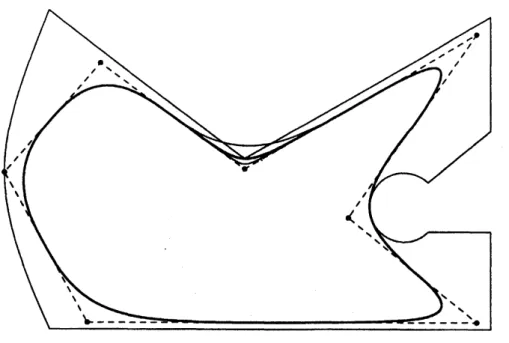
To keep the transition curvewithin a closed boundary, value of shape controlparameter $r$ can be derived from (3.2) when control points and boundary information are given. A
constrainedguided
curve
isshown in Figure 4.4
Examples,
Analysis
and
Conclusion
In Figure4,
a
constrained$G^{2}$ continuous cubic spiralsplineuses
straightline tostraightlinetransition. Theboundaryis composedof straight line segments and circulararcs.
Thesecurves
areguidedby shape control parameter and all segments have completely local control, i.e., any change inone
segment does not effectcontinuityand shapeof neighboringsegments. The data for boundary and controlpoints has been takenfrom Figure 8in [7] whichhas $G^{1}$ continuity and scheme is notcompletely local.Cubicspiral segments
are
usefulin the design of objects when it is desirablethatfaircurves
be usedin the designprocess. A method forstraight line to circletransition has beendiscussed and extendedto
transition
curve
between twonon
parallel straight lines. We proved that Walton scheme for cubic [11]isa special
case
ofour
most flexible scheme. We offered reasonable degreeof freedom and extendedourschemes to $G^{2}$ guided spiral spline constrained by a closed boundary. Our scheme has $G^{2}$ continuity which is better than $G^{1}$ continuity in [7]. $G^{1}$ continuity is not suitable for many practical applications where high degree ofsmoothness is required.
170
Figure4: A $G^{2}$ cubicguided spiral spline constrained by aclosed boundary.
References
[1] Q. Duan, G. Xu, A. Liu, X. Wang, and F. Cheng. Constrained interpolationusing rational cubic
spline
curves
with linear denominators. Korean Journalof
Computational8
Applied Mathematics, 6:203-215, 1997.[2] G. Farin. Curves and
Surfaces for
Computer Aided GeometricDesign: A Practical Guide. AcademicPress, NewYork, 4th edition, 1997.
[3] G. M. Gibreel, S. M. Easa,Y. Hassan, and I. A. El-Dimeery. State ofthe art of highway geometric
design consistency. ASCE Journal
of
$\mathfrak{W}nspo\hslash ation$Engineering, 125(4):305-313,1997.[4] B. H. Goodman, T. N. T. Ong and K. Unsworth. NURBS
for
Curve andSurface
Design., chapter ConstrainedInterpolation Using Rational Cubic Splines, pages59-74. SLAM, Philadelphia, 1991.[5] Z. Habib and M. Sakai. $G^{2}$ planar spiral cubic interpolation to a spiral. pages 51-56, USA, July
2002. The Proceedings ofIEEE International Conference
on
Information Visualization-IV’02-UK, IEEEComputer Society Press.[6] T. F. Hickerson. Route Location and Design. McGraw-Hill, NewYork, 1964.
[7] D. S. Meek, B. Ong,and D. J. Walton. A constrained guided$G^{1}$ continuous spline
curve.
Computer Aided Design, 35:591-599,2003.[8] H. Nowacki and X. Lu. FairingB\"ezier
curves
with constraints. Computer Aided Geometric Design, 7:43-55, 1990.[9] B. Ong. Mathematical Methods in Computer Aided Geometric Design, chapterOn Non-parametric
ConstrainedInterpolation, pages 419-430. Academic Press,Philadelphia, 1992.
[10] M. Sakai. Osculatory interpolation. Computer Aided Geometric Design, 18:739-750,2001.
[11] D. J. Waltonand D.S.Meek. A planar cubic Bezier spiral. Computationaland Applied Mathematics,