Polynomial-Time Identification
of
an
Extension
of
Very Simple
Grammars
from
Positive Data
東京大学大学院学際情報学府 吉仲亮 (RYO YOSHINAKA)
$\mathrm{r}\mathrm{y}\emptyset \mathrm{i}\mathrm{i}\mathrm{i}$ .u-tokyo.ac.jp
Graduate School
of
InterdisciplinaryInformation
Studies,University
of
Tokyo AbstractInthis paper, westudy thelearning efficiencyofasubclass ofsimple deterministiclanguages. We
defineasuperclassof verysimplegrammarsand show that the class is identifiable in the limit from
positive data bypresenting an algorithmwhichupdatesits conjectures in polynomial time in the
size of provideddata. Moreover, weinvestigatean algorithmwhich decidestheinclusionproblem
forthe class efficiently, which isasub-algorithm ofthe learning algorithm.
1
Introduction
Whilethere
are
fewsubclasses of context-freegrammars
(CFGs) known to belearnable efficiently frompositivedata only, Yokomori [6] shows that the class of verysimple grammars (VSGs) is identifiable in
the limit from positivedataby
an
algorithmwhich updates its conjecture in polynomialtimeinthe sizeof provided data. In this paper, we define
a
superclass of very simple grammars, called the right-unique simple grammars (RSGs) and show that theclass is also efficiently learnable by an algorithm, which is basedon
the learning algorithm for VSGs by Yokomori. Ouralgorithm hasasub-algorithm which decidesthe inclusion whether $L(G’)\subseteq L(G)$ between
an
RSG $G$ andan
arbitrary CFG $G’$, which is basedon
(and
runs
faster than) the algorithm for the inclusion problem for VSGs proposed by Wakatsuki andTomita [5].
For
more
detaileddiscussion (in particular forthe proofsofthelemmas andtheorems omittedinthispaper)
on
theissues treatedinthispaper,see
the master’s thesis byYoshinaka [7],fromwhich this paperexcerpts. Thethesis includes aslight improvement
on
the algorithmfor theinclusion problem for RSGs.2
Preliminaries
$\epsilon$ denotes the empty string and $\emptyset$ denotes the empty set. $|\cdot$ $|$ denotes the length of the string
or
thecardinality oftheset. Acontext-free grammar (CFG) $G$ is denoted by
a
4-tuple $(N, \Sigma, P, S)$ where$N$ isthe finiteset of nonterminal symbols, $\Sigma$ is the finite set ofterminal symbols disjoint ffom $N$, $P$ is the
finite set of production rules and $S\in N$ is the start symbol. Nonterminals
are
denoted by uppercase
lettersfrom the beginning of the alphabet, $A$,$B$,
. . .
etc. andterminalsare
denotedby lowercase
lettersffom the beginning ofthe alphabet, $a$,$b$,
.
..
etc. Sequences of nonterminalsare
denoted by lowercase
letters fromthe beginningof the Greek alphabet, $\alpha$,$\beta$,
$\ldots$ etc. and sequences ofterminals (strings)
are
denoted by lower
case
letters from the end of thealphabet, $x$,$y$,.
. .
etc. We define abinaryrelation $\Rightarrow G$as
$\Gamma\Rightarrow\subset$A for $\Gamma$, A $\in$ $(\mathrm{I}\cup N)^{*}$ iff (ifand only if) $\Gamma=$ AIAA3, A $=\Delta_{1}\Delta_{2}\Delta_{3}$ and $Aarrow$ $\Delta_{2}\in P.$ Wesome
times write $\Rightarrow$ instead of $\Rightarrow G$ ifno
confusionoccurs.
$\mathrm{S}$
is the transitive closure of$\Rightarrow$
.
$\Rightarrow^{*}$is the
reflexiveand transitive closure of$\Rightarrow$
.
We definethe language $L(G)$ by a grammar $G$as
$L(G)=L(G, S)$where $L(G, A)=\{w\in\Sigma^{*}|A\Rightarrow^{*}w\}$
.
A CFG $G$ is reduced ifffor every nonterminal $A\in N,$ there is$xyz\in L(G)$ such that $S\Rightarrow^{*}xAz\Rightarrow xyz*$
.
Definition 1. A positive data ofa language$L$ is
a
surjection from the set ofnaturalnumbers$\mathrm{N}$ to $L$.
For
a
positivedata$R$ of$L$, let $R_{n}$ denote$\{R(0), \ldots, R(n-1)\}$.
An algorithm$A$ converges to $G$for
$R$iff there is $k\in \mathrm{N}$suchthat$A(R_{n})=G$forall$n\geq k,$where$A(R_{n})=G$means
thattheoutput of$A$is $G$for theinput Rn. WesaythatA
learnsa
class $\mathcal{L}$ oflanguages if forany $L\in \mathcal{L}$and anypositivedata$R$for$L$, $A$converges to$G$ such that $L(G)=L.$
Theterm “the efficiency of
a
learning algorithm” is controversial. Since thesize ofthe inputdata$R_{n}$increases infinitely,
every
learningalgorithmcan
be modified intomore
“efficient”one
which updates itsconjecture faster. In order
to
make the discussion constructive,we
introduce
the followingtwo
common
Definition 2. A grammar $G$is consistent with$L$ iff$L\subseteq L(G)$.
A
learning algorithm$A$is consistent iffthe output is always consistent with the input, i.e., $R_{n}\subseteq A(R_{n})$for everypositivedata$R$and anatural
number$n$
.
An algorithm$A$is conservative iff$R(n)\in A(R_{n})$ implies $4(7?_{n+1})$ $=A(R_{n})$ forevery $R$ and$n$
.
Th$\mathrm{e}$learning algorithmfor VSGsbyYokomori [6] updates its conjecture in
$\mathcal{R}_{n}^{|\Sigma|}$
under the abovetwo constraints, where $\mathcal{R}_{n}=\sum_{0\leq k<n}|R(k)|$ is the tot\^a length of the input data $R_{n}.1$ In this paper,
we
defineasuperclass ofVSGs and discuss its learning efficiency.
Definition 3. A CFG $G$ is in Greibach normal
form
ifevery production rule is in the form of $Aarrow$$a\alpha$for
some
$a\in C$ and $\alpha\in N’.$ A CFG$G$inGreibachnormalform isa
simplegrammariff$Aarrow a\alpha$, $Aarrow$ $a\beta\in P$implies $\alpha=\beta$. A simple grammar $G$ is very simple iff$Aarrow a\alpha$, $Barrow a\beta\in P$implies $A=$ $B$ and $\alpha=\beta$.
Asimplegrammar
$G$is right-unique iff$Aarrow a\alpha$, $Barrow a\beta\in P$ implies$\alpha=\beta$.
The class of
RSGs
isa
proper superclass of VSGs. The following example ofan
RSG expressesformulas of first order logic, which cannot be expressed by
a
VSG sincea
VSG cannot distinguish‘variables” (represented bythe nonterminal $V$below) from “terms” (by$T$).
Example 4. Let
an
RSGbe such that$N=\{S,T, V, C, L, R\}$, $\Sigma=\{\mathrm{p},\mathrm{q}, \mathrm{f},\mathrm{g}, \mathrm{a},\mathrm{b}, \mathrm{x}, \mathrm{y}, \neg, \vee, \exists, (, ), .\}$, $\mathrm{m}\mathrm{d}$$P=\{Sarrow\neg S$, $Sarrow$ VLSCSR, $Sarrow\exists VS$, $Sarrow \mathrm{p}LTR$, $Sarrow \mathrm{q}LTCTR$, $Tarrow \mathrm{f}LTR$, $Tarrow$ gLTCTR,
$Tarrow \mathrm{a}$, $Tarrow \mathrm{b}$, $Tarrow \mathrm{x}$, $Tarrow \mathrm{y}$, $Varrow \mathrm{x}$
,
$Varrow \mathrm{y}$, $Carrow.$,
$Larrow$ $(, Rarrow)\}$.
Then, for example, there isa
derivation $S\Rightarrow\neg S\Rightarrow\urcorner \mathit{3}VS$$\Rightarrow\neg\exists \mathrm{x}S\Rightarrow$ $w\mathit{3}\mathrm{x}\mathrm{p}LTR$ $\Rightarrow\neg*$]xp(/) ! $\neg$3xp(gLTCTR) $\Rightarrow^{*}\neg 3\mathrm{x}\mathrm{p}(\mathrm{g}(\mathrm{a}.\mathrm{x}))$
.
Angluin [1] shows that the class of $k$-reversible languages is learnable from positive data efficiently
for any natural number $k$, where a regular language $L$ is $k$-reversible iff $\{x_{1}yz_{1}, x_{2}yz_{1}, x_{1}yz_{2}\}\subseteq L$
and $|y|=k$ implies $X2yz2\in L$. While it is shown by Yokomori [6] that if $L$ is
a
regular and verysimple language then$L$is zer0-reversible, in contrast, there is aregular and right-unique simple language $L$ which is not $k$-reversible for any $k$, e.g., $L=\{ac^{n}de, ac^{n}df, bc^{n}de|n\geq 0\}$ defined by
an
RSG as$P=\{Sarrow aCF, Sarrow bCE, Carrow cC, Carrow d, Earrow e,Farrow e, Farrow f\}$
.
Theorem 5. The class ofRSGsis closed under
none
of the following; union, intersection, complement,concatenation, Kleene closure $(*, +-)$, ($\in$-ffee) homomorphism, inverse homomorphism, orreversal.
3
A
$\mathrm{L}\mathrm{e}\mathrm{a}\mathrm{r}\mathrm{n}\acute{\mathrm{l}}\mathrm{n}\mathrm{g}$ $\mathrm{A}\circ \mathrm{r}\mathrm{i}\mathrm{t}\mathrm{h}\mathrm{m}$for
RSGs
Under the constraint of the consistencyandconservatism,
a
learning algorithm must outputa
grammarwhich represents a minimal languageinthe languages including the input data. The following function defined
on an
RSGisveryimportant to study the properties of RSGs.Definition 6 (shape). For
an
RSG $G$,a
function$\#\mathrm{G}$ mapping from $(\Sigma\cup N)^{*}$ to thesetofintegers$\mathbb{Z}$
isdefined as
.
follows;$\# c(a)=|$
cr
$|-$ $1$ for$Aarrow a\alpha$.
$\# c(A)=-1$ for $A\in N$.
$\neq_{G}(\Gamma\Delta)= G(\Gamma)+\neq_{G}(\Delta)$ (homomorphism)We call$\# G$ the shape of$G$
.
A function
$c
: $\Sigma^{*}arrow \mathrm{N}$ isdefinedas
follows;.
$c
$(\epsilon)=0$.
$\_{G}(x)=\max${1-#c
$(x’)|x$’ isa
proper prefix of$x$}
for $x\neq\epsilon$If$a\Rightarrow*x\beta$, then $\#(\alpha)=*(x\beta)$ (i.e., $j(x)$ $=|\beta|-|$
a
$|$). $\mathrm{t}(\mathrm{x})$ denotes the necessary and sufficientlengthofa sequenceof nonterminals to derive$x$ by
a
left-most derivation,because $|\beta’|$ $=|\alpha|+\#(x’)\geq 1$for $\alpha\Rightarrow^{*}x’\beta’\Rightarrow+\mathrm{x}\mathrm{O}$
.
That is, $\alpha\Rightarrow*x\beta$ implies $\alpha’\Rightarrow*x\beta’$ for the prefix at’ of length$(rr)
of $\alpha$ and$|\beta’|=x)+\#(x)$
.
Lemma 7 (right-uniqueness). For twoderivations $\alpha_{1}\Rightarrow*$
? $x\beta_{1}$ and a2 $*i$ $x\beta_{2}$, if $|01|=|\mathrm{c}\mathrm{b}2|=x)$,
then $\beta_{1}=\beta_{2}$
.
Yokomori additionally claims that the algorithm satisfies the condition for polynomial time identification proposed by Pitt [4]. The author does not think the conclusion is false buthasaquestiononhis proof.
Definition 8 (consistent shape). Theshape$\#$ of
some
RSG (ahomomorphism$\#$ from $\Sigma^{*}$ to$\mathbb{Z}$ suchthat $\#(a)\geq-1$ for all $a\in$ $\Sigma$) is consistent with a language $L$ iffthere is
an
RSG $G$ whose shape is $\#$such that $L\subseteq L(G)$
.
Lemma 9. A shape $\#$ is consistent with $L$ iff (1) $\#(w)=-1$ and (2) $\#(\mathrm{t}1’)$ $\geq 0$ for all the proper
prefixes $w’$ of$w$ for every $w\in L.$ The condition (2)
can
be replaced with (2’)$(w)=l,
where$(w)=
$\max$
{
$1-\#(x’)|x$’ isa
proper prefixof$x$}.
If$\#$ is consistent with$L$, then $zay\in L$ implies $\#(a)<|y|$
.
Corollary 10. For
a
provided data $R_{n}$, all the consistent shapescan
be enumerated in finite steps$O( \mathcal{R}_{n}^{|\Sigma|-1})(\mathcal{R}_{n}=\sum_{0\leq k<n}|7?(k)|)$
.
Inorder to obtain theset of consistent shapes
more
fast, in practice, it isa
good idea to constructand solve the simultaneous linear equations which represent the condition (1) of Lemma 9, that is,
$\sum_{a\in\Sigma}$ $(\mathrm{o}\mathrm{c}\mathrm{c}(a, w)\cdot$ $\#(\mathrm{a}))$ $=-1$ for each $w\in R_{n}$ where $\mathrm{o}\mathrm{c}\mathrm{c}(a,w)$ denotes thenumber of
occurrences
of$a$in$w$. But, unfortunately, such
a
strategy does notimprove the worst-case time complexity theoretically.Suppose that
an
input$R_{n}$ andaconsistent shape$\#$are
given. Let$\mathcal{G}_{\#}=\{G|\# c=\neq\}$be the subclassof RSGs whose shapes
are
all $\#$.
Then, it is easy to find the minimumgrammar
Go
in $\mathcal{G}\neq$ such that$R_{n}\subseteq L(G_{0})$
as
follows. Weassume
thattherightsideof each ruleofeach grammarin$\mathcal{G}_{\#}$ is intheformof $?_{a}arrow$
oAO|0
...
$A_{a,\#(a)}$ and the set of nonterminals is $N_{\#}=\{S\}\cup\{A_{a,i}|a\in\Sigma,0\leq i\leq*(a)\}$.
This assumption losesno
generality. Then,we
determine the left side of the rules of$G_{0}$ by simulating thederivations ofall $n$ $\in$ Rn. We
can
completesucha
simulationwithoutfail. Forexample,supposeashape$\#(\mathrm{a})$$b$,$c,d)$ $=(1,0, -1, -1)$ given. The right sideofthe rules of$G\circ$ is determined
as
$?_{a}arrow$$\mathrm{a}\mathrm{A}0\mathrm{A}\mathrm{i}$ $?b$$arrow bB0$, $?_{\mathrm{C}}arrow$? $c$, $7d$ $arrow d.$Ifabcbd$\in R_{n}$, then
we
simulate the derivationas
$S\Rightarrow$aA0Ai4$abB_{0}A_{1}\Rightarrow abcA_{1}\Rightarrow$a6c6B0$\Rightarrow$abcbd,
and therefore,the rules
are
determinedas
follows;$Sarrow aA_{0}A_{1}$, $A_{0}arrow bB\circ$, $A_{1}arrow bB_{0}$, $B_{0}arrow c$, $B_{0}arrow d.$
As
seen
above, the distinctions between RSGs in $\mathcal{G}_{\#}$are
what nonterminalsare
in ? for each $a\in$E. In other words, (the equivalence classes of) $\mathcal{G}*$ forms a finite Boolean algebra isomorphic to the
power set $\mathcal{M}_{\#}$ of $\Sigma$
$\mathrm{x}N\#$
.
The correspondence between $G\in \mathcal{G}\neq$ and $M_{G}\in \mathcal{M}\#$ is that $A_{b,k}arrow$ $aA_{a,0}$...
$A_{a,\neq(a)}$ is in$G$ iff $(a, \text{\^{A}} k)$ $\in MG.$ Then it is easy to verifythat $L(G_{1})\cap L(G_{2})=L(G_{1} \cap G_{2})$ holds, where $\cap$is definedas
$G=G_{1}$\cap$G_{2}$ iff$M_{G}=M_{G_{1}G_{2}}\cap M$.
Thisassures
thatif$\#$is consistentwitha
language$L$ then theminimumgrammarGo
in$\mathcal{G}_{\#}$ suchthat $L\subseteq L(G_{0})$ is uniquelydetermined.Summarizing the above, for agiven input,
.
Wecan
enumerateshapes consistentwiththe input..
Wecan
compute theminimum consistentgrammarwith the input fora
given shape consistent withtheinput.
The minimum grammar for
a
fixed shape is, however, not necessarilya
minimalgrammar
in all theconsistent RSGs with the input. There are a number ofconsistent shapes for theinput. The remained
task is to choose
a
minimalgrammar
inthe minimumgrammars.
For this task,it is enoughto showan
algorithmwhich decides the inclusion of RSGs with different $\mathrm{s}\mathrm{h}\mathrm{a}\mathrm{p}\mathrm{a}\mathrm{e}.2$ We present such
an
algorithm inthe next section.
Corollary 11. The inclusion problem for RSGs which
are
constructed ffoma
provided data&
and consistent shapescan
be solved in $O(|\Sigma|^{4}\mathcal{R}_{n}^{10})$ steps.Therefore, we canchoose
a
minimalgrammar
consistentwith agiven input. Moreover, it is easy tosee
thatthe algorithmconverges
toan
RSG which representsthetargetlanguage,because (1) the set$s_{n}$ of shapesconsistentwith$R_{n}$ is finite, (2) $s_{n}\subseteq s_{n+1}$ifallthe terminals of the targetgrammarappear in$R_{n}$, and (3) finitelymanyessentially different grammars havea
same
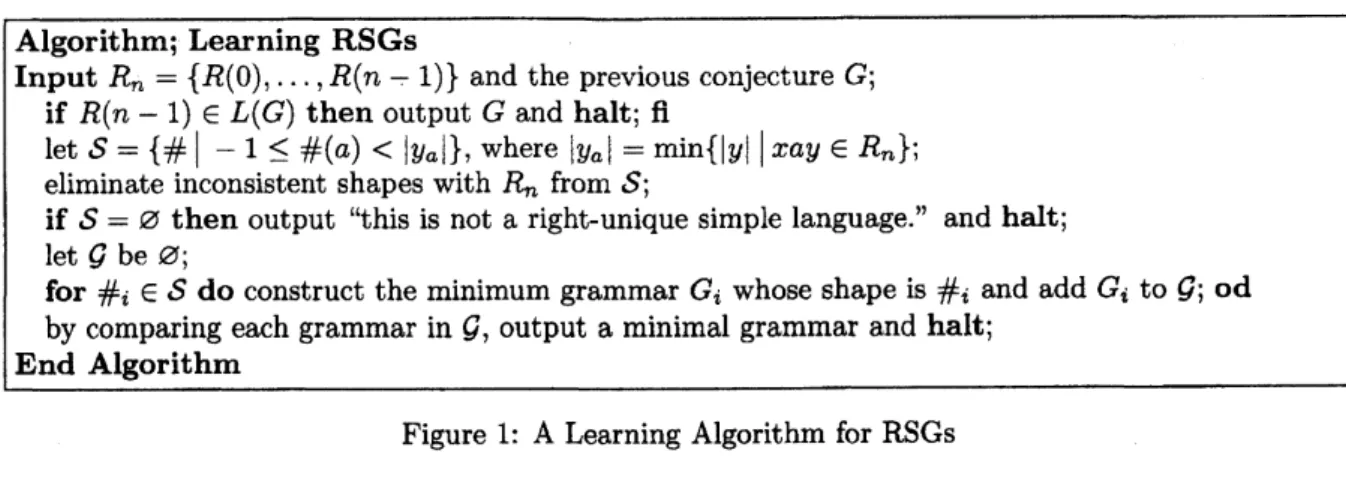
shape ($\mathcal{M}_{\#}$ is finite).Theorem 12. Thealgorithm inFigure1learns theclass ofright-uniquesimplegrammarsconservatively
andconsistently,which updates its conjecture in$O(|\Sigma|^{4}\mathcal{R}^{|\Sigma|+9})$steps.
$2\mathrm{Y}\mathrm{o}\mathrm{k}\mathrm{o}\mathrm{m}\mathrm{o}\mathrm{r}\mathrm{i}$$[6]$showsthatwe canchooseaminimalVSGinanumber of VSGs withoutdeciding theinclusion. Butsuch
Algorithm; Learning RSGs
Input $R_{n}=\{R(0), \ldots, R(n-1)\}$ and the previous conjecture $G$;
if $R(n-1)\in L(G)$ then output $G$ and halt; fi
let $S=$ $\mathrm{E}$$|-1$ $\leq$
#(a)
$<|y_{a}|\}$,where $|y_{a}|= \min\{|y||xay\in R_{n}\}$; eliminate inconsistent shapes with $R_{n}$ from $S$;if $S=\emptyset$ then output “this is not
a
right-unique simple language.” and halt;let $\mathcal{G}$ be $\emptyset$;
for $\neq_{i}\in S$doconstructthe minimum grammar $G_{i}$ whose shape is $\neq_{i}$ and add $G_{t}$ to $\mathcal{G}$; od
by comparing each
grammar
in$\mathcal{G}$, outputa
minimalgrammar
and halt;End Algorithm
Figure 1: A LearningAlgorithmfor RSGs
4
An
algorithm
for Inclusion Problems of RSGs
It is already shown that the inclusion problem for
some
superclasses of right-unique simplegrammars
isdecidable by Linna [3] and Greibach and Friedman [2]. But these algorithms, which take exponential
time in $\mathcal{R}_{n}$,
are
not enough efficient to be adoptedas a
sub algorithm ofour
learning algorithm. Onthe other hand, Wakatsuki and Tomita [5] show that the inclusion problem for VSGs is decidable in
polynomial time in the thicknesses of compared
grammars.
Thethickness $r$; ofa
CFG $G$ isdefinedas
$\tau c$ $= \max\tau_{G}A\in N(A)$ for $\tau_{G}(A)=\min_{A\Rightarrow^{*}w}|w|$. Becausethe length ofa
shortest string in the language bya
CFGcannot be boundedby
a
polynomial in thedescriptionsize of the grammar generally, it is thought to bereasonable to adopt the thickness as
a
parameter foran
evaluationofthe computational complexity ofan
algorithm which treats CFGs. Basedon
their algorithm,we
investigatean
algorithm which decides the inclusion problem for RSGsmore efficiently than theirs.Theorem 13. For
an
RSG $G=$ $(N, \Sigma, P, S)$ andan
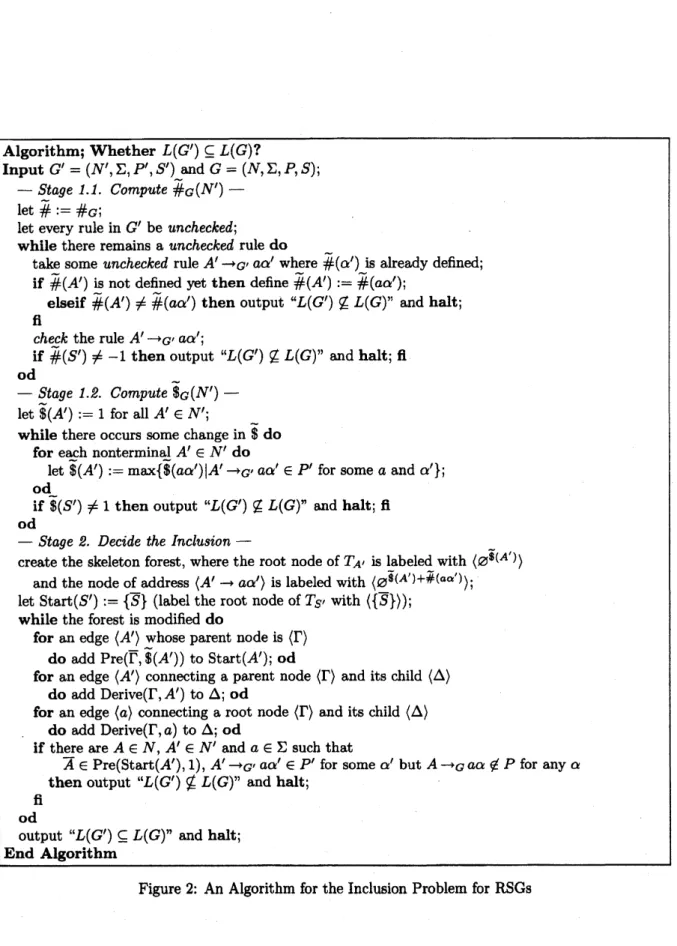
arbitrary CFG $G’=(N’, \Sigma, P’, S’)$ in Greibachnormalform, the questionwhether $L(G’)\subseteq L(G)$ isdecidable in $O(|\Sigma|^{4}|N|^{2}|G’|^{6}\tau_{G}^{2},)$ by the algorithm
inFigure 2, where $|G’|$ denotesthe description sizeof$G’$ defined as $|G$’$|= \sum_{A’arrow}aa’($$P’(3+|\alpha’|)$
.
Notethat, though
we assume
that $G’$ is in Greibach normal form here foraconvenience, but that isinessential restrictionat all.
Our algorithmchecks whether $\#\mathrm{G}$ is consistent with $L(G’)$ first. This is a necessary condition for
$L(G’)\subseteq L(G)$
.
Through thissection, weassume
that both $G$ and$G’$ arereduced.Definition 14 (extended shape). Suppose that $\neq_{G}$ isconsistent with$L(G’)$
.
In sucha
case,we
can
define
$\# c(A’)$ for $A’\in N’$ by identifying$A’$as a
string in $L(G’, A’)$.
.
$\neq_{G}(A’)=\#$ $\mathrm{x}(y)$ forsome
$A\Rightarrow^{*}$ ;’$y$This is welldefined, because for differenttwo strings $y_{1}$,$y_{2}\in L(G’, A’)$ and a derivation
$S’\Rightarrow^{*}G’xA’z\Rightarrow*$ $xy_{i}z$,
we
obtain $\# c(xy_{i}z)=-1$and $\# c(A’)=\# c(y_{i})=-1-\# c$(xz). In addition,we
define$c(A’)$as
follows;
.
$\_{G(\Gamma)=\max\{\_{G}(y)|\Gamma’\Rightarrow G’y\}}*$for $\Gamma\in$ $(\mathrm{I}\cup N’)^{*}$,
.
$G$( \mathrm{A}’)=\max\{ c(y)|A’\Rightarrow^{*}\subset$’1:
in particular.Itis easyto
see
that $A’)$ and$(\Gamma )
hasa finitevalueif $l\subset$ is consistent with$L(G’)$.
Lemma
.
15. Supposethat $\neq_{G}$ is consistent with$L(G’)$.
Then, $\neq_{G}(A’)=\# c(a\alpha’)$ for all rules $A’arrow a\alpha’\in P’$ of$G’$,.
$\_{G}(A’)=\max\{\_{G}(a\alpha’)|A’arrow a\alpha’\in P’\}$,.
$G (r).
. .
$X_{m}$) $=$$\max\{-\# c(X_{1}\ldots X_{k-1})+ c(X_{k})|1\leq k\leq m\}$for $X_{:}\in$ $\mathrm{f}^{\mathrm{I}}\mathrm{t}$ $\cup N’$.
The algorithm in Figure 2
decides
the consistencyof$\# G$ with $L(G’)$ in Stage1.
Thecorrectness
ofthe procedure is guaranteed by the above lemma.
Suppose that
we
obtaina
conclusion that $\# c$ is consistent with $L(G’)$ (otherwise $L(G’)$\not\subset
$L(G)$).Secondly, the algorithm emulates the derivations of$G’$ by $G$ in Stage 2. We
conclude
$L(G’)\subseteq L(G)$ iffwewrite $\#\sim$ and
\sim$
for the extended $fc$ and$\_{G}$ computed in Stage 1. The rules of$G’$are
representedbyaset oftrees. Each treecorrespondsto
one
nonterminal of$G’$ and thereisa
path from therootnode whichrepresents a rule in $G’$
.
Thus, each tree $T_{A’}$ represents the derivations of$L(G’, A’)$.
For example, thetrees whichrepresent the rules $\{A’arrow a, A’arrow aB’, B’arrow bC’, B’arrow bB’D’\}$
are
describedas
follows:$T_{A’}$: $T_{B’}$:
$a$ $b$
$B$’ $\mathrm{O}$
$B$’
c’
$D$’$\mathrm{O}$ $\mathrm{O}$ $\mathrm{O}$
For each nodein$T_{A’}$
, we say
the address ofthe node is $\langle A’arrow a\alpha’\rangle$if the path ffomtheroot nodeis$\langle a\alpha’\rangle$(i.e., the edges
on
the pathare
labeled with $a,A_{1}’$,
. .
.
,$A_{|\alpha|}’$, inthis order where$\alpha’=A_{1}’$. . .
$A_{|\alpha|}’$, ). Notethat, inthis case, there is
a
rule $A’arrow G^{\mathrm{t}}$$\alpha’\alpha’$’ forsome
$\alpha’’\in N^{\prime*}$ but notnecessarily a rule $A’arrow c^{z}$ $a\alpha’$.
We call the node whose address represents
a
rule in $G’$final
node (indicated by double circles in theabove). Alltheleafnodes
are
final nodes, but theconverse
is notnecessary.
Eachnode islabeled with
a sequence
ofsubsets of$N\cup\overline{N}$where$\overline{N}$is
a
twinof$N$ (howeverthelabelsof root nodes consistof subsets of$\overline{N}$only), while each edgeis, in contrast, labeled with
a
single terminalor
nonterminal in$G’$.
The length of the labelon
the node of address $\langle A’ - a\alpha’\rangle$ is$\simA’)+*(a\alpha’)\sim$ andthe length of the label
on
the root node of$T_{A’}$ is $A’)$.
In particular, the length of the labelon
everyfinal node in$T$,’ is$\simA’)+\#(A’)\sim$
.
The algorithm beginswiththe forest called skeletonforest
whose allnode labels
are
sequences of theempty sets. The algorithm addssome
members of$N\cup\overline{N}$to labelson
nodes step bystepinorder to complete
the forest
as
in Figure2.
Hereafterwe
use
uppercase
letters fromtheendof the alphabet,$X$,$\mathrm{Y}$,$Z$,
.. .
for subsets of$N\cup\overline{N}$ and uppercase
letters of the Greekalphabet,$\Gamma$,$\Delta$,$\Theta$,
. . .
for sequences ofsubsetsof$N\cup\overline{N}$.
Suppose that the forest is completed (this means $L(G’)\subseteq L(G)$) and that the root node of$T_{A’}$ is
labeled with$X_{1}$
...
$X_{m}(m=A’))\sim$,$\overline{A_{i}}\in X_{i}$,$A’\Rightarrow c^{\mathrm{r}}$$a\alpha’\beta’\Rightarrow^{*}$ ay/3’,and thenodeof address$\langle A’arrow a\alpha’\rangle$is labeled with$\mathrm{Y}_{1}$
...
$\mathrm{Y}_{n}(n=m+\#(a\alpha’))\sim$.
Then, thereare
$B_{1}$,$\ldots$,$B_{n}$suchthat$A_{1}$
...
$A_{m}\Rightarrow^{*}c$ayBi
. ..
$B_{n}$,where $B_{i}\in \mathrm{Y}_{t}$ for $1\leq i\leq\overline{\}(ay)+\#(ay)\sim$ and$\overline{A_{j-\#(ay)}\sim}=\overline{B_{j}}\in \mathrm{Y}_{\mathrm{j}}$ for $(ay)+#(ay)<i $\leq n.$ In other
words, $B_{i}\in N$ is determined by$y$ but independentlyfrom any $A_{i}$ bythe right-uniqueness and$\overline{B_{j}}\in\overline{N}$
appearsonlywhen it has already appeared before deriving $y$
.
This is the difference between $N$and$\overline{N}$
.
In an uncompleted forest, thus, the algorithm updates each node label
as
follows: Suppose thatan
edge labeled with $A’$ connectsa
node labeled with $\Gamma$ and its child node insome
tree. Ifthereare
nonterminals which appear in $\Gamma$ but not in the label
on
the root node of$T_{A’}$, thenwe
must add them into the appropriate position inthe labelon
the root node of$T_{A’}$. Ifsome
final node of $T_{A’}$ is labeledwith nonemptysets, then by referring$\Gamma$ and the labels
on
the root node and the final nodes of$T_{A’}$,we
determine what nonterminals in$N\cup\overline{N}$should be
added to appropriate positioninthe label
on
thechildnode. Therefore, recursivelywe can determine all thelabelson nodes inthe forest.
Ifit
occurs
thatthereare a
tree$T_{A^{J}}$ and$\overline{A}\in X$ where the root node of$T_{4^{\mathrm{t}}}$ is labeled with$X\Gamma$ suchthat $A’arrow G^{z}$ $a\alpha’\in P’$ but $Aarrow$($a\alpha\not\in P$ for any$at\in N^{*}$, then the algorithm concludes$L(G’)Z$ $L(G)$
.
Excluding such
a
case, when itoccurs
that thealgorithmcannotmodifyanylabelson
trees,thealgorithmconcludes $L(G’)\subseteq L(G)$
.
The algorithm terminates in finite steps, since each $X$ ineach nodelabel hasthe upper bound $N\cup\overline{N}$
.
The formal definitions ofnotations used inthealgorithm is given
as
follows:Definition 16. Let $\Gamma=X_{1}$
. . .
$X_{n}$, A$=\mathrm{Y}_{1}$. .
.
$\mathrm{Y}_{m}$ and $\Theta=Z_{1}\ldots$$Z\iota$.
.
$\Gamma\subseteq$ Aiff$n=m$and$X_{\dot{l}}\subseteq \mathrm{Y}_{i}$ for all$i$.
.
.
$\mathrm{e}$ $=\Gamma\cap\Delta$ iff $n=m=l$ and$Z_{1}$. $=X_{i}\cap \mathrm{Y}_{\dot{l}}$ for all $i$.
$\Theta$ $=\Gamma\cup\Delta$ iff $n=m=l$ and$Z_{\dot{l}}=X_{1}\cup \mathrm{Y}_{1}$. forall$i$
.
.
Pre(I,$k$) $=X_{1}$...
$X_{k}$ isdefinedonly if$k\leq n.$.
Start(A’)denotes
thelabel
on
the rootnode of
$T_{A’}$.
.
Final(A’) denotes the union of labelson
the final nodes of$T_{A’}$.
.
Roughly speaking, Derive(F,$A’$) (or Derive(I,$a$)) expresses the sequences ofnonterminals whichappearwhen
some
elements of$\Gamma$derivestrings in $L(G’, A’)$ (or$a$ respectively).Let $\Gamma=X_{1}\ldots$$X_{n}$ and $Aarrow c$$aB_{1}$
. . .
$B_{k}$ forsome
$A\in N.$ ThenDerive(F,’$a$) is defined as Derive(I,$a$) $=\{B_{1}\}\ldots$ $\{B_{k}\}X_{2}\ldots$$X_{n}$.
For Final(i4’) $=\mathrm{Y}_{1}$.
. .
Y\sim $(A’)
$+\mathrm{i}(A’)$, Derive(I,$A’$) is defined
as
Derive$(\Gamma, A’)=\Delta_{1}\emptyset^{n-}\sim$ $4’)\cup\emptyset^{m}\Delta_{2}\emptyset n-A’)\cup\emptyset\Delta_{3}A’)+\#(A’)\sim\sim\sim$
where $m= \max\{0, \#(A’)\}\sim$,
$\mathrm{s}_{1}$ $=N^{A’)+\#(A’)}\cap\sim-$Final(A
$’$
),
$\Delta_{2}=Z_{1}$
. . .
$Z_{k}$where $k= \min\{A’),A’)\sim\sim+\#(A’)\}\sim$and $Z_{i}=$
{
$A|A\in X_{i-\#(A)}\sim$, and$\overline{A}\in \mathrm{Y}_{i}$}
$\cup${
$\overline{A}|\overline{A}\in X_{i-\#(A’)}\sim$ and$\overline{A}\in \mathrm{Y}_{i}$},
$\Delta_{3}=X\simA^{J})+1^{\cdot}$
.
.
$X_{n}$.
5
Further
Discussions
We havepresented
an
algorithm whichefficiently learnsRSGsffom positive dataandan
algorithm whichdecidestheinclusion problem for RSGs. Weseethat the function shape ofa grammarplaysaimportant
role in these algorithms. Then, it is natural to ask whether similar issues on thelearning efficiency and inclusion problem is applicable tothe subclass of simple
grammars
in which the shape is well defined, i.e., $Aarrow a\alpha$,$Barrow a\beta$implies $|\alpha|=|1|$.
We can show an algorithm which solves the inclusion problemfor thesubclass in polynomial in thethicknesses and description sizes in the comparedgrammars. But, it is easy to seethat the subclass isnot learnable from positive data.
References
[1] Dana Angluin. Inferenceofreversiblelanguages. Journal
of
theAssociationfor
Computing Machinery,29(3):741-765, 1982.
[2] Sheila A. Greibach and Emily P. Friedman. Superdeterministic pdas: A subcase with
a decidable
inclusion problem. Journal
of
the Associationfor
Computing Machinery, 27(4):675-700, 1980.[3] Matti Linna. Two decidability results for deterministic pushdown automata. Journal
of
Computerand System Science, 18:92-107, 1979.
[4] Leonard Pitt. Inductive inference,dfas, andcomputationalcomplexity. In Proceedings
of
2ndWork-shop
on
Analogical and Inductive Inference, Lecture Notes in Artificial Intelligence, pages 18-44,1989.
[5] Mitsuo Wakatsuki and Etsuji Tomita. A fast algorithm for checking the inclusion for very simple
deterministic pushdownautomata. IEICE transactions
on
info
rmation and systems, E76$\mathrm{D}(10):1224-$1233, 1993.
[6]
Takashi Yokomori.
Polynomial-time identification of very simplegrammars
from positive data.The-oretical Computer Science, 298:179-206,
2003.
[7] Ryo Yoshinaka. A study
on
themathematicalproperties andlearning efficiencyof verysimplegram-mars
andsome
extensions. Master’s thesis, GraduateSchool ofInterdisciplinaryInformation
Studies, UniversityofTokyo,2003.Algorithm; Whether $L(G’)\subseteq L(G)$?
Input $G’=(N’, \Sigma,$P’,$S’)$ and G $=(N, \Sigma,$P, S);
- Stage 1. i. Compute $\neq_{G}(N’)-\sim$
let
7
$:=\neq G;$let every rule in$G’$ be unchecked
while there remains
a
unchecked rule dotake
some
unchecked rule A’$arrow G^{\mathrm{t}}$$a\alpha’$ where $*(\alpha’)$ isalready defined;
if $\#(A’)\underline{\mathrm{i}\mathrm{s}}-$notdefined yet then define $\#\mathrm{C}^{4’}$)
$\sim$
$:=\#(a\alpha’)\sim$;
elseif $*(A$’) ’ $\#(a\alpha’)\sim$ then output $” L(G’)$ $\not\subset$ $L(G)$” and halt;
fi
check the rule
A’
$arrow G^{t}$$a\alpha’$;if $\#(S’)\sim$$\neq-1$ thenoutput $” L(G$’) $\not\subset$ $L(G)$” andhalt; fl
od
- Stage
1.2.
Compute\sim$c
$(N’)-$let$\simA’):=1$ for all A’ $\in N’$;
while there
occurs
some
change in $ dofor each nonterminal A’$\in N’$ do
let$\simA’):=\max$
{
$a\alpha’)|A’arrow G^{t}$ $a\alpha’\in P’$ forsome a
and$\alpha’$};
od
if
$(A’)\neq l
then output $” L(G$’)X
$L(G)$” andhalt; flod
- Stage 2. Decide the Inclusion–
createtheskeletonforest,where the root node of$T_{A^{l}}$ islabeledwith $\langle\emptysetA’)\rangle$
and thenodeof address \langle A’$arrow a\alpha’\rangle$ islabeled with
\langle s$(A
$’)+4(\mathrm{c}\mathrm{o}’$)\rangle;let Start(5’) $:=\{\overline{S}\}$ (labelthe
root
node ofTgzwith $\langle\{\overline{S}\}\rangle$);while the forest
is
modified dofor
an
edge\langle
A’) whose parent node is (T) do add Pre$(\mathrm{F},A’))\sim$ to Start(A’); odfor
an
edge\langleA\prime\rangle
connectinga
parent node (F) andits child (A) do add Derive$(\Gamma,$A’) to$\Delta$; odfor
an
edge \langlea\rangle connectinga
root node (F) and its child $\langle\Delta\rangle$do add Derive(\Gamma , a) to $\Delta$; od
if there
are
A $\in N$, $A’\in N’$and a $\in$ Isuch that$\overline{A}\in$ Pre(Start(A’), 1), $A’arrow G^{z}$ $a\alpha’\in$$P’$ for
some
$\alpha’$ but A$arrow Ga\alpha\not\in P$for any $\alpha$then output $” L(G$’)$\not\in$ $L(G)$” and halt;
fi od
output $” L(G’)$ $\subseteq L(G)$” and halt;
End Algorithm