Progressive Application of
a
Lagrangian Vortex Method into
FluidEngineering
and Possibility
of
the Concept of
Discrete
Element
Methods in
Vortex
Dynamics
Kyoji Kamemoto ProfessorEmeritus, DepartmentofMechanical Engineering, YokohamaNational University 1. Introduction
The vortex methods have been developed and applied for analysis ofcomplex, unsteady
and vortical flows in relation to problems in awide range ofindustries, because they consist
ofsimple algorithm based
on
physics offlow. Nowadays, applicability ofthe vortex elementmethods has been developed and improved dramatically, and it has become encouragingly clear that the vortex methods have
so
muchinteresting
features thatthey provide researchers and engineers with easy-to-handle and completely grid-ffee Lagrangian calculation ofunsteady and vortical flows without
use
of any RANS type turbulence models.Leonardl
summarized the basic algorithm and examples of its applications.
Sacpkaya2
presented a comprehensive review ofvarious vortex methods basedon
Lagrangian ormixed Lagrangian-Eulerian schemes,theBiot-Savart lawor
the vortex incell methods.Kamemoto3
summarized the mathematical basisoftheBiot-Savartlawmethods. Recently,Kamemoto4
reportedseveral attractive applications involving simulation of various kinds of unsteady flows withan
advanced vortex method, and Ojima and
Kamemoto5
reported interestingresultsofa
studyonnumerical simulation of unsteadyflows arounda swimming fishbyusing theirvortexmethod.
As well
as
many finite difference methods, it isa
crucial point in vortex methods that the number of vortex elements should be increased when higher resolution of turbulencesrucmres
is required, and then the computational time increases rapidly. In order to reducethe operation count of evaluating the velocity at each vortex element
or
particle $throu\phi$a
Biot-Savart law, fast$N$-body solvers, by which the operation count is reduced Rom $O(N)$ to
$O(N\log N)$, have been proposed by Greengard and
Rohklin.6
On the other hand, in order toreduce the computational load incalculation of mrbulence stmcmres, Fukuda and
Kamemoto7
proposed
an
effective redistribution model of vortex elements with consideration ofconvective motionandviscous diffisionin
a
three-dimensionalcore-spreading model.Recently, in orderto expandthe applicability of the advanced vortex method,the group of
the presentauthor has made attempts to applyit into fiirther complicatedand vorticalflows in
several fields. Kamemoto and
Ojima8
applied the method into the fluid dynamics in sportsscience, and they simulated three-dimensional, complex and unsteady flows around
an
isolated 100 $m$
runner
and also aski-jumper. Iso andKamemoto9
developed a coupled vortexmethod and particle method analysis tool for numerical simulation of intemal unsteady two-phase flows, and they numerically simulated intemal liquid-solid two-phase flows
in
a
vertical channel and
a
mixing tee. Furthemiore, expanding the concept of the Lagrangian vortex methodin whichvorticitylayersare
expressed byanumber ofdiscrete vortexelements,Ishimoto$1$
and the group of the present author have attempted numerical simulation of behavior ofplasmain
a
magnetic fieldbyintroducing superparticles of electrons.In tins paper, in order to overview the recent attempts, the mathematical background
and numerical procedure of the advanced vortex method applied to the recent studies
are
briefly explained andthe progressive studieson
simulation of such hard-to-solve and vortical flowsas
the complex flows around a 100 $m$ runner, the liquid-particle two phase flows in achannel and the vortical motionof plasma cloudsin
a
magnetic fieldare
digested. And finally,a
new direction of ffinher development of the vortex element dynamics is viewed in conclusion.2.Algorithms of Lagrangian Vortex Element Method
The govening equations for viscous and incompressible flow
are
described with the vorticitytransportequation and thepressurePoisson equation, whichcan
be derivedbytaking the rotationand the divergence ofNavier-Stokes equations, respectively.$\frac{\partial w}{\partial t}+(u\cdot\Psi^{ad)w}=(\Phi\cdot\Psi^{ad)u+\Pi^{2}q)}$ (1)
$\forall p=\rho div$($u$
.
grad
u) (2)Where $u$ is
a
velocity vector, and $v$ and $\rho$ respectively denote kinematic viscosity and fluiddensity. The vorticity $\omega$ is defined
as
$a=rotu$. As explained by Wu and Thompson$1^{}$ , theBiot-Savart law
can
bederived ffom the definition equationofvorticityas
follows.$u= \int_{V}(\omega_{0}x\nabla_{0}G)dv+\int_{s}\{(n_{0}\cdot u_{0})\cdot\nabla_{\theta}G-(n_{0}xu_{0})x\nabla_{0}G\}ds$ (3)
Here, subscript $0$
” in
Eq.(3) denotes variable, differentiation and integration at
a
location $r_{0}$,and $n_{0}$ denotes the normal unit vector at
a
pointon
a
boundary surface $S$. And $G$ is thefundamental solution ofthe scalar Laplace equation with the delta hmction 6$(r- r_{0})$ intheright
hand side, which is written
as
$G=1/(4\pi|r- r_{o}|)$ fora
three-dimensional field. In Eq. (3), theinner product $(n_{0}. u_{0})$ and the outer product $(n_{0}\cross u_{0})$ stand for respectively normal and tangential velocity components
on
the boundary surface, and they respectively correspond tosource
and vortex distributionson
the surface. Therefore,as
shown in Fig.1, it is mathematically understood that avelocity field ofviscous and incompressible flowis amivedat the field integration conceming vorticity distributions in the flow field and the surface integration conceming
source
andvortexdistributions around the boundary surface.Instead ofthe finite difference calculation ofthe
pressure
Poisson equation representedby Eq. (2), thepressure
in the flow field is calculated ffom theintegration
equation, whichwas
formulatedbyUhlman12
as
follows.$\beta H+\int_{s}H\frac{\partial G}{\partial n}ds=-\int_{V}\nabla G(ux\omega)d\nu-\int_{s}\{G\cdot n\cdot\frac{\partial u}{\partial t}+\nu\cdot n\cdot(\nabla Gx\omega)\}ds$ (4)
Here,$\beta$ is $\beta=1$ inside the flow and $\beta=1/2$
on
the boundary S. $H$is the Bemoulli functiondefined
as
$H=P/\rho+|u|^{2}/2$. The valueof$H$on
the boundary surface is calculated ffom Eq. (4)byusingthe panelmethod.
One of the most important schemes in the vortex method is how to represent the distribution of vorticity in the proximity of the body surface, taking account of viscous di$\mathfrak{N}sion$ and convection of vorticity under the non-slip condition
on
the surface. In thepresent method,
a
thinvorticitylayer isconsidered along the solidsurface, and discretevortexelements
are
introduced into the surrounding flow field considering the diffision and convection ofvorticityffomdiscrete elements ofthe$t!\dot{u}n$ vorticitylayerwith vorticity $\omega$.
Thedetails of treatnents have been explained in the paper written by Ojima&Kamemoto
13.
It will be noteworthy thatas a
linear distribution of velocity is assumed in the thin vorticity layer, the ffictional stresson
the wall surface is evaluated approximately Rom the following equationas
$\tau_{w}=\phi u/\partial n=-\mu\omega$.
Once the pressure distribution and frictional stress aroundthe boundary surface
are
calculated, integration of the pressure and the shearing stress alongthe surface yields the force acting on the body. When a vortex element, which is introduced
into the surroundingfield, flows downstream and far ffom the solid surface,it
can
bereplacedwith
an
equivalent discrete vortex element for simplification of numerical treatment byconsidering conservation of vortex strength. The discrete vortex element is modeled by
a
vortex blob which hasa
spherical structure witha
radial symmetric vorticity distributionproposed by Winkelmans
&Leonardl4.
The motion of the discrete vortex elements isrepresentedby Lagrangianfomi of
a
simpledifferential equation$dr/dt=u$.
Then,trajectory ofa
discrete vortex elementover
a
time step is approximately computed Rom the Adams-Bashforth method. On the otherhand, the evolution ofvorticity is calculated by Eq.(l) with the three-dimensionalcore
spreading method proposed by Nakanishi&Kamemotol5.
It should be noted here that in order to keep higher accuracy in expression ofa
local vorticitydistribution, a couple ofadditional schemes ofre-distribution of vortex blobs
are
introducedin thepresentadvanced vortexmethod. Whenthe vortex core of
a
blob becomes larger than arepresentative scale of the local flow passage, the vortex blob is divided into
a
couple ofsmallerblobs. On the otherhand, ifthe rate ofthree-dimensional elongation becomes largeto
some
extent, the vortex blob is discretized into plural blobs in order to approximate theelongated vorticity distribution much
more
properly. The detail ofthe redistribution model is explainedinthepaper
writtenbyFukuda andKamemoto7.
3. Progressive Applications
3.1Application to sports aerodynamics
In the study of numerical simulation of the flows around a 100 $m$
runner
and aski-jumper by Kamemoto and
Ojima8,
anumerical model ofa moving athlete is represented by distributing 3,020 quadrilateral panels around its body-sutfaceas
shown in Fig.2 (a). For the moving conditions of each panel, thenew
co-ordinates ofeachpanel, instantaneous velocity and acceleration ofthe panel movementare
given at each time step, and theone
cycle of motion is produced by $320steps$ ofinstantaneous body configurationas
shownin Fig.2 (b) inwhich only eight characteristic steps of instantaneous running style are shown. The moving boundary data
are
imported into the calculation at each time step, whichare
used to changeboth the configuration of athlete body and the boundary condition during the calculation of the flow field around the moving body. In order to examine the influence of runner’s posture,
calculations offlows around
a runner
with different forward-bent angles $(a=0^{o},$ $10^{o}$.
$20^{o}$.
$30$$0)$ shown in Fig.2 (c)
were
perfomied. Moreover,a
muchmore
realistic flow around thenmner was
simulated by introducing continuous variationof the forward-bent angle ffom 5$0^{0}$to $0^{o}$ degree withthe elapsed time.
(a)Paneldistribution (b)One cycle of runningmotionat$a=0^{o}$ (c)Definition of forward-bentangle$a$
Fig.2 Representation ofabody configuration by quadrilateral panels.
In the study, in orderto normalize length scale,the breadth ofthe runner’s shoulders 0.4$m$
was
usedas
the representative length $L$ for normalization of the length scale. The assumedmmuing speed 10 $m/s$
was
usedas
the representative velocity $U$ for normalization of thevelocity scale. As
one
cycle motionwas
represented 320 steps of instantaneous body configuration, andas
it is known thatone
cycle of sprint rumuing motion ofa
first classrunner
takes approximately 0.45 $s$, the size of time step of the present time marchingcalculations
was
taken to be $1.40x10^{-3}s$.
The kinematic viscosity $\nu$ and density $\rho$ of theatmosphere
were
respectively assumedas
$1.43\cross 10^{5}m^{2}/s$ and 1.2 $kym^{3}$.
Therefore, theReynolds number of the flowaround the
runner
becomes $Re=UL/v=2.8$xl$0^{5}$.
Figure 3 shows four views ofinstantaneous pressure distributions around the runner’s body
surface atthe bent angle $a=0^{o}$
.
Itis clearly observed that higher pressure regionsare
formedonthe face and ffontal surfaces of body and the leftleg, and lowerpressure spots are formed
on the back and side surfaces of body and the
rear
surface ofthe left foot. And it has been(a) $t=1.8\sec(a=30^{o})$
about 18 $N$ which corresponds to the value of drag coefficient Cd $\sim 0.8$
on
the assumptionofdragarea as about 0.4$m^{2}$.
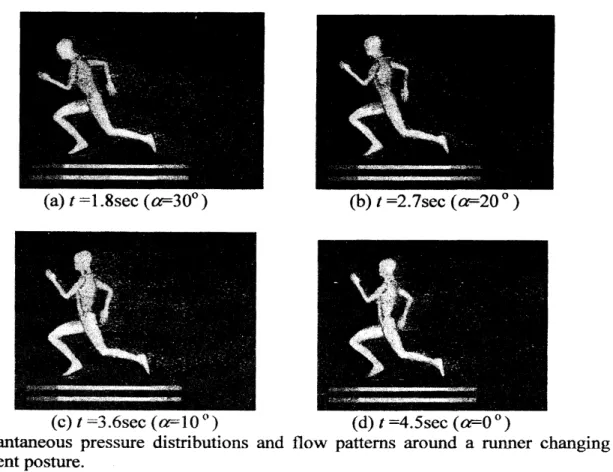
Figure 4 shows instantaneous pressuredistributions and flow pattems around
a
runner
whois continuously changing forward-bentposture from 5$0^{0}$ to $0^{o}$. It is
seen
inthis figure that thewidth of the wake formed behind therunneratthe forward-bent angle is 3$0^{0}$ is
narrower
andit becomes wider asthe forward-bent angle becomes smaller. It hasbeen confirmed Rom this
calculations thatthe fluid force actingonthe
runner
varies according to the angle offorward-bentposture.
Fig.5 Time history of drag and lift forces during motion of continuously changing the forward-bentpostureffom $50^{o}$to $0^{o}$withtime.
Figure 5 shows
time
history of drag and lift forces actingon
therunner
duringmotion of continuously changing the foiward-bent posture ffom $50^{o}$to $0^{o}$ with time. It is interesting to fmd thatas
the forward-bent angle decreases, drag force tends to increase monotonously andlift force is periodically flucmating but it tends to decrease ffom positive lift (up-force) to
negative
one
(down force).3.2
Application ofa
coupled vortex element and particle method to liquid-solidtwo-phase flows
In the study by Iso and
Kmemoto9,
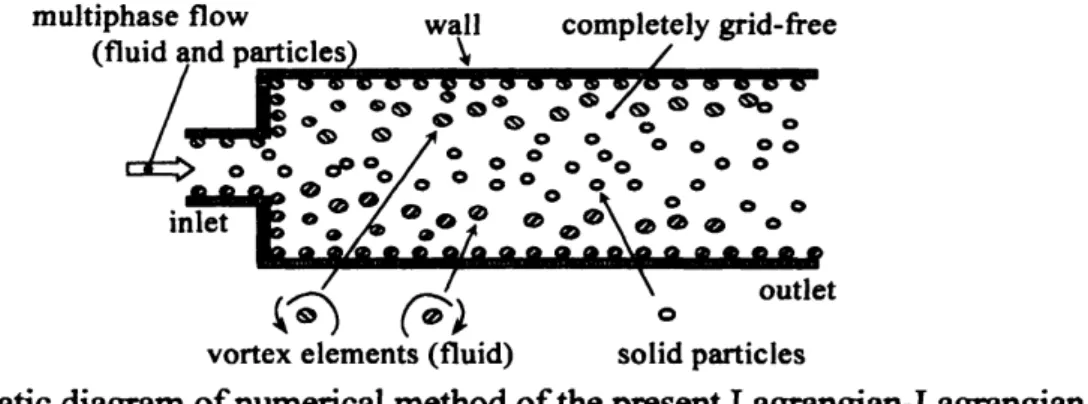
both fluid phase and particlephaseare
treated bythecompletely grid-ffee Lagrangian-Lagrangian simulation, without
use
of the Eulerian gridsas
schematically shown in Fig.6. It is possible to simulate directly particle motion oriented by
the vortex-induced fluid dynamical forces. Detail of the method and examples applied to intemal multiphase flows
are
describedin
thepaper
by Iso andKamemotol6.
Solid particleswere
treated by the $pa\hslash icle$ trajectory tracking methodas
a Lagrangian calculation.Particle-particle and particle-wall collisions
aoe
calculated by adeterministic method. To $simpli\theta$theproblem in this study, the liquid-solid two-phase flows
are
treatedas
those ofdilute mixtureofparticles and it is assumed that the effect of particles
on
the liquid flow is neglected(one-way model). And
a
solid particlesis consideredas
a
rigid sphere witha
particlediameter.Fig. 6 Schematicdiagram ofnumerical method of thepresent Lagrangian-Lagrangian simulation for intemal flows.
Based
on
the above assumptions, it is generally accepted that dominant forceson
eachparticle
are
the drag force, Magnus lift force, Saffinan lift force, force to accelerate thevirtually added
mass
in the ambient fluid, and gravitational force. The force on the particlesdue to pressure gradient and the Basset force
are
neglected in this study. The equation ofmotion for
a
particleisexpressedas
$\frac{du_{p}}{dt}=\frac{1}{M_{p}}(F_{D}+F_{LM}+F_{IS}+F_{\nu^{r}M}+F_{G})$ (5)
Here, $u_{p}$ is the particle velocity vector, $M_{p}$ the particle mass, and $F$the force vector
on
theparticle; namely, $F_{D}$ is the drag force due to relative velocity of the particle to the fluid, $F_{LM}$
the Magnus lift force due to rotational motion, $F_{IS}$ the Saffinan lift force due to velocity
gradient, $F_{VM}$the force to accelerate the virtual added
mass
in the ambient fluid and $F_{G}$ theomitted. They
are
similar to the formulas in the literature, for example, Tsuji etal.17
and Yamamotoet al. 18As the rotation of
a
particle is affected by the fluid viscosity, the equation of rotational$particlerotationwhichistheoretica11yobtainedbyDenniseta1motionofeachparticleisnumerica11yso1vedbyconsiderin_{1}\S$
.
theviscous
torque againstParticle-particle andparticle-wallcollisions
were
calculatedbya
detemiinisticmethod. The traveling velocity and the rotational velocity ofa particle after collisionare
calculatedby the equations of impulsive motionofa
particle. For the calculation of particle-wall collision, thecollisionis modeled
as
irregular bouncing ofaparticleon
the virtual wall model proposed byTsuji et
al.17,
in which the wall is replaced with a virtual wall havingan
angle relativeto thereal wall.
Physical motion of the particles is split up into two stages in order to reduce the computational load. Inthe first stage, all particles
are
moved basedon
the equation ofmotion
without collisions. In the second stage, particle-particle collision is calculated, and then, the velocity ofa
particle after the collision is replaced with post-collision velocity withoutchangingtheposition.
In the beginning, the two-dimensional liquid-solid two-phase flow in a vertical channel
was
calculated to validate the coupled vortex element and particle method. The numerical simulationwas
performed for thesame
conditionsas
those in the two-phase experiments of Hishida et al. 20,21.
The flow field is schematically shown in Fig.5. Flow direction of bothphases is downwards. The Reynolds number is $R_{e}=U_{c}W/\nu=5.0\cross 10^{3}$, based
on
themean
velocity on the centerline $U_{c}=0.17m1s$ and the channel width $W=3.0x10^{-2}m$
.
Here, $v$is thekinematic viscosity of water. Periodic boundary conditions for both phases were applied in
the streamwise direction due to restrictions
on
computational power. The length $L$ of thecomputationalregion in the streamwise direction
was
equal to $3W$.
Particlesare
introducedinto the channel using random numbers,
so
as
to satisfy uniform distribution at the loadingmass
ratio which is $m=1.1x10^{-2}$.
Density and diameter of the particlesare
$\hslash=2590kym^{3}$(relativedensity: $\hslash/\rho_{f=}2.59$)and$d_{p}=500\mu m$, respectively.
$\ulcorner_{X}J^{r}$
A
Fig. 7 Schematic viewofliquid-solid two
phase flow in
a
vertical channel. Fig.velocities of8 The time-averagedfluid andsolid particles.streamwiseFigure 8 shows the results for the time-averaged streamwise velocities of fluid and solid
particles. In this downward flow, the particle velocity is faster than the liquid, because the
density of particles is larger. Numerical results showed very good agreement with the
quantitative accuracy and the applicability of the special combination ofvortex method and particletrajectorytracking method to intemal two-phase flow of high Reynoldsnumber.
Fig.9 Schematicview oftheliquid-solid two-phase flow
in
the mixingtee.The coupled vortex element and particle method
was
applied to the two-dimensionalliquid-solid two-phase flowin amixing tee
as a
typical problem to mixing of liquid and solidparticles in ducts. The flow field is schematically shown in Fig.9. The flow field is not only the basic component in industrial pipelines but also the simple mixing device for multi-phase
flow. For details, refer to Kawashimaet $a1^{22,23}$and Blancard et
al.24.
InFig.9, the branchflowmerges into the main flow at
a
right angle. The cross-sections ofthe confluenceare
squares. The widths of themain and branch channelsare
$W_{1}$ and $W_{2}$, respectively, and the widthratiois $W_{2}/W_{1}=0.5$ $(W_{1}=20 mm, W_{2}=10 mm)$
.
The volumetric flow rates in the main and branchchannels before confluence
are
$Q_{1}$ and $Q_{2}$, respectively, and the confluent flow rate ratio $Q_{2}/Q_{1}$ is changedas
$Q_{2}/Q_{1}=1,2,3$, which correspond to the values of fluid momentum ratio $M_{2}/M_{1}$ of 2, 8, 18, respectively. The value of $Q_{2}/Q_{1}$ is controlled by changing only thevolumetric flowrate ofthe branch channel. The velocity
in
themain
channelis
$U_{1}=0.25m/s$,and the velocity in the branch channel is $U_{2}=0.5,1.0,1.5n\vee s$
.
Reynolds numbersare
$Re=(U_{3}W_{1})/v=1.0x10^{4},1.5x10^{4},2.0\cross 10^{4}$, based on the average velocity $U_{3}$ and the width $W_{1}$ downstream of the confluent point. Here,$v$ is the kinematic viscosity of water. Particles
are
introduced into the branch channel only, using random numbers,so
as
to satisfy uniform distribution at the volume concentration $C_{V}=0.01$.
Density and diameter of particlesare
$\hslash^{=}$2590 $kym^{3}$ (relative density: $\hslash/\rho_{f=}2.59$) and $d_{p}=425\mu m$, respectively. Direction ofgravity
is downward inFig.9.
$t$ $0$ 1 a a 5 7
(a)Vortex elements (b)Fluidvelocity distributions
Fig.11 Comparisonbetween calculation andexperimentfordistribution ofparticles. Figure 10 shows two snap shots ofinstantaneous distributions ofvortexelements and fluid
velocity obtained by the numerical simulation. The condition of the confluent flow rate ratio is $Q_{2}/Q_{1}=2$, and the instantaneous non-dimensional times
are
$tUy’W_{1}=85.0$ and 87.5. Thecontour of velocity expresses the streamwise fluid velocity. After two perpendicular flows merge in the mixing tee, the confluent flow deflects and unsteady flow separation
occurs
atthe downward
comer
ofthejunction. First,the confluentflowis accelerated inthe contraction region ofthe mixing point. Then, the flow is decelerated to the streamwise direction in the expansion. Consequently, unsteadyflow separationoccurs
andgrows up ffomthe bottomwall of themainchannel, because the adverse pressuregradient is strong in the flow direction. Theseparation vortices aggregate, break up and diffuse downward. Such phenomenon
was
alsoobseivedin the experiments by inktracevisualization.
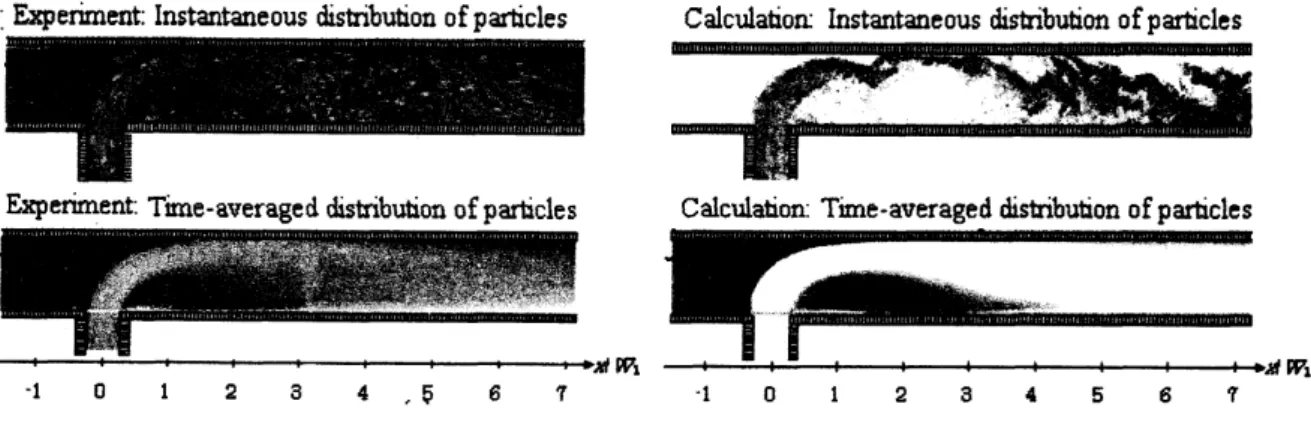
In Fig.11, the instantaneous and time-averaged distributions of solid particles for the condition of $Q_{2}/Q_{1}=2$
are
shown, and numerical resultsare
compared with experimentalobservations where thetime-averaged experimental photographs
were
taken by longexposure.
Both, experimental and numerical results show that particleshave mixed almost unifornly at
$x/W_{1}=3$
.
As mentioned before, it is seen that the confluent flow deflected and the unsteadyseparations occurred at the downward
comer
ofthe junction. The confluent flow becomesunsteady and complexdue tothe unsteadyseparation of flow from the channel walls. Thus, in
thecondition $Q_{2}/Q_{1}=2$, the abilityofthe particlemixingis good.
3.3 Plasma particletrajectorytracking method
Expanding the concept of the Lagrangian vortex method in which vorticity layers
are
expressed by
a
number of discrete vortex elements,Ishimotol
and the group of the presentauthor have attempted numerical simulationofbehavior ofpure electron plasmain
a
magnetic field by introducinga
number of chargedparticles called superperticles.It is known that the motion ofnon-neutral plasma in
a
magnetic field is similar to the vortical flow offluid. So far, formation of coherent vortex structures of two-dimensional electron plasmas have been observed in experiments by $Kiwamoto^{25}and$ Sanpei etal26,
which
were
performed with the photo-cathode pure-electron plasma traps ofa
Malmberg-Penning trap type. The vortex crystal formation in two-dimensional plasma turbulence
was
theoretically investigated by Jin andDubin27
and for numerical simulation of the various phenomena in plasma, the particle-in-cell method, the leap-ffog method and othersare
explained byBirdsall and
Langdon28,
Naitou29,
Isiguro$3$and
Ohsawa31.
The leap-ffog methodand Lagrangian method like the advanced vortex element method mentioned above is not
discussedindetail,
so
far.In general, in a field with the intensity ofelectric field $E$ and the magnetic density$B$, the
motion of
a
charged particle with the strength of charge $q$ and themass
$m$ is expressedas
follows.
$m \frac{du}{dt}=q(\Xi+u^{x}B)$
(6)
Here, $u$ denotes the velocity of the center of the particle which is given by $dr/dt$, and the
motion consistsofcircularmotion aroundthe axisof$B$and the motion of drifl inthe direction
of $E\cross B$
.
In the $rig\iota$-hand side of Eq. (6), the first temi $qE$ and the second $q(u\cross B)$respectively correspond tothe Coulomb force and the Lorentz force acting
on
the particle. In the study, the two-dimensional motion of superpamcles of electrons ina
uniform magnetic field $B_{o}$was
calculated. Therefore, the intensity of electric field $E$ is calculated $fi\cdot om$ thesummation of individual intensity of electric field induced by each superparticle in the field and the magnetic density$B$is givenby$(B_{o}+dB)$ in which $dB$ denotesfluctuation ofmagnetic
density induced by motions ofthe electronic superparticles and it is calculated by the Biot-Savart law derived ffom the Maxwell equation. As the study
was a
firstattempt for the group of the presentauthorto apply the conceptofthe vortex method, asimple superparticlemodelwas
introduced, which hasa
spherical shape with the radius $r_{d}$ and the number of electronsuniformly distributed in it is $N_{v}$ , and to simplify the numerical ffeamients, the effects of
electronic diffusion and collisions between particles
were
ignored. In order to compare the calculation results with experiments byKiwamoto25,
theinteraction
between two clouds of superparticles and the formation of vortex crystals ffoma
ring cloudwere
calculated under the conditions similartothe experimentalones.
$\sim$ .
$N1\bullet 253\bullet\bullet$
$\prime 1..\backslash \backslash _{\backslash \cdot=}:_{l^{\backslash }}..\dot{\alpha}_{\wedge^{\wedge}}^{:}\backslash ’..\cdot\cdot\cdot\cdot..\cdot.\cdot\cdot.\cdot$
$N|=5$ $\bullet\bullet$ $\infty$
$\oint_{\ddot{*}}$
, $-\backslash \cdot\sqrt{}\backslash ae_{:^{=}}\cdot..$
.
$0\mu\S$ $0.2\mu s$ $0.5\mu s$ $1.0\mu s$ $10.0\mu\S$
Fig.12 Comparison ofcalculated results of merging of
a
pair of electronicplasma.In the calculations ofinteraction between two clouds, the following conditions
were
used;density of magnetic field $B_{o}=0.048N/Am$, the charge of
an
electron $e=1.6021$xl$0^{-19}C$, themass
ofan
electron $m_{\epsilon}=9.109$lx 1$0^{}$ kg, the electric permittivity $a=8.8542$xl$0^{-12}C^{2}/(Nm^{2})$,the electric perneability $\mu=1.2566x10^{6}N/A^{2}$, the initial radius ofacloud $r_{i}=0.4$xl$0^{-3}m$, the
initial distance between two clouds $L=1.0x10^{-3}m$
.
In order to examine the effect of thenumberofelectrons in
a
superparticle $N_{v}$and the imitial numberof superparticles in acloud$N_{i}$combinations ofthe numbers
were
introducedas
$(N_{v}=100, N_{i}=253)$ and $(N_{v}=460, N_{i}=55)$, andthree differentvalues for the radius ofsuperparticle
were
examined for each combinationas
$r_{d}$$=2.5x10^{-5},$4xl$0^{}$ and2.5xl$0^{}$
$m$for the
case
$ofN_{i}=253$, and$r_{d}=5x10^{-5},$ 4xl$0^{}$ and5xl$0^{}$ $m$forthe
case
of$N_{i}=55$.
The calculationtimestepwas
fixedas
$d=1$xl$0^{-10}s$.
In Fig.12,
a
couple of calculation results of evolution of merging ofa pair of electronicplasma clouds
are
shown, whichwere
obtained for $(N_{i}=253, r_{d}\triangleleft-x10^{-7}m)$ and $(N_{i}=55,$$r_{d}$
$\triangleleft-x10^{7}m)$
.
From comparison of the results, it is clearly observed thatas
the time proceeds,the two clouds catch and join each other, and then they finally merge into
a
new
isolated cloud due to the interactive motion of superparticles. The calculated evolution ofmerging isin
qualitatively coincidence with theexperiments25.
And ithas been confirmed that thereare
no
significantdifferences inthe calculated merging processes correspondingtothe differences ofnotonly the numbers ofboth superparticles ina
cloud and electrons ina
superparticle, but also theradius ofa
superparticle,as
faras
this studyis concemed.Fig.13 $Fomat_{-}ion$of vortex crystal structure Rom
a
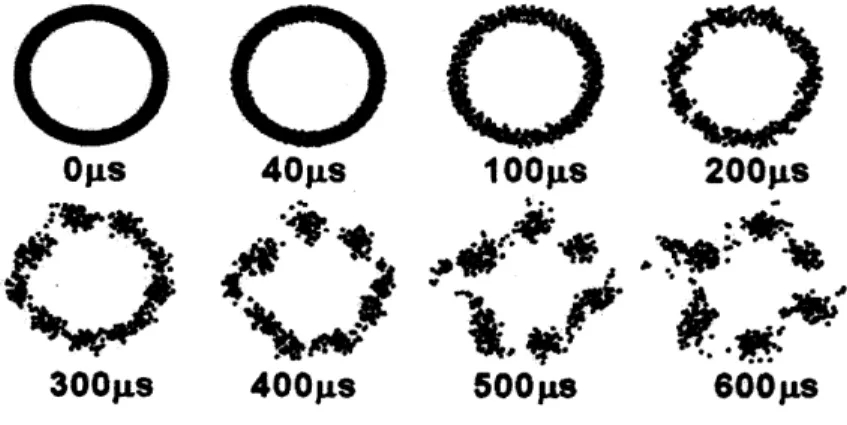
ringIn the calculation of the fomiationof vortex crystals ffom
a
ring cloud, the magnetic field conditionsare
thesame
as
those mentioned above. The initialouterradius and innerradiusof the ring cloudare
$R_{o}=5\cross 10^{-3}m$ and $R_{i^{-}}\triangleleft x10^{-3}m$, respectively and the inner radius of theconducting wall in which the ring cloud ofplasma
was
coaxially trapped is $R_{w}=5.5$xl$0^{-3}m$.The number of superparticles in the ring cloud is $N_{r}=398$ and the number of electrons in
a
superparticle is $N_{v}=46$
.
In Fig.13, evolution of disturbance on motion of superparticls withtime and formation of six vortex crystals
are
clearlyseen.
It has been confirmed that the calculated features of vortex crystal formation is also in qualitatively coincidence with the experiments and numerical resultsreportedbyKiwamoto25.
4.AView of NewDirection ofDiscrete Vortex Dynamics
In the former section,three examples ofapplicationsof Lagrangian trackingmethods based
on avortex elementmethod and aparticle method. It
seems
very interesting that although thefluid is assumed
as
continuum and the particlesare
discrete ffagnents ofa
material, thephenomena of vortex formation
are
certainlyobserved in dynamicmotionofbotha
fluidandparticles. It is well known that the dynamic behaviors of statistically many particles like
powder, heavenly bodies inthecosmos,
cars
on a
crowdedroad, andso
on,can
be representedby the goveming equations in the fluid dynamics. So far, there exist such research fields
as
powder fluidization, ferrofluid, plasma flow,cosmic fluid,traffic flowand
so
on, and usually,differential equations of fluid dynamics
are
appliedinto investigations ofthosemotions.
However, it must be considered that the applicability of those equations to
a
fluid dynamics
are
constructed formacroscopic flow fields on the assumption ofcontinuum.Therefore, it is not always correct to introduce infinitesimally smaller size of grids in the
numerical calculation with use of a huge parallel-computer system aiming to increase accuracyofthenumerical treatnents.
As shown in the former section, it is important to consider that the introduction of
various
discrete elements isa
key technology of the present numerical treamients, which iscommon
to the calculations of both the dynamic phenomena ofvorticity transportation in
a
fluid and the dynamic motion of particles. In the vortex method, the discrete element isa
discretevortex blob in which the distribution of vorticity and the particle size
are
modeled. In thepaiticle method used for the two-phase flow calculation, the discrete element is
a
solid particle itself in whichmass
and sizeare
modeled. And in the particle method used in the plasma vortex calculation, the discrete elementconsists
ofa
superparticlein
whicha
distribution of electrons (mass and electric charge) and particle sizeare
modeled. Itseems
astimulating fact for consideration of a
new
direction of discrete vortex dynamics that thevortical phenomena not only in a fluid flow but also in
a
multi-particle flowcan
be analyzedby the discrete element method. Although the presentauthor had considered the vortexblobs
to be ffagmentsto discretizethe continuous vorticity flield, recently he has looked them ffom a different point ofviewto be
a
sortofsuperparticles, which essentially consists ofa numberofelementary particles. Therefore, it will be very interesting to accumulate comprehensive
knowledge on various kinds of vortex motions Rom molecular dynamics to cosmetic flowby
investigating the fiactal features of the vortex motion and by modeling superparticles with various scalesand characteristics requiredin corresponding dynamic fields.
5. Conclusions
In this paper, aiming to overview the recent attempts of progressive application ofthe advanced vortex method, mathematical background and numerical procedure of the method
aoe
briefly explained, and characteristic results of the progressive studieson
simulation of complex flows around a 100 $m$ runner, liquid-particle two phase flows ina
channel andvortical motion of plasma clouds in
a
magnetic fieldare
digested with explanation ofthe particle methods used in the latter two studies. And finally,a new
direction of furtherdevelopmentofthediscrete particle methods forvortex dynamuics is discussed. The discussion
issummarized
as
follows.1$)$ The three examples of applications of the vortex method, the coupled vortex-particle
method and the plasma particle method,
seem
to suggest that most of the vortex motions observed in various fieldsare
essentiallyorientedto the discrete particledynamics insteadofthecontinuousfluid dynamics.
2$)$ It is not always correct to introduce infinitesimally smaller size of grids inthe numerical
calculation with
use
ofa
huge parallel-computer system aiming to increase accuracy of the numerical treatnents, because the molecular dynamics govems the microscopic field insteadof the continuumdynamics.3$)$ Considein
$g$ the above discussion, it
seems
interesting to accumulate comprehensive knowledgeon
various kinds ofvortex motionsffommolecular dynamicsto cosmetic fluiddynamicsbyinvestigating the ffactal features.
4$)$ It will be a
new
direction ofexpansion ofthe concept of discrete elements methods toestablish comprehensive algorithms of modeling physical behaviors of elementary
particles like vortex blobs and plasma superparticles which have various scales and
ACKNOWLEDGMENTS
The author wishes to thank Dr. Ojima of CMH for discussing on the treatment ofdiscrete
vortex particles and providing with the software of vortex method used in the calculations of
flows around
a
$100m$ runner, and Dr. Iso ofIHI for discussingon
application of the panelmethods forintemalflows. REFERENCES
[1] Leonard, A., Vortex methods for flow simulations. J. Comp. Phys. 1980, 37,
289-335.
[2]Sarpkaya, T., Computational methods with vortices-the 1988 Freeman scholar $1ecmre_{0}$
J FluidsEngng., 1989, 111, 5-52.
[3] Kamemoto, K., On attractive features of the vortex methods. Computational Fluid
Dynamics Review 1995, ed. M.Hafez and K.Oshima, JOHN WILEY $\backslash$
&SONS,
1995,334-353.
[4] Kamemoto, K., Recent$con\theta ibution$ of
an
advanced vortex element method to simulationofunsteady voitex flows. ComputationalFluid$1\eta namics$ Journal, 2007, $15(4):55,422-$
437.
[5] Ojima A. and Kamemoto, K., Numerical simulation ofunsteady flows around
a
fish. Proc.of
the Third InternationalConference
on
Vortex Flows and VortexModets-ICVFM2005, Yokohama, Japan,November2005,96-101.
[6] Greengard L. and Rohklin V., A fast algorithm for particle simulations. J Comp. Phys. 1987, 73-2,
325-348.
[7] Fukuda K. and Kamemoto, K., Application of
a
redistribution model incorporated ina
vortexmethod to turbulent flow analysis. Proc.
of
the Third InternationalConference
on VortexFlows and Vortex Models-ICVFM2005, Yokohama, Japan, November2005,
131-136.
[8] Kamemoto K. and OjimaA., Application of
a
vortexmethodto fluiddynanuics insportsscience Proceedings
of
FEDSM2007 5th Joint $ASME/JSME$ Fluids EngineeringConference,July30-August2, 2007 San Diego,Califomia, USA,FEDSM2007-37066.
[9] Iso Y. and Kamemoto K., Vortex method and particle trajectory tracking method for
Lagrangian-Lagrangian simulation applied to internal liquid-solid two-phase flows. Proc.
of
the Third InternationalConference
on Vortex Flows and VortexModels-ICVFM2005, Yokohama, Japan,November2005, 287-292.
[10] Ishimoto S., Application of vortex method into motional simulation of plasma particles.
Bachelor Thesis, Yokohama National University, Submitted to Prof. Kamemoto,
February
2007.
[11] Wu J.C. and Thompson J.F., Numerical solutions of time-dependent incompressible Navier-Stokes equations using
an
integro-differential formulation. Computers 6}Fluids,1973, 1-1, 197-215.
[12] Uhlman, J.S., An integral equation fomulation of the equation of motion of
an
incompressible fluid. Naval Undersea
Warfare
Center, 1992, T.R. 10-086.[13] Ojima A. and Kamemoto K., Numerical simulation of unsteady flow around three dimensional bluffbodies by
an
advanced vortex method. JSME Int. Journal, B, 2000,43-2, 127-135.
[14] Winkelmans G. and LeonardA., Improved vortex methods forthree-dimensional flows. Proc. Workshop
on
MathematicalAspectsof
Vortex Dynamics, Leeburg, Virginia,USA,1988, 25-35,
[15] Nakanishi Y. and Kamemoto K., Numerical simulation of flow around
a
sphere with vortexblobs.Journal WindEng. andInd Aero, 1992,46-47, 363-369.[16] Iso Y. and Kamemoto K., Vortex method and particle trajectory tracking method for
liquid-solid two-phase simulation applied to intemal flows. Trans. JSME Ser.B, 2005,
71-71, 2671-2678, (inJapanese).
[17] Tsuji Y., Morikawa Y., Tanaka T., Nakatsukasa N. and Nakatani M., Numerical simulation ofgas-solid two-phase flow in
a
two-dimensional horizontal channel. Int. $J$MultiphaseFlow, 1987, 13-5, 671-684.
[18] Yamamoto Y., Potthoff M., Tanaka T., Kajishima T and Tsuji Y., Large-eddy
simulation of turbulent gas-particle flow in
a
vertical channel: effect of considering inter-particle collision. J FluidMech., 2001, 442,303-334.
[19] Dennis, S. C. R, Singh S.N. and Inghan D.B., The steady flowdue to
a
rotating sphereat lowand moderate Reynolds number. J FluidMech., 1980, 101, 257-279.
[20] Hishida, K., HanzawaY., SakakibaraJ., Satou Y. and MaedaM., TransofJSME, Ser. $B$
1996,62-593, 18-25 (in Japanese).
[21] Hishida, K., HanzawaY., SakakibaraJ., Satou Y. andMaeda M., Trans ofJSME, Ser. $B$
1996, 62-593,26-33 (inJapanese).
[22] Kawashima Y., Nakagawa M. and Inoue S., Characteristics ofmixing due to confluent
flow in
a
two-dimensional right-angled T-shaped flow section. The Societyof
ChemicalEngineersJapan, 1982,8-2, 109-114,(in Japanese).
[23] Kawashina Y., Nakagawa M. and Inoue S., Flow pattems at
a
two-dimensionalright-angled T-shaped confluence. The Sociely
of
Chemical Engineers Japan, 1982, 8-6,664-670, (in Japanese).
[24] Blancard J. N. and Brunet Y., Interaction between
a
jet getting out ofa
tluin slit and emerging intoa
crossflow.ASMEFluids Eng. Div. Conf, 1996, 4, 39A6.[25] Kiwamoto Y., Vortex dynamics in nonneutral plasma. J Physical Society
of
Japan,2001,56A, $253- 261$, (inJapanese).
[26] Sanpei A., Ito K., Soga Y., Aoki J. and Kiwamoto Y., Formationof
a
symmetric vortex configurationina
pure electron plasma trapped witha
penningtrap. Hyparfine Interact,2007,
174.71-76.
[27] Jin D.Z.and Dubin D.H.E., Theory of vortex crystal formation in two-dimensional turbulence. Phys. Plasmas,2000,7-5,1719-1722.
[28] Birdsall C.K. and Langdon A.B. , Plasma Physics via Computer Simulation
(McGraw-Hill Book Company, NewYork, 1985 and Adam Hilger, Bristol, Philadelphia and New
York, 1991).
[29] Naitou H., Basic theory of particle simulation. Jr. Plasma and Fusion Research, 1998,
74-5, 470-478 (in Japanese).
[30] Ishiguro S., Electrostatic Particle Simulation. Jr. Plasma andFusion Research, 1998, 74
-6, $591- 597$(in Japanese).
[31] Ohsawa Y., Relativistic Electromagnetic Particle Simulation. Jr. Plasma and Fusion