Smoothness
of
hairs
for
some
transcendental
entire
functions
Dedicated to Professor Shigehiro Ushiki on the occasion of his 60th birthday
Masashi
KISAKA
(
木坂 正史)
Department of Mathematical Sciences,
Graduate School of Human and Environmental Studies,
Kyoto University, Kyoto 606-8501, Japan
Mitsuhiro
SHISHIKURA
(
宍倉 光広
)
Department of Mathematics,
Faculty of Science,
Kyoto University, Kyoto 606-8502, Japan
Abstract
We investigate the existence and smoothness ofhairs for some
transcen-dental entire functions. We show their existence and smoothness under a
general setting. This is applicablefor the function $P(z)e^{Q(z)}$, where$P(z)$ and
$Q(z)$ are polynomials. This generalizes the previous results by R.L.Devaney,
M.Krych and M.Viana.
1
Preliminaries
Let $f$ be an entire function and $f^{n}$ denote the n-th iterate of$f$, that is,
$f^{n}= \frac{ntimes}{fofo\cdots of}$
.
Recall that the Fatou set$F(f)$ is the set ofpoint $z$ where $\{f^{n}\}_{n=1}^{\infty}$ forms a normal family
in a neighborhood of $z$. We call the complement of $F(f)$ the Julia set of $f$ and denote
it by $J(f)$. By definition, $F(f)$ is open and $J(f)$ is closed in $\mathbb{C}$. Also $J(f)$ is compact if $f$ is a polynomial, while it is non-compact if $f$ is transcendental. This is due to the fact
that $\infty$ is an essential singularity for a transcendental entire function.
The purpose of this paper is to construct so-called hairs, which is subsets of the Julia set $J(f)$, and to show their smoothness for a certain class of transcendental entire
functions. Devaney and Krych first constructed hairs for exponential family $E_{\lambda}(z)=$
$\lambda e^{z}(\lambda\in \mathbb{C}\backslash \{0\})$ in 1984 ([DK]). Here
we
briefly explain their results. Define$B_{l}:=\{z|(2l-1)\pi<{\rm Im} z+\theta<(2l+1)\pi\}$, $\theta=\arg\lambda\in[-\pi, \pi),$ $l\in \mathbb{Z}$
then we can define itinerary $S(z)$ $:=s=(s_{0}, s_{1}, \cdots, s_{n}, \cdots)\in Z^{N}$ for a point $z\in \mathbb{C}$ by
Theorem 1.1 (Devaney-Krych, 1984).
If
$s\in Z^{N}$satisfies
the following “growthcon-ditio$n^{f\rangle}$:
$\text{ョ_{}x_{0}\in \mathbb{R}},$ $\forall_{n},$ $(2|s_{n}|+1)\pi+|\theta|\leq g^{n}(x_{0})$, $g(t):=|\lambda|e^{t}$,
then there exists a continuous curve $h_{\epsilon}(t)\subset J(E_{\lambda})$ which
satisfies
the following;(i) $E_{\lambda}(h_{s}(t))=h_{\sigma(s)}(g(t))$, where $\sigma$ is the
shift
map on $Z^{N}$,(ii) $E_{\lambda}^{n}(h_{s}(t))arrow\infty(narrow\infty)$
for
every$t$. $\square$The
curve
$h_{\epsilon}(t)$ is called a hair. Viana showed that this hair $h.(t)$ isa
$C^{\infty}$curve
([V]).Later, the existence of hairs
was
proved forsome
other class of functions, like $\lambda ze^{z}$ orthe complex standard family (see [F]. Note that this did not mention the smoothness
of hairs). In this paper we consider the existence and smoothness of hairs under a
general setting. In particular
we
generalize this result for the exponential functions to$f(z)$ $:=P(z)e^{Q(z)}$, where $P(z)$ and $Q(z)$
are
polynomials. We stateour
detailed settingand the results of existence in
\S 2.
In\S 3
and\S 4
we explain the smoothness of hairs. In\S 5
we state the result for $f(z)=P(z)e^{Q(z)}$ as an application ofour general results.2
$C^{0}$a
priori
estimates –existence
of
a
hair
$h(t)$ –Definition 2.1. Let $\rho$ : $[\tau_{*}, \infty)arrow \mathbb{R}_{+}$ be a positive function (called weight function).
Define for a function $\psi$ : $[\tau_{*}, \infty)arrow \mathbb{C}$,
$|| \psi||_{\rho,\tau}=\sup_{t\geq\tau}|\psi(t)|\rho(t)$.
The set of continuous functions $\psi$ with $||\psi||_{\rho,\tau}<\infty$ forms a Banach space $X_{\rho,\tau}$.
Our setting is as follows:
$A$: Let $f_{n}$ : $U_{n}arrow V_{n}(n=0,1,2, \ldots)$ be holomorphic diffeomorphisms between
un-bounded domains $U_{n}$ and $V_{n}$ in $\mathbb{C}$. The reference mapping
$g:[\tau_{*}, \infty)arrow \mathbb{R}$ is an
increas-ing $C^{\infty}$ function such that $g(t)>t$ for
$t\geq\tau_{*}$. $($Hence $g^{n}(t)arrow\infty(narrow\infty).)$ Denote
$\tau_{n}=g^{n}(\tau_{*})(n=0,1,2, \ldots)$.
For the application in \S 5, we will take $f_{n}$ as a restriction of a single function $f$ to
some
domains $U_{n}$, that is, $f_{n}:=f_{u}.$, but in general we do not need this.
Our goal is to construct functions $h_{n}$ : $[\tau_{n}, \infty)arrow U_{n}(n=0,1,2, \ldots)$ satisfying
$f_{n}oh_{n}(t)=h_{n+1}og(t)$ for $t\in[\tau_{n}, \infty)$, (1)
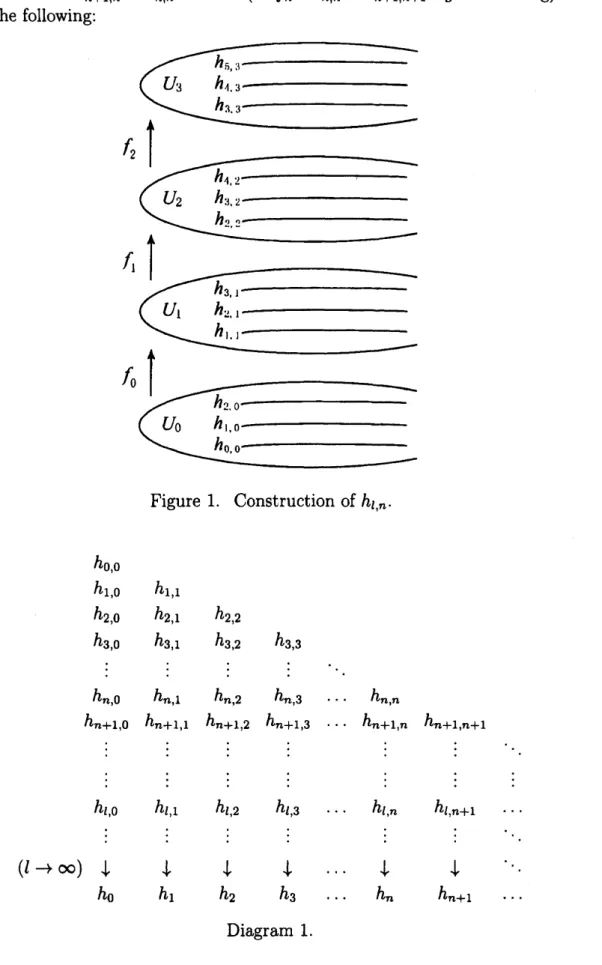
and showtheir smoothness. In order to construct suchfunctions, westart with a function $h_{l,l}$ : $[\tau_{l}, \infty)arrow \mathbb{C}$, then define $h_{l,n}$ : $[\tau_{n}, \infty)arrow \mathbb{C}(0\leq n<l)$ by “lifting” it successively
so
that for $n=l-1,$$l-2,$ $\ldots,$ $1,0$,$f_{n}oh_{l,n}(t)=h_{l,n+1}og(t)(t\in[\tau_{n}, \infty))$. (2)
See Figure 1 and Diagram 1 below. Once $h_{l,n}(t)(l=0,1,2\ldots, 0\leq n\leq l)$
are
defined,our $h_{n}(t)$ will be obtained as
we
need to impose various conditionson
$f_{n}$ and $h_{n,n}$ together with auxiliary functions$R(t),$ $\rho_{k}(t)$ and $\sigma_{k}(t)$, which
are
defined below. In particular, the initialcurves
shouldbe chosen
so
that $h_{n+1,n}-h_{n,n}$ is small (or $f_{n}oh_{n,n}-h_{n+1,n+1}og$ not too big). So weassume
the following:Figure 1. Construction of$h_{l,n}$. $h_{0,0}$ $h_{1,0}$ $h_{1,1}$ $h_{2,0}$ $h_{2,1}$ $h_{2,2}$ $h_{3,0}$ $h_{3,1}$ $h_{3,2}$ $h_{3,3}$ : ..
.
.
...
$h_{n,0}$ $h_{n,1}$ $h_{n,2}$ $h_{n,3}$ . . . $h_{n,n}$ $h_{n+1,0}$ $h_{n+1,1}$ $h_{n+1,2}$ $h_{n+1,3}$ . . . $h_{n+1,n}$ $h_{n+1,n+1}$:.
: : : : :...
: ::.
: : ::.
$h_{l,0}$ $h_{l,1}$ $h_{l,2}$ $h_{l,3}$ . . . $h_{l,n}$ $h_{l,n+1}$.:
: :$(larrow\infty)$ $\downarrow$ $\downarrow$ $\downarrow$
$h_{0}$ $h_{1}$ $h_{2}$
: : :
...
$\downarrow$
. .
. $\downarrow$ $\downarrow$..
$h_{3}$
.
. .
$h_{n}$ $h_{n+1}$$B$: (Initial curves) Suppose that continuous functions
$h_{n,n},$$h_{n+1,n}:[\tau_{n}, \infty)arrow U_{n}(n=$ $0,1,2,$ $\ldots),$ $R:[\tau_{*}, \infty)arrow \mathbb{R}_{+}$ and a constant $0<\kappa<1$ satisfy for $t\in[\tau_{n}$,oo$)$:
$\bullet f_{n}oh_{n+1,n}(t)=h_{n+1,n+1}og(t)$; (3)
$\bullet|h_{n+1,n}(t)-h_{n,n}(t)|\leq(1-\kappa)R(t)$; (4) $\bullet$There exists an open set $B_{n}(t)\subset U_{n}$ with$\overline{B_{n}(t)}\subset U_{n}$ such that
$f_{n}:B_{n}(t)arrow D(h_{n+1,n+1}(g(t)), R(g(t)))$
is bijective. In particular, $D(h_{n+1,n+1}(g(t)), R(g(t)))\subset V_{n}$; (5) $\bullet$ For $z\in B_{n}(t),$ $|f_{n}’(z)| \frac{R(t)}{R(g(t))}\geq\frac{1}{\kappa}$. (6)
We have
a
sufficient condition for B.Lemma 2.2. Suppose that continuous
functions
$h_{n,n}$ : $[\tau_{n}, \infty)arrow U_{n}(n=0,1,2, \ldots)$and constants $\tilde{R}>0,0<\kappa<\frac{1}{2}$ satisfy
for
$t\in[\tau_{n}, \infty)$:$D(h_{n+1,n+1}(t’),\tilde{R})\subset V_{n}$, where $t’=g(t)\in[\tau_{n+1}, \infty))$ (7)
$|f_{n}oh_{n,n}(t)-h_{n+1,n+1}og(t)|\leq\tilde{R}/3$; (8)
$|f_{n}’(h_{n,n}(t))|\geq 16/\kappa$. (9)
If
we choose $R(t)$ so that$\frac{4\tilde{R}}{3(1-\kappa)|f_{n}’(h_{n,n}(t))|}\leq R(t)\leq\frac{\kappa\tilde{R}}{12(1-\kappa)}$, (10)
$ingB(which$ is possible by (9)
$)_{f}$ then there exist $h_{n+1,n}$ :
$[\tau_{n}, \infty)arrow U_{n}(n=0,1,2, \ldots)satish-\square$
Let
us
denote $\rho_{*}(t)=1/R(t)$. Using the norm $||\cdot||_{\rho,\tau}$ defined in the beginning of thissection, the above condition (4) can be expressed as
I
$h_{n+1,n}-h_{n,n}||_{\rho_{*},\tau_{n}}\leq 1-\kappa$.Under the above setting, we
can
show the existence ofa
hair $h_{n}(t)(n=0,1, \cdots)$.Lemma 2.3. Under the assumptions Aand $B$, there exist continuous
functions
$h_{l,n}$ :$[\tau_{n}, \infty)arrow \mathbb{C}(l=0,1,2, \ldots, 0\leq n\leq l)$ such that
$f_{n}oh_{l,n}(t)=h_{l,n+1}og(t)$
for
$t\in[\tau_{n}, \infty),$ $n<l$; (11)1
$h_{l+1,n}-h_{l,n}||_{\rho_{*},\tau_{n}}\leq(1-\kappa)\kappa^{l-n}$; (12) $||h_{l,n}-h_{n,n}||_{\rho_{*},\tau_{n}}\leq 1-\kappa^{l-n}$. (13)Therefore
there exists continuousfunctions
$h_{n}(t)= \lim_{larrow\infty}h_{l,n}(t)$ satisfying$f_{n}oh_{n}(t)=h_{n+1}og(t)$
for
$t\in[\tau_{n}, \infty)$ and $|h_{n}(t)-h_{n,n}(t)|\leq R(t)$. (14)3
$C^{1}$estimates
We
are now
going to show that $h_{n}$ are $C^{1}$ under additional assumptions. Ifwe
knowthat $h_{l,n}$
are
$C^{1}$, then the differentiation of (11) gives$\log h_{l,n}’=\log h_{l,n+1}’og+\log g’-\log f_{n}’oh_{l,n}$. (15)
Fix
an
$l$ and denote$\psi_{n}(t)=\log h_{l,n}’(t)$ and $\hat{\psi}_{n}(t)=\log h_{l+1,n}’(t)(n=0, \ldots, l)$, (16)
where anappropriate branchoflog should be taken along the hairs
so
that$\psi_{n}(t)-\hat{\psi}_{n}(t)arrow$$0(tarrow\infty)$. Then it follows from (15) that for $n=1,2,$$\ldots$
$\psi_{n}-\hat{\psi}_{n}=(\psi_{n+1}-\hat{\psi}_{n+1})\circ g-(\log f_{n}’\circ h_{l,n}-\log f_{n}’oh_{l+1,n})$
.
(17)Our goal is to derive a geometric estimate of the form
$|\psi_{n}(t)-\hat{\psi}_{n}(t)|\leq const\kappa_{0}^{l-n}$
with $0<\kappa_{0}<1$. Note that Theorem in the previous section gives
an
estimate for thesecond term of (17) by const$\kappa^{l-n}$. In order to give recursive estimates on $\psi_{n}-\hat{\psi}_{n}$ from
$n=l$ down to $n=0$, observe the following fact: if $\psi_{n+1}-\hat{\psi}_{n+1}$ goes to $0$
as
$tarrow\infty$, bycomposing $g,$ $(\psi_{n+1}-\hat{\psi}_{n+1})og$ may go to $0$ faster. This
can
be formulated in terms ofthe
norm
$||\cdot||_{\rho 0,\tau}$.
withan
appropriate weight function $\rho_{0}$ : $[\tau_{*}, \infty)arrow \mathbb{R}^{+}$. If fact fora
function $\psi$ : $[\tau_{*}, \infty)arrow \mathbb{C}$, we have
$|| \psi\circ g||_{\rho_{0},\tau}=\sup_{t\geq\tau}|\psi(g(t))|\rho_{0}(t)=\sup_{t\geq\tau}\frac{\rho_{0}(t)}{\rho_{0}(g(t))}\cdot|\psi(g(t))|\rho_{0}(g(t))$
$\leq(\sup_{t\geq\tau}\frac{\rho_{0}(t)}{\rho_{0}(g(t))})\cdot(\sup_{t’\geq g(\tau)}|\psi(t’)|\rho_{0}(t’))=(\sup_{t\geq\tau}\frac{\rho_{0}(t)}{\rho_{0}(g(t))})||\psi||_{\rho_{0},g(r)}$. (18)
So if $\sup_{t\geq\tau}\frac{\rho_{0}(t)}{\rho_{0}(g(t))}<1$, then $||\cdot||_{\rho_{0},\tau}$-norm is contracted by composing $g$. This gives
a
possibility to prove the geometric estimate
on
$\psi_{n}-\hat{\psi}_{n}$.For further estimates $(C^{k}, k=1,2, \ldots)$, we need to prepare the following.
Definition 3.1. In what follows,
we
shall introduce weight functions $\rho_{k},$$\sigma_{k}$ : $[\tau_{*}, \infty)arrow$ $\mathbb{R}_{+}$ tomeasure
the norm $||\cdot||_{\rho_{k},\tau}$ of $\psi_{n+1}^{(k)}-\psi_{n}^{(k)}$ and the norm $||\cdot||_{\sigma_{k},\tau}$ of $\psi_{n}^{(k)}$ for $k=$$0,1,2,$ $\ldots$ , with $\sigma_{k}(t)\leq\rho_{k}(t)$. Given those weight functions, define $\alpha_{k}(t)=\frac{\rho_{k}(t)|g’(t)|^{k}}{\rho_{k}(g(t))}$ and
$\overline{\alpha}_{k}(\tau)=\sup_{\iota\geq\tau}\alpha_{k}(t)$
for $k=0,1,2,$ $\ldots$ and $t,$$\tau\geq\tau_{*}$. We also need
$D_{n,k}(t)= \sup_{z\in B_{n}(t)}|(\log f_{n}’)^{(k)}(z)|$ ,
Suppose there exist weight functions $\rho_{0},$$\sigma_{0}:[\tau_{*}.\infty)arrow \mathbb{R}_{+}$ satisfying $C_{0},$ $D_{0}$ and $F_{0}$
.
$C_{0}$: $h_{l,l},$ $h_{l+1,l}$
are
$C^{1}$ with$h_{l,l}’(t),$$h_{l+1,l}^{l}(t)\neq 0$ and $\psi_{l,l}(t)=\log h_{l,l}’(t),$ $\psi_{l+1,l}(t)=$ $\log h_{l+1,l}’(t)$ satisfy
$||\psi_{l+1,l}-\psi_{l,l}||_{\rho 0,\tau_{l}}<\infty$ and $||\psi_{l,l}||_{\sigma 0,\tau_{l}}<\infty$.
$D_{0_{\tauarrow\infty}^{;hm\overline{\alpha}_{0}(\tau)}}=\lim_{tarrow}\sup_{\infty}\frac{\rho_{0}(t)}{\rho_{0}(g(t))}<1$ .
$F_{0}:K_{0}:=\sup_{n\geq}\sup_{t\geq\tau_{n}}D_{n,1}(t)R(t)\rho_{0}(t)<\infty$.
Lemma 3.2. Suppose $A,$ $B,$ $C_{0},$ $D_{0}$ and $F_{0}$
are
satisfied.
Then $h_{l,n}$ are $C^{1}(l=$$0,1,2,$ $\ldots,$ $0\leq n\leq l)$ and there exists $\kappa_{0}<1$ and $C_{0}$ such that $\psi_{l,n}(t)=\log h_{l,n}’(t)$ satisfy
$||\psi_{l+1,n}-\psi_{l,n}||_{\rho_{0},\tau_{n}}\leq C_{0}\kappa_{0}^{l-n}$ $(l=0,1,2, \ldots, 0\leq n\leq l)$. (19)
Therefore
the limits $h_{n}(t)$ are also $C^{1}$ and $\psi_{n}(t)=\log h_{n}’(t)$satisfies
$||\psi_{n}-\psi_{n,n}||_{\rho_{0},\tau_{n}}\leq C_{0}/(1-\kappa_{0})$ and $||\psi_{n}||_{\sigma_{0},\tau_{n}}\leq C_{0}/(1-\kappa_{0})+||\psi_{n,n}||_{\sigma_{0},\tau_{n}}<\infty$
.
$\square$
4
Higher order derivatives
–estimate for
$\psi_{n}^{(k)}(k=1,2, \ldots)$ –Wenow try to apply similar estimates as in the previoussection to $\psi_{l,n}^{(k)}(k=1,2, \ldots)$,
but the estimates must involve with
more
terms. Differentiating (15) and using $h_{l,n}’=$$e^{\psi_{l,n}}$, we have
$\psi_{l,n}’=(\psi_{l,n+1}’og)\cdot g’+(\log g’)’-((\log f_{n}’)’\circ h_{l,n})e^{\psi_{l,n}}$ , (20) $\psi_{l,n}’’=(\psi_{l,n+1}’’og)$
.
$(g’)^{2}+(\psi_{l,n+1}’og)$.
$g”+(\log g’)’’$$-((\log f_{n}’)^{l\prime}\circ h_{l,n})e^{2\psi_{l,n}}-((\log f_{n}^{l})’\circ h_{l,n})e^{\psi_{l,n}}\psi_{l,n}’$. (21)
More generally, it is easy to check the following by the induction: Lemma 4.1. For $k=1,2,$ $\ldots$ , we have
$\psi_{l,n}^{(k)}=(\psi_{l,n+1}^{(k)}og)(g^{l})^{k}+\sum_{j_{\ell}=k}j_{1}>>j\ell\geq 1j_{1}\mp\cdot\cdot.\cdot\mp 1\leq.\cdot\ell<k$
const $(\psi_{l,n+1}^{(\ell)}og)g^{(j_{1})}\ldots g^{(j_{\ell})}+(\log g’)^{(k)}$
$- \sum_{1\leq\ell\leq k,0\leq_{\geq}\nu_{1}}\ell^{j_{1}\geq\cdot\geq j_{\nu}}+j_{1}+\cdots+j_{\nu}=k$
const $((\log f_{n}^{l})^{(\ell)}oh_{l,n})e^{\ell\psi_{l,n}}\psi_{l,n}^{(j_{1})}\ldots\psi_{l,n}^{(j_{\nu})}$, (22)
Remark 4.2. (1) Note that in the right hand side of (22), only the first term contains
k-th derivative of$\psi_{n}$ and all other terms involve lower order derivatives of $\psi_{n}$ (or none).
Therefore if lower order derivatives
are
“under control,” itis expected thatwe
can
proceedas
in the previous section.(2) For the exponential map $f(z)=\lambda e^{z}$ and $g(t)=|\lambda|e^{t}$, we have $(\log f’)^{l}\equiv 1$ and
$(\log f’)^{(\ell)}\equiv 0(\ell>1)$. So the formula (22) simplifies substantially. Moreover $g^{(j_{1})}\ldots g^{(j_{\ell})}$ is a constant multiple of$g^{p}$ which also simplifies the expression.
Suppose weight functions $\rho_{k},$$\sigma_{k}:[\tau_{*}, \infty)arrow \mathbb{R}_{+}$
are
given. We require the following:$C_{k}:h_{l,l},$ $h_{l+1,t}$ are $C^{k+1}$ and $\psi_{l,l}=\log h_{l,l}^{l}$ and $\psi_{l+1,l}=\log h_{l+1,l}’$ satisfy
$||\psi_{l+1,l}^{(k)}-\psi_{l,l}^{(k)}||_{\rho_{k},\eta}<\infty$ and $||\psi_{l}^{(k)}||_{\sigma_{k},\eta}<\infty$
.
$D_{k}:\lim_{\tauarrow\infty}\overline{\alpha}_{k}(\tau)<1$.
$E_{k}$: For $1\leq\ell<k$ and $j_{1},$
$\ldots,$$jp\geq 1$ with $j_{1}+\cdots+j\ell=k$,
$\sup_{t\geq\tau}\frac{\rho_{k}(t)|g^{(j_{1})}(t)\cdots g^{(j\ell)}(t)|}{\rho_{p}(g(t))}<\infty$
.
$F_{k}$: For $1\leq\ell\leq k,$ $\nu\geq 0,$ $j_{1},$$\ldots,j_{\nu}\geq 1$ with $\ell+j_{1}+\cdots+j_{\nu}=k$,
$\sup_{n\geq 0t}\sup_{\geq\tau_{*}}D_{n,\ell+1}(t)R(t)\frac{\rho_{k}(t)}{\sigma_{j_{1}}(t)\cdots\sigma_{j_{\nu}}(t)}<\infty$;
$\sup_{n\geq 0}\sup_{t\geq\tau_{r}}D_{n,l}(t)\frac{\rho_{k}(t.)}{\rho_{0}(t)\sigma_{j_{1}}(t)\cdot\cdot\sigma_{j_{\nu}}(t)}<\infty$;
if $\nu\geq 1$, for $1\leq i\leq\nu$, $\sup_{n\geq 0}\sup_{t\geq\tau}D_{n,\ell}(t)\frac{\rho_{k}(t)\sigma_{j_{*}}.(t)}{\sigma_{j_{1}}(t)\cdots\sigma_{j_{\nu}}(t)\rho_{j_{i}}(t)}<\infty$ .
Here if $\nu=0$, set $\sigma_{j_{1}}(t)\cdots\sigma_{j_{\nu}}(t)=1$. Note that the last condition should be satisfied
only when $\nu\geq 1$.
Under these assumptions, we can show the following:
Lemma 4.3. Let$k\geq 1$. Suppose $A,$ $B,$ $C_{j}(0\leq j\leq k),$ $D_{j}(0\leq j\leq k),$ $E_{j}(1\leq j\leq k)$
and $F_{j}(0\leq j\leq k)$ are
satisfied.
Then $h_{n}$ are $C^{k+1}(n=2,3, \ldots)$ and there existconstants $0<\kappa_{k}<1$ and $C_{k}$ such that
$||\psi_{l+1,n}^{(k)}-\psi_{l,n}^{(k)}||_{\rho_{k},\tau_{n}}\leq C_{k}\kappa_{k}^{n}$ $(n=0,1,2, \ldots)$. (23)
Therefore
the limits $h(t)$ are also $C^{k+1}$ and $\psi_{n}=\log h_{n}’$satisfies
$||\psi_{n}^{(k)}-\psi_{n,n}^{(k)}||_{\rho_{k},\tau_{n}}\leq C_{k}/(1-\kappa_{k})$ and $||\psi_{l,n}^{(k)}||_{\sigma_{k},\tau_{n}},$ $||\psi_{n}^{(k)}||_{\sigma_{k},\tau_{n}}\leq C_{k}’$.
5
Examples
As an application of our results, we consider the following function:
$f(z)=P(z)e^{Q(z)}$, $P(z)=b_{m}z^{m}+\cdots+b_{0}$, $Q(z)=a_{d}z^{d}+\cdots+a_{1}z+a_{0}$
$m=\deg P\geq 0,$ $d=\deg Q\geq 1,$ $(a_{d}\neq 0, b_{m}\neq 0)$.
By a linear change of coordinate and multiplying $P$ by $e^{a0}$, we may
assume
that $a_{d}=1$and $a_{0}=0$. Since the function $f(z)=P(z)e^{Q(z)}$ is structurally finite, we
can
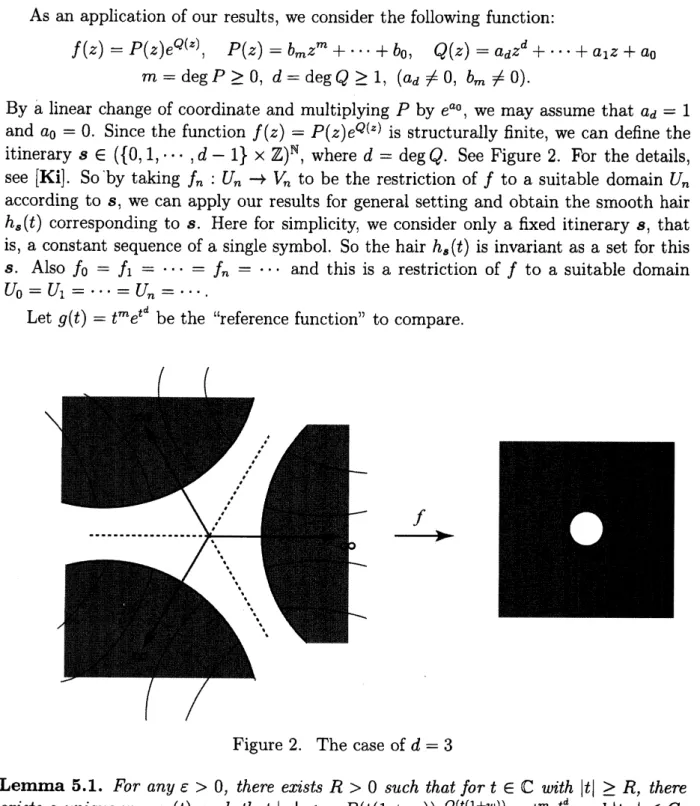
define theitinerary $s\in$ $(\{0,1, \cdots , d-1\}\cross Z)^{N}$, where $d=\deg Q$
.
See Figure 2. For the details,see
[Ki]. So by taking $f_{n}$ : $U_{n}arrow V_{n}$ to be the restriction of $f$ toa
suitable domain $U_{n}$according to $s$, we
can
applyour
results for general setting and obtain the smooth hair$h_{\epsilon}(t)$ corresponding to $s$. Here for simplicity, we consider only a fixed itinerary
$s$, that
is, a constant sequence of
a
single symbol. So the hair $h_{\epsilon}(t)$ is invariantas a
set for this$s$. Also $f_{0}=f_{1}=\cdots=f_{n}=\cdots$ and this is a restriction of $f$ to a suitable domain
$U_{0}=U_{1}=\cdots=U_{n}=\cdots$ .
Let $g(t)=t^{m}e^{t^{d}}$ be the (reference function” to compare.
$arrow^{f}$
Figure 2. The case of$d=3$
Lemma 5.1. For any $\epsilon>0$, there exists $R>0$ such that
for
$t\in \mathbb{C}$ with $|t|\geq R$, there exists a unique $w=w(t)$ such that $|w|<\epsilon,$ $P(t(1+w))e^{Q(t(1+w))}=t^{m}e^{t^{d}}$ and $|tw|\leq C$,where $C$ is a constant. $\square$
To apply the previous result, we change the notation
as
follows: We set$h_{0,0}(t)=h_{1,1}(t)=\cdots=h_{n,n}(t)=\cdots$
and denote this by $h_{0}(t)$. Also we set $h_{n}\{t)$ $:=h_{n,0}(t)$. Then by using the function $w(t)$
Proposition 5.2. There exist $\tau_{*}>0$ and $C^{\infty}$
-function
$h_{0}$ : $[\tau*, \infty)arrow \mathbb{C}$ such that$h_{0}’(t)\neq 0$ and
$foh_{0}(t)=g(t)(=t^{m}e^{t^{d}})$ (24)
$h_{0}(t)$ $:=t(1+w(t))=t+O(1)$ $(as tarrow\infty)$ (25)
$( \log h_{0}’(t))^{(k)}=O(\frac{1}{t^{k+2}})$ $(k=0,1,2, \ldots)$. (26)
Moreover$h_{0},$ $h_{1}$ $:=f^{-1}(h_{0}og)$
satisfies
A and $B$ with $R(t)= \frac{const}{t^{d-1}g(t)}$.
$\square$Proposition 5.3. Let$\sigma_{k}(t)=t^{k+2}(k=0,1,2, \ldots)$. Suppose that $\rho_{k}(t)(k=0,1,2, \ldots)$
satisfy $\sigma_{k}(t)\leq\rho_{k}(t)$ (27) $\lim_{tarrow}\sup_{\infty}\frac{\rho_{k}(t)t^{k(d-1)}(g(t))^{k}}{\rho_{k}(g(t))}<1$ (28) $\rho_{k}(t)\leq const\frac{\rho_{l}(g(t))}{t^{k(d-1)}(g(t))^{\ell}}(1\leq P<k)$ (29) $\rho_{k}(t)\leq const\cdot t^{k}g(t)$ (30) $\rho_{k}(t)\leq const\frac{\rho_{0}(t)}{t^{d-k}}(k\geq 1)$ (31) $\rho_{k}(t)\leq const\frac{\rho_{j}(t)}{t^{d+j-1}}(1\leq j<k)$. (32)
Then $C_{j}(0\leq j\leq k),$ $D_{j}(0\leq j\leq k),$ $E_{j}(1\leq j\leq k)$ and $F_{j}(0\leq j\leq k)$ are
satisfied.
口
Corollary 5.4. For a suitable choice
of
const and$\mu_{k}>0,$ $\rho_{k}(t)=const\frac{e^{et}}{t^{\mu_{k}}}$satisfies
thehypothesis. $\square$
References
[DK] R. Devaney, M. Krych, Dynamics
of
$Exp(z)$, Ergod.Tb.
&
Dynam. Sys. 4 No.1(1984), 35-52.
[F] N. Fagella, Limiting dynamics
of
the complex standard family, Int. J. of Bif. andChaos 3 (1995), 673-700.
[Ki] M. Kisaka, Dynamics
of
structumllyfinite
transcendental entire functions.,Stud-ies on complex dynamics and related topics (Kyoto, 2000), Surikaisekikenkyu-sho
Kokyuroku, No.1220 (2001), 17-25.
[V] M. Viana da Silva, The differentiability