ON THE TWISTED ALEXANDER POLYNOMIAL FOR METABELIAN
$SL_{2}(\mathbb{C})$
-REPRESENTATIONS
WITH THE ADJOINT ACTIONYOSHIKAZU YAMAGUCHI
1. INTRODUCTION
We devote this note to expose an explicit form of the twisted Alexander invariant
for irreducible metabelian $SL_{2}(\mathbb{C})$-representations of knot groups. This work was
mo-tivated by the characterization of irreducible metabelian $SL_{2}(\mathbb{C})$-representations in [9],
concerning the conjugacy classes of $SL_{2}(\mathbb{C})$-representations. We can correspond the set
of conjugacy classes of $SL_{2}(\mathbb{C})$-representations to an affine variety called the chamcter
variety (for details, we refer to [2, 7]). The conjugacy classes of irreducible metabelian
$SL_{2}(\mathbb{C})$-representations forms the fixed points on the character variety under an
involu-tion ($\mathbb{Z}_{2}$-action). Since the twisted Alexander invariant has the invariance under
con-jugation of representations, it is expected that the feature of conjugacy classes of
irre-ducible metabelian $SL_{2}(\mathbb{C})$-representations is carried over into the computation result of
the twisted Alexander invariant for irreducible metabelian $SL_{2}(\mathbb{C})$-representations. In
particular, we consider the composition of $SL_{2}(\mathbb{C})$-representations with the adjoint
ac-tion. Since the adjoint action connects the homology of group with the cotangent space
on the character variety, we canexpect that the twisted Alexander invariant have a more
significant feature concerning the linear map induced by the involution on the cotangent
space at a fixed point. Our main theorem is stated
as
follows:Main Theorem
If
an $SL_{2}(\mathbb{C})$-representation $\rho$of
$\pi_{1}(E_{K})$ is metabelian andlongitude-regular (requiring irreducibility and some additional conditions), then the twisted
Alexan-der invariant
for
the compositionof
$\rho$ with the adjoint actionfactors
into the product$(t-1)\triangle_{K}(-t)P(t)$
where $\Delta_{K}(t)$ is theAlexanderpolynomial
of
$K$ and$P(t)$ is a Laurent polynomial satisfyingthat $P(t)=P(-t)$.
Throughout this note, we use the symbol $K$ for a knot in $S^{3}$ and $E_{K}$ for the knot
exterior $S^{3}\backslash N(K)$ where $N(K)$ is an open tubular neighbourhood of $K$. Hence $\pi_{1}(E_{K})$ denotes the knot group of $K$.
In the Main theorem, it seems that the symmetry of$P(t)$ corresponds to the feature of
theconjugacyclass of$\rho$asa fixedpoint under the involution and theAlexanderpolynomial
withthe variable multiplied with-l seems to be the effect by the linear map induced by
the involution on the cotangent space at the fixed point.
We aim to observe the twisted Alexander invariant for the composition of irreducible metabelian $SL_{2}(\mathbb{C})$-representations with the adjoint action (for the definition, see
Sec-tion 2) and compute concrete examples. For this purpose, we need a pair of a
suit-able presentations of knot groups and explicit forms of irreducible metabelian $SL_{2}(\mathbb{C})arrow$
representations. X.-S. Lin [6] has introduced such
a
useful presentationofknot groups byusingfree Seifert surfaces for knots.
Instead of giving the rigorous proof to our main theorem, we discuss the details of construction and computation for Lin $s$ special presentations of knot groups and show
computation procedures ofthe twisted Alexander invariant via concrete examples.
ORGANIZATION
First we will review the twisted Alexander invariant for the composition of $SL_{2}(\mathbb{C})-$
representations with the adjoint action in Section 2. Section 3 shows a brief exposition
of metabelian $SL_{2}(\mathbb{C})$-representations ofknot groups and its characterization in the
char-acter variety. Section 4 gives a review
on
special presentations of knot groups, by usingfree Seifert surfaces, and the detail
on
how to write down such presentations via the concrete example for the trefoil knot. In Section 5,we
will stateour
main theoremon
the twisted Alexander invariant for the composition of irreducible metabelian $SL_{2}(\mathbb{C})-$representations with the adjoint action and the sketch of the proof. Last,
we
calculatethe twisted Alexander invariants of the trefoil knot, figure eight knot and $5_{2}$ knot for the
composition of irreducible metabelian $SL_{2}(\mathbb{C})$-representations with the adjoint action in
Section 6.
2. REVIEW OF THE TWISTED ALEXANDER INVARIANT
Wereview the definition of twisted Alexander invariant. We followthedefinition in the
way ofWada [12] by using Fox differential calculus on knot groups. To define the twisted Alexander invariant,
we
needa
presentation and two homomorphisms ofa
knotgroup.
Onehomomorphismis theabelianization homomorphism ofaknot group. The
abelian-ization homomorphism is the quotient oneby the commutatorsubgroup and the quotient
group is called the abelianization of a group. It is known that the abelianization of a fundamental group is isomorphic to the first homology group. Since the abelianization of
a knot group is a free abelian group with rank one,
we
express this abelianizationas
themultiplicative group $\langle t\rangle$
.
We denote by $\alpha$ the following abelianization of$\pi_{1}(E_{K})$:$\pi_{1}(E_{K})arrow\langle t\rangle$, $\mu\mapsto t$
where $\mu$ is ameridian ofthe knot $K$. The otherhomomorphism is called a representation
of a knot group. Representations
means
homomorphisms from a group into a linearautomorphism group of a vector space. In this note, we consider representations into
$SL_{2}(\mathbb{C})$, i.e.,
a
representation $\rho$ isa
homomorphism from $\pi_{1}(E_{K})$ into$SL_{2}(\mathbb{C})$ and we take
the composition of an $SL_{2}(\mathbb{C})$-representation with the adjoint action.
Definition 2.1. The Lie group $SL_{2}(\mathbb{C})$ acts
on
the Lie algebra $5[_{2}(\mathbb{C})$ by conjugation: $A:\epsilon t_{2}(\mathbb{C})arrow\epsilon 1_{2}(\mathbb{C})$where $A\in SL_{2}(\mathbb{C})$. This is called the adjoint action of $A$ and denoted by the symbol $Ad_{A}$.
The Lie algebra $\epsilon \mathfrak{l}_{2}(\mathbb{C})$ is generated by the following three matrices over $\mathbb{C}$:
(1) $E=(\begin{array}{ll}0 10 0\end{array})$ , $H=(\begin{array}{ll}1 00-1 \end{array})$ , $F=(\begin{array}{ll}0 01 0\end{array})$ .
In particular, when we regard $5[_{2}(\mathbb{C})$ as a 3-dimensional vector space over $\mathbb{C}$, the adjoint
action turns into a homomorphism from $SL_{2}(\mathbb{C})$ into $Aut(g1_{2}(\mathbb{C}))\simeq Aut(\mathbb{C}^{3})$. It is also
known that thedeterminant of theadjoint action is always 1. More preciselyifanelement
$A\in SL_{2}(\mathbb{C})$ has the eigenvalues $\xi^{\pm 1}$, then the composition $Ad_{A}$ has the eigenvalues $\xi^{\pm 2}$
and 1 (see Eq. (6) for example). Hence the composition of an $SL_{2}(\mathbb{C})$-representation $\rho$
with the adjoint action gives an
SL3
$(\mathbb{C})$-representation of$\pi_{1}(E_{K})$: $Ad\circ\rho$ : $\pi_{1}(E_{K})arrow^{\rho}SL_{2}(\mathbb{C})arrow Aut(\epsilon 1_{2}(\mathbb{C}))Ad$ .Thesecompositions with the adjoint action appear homology of groups with coefficient in
$\epsilon \mathfrak{l}_{2}(\mathbb{C})$ (we refer to [10] and [11, Lecture 15] for SU(2) case).
We also review the definition of the twisted Alexander invariant for the composition of an $SL_{2}(\mathbb{C})$-representation
$\rho$ of a knot group $\pi_{1}(E_{K})$ with the adjoint action. Definition 2.2. We choose a presentation of aknot group $\pi_{1}(E_{K})$ as
$\pi_{1}(E_{K})=\langle g_{1},$
$\ldots,$$g_{k}|r_{1},$$\ldots,$$r_{k-1}\rangle$
and an $SL_{2}(\mathbb{C})$-representation $\rho$. Let $\Phi_{Ado\rho}$ be the linear extension of the tensor product
$\alpha\otimes Ad_{\rho}:\pi_{1}(E_{K})arrow \mathbb{C}[t^{\pm 1}]\otimes_{\mathbb{C}}$
SL3
$(\mathbb{C})$ on the group ring $\mathbb{Z}[\pi_{1}(E_{K})]$, i.e., $\Phi_{Ad\circ\rho}:\mathbb{Z}[\pi_{1}(E_{K})]arrow \mathbb{C}[t^{\pm 1}]\otimes M_{3}(\mathbb{C})=M_{3}(\mathbb{C}[t^{\pm 1}])$$\sum_{i}a_{i}\gamma_{i}\mapsto\sum_{i}a_{i}\alpha(\gamma_{i})\otimes Ad\circ\rho(\gamma_{i})$
Here we identify $\mathbb{C}[t^{\pm 1}]\otimes M_{3}(\mathbb{C})$ with $M_{3}(\mathbb{C}[t^{\pm 1}])$. We
assume
that $\alpha(g_{1})\neq 1$. Then thetwisted Alexander invariant $\triangle_{E_{K}}^{\alpha\otimes Ad\circ\rho}(t)$ is defined as the following ratio of two
determi-nants ofelements in $M_{3}(\mathbb{C}[t^{\pm 1}])$:
(2)
$\triangle_{E_{K}}^{\alpha\otimes Ad\circ\rho}(t)=\frac{\det(\Phi_{Ad\circ\rho}(\frac{\partial r_{i}}{\partial g_{j}}))_{1_{\frac{\leq}{2}}i_{\frac{\leq}{j}}k-1}\leqq\leqq k}{\det(\Phi_{Ad\circ\rho}(g_{1}-1))}$
.
Remark 2.3. When we consider the rational function
$\det(\Phi_{Ad\circ\rho}(\frac{\partial r_{i}}{\partial g_{j}}))_{1\leqq i\leqq k-1}1\leqq j\leqq k,j\neq\ell$
$\det(\Phi_{Ad\circ\rho}(g_{l}-1))$
for other generator $g_{\ell}$ satisfying that $\alpha(g_{\ell})\neq 1$, we have the
same
rational function asEq. (2) up to a factor $\pm t^{n}(n\in \mathbb{Z})$
.
In this note, we choose the last generator in a3.
METABELIAN REPRESENTATIONSWemainlyconsider thespecial $SL_{2}(\mathbb{C})$-representations, which arecalled metabelian. In
particular, we focus on irreducible metabelian $SL_{2}(\mathbb{C})$-representations in this note.
Definition 3.1. An $SL_{2}(\mathbb{C})$-representation $\rho$ of$\pi_{1}(E_{K})$ is metabelian if the image of the
commutator subgroup $[\pi_{1}(E_{K}), \pi_{1}(E_{K})]$ by $\rho$ is an abelian subgroup in $SL_{2}(\mathbb{C})$.
In the definition 3.1, we consider the condition concerning the image of the comutator sugroup by an $SL_{2}(\mathbb{C})$-representation. Concerning the whole image of $\pi_{1}(E_{K})$, we often
consider the existence
on
acommon
eigenspace for all $SL_{2}(\mathbb{C})$-elements in the image of$\pi_{1}(E_{K})$
.
According to the existence on a common eigenspace, an $SL_{2}(\mathbb{C})$-representationis referred to
as
being either reducible or irreducible.Definition 3.2. An $SL_{2}(\mathbb{C})$-representation $\rho$is reducibleifthereexists
an
invariantline $L$in $\mathbb{C}^{2}$ such that
$\rho(\gamma)(L)\subset L$ for all $\gamma\in\pi_{1}(E_{K})$. This
means
that there existsa
common
eigenvector of $\rho(\gamma)$ for all $\gamma\in\pi_{1}(E_{K})$. Hence by taking conjugate we can
assume
theimage of $\pi_{1}(E_{K})$ by a reducible $SL_{2}(\mathbb{C})$-representation is contained in upper triangular
matrices in $SL_{2}(\mathbb{C})$. We call an $SL_{2}(\mathbb{C})$-representation $\rho$ irreducible if$\rho$ is not reducible.
Remark 3.3. By direct computation, for upper triangular $SL_{2}(\mathbb{C})$-matrices $A$ and $B$we
have
$[A, B]=ABA^{-1}B^{-1}=(\begin{array}{l}1*01\end{array})$ .
Together with the fact that all upper triangular matrices with diagonal components 1
forms
an
abelian subgroup in $SL_{2}(\mathbb{C})$, thismeans
that all reducible representations aremetabelian.
The twisted Alexander invariant for reducible $SL_{2}(\mathbb{C})$-representations is calculated
ex-plicitly, in [5, 14]. Therefore wefocuson irreducible metabelian$SL_{2}(\mathbb{C})$-representations of
$\pi_{1}(E_{K})$ in the subsequent sections. For the expositionon the twisted Alexander invariant
for metabelian $SL_{2}(\mathbb{C})$-representations, we refer to [15].
We deal with $SL_{2}(\mathbb{C})$-representations in the difference between reducible ones and
metabelian ones. Such the difference is expressed
as
only finite number of conjugacyclasses.
Remark 3.4. It has been shown in [6, 8] that the conjugacy classes of irreducible metabelian $SL_{2}(\mathbb{C})$-representations of$\pi_{1}(E_{K})$ is finite and the number is given by
$\frac{|\triangle_{K}(-1)|-1}{2}$
where$\Delta_{K}(t)$ the Alexander polynomial of$K$
.
For explicit forms of irreducible metabelian$SL_{2}(\mathbb{C})$-representations,
see
Proposition 5.3.To characterize these conjugacy classes, we define an involution on the set of $SL_{2}(\mathbb{C})-$
representations of a knot group by using scalar multiplication for matrices. For $\rho$ is
an
$SL_{2}(\mathbb{C})$-representation of $\pi_{1}(E_{K})$, we can define a new $SL_{2}(\mathbb{C})$-representation $(-1)^{[\cdot]}\rho$
as
$(-1)^{[\cdot]}\rho:\pi_{1}(E_{K})arrow SL_{2}(\mathbb{C})$
where $[\gamma]$ is the homology class of
$\gamma$ in $H_{1}(E_{K};\mathbb{Z})\simeq \mathbb{Z}$. It is easy to see that the
correspondence $\rho\mapsto(-1)^{[\cdot]}\rho$ is
an
involution and induces the involution on the set ofconjugacy classes.
Remark 3.5. It is shown in [9] that every irreduciblemetabelian$SL_{2}(\mathbb{C})$-representation$\rho$ of$\pi_{1}(E_{K})$ is conjugate to $(-1)^{[\cdot]}\rho$
.
Moreover it is also shown that an irreducible $SL_{2}(\mathbb{C})-$representation $\rho$ is metabelian if it is conjugate to $(-1)^{[\cdot]}\rho$. This means that the
conju-gacy classes of irreducible metabelian $SL_{2}(\mathbb{C})$-representations form the fixed points in the
$SL_{2}(\mathbb{C})$-character variety of $\pi_{1}(E_{K})$ under the involution.
Remark 3.6. The higher rank analog (SL$n(\mathbb{C})$ cases) in Remark3.5 is given by H. Boden
and S. Riedl in [1].
We can expect that the invariance of irreducible metabelian representation under the
action of $\mathbb{Z}_{2}$ gives rise to significant features of the twisted Alexander invariant for irre-ducible metabelianrepresentations. Forthe computationprocedureof thetwisted
Alexan-der invariant, we need a suitable presentation of a knot group to write down irreducible
metabelian $SL_{2}(\mathbb{C})$-representations explicitly.
4. REVIEW OF LIN PRESENTATIONS
To investigate metabelian $SL_{2}(\mathbb{C})$-representations, it is useful to
use
the specialpre-sentations ofknot groups, introduced by X.-S. Lin in [6]. We call such presentations $Lin$
presentations of $\pi_{1}(E_{K})$. We review the definition ofLin presentations and show how to
obtain such presentation of$\pi_{1}(E_{K})$ with an explicit example.
4.1. Definition of Lin presentations. In the definition of Lin presentations, we need
free
Seifert surfaces of knots. We start with the definition offree Seifert surfaces.Definition 4.1. A Seifert surface ofa knot is
free
ifthe complement ofan open tubularneighbourhood of$S$ in $S^{3}$ is a handlebody. Hence $\pi_{1}(S^{3}\backslash N(S))$ is a free group with rank
$2g$ where $N(S)$ is an open tubular neighbourhood of$S$ and $g$ is the genus of$S$.
For example, we can see a free Seifert surface of the trefoil knot
as
in Figure 1. To see$=$
FIGURE 1. A free Seifert surface $S$ of the trefoil knot
that theSeifert surface
as
in Figure 1 is free, we make a Heegaard splitting of $S^{3}$ by usingthe Seifert surface along the following procedure:
1. Decompose $S^{3}$ into the union $B_{1}\cup B_{2}$ of two 3-balls where $B_{1}$ contains the Seifert
surface $S$
as
the left side in Figure 2.2. Removetwo l-handles alongthe loops $x_{1}$ and $x_{2}$ outside the Seifert surface$S$from
$x_{1}$ $x_{2}$ $x_{1}$ $x_{2}$
$arrow$
$H_{1}=S\cross[-1,1]$ $H_{2}=\overline{S^{3}\backslash H_{1}}$
FIGURE 2. Heegaard decomposition by the free Seifert surface ofthe trefoil knot
Wedefine aLinpresentationof$\pi_{1}(E_{K})$ associated withafree Seifert surface $S$ ofaknot
$K$
.
The generators consist of thegenerators $x_{1},$$\ldots,$ $x_{2g}$ of$\pi_{1}(S^{3}\backslash N(S))$ and ameridian$\mu$
.
The relations are given by $2g$ loops in the spine of$S$. Here the spine of a Seifert surface is
a
deformation retract of the Seifert surface. That deformation retract is given by abouquet of circles $a_{1},$
$\ldots,$ $a_{2g}$ since a Seifert surface is a compact connected surface with
one
boundary circle. The homotopy class of the loop $a_{1}^{+}$ (resp. $a_{i}^{-}$), given by pushing up(resp. down) the loop $a_{i}$, is expressed
as
a word in $x_{1}\ldots,$$x_{2g}$.
Onecan see
the relation$\mu a_{1}^{+}\mu^{-1}=a_{1}^{-}$ for these two words $a_{i}^{+}$ and $a_{i}^{-}$. We have
a
presentation which consists of $2g+1$ generators and $2g$ relationsas
follows.Definition 4.2. We choose a free Seifert surface $S$ of a knot $K$. When we denote by
$x_{1},$$\ldots,$
$x_{2g}as$ thegenerators ofthe free group
$\pi_{1}(S^{3}\backslash N(S))$, we can express the knot group $\pi_{1}(E_{K})=\langle x_{1},$
$\ldots,$ $x_{2g},$$\mu|\mu a_{i}^{+}\mu^{-1}=a_{i}^{-},$$i=1,$ $\ldots,$
$2g\rangle$
where $a_{\dot{\iota}}^{\pm}$ are words in
$x_{1},$ $\ldots,$ $x_{2g}$ and denote the homotopy classes of loops given by
pushing up and down the loop $a_{i}$ in the spine $\vee a_{i}$ of $S$
.
We call this presentation a $Lin$presentation associated with $S$.
4.2. How to compute relations in Lin presentations. In this section,
we
describerelations of Lin presentations in details via the trefoil knot. To obtain relations of a Lin presentation associated with a free Seifert surface $S$, it is enough to write down the
loops $a_{\dot{\iota}}^{\pm}$ given by pushing up and down
$a_{i}$ in the spine of $S$
as
element in $\pi_{1}(S^{3}\backslash N(S))$.Hence by chasing the intersection of $a_{i}^{\pm}$ with the
cocores
of l-handles in the handlebody$S^{3}\backslash N(S)$, we can describe the homotopy classes of $a^{\dot{\pm}}$ as
words in the generators of
$\pi_{1}(S^{3}\backslash N(S))$. We denote by $x_{i}$ the generator in $\pi_{1}(S^{3}\backslash N(S))$ corresponding to a
1-handle in $S^{3}\backslash N(S)$ and by $D_{i}$ the cocore of the l-handle as in Figure 3. We set the
orientations $x_{i}$ and $D_{i}$ such that the intersection is positive.
Lemma 4.3. We suppose that a loop $\gamma$ in $S^{3}\backslash N(S)$ intersects with $D_{j_{1}},$ $D_{j_{2}},$ $\ldots$ in this
order. When
we
denote by $\epsilon_{k}\in\{\pm 1\}$ the signof
the intersectionof
$\gamma$ with the disk $D_{j_{k}}$,the homotopy class
of
$\gamma$ is given by the word $x_{j_{1}}^{\epsilon_{1}}x_{j_{2}}^{\epsilon 2}\cdots$.
Example 4.4. Theexample of thetrefoil knot. For the Seifert surface $S$in Figure 1, the
spine of$S$ is given by the bouquet $S^{1}\vee S^{1}$
as
in Figure 4.By pushing up and down this spine $a_{1}\vee a_{2}$,
we
have the closed loops $a_{1}^{+},$ $a_{2}^{+},$ $a_{1}^{-}$ and$x_{1}$ 1 $|$ ’ 1 $1$ $t1$
:
1 $11$ 1 1 in $S^{3}$ $\prime 1|$FIGURE 3. The
cocores
in l-handles$rightarrow$
$h.e$
.
FIGURE 4. The spine of Seifert surface for the trefoil knot
The fundamental group $\pi_{1}(S^{3}\backslash N(S))$ is a free group and generated by the homotopy
classes of $x_{1}$ and $x_{2}$. The homotopy classes of the closed loops $a_{1}^{\pm}$ and $a_{2}^{\pm}$ are expressed
as words in $x_{1}$ and $x_{2}$. One can find that
(3) $a_{1}^{+}=x_{1}$, $a_{1}^{-}=x_{1}x_{2}^{-1}$,
(4) $a_{2}^{+}=x_{2}^{-1}x_{1}$, $a_{2}^{-}=x_{2}^{-1}$
where weuse the same symbols for the homotopy classes of $a_{i}^{\pm}(i=1,2)$ for simplicity.
$arrow^{pushingup}$
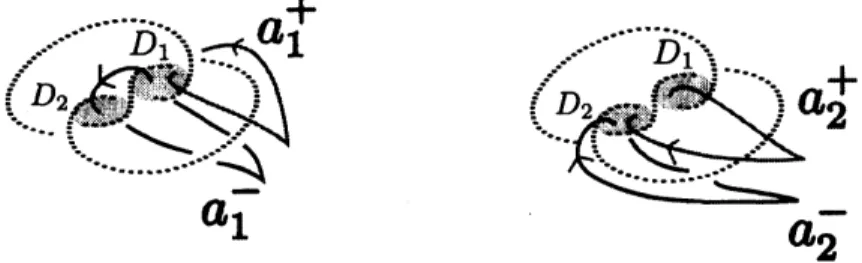
FIGURE 5. The loops $a_{1}^{+}$ and $a_{2}^{+}$ obtained by pushing up the spine
We deduce the above relations in (3)& $(4)$ from countingthe intersectionoftheclosed
loops$a_{1}^{\pm}$ and$a_{2}^{\pm}$ with the
cocores
$D_{1}$ and $D_{2}$ in the handlebodyof$S^{3}\backslash N(S)$as
in Figure7.Theclosed loop $a_{1}^{+}$ hasthe only positiveintersection with $D_{1}$. The closed loop$a_{1}^{-}$ has
one
positive intersection with $D_{1}$ and
one
negative intersection with $D_{2}$ in this order. Hencewe also see the expressions $a_{1}^{+}=x_{1}$ and $a_{1}^{-}=x_{1}x_{2}^{-1}$ in Eq. (3) by Lemma 4.3. We can
see the expression in Eq. (4) similarly.
$a_{1}^{-}$
$a_{2}^{-}$
FIGURE 7. The intersections $a_{1}^{-}$ and $a_{2}^{-}$ with $D_{1}$ and $D_{2}$
We also
see
how the relations $\mu a_{i}^{+}\mu^{-1}=a_{t}^{-}$ is illustrated for the trefoil knot. Forexample, the closed loops $a_{1}^{\pm}$
are
obtainedby pushing up and down thespine$a_{1}$ alongthe
normal direction of the Seifert surface $S$
as
in Figures $5$&
$6.$ Hencewe
putan
annulusbetween $a_{1}^{+}$ and $a_{1}^{-}$
.
This annulus intersects with the trefoil knot at the two pointsas
in Figure 8. By attaching two meridians to avoid the intersection points of the annulus with thetrefoil knot, we
can
see the disk whoseboundary is homotopic to the closed loop$\mu a_{1}^{+}\mu^{-1}(a_{1}^{-})^{-1}$.
FIGURE 8. The homotopy between $a_{1}^{+}$ and $a_{1}^{-}$
5. MAIN THEOREM
In thissection, Westate theexplicit form ofthe twistedAlexanderinvariantfor the
com-positionof irreducible metabelian $SL_{2}(\mathbb{C})$-representationswith theadjoint action andgive
asketchofthe proof. Inourtheorem, werequirealittlemorestrong technicalcondition for metabelian representations thanirreducibility. This condition is called longitude-regular.
The irreducibility of representations is included in longitude-regularity (fordetails about
the longitude-regularity, we refer to [15]$)$
.
Our main theorem is statedas
follows.Theorem 5.1. Let $\rho$ be
an
$SL_{2}(\mathbb{C})$-representationof
a
knot group $\pi_{1}(E_{K})$.
If
$\rho$ is metabelian and longitude-regular, then the twisted Alexander invariant $\Delta_{E_{K}}^{\alpha\otimes Ad\circ\rho}(t)$ is $exarrow$pressed
as
where$\triangle_{K}(t)$ is the Alexanderpolynomial
of
$K$ and$P(t)$ is aLaurentpolynomialsatisMngthat $P(t)=P(-t)$.
Remark 5.2. Note that the assumption oflongitude-regularity is a sufficient condition
for the twisted Alexander invariant to be a Laurent polynomial.
To compute the twisted Alexander invariant, we need explicit forms of irreducible
$SL_{2}(\mathbb{C})$-representations. It is shown by using a Lin presentation of a knot group in [8]
that we havethefollowingrepresentativeineachconjugacy class of irreducible metabelian
$SL_{2}(\mathbb{C})$-representations.
Proposition 5.3 (See the proof of Proposition 1.1 and Theorem 1.2 in [8]). We $\sup-$
pose that a knot group $\pi_{1}(E_{K})$ has a $Lin$ presentation $\langle x_{1},$
$\ldots,$ $x_{2g},$$\mu|\mu a_{i}^{+}\mu^{-1}=a_{i}^{-},$ $i=$
$1,$
$\ldots,$$2g\rangle$.
If
$\rho$ is an irreducible metabelian $SL_{2}(\mathbb{C})$-representation, then $\rho$ is conjugate tothe $SL_{2}(\mathbb{C})$-representation given by the following correspondence:
(5) $\mu\mapsto(\begin{array}{ll}0 1-1 0\end{array})$ , $x_{i}\mapsto(_{0}^{\xi_{i}}$ $\xi_{i}^{-1)}0$ $(i=1, \ldots, 2g)$
where every $\xi_{i}$ is a root
of
unity.The twisted Alexander invariant has the invariance under conjugation of
representa-tions. Hereafter we consider irreducible metabelian $SL_{2}(\mathbb{C})$-representations which sends
the generators in a Lin presentation to the matrices
as
in Proposition 5.3. By directcalculation, we also obtain the following explicit forms of the composition of irreducible
metabelian $SL_{2}(\mathbb{C})$-representations with the adjoint action.
$|$
Proposition 5.4. Let $\rho$ be an irreducible metabelian $SL_{2}(\mathbb{C})$-representation
of
a knotgroup $\pi_{1}(E_{K})$. We suppose that the knot group $\pi_{1}(E_{K})$ has a $Lin$ presentation $\pi_{1}(E_{K})=\langle x_{1},$
$\ldots,$ $x_{2g},$$\mu|\mu a_{i}^{+}\mu^{-1}=a_{i}^{-},$ $i=1,$ $\ldots,$$2g\rangle$
and $\rho$ sends the genemtors $x_{1},$
$\ldots,$ $x_{2g}$ and $\mu$ to the diagonal matrices and the
trace-free
matrix as in Eq. (5).
Then the composition
of
$\rho$ with the adjoint action is decomposed into a directsum
of
the following l-dimensional representation $\psi_{1}$ and 2-dimensional representation $\psi_{2}$of
$\pi_{1}(E_{K})$;
$Ad\circ\rho=\psi_{1}\oplus\psi_{2}$
where $\psi_{1}$ is a $GL_{1}(\mathbb{C})$-representation and $\psi_{2}$ is a $GL_{2}(\mathbb{C})$-representation, given by the
following correspondence:
$\psi_{1}(\mu)=-1$, $\psi_{1}(x_{i})=1$ $(i=1, \ldots, 2g)$,
$\psi_{2}(\mu)=(\begin{array}{ll}0 -1-1 0\end{array})$ , $\psi_{1}(x_{i})=(_{0}^{\xi_{i}^{2}}$ $\xi_{i}^{-2)}0$ $(i=1, \ldots, 2g)$.
Remark 5.5. Therepresentations $\psi_{1}$ and$\psi_{2}$ aretherestrictions of irreducible metabelian
$SL_{2}(\mathbb{C})$-representation $\rho$ on the subspace $V_{1}=\langle H\rangle$ and $V_{2}=\langle E,$$F\rangle$ in $5[_{2}(\mathbb{C})$.
The proofof
our
main theorem is based on Proposition 5.4. We sketch the proof theA sketch
of
the proof. By Proposition 5.4 and the multiplicativity ofthe twistedAlexan-der invariant (we refer to [5]), we factor the twisted Alexander invariant $\triangle_{E_{K}}^{\alpha\otimes Ado\rho}(t)$ into
the product of two twisted Alexander invariants $\Delta_{E_{K}}^{\alpha\otimes\psi_{1}}(t)$ and $\triangle_{E_{K}}^{\alpha\otimes\psi_{2}}(t)$
.
By the computation for l-dimensional representations in [5, Section 3.3 Examples and
computations of the twisted polynomials], the twisted Alexander invariant $\Delta_{E_{K}}^{\alpha\otimes\psi_{1}}(t)$ turns
into the rational function $\Delta_{K}(-t)/(-t-1)$
.
On the other hand, by Wada$s$ criterion [12,Proposition 8], twisted Alexander invariant $\triangle_{E_{K}}^{\alpha\otimes\psi_{2}}(t)$ turns into a Laurent polynomial
$Q(t)$
.
Moreover by the invariance of the twisted Alexander invariant under conjugation,one
can see
that $Q(t)=Q(-t)$ viaconjugation bythe diagonal matrix $(^{\sqrt{1}0}0-\sqrt{-1})$.
Sum-marized the above, the twisted Alexander invariant $\Delta_{E_{K}}^{\alpha\otimes Ado\rho}(t)$ turns into the following
product:
$\triangle_{E_{K}}^{\alpha\otimes Ad\circ\rho}(t)=\triangle_{E_{K}}^{\alpha\otimes\psi_{1}}(t)\cdot\triangle_{E_{K}}^{\alpha\otimes\psi_{2}}(t)$
$= \frac{\Delta_{K}(-t)}{-t-1}$
.
$Q(t)$.
Since we
assume
that $\rho$is longitude-regular, it followsfrom [13] thatthe twisted Alexanderinvariant $\Delta_{E_{K}}^{\alpha\otimes Ad\circ\rho}(t)$ has
zero
at $t=1$. It is known that $\Delta_{K}(-1)$ isan
odd integer. Hencewe
factor $Q(t)$ into the product $(t-1)(t+1)P(t)$ by the symmetry that $Q(t)=Q(-t)$.
This completes
our
proof. $\square$Remark 5.6. The factors $\Delta_{K}(-t)$ and $P(t)$ imply the features ofconjugacy classes of
irreducible metabelian representations in the character variety. Thepoints corresponding
to the conjugacy classes of irreducible metabelian representations forms the fixed points
ofthe character variety under an action of$\mathbb{Z}_{2}$. The symmetry that $P(t)=P(-t)$ implies
the invariance of conjugacy classes under $\mathbb{Z}_{2}$-action
as
the fixed points. The Alexander polynomial with the$variable-t$seems
tobe related to the linear actionon
the cotangentspaces at the fixed points induced by $\mathbb{Z}_{2}$-action.
6. EXAMPLES
This section shows three concrete examples of the twisted Alexander invariant for the
composition of irreducible metabelian $SL_{2}(\mathbb{C})$-representations with the adjoint action.
6.1. The trefoil knot. We start with the trefoil knot and irreducible metabelian$SL_{2}(\mathbb{C})-$
representations of the knot group. We use the Lin presentation associated with the free
Seifert surface as in Figure 1. Recall that the Lin presentation is expressed
as
$\pi_{1}(E_{K})=\langle x_{1},$$x_{2},$$\mu|\mu x_{1}\mu^{-1}=x_{1}x_{2}^{-1},$$\mu x_{2}^{-1}x_{1}\mu^{-1}=x_{2}^{-1}\rangle$.
The number ofconjugacy classes of irreducible metabelian$SL_{2}(\mathbb{C})$-representations is given
by$(|\Delta_{K}(-1)|-1)/2$
.
SincetheAlexanderpolynomialof the trefoil knotis$t^{2}-t+1$, wehaveoneconjugacy class of irreducible metabelian$SL_{2}(\mathbb{C})$-representations. By Proposition5.3,
we
can
take arepresentative $\rho$ ofthis conjugacy classas
follows:where $\zeta_{3}=e^{2\pi\sqrt{-1}/3}$. The composition of
$\rho$ with the adjoint action is expressed
as
(6) $Ad\circ\rho(\mu)=(\begin{array}{lll}0 0 -10 -1 0-l 0 0\end{array})$ , $Ad\circ\rho(x_{i})=(\begin{array}{lll}\zeta_{3}^{2i} 0 00 1 00 0 \zeta_{3}^{-2i}\end{array})$
with respect to the basis $\{E, H, F\}$ of$5\mathfrak{l}_{2}(\mathbb{C})$ as in (1).
With $\alpha(\mu)=t$ and $\alpha(x_{i})=1$ in mind, we can express the twisted Alexander invariant
as the followingratio of two determinants:
$\triangle_{E_{K}}^{\alpha\otimes Ad\circ\rho}(t)=\frac{\det(\Phi_{Ado\rho}(\frac{\partial r_{i}}{\partial x_{j}}I)_{1^{\frac{\leq}{\leqq}}j^{\frac{\leq}{\leqq}}2}1i2}{\det(\Phi_{Ad\circ\rho}(\mu-1))}$
where $r_{1}=\mu x_{1}\mu^{-1}x_{2}x_{1}^{-1}$ and $r_{2}=\mu x_{2}^{-1}x_{1}\mu^{-1}x_{2}$ and $\partial r_{i}/\partial x_{j}$ is Fox differential of the
word $r_{i}$ by $x_{i}$.
The Fox differentials $\partial r_{i}/\partial x_{j}(1\leqq i, j\leqq 2)$ turn into
$\frac{\partial r_{1}}{\partial x_{1}}=\frac{\partial}{\partial x_{1}}\mu x_{1}\mu^{-1}x_{2}x_{1}^{-1}$
$=\mu-\mu x_{1}\mu^{-1}x_{2}x_{1}^{-1}$
$=\mu-1$,
$\frac{\partial r_{2}}{\partial x_{1}}=\frac{\partial}{\partial x_{1}}\mu x_{2}^{-1}x_{1}\mu^{-1}x_{2}$
$=\mu x_{2}^{-1}$,
$\frac{\partial r_{1}}{\partial x_{2}}=\frac{\partial}{\partial x_{2}}\mu x_{1}\mu^{-1}x_{2}x_{1}^{-1}$
$=\mu x_{1}\mu^{-1}$,
$\frac{\partial r_{2}}{\partial x_{2}}=\frac{\partial}{\partial x_{2}}\mu x_{2}^{-1}x_{1}\mu^{-1}x_{2}$
$=-\mu x_{2}^{-1}+\mu x_{2}^{-1}x_{1}\mu^{-1}$
$=-\mu x_{2}^{-1}+x_{2}^{-1}$. Therefore the twisted Alexander invariant $\Delta_{E_{K}}^{\alpha\otimes Ad\circ\rho}(t)$ turns out
$\Delta_{E_{K}}^{\alpha\otimes Ad\circ\rho}(t)=\frac{\det(\Phi_{Ad\circ\rho}(\frac{\partial r_{i}}{\partial x_{j}}))_{1^{\frac{\leq}{\leqq}}j^{\frac{\leq}{\leqq}}2}1i2}{\det(\Phi_{Ad\circ\rho}(\mu-1))}$
(7) $= \frac{\det(_{\Phi_{Ad\circ\rho}(\mu x_{2}^{-1})\Phi_{Ad\circ\rho}(-\mu x^{\frac{x}{2}1}+x_{2}^{-1})}^{\Phi_{Ad\circ\rho}(\mu-1)\Phi_{Ad\circ\rho}(\mu_{1}\mu^{-1})})}{\det(\Phi_{Ad\circ\rho}(\mu-1))}$
When we substitute (6) into the numerator and the denominator in (7), we have the
determinant in the numerator:
and the determinant in the denominator:
(9) $\det(\begin{array}{lll}-1 0 -t0 -t-1 0-t 0 -1\end{array})=(t+1)(t^{2}-1)$.
By replacing the numerator and denominator in (7) with the determinants (8)& $(9)$ and
reducing this rational function,
we
have$\Delta_{E_{K}}^{\alpha\otimes Ado\rho}(t)=\frac{-t^{6}-t^{5}+t^{4}+2t^{3}+t^{2}-t-1}{(t+1)(t^{2}-1)}$
$= \frac{-(t-1)^{2}(t+1)^{2}(t^{2}+t+1)}{(t-1)(t+1)^{2}}$
$=-(t-1)\Delta_{K}(-t)$.
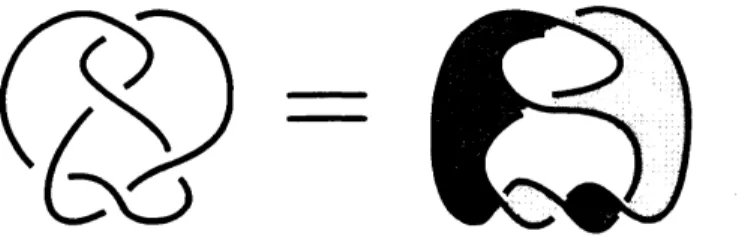
6.2. The figure eight knot. We consider the figure eight knot and the free Seifert
surface illustrated
as
in Figure 9.$=$
FIGURE 9. A free Seifert surface $S$ ofthe figure eight knot
The spine of the Seifert surface $S$ is a bouquet $a_{1}\vee a_{2}$ of two circles and the closed
loops corresponding to generators of $\pi_{1}(S^{3}\backslash N(S))$
are
illustratedas
in Figure 10.FIGURE 10. The spine of $S$ and the generators $x_{1}$ and $x_{2}$ of$\pi_{1}(S^{3}\backslash N(S))$
The Lin presentation associated with the Seifert surface $S$ is expressed as
$\pi_{1}(E_{K})=\langle x_{1},$$x_{2},$$\mu|\mu a_{1}^{+}\mu^{-1}=a_{1}^{-},$$\mu a_{2}^{+}\mu^{-1}=a_{2}^{-}\rangle$
$=\langle x_{1},$$x_{2},$$\mu|\mu x_{1}\mu^{-1}=x_{1}x_{2}^{-1},\mu x_{2}x_{1}\mu^{-1}=x_{2}\rangle$.
The number of conjugacy classes of irreducible metabelian $SL_{2}(\mathbb{C})$-representations is
given by $(|\Delta_{K}(-1)|-1)/2$. Since $\Delta_{K}(t)=t^{2}-3t+1$ forthe figureeight knot, wehave two
conjugacy classes of irreducible metabelian $SL_{2}(\mathbb{C})$-representations. The representatives
ofthese conjugacy classes is given by the following $SL_{2}(\mathbb{C})$-representations $\rho_{1}$ and $\rho_{2}$:
where $\zeta_{5}=e^{2\pi\sqrt{-1}/5}$. The composition of
$\rho_{k}$ with the adjoint action is expressed as
$Ad\circ\rho_{k}(\mu)=(\begin{array}{lll}0 0 -10 -1 0-1 0 0\end{array})$ , $Ado\rho_{k}(x_{i})=(\begin{array}{lll}\zeta_{5}^{2ki} 0 00 1 00 0 \zeta_{5}^{-2ki}\end{array})$ $(i=1,2)$.
The twisted Alexander invariant for $\rho_{k}$ is given by
$\triangle_{E_{K}}^{\alpha\otimes Ad\circ\rho_{k}}(t)=\frac{\det(\Phi_{Ad\circ\rho_{k}}(\frac{\partial r_{i}}{\partial x_{j}}))_{1^{\frac{\leq}{\leqq}}j2}1i_{\frac{\leq}{\leqq}}2}{\det(\Phi_{Ad\circ\rho_{k}}(\mu-1))}$
where $r_{1}=\mu x_{1}\mu^{-1}x_{2}x_{1}^{-1}$ and $r_{2}=\mu x_{2}x_{1}\mu^{-1}x_{2}^{-1}$.
The Fox differentials $\partial r_{i}/\partial x_{j}(1\leqq i,j\leqq 2)$ turn into
$\frac{\partial r_{1}}{\partial x_{1}}=\mu-\mu x_{1}\mu^{-1}x_{2}x_{1}^{-1}$, $\frac{\partial r_{1}}{\partial x_{2}}=\mu x_{1}\mu^{-1}$
$=\mu-1$,
$\frac{\partial r_{2}}{\partial x_{1}}=\mu x_{2}$, $\frac{\partial r_{2}}{\partial x_{2}}=\mu-\mu x_{2}x_{1}\mu^{-1}x_{2}^{-1}$
$=\mu-1$.
For $\rho_{1}$, the numerator of the twisted Alexander invariant is expressed
as
$\det(\Phi_{Ado\rho_{1}}(\frac{\partial r_{i}}{\partial x_{j}}I)_{1\leqq j\leqq 2}1\leqq i\leqq 2,$ $= \det(\frac{0}{0,t0}t1$
$–1 \frac{t_{0}^{0}0}{0}t$ $-t\zeta_{5}^{-4}-1000^{t}$ $\frac{\zeta_{5}00}{-0}1-2t$
$-t_{0}^{0}-1001$ $-1\zeta_{5}^{2}0^{t}00)$
$=(t^{2}+3t+1)(t^{4}-(\zeta_{5}^{2}+\zeta_{5}+\zeta_{5}^{-1}+\zeta_{5}^{-2}+3)t^{2}+1)$
$=(t^{2}+3t+1)(t^{2}-1)^{2}$
$=(t^{2}+3t+1)(t-1)^{2}(t+1)^{2}$
Since the denominator of the twisted Alexander invariant is given by $(t-1)(t+1)^{2}$ (see
Eq. (9)$)$, we have
$\Delta_{E_{K}}^{\alpha\otimes Ad\circ\rho_{1}}(t)=\frac{(t^{2}+3t+1)(t-1)^{2}(t+1)^{2}}{(t-1)(t+1)^{2}}$
$=(t-1)\triangle_{K}(-t)$.
For the other irreducible metabelian $SL_{2}(\mathbb{C})$-representation $\rho_{2}$, we have the
same
result as that for $\rho_{1}$.6.3. $5_{2}$ knot. Last we consider the $5_{2}$ knot and the free Seifert surface illustrated
as
inFigure 11. This knot is often called a twist knot with type $(-2,3)$
.
The trefoil knot,the figure eight knot and $5_{2}$ are the first three non-trivial examples in twist knots. (We
follows the convention oftwist knots along [3, 4].$)$
The spine of the Seifert surface $S$ is a bouquet $a_{1}\vee a_{2}$ of two circles and the closed
$=$
FIGURE 11. A free Seifert surface $S$ ofthe $5_{2}$ knot
FIGURE 12. The spine of $S$ and the generators $x_{1}$ and $x_{2}$ of$\pi_{1}(S^{3}\backslash N(S))$
The Lin presentation associated with the Seifert surface $S$ is expressed
as
$\pi_{1}(E_{K})=\langle x_{1},$$x_{2},$$\mu|\mu a_{1}^{+}\mu^{-1}=a_{1}^{-},$$\mu a_{2}^{+}\mu^{-1}=a_{2}^{-}\rangle$$=\langle x_{1},$$x_{2},$$\mu|\mu x_{1}\mu^{-1}=x_{1}x_{2}^{-1},$ $\mu x_{2}^{-2}x_{1}\mu^{-1}=x_{2}^{-2}\rangle$.
The number of conjugacy classes of irreducible metabelian $SL_{2}(\mathbb{C})$-representations is
given by $(|\Delta_{K}(-1)|-1)/2$. Since $\Delta_{K}(t)=2t^{2}-3t+2$ for the $5_{2}$ knot, we have three
conjugacy classes of irreducible metabelian $SL_{2}(\mathbb{C})$-representations. The representatives
of theseconjugacyclasses is given bythefollowing $SL_{2}(\mathbb{C})$-representations$\rho_{k}(k=1,2,3)$:
$\rho_{k}:\mu\mapsto(\begin{array}{ll}0 1-1 0\end{array})$ , $x_{1}\mapsto(\begin{array}{ll}\zeta_{7}^{k} 00 \zeta_{7}^{-k}\end{array})$ , $x_{2}\mapsto(\begin{array}{ll}\zeta_{7}^{2k} 00 \zeta_{7}^{-2k}\end{array})$
where $\zeta_{7}=e^{2\pi\sqrt{-1}/7}$. The composition of
$\rho_{k}$ with the adjoint action is expressed
as
$Ado\rho_{k}(\mu)=(\begin{array}{lll}0 0 -10 -1 0-1 0 0\end{array})$ , $Ado\rho_{k}(x_{i})=(\begin{array}{lll}\zeta_{7}^{2ki} 0 00 1 00 0 \zeta_{7}^{-2ki}\end{array})$ $(i=1,2)$ .
The twisted Alexander invariant for $\rho_{k}$ is given by
$\triangle_{E_{K}}^{\alpha\otimes Ad\circ\rho_{k}}(t)=\frac{\det(\Phi_{Ad\circ\rho_{k}}(\mathscr{N}_{X_{j}}^{\partial r}))_{1i\leqq 2}1^{\frac{\leq}{\leqq}}j\leqq 2}{\det(\Phi_{Ad\circ\rho_{k}}(\mu-1))}$
The Fox differentials $\partial r_{i}/\partial x_{j}(1\leqq i,j\leqq 2)$ turn into
$\frac{\partial r_{1}}{\partial x_{1}}=\mu-\mu x_{1}\mu^{-1}x_{2}x_{1}^{-1}$, $\frac{\partial r_{1}}{\partial x_{2}}=\mu x_{1}\mu^{-1}$
$=\mu-1$,
$\frac{\partial r_{2}}{\partial x_{1}}=\mu x_{2}^{-2}$, $\frac{\partial r_{2}}{\partial x_{2}}=-\mu x_{2}^{-1}-\mu x_{2}^{-2}+\mu x_{2}^{-2}x_{1}\mu^{-1}+\mu x_{2}^{-2}x_{1}\mu^{-1}x_{2}$ $=-\mu x_{2}^{-1}-\mu x_{2}^{-2}+x_{2}^{-2}+x_{2}^{-1}$.
For $\rho_{1}$, the numerator of the twisted Alexander invariant is expressed as
$\det(\Phi_{Ado\rho_{1}}(\frac{\partial r_{i}}{\partial x_{j}}))_{1\leqq i,j\leqq 2}$
$= \det(_{-}\frac{-0}{t\zeta 00}t17-8$ $–1 \frac{t_{0}^{0}0}{0}t$ $-t\zeta_{7}^{8}-1000^{t}$ $t\zeta_{7}^{-8}+t\zeta_{7}^{-4}\zeta_{7}10_{0}^{0}+\zeta_{7}^{6}\zeta_{7,0}^{-2}$ $2t_{0}^{0}00+21$ $\zeta_{7}-10^{0}+\zeta_{7}^{-6}t(_{7}^{8}+t\zeta_{7}^{4)}\zeta_{7}^{2}00$
$=(2t^{2}+3t+2)$
. $(-(\zeta_{7}^{3}+\zeta_{7}^{-3}+2)t^{4}+(\zeta_{7}^{3}-\zeta_{7}^{2}-\zeta_{7}-\zeta_{7}^{-1}-\zeta_{7}^{-2}+\zeta_{7}^{-3}+3)t^{2}-\zeta_{7}^{3}-\zeta_{7}^{-3}-2)$
$=-(2t^{2}+3t+2)(\zeta_{7}^{3}+\zeta_{7}^{-3}+2)(t^{2}-1)^{2}$
$=-(2t^{2}+3t+2)(\zeta_{7}^{3}+\zeta_{7}^{-3}+2)(t-1)^{2}(t+1)^{2}$.
Since the denominator of the twisted Alexanderinvariant is given by $(t-1)(t+1)^{2}$ (see
Eq. (9)$)$, we have
$\Delta_{E_{K}}^{\alpha\otimes Ad\circ\rho_{1}}(t)=\frac{-(\zeta_{7}^{3}+\zeta_{7}^{-3}+2)(2t^{2}+3t+2)(t-1)^{2}(t+1)^{2}}{(t-1)(t+1)^{2}}$
$=-(\zeta_{7}^{3}+\zeta_{7}^{-3}+2)(t-1)\Delta_{K}(-t)$.
Similarly, we have the twisted Alexander invariants for $\rho_{2}$ and $\rho_{3}$
as
follows:$\triangle_{E_{K}}^{\alpha\otimes Ad\circ\rho_{2}}(t)=-(\zeta_{7}+\zeta_{7}+2)(t-1)\triangle_{K}(-t)$, $\triangle_{E_{K}}^{\alpha\otimes Ado\rho_{3}}(t)=-(\zeta_{7}^{2}+\zeta_{7}^{-2}+2)(t-1)\Delta_{K}(-t)$.
ACKNOWLEDGMENT
This research
was
supported by Research Fellowships of the Japan Society for thePromotion of Science for Young Scientists.
REFERENCES
[1] H. Boden andS. Friedl, Metabelian SL(n,$\mathbb{C})$ representations ofknot groups, $\Pi$; Fixed points, Pacific J. Math., 249 (2011), 1-10.
[2] M. Culler and P. Shalen, Varieties ofgroup representations and splittings of3-manifolds, Ann. of
Math., 117 (1983), 109-146.
[3] J. Dubois,V. Huyhn and Y. Yamaguchi, Non-abelian Reidemeister torsionfortwist knots, J. Knot Theory Ramifications, 18 (2009), 303-341.
[4] J. Hoste and P. D. Shanahan, A fomula for the A-polynomial of twist knots, J. Knot Theory
Ramifications, 13 (2004), 193-209.
[5] P. KirkandC. Livingston, TwistedAlexanderInvariants, Reidemeistertorsion, andCasson-Gordon
invariants, Topology, 38 (1999), 635-661.
[6] X.-S. Lin, Representationsofknot groups andtwistedAlexander polynomials, ActaMath.Sin. (Engl.
Ser.), 17 (2001), 361-380.
[7] A. Lubotzky and A. R. Magid, Vareeties ofrepresentations offinitely groups, Mem. Amer. Math.
Soc., 58 (1985), no. 336, $117+xi$pages.
[8] F. NagasatoFiniteness ofasection ofthe SL(2,$\mathbb{C})$-chamctervariety ofknot groups, Kobe J. Math.,
24 (2007), 125-136.
[9$|$ F. Nagasato and Y. Yamaguchi, Onthegeometry ofthe slice of trace-freechamctersofaknotgroup,
to appear in Math. Ann. (preprint arXiv:0807.0714).
[10] J. Porti, Torsion de Reidemeister pour les varietes hyperboliques, Mem. Amer. Math. Soc., 128
(1997), no. 612, $139+x$ pages.
[11] N.Saveliev, Lectures onthe topology of3-manifolds, de GruyterTextbook (1999),Walter de Gruyter
&Co., Berlin.
[12] M.Wada, Twisted Alexander polynomialforfinitely presentablegroups, Topology33 (1994),241-256.
[13] Y. Yamaguchi, A relationship between the non-acyclicReidemeistertorsion and a zeroofthe acyclic Reidemeistertorsion, Ann. Institut Fourier, 58 (2008), 337-362.
[14] Y.Yamaguchi, Limitvaluesofthe non-acyclicReidemeister torsionforknots, Algebr. Geom.Topol.,
7 (2007), 1485-1507.
[15] Y. Yamaguchi, On the twisted Alexander polynomial for metabelian represetations into $SL_{2}(\mathbb{C})$,
arXiv:1101.3989 (preprint).
DEPARTMENT OF MATHEMATICS, TOKYO INSTITUTE OF TECHNOLOGY