GRASSROOTS ORGANIZATION FOR COMMUNITY CAPACITY DEVELOPMENT: A CASE STUDY OF AN AGRICULTURAL COOPERATIVE IN THE RURAL COMMUNITY
OF SAN PABLO, NORTH AUTONOMOUS REGION OF NICARAGUA
By
Waters Garth Ivone Glaudin (ID No. 51212004)
March 2014
Research Report presented to the Higher Degree Committee of Ritsumeikan Asia Pacific University in Partial Fulfillment of the Requirements for the Degree of
ii
ACKNOWLEDGEMENTS
This research was prepared as a partial fulfillment of the requirement for the Degree of Master of Science in International Cooperation Policy from the graduate program of Ritsumeikan Asia Pacific University (APU) located in Kyushu region, Japan.
This was a wonderful experience conducting research without previous experience. I had receive support from brilliant people to whom I would like to express my most sincere gratitude to all those whom supported and guided me in the preparation of this research and during my study life in Japan. My very warm and deepest acknowledgement goes to:
1. To God almighty for all the blessing, guidance, health and wisdom given to accomplish successfully my research and study program in Japan.
2. To my Supervisor Professor Miyoshi Koichi for his valuable advice, excellent guidance, comments, and constructive suggestions that have helped me shape the content of this research. Sensei, without your advice this work wouldn’t have been completed.
3. To my beloved family for their daily moral support and encouragement during my study life in Japan.
4. To Japan International Cooperation Agency (JICA) for granting me the opportunity of holding a Master Degree Ritsumeikan Asia Pacific (APU). For building my capacity on international cooperation frameworks and community development approaches.
5. To Nicaragua Government of National Unity and Reconciliation for the opportunity, confidence and trust given to the first black afro-descendant women of the North Atlantic Autonomous Region (RAAN). Also, my deep gratitude goes to Puerto Cabezas Municipal Government for sending me to acquire knowledge that can contribute to my
iii
region development and for all the support provided during the fieldwork and data collection process.
6. To all my seminar colleagues and friends for their permanent support, positive comments, suggestion and cooperation in the design of the present research.
I am deeply indebted with all of the above mentioned. Without these support I wouldn’t have been able to accomplish this report study. Many thanks to all of you...
iv
DECLARATION OF ORIGINALITY
I, Waters Garth Ivone Glaudin, hereby declare the content of this report submitted for the degree of Master of Science in International Cooperation Policy, contain my original work. Any
v
LIST OF TABLES
Page No.
Table 4.2 Nicaragua Political and Administrative Division ……….31
Table 4.5 North Autonomous Region Rural-Urban Population………44
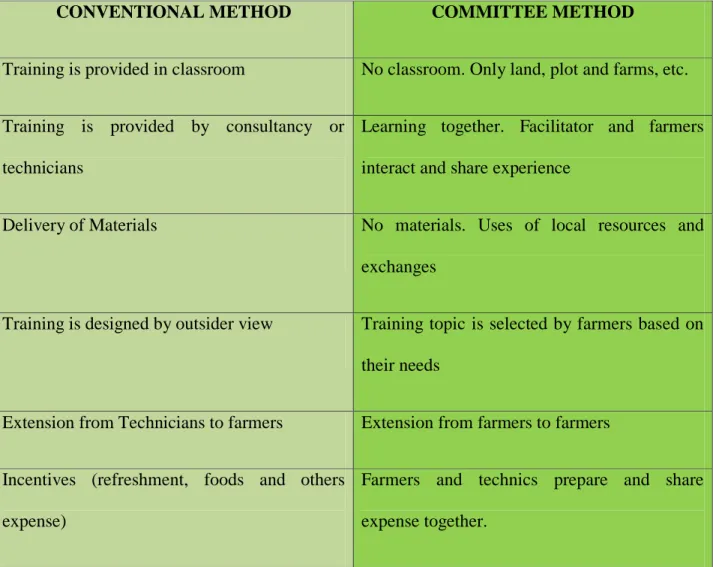
Table 4.7.1 Conventional versus Rural Committee Training Methods………..……..49
Table 5.4 Cooperative Potential Products and Farming Periods……….….68
Table 5.4.4 Organization Networks description………..80
Table 5.6 Community Social Changes……….87
LIST OF FIGURE Figure 2.4 Community Levels……….………15
Figure 2.4.2 Community Capacity Development and Policy Structure……….…17
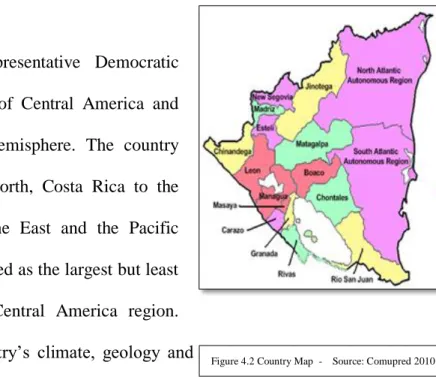
Figure 4.2 Country Map………..30
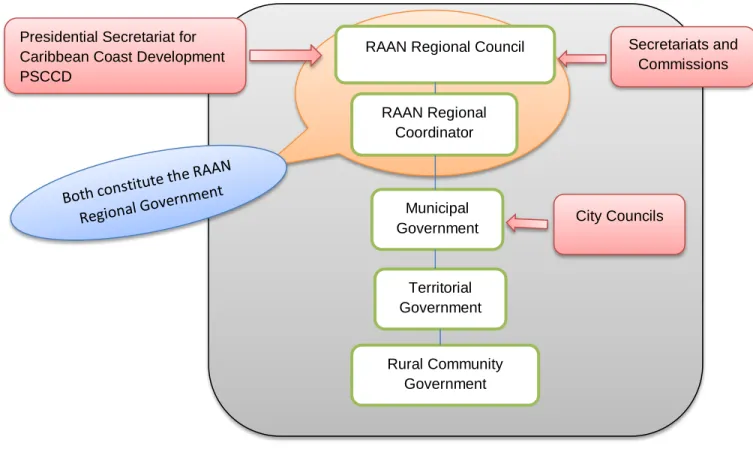
Figure 4.6 North Autonomous Region Administrative System………..47
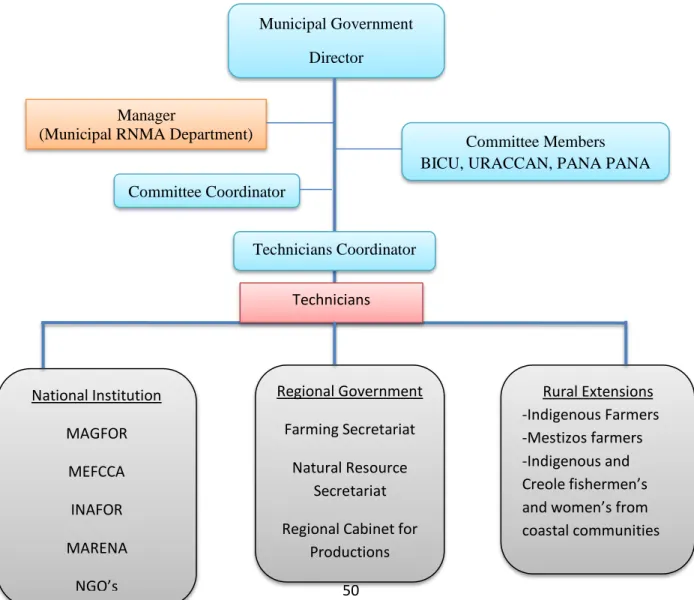
Figure 4.7 Puerto Cabezas Rural Development Committee Structure………50
Figure 5.2.1 Tasba Pri Government Operational Framework………60
vi
Figure 5.4.3 Cooperative Marketing Distribution Channels………..78
Figure 5.4.4 Organization Social Networks with External Stakeholders……….….80
LIST OF PICTURES Picture 4.7 Rural Development Committee Training Activities……….………51
Picture 4.7.2 Municipal Government Local Fair Exhibition……….……….53
Pictures 5.4 Traditional Farming Methods………69
Picture 5.4.1.1 Draying and Storage Process……….70
Picture 5.6 Farmers houses before and after production increased………..89
vii
LIST OF ABBREVIATIONS
BICU CIUM Bluefield’s Indian and Caribbean University
CRISSOL Christian, Socialist and Solidarity Program
ENABAS Nicaragua Food and Basic Grain Company
EU European Union
HIPC Highly Indebted Poor Country Initiatives
HAMBRE CERO Zero Hunger
INAFOR National Forestry Institution
INIDE Nicaragua Institute for Census and Statistic
INIFOM National Institute for Municipal Development
INTA Nicaragua Institute of Agricultural and Technology
IFM International Monetary Fund
GRUN Government for Reconciliation and National Unity
MAGFOR Ministry for Agriculture and Forestry
MEFCCA Ministry of Household’s Economy, Cooperative,
Associative and Community
MDG’s Millennium Development Goals
viii
NDP National Development Plan
NGO’s Non-Governmental Organizations
RAAN North Atlantic Autonomous Region
RAAS South Atlantic Autonomous Region
RDC Rural Development Committee
RDP Rural Development Plan
PANA PANA Microfinance Organization
PSCCD Presidential Secretariat for Caribbean Coast Development
PRPS Poverty Reduction Strategy Paper
PROMIPYME Promotion of Micro, Small and Medium enterprises
PRO-RURAL Rural Development Sectorial Plan
PRO-RURAL INCLUYENTE Rural Development Inclusive Sectorial Plan
UCOTAP Tasba Pri Communities Unions
UNAG National Union of Agricultural and Livestock Farmers
URACCAN University of the Autonomous Region of the Caribbean Coast of Nicaragua
USURA CERO Zero Usury
ix ABSTRACT
This research studied the experience of a grassroots organization in developing community capacity and improving the quality of life of San Pablo community members. The purpose of the research was to develop a clear understanding of how grassroots initiatives can bring social changes to community life. In details, the research describes the basic strategy introduced by the grassroots organization to achieve a manageable and realistic community development. The research also introduces Nicaragua Government major rural development programs designed with the goals to reduce rural poverty and increase economic growth. In line with the context of the study, it illustrates the experience and success of few citizens’ who have benefited with national rural development programs.
Community development and poverty alleviation has been the major concern of Nicaragua Government. Until date, several development strategies have been introduced by outside stakeholders, which mainly consist of microfinance loans, short-terms trainings, deliver of materials and equipment through projects, as a mean to increase production, economic growth and livelihoods. The study revealed that outsider programs are necessary, but not sufficient to ensure sustainability after program ends. These exogenous programs relief instant needs and does not focus on strengthening existing activities. This study demonstrate how rural people can also bring about endogenous initiatives for community development that can be more realistic, practical, cost less and appropriate to ensure sustainable community development. Community becomes more resilient, independent and sustainable when its individuals, groups and organizations existing capacity is enhanced. September 4th agricultural cooperative is demonstrated as an endogenous development initiative for community capacity. As the study focused on community members’ activities, feelings and experiences; it adopts a qualitative
x
approach based on a particular case study. Two types of data were used to structure the content of the research which includes primary and secondary data.
xi
TABLE OF CONTENTS
Acknowledgements………...……..ii
Declaration of Originality………...iv
List of Tables and Figures....………...v
List of Pictures…………..……….………vi
List of Abbreviations……….…vii
Abstract………..…ix
CHAPTER I INTRODUCTION……….1
1.1 Background of the study………...2
1.2 Research Problem………..………....4
1.3 Research Questions………5
1.4 Research Objectives ………..5
1.5 Significance of the Research………..6
1.6 Scope and Limitation of the Research………...6
1.7 Structure of the Research………...7
CHAPTER II THEORETICAL REVIEW……….8
2.1 Nature of Governance and Emerges of Decentralization……..…...………8
2.1.1 Decentralization……….8
2.1.2 Social Inclusion………...9
xii
2.1.4 Bottom-up approach………...………...10
2.2 Poverty and Economic Growth in Nicaragua………..10
2.2.1 Defining a PRSP’s………10
2.2.2 Poverty and Economic Growth………...………...11
2.3 Grassroots Organizations………...……….……….12
2.3.1 Organizational Leadership………13
2.3.2 Collective Activities………..13
2.3.3 Organization Networks……..……….……..14
2.4 Defining Community..………..……….…..14
2.4.1 Understanding Community Capacity...………15
2.4.2 Community Capacity Development and Policy Structure...16
CHAPTER III METHODOLOGY………..18
3.1 Introduction………18
3.2 Research Paradigm……….…18
3.3 Methodological Philosophy and Strategy of Enquire………19
3.4 Data Collection………..………20
3.4.1 Schedule………23
3.4.2 Case Study ………..……….24
3.4.3 Interviews………..25
xiii
3.5 Challenges and Experiences……….…….26
3.6 Summary……….…...28
CHAPTER IV NICARAGUA NATIONAL RURAL DEVELOPMENT PROGRAMS FOR COMMUNITY CAPACITY DEVELOPMENT………....29
4.1 Introduction………29
4.2 Country Information……….……….30
4.3 National Laws related to Community Development………...33
4.3.1 Law No.40. Law of Municipal Government and its Reforms………..34
4.3.2 Law No.28. Autonomous Status Law………..34
4.3.3 Law No.445. Law of Communal Property Regime of Indigenous people and Ethnic’s communities of Nicaragua autonomous region and the rivers Bocay, Coco, Indio, and Maiz………..35
4.4 Types of National Rural Development Programs………..………....35
4.4.1 Pro-Rural 2005-2009………36
4.4.2 Pro-Rural Inclusive 2010-2014…….………37
4.5 Localization of National Programs in the context of Development of Indigenous and Ethnic’s Communities of the North Autonomous Region…………..………42
4.6 Regional Government Administrative System………..46
4.7 The case of Puerto Cabezas Municipal Agricultural Program……….….48
4.7.1 Rural Development Committee………48
4.7.2 Municipal Government Local Exhibition Fair……….52
xiv
CHAPTER V A CASE STUDY OF SEPTEMBER 4TH AGRICULTURAL
COOPERATIVE………..56
5.1 Introduction………56
5.2 Tasba Pri and Territorial Government………...56
5.3 San Pablo Rural Community……….60
5.3.1 Hurricane Felix and Post relief Supports……….65
5.4 September 4th Agricultural Cooperative: A model of Village Organization………66
5.4.1 Leadership Influences………..…………...……….71
5.4.2 Collective Marketing ……….………...73
5.4.3 Cooperative Marketing Distribution Channels ………77
5.4.4 Organization Networks with External Stakeholders……….79
5.5 Policies Correlations of Cooperative, Community and Territorial Government………..84
5.6 Community Social Changes………..87
5.6.1 Citizens experience non-members of the Cooperative……….89
5.7 Brief Summary………..90
CHAPTER VI CONCLUSION………...92
6.1 Introduction……….…………92
6.2 Summary of Analysis………..………….…92
6.3 Suggestion for Further Studies………...94
1
CHAPTER I INTRODUCTION
The evolution of grassroots organizations in communities has been increasing numerically and playing a key role in carrying out the voice of community people. The nature and scope of informal groups’ activities offers an alternative approach to localize development programs to community levels. We have been experiencing numerous examples of good endogenous development initiatives that have been sustaining rural households for a long time, which can also be a pathway to boost rural economies and reduce poverty rate. A practical case study of an endogenous development is presented in the course of this research focusing on a grassroots organization experience in improving the living condition of San Pablo community members.
The overall goals of the study is to explore community members’ capacity for community development and the ability these possessed to bring about development changes for their community in a more practical and realistic manner. The shifted patterns of States administrative systems from centralization to decentralization reflect an opportunity for rural people scale-up out of their system and network outside community environment. Enhancing existing capacity is an important element for development.
The initiative of this study arose from the researcher experience involved in rural development and poverty reduction programs. As for many years, I have been working with municipal government and designed community development plans, programs and projects from a political perspective. After coming to Japan I wanted to explore new forms of developments that can contribute to enhance rural development programs of my region. After all I was lucky to be assigned a supervisor who’s had a vast experience on community capacity and rural development from whom I have learnt a lot. This qualitative case study research was carried out in a rural
2
community of the north autonomous region of Nicaragua. The study is comprised of primary and secondary data.
The first chapter is structured into seven sections. It begins with a brief background of the study. The second section introduces the research problems identified. The third, section provides a range of research questions followed by objectives and the research scope and limitation of the research. The chapter concludes detailing the significance and the structure of the research study.
1.1 Background of the Study
Nicaragua is the second poorest nation in Latin America after Haiti (World Bank, 2014). Poverty eradication, education and access to basic services are among the principal challenges of the country. The political instability and ten years of civil war collapsed national economy and increased poverty and extreme poverty rate in urban and rural areas. Poverty rate are high in rural areas, especially in the North Atlantic Autonomous Region (RAAN), home to most indigenous communities, where 37% of the populations live in extreme poverty (WFP 2013).
RAAN region is endowed with natural resources and cultural diversity. For over fifteen years, the centralized administrative system introduced different development approaches to develop community capacity most approaches were designed from a top-down level an urban perspective where external influence design the future of the poor. However, most rural development programs and approaches did not fit the context and needs of rural citizens. Many scholars have argued the need to change the traditional development approaches. Experts like Miyoshi (2010) claims “if centralize approach really appropriate for rural development? Can the development challenges of people residing in urban areas and rural areas be judged by the same perspective and criteria? Can the lives of people living surrounded by or with nature be equally and
3
adequately discussed alongside the lives of those who must seek and pay handsomely to come in contact with nature? I strongly doubt this urban centered approach”.
Within community there are different type’s local organizations and traditional governments, through which citizen’s identity, values, cultural system, community structure and capacity can be enhanced. The notion of strengthening people’s ability to create or maintain organizations that can represent and be accountable to them is the essence of a capacity-building approach Eade (1997).
Even though that Nicaragua has shown its commitment to combat poverty and develop community capacity there are still some gaps identified between policy theory and citizens real situation. Community people priority and needs cannot be same as urban people, cause of their different surrounding environment, geographic location, illiteracy, culture and lifestyle; these areas require different types of development approaches. Continue introducing exogenous programs makes community becomes more dependent on outsider support.
Within the North Atlantic Autonomous Region, particularly in Puerto Cabezas district few studies has been done on rural community development conducted on behalf of donors or government to measure programs/projects outcomes these studies were focused on cultural revitalization, gender equality, increase of agricultural production and value added, sexual and reproductive health, environment degradation, child protection, etc. I haven’t identified any research study focused on community capacity and policy structure. The promotion of endogenous development initiatives hasn’t been yet valued by external stakeholders.
4
1.2 Research Problem
Governments and donors are compromised with community development and poverty eradication. For decades, community developments model have been flowing from one direction from a top-down level. “The links of modern scientific knowledge with wealth, power and prestige condition outsiders to despise and ignore rural people’s own knowledge” (Chambers1983). In some way, these types of model lead to more vulnerability than before.
Within Puerto Cabezas district were cultural diversity exist programs should be created based on each territories traditions or ethnic group culture. Miyoshi (2010) indicated the need to create an alternative development approach that matches the needs of rural communities; people in rural areas should conduct development based on the values, visions and norms of the community they belong to. Whilst, Chambers (1983) stated that for a more complementary combination outsider professionals have to step down off their pedestals, and sit down, listen and learn from the rural area.
Despite of the large investment made by government and donors in implementing large programs or projects, rural poverty continues to remain as the core problem in Nicaragua. Within rural areas there is still lack of capacity for self-development, irrational uses of local resources, high dependency and other factors than hampering down the development of authentic communities within RAAN region. Nonetheless, as capacity building is an integral tool of development; therefore this study focus to demonstrate the capabilities of rural people to bring about practical development initiatives that are more realistic to rural lifestyle, handy, in harmony with nature and capable to main sustainable community development.
5
1.3 Research Questions:
To address the above problem the report main question was formulated as follow:
In what way grassroots organizations can contribute to community capacity development?
A range of sub-question was also formulated:
Sub-questions:
To what extent Nicaragua national rural development program enhance community capacity?
To what degree collective activities and social networks can empower grassroots organizations?
How community capacity can be transformed?
1.4. Research Objectives:
To explore the grassroots organization capacity
To clarify the types of national rural development programs
To describe organization type of collective activities and social networks
6
1.5. Significance of the Research
In the present era, all nations are compromised to improve the quality of life of those living in poverty and extreme poverty. There hasn’t been a unique global development strategy or approaches each developing countries and donors have different types of approaches; it has been shown that these approaches are designed from a top-down level, by those who are powerful, dominant and received formal education, training and believes that their knowledge is advanced, sophisticated and valid to design the future of those uneducated poor people living in rural areas. As knowledge is considers as key element to uplift development and ensure sustainability. From this perspective, the significance of this research is to present the capacity of community people on carrying out self-endogenous development initiatives that can contribute to community development in a more rural atmosphere. The importance of flows knowledge in many directions is an alternative strategy to enhance community capacity.
1.6 Scope and Limitations of the Research
The research focus on describing the experience of San Pablo community where a grassroots organization took the role of organizing community members, enhance group capacity and improve the quality of life of community members. The uses of quality approaches for case studies require talent and capacity to develop quality findings. The first limitation was timeframe and data gathering, since I was a student in Japan I had to go back to Nicaragua to identify a successful case study in a rural community. I had only four weeks to identify a successful case which result to be a bit difficult. Second limitation was the researcher inexperience in conducting and writing Master research report. Third, is language limitation since the researcher is not a native English speakers it limits my writing and analytical ability.
7
1.7 Structure of the Research
The present research is structured into six chapters and each chapter is subdivided into section. Chapter I introduce the basic framework of the study such as: Introduction, research question, objectives, scope and limitations and significance of the research. Chapter II is a compress of literature review of previous studies related to the research topic, as a guide to clarify the concept and theory of the study. Chapter III describes in detail the methodology of the study and data collection methods utilized. Chapter IV illustrates Nicaragua rural development programs and the way this was adopted by the RAAN regional government and applied to rural people lifestyle. Meanwhile, Chapter V focuses on a case study of a grassroots organization role in the context of community capacity development in the north autonomous region. Chapter VI concludes with a summary of the study and provides a list of suggestion for further research.
8
CHATER II THEORETICAL REVIEW
2.1 The Nature of Governance and Emerges of Decentralization
Literature on the term Governance is broad and it can be defined from different angle. Governance is the exercise of economic, political and administrative authority to manage a country’s affairs at all levels. It comprises the mechanism, processes and institutions, through which citizens and groups articulate their interest, exercise their legal rights, meet their obligations and mediate their differences (UNDP 1997). Researcher like Stoker & Chhotray (2009) defines Governance as the formal and institutional process which operates at the level of the nation and state to maintain public order and facilitate collection actions. On the other side, global institution such as the World Bank relate the terms Governance with Good Governance as the rule of the rulers, typically within a given set of rules (World Bank 2002). As globalization expands countries governing system tends to change. Furthermore the global institution states that good governance is epitomized by predictable, open and enlightened policy making; a bureaucracy imbued with a professional ethos; an executive arm of government accountable for its actions; and a strong civil society participating in public affairs; and all behaving under the rule of law (World Bank1994)
2.1.1 Decentralization
Decentralization has been a long-term trend in developed countries (Todaro & Smith 2011p.547). Global agencies defines decentralization as the devolution by central government of specific function with all of the administrative, political and economic attributes that these entail, to local governments which are independent of the center and sovereign within a legally delimitated geographic and functional domain (FAO,1997). There are different types of
9
decentralization. The World Bank (2001) relates administrative decentralization with tree major form of decentralization such as de-concentration, delegation and devolution each one have different characteristics
2.1.2 Social Inclusion
Social Inclusion is defined as a series of positive actions to achieve equality of access to goods and services, to assist all individuals participate in their community and society, to encourage the contribution of all persons to social and cultural life to be aware of and to challenge all form of discrimination (Kelly 2010). Social inclusion was defined as the process by which efforts are made to ensure equal opportunities - that everyone, regardless of their background, can achieve their full potential in life. Such efforts include policies and actions that promote equal access to public services as well as enable citizens’ participation in the decision-making that affect their lives (UNDP/n.d)
2.1.3 Participatory Planning
As society grows the planning process of governments have been changing. Participatory planning is defined as tool to identify the needs of all individuals within a community, a way of building consensus and a means of empowering disadvantaged groups (World Bank 2013). The need of social participation is becoming a common practice in developing countries. As stated by Olthelen (1999) defines participatory planning as the initial step in the definition of a common agenda of development by a local community and external entity or entities. Over the period, this initial step to evolve for the parties concerned toward a self-sustained development planning process at the local level. On the other hand, Karki (2012) claims that a planning process consist
10
of including stakeholders in the project design, in various collaborative capacities, from identifying critical problems, to setting priorities and deciding on which strategies to adopt.
2.1.4 Bottom-up approach
Development programs traditionally been characterized by a top-down approach (Karki 2012). The term top-down is used to describe an approach where appropriate public policies are put first in place followed by roll-out of programs to implement those polices (WFEO 2010, p.18). The top-down approach is structured around the use of professional leadership that plan, implement and evaluate development programs (Macdonald, 1995). While the bottom-up approach means that local actors participate in decision-making about the strategy and in the selection of the priorities to be pursued in their local area (ELARD, 2014). On the other side, some agencies claims that bottom-up approach is initiated when a person, institution or community sense a need and establishes a program itself without necessarily considering public policies or the lack thereof, and with the intention of effecting wide impact (WFEO 2010, p.18). Furthermore, it is argue that experience has shown that the bottom-up approach should not be considered as an alternative or opposed to top-down approaches from national or regional/authorities but rather as combining and interacting with them, in order to achieve better overall results (ELARD 2014).
2.2 Poverty and Economic Growth in Nicaragua
2.2.1 Defining a Poverty Reduction Strategy Papers
Poverty Reduction Strategy Papers refers as PRSPs were introduced by the World Bank and IMF as a new framework to enhance domestic accountability for poverty reduction reforms; a means to enhance the coordination of development assistance between governments and development partners; and a precondition or access to debt relief and concessional financing from both
11
institutions’ HIPIC Initiative (World Bank 2011). This strategy has created a new era of good governance and democracy for low income countries.
2.2.2 Poverty and Economic Growth
Poverty reduction has become a global concern. The term poverty is defines as a condition in which a person lacks many of the basic necessities of life and income needed to buy them (Economic-glossary 2008). Global governance like the United Nations claims that poverty is more than a shortfall of income and calories intake. Is about the denial of opportunities and choices that are widely regarded as essential to lead a long, healthy, creative and to enjoy a decent standard of living, freedom, dignity, self-esteem, and the respect of others (UN).
In 1996 the World Bank and IFM launched the Debt Initiative for Heavily Indebted Poor Countries (HIPIC) program to support those highly indebted countries as a mean to support growth and reduce poverty. In 1999 Nicaragua became part of the HIPIC program and draft it first poverty reduction strategy paper with major focus on economic growth and human capital. Nicaragua has developed several strategies to combat poverty and improve economic growth but it still remain as the second poorest country in the region with poverty rate of 42.5% (World Bank 2012).
Practitioners consider economic growth as the solution to reduce poverty. Todaro and Smith (2011, p.109), claim that every nation strives after development. Economic progress is an essential component, but it is not the only component. For decades, Nicaragua economic history has been focused on crops. The country economy grew rapidly in the 1950s and 1960s as Nicaragua converted its best lands into fields of cotton and canes, or pastures of beef cattle. As
12
the fastest growing Central American economic at this time, by the turn of 1970s it was also the region’s most prosperous economy (Wiggins 2006).
2.3 Grassroots Organizations
With the emergences of global entities around the world the meaning of grassroots organizations have been changing its definition gradually. The basic dictionary of Miriam-Webster defines of the word grassroots as being, originating or operating in or at the grassroots, not adapted from or added to an existing facility or operation (Mirriam-Webters dictionary). Researcher like Batliwala (2002) states grassroots as the basic building block of society-small rural communities or urban neighborhoods where the “common man” (or women) lived. Grassroots organization it is value based process where people are brought together to act in the interest of their community and the common interest (Shah et all 2013)
Organization is a system of consciously coordinated activities or forces of two or more person (Barnard 1939, in Kreitner & Kinichi 2007). Organization consist of groups of individuals, bound by a common purpose involving a defined set of authority relations and dedicated to achieve objectives (Alsop & Kurey 2005, p.5). On the other side, researcher such as Hatch (2007) states that an organization is a social structure, a technology, a culture, a physical structure and as part of an environment. The author argue that organization should be studied in terms of the central issues and recurring themes of organizing that its traced from a stage of control, conflict, decision making, power, politics and change. Whilst Kreitner and Kinichi (2007, p.5) considers organization as a social invention that help us to achieve things collectively, since we could not achieve alone both authors emphasis the organizational behavior on three basic level of analysis individuals, groups and organizational.
13
Organizing is the process of helping people understand the shared problem they face while encouraging them to join together to fight back. Rubin & Rubin (2001, p.6) claims that organizing enable people and their community to gain the capacity to take actions for change, a capacity that we label as development. Also, it can be seeing as place of people interaction, share information and gain confidence.
2.3.1 Organizational Leadership
Literatures on leadership is enormous and the have been many practical case studies illustrated by scholars and organizations. Leadership is a tool of change and development. Leaders play a key role in transforming society (World Bank, 2011). Whilst, Chaskin and colleagues (2001) defines leadership as one of the core strategies of an organization development; they facilitate and give direction to the work of a community organization, they advocate for community interest and catalyze the formation of informal groups to address emerging problems or capitalize on opportunity. Storey (2004) claims that transactional leader, are managers whose seek to operate and maintain current system, accept given objectives and meanings, control and monitor, rade on exchange relationships, have a short-term focus and focus on details and procedure. For the purpose of this study organizational leaders is considers as a visionary person whose naturally possess talents and ability to influence others individuals and to bring about social changer for the well-being of its surrounded members.
2.3.2 Collective Activities
The science of group dynamics is based on one core assumption that people act collectively. Forsyth (2010) defines collective activities as the action of a group of people who are responding in a similar way to an event or situation, including people who all occupy the same location.
14
Similarly, Barreda (2011) states collective activities as a collection action that emerges when people come together and work towards a collective goal. Whilst, Gilchrist (2004, p.44) express that collective action enable people without much power to assert their interest and influence decision maker.
2.3.3 Organizational Networks
Social network is an element of social capital. Every kind of social aggregation can be represented in terms of units composing this aggregation and relation between these units is a kind of representation of social structure is called “social networks” (Martino & Spoto 2006). Network is an intermediate mechanism through which individuals establish trust and build the basis for enduring role relationship (Bott, 1995 in kilduff & Shipoilov 2011). Whilst, Putman argue that social capital and trust goes hand in hand due to reciprocity trust breeds trust and this build social capital into organizations and societies. Many scholars claim that network is a unique form of organization that takes time to develop (Kilduff & Shipilov 2011). Gilchrist (2004) confirm that network contribute to empowerment on a psychological level, by enabling people to compare their experience, learn from each other’s success and develop greater awareness.
2.4 Defining Community
Community is as a group of people who regardless of the diversity of their backgrounds have been able to accept and transcend their differences enabling them to communicate effectively and openly and to work together towards goals identified as being for their common good (Hampton 2000). The term community is also defined as a relative aggregation constructed by individuals, groups and organizations acknowledged by a specific area, generally defined by
15
administrative boundaries, and within this boundary, these individuals, groups and organization recognize themselves as being a member of the community (Miyoshi 2010). Moreover, international agency such as IFAD (2009) defines community as the locus where all members of a group of people, having some form of collective claim over a territory and reorganizing some form of collective governance, can be given the opportunity to influence decisions in matters of public choice that affect their livelihood.
Figure 2.4 Community Levels
Note Source: Miyoshi 2010
2.4.1 Understanding Community Capacity
Community Capacity is defined as the interaction of human capital, organizational resources and social capital existing within a given community that can be leveraged to solve collective problems too improve or maintain the well-being of a given community. It may operate through informal social process and/or organized efforts by individuals, organizations and the networks of association among them and between them and the broader systems of which the community
16
is a part (Chaskin 1999). Also, community capacity is defined as the as a basic element that enables a community to function and refers to the ability to achieve the communities shared goals as well as to promote and maintain the richness of the community through the collective efforts of individuals and organizations within a community, utilizing the human, organizational and social resources available (Stenning & Miyoshi 2010). On the other side, Mayer (1995) defined community capacity as the combined influence of the community’s commitment, resources and skills that can be developed to build on community strengths and address community problems. Furthermore, he argue that a variety of community groups and institutions contribute to community capacity. Each is a potential partner in the work of strengthening the viability and vitality of community. In partnership, each can gain in capacity.
2.4.2 Community Capacity Development and Policy Structure Model
Capacity Development is the central process of long-term development. It is the process through which the ability of individuals, institutions and societies to perform functions, solve problems, set and achieve objectives in a sustainable manner is developed and maintained over time (UNDP 2002). However, enhancing community capacity is referred to as community capacity development. Community capacity development is seeing and creating strengths and opportunities than can lead to development, in order to promote positive change within the community. Capacity is developed through attempts of the community to develop and maintain these discovered strengths and opportunities (Stenning and Miyoshi 2010)
Furthermore, the authors introduced a Policy Structure model that provides the foundation to analyze the community capacity development by utilizing a Program Theory Matrix (input, activities, output, intermediate outcome and final outcomes) to measure ends and means from a
17
policy, program and project levels. The Policy Structure model consist of community economic, social, environmental and political activities is implemented and carried out with the goal of changing people’s lives by creating a community that secure richer lifestyles with more added value. In figure 2.4.2 is illustrated Community Capacity Development and Community Policy Structure Model created by Chaskin and colleagues and modified by Miyoshi and colleagues.
Figure 2.4.2 Community Capacity Developments and Policy Structure Model
Note source: Miyoshi and colleagues 2010
Intermediate Outcomes (Change of Target Group) Outcomes of Community (Change of Society) Outcomes Outputs Economic Formal/Informal Collective/Individual Social Formal/Informal Collective/Individual Environmental Formal/Informal Collective/Individual Political Formal/Informal Collective/Individual Inputs
Community Policy Structure
Characteristics of Community Capacity Sense of Community
Commitments
Ability to Set and Achieve Objectives Ability to Recognize and Access to Resources
Strategic Components Human Resources Leadership Organization Network Historical Condition and Context
Decentralization
Community Community Capacity Implementation
Function Planning Implementation Evaluation
18
CHAPTER III METHODOLOGY
3.1 Introduction
This chapter describes the methodology utilized for the study and types of data collected. The chapter is divided into six sections. The first part provides a description of the type of research paradigm of the study. Second part, presents an overall view of the differences between qualitative and quantitative methods, as well as the strategy of enquiry utilized for the specific case study and the fact why this is relevant for the study. The third part, provide a description of the two types of data utilized and the way it was collected this is subdivided into three sub-sections such as field visit schedule, case study, interviews, observation and the list of challenges identified during the field work.
3.2 Research Paradigm
Over decades the nature of social sciences has been a controversy to researchers. Until date, for many scholars when talking about science is understood as experimental chemistry and biology science. According to Neuman (2000 p.64) it was until 1800’s philosophers and religious involved in armchair speculation studied or wrote about human behavior. In fact, that our modern civilization has agreed on the need of a special science to study the social life of people, looking deeply into human behavior within specific social setting rather than focusing on a broad picture.
Many philosophers argue that it does not matter the field or type of science people wants to study what’s matter is the type of paradigm used to conduct the study. Brett (2007, p.9) argues that in
19
carrying out research into people’s opinions, feelings, experiences or behavior need to use one of the two referred paradigms qualitative or quantitative. Both deliver useful and informative outputs but each serves a different purpose and has been the subject of academic circle discussion. On the other side, Holliday (200, p. 6) claims that quantitative is normative. He states that there is a normality that we can fathom and understand, and master by statistic and experiment. Qualitative approach is an interpretive it maintains that we can explore, catch glimpses, illuminate and then try to interpret bits of reality.
Naturalism or post positivism result to have a more traditional qualitative view much closer to positivism in that reality is seen as relatively straightforward interpretative and naturalistic focus to the world (Holliday 2007. p 18-19). Taken from Hammersley and Atkison (1995:11, their emphasis) states that postmodern qualitative researchers portray people as constructing the social world and researchers as themselves constructing the social world through their interpretation of it.
The roots areas of a qualitative method are embedded in philosophical, psychological and sociological sciences and it focus on resolving simple questions such: How do we know what we know? How do we know what other people feel? Is what people say different from what people do? These and other similar questions are discoursed to qualitative approach. As qualitative research consists of studying things in their natural and authentic setting, that makes phenomena visible to world. In this sense, this research adopts a “qualitative descriptive method”, because of the nature of variable information which cannot be measureable it is characterized by the feelings and opinion of the people.
20
The nature of qualitative research can be, realistic, dynamic and interactive in the field. Qualitative research methodological process can be crucial and distinctive in its first stage. Some scholars consider that a research is a process of engaging in planned and unplanned activities related to the real world which can be explored, interpretive and constructed through various methods. However, researchers like Brett (2007, p.151) argue that qualitative research methods stretches from interviewers and observation to the use of artefacts, documents and records from the past; from visual and sensory data analysis to ethnographic methods.
Focusing on small case study can be very practical and ideal for new entry-level researchers. Case studies offer student the opportunity to focus attention on the topics relevant to their field without being tied to what they may see as too narrow an approach to methodology (Brett 2007 p.184). When talking about case study it can be focused on an organized small group, small town, a village, a seminar group or a family. Brett continues stating that this type of research includes the exploration of background statistic the review of documentary evidence and data from interviews, groups or observations. As this inquiry is focused on a qualitative research with emphasis on human being activities in their natural setting. The specific, case study strategy was adopted cause of the authenticity of field activities identified within the location of the case study which is in alignment with existing theories and elements that shape a qualitative research. Moreover, for a more comprehensive understanding the researcher adopts a descriptive case study utilizing interview and observation methods.
3.4 Data Collection
Gathering data for this research was very excited and fun I had getting the opportunity to live with rural people, interact directly, experienced their lifestyle as well as the community unique
21
and authentic environment. However, for this research there were two types of data collected primary and secondary data. The method employed to gather these data was through:
- Informal tailored interviews and open ended. I did not utilize formal interview category - Observations of local citizen’s daily activities including individuals, groups and
organizations
- Visual data such as photographs - Voice-recorder. and
- Collection of relevant documents
At the beginning I took few writing notes but to be more exploratory I decided to utilize two voice-recorded apparatus by placing one on the researcher and the other on the interviewee while having lunch, walking around the community and in other occasion while sitting on rocks in the corn plantation.
The primary data was collected from field visit through direct interviews, observations, photographs and using a voice-recorder (Iphone 4S). The data was collected from San Pablo rural community, specifically from three different groups. First, I collected data from members of the agricultural organization which is the target case study of this research, the organization is known as “September 4th
Agricultural Cooperative”. The second, range of data was collected from the community traditional government and territorial government members. The third range of primary data was collected from interviews made to local citizen’s whose do not belongs to the agricultural organization but somehow has gained benefits from it.
Another range of primary data was collected from Bilwi urban city by direct interview made to public officers from central government institutions branches, Presidential Secretariat for the
22
Caribbean Coast Development members, RAAN regional government secretariats and councils board and Puerto Cabezas municipal government practitioner; all these public institutions are deeply involve with rural development planning and programs implementations. As a researcher after interviewing public officers and hearing all positive result of the government rural development programs, I decided to expand the interviewees list and rush towards society to interview citizens whose had been benefited with the national rural development program with the purpose to get the insight of these beneficiaries and to explore the social changes brought to their lives. All data was collected in Spanish language and translated into English language by the researcher.
The other type of data collected was secondary data that was used to shape the context of few chapters of this research. Some of the secondary data was given during the interview moment and others were downloaded from the institution websites as well as from journal articles and NGO’s websites such as the World Bank, UNDP and IFM database site. These data are public documents and are accessible to everyone such as Nicaragua Poverty Reduction Strategy Paper, National Human Development Plan, Government National Development Plan and the Caribbean Coast Development Plan. Also, others data was gathered through books, lecture notes and JICA training materials all are referenced at the end of this research.
At the time of collecting primary and secondary data I was a government public officer studying at the Ritsumeikan Asia Pacific University in Japan, as part of the technical cooperation program between the government of Japan and Nicaragua. I was sent on behalf of my country but representing Puerto Cabezas municipal government and the Rural Development Committee of Tawan Ingnika in my region, which has made possible the data collection process. Before going into to the field the municipal authorities provided me support with transportation facilities,
23
drivers and a technician to permanently accompany me during the visit Tasba Pri rural community.
3.4.1 Schedule
During my visit to the Republic of Nicaragua primary data was collected through interviews made to policy makers and rural-urban citizens of San Pablo community and Bilwi city located in the north autonomous region of Nicaragua. The period scheduled for this fieldwork was from August 30 to September 30, 2013. Prior to my visit to Nicaragua previous coordination was already arranged with the President of Tasba Pri territorial government and RAAN regional government members. Initially, the field visit program was scheduled to conduct in two parts but after conducting the first field visit I found it necessary to return back twice to the community.
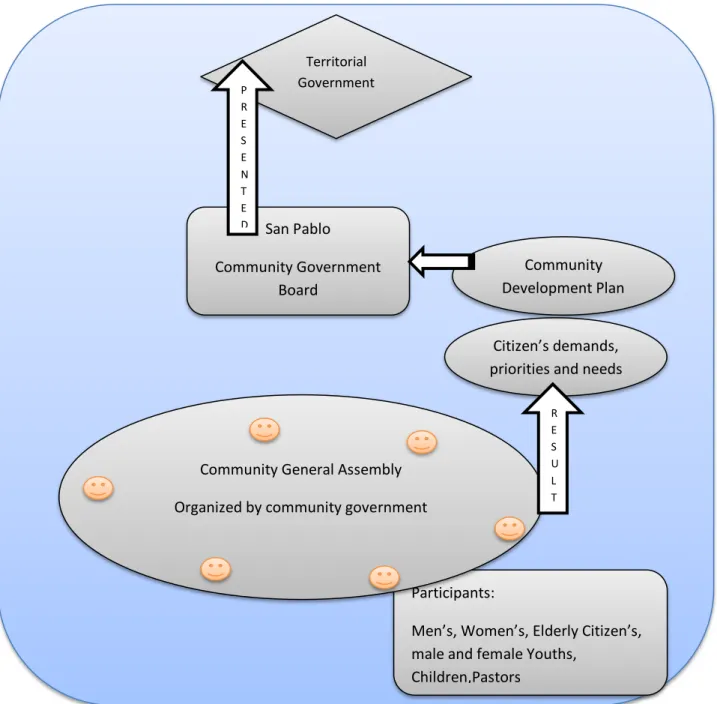
The first field visit was schedule from September 5 to 10 data was collected from local organization located in Sumubila, Naranjal and Sahsa communities which initially was the target case study of this research study; at the same time an informal meeting was held with the President of territorial government. The second visit was from 14 to 15 September, this is a national holiday in Nicaragua (Central America Independence Day) but I schedule field visit for these holidays, bearing in mind that it would be a proper moment to find all community people at their home. In fact, during this second visit I was able meet all target interviewees data was collected from San Pablo community government staff and members of September 4th Agricultural Cooperative organization; at the same time I was invited to attend the upcoming Community General Assembly. The third field visits was from 19 to 20 September, in this occasion the purpose was to homestay with rural people and attend as a volunteer community General Assembly as well as to observe Tasba Pri Cooperative Union organizations monthly
24
meeting. The Tasba Pri Cooperative Union meeting was held in Sasha community which is 30 minutes drives from San Pablo community. During the homestay days I continue interviewing few rural women’s who’s belongs to other organization inside the community and has been benefited with outsiders programs.
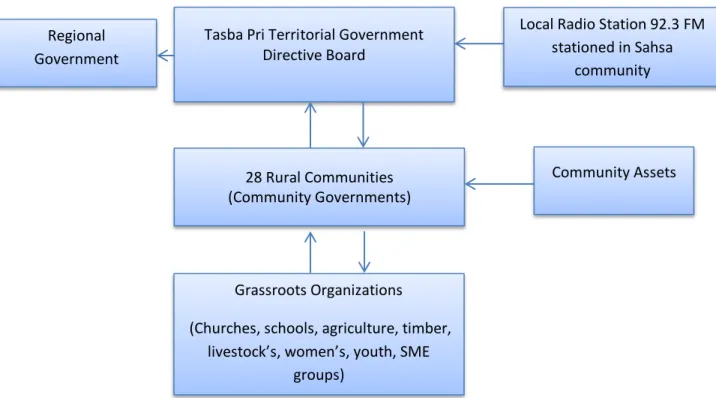
As was mentioned in chapter one of the introductory section, Tasba Pri territory is compose of 28 rural communities within each community there are different type of grassroots organizations constitute. However, when all gather together as a territory they are known as Tasba Pri Cooperative Union Organizations, currently these organizations directive board is manage by the President of the September 4th Agricultural Cooperative.
During the last week of September month visit was made to central government institutions branches local in Bilwi urban city such as Ministry of Households, Community, Cooperative and Associative, Ministry for Agriculture and Forestry, Puerto Cabezas municipal government specifically at the department of environmental and natural resources, the north autonomous regional government secretariat for regional planning, secretariat for municipal and indigenous community development, secretariat for regional economic development and the Presidential Secretariat for the Caribbean Coast Development located in the capital city of Nicaragua. Finally, I interviewed few urban citizens whose has been benefited with the government national rural development programs.
3.4.2 Case Study
San Pablo agricultural cooperative organization is the target case study of this research. Initially, I was targeting others community organizations but after conducting the first field visit and dialoging with local citizens and community governments leaders they pointed out San Pablo
25
community agricultural cooperative organization as the most organized and developed organization within Tasba Pri territory. At this time, I was in Sumubilia community interviewing the religious organization and community leaders they helped me to establish contact with San Pablo community government and the President of the agricultural organization, so I immediately moved forward to the community and overnight there.
The following day I visited the community leader and the reverend father of the Catholic Church to explain the purpose of my visit and time stay in the community, in order to get the community authority support. In Nicaragua it is very common when stranger visit rural communities most people believes that is for project purpose, so before starting the informal interview I had to clarify the purpose and uses of the data and therefore explain how this study can benefit the organization and community in the near future.
Since much study has not been done on community capacity development in my region, and as native citizen of this region who’s has been involved in rural development programs over past five years, I had decided to focus my research study on identifying a successful case study utilizing Miyoshi and Stenning (2008) community capacity development and policy structure model, as a guide tool to identify endogenous development initiatives that can be uses as a reference tools for communities development as well as for present and future researchers.
3.4.3 Interviews
Previous to my field visit some data did already collected via skype and telephone calls made from Japan. However, before traveling to the field a set of formal questionnaire was developed and printed to give to selected interviewees but after meeting with community leaders and cooperative members, I introduced myself as a native citizen of the north autonomous region. At
26
this point I notice there was no need of conducting formal structural interviews, I realized data can be much more explored and gathered through our social interaction and informal conservation (interviews). So I decided to be more flexible with interviewees in order to make community people gain confidence and freely express themselves.
As Puerto Cabezas municipal government assigned me a driver and a technician to accompany me full time to Tasba Pri rural communities. In this manner, I involved them in the fieldwork activities. Interviews were conducted with one leading the conversation, other holding and pinning the voice recorder instruments on the interviewee and the driver plays the role of photographer without previous experience of being a photographer. All conversation where hold in Spanish language and then analyzed into categories and translated into English language.
3.4.4 Direct Observation
When utilizing observation techniques it requires the researcher full concentration in order not to lose the balance between the conversation and the subject in observation. Observation is a tool to describe social reality it demands participant involvement in the study field. However, according to Taylor-Power and Steele (1996, in Suhonen 2009) stated that seeing and listening are key aspect of direct observation. The method provides the opportunity to collect such data for instance might be difficult to collect via questionnaire or interviews. Holliday (2007, p.65) consider that visual data and descriptive data both are ways of representing what a researcher sees.
3.5 Challenges and Experiences
27
As in all research challenges will always be along the way and new experiences and lesson will always be learnt. The first challenge confronted was the time frame. Despite the small sample of a case study, it require more time to explore people feelings and community activities, I needed to interact more with community people to explore information of the before and after of the agricultural cooperative organization existence. My trip to Nicaragua was programed for 30 days and it took me 3 days to travel from Japan to the target community and vice-verse. However, I had a limited timeframe of three weeks to conduct my fieldwork, in such limited time, I had to manage to identify a successful case study and collect all possible data.
Experience 1: To explore the experience of a community capacity development it require time,
especially when the focus case study is located in an isolated communities.
Challenge 2
The second challenge identified was the climate season. Nicaragua autonomous regions are characterized by having tropical climate season known as the raining season. In RAAN region it usually rain from May and November months and during these six months it is very common to have floods and hurricanes. However, two week before conducting the field visit a tropical storm had recently affected the area and during the field visit another tropical storm was developing in Atlantic Ocean that has caused lots of heavy rains, strong winds and floods in some communities of RAAN region.
Experience 2: When planning to conduct field visit we need to take into consideration climate
season of the target area as well as to have a plan B in case of heavy floods and hurricane.
28
The third challenge was infrastructure accessibility, the highway road to San Pablo community is not paved and the target agricultural organization members farm was located about three kilometers away from the community center in the high forest zone which made it difficult for car accessibility. The researcher, helpers and farmers had to ride horses to enter the corn and rice plantations.
Experience 3: Exploring community people lifestyle through a dynamic interaction, observation
and homestays has made me learned the quality of capacity rural people possess to bring about changes. As a government officer I never explored this type of development approaches before. It was a wonderful experience riding horses and dialoguing with local citizens.
3.6 Summary
This chapter presented the research methodology utilized and the reason for adopt a qualitative approach for this study. It provides the view of some philosopher’s on the debate of quantitative and qualitative approaches as many agreed when studying human being researchers needs to be realistic, exploratory and flexible to catch of the world. The uses of artefact’s is an important tools to help construct and interpret reality. As a qualitative approach is considers as dynamic and interactive in-depth interview and observation methods became part of the study of particular case study entitled “Grassroots Organization for Community Capacity Development: A case study of agricultural cooperative in the rural community of San Pablo, northern autonomous region of Nicaragua. This crucial methodology is distinctive and appropriate for student or beginner’s researchers. In the context was highlighted a list challenges and experiences acquired during the field visit as well as the types of artifacts uses to gather data.
29
CHAPTER IV NICARAGUA NATIONAL RURAL DEVELOPMENT PROGRAMS
FOR COMMUNITY CAPACITY DEVELOPMENT
4.1 Introduction
This chapter describes Nicaragua government national rural development program introduced as a mean to reduce poverty, increase production and develop communities. It explores in details to what extent the program enhance community capacity and the types of development approaches utilized for community development. Furthermore, it describes the north autonomous regional government experience in localizing national programs to the context of indigenous and ethnic community development. Finally, the chapter concludes by highlighting the case of Puerto Cabezas municipal government agricultural program for community development.
Data for this chapter was collected through direct interviews made to authorities and practitioners from the national, regional and municipal governments. Furthermore, a second range of data was collected from local citizen whose has been benefited with the national rural development program with the purpose to get their opinion, experience and success of the government rural development program. To shape the context of the chapter I used some secondary data that was provided by interviewees. These were relevant public document such as Nicaragua National Development Plan, Population census and rural community development Plans documents.
30
4.2 Country Information
Location: Nicaragua is a Representative Democratic Republic, located in the center of Central America and north land of Latin America hemisphere. The country borders with Honduras to the north, Costa Rica to the south, the Atlantic Ocean to the East and the Pacific Ocean to the West. It is categorized as the largest but least densely populated country in Central America region.
Geographically, due to the country’s climate, geology and ecological characteristic it is sub-divided into three regions: pacific south-western region, central region and autonomous region. Governance: The administrative system of the country is governed by four principal organs:
1) Legislative, Parliament or National Assembly composed of 92 national deputies
2) Judiciary power maximum court for justice integrated by 16 judges assigned by the Parliament
3) Electoral organ is the supreme electoral council that seeks for national elections process and provide national ID card, and
4) Executive organ is integrated by the President of the Republic and its group of cabinet.
For administrative purposes the country is divided into 15 departments and 2 self- governing regions known as North and South Autonomous Regions. The departments and regions are then sub-divided into 153 municipalities or districts. Most of these municipalities are located in the
31
western pacific and central area of the country and less than 20 municipalities in the autonomous region (Campbell 2008). Table 4.2 illustrates Nicaragua departments and regions and their capital city:
Table 4.2 Nicaragua Political and Administrative Division
No. Departments/ Districts Capital City
1 Managua Managua
2 Masaya Masaya
3 Matagalpa Matagalpa
4 Nueva Segovia Ocotal
5 Rivas Rivas
6 Rio San Juan San Carlos
7 Madriz Somoto 8 Leon Leon 9 Jinotega Jinotega 10 Granada Granada 11 Estelí Estelí 12 Chontales Juigalpa 13 Chinandega Chinandega 14 Carazo Jinotepe 15 Boaco Boaco
16 North Atlantic Autonomous Region -RAAN
Bilwi, Puerto Cabezas 17 South Atlantic Autonomous Region-
RAAS
Bluefields
32
For over fifteen year the country governing system was centralized at the central level. Since 2007 the administrative system were changed from centralization to decentralization system, national economic were reform and democratization became widespread.
Population and Poverty Rate: Nicaragua is the second poorest country in Latin America after Haiti. According to the World Bank data on Nicaragua, the country has an estimated population of 5.992 inhabitants and a poverty headcount ratio at national level of 42.5% as 2009 latest report (World Bank 2010). The national population consists of 69% mestizos (mixture of Amerindians and European), 17% white (European ancestry origin), 9% creole ethnics (Afro-descendant) and 5% indigenous people’s (Walker 2011). Poverty remains widespread and varied considerable by region. Nicaraguan rural poverty people is characterized as illiterate, lack of access to basic services, limited access to sanitation facilities, unnourished, poor housing quality, vulnerable to natural disaster, dependence and lack of capacity for self-development.
Spanish is the country official language although local natives’ languages are widely spoken in the autonomous regions. Nicaragua is vulnerable to natural disasters like earthquakes, volcanoes eruptions, floods and hurricanes; the country also experiences constant civil strife and market fluctuations in commodity prices.
Economy: Economically Nicaragua is an agricultural based country, where 60% of its national exports are based on agriculture products produced in the central region of the country. Some of the main growing products for exports and consumptions are: coffee, beans, sesame, groundnuts, cacao, corn, cassava, banana, tobacco, sugarcane, vegetables, fruits, root crops (Walker 2011). Also, small industry such as textile goods (maquilas), banking, mining, fisheries are generally expanding within the country. Tourism has becoming a very important source of income and is
33
expanding across the country. Remittance from Nicaraguans living abroad and foreign assistance are also a source of foreign income that contributes to the national economy.
4.3 National Laws related to Rural Community Development
Within Central America region Nicaragua is categorized as one of the country with most Public Laws, there are laws created most all developmental sectors. According to the country national constitution of 1987 in its article 99, defines that the State is responsibility to develop, promote and manage all public goods of the country. Also to promote social democracy, public-private enterprises, foster development at the urban and rural levels and guarantee freedom, rights and equality to all Nicaraguans. Since the adoption of the constitution until date there has been several amendments made to it, from which is derived a set of public policies related to administrative, social, political, environmental, economic consolidation with the purpose to create a more efficient and operational public sector.
The present administration known as Government for Reconciliation and National Unity (GRUN) which is in function since 2007 is considered as the first Nicaraguan government to have a humanist vision of development, where social injustice, poverty alleviation, social inclusion, gender equality and human capital is define as national priority. From this perspective all national laws, policies, amendments and protocols are design to achieve a sustainable growth.
The researcher have identified several public laws concerning to community development that are related to gender equality, citizen social participation, education and health policies, basic services, environmental and local resources protection and conservation, cultural promotion, agricultural and livestock policies and so on, but for the purpose of this report the three principal laws concern the north autonomous region developments which is described below: