
Representation of the Non-Representable : Synaesthetic Concepts in Chinese Landscape Painting
18
0
0
全文
(2) 立命館言語文化研究 28 巻 4 号. Introduction Artistic representation has an aesthetic value in that one can attempt to show the insubstantial through the substantial. The purpose of representation is at first the transformation of one s own thought, emotion and mind, and then its transference into another person s spirit. However, in the perception and representation of landscape not only personal feelings are significant, but also the respective theories and ideas about the constitution of nature and human beings. Referring to the traditional theory of landscape painting, this paper examines in which way the objective landscaped world can at all be represented subjectively in traditional Chinese landscape paintings, and which elements of nature are regarded as the non-representable in Chinese landscape painting, and how the Chinese painters dealt with the limitations of representing the sublime in nature.. 1. The term synaesthesia The origin of the term synaesthesia lies in the ancient Greek words syn and aisthesis and means the sense of perception. It refers to the simultaneous stimulation of other organs of the senses when a different one has been affected: For example, we smell or hear something, when actually we are seeing. 1) Synaesthetic perception provides a condition in which one type of stimulation evokes the sensation of another, as when the hearing of a sound produces the visualization of a colour. In other words, one of the most common types of metaphoric, connotative and associative transference is synaesthesia. Synaesthetic perception makes metaphors and associations possible, and synaesthetic metaphors are a category of primary metaphors that are basic in human perception and expression. 2) Synaesthesia, called lianjue 聯覺 or tonggan 通感 in Chinese, gonggamgak, kyōkankaku 共感覚 in Korean and Japanese. Synaesthetic metaphor has been used over the centuries as a conscious element of style to increase the quality of poetic and artistic expressions, such as the German scholar Günther Debon remarks in his book Chinesische Dichtung: In all languages, synaesthetic expansion of expression is often simply the result of the poverty of language. Only when it is used consciously by the poet does it become an element of style. 3) As a good example of the use of synaesthesia in poetr y Debon names Li Bai s 李白(701-762) poem Yujieyuan 玉階怨( Sorrow on the Jade Steps ). Li Bai elegantly uses the double meaning of the word linglong 玲瓏, which in its primary usage refers to the sound that semi-precious stones, such as jade or rock cr ystal, make when they are str uck against each other. Without the synaesthetic expansion of meaning, the verse would be translated thus: −4−.
(3) Representation of the Non-Representable(LEE-KALISCH). She opens the heavy curtain of rock crystal, looks up to the autumn moon through the cristalline sound linglong. 却下水晶伩 , 玲瓏望秋月 But in reference to the sense of sight, linglong means radiant or splendid. Debon translates it as shimmering splendour. In other words, as we see we should also hear a shimmering splendour of cristalline sounds. Keeping this in mind, the verse should be translated thus: She opens the heavy curtain of rock crystal, looks up to the moon through the shimmering splendour. 4). 2. Synaesthetic concepts and the Song-court academy(Huaxue 畫學) Chinese painters as well have consciously used synaesthesia in order to expand the dimensions of their presentations. Whether it is objects or elements actually depicted in the painting, or words or even the calligraphy of the poem inscribed on the painting – all can serve as a synaesthetic trigger to the imagination of the beholder. Here, it is not a detailed naturalistic representation that stimulates the synaesthetic leap, but the conscious painterly conception and reduction of means. Two anecdotes from Emperor Huizong. 宗(1082-1135, r. 1101-1126), recorded by the Qing. dynasty scholar Zou Yigui 鄒一桂(1686-1772)in his treatise on painting, Xiaoshan huapu 小山畫譜, 5). in the chapter, Jiegou 結構 , on artistic concepts illustrate this point nicely. Both stories. describe painting competitions among the painters – civil servants – at his court academy(Huaxue 畫學). The emperor often used verses from ancient poets(guren shigou 古人詩句)as the basis for the competition, and court painters were to illustrate them. In the first anecdote, the task was to illustrate the following poem: At the bridge s edge the tavern, surrounded by bamboo. 6). 竹鎖橋邊賣酒家 Many contestants set the tavern, carefully painted in detail, in the center of the painting. But the painting that won showed only a little pennant, hanging on the bridge on the other side of the bamboo grove. On it was written the word jiu 酒 , meaning wine or alcoholic beverage. The banner is the synaesthetic means which invites the obser ver to imagine the tavern in all its activity, colours, sounds, tastes and smells. In this poetic and charming way it becomes the center of the painting without actually being painted. 7) −5−.
(4) 立命館言語文化研究 28 巻 4 号. In the second tale, this verse was the basis for the competition: My horse gallops through the flowers; fragrant are his hooves. 8). 踏花歸去馬蹄香 Most of the contestants painted a man on horseback, riding through a landscape full of blooming trees. However, the candidate who won the prize smeared red paint, whirled up, on the path, and painted a pair of red butterflies who flew about as if startled by the horse. The red smear was associated with flower petals stamped upon and, therefore, releasing their fragrance to the hooves of the horse. These descriptions of the winning paintings clearly show that the painters renounced simple naturalistic representations of numerous details and instead focused upon clear, simple elements, which in turn evoked further sensory associations. Based on the judgement of these paintings, we see how the synaesthetic content of artistic concepts takes central stage.. 3. Synaesthetic concepts to capture the quintessence The synaesthetic concepts are also used to capture the quintessence of nature. As we know, the goal of Chinese artists was not to achieve a naturalistic reproduction of objects, but rather to transcend the mere object by capturing its essential quality, its qi 氣 or life-energy. Capturing the quintessence is the beginning of the synaesthetic artistic concept. This central aspect was already discussed in treatises on painting from the 4th and 5th centuries, as for example in Zong Bing s 宗柄 (375-443)Hua shanshui xu 畫山水序( Intoduction to the Painting of Landscapes) or Wang Wei s 王 微(414-443)Xuhua 叙畫(Discourse on Painting). 9) The tracts of the Tang dynasty(618-907) emphasize the importance of expressing the qi in every painted object.10) The great Song dynasty painter, Guo Xi 郭熙(1020-1075), clearly states in his tract Linquan gaozhi 林泉高致(The Lofty Message of Forests and Streams)that the naturalistic reproduction of a landscape is a stylistic mistake. According to Guo Xi, whose writings were published by his son, a painter must be capable of choosing the essential qualities of mountains and rivers when he wishes to represent a landscape. To capture the quintessential quality, the painter must reduce the elements to a bare minimum in order to depict only the absolute essentials: What is meant by not discovering the quintessential? In a thousand mile stretch of mountains it is impossible to appreciate all the wonders. In ten thousand miles of water how can one appreciate all the beauties? The T ai-hang mountain range is pillowed against the Hua-sia region while it faces Lin-lü. Mount T ai bestrides the Ch i and Lu districts [of Shantung], −6−.
(5) Representation of the Non-Representable(LEE-KALISCH). while its most remarkable scenery is at Lung-yen. To paint the whole extent in one would simply produce a map. All works which do so suffer from the fault of not discovering the quintessential. 11). 何謂所取之不精粹? 千里之山不能尽奇,萬里之水豈能尽秀。太行枕華夏而面目者,林慮泰山占齊魯而勝絶者, 龍岩一概畫之,版圖何異?凡此之類,咎在於所取之不精粹也。12) It is precisely this, renouncing the simple naturalistic reproduction of objects in favour of searching for a manner to express their essence that awakes the cognitive expansion of the beholder. This expansion or connection is based, directly or indirectly, unpon synaesthesia.. 4. Representation of the non-representable in Chinese painting To return to Zou Yigui, who during his lifetime studied both traditional Chinese treatises as well as European ones, came to his own conclusions in his treatise Xiaoshan huapu( Xiaoshan s Discourse on Painting). Through the synaesthetic expansion of sensual dimensions, the beholder of a Chinese painting can indeed hear the roaring of a waterfall or the howling of the autumn wind, and sense the purity of the snow and the shine of the moon, if only the painter could capture the essence of these things: Among the people there is a saying: One may paint the snow, But he cannot paint its purity; One may paint the moon, But he cannot paint its shining; One may paint flowers, But he cannot paint their fragrance; One may paint people, But he cannot paint their feelings. For these things are abstact, and so one cannot show them in a form. [Those who say this] do not realize, that when we capture the being or the essence of a thing, that the abstract comes by itself. When we paint [like Liu Pao] a painting of the North Wind, it spreads coldness; when we paint [like him] a painting of the Milky Way, it spreads warmth. When we paint [like Li Ssu-hsün] a body of water on the wall, one hears the rushing of the waters at night. Those who think this is impossible understand nothing about painting. 13). −7−.
(6) 立命館言語文化研究 28 巻 4 号. 人有言, 繪雪者不能繪其清, 繪月者不能繪其明, 繪花者不能繪其馨, 繪人者不能繪其情. 以數者虛而不可以形求也. 不知實者. 肖則虛者自出. 故畫北風圖則生凉, 畫雲漢圖則生熟, 畫水於壁則夜聞水聲, 謂. 為不能者固不知畫者也. According to Zou Yigui s text, moon, flowers, snow and people belong to the realm of concrete things(shi 實) , whereas shining, fragrance, purity and emotion belong to the realm of abstract things(xu 虚).14) He criticizes explicitly those who think that such abstract elements are not possible to be portrayed in painting. According to Zou Yigui, this is most certainly possible by the use of bixiao. 肖 . Günther Debon and his co-author Chou Chün-shan translate bixao as true to. nature . But actually the Chinese character xiao has the original meaning of the resemblance of the son to the father .15) This resemblance extends beyond mere similarity of features; character and nature are included as well. Perhaps, Zou Yigui intended to emphasize less the precise naturalistic representation or formal resemblance rather than the search for the inner essence of the painted objects.16) In other words, if the painter is only able to capture the quintessence of an object, it will in fact be possible to smell, hear and touch this object by way of synaesthetic cognitive expansion. In the course of time, Chinese painters have developed formulas, laid down in treatises on painting, as to which synaesthetic means are most suited for specific themes. For example, how can one represent landscapes at changing weather conditions, different times of the day or different seasons of the year? Jing Hao. 浩(ca. 870-930), in his treatise Shanshuilun 山水論(Discussion of. Landscape), describes how one can represent a landscape in the rain, in the clearing up after the rain, in clear weather, in windy conditions with or without rain, just as one can indicate a landscape in the morning, at dusk, in the moonlight or at the different seasons.17) Another scholar, Han Zhuo 拙(active around 1095-1125), in his work Shansui chunquan zhi 山水純全集(Chunquan s Compilation on Landscape), discusses which human activities in the landscape are most appropriate for particular times of year.18) The numerous painting themes which are named for a particular time of day or year or for a particular kind of weather continued to evolve from schematic types of paintings.19). 4.1 The atmosphere of different weather conditions, times of day and seasons of year The following examples show how the atmosphere of the different seasons can be evoked by the simplest of means. Through a single twig of plum flowers, a blossoming bush of tender willow −8−.
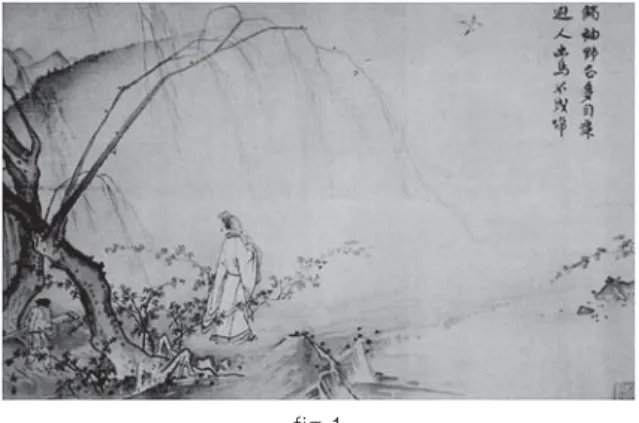
(7) Representation of the Non-Representable(LEE-KALISCH). catkins, the whole magic of spring can be evoked. In the album leaf Shanjing chunxing 山徑春行 ( On a Mountain Path in the Springtime , fig. 1)20), painted by the Song dynasty master Ma Yuan 馬遠(active from ca.1190-1225), the warm atmosphere of spring is evoked by the flowering bushes depicted in the left and right edges of the painting. In this yibian yijiao 一邊一角 compositions schemata a scholar strolls along a brook with all the time in the world. Stroking his beard with his fingertips, he watches a pair of birds. While one is still sitting on a branch, the other – perhaps startled by the scholars steps – is flying away. His servant follows with a zither. The fine swinging lines of the hanging willow branches, already showing their first delicate leaves, imply a gentle spring breeze. Here the beholder is invited to wander as the scholar along the mountain path, to sense the imaginary fragrances carried by the spring breeze and to perchance composing a poem – just as Emperor Ningzong 寜宗(1187-1224)did by writing his impressions in the upper righthand corner: Wild flowers dance, touched by his sleeves, Wild birds, startled, fly away, silenced, though the leaves.. 觸袖野花多自舞, 避人出鳥不成啼 To express an autumn atmosphere, a few red leaves are one of the most minimal artistic means. Sometimes it is enough to show a few trees with red leaves to evoke the feeling of autumn in the beholder.21)He or she perceives the red leaves and the entire landscape as a representation of fall. A beautiful example is the album leaf with the Autumn Scene (fig 2)22)by Hua Yan 華喦 (1682-1765), who was one of the Yangzhou baguai 楊州八怪( Eccentrics of Yangzhou )in the Qing dynasty. His contemporaries often criticized him for leaving out too many details. Despite his minimalist style, here he also manages to evoke an autumnal mood by the traditional artistic means of depicting red leaves. A scholar with a walking stick is resting on a bench at a stream between a cliff and two trees, and he is gazing at a faraway mountain peak. A few red leaves are falling from the tree, increasing the melancholy and autumnal mood in this landscape which is accentuated with hues of green, brown and blue. Various weather phenomena are also expressed via synaesthetic means. For example, a few twigs hanging down in hazy surroundings or strokes of washes distributed lightly over the entire area of a painting, are sufficient quintessential elements to indicate a rainy landscape to the viewer.23) The hanging scroll Fengyu 風雨( Wind and Rain , fig. 3), a painting executed in ink and in the possession of the Nezu Art Museum in Tokyo, is a later copy of a painting by the Song dynasty painter Xia Gui 夏珪, who was active in the first half of the 13th century. The painting is generally −9−.
(8) 立命館言語文化研究 28 巻 4 号. considered to be a pictorial representation of the fourth verse of the poem Xianyangcheng xilou 襄陽城西樓( West Tower of Xianyang )by the ninth-century Tang dynasty poet Xu Hun 許渾 : ...... With the mountain rain comes the wind and fills the tower hall. 24) ...... 山雨欲來風滿樓 How did the painter portray this theme? One feels the wind blowing through the leaves, which are freed of their twigs, and the obliquely slanting branches. The empty hanging twigs connote the wetness of the leaves. The empty space of the painting plays a significant role in the composition while it simultaneously evokes the feeling of a landscape in the mountain rain. Above all, the figure in the lower right-hand part of the painting conveys to the beholder the feeling of a landscape in wind and rain. Trying to protect himself against the rain, hunched over and carrying a straw hat in his hand as protection, the figure is hurrying towards the safety of the pavilion. With only these few means, the painting clearly signifies to the beholder the landscape and lets him or her be captivated by its atmosphere. In the hanging scroll Jiangcun fengyu 江村風雨( River Village in a Rainstorm , fig. 4), 25)by the Ming dynasty court painter Lü Wenying 呂文英(15th & 16th centuries), the figure, almost hidden behind the cliffs in the lower right of the painting, does not fail either to hurry home. The restless wave adds to the mood of the stormy rain. The painter depicts the essential elements of the landscape not only by means of the trees and their leaves, but also only by a few diagonal stroke of washes which are spread over the entire painting. Through the synaesthetic expansion of perception, the beholder literally feels the cold, strong, autumnal – recognizable by the red leaves – rainstorm.. 4.2 The sound of the waterfall Like the theme Rainstorm 風雨, the beloved theme guanpu 觀瀑( The Scholar Contemplating the Waterfall )arouses a synaesthetic expansion of sensory perception. The hanging scroll with the title Songxia guanpu 松下觀瀑( The Scholar Contemplating the Waterfall under pine trees , fig. 5)26) by Wen Zhengming 文徵明(1470-1559)shall serve as an example to illustrate this point. Under the tall twin pine trees and one old cypress two scholars sit on a plateau listening to the waterfall, which flows in strands from the rock mountain in a deep forest dense on the left, gushing to form a stream. The posture and gaze of the scholars are focused upon the water and its sound, and a young attendant in the foreground brings scrolls. Insofar as one identifies with the scholars contemplating the strands of water, one perceives − 10 −.
(9) Representation of the Non-Representable(LEE-KALISCH). the violent tossing of the waterfall in the valley. The thunder of the falling masses of water echo into the solitar y silence of the mountains and drown out the noise of the world. A metaphorical connotation arises out of the synaesthetic arousal of perception: the ears and the heart of the beholder are cleansed from the dust of the world.. 4.3 The natural scenery in changing day-light Chinese landscape painting simply does not make use of the naturalistic reproduction of natural phenomena in changing light. This is in complete contrast to Western landscape painting, where painters will often portray the same subject in different lights, as for example depicting the same scene in the red light of the sunset, in the burning midday sun or in the darkest night. Chinese painters renounce this play of light and shadow, as well as the use of effects caused by the different sources of light and diverse points of view. But might it be possible to portray landscapes at different times of day and night without using naturalistic means – just only through the usage of synaesthetic artistic elements? The Qing dynasty scholar Tang Yifen 湯貽汾(1778-1853)states in his 1804 treatise, Huaquan xilan 畫筌析覽(Analytical Examination on Paintings), that: Only the sun and the moon are truly difficult to paint. It is impossible to paint the form of the sun; it is impossible to paint the colour(shine or shimmer)of the moon.27) When one portrays the sun with its colour, one can hardly paint the dawn with the sunrise or the evening rays before sundown. When one portrays only the shape of the moon, it is also impossible to render its light upon the waves or in the shadows of the forest. How does one solve this problem? When we paint the sun with its colour, the shape will come automatically. When one represents the moon by its form, the colours will come of themselves. 28). 難者唯日與月, 日不可圖其形. 月無徙繪其色也. 即日而繪色,. 可坐朝旭夕暉.. 月而圖形, 亦無補波光林影. 然终如何而可 ? 則日可遺色而得形. 月可遺形而得色. In rendering the atmosphere of dawn or sunset, the colour of the sun is the synaesthetic element. Through the visual perception of colour, the beholder senses the time together with the atmosphere as a whole. So, can a few reddish horizontal lines painted behind distant hills, as depicted in the hanging scroll Xiyang shanshui 夕陽山水( Evening Landscape , fig. 6)29)by the Song dynasty painter Ma Lin 馬麟(early to mid 13th century), which dates to 1254 and is owned by the Nezu Art Museum in Tokyo, evoke the impression of an evening sunset? The mountains appear blue and the atmosphere is transparent and in the background against the evening sky, delicately indicated by horizontal lines of pale red clouds. In the foreground, four − 11 −.
(10) 立命館言語文化研究 28 巻 4 号. swallows flutter over a body of water, which disappears in the mist. By concentrating on just a few elements, the painter has captured the complete mood of an evening landscape. This particular impression of an evening landscape is expressed in following poem, which was inscribed by Emperor Lizong 理宗(1205-1264)in the sky of this painting that he gave to his daughter: The mountains, wearing the colours of autumn, seem nigh, The swallows, too late, crossing over the evening sky.. 山含秋色近, 燕渡夕陽遲. 4.4 The moonshine To perceive the moon as a shining object, it is enough to show a simple circle, which can often even hang in a pale sky.. 30). By identifying the circle as the moon, the beholder sets the process of. synaesthetic sensory expansion in motion and he or she perceives the scene as a landscape in the moonlight. In the hanging scroll of the Song-master Ma Yuan Gaoshi guanyue 高士觀月( Gazing at the Moon , fig. 7)31)a peaceful, still mood arises: A scholar, accompanied by a young servant, is sitting at the foot of a pine tree. In deep thought, he is leaning back his head a little and looking through the branches and needles of the tree, past the cliffs, at the full moon high in the heavens. A gentle breeze is lifting the pine twigs. A few needles have been loosened by the wind and are falling to the ground. The moon, which is an object of contemplation, is commonly shown in Chinese painting as a full moon and, particularly, as the autumn moon which is considered to be the brightest and purest of the year. 32) The wind in the pine trees, here evoked through the pine needles falling, is also considered the purest wind. Therefore, this painting invites the beholder to sense and to feel the purity of the autumn wind, as well as the brightness of the autumn moon, called qingfeng mingyue 清風明月 in Chinese. The character guan 觀, meaning to observe or to contemplate, originates from guanyue 觀月 and has much greater implications than simply referring to the mere optical perception of an object. One of these other implications is the inner transposition of that which has been seen. For example, the moon arouses intense feelings of longing and lonliness in the beholder. Therefore, the definition of the word guanyue 觀月 includes both the form of the moon and the emotions aroused by it.. − 12 −.
(11) Representation of the Non-Representable(LEE-KALISCH). 4.5 The night scenery Sometimes the use of the synaesthetic means is almost hidden. Sometimes one has to search carefully for it, as in the following hanging roll by Dai Jin 戴進, a Ming dynasty painter who was active in the early 15th century. The title of the painting is Chunyou wangui 春遊. 歸( Late Return from a Spring Excursion ,. fig. 8)The late return is literally depicted by showing the master of the house knocking at the door. The odour of plum blossoms suffuses with the spring air. Peasants coming home from the fields or driving their geese indicate the late time of day. But the clearest indication for just how late it has become is a lamp, which is being held by a servant hurrying to the door of the manor and depicted on the bottom right of the painting. Here, the lamp is the key element that transforms the bright painting into twilight or even darkness. Like lamps, candles also act as a minimal, synaesthetic signals in Chinese painting, and are capable of transforming the depiction of a normal daylight scene and its objects in a painting into a dark night scene simply by being in the painting. We experience an exciting change of times in the processes of viewing the horizontal scroll Yaocao shanfang 葉 草 山 房( Herb Mountain Cottage , fig. 9a and 9b)33) in the possession of the Shanghai Museum, a group endeavour of the Ming dynasty painters Qian Gu 錢轂(1508- ca. 1578), Zhu Lang 朱朗(active in the mid 16th century), and Wen Jia 文嘉(1501-1583). Let us view the 114.8 cm long scroll in the traditional way, from one section to the next starting at the beginning.34)When we first unroll it(fig 9a), we only see the right half. The air space is left completely empty; the objects in the painting are painted in ink and light colours. Clues for the beholder, such as a lamp or a candle, that help one understand the time of day are nowhere to be seen. We only know the title of the painting, Herb Mountain Cottage, which gives no indication of the time. Judging from the method in which the objects are rendered, we assume – for this section – a daytime landscape. However, as we continue to unroll the scroll various clues, such as a burning candle and smoke arising from an inscence burner, appear(fig. 9b). It is apparent that we are looking at a night landscape although nothing has changed in the representation of the air space. Solely the candle opens our perception: the room is suffused with candlelight and the fragrance of inscence. Unrolling the scroll further, we find a separate section of paper with poems. Based on the written remarks of the painters and other scholars, we learn that on the evening of the nineteenth of the tenth month in the year cycle gengzi 庚子(1540)a gathering of literati was held in this little hut. The rain had just stopped and the moon had just appeared. In this happy mood, the three painters painted this image while others composed the poems. Thus it becomes clear that this depiction does not show an ordinary night scene, but a night scene bathed in moonlight.35). − 13 −.
(12) 立命館言語文化研究 28 巻 4 号. The beholder experiences in this way three dif ferent kinds of settings: daytime, night indicated by the burning candle, and moonlight indicated by the written commentary. The last setting becomes clear only upon viewing the entire roll. This experience of a seemingly effortless change of time in one and the same painting is possible because of the format and the method of viewing a horizontal scroll, as well as the specific mode of interpretation characteristic of Chinese painting that must not be neglected.. 4.6 Synaesthetic function of poetic inscriptions on painting As indicated in the previous paintings, written comments and poems also have a synaesthetic function in Chinese painting. On the one hand, the poems can help to arouse synaesthetic perception through the objects already present in the painting. On the other hand, a poem on a painting can act alone as the trigger for synaesthetic impressions and the painting is like a stage set. An example is Zhu Da s(Bada shanren, 1626-1705)hanging scroll Guayue ( watermelon and moon , fig. 10)executed in ink on paper.36) With the Guayue of the Qing painter, we first have the feeling we are looking at a still life. The big round circle of the moon is in the painting; in front of it there is a small dark watermelon. The poem by Bada shanren in the upper left corner makes clear the very special meaning of these objects: The view is directed to one side of the flat, round cake. The moon is full, and then it is time for the watermelon. Each shows the moon cake. In the year of donkey, the time has come, and then the melon is ripe.. 眼光. 子一面. 月圓西瓜上時 個個指月. 子. 驢年瓜熟為期 In addition to the objects shown in the scene, the moon and watermelon, a further one is mentioned in the poem: the moon cake. Due to the shape the lunar disc can be understood as the moon cake, and it can therefore be seen as a twofold signifier. This gives rise to interesting aspects of the interpretation of the image. In China, all three objects, the moon, the watermelon and the moon cake are at first a reference to mid-autumn. The round cakes(yuebing)that are eaten during the Mid-Autumn Festival, symbolize the unity of the family. Moreover, yuebing allude to a historic event: At the end of the foreign rule of the Mongol Yuan Dynasty, the Chinese Red Army - named after red cloths that are tied around the head - hid a small piece of paper inside a moon cake, calling for the mass uprising. This way, they − 14 −.
(13) Representation of the Non-Representable(LEE-KALISCH). actually succeeded in defeating the foreign rulers.37) In his poem Bada shanren alludes to the historic event of the overthrow of a foreign dynasty, which must have been very important to him personally. On the one hand, he was a descendant of the Chinese dynasty of Ming, which replaced the foreign rulers of the Mongols. On the other hand he cherished hopes for a fall of the present Qing dynasty – again a foreign rule. The first line of the poem tells us that attention is directed towards the moon cake, through which one day the signal for revolt was given. The next line hints at the season: The moon is full, and then it is time for the Watermelon , which means the fruits are ripe. So the painter-poet describes the Mid-Autumn Festival as the time of rebellion against the Mongols and as a possible moment of renewed resistance against the Qing. Finally, Bada shanren tells us exactly when this will be: In the year of the donkey . The uprising should take place in the year of the donkey. However, knowing that the year of the donkey does not exist in the cycle of the twelve animal years, Bada shanren expresses his hopelessness and resignation in this poem.. Conclusion In summar y, we may say that the use of synaesthesia in the artistic concept of a Chinese painter knows no bounds. It is a conscious artistic means to capture the atmosphere of different weather conditions, times of day and year. In the planning of their concepts for a painting, Chinese painters have always expected that the beholder will perceive the things not depictable - reflections of the landscape in the water, the play of light and shadow – via the expanded sensory perception made possible by synaesthesia. A candle, lamp or moon expresses shining through the darkness of night. Preparing blossoms, tea or wine evoke their tastes and smells in a painting. Musical instruments or a particular refined gesture evoke imaginary sounds; painting themes, such as the rustling of the wind or the trickling of a fountain, the contemplation of the moon or a waterfall, assume in the beholder the inner transposition and assimilation of that which has been seen. The poetic inscriptions resemble a painting in words, and the title, all of which are directly on the painting itself, also serves as an important trigger to expand the sensual imagination. Chinese landscape painting can only be truly seen when the beholder experiences this synaesthetic quality as it was once attributed to the Tang dynasty Emperor Xuanzong 玄宗(r. 712755), who is said to have praised a painting by Li Sixun 李思訓(651-718): I heard the rushing of the waters at night from the folding screen which you painted. You are a true master: truly you are in touch with the devine!38). 壁兼掩障夜聞有水聲,(而明皇謂)思訓通神之佳. − 15 −.
(14) 立命館言語文化研究 28 巻 4 号. Notes 1)Ritter, Joachim: Historisches Wör terbuch der Philosophie(Basel: Schwabe AG, 2004), 767; Olbrich, Harald: Lexikon der Kunst, Leipzig: Seemann Verlag, 1987: 162-163; Deutsches Wörterbuch, Wahrig, Gerhard, Gütersloh: Bertelsmann Lexikon Verlag, 2000: 3648. 2)Bretones Callejas, Carmen: Synaesthetic Metaphors in English. Berkeley: University of California at Berkeley & International Computer Science Institute, in: http://www.icsi.berkeley.edu/ftp/pub/ techreports/2001/tr-01-008.pdf [September 21. 2015]; Day, Sean: Synaesthesia and Synaesthetic Metaphors, in: http://www.daysyn.com/Day1996.pdf [September 21. 2015]. 3)Debon, Günther: Chinesische Dichtung, Leiden: Brill, 1989: 169. 4)Debon 1989: 182; Tangshi sanbaishou 唐詩三百首, Hong Kong: Kwong Chi Book Co.: 123; Tangshi jianshang cidian 唐詩鑑賞辭典, Shanghai: Shanghai cishu chubanshe, 1983: 244-245. 5)This thesis on painting is translated and explained in Günther Debon & Chou Chün-shan, Lob der Natur, Wiesbaden: Harassowitz, 1969: 103. 6)Yang Jialuo, ed. Yishu congbian 藝術叢編, Taipei: Shijie shuju, 1962: vol. 15, 123; Hualun congkan 畫論叢 刊, ed. Yu Anlan, Beijing, 1960: 795; Huang Binhong and Deng Shi, eds. Meishu congshu 美術叢書, Shanghai: Shenzhou guoguangshe 1947, vol. 5: 123; see the chapter Mingren huatu yulu 明人畫圖語錄, Huishi weiyan 繪事微言 by Tang Zhiqi 唐志契(1579-1657), in: Hualun congkan 1960: 131. 7)According to the Huishi weiyan by Tang Zhiqi, Li Tang 李唐(approximately 1050-1130)was the creator of the painting, which unfortunately was not saved for future generations. 8)Debon/Chou 1969: 103-104; Hualun congkan 1960: 131, 796. 9)Cf. Bush, Susan and Shih, Hsio-yen, comp. and ed.: Early Chinese Texts on Painting, Cambridge, Mass & London, England: Harvard University Press, 1985: 36-39; Goepper, Roger: Vom Wesen chinesischer Malerei, München: Prestel, 1962: 12; see also, Lidai minghua ji 歷代名畫記 by Zhang Yanyuan 張彥遠(ca. 815-?), ed. Yu Jianhua. Beijing: Renmin meishu, 1963, vol. 6: 348-349; Zhongguo hualun leibian 中國畫論類编, ed. Yu Jianhua, Beijing, 1956 & 1986: 583-584. 10)This theor y originated with Zhang Yanyuan und Zhu Jingxuan 朱景玄(ca. 9th centur y). See Acker, William: Some Tang and Pre-Tang Texts on Chinese Painting, Leiden: Brill, 1954: 148-149; Zhongguo hualun leibian 1986: 22-23; Bush/Shih 1985: 48-49; Goepper 1962: 12. 11)Cf. Bush/Shi 1985: 181-182. See Goepper 1962: 12; Meishu congshu, vol. 2, 27; Zhongguo hualun leibian 1986: 636-638; Hualun congkan 1960:16-23. 12)Cf. Linquan gaozhi 林泉高致 in http://wuyuan.ucoz.com/theory/lqgz.html [January 10. 2017]. 13)See Debon/Chou 1969: 110; Hualun congkan 1960: 797. 14)In the case of the North Wind, which he uses in the text as an example, he contradicts himself. He regards the North Wind as a concrete object that can be represented shi. It can arouse xu via expert representation, in this case, coldness. He overlooks the fact that the wind is also a phenomenon which possesses no form of its own. 15)Dai kanwa jiten 大漢和辭典, comp. Morohashi Tetsuji, Tokyo: Taishûkan shoten, 1955-1960: 9-29263. 16)If one was to interpret the word bixiao as a true-to-nature painting or a reflection of things as they are, this would mean that Zou Yigui contradicts his own text and his own examples. Above all, he would be contradicting the very ideal of Chinese literati painting. However, Zou Yigui s term true to nature refers to the formal similarity, but never to the naturalism in the Western sense. This becomes clear in his judgement of European painting: ...such paintings might be clever and painted well, but the quality remains stuck in the artistic aspect. In painting of high quality there is no place for them.. − 16 −. Debon/Chou.
(15) Representation of the Non-Representable(LEE-KALISCH) 1969: 90-92, 153. 17)Zhongguo hualun leibian 1986: 596-597; Hualun congkan1960: 6-7; see also, Bush/Shih 1985: 173-176. 18)Zhongguo hualun leibian 1986: 669-671; Hualun congkan 1960: 41-42; Bush/Shih 1985: 155-156; see also, Maeda, Robert J.: Two Sung Texts on Chinese Painting and the Landscape Styles of the 11th and 12th Centuries, New York: Garland, 1978: 37-38. 19)The painting themes Xiaoxiang bajing 瀟湘八景( Eight Views of the Xiao and Xiang Rivers )are mentioned here as further excellent examples. The painting titles, as for example, Yucun xizhao 渔村夕照 ( Fishing Village in the Evening Glow ), Xiaoxiang yeyu 瀟湘夜雨( Night Rain on Xiao and Xiang ), Dongting qiuyue 洞庭秋月( Autumn Moon over the Lake Dongting ), Yansi wanzhong 煙寺. 鐘. ( Evening Bell from Mist-shrouded Temple ), Shanshi qinglan 山市晴嵐( Mountain Market, Clear with Rising Mist )and Jiangtian muxue 江天暮雪( River and Sky in Evening Snow ), make it clear that not only the Xiao-Xiang region with eight different vistas, but also different times of day, year, and various weather conditions are being depicted. Further painting themes such as Pingsha luoyan 平沙落雁( Wild Geese Descending to Sandbar )und Yuanpu guifan 遠逋歸帆( Returning Sail off Distant Shore ) serve as further examples. 20)Colours and ink on silk, 27,4 x 43,1 cm. The National Palace Museum, Taipei: www.npm.gov.tw/dm/ album/selection/c041.htm [March 29, 2016]. 21)Another example is the horizontal scroll Qiuge juyin 秋舸聚飮( Autumn Journey with a Boat on the River )by Sheng Mou 盛懋(active between 1320-1361), dated 1361, ink and colours on paper. Hight 24.7 cm. The National Palace Museum, Taipei. 22)Colours and Ink on paper, dated 1729, Freer Gallery of Art. 23)A good example of this is the hanging scroll attributed to the Song dynasty painter Ma Yuan entitled Yuzhong shanshui 雨中山水( Landscape in the Rain ) . The painting is executed in ink and colours on silk, measures 111.00cm x 56.00cm and is in the Seikaido Collection.(compare with Sekai bijutsu zenshu 世界美術全集, Tokyo 1954: no. 14, pl. 49. 24)Tangshi jianshang cidian 1983: 1052. 25)The Cleveland Museum of Art and Chinese Painting, ink and colours on silk, 169,2 x 103,5 cm: http:// www.clevelandart.org/art/1970.76 [March 30, 2016]. 26)346x104 cm, ink and colours on paper, Yantai Museum 焑臺: Zhongguo huihua chuanji 2000: vol. 13, pl. 46. 27)The Chinese character se 色 is generally translated as meaning colour, however, it can also mean glitter or shine (guangse 光色); Compare Dai kanwa jiten 1955-1960: 9-30602, 1-ha. 28)Zhongguo hualun leibian 1986: 826; Hualun congkan 1960: 518. 29)Colours and ink on silk, 51.4 x 26.6cm: http://www.nezu-muse.or.jp/jp/collection/detail.php?id=10393 [March 30, 2016]. 30)Various methods of depicting the moon are discussed in Lee-Kalisch, Jeonghee, Das Licht der Edlen(junzi zhiguang 君子之光)( The Light of Nobility ), Der Mond in der chinesischen Landschaftsmalerei, Sankt Augustin: Monumenta Serica, 2001: 91-145. 31)Ink and colours on silk, 57,4 x 26,8 cm. MOA Museum of Art: http://www.moaart.or.jp/collection/chinese-paintings6/ [March 30, 2016]. 32)The Song scholar, Han Zhuo. 拙(active around 1095-1125), in his work Shansui chunquan zhi 山水純. 全集(Chunquan s Compilation on Landscape), also describes the figure of the scholar gazing at the full moon as a motif typical of autumn and evoking a typical autumn mood: Paintings of autumn should be painted with mournful-looking figures gazing at the moon, ...... , cf. Bush/Shih 1985: 155. − 17 −.
(16) 立命館言語文化研究 28 巻 4 号 33)Li, Chutsing and Watt, James C.Y.: The Chinese Scholars Studio, London, Thomas und Hudson, 1987: pl. 7. 34)A Handscroll in Chinese painting is not viewed as a whole, as we have just done, but section by section. The beholder holds the scroll in his or her hands, so that only a section of approximately 60 cm is visible at one time.(About as wide as the outspread arms can comfortably hold it). Paintings in this format are usually ver y carefully painted in minute detail and require that the beholder comes ver y close to the artefact which is contrary to the viewing of a hanging scroll. See Goepper 1962: 58. 35)For example, the burning candle depicted in the album leaf with the title Yezuo 夜坐( Sitting awake through the night by the light of a candle ), compare Sirèn 1956-58, vol.VI, pl. 272), by the painter Sun Kehong 孫克弘(1533-1611), indicates a landscape at night. However, one cannot identify the landscape as being a moonlit night because the moon itself does not appear in the painting and is also not mentioned in the poetic inscription. 36)89,0 x 38,6 cm, Ar thur M. Sackler Museum, Har vard University Ar t Museum: http://www. harvardartmuseums.org/art/202768 [March 30, 2016]. 37)Wang/Barnhart 1990: 106. 38)Cf. from Debon/Chou 1969: 111; Compare Giles, Herbert: An Introduction to the History of Chinese Pictorial Art, Shanghai, 1905: 42; Teng, Ku: Chinesische Malkunsttheorie in der Tang- und Song Zeit in: Ostasiatische Zeitschrift 18, 1934: 242.. − 18 −.
(17) Representation of the Non-Representable(LEE-KALISCH). fig 1. fig 2. fig 3. fig 4. fig 5. − 19 −.
(18) 立命館言語文化研究 28 巻 4 号. fig 6. fig 8 fig 7. fig 9a. fig 10. fig 9b. − 20 −.
(19)
図
関連したドキュメント
Then it follows immediately from a suitable version of “Hensel’s Lemma” [cf., e.g., the argument of [4], Lemma 2.1] that S may be obtained, as the notation suggests, as the m A
Definition An embeddable tiled surface is a tiled surface which is actually achieved as the graph of singular leaves of some embedded orientable surface with closed braid
Our method of proof can also be used to recover the rational homotopy of L K(2) S 0 as well as the chromatic splitting conjecture at primes p > 3 [16]; we only need to use the
Subsequently, Xu [28] proved the blow up of solutions for the initial boundary value problem of (1.9) with critical initial energy and gave the sharp condition for global existence
This paper presents an investigation into the mechanics of this specific problem and develops an analytical approach that accounts for the effects of geometrical and material data on
We study the classical invariant theory of the B´ ezoutiant R(A, B) of a pair of binary forms A, B.. We also describe a ‘generic reduc- tion formula’ which recovers B from R(A, B)
While conducting an experiment regarding fetal move- ments as a result of Pulsed Wave Doppler (PWD) ultrasound, [8] we encountered the severe artifacts in the acquired image2.
For X-valued vector functions the Dinculeanu integral with respect to a σ-additive scalar measure on P (see Note 1) is the same as the Bochner integral and hence the Dinculeanu
