Governance of Civil Society Organizations in Japan:
Legal and Cultural Dimensions
※Yashavantha
Dongre
※※,D
EGUCHIMasayuki
※※※1. Conception of Governance
Governance as a concept and process has come to occupy a place of significance in the context of all types of institutions. While the term governance per se is not new, its present usage and importance is certainly derived from the mandate for States that the World Bank proposed in the later part of 1980s (World Bank, 1989). The World Bank made it clear to the developing countries that the international multilateral aid would be tied to the issues of good governance and public participation in the process of governance. This development was soon replicated by the corporate world, when the Cadbury Committee (1992) came out with guidelines for corporate governance. In both the above cases governance was seen to be a process led by the competent body, say the ministry or board of directors as applicable, in ensuring accountability, transparency, stakeholder participation and adherence to the rule of law.
Governance is being interpreted differently under different contexts ranging from the very specific to the very broad definitions. For instance the Webster s Dictionary (1986) notes governance as the act or process of governing, specifically authoritative direction and control . On the other hand the British Council takes a broader stance and says Governance involves interaction between the formal institutions and those in civil society. Governance refers to a process whereby elements in society wield power, authority and influence and enact policies and
※※ This paper is based on some early findings of an ongoing research initiated when the
authors were at the National Museum of Ethnology, Osaka.
※※ Professor & Coordinator, Third Sector Research Resource Centre, University of Mysore,
India. ([email protected])
※※※ Commissioner, Public Interest Corporation Commission, Tokyo, Japan (deguchi@soken.
ac.jp)
© Graduate School of Policy Science of Ritsumeikan University:
decisions concerning public life and social upliftment.
Taking on to the broader framework, Governance is also defined as the exercise of political, economic and administrative authority to manage a society s affairs. It is a broad concept that encompasses the organizational structures and activities of central, regional and local government, the parliament and the judiciary and the institutions, organizations and individuals that comprise civil society and the private sector insofar as they actively participate and influence the shaping of public policy that affects people s lives (UNDP, 1996).
It is thus evident that the conceptions of governance vary from a narrow view of authority, direction and control (a process synonymous with management) to a very broad process involving all institutions and stakeholders in an economy and society. Even though there is a difference of view in what constitutes governance, there seems to be a consensus that good governance is the prime need of the day. This position is the direct outcome of the understanding that more than the resources, it is the means or ways in which the resources are utilized that have resulted in the present day situation for many countries. Therefore multilateral agencies started speaking about good governance as a priority especially for the State machinery in all the countries.
While focusing on the need for good governance the world bank report states that Good governance is epitomized by predictable, open and enlightened policy-making, a bureaucracy imbued with a professional ethos acting in furtherance of the public good, the rule of law, transparent processes, and a strong civil society participating in public affairs. Poor governance (on the other hand) is characterized by arbitrary policy making, unaccountable bureaucracies, unenforced or unjust legal systems, the abuse of executive power, a civil society unengaged in public life, and widespread corruption. (World Bank, 1989).
Drawing from the above definitions, we may deduce that governance, in the context of any organization, is a process of designing and implementing policies with Autonomy in decision making, Transparency in and Accountability to actions, Democratic leadership and processes and Adherence to law. These elements would ensure good governance of organizations and ensure inclusiveness in their pursuits.
2. Governance of State and Business Entities
The embracing of economic liberalism necessitated a shift from good public administration or good management to good governance . For instance, in many part of Europe, the sponsoring of quasi government or state sponsored autonomous bodies to implement various welfare activities, created a sense of unease in terms of the way they were governed. It was opined that such establishments were created without clear principles and methods creating a governance gap (Plummer 1994). In the mid 90s, a state appointed committee in United Kingdom emphasized on the need for selflessness, integrity, objectivity, accountability, openness, honesty and leadership as the seven basic needs for politicians as well as those holding government offices (Nolan, 1995). While the issue of governance of the state machinery was increasingly put to scrutiny by the civil society in most countries of the North, it was the multilateral agencies that started raising issues of governance for the states in the developing world. However, a notable trend in the last couple of decades is that the state apparatus had been hit by the problem of erosion of values, almost everywhere. Hence the question of good governance of State occupied center stage in academic discourses. Akin to the issue of governance of governments, is the issue of corporate governance. In what culminated into the great economic crisis, the series of events in the past decade raised issues of corporate responsibility and governance. Despite the fact that there have been attempts both from within and outside corporate world to set up standards and norms of good governance, such status could not be achieved. In a liberal economic policy framework, where both the state and the people at large part with their resources and savings to strengthen the capital structure of the corporate world, it is of greatest significance that they follow the dictum of good governance. While there are constitutions and legislations to oversee the governance process of State and the Corporate, they may not suffice. The deepening economic crisis at the global level has raised doubts about the governance processes of both these structures. In particular the corporate governance has been a suspect as evidenced by large scale mismanagement of financial resources put in through the hard earned money and savings of the ordinary people. It is therefore imperative that there will have to be other internal pressures and benchmarks to ensure better governance of these two mainstream institutions and civil society institutions are called upon to play this role.
3. CSO Governance
Governance in relation to Civil Society Organizations (CSOs) is probably much more important than that of the other two sectors. Any organization that gets labeled as service organization would be naturally subject to public scrutiny to a greater extent. Even though, governance is of utmost importance to any organization, it occupies greater significance in the context of CSOs, since they function with the label of organizations for public good that neither seek political power nor monetary profit. More importantly the CSOs are often seen to be the watchdogs of good governance of the State and the Corporate, setting benchmarks, monitoring and raising issues when needed. Hence the question of their governance obviously becomes important.
Civil society vis-a-vis governance, especially in relation to state, has been a widely studied area (Yamamoto 1999, Tandon & Mohanty 2003, Maloney & Deth 2008). But the internal governance practices of civil society organizations have not formed the main theme of the study as much. There have been some country level studies focusing on NGOs (Antlov et.al, 2005) examining CSO and state s governance relationships (Houghton & Day, 2005), governance issues involved in service delivery by CSOs (Clayton et.al, 2000) etc. While one edited volume, (Edwards & Hulme, 1995), focusing on NGOs, gives us an overview of need for accountability, problems involved in measuring performance and accountability etc., along with some case studies, another recent edited volume (Hassan & Onyx, 2008) explores the internal governance practices of civil society organizations in six Asian countries. However, the dynamics of governance process in different types of CSOs remains an area calling for greater academic attention.
Good governance of CSOs has many functional dimensions. Setting the purpose, mission, objectives and strategies for the organization, ensuring that the goods and services the Organization offers are the most appropriate to achieve its objectives; that they are produced efficiently and to predetermined quality standards, defining and maintaining relations between different components of the organization; the board, staff, members, volunteers and beneficiaries and relating the Organization to its wider society; its local community, government regulators and funders, sources of finance, the media and providing an assurance that the organization is faithful to its mission.
Good governance of CSOs has other dimensions too. As not-for-profit organizations most CSOs generally depend on external sources for funding. Be it domestic or international, these sources would like to make sure that the funds
are put to right use. This calls for establishment of credibility on the part of fund seekers. Governance practices would go a long way in establishing credibility and ensuring support to the endeavors of CSOs. By their very nature, these organizations are the benchmarks of gauging the societal values. People would always look for good things in these organizations, since they are people s organizations. It is governance again that speaks of the value system of CSOs and makes them real representatives of people.
It is important to note that CSOs are organizations that have multiple constituencies and multiple stakeholders. This has its implications for governance. Much earlier to the debate of governance of CSOs catching up, Kanter and Summers (1987) had observed that multiple constituencies lie at the core of governance challenges of nonprofit organizations. Studies have identified presence of such varied components in CSO type of organizations (Handy, 1990) and viewed from the point of governance, these varied components develops its own culture , routines and procedures over time (Anhier, 2005, 230). We need to view the governance issues of CSOs in Japan in the above context.
4. Goavernance: Importance of Law and Culture
Our effort in this study is to look in particular to the legal and cultural aspects of governance. A legal regime is normally designed in any country, keeping in mind both the promotional and regulatory intent. These provisions together are supposed to ensure good governance. Generally the legislations are very prescriptive and give a detailed account of dos and don ts in their provisions. The legal framework dealing with incorporation, operations and issues like fundraising and taxation in relation to CSOs are devised to ensure better governance. The structure, mechanism of purpose compliance and monitoring of adherence to legal provisions are overseen by state machinery. But then, the question arises as to whether legislations can ensure good governance? Do the CSOs follow the legal provisions both in letter and spirit? Are there factors that cut across legal boundaries and influence the governance process in CSOs?
It is here that a factor like Culture comes to the fore. Culture is a pattern of beliefs and expectations shared by the organization s members. These beliefs and expectations produce norms that powerfully shape the behavior of the individuals and groups in the organization . (Schwartz & Davis, 1981, 33) In other words they would determine the actual happenings in an organization. It has been argued that organizational strategies are primarily an outcome of cultural
processes (Bate, 1994). However, there have been divergent views about the way in which cultural factors actually influence the outcome in terms of performance. While some hold the view that culture has positive implications (Johnson, 1992) it has also been viewed as a barrier to success (Barney, 1986). An organization is a place where cultural processes happen and in turn the organization gets shaped by such processes. Thus every organization is both a product and a producer of culture . (Linstead et. al 2004)
The fact that cultural factors have a significant influence on the operations of enterprises has been well illustrated. It is true not just for the not-for-profit organizations but those for profits as well. For instance while analyzing the management and governance processes of the most successful modern business enterprises in Japan, it is held that factors like the old Confucian ethics (Khan, 1979) and/or the Samurai culture (Murakami, 1986) have tremendous influence even in the modern day setup. Culture is said to be giving a framework of meaning that allows entrepreneurs to make sense of all the various, often conflicting pieces of information. Culture gives shape to the interpretative process that is entrepreneurship (Lavoie & Wright, 2000). It is viewed that many times the organizations, while maintaining the formal systems, might at the same time be following things that are not compatible with it. As held by Aktouf (1996) the organization does the utmost to maintain an official discourse, and then acts in direct opposition to that discourse . We intend examining these issues in the context of CSOs in Japan.
5. Japanese Context
For well over five decades after its defeat in the world war, Japan managed its economy and society through a dominant and often called developmental state structure. Western scholarship has seen Japanese situation as that of a strong State (McKean, 1993), soft authoritarianism (Johnson, 1982) and even a crypto-communist society (Kenrick, 1988). The State and bureaucracy in particular, became very paternalistic and tried to attend to all kinds of needs of people. Many hold the view that it is this kind of state structure that was responsible for a less visible civil society domain the Japan. (Schwartz & Pharr, 2003) However, after the passing off of the growth phase, and Japan entering a new socio economic situation, the state apparatus seem to be becoming less and less effective. Add to this the rigid hierarchical approach by government machinery, the all knowing attitude of bureaucracy, falling stature of political
leadership and corruption and scandals both by politicians and bureaucrats have contributed to dilution of state s ability to respond to the needs of the people. (Hirata, 2002) This situation, exemplified during the crisis of Hanshin earthquake in 1995, brought the NPOs to the fore. (Takao, 2001) Currently the civil society organizations are not only to act as service providers but need to act quickly to compensate for the erosion taking place in the traditional mainstream institutions. It is therefore obvious that the trust in them by people and their professional ability needs to be enhanced. This means there is an urgent need to strengthen the governance structures and processes in Japanese civil society organizations.
Japan s civil society organizations have dual context. A large number of small, unincorporated, grass roots organizations and a small number of formal, legal entities constitute the CSO domain. The laws are quite stringent and many scholars have felt that Japan s legal environment for CSOs is probably the most stringent among the developed democracies. Obviously this has its implications for governance. While the design of laws and the approach of bureaucracy makes autonomy a difficult question, the general belief of the people that only the organizations that have state sanction (legal recognition) are trust worthy, puts a challenge for the governance of the small and unincorporated CSOs. In any case the fact that the CSOs are becoming prominent and that they are most likely to play an increasingly important role in the Japanese society, underlines the fact that they need to be governed well. It has been well argued that Japan is becoming multicultural both in terms of internal diversities as well as in terms of the increasing presence of the gaijin in Japan (Sugimoto 1997, Hendry 2003). The increased trend of volunteering (Nakano, 2005) and the globalization leading to Japanese presence outside Japan and outsiders presence in Japan (Befu & Anguis, 2001) have also been critical to the civil society domain in Japan. This raises issues of the shape Japanese civil society in general is likely to take in the future. Such a development would in turn depend on the nature of governance of the civil society organizations. But then, what is the current situation of governance process and the quality of governance in these organizations? How far are the laws determining the governance process? What cultural factors are playing their role in this process? And most importantly, can the Japanese CSOs set the benchmark for better governance of State and Corporate bodies that have been fast loosing public faith? These and similar other questions become highly relevant in the present day context of CSO domain in Japan.
6. Civil Society Organisations in Japan1
Japanese society is often identified as a society that rests on group identities than individual identities. This is also seen to be a basic distinguishing point for Japan from West. High social capital is the essence of Japanese life and it is held that CSOs have a strong contribution in this regard. (Pekkanen 2006) High levels of GDP, better education and life expectancy, lesser extent of rich-poor divide and very low crime rates makes Japan easily one of the better places in the world to live. Japan is one of the top ten countries of the world in terms of human development indices. (UN, 2009) However, even though Japan matches with or looks better than most developed countries of the West, the civil society activism is not of a high order, especially in terms of policy interventions. (Schwartz & Pharr 2003, Pekkanen 2006) It is therefore very important that when we refer to civil society and its role in Japanese context, we need to think out of box.
The domain of CSOs is quite diverse and vibrant in Japan. However, the term CSO is not familiar as used in the global setting. The term Third Sector is known in some quarters but in its Japanese usage it gives a different meaning. It is often referred to the domain of quasi-public, quasi-business organizations (dai
san sekutah). While the NPOs and NGOs, though used to mean different types of
organizations, are a familiar category the other constituents are not generally treated as a civil society domain. For instance even though the religious corporations are one of the leading type of organizations both in number and in terms of social activities, they are not seen as part of the civil society domain. For the purpose of this study however, we are trying to use the term CSO to mean the entire organized space of civil society. We are including all types of initiatives, with scope for voluntary participation and not primarily aimed at seeking power or profit .
Taken in this broad sense, the CSO domain in Japan looks quite huge. If we include the non incorporated organizations known till date, then the total number of organizations comes to about 1.5 million, with a ratio of 1:84, meaning there is one CSO for every 84 people (based on 2006 population figures). This compares with the countries with a very high density of associations. Discussions on Japanese civil society has often tried to project this space as something of a new born, generally passive and a space increasingly shaped through state interventions. But it is very important to note that the civil society organizations have a long history of not only being present as autonomous institutions but even
influencing the state policies. The best example is of religious organizations, which not only managed to get their due right from the beginning of mejie restoration, but indirectly influence state policies and politics even now. The fact that a political party with known religious backing was part of the ruling coalition is testimony to this situation. Similarly there are evidences that the NPOs are not only taking over part of the activities of the local governments, but have actually started shaping the policies of the local governments at least on certain chosen areas. (Takao, 2006) However, what is very significant is the nature and spread of the CSOs.
The main feature of Japanese CSO domain is the presence of large number of small and unincorporated grassroots organizations and small number of medium and large incorporated organizations. Until the passing of the NPO legislation in 1998, the incorporated segment was actually too small, with both the very large NGOs working at the international level and the small and very small voluntary organizations and other local groups remaining unincorporated. The legislation of 1998 created another window in the form of NPOs, which now accounts for one of the prominent grove among incorporated CSOs. The organizations that are generally treated as part of the civil society domain elsewhere but not in Japan are the Religious corporations, Medical corporations, Social Welfare corporations and Private School corporations. All these are incorporated through separate legislations attached to the civil code and supervised by the respective ministries. They vary in size from large to very small. They also play very significant social role in the social sphere, in particular the religious and school corporations. Even then their number does not match that of the informal grassroots organizations. It is also important to note that the large groups of small organizations are actually heavily culture integrated and have been evolved with a long history of their presence and bonding with people. They have become such an integral part of the society that most Japanese not even consider them as organizations. But this domain, in fact, looks like the real civil society of Japan. It is held that these are the agencies that really create the social capital base for collective and group life pattern of Japan (Pakkanen, 2006). The formal and large organizations are more recent and fall more in to the Western organizational type, established first through the provisions of the Civil Code and now getting transformed with the passing of the new Public Interest Corporation Act of 2006. The public interest corporations established under the civil code, include many large organizations but have been run almost like state owned enterprises and were a suspect too in terms of the real public good activities, which was responsible for the new act to
be put in place. The NPOs are the typical modern voluntary organizations, and though are doing a commendable work; they are essentially driven by the philanthropic individual leaders and are many times confined to serve an agency function for the local governments. So in essence the organizations that have closer links with people on a day to day basis are the ones like school corporations, cooperatives and the grass roots organizations that are not generally considered part of the CSO domain.
The State and civil society relationship in Japan is an important dimension to be considered, while studying governance issues. During the period of postwar economic reconstruction and growth (1950-1980) civil society or NGO was not a palatable domain. In fact, people representing this domain were considered to be anti-state or even radicals who are not in the national interest. The state policy covertly discouraged this domain from becoming visible (Hirata 2002). The least attention this field received in the mainstream media is one indicator of how state agencies and especially the bureaucracy looked at civil society organizations. The scene totally changed once the economic bubble burst in the 1990s. The ills of the economy, social problems such as the problems of the aged and the advent of globalization has made State not only accept and encourage civil society organizations, but even use them to contract out some of the services otherwise offered directly by government channels. Today it looks as though the state machinery is quite eager to virtually outsource many of its tasks, especially those related to the sphere of social welfare, to the NPOs. There are criticisms that it is an attempt again by bureaucracy to co-opt and through that, put down the possibility of evolution of an independent civil society as opposed to state, as well as an attempt to cut down its cost of welfare budget by making the low cost entities like NPOs to take over part of its responsibilities. (Ogawa, 2009) The developmental state model pursued by Japan to realize fast economic growth in the post war period, has its hangover even today. State has its catch phrase of competent authority used at all levels from recognition, incorporation and up to the day to day activities of many of the civil society organizations. It is held that majority of the incorporated associations in Japan do not qualify to be a CSO in terms of being voluntary and self governing (Salamon & Anheier 1996) and over twenty percent of incorporated organizations are actually State run organizations (Baron 1997). In any case the dominant developmental state of the post war period looked well suited to the people who were used to the early Confucian idea of omnipotent state or the later regime under which the emperor was seen to be omnipotent. In a sense this image of state seems to be working largely even
today, though the strength and legitimacy of state machinery has eroded in the past couple of decades. Any agency which does not have a legal recognition or recognition at least by the local government and/or any agency which goes against the ideas of the state, is generally perceived to be not acceptable. In other words people tend to judge an organization based on the recognition it gets from the state, than assessing it in terms of its services, performance or methods of public reporting. This situation obviously has its implications for the governance process of civil society organizations, as we discuss in the sections to follow.
7. Size and Diversity of CSOs in Japan
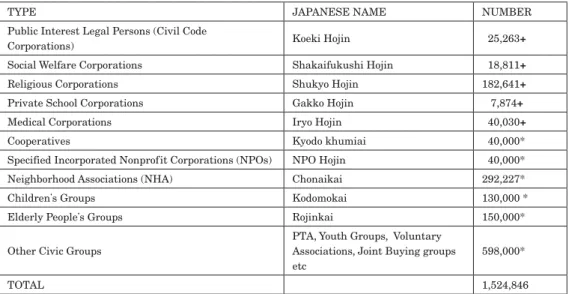
Japan has a wide variety of civil society organizations operating. Interestingly it has a legislative framework on a functional line and CSOs have been incorporated based on their basic functions. There are also a good number of unincorporated CSOs, though most of them account for small grassroots organizations. Table 1 gives a panoramic view of the size and legal classification of this interesting terrain.2
Table 1. Nature and Size of CSOs in Japan
TYPE JAPANESE NAME NUMBER
Public Interest Legal Persons (Civil Code
Corporations) Koeki Hojin 25,263+
Social Welfare Corporations Shakaifukushi Hojin 18,811+
Religious Corporations Shukyo Hojin 182,641+
Private School Corporations Gakko Hojin 7,874+
Medical Corporations Iryo Hojin 40,030+
Cooperatives Kyodo khumiai 40,000*
Specified Incorporated Nonprof it Corporations (NPOs) NPO Hojin 40,000*
Neighborhood Associations (NHA) Chonaikai 292,227*
Children s Groups Kodomokai 130,000 *
Elderly People s Groups Rojinkai 150,000*
Other Civic Groups
PTA, Youth Groups, Voluntary Associations, Joint Buying groups etc
598,000*
TOTAL 1,524,846
Source: Amenomori 1993, Pekkanen 2006, Ministry websites (*Figures are approximations only, + as at the end of 2006 – Source: White paper on Koeki hojiin, Ministry of Internal Affairs and Communication)
Even though there was a big legal constraint, that between the civil code days and the passing of the NPO act in 1998 there was no facilitative legal
environment and the state was generally not very supportive, we may notice that the CSOs constitute a big number in Japan. It is important to note that the formal and legal category is still only a part of the total associational sphere. There are a huge number of traditional village associations, youth organizations/ groups, neighborhood associations etc., which certainly fall under the category of civil society organizations. We have tried to follow the categorization given by earlier studies (Amenomori 1992, Pekkanen 2006) and update it with recent figures and adding new categories. If these organizations are included, and in principle they should be, then the size of the sector will be about 1.5 million organizations.
The earliest types of formal and incorporated civil society organizations were established through the provisions of Article 34 of the Civil Code. Known as charitable or public benefit organizations (Koeki Hojin) these corporations are considered legal persons, accorded benefits such as exemptions from income tax and are generally treated as organizations for public good. There are two forms under these civil code entities, generally categorized as incorporated foundation (Zaidan Hojin), and the incorporated association (Shadan Hojin). Even after the passing of separate legislations for different types of civil society organizations, the organizations seeking incorporation under civil code continued, mainly because such organizations were defined very broadly and would cut across the strict functional divisions otherwise earmarked under the new legislations. The establishment of these corporations has a prerequisite of first pooling together a basic capital, as high as about 300 million yen and then obtaining permission/ approval (kyoka) of the competent authority. The competent authority is usually the ministry in the relevant field. The huge initial capital base as well as the complicated process of obtaining the ministry s prior permission meant that these types of organizations could be started only with groups that have a close relationship with government. Ministries handling social welfare, health and education are the ones that have accorded approval for most number of such corporations. With the passing of the separate legislation in 2006, which came in to effect from December 2008, these organizations are now undergoing a transformation.
According to the new system, first of all, people can create a general non-profit corporation and obtain the status of a legal personality by complying with the general rules or completing registration, irrespective of whether or not the corporation is for the public interest. This is to ensure that more organizations are
given opportunities to obtain the status of a legal personality, and encouraging nonprofit corporations to engage in a wider range of activities. In the second phase, the government set out a scheme in which a designated autonomous body will examine the requests by general non-profit corporations, which satisfy certain requirements, and declare them eligible to become public interest non-profit corporations (New Koeki Hojins).
General non-profit corporations will be established in the form of incorporated associations (Ippan Shadan Hojin) or incorporated foundations (Ippan Zaidan Hojin). Ippan Shadan Hojin can be established if there are at least two members without the minimum requirement for its financial base. They must have a general assembly of members and directors, and may also have a board of directors and an auditor. The responsibility of the directors and auditor shall be clearly set out. The procedure to be followed by members while filing a representative suit is also provided in the Act. Ippan Zaidan Hojins, by contrast, must hold net assets of at least 3 million JPY. They must have a board of directors, a council in charge of checking and supervising directors in the performance of their duties, and an auditor. A general non-profit corporation shall establish necessary provisions on general disclosure of financial conditions, change of articles of incorporation or act of endowment, dissolution, merger, liquidation, and other matters.
The new law has provided for creating the Public Interest Corporation Commission (PICC) which plays the role of the third party determinations on public interest. The Act also describes requirements and procedures necessary for a general incorporated association or foundation that applies to obtain its a u t h o r i z a t i o n . P I C C h a s b e e n s e t u p u n d e r t h e c a b i n e t o f f i c e a n d 7 Commissioners are appointed by the Prime Minister upon obtaining the consent of both houses of the Diet. The function of PICC is similar to that of Charity Commission in the UK. A five year time frame has been set for all the existing
koeki hojins to switch over to the new system and the PICC is endowed with the
task of scrutinizing their applications and overseeing the shift to the new system. With the enactment of The Law to Promote Specified Nonprofit Activities (NPO law) in 1998, a designated category of nonprofit organizations came in to vogue. Many voluntary associations working as informal entities up till then got legal recognition under the new law, and as on date there are about 30,000 NPO
hojins. Generally these organizations are reporting to the prefectural
governments and many are also dependent on local governments for most or their finances. In fact a good deal of local government activities in the domain of social
welfare is actually contracted out to NPOs. Some of the local governments provide patronage in terms of office space for NPOs, logistic support etc and in turn the NPOs carry out the state sponsored programs. These organizations are one of the fast expanding segments of civil society organizations in Japan. Majority of these organizations are still very small, depend more on volunteers and driven by individuals, either the Chairperson or the CEO.
Religious corporations (shukyo hojin) are the largest in terms of number of incorporated CSOs operating in Japan, though they are generally not seen to be part of the domain. They are also the first among the organizations that were incorporated through a separate legislation, through an act attached to civil code. Even though it was an attempt to regulate and monitor the religious institutions, the act also provided space for them to engage in various types of civic and social activities such as education, health care etc. Standing at 226,060 this group of CSOs is big not only in number, but some of them, in terms of financial strength and political influence as well. Majority of these organizations were the Shinto and the Buddhist groups, but since it has become mandatory for all religious groups to get legal recognition, a good number of new religions too have come under this category. Aum Shinrikyo became the first of these organizations to get sacked from its legal status. After the Aum incident, the religious corporations law was amended and the reporting and monitoring systems were made more rigorous. Religion is not so much an emotional part of the daily lives of the Japanese, none the less the shrines and temples, especially those belonging to the Shinto groups, have a big influence both socially and politically. Many religious groups, those registered as shukyo hojin, have been engaged in other public services such as education and medical services through separately incorporated entities in the relevant domain. This situation is similar to many other common law countries where the religious endowments engage in other activities for which they have to create a separate legal entity.
Next in line, in terms of number and reach are the cooperatives. Again unlike most countries, where the cooperatives are incorporated through a single legislation, Japan chose to enact different legislations based on the functional divisions of cooperatives. Among the cooperatives we find diversity both in terms of ideology and affiliation with state. The agricultural cooperatives are perceived to be the most closely linked to state machinery and also politically aligned to the LDP. The same is true of the cooperatives of small and medium business associations, since along with farmers, it is the small and medium businesses which are seen to be traditional supporters of LDP (Tsujinaka, 2003). On the
contrary the Consumer Cooperatives are more independent of state and are also seen to be left oriented in their ideological perspective. Even though cooperatives are business organizations and basically economic associations, they have been engaged in members welfare even outside of their business activities. For instance activities such as peace and solidarity, environment protection etc., are common set of agenda for consumer cooperatives. The representatives of Japanese cooperatives have participated in many UN initiatives on environment and disarmament, and voiced their views. In the International Cooperative Alliance, they have made a huge contribution towards issues related to women empowerment and youth participation. In this sense cooperatives make an important segment of civil society organizations in Japan, similar to Europe under the social economy approach.
The real and most important part of the associational life in Japan seem to rest in the organizations that are informal and outside the legal framework. The Neighborhood Associations, (jchijikai and chonaikai) Children Associations, Youth Associations and the Elderly Associations have much longer history and are based at the grassroots level. There are also large number of informal voluntary associations working in rural areas, in urban social sphere as well as attached to shrines, museums etc. They are also the largest in quantitative terms accounting to more than half of the associational sphere. These organizations may not have aggressively participated in policy formulations, but have certainly been central to the Japanese group culture and social capital and has made scholars wonder whether Japan has in fact gotten civil society right? (Pakkanen, 2006, 187). Most of the day to day associational interactions of Japanese people take place in these platforms. They are the organizations that build social capital, consolidate public opinions and even indirectly decide the electoral fate of the political parties. Knowing this well, it is common for the politicians to attend for example, the activities of the neighborhood associations in their constituency. Of course, associations like chonaikai are said to be purposively started through state initiative, used extensively by local governments for reaching out to people and many times depend on some State support. There have been views that the NHAs are dwindling in terms of active participation of members, if not in numerical terms. However, there are also evidences showing them to have much longer history, independent of state, (Yoshihara & Dwinato, 2003) be active groups (Pekkanen 2006), quite possessive of their identity (Oshima 2005) and have eventually evolved in to NPOs (Ueto, 2003).
Parent Teacher Associations (PTA) have an important role in shaping the educational activities and hence in shaping the minds of the young Japanese. The Associations of the Elders, which in the days to come are certainly going to increase both in number and in terms of the diversification of activities, have been very important for over a quarter of the Japanese population. Apart from these widely known groups, there are a wide variety of other voluntary groups working in tandem with many state, cooperative or religious organizations. The issues of governance of these types of organizations too have been studied by many Japanese scholars (see for example Oshima, 2005)
8. The Legal Regime Governing CSOs in Japan
The legal regime governing CSOs is varied in different countries of Asia. It varies from a free rein, token legislation with no regular monitoring in countries like India to strict regimentation in countries like Japan. Even though the nature and intensity of legal systems vary, all of them seem to pursue a common intent that of ensuring better governance of CSOs. In some cases the legislations seem to have evolved based on a thinking that CSOs have a very significant role to play in the socio-economic sphere of the country and hence their existence need to be facilitated. In other cases the basis of legislation seems to be a thinking that CSOs are likely to misuse the opportunity of using the public funds and hence their activities need to be closely monitored. So the legal systems vary from pure faith on civil society initiatives to more of a suspicion on their intent and activities. Given the domain of civic engagement it is only natural for the states to think on these lines. There are evidences world over for the CSOs acting as agents of States and at the same time CSOs joining hands with forces that try to overthrow or replace a government. Hence, almost everywhere the relationship between state and CSOs has been one of a love-hate type.
Japan is a liberal democracy, but has been ruled by a political group with conservative outlooks for well over five decades. It is therefore, natural that the legislations with regard to CSOs are closer to regimentation. Unlike the common law countries in Asia, which inherited a British model of legal framework in general, Japan opted for the civil code system with continental influence. In spite of a liberal constitution and series of legislations implemented by the US regime during the post world war occupation, Japan is basically governed through the Civil Code system. It did had some British influence early on, but then the German and French influences became more pronounced during the period
preceding Japan s defeat in the second world war. Even though the post war legal mechanisms were clearly influenced or to some extent even imposed by the United States, the legislations related to incorporation and operations of CSOs have not taken so much the US line.
The civil code structure forming the foundation for all administrative norms since the meiji period, a developmental state with a dominant bureaucracy and long tenure of political domination by conservatives have shaped the legal regime in Japan. Obviously such a backdrop cannot be very conducive for the civil society to emerge. While this structure has certainly been able to facilitate fast track economic development, it has also made people rather apathetic to intervening and shaping the state policies. In a way Japanese bureaucracy seem to believe that it best knows how to keep the state moving to meet people s needs and the people too seem to think that the government best knows how to take care of their needs. The developments of the post war period and the emergence of Japan as a strong economic power, has made people to look for state approval for anything to be legitimate. Until recently, till the burst of the economic bubble on the one hand and the surfacing of the large number of cases corruption of politicians and bureaucrats, on the other average Japanese populace had seen no need to think of a civil society independent of state. The change of guard at the national level with the DPJ sweeping the recent polls with promises such as ending amakudari and putting the elected representatives in charge of policy making instead of bureaucracy, could be a sign of changing moods of the people. It might as well be the beginning of new opportunities to the CSO domain.
However, it is also important to note that there has always been associational life for people in Japan. In fact the group culture often said to be unique to Japan and at the root of its success, has its origin in the associational life. Of course it does appear that there is a hierarchy even here – that of Individual seeing group as more important, a group seeing a company or institution as more important and the institutions seeing the state as more important, ultimately everybody accepting state supremacy. In tune with this structure, we find ample evidence of the state promoting associations and enterprises, but ultimately shaping them as per the state s perspective of public good. It is not possible to say whether this kind of associational and group environment is good or bad, though it is certainly very different from other developed economies of the world.
The striking feature of Japanese laws related to CSOs is the multiplicity of legislations based on specific background of institutions. There are half a dozen different laws related to CSO incorporation or creating an associational legal
person, though many of them are linked to Article 34 of the civil code. This list of legislations will swell, when we include some of the other associations with cooperatives themselves having multiple legislations depending on their functional focus. It does appear that the legislations in many cases are rather a reactive step than a proactive measure of the State. For instance, the establishment and structuring of the koeki hojins was conceived to serve the interest of the state, as visible in the conditions laid down in civil code. Quite contrary to the other developed countries, in case of Japan establishing a not for profit (article 34) entity is much more difficult than establishing a for profit (article 35) entity. (Osborne 2003, Pekkanen 2006) The amendments made to the religious corporations law (shukyo hojiin) in 1995 as well as the NPO law amendments put out in 2000 are reflections on this situation.
It is held that compared to other industrialized democracies, Japan s legal framework for VNPOs is relatively strict, making is difficult for groups to form legal entities. The system is also quite stingy with the tax and other benefits they receive and the Japanese law frequently inhibits the autonomy of the VNPOs it governs, and it can be applied to the disadvantage of groups that seek to maintain their independence from state control . (Pekkanen & Simon, 2003, 76). However, it is also noted that there are examples of local governments taking the initiative and trying to evolve a highly supportive climate for the NPOs to obtain legal status and operate with lesser intervention (Auger, 2003). One of the reasons for the highly rigid regulatory regime is the political climate over the years (Pekkanen, 2006) which now seem to be changing.
We can notice that all the legislations have provisions put in place to make the organizations democratic and being governed by a committee or board. In terms of supervision and control we find dual authorities one in the form of ministry or and the other in the form of local or prefectural government. It is possible to view the reporting authorities at three levels. The PILPs and Cooperatives generally fall under the domain of ministries of the national government. The NPOs are basically linked to the local or prefectural governments. However, religious institutions, educational institutions and medical corporations seem to be much more autonomous though technically under the bureaucratic control of the national government. Irrespective of these reporting and control structures, it is also visible that many of these organizations enjoy certain concessions, the most notable being reduced income tax rates for their incomes and tax exemption for donors with some conditions. . The main restrictions center on the mandate of the organizations, with clear
limits to their activities. While political and religious activities (the later except in case of religious organizations) are totally banned the legislative provisions also regiment the organizations to confining only to the specified activities as per their original mandate. So a cursory glance at the legislations gives one a feeling that the State believes that the legal control can ensure better governance of CSOs and thus the restrictive provisions seem to overweigh the facilitative provisions.
9. CSO Governance: Perceptions & Practices
Our study was an attempt to see the internal governance practices (organizational governance) of CSOs in the context of the legal and cultural factors. Towards this end we circulated a questionnaire to 50 Key Informants consisting of 10 from academics, 10 from NPOs, 10 from State, 10 from Business and 10 others including Journalists, Artists, representatives of international organizations etc. Our questionnaire was divided broadly into two parts. The first with eight multiple choice questions, of which the key informants were asked to chose the one most appropriate answer and the second with four open ended questions with ample scope for expressing their views. 28 key informants responded. Further, a series of detailed personal interviews were held with 31 persons, 9 of whom were the Key Informants who had already responded to the questionnaire. So in effect we have views of 50 persons. Further, five organizations, one each of a NPO, a Cooperative, a Religious organization, a Koeki
hojiin and an informal voluntary organization were visited to cross check the
views expressed by the key informants. These were multiple visits over an extended period of time. In many cases the researchers were able to attend the Board Meeting or the meeting of the General Assembly and were also able to discuss with the staff members. What follows is an overview of the governance situation drawn from all of the above.
Governance is not a familiar term among the CSOs in Japan, nor there any acceptable Japanese equivalent to this term. This is the case with most Asian countries and the experience in the earlier studies too (Hassan and Onyx, 2008) has confirmed this situation. Japanese researchers seem to prefer the usage of the English word in its local katakana version (gavanensu) to explain the concept. We therefore thought it apt to first ascertain the perception of different groups of people involved with CSOs, on what they see as key elements of governance in the context of Japanese CSOs. Not surprisingly, majority of the key informants, other
than academicians have seen governance as equivalent of the process of management . There could be two reasons for this interpretation. First, the English word governance translates in Japanese to the rule (osameru) or control (kanri suru). Second and more important, Japanese generally see the State as the symbol of governance and hence follow a typical hierarchical model of good and bad. Hence, the idea that governance is equivalent to the process of management. This situation becomes clear in our ensuing discussion.
A glaring factor that emerges at the outset is that NPOs, Cooperatives, Voluntary Organizations and Public Interest Corporations are the only type of organizations mentioned by the key informants as the ones they know of, even though there is a mention of other types of organizations in our questionnaire. Organizations like social welfare corporations, school corporations and medical corporations are not seen to be under the CSO domain. No one mentioned about the religious corporations or neighborhood associations as well.
A clearly visible difference is the view on who plays an important role in the process of governance. While generally majority of the key informants give a central place for Members in the process of governance in its ideal form, the key informants with business background emphasize more on the role of CEO where as the academia stresses more on the role of the Board. We may also see that those who understand governance as a process of management are the ones who stress on the role of the CEO, where as those giving central place to Board are researchers who have seen governance as associated with Vision and Mission of the organization. In any case, when it comes to actual governance, the key informants overwhelmingly hold the view that there is a gap between the ideal and the actual practice. About 80 percent of the informants feel it is generally the CEO who handles everything in practice. There is no difference in this view across the type of the organization. Those talking from the background of cooperatives, those referring to the Koeki hojins as well as those talking about NPOs, all seem to believe that against the ideal situation of the Board or Members playing a central role, the CEOs dominate the governing of the CSOs in Japan.
It is also important to note that apart from the CEO, there is always a small group within the Board that decides for Board and actually controls a good deal of organizational governance. This looks to be an extension of the Japanese corporate practice of a Core Group, which is quite often responsible for the decisions and its implementation, though done in the name of the Board. So it
emerges that most key informants hold the view that it should be the members/ board which should take care of governance, but it is the CEO who actually does it. So in reality it is the CEO with a core group running the show, irrespective of the type of CSO in question.
Nemawashi, is a common practice in all types of organizations. This unique
Japanese practice, needs to be explained in the context of the spirit of laws. The personal discussions with some of the key informants and the empirical investigations at the organizational level, clearly demonstrate that most decisions are a product of nemawashi, where the secretariat will have an important say. The Board and even the General Assembly seem to generally approve the proposals that are products of such behind the curtain meetings. This situation is confirmed by other studies (Ogawa 2009, Deguchi 2009) as well. Further, in half a dozen meetings of the General Assembly that this researchers attended, in none was there any difference of views on agenda items and mostly members raised their hands with colored slips to show their consent. The laws do not provide for either such meetings or for the core groups. The provisions of Japanese laws in this regard are almost similar to that of other countries, which make Board responsible for all policy decisions. However, the dominant role of the secretariat is glaring, though informal. However, we need to look at this culture of governance from another perspective as well. Consensus has been the core of internal governance practices in Japan for a long time and nemawashi is one way of arriving at consensus. The intentions here have often been good and the functioning of the organizations has been smooth. It reinforces our hypothesis that cultural factors have an important say in governance practices.
The key informants representing NPOs have noted that the Founder of the organization generally exerts a lot of controlling power in most NPOs. In majority of these cases, the founder is generally the President or CEO of the organization. One young executive of a network organization, an NPO supporting NPOs, was very vocal on this point. The Founders are almost always really well meaning people. There is no question that they have full commitment for the cause for which the NPO is established. But, they simply cannot understand the idea of decentralization or the idea of modern usage of governance. This creates a situation where, all the others can only make suggestions but finally have to follow what the founder says. So in the final analysis while good values, the emphasis on the cause and selfless work are definitely there, it is not guaranteed that there is presence of participation, democracy and collective decision making . This view is further evidenced through our observation while visiting different
organizations. For instance, it was found that in case of NPOs most Presidents or CEOs actually are the first generation leaders. This could be because NPOs are of comparatively recent origin. However, there seems to be no conscious effort to recognize, encourage and develop second line leadership. Some evidences of closure of NPOs suggest that they were closed no sooner than the CEOs left, indicating a leadership gap. Leadership is a key element in good governance and sustainability of CSOs, and this looks to be an area calling for immediate attention.
Given the fact that our key informants were drawn from different segments of stakeholder groups and that their views were compared with those actually working in CSOs, it may be inferred that the organizational governance in Japanese CSOs are dependent on individual leaders, do not comply fully with the spirit of the law and holds on the specific local factors. This shows closer resemblance with the CSOs in other Asian countries, than those in Europe or USA. It may also be argued that even though Japan is a developed economy and has drawn its legal structures from the Western and the economically developed countries, the governance practices of CSOs are heavily culture integrated and falls in line with practices in other relatively less developed Asian countries. This very much falls in line with some of the earlier studies that have argued that Western theories are not generally applicable in the context of Japanese civil society. (Knight, 1996)
NPOs are cited as the most familiar forms of CSOs by over three quarters of our key informants. While this speaks on the one hand about the increased visibility of the NPOs in Japan, on the other hand it also denotes a situation where other forms of organizations are generally not seen as part of the civil society domain. This seems to be a historically conditioned view, since the state in the post war period and until 1998, did not explicitly encourage any CSO movement. Interestingly the respondents drawn from the State domain seem to be appreciative of the governance efforts by NPOs, though they try to recognize their identity more in terms of a principal – agent relationship.
Among the institutions of CSO domain, Cooperatives are obviously the most organized and having the governance structures in place. However, may be because they are primarily organizations engaging in economic activities, the key informants representing the cooperatives emphasize on greater decision making role to the CEOs. They are unanimous in giving a central place to the Members while speaking of the ideal situation, but very emphatic on the centrality of CEO in actual practice. A discussion at the personal level, with those connected with
cooperatives, both executives and researchers reveal that cooperatives in Japan cannot be taken as the one holistic domain in terms of their approach to governance, since it depends on the degree of their closeness to State, as already discussed. It is important to note the emphasis on members in a typical consumer cooperative. The Board members as well as the CEO seem to generally hold and endorse the view that members needs are to be given priority while designing business plans and developing new services. However, the specific decisions seem to emerge through a briefing to the Board by the secretariat. In any case among the CSOs in Japan, it is the cooperatives that are more acquainted with the term governance. It is not uncommon to find this word used in many of their reports and even agenda notes of the general assembly.
There seems to be unanimity among the key informants of all background that NPOs in Japan face severe problems related to governance. As illustrated in some of the studies (Ogawa, 2009) whenever NPOs get into the contracting of state sponsored activities, such as the welfare services, they almost become an appendage to the local government. So the basic element of autonomy in policy decisions is not seen. If they prefer to be independent, then their governance process is affected either in the form of dependence on individual leaders or in terms of problems associated with resource mobilization. One key informant stated that governance is a chicken or egg problem. But all civil society organizations need to grow larger and have a stronger financial base before one can talk about governance. Typical NPOs have only a few paid staff or are no more than a group of well meaning volunteers. On the other hand, private school corporations and social welfare corporations, though much more established as organizations, tend to get bureaucratic structures that may look well-governed, but have internal problems that they themselves can hardly solve . Our cross examinations during the field visits confirmed this situation. For instance, the NPOs which are very small will have an office space provided to them through an NPO network organization, but the facility is provided mostly by the local government. This is the first step, where the NPOs get in to the government fold and some of them find it very convenient to contract with the local government, since an already well established activity package will be ready and the funding too will be available. Of course this will not be easy, since the local governments would choose an NPO for contracting, only if they are seen to be good enough for that. In case of one NPO, the CEO mentioned that because of the recent high spending budget of the Japanese government, it became possible for them to hire four paid staff, indicating that the swollen state budget got them funds, which
they would otherwise have not been able to garner. However, the organization actually took up a set of activities, very different from what they were actually hoping to carry out, when they registered as an NPO. Similarly our cross examinations with a big school corporation again gave enough evidence that even though it is legally a not for profit organization, its governance practices are not very transparent and not totally independent of the state s influences.
Another significant factor that emerges from the views of the key informants relates to the public perceptions about organizations and their governance. Many key informants felt that people easily accept State institutions and the CSOs that are identified with State, than the organizations outside this domain. For instance it was both mentioned by key informants and well illustrated in some of the earlier studies (Schwartz & Pharr 2003, Pekkanen 2006) that people in Japan are accustomed to look at State as a symbol of good governance. It is also held that in Japan state is viewed as an embodiment of morality and moral leadership (Smith, 1983). So they can easily accept institutions like koeki hojins, which have a close bearing with state bureaucracy. School corporations, medical corporations etc are next in line. Their acceptance of NPOs would be probably least not only because of lack of tradition, publicity or their small size, but also due to their relative loose external control .
Some of the key informants have made a reference to the on-going legal reformations in the context of Public Interest Corporations (koeki hojins). It is noted that koeki hojins have been criticized as excuses for giving cushy jobs to retired bureaucrats and enjoying subsidy from the government. Government officials who obtain executive posts in koeki hojins for which they used to be responsible for supervision and over sight, is called amakudari or descent from heaven . The government makes subsidy to such organizations in order not so much to conduct public benefit activities but to pay high salary to the retired bureaucrats as executives of the organizations .
In essence the reforms of koeki hojins were the outcome of a crisis of efficiency and crisis of legitimacy (Deguchi 2001) or simply stated a crisis of governance. There were various criticisms regarding the modalities of management, supervision and oversight, and governance matters such as issuance of kyoka (permission) by competent authorities for establishing a koeki
hojin. It was a kind of self dealing between active bureaucrats and retired
bureaucrats. Viewed from the perspective of governance there were three key problems related to Koeki Hojins. First was the situation of discretion or arbitrariness in issuing permission, which lies with the competent authority or
the relevant ministry. This was seen to be a situation wherein some of the not deserving initiatives would get kyoka where as some times the deserving ones may not, depending entirely on the perception of the ministry. Second was the problem of Amakudari, where the koeki hojins were used as a shelter for providing the retiring bureaucrats with a well paying new assignment. And the third was the government subsidies, which facilitated large flow of financial assistance to these organizations converting them in to actual government departments, there by eroding the operational autonomy. The legal reforms were initiated in order to set these things right and ensure better governance . However, one of the key informants, closely following the developments in the implementation of the new legislation has observed that even while the new law seeks koeki hojins to become institutions governed independently and for the purpose of public interest, the bureaucracy, though often well meaning, is too involved and paternalistic in pushing through the changes .
The degree of government control and the reasons for the same constitute another important area related to governance. It speaks of the extent of autonomy enjoyed by the organizations and on the focus of government while monitoring these organizations. It emerges from the opinions of the key informants that people related to NPOs opine that the control is high or depends on the type of CSOs, where as those connected with cooperatives have seen it as moderate or hardly any control. However, the single most important reason quoted for state control is to avoid diversion and misuse of funds. Obviously, the views of the key informants are immediately drawn to reports of scandals in different organizations in the past. So possibilities of misuse of funds loom large and that makes financial reporting as an important factor in CSO governance. However, a general discussion with some of the key informants and NPO activists showed that people do not focus much on public reporting, but see reporting to government as very important. If the government approves some organization, then it is taken to be well governed than an organization that tries to reach out to public. Here again it is the centrality of state in public affairs that comes up as a striking feature. It was seen in an earlier study (Hasan & Onyx, 2008) that unlike Japan in many Asian countries, public acceptance and public reporting is seen more important than reporting to government. This variance could be a matter of degree of public faith in governmental institutions in each of the country in question. In many countries state machinery is not seen with high regard by people. In Japan, however, people seem to look for state to give the final verdict. It should however stand to the credit of both the CSOs and the State that
the rate of regular reporting by CSOs is very high and also the regular scrutiny by the concerned state machinery. It is this kind of response-response relationship that looks very unique in Japanese context.
10. Conclusion
Governance is indeed a complex process. None the less autonomy, transparency, accountability, participation and rule of law are key elements of this process. States across the world seek to ensure good governance of organizations through statutory means. This gives Boards a central place in governance process and also presumes that regular reporting to state machinery would ensure good governance. However, in practice organizations might strive to ensure good governance not so much through legislative means, but by relying on specific local cultural factors.
Japanese CSOs are no exception to this situation. In this regard Japan seems to fall in line with other Asian countries than its counterparts in the economically developed group. The CSO domain though large, has not been on the centre stage of policy domain in post war Japan. Recently, there has been a change for the positive in this front. This means, the role of CSOs and consequently their governance would become a key issue. This study has merely scratched the surface of this issue and limits itself to drawing attention to some of the key issues related to organizational governance practices. Indeed governance is a process on which not much attention is focused by Japanese CSOs. However, they have started recognizing that if they need to play their expected role in the changing dynamic of policy design and meeting the needs of society, they have to work towards realizing better governance norms. They certainly need greater research output in this domain.
Notes
1. There have been varied interpretations for what constitutes a CSO. While some people view it in terms of a narrow perspective of limiting its scope only to the formally structured nonprofit organizations, we would like to cast the net wider. For the purpose of this study, we include all types of peoples initiatives that have an organized approach to socio economic issues, whether incorporated or not, whether distributing surplus or not and whether initiated by people, state or corporate, so long as they are currently considered outside the direct domain of State and the Corporate. In other words, all such initiatives other than state machinery and market that do not seek political power and/or monetary profit are considered as CSOs. More specifically CSO domain is not limited only to NPOs and NGOs but includes institutions like Cooperatives and Neighborhood associations as well.
2. It is important to take note that Japan is presently undergoing an important phase of transition in CSOs in terms of their legal structure. After the passing of the new legislations in 2006, the Public Interest Legal Persons (Koeki Hojin) are beginning to move to the new legislation and are going to be grouped in to General Incorporated associations, General Incorporated foundations, Public Interest Incorporated Associations and Public Interest Incorporated Foundations. There is also a chance for many organizations incorporated under other legislations such as the School Corporations or NPO Hojins to move in to the new legal framework. This means that the situation is dynamic and the exact numbers of each type might keep changing quickly. In any case the numbers given in the table are mostly approximations.
References
Aktouf. O (1996) Competence, symbolic activity and promotability In Linstead Stephen, Grafton Small R & Jefcutt P, Understanding Management, Sage, London
Amenomori, Takayoshi (1993) Defining the Nonprofit Sector: Japan, Working Papers of the Johns Hopkins Comparative Nonprofit Sector Project, no. 15, edited by L.M. Salamon and H.K.
Anheier. Baltimore: The Johns Hopkins Institute for Policy Studies, 1993.
Anheier, Helmut K., (2005) Nonprofit Organizations: Theory, management, policy, Routledge, New York
Antlov, Hans, Ibrahim Rustam & Tuijl, Peter van (2005) NGO governance and Accountability in
Indonesia: Challenges in a newly democratizing country, -July 2005 version - http://www.
justassociates.org/associates_files/Peter_NGO%20accountability%20in%20Indonesia%20 July%2005%20version.pdf
Auger Deborah A, The Government-Nonprofit relationship in contemporary Japan: an emerging
local government-nonprofit partnership in Miyagi, In Osborne Stephen P (Ed. 2003), The
Voluntary and Non-Profit Sector in Japan: The Challenge of Change, Routledge Curzon, London
Baron B.F., (1997), Funding Civil Society in Asia: Philanthropy and Public-Private Partnerships, The Asia Foundation Working paper No. 3
Bate S.P., (1994) Strategies for Cultural Change, Butterworth Heinemann, London
Barney J (1986) Organizational Culture: Can it be a source of sustained competitive advantage? Academy of Management Review, 2 (3) 656-65
Befu Harumi & Anguis Sylvie Guichard (2001) Globalizing Japan, Routledge, London
Cadbury Committee (1992) Report of the Committee on the Financial Aspects of Corporate
Governance, United Kingdom
Clayton, Andrew., Oakley, Peter & Taylor, Jon (2000), Civil Society Organizations and Service
Provision, Civil society and social Movements program number 2, October 2000, U.N.
Research Institute for Social Development, http://www.pogar.org/publications/other/unrisd/ intrac.pdf
Cornforth Chris., (2003) The Governance of Public and Non-Profit Organizations: What do
Boards do? Routledge, London
Deguchi Masayuki (2001) The Distinction between institutionalized and noninstitutionalized
NPOs: new policy initiatives and nonprofit organizations in Japan, In Anheier Helmut K
and Kendall Jeremy (Ed. 2001) Third Sector Policy at the Crossroads, Routledge, London Deguchi Masayuki (2009) Governing Civil Society Organizations in Japan, Paper presented for
Panel Discussion at 6th ISTR Regional Conference, Taipei, 2-3 Nov. 2009
Edwards & Hulme (Ed. 1995), Non Government Organizations – Performance and
Accountability, Earthscan, London
Handy, C (1990) Understanding Voluntary Organizations: How to make them function