The stakes of politics and electoral
administration : a comparative study of
Southeast Asian democracies
著者
Kawanaka Takeshi
権利
Copyrights 日本貿易振興機構(ジェトロ)アジア
経済研究所 / Institute of Developing
Economies, Japan External Trade Organization
(IDE-JETRO) http://www.ide.go.jp
journal or
publication title
IDE Discussion Paper
volume
536
year
2015-10-01
INSTITUTE OF DEVELOPING ECONOMIES
IDE Discussion Papers are preliminary materials circulated to stimulate discussions and critical comments
Keywords: democracy, election, electoral administration, Southeast Asia, the
Philippines, Thailand, Indonesia, the stakes of politics
* Senior Researcher, Area Studies Center, IDE ([email protected])
IDE DISCUSSION PAPER No. 536
The Stakes of Politics and Electoral
Administration: A Comparative Study of
Southeast Asian Democracies
Takeshi KAWANAKA*
October 2015
Abstract
Elections play a crucial role in political stability in post-democratization, and electoral administrations are the key to the electoral process. However, not all newly democratized countries have established reliable electoral administration. New democracies in Southeast Asia, such as the Philippines, Indonesia and Thailand, have independent election commissions which have different characteristics, especially in terms of neutrality. Based on three cases, this paper claims that the stakes of politics are the major determinant of the variations in neutrality. The high stakes of politics in Thailand brought about the partisan election commission, while the low stakes in Indonesia made the electoral system relatively neutral. Like Thailand, the high stakes of politics in the Philippines also cause political intervention in the electoral administration.
* The author thanks Maki Aoki-Okabe, Shingo Hamanaka, Koichi Kawamura, Rieko Kage, and Shinichi Shigetomi for their useful comments. This work is supported by the Grants-in-Aid for Science Research (A) (23243022 and 15H01931) and Grants-in-Aid for Science Research (C) (15K03307).
The Institute of Developing Economies (IDE) is a semigovernmental, nonpartisan, nonprofit research institute, founded in 1958. The Institute merged with the Japan External Trade Organization (JETRO) on July 1, 1998.
The Institute conducts basic and comprehensive studies on economic and related affairs in all developing countries and regions, including Asia, the Middle East, Africa, Latin America, Oceania, and Eastern Europe.
The views expressed in this publication are those of the author(s). Publication does not imply endorsement by the Institute of Developing Economies of any of the views expressed within.
INSTITUTE OF DEVELOPING ECONOMIES (IDE), JETRO 3-2-2, WAKABA,MIHAMA-KU,CHIBA-SHI
CHIBA 261-8545, JAPAN
©2015 by Institute of Developing Economies, JETRO
No part of this publication may be reproduced without the prior permission of the IDE-JETRO.
1. Introduction
How to make elections fair is a crucial issue in democratic consolidation. When political competitions are not fair, major political players seek to deviate from political institutions. This brings about instability. The key to holding fair elections is neutrality (being non-partisan) and capacity for electoral administration.1 Nevertheless, newly democratized countries do not necessarily have neutral and capable electoral administrations. In particular, the degree of neutrality in electoral administration varies among countries, even if they have independent election commissions. What prevents an electoral administration from being neutral in newly democratized countries? Focusing on three new democracies in Southeast Asia, this paper seeks to answer this question.
Theoretically, it has been argued that the nature of electoral administration is determined by strategic interactions between competing political players. Especially, the size of the power which is obtained by the winner of the competitions (the stakes of politics) and the degree of the opposition’s protest against electoral manipulation decide the payoff structure of the game of establishing electoral administration (Przeworski 1991, Magaloni 2010). The high stakes of politics provide the incentive to grab the power regardless of the means. The ruler then has less interest in establishing a neutral electoral administration. On the other hand, the high probability of strong protest from the opposition increases the cost of oppression. This discourages the ruler from rigging elections. The degree of the opposition’s protest depends on their resources (funds and membership) as well as the seriousness of coordination problems among them.
The cases of three Southeast Asian democracies (the Philippines, Thailand and Indonesia) indicate the significance of the stakes of politics in determining the nature of electoral administrators.2 The high stakes of politics intensify electoral competitions and
1
We define “electoral administration” as the system of election management. An election commission is a part of the system. Moreover, organizations other than an election commission play decisive roles in some countries such as Indonesia. We also consider such entities as a part of electoral administrations.
2
When the author was conducting research in 2013, Thailand was still a democratic country. As of 2015, Thailand is under military rule, and apparently non-democratic. Nevertheless, Thailand established an independent election commission in 1997, and it suggests significant implications in assessing the relations between the stakes of politics and the neutrality of electoral administration. Hence, we include the case of Thailand
1
decreases the probability that fair elections will be held. The 1997 Thai Constitution raised the stakes of politics by adopting majoritarian-type political institutions. Under this institutional setting, the election commission took partisan actions. The high stakes of politics in the Philippines, where political control provides large economic rents, also intensify the competition and make the electoral administration vulnerable to political intervention. In contrast, the election commission in Indonesia shows non-partisanship under consensus-type political institutions. However, as for the probability of protests against electoral manipulation, we have not confirmed a clear influence on the nature of electoral administration.
In the following section, we review the theoretical framework. Then, we investigate the effects of the stakes of politics by examining the cases of the Philippines, Thailand and Indonesia.
2. Determinants of Electoral Administration
The simplest criterion to classify electoral administrations is whether or not an independent election commission is established (Onishi 2013). However, external independence is not necessarily equivalent to substantive independence. We need to look at the degree of the substantive independence of election commissions in order to reveal its impacts on the electoral process.3
We find two possible explanations for the nature of election commissions. One is their historical paths. In this case, the initial type of electoral administration is seen to determine the type in the next period. The other possible explanation is the strategic interactions of the political players. In this case, the nature of electoral administration is perceived as the result of their interactions.
The logic of each is different, but they do not contradict each other. Even if we regard historical paths as important, the payoff calculations of major players and their strategic interactions affect the evolutionary process of institutions. Likewise, even if we emphasize the strategic interactions as a key determinant, the payoffs of players are
(1997-2014) in our discussion.
3
2
determined in historical context. This paper focuses on the strategic interactions of political players as a major determinant of electoral administration. Nonetheless, we place the interactions in historical context (Kawanaka and Asaba 2013, Soga 2013).
To construct the logic of interactions, we assume that each player prefers the type of electoral administration which enables it to win the elections. The first player who can determine the substantive nature of electoral administration is the one who holds power. Hence, this process is considered as the institutional choice of the player sitting in a powerful position, in short, the ruler. The ruler is expected to prefer a situation in which he can intervene in the electoral process to obtain favorable results. Nonetheless, blatant manipulation of elections causes negative repercussions from the citizens. Therefore, as long as the cost caused by the protest exceeds the benefits of holding power, the ruler has an incentive to establish a neutral electoral administration to maintain the fairness of the elections.4 This means keeping the commitment of the ruler to hold fair elections credible by means of binding his/her own hands so that he/she cannot intervene in elections. The costs are minimized if the opposition’s protest is avoided (Magaloni 2010). Moreover, the higher the probability of the ruler’s victory, the stronger the ruler’s incentive to establish an independent electoral administration. As long as the ruler is certain about his/her victory, a neutral electoral administration does not harm his/her payoff.5 Nonetheless, if the stakes of power exceed the cost of negative repercussions caused by manipulation, the ruler loses the incentive to establish a neutral electoral administration.
In sum, if we survey previous works, the factors which determine the nature of electoral administration are:
(1) The stakes of politics
(2) The expected intensity of protest against manipulation
Przeworski (1991) emphasizes the stakes of politics in democratic stability. Although it is not easy to operationalize the stakes of power, the number of veto players could be a
4
We also need to consider the cost of electoral fraud itself, such as the use of funds for vote buying.
5
However, some claim that the invincibility of the ruling party through dominance of the elections would make its authoritarian rule firm. If a ruler would like to have formidable dominance that exceeds a mere majority, the ruler would still have an incentive to rig elections (Magaloni 2006, Simpser 2013).
3
possible measurement (Tsebelis 2002).6 The more veto players exist, the lower the stakes of power become. Political institutions such as executive-legislative relations and the party system determine the number of veto players. On the other hand, the expected intensity of the protest is determined by two factors. One is how many political resources the opposition has. Political resources consist mainly of the funds and the people whom the opposition can mobilize. Another is the seriousness of the coordination problem within the opposition (Weingast 1997). The level of the coordination problem is decided by the situation of social cleavages and how such cleavages are connected to political groups.
However, we have a problem in dealing with these two factors simultaneously because the high stakes of politics and the expected intensity of protest against manipulation seem to correlate. Strong protests actually indicate the intensity of competition, which is raised by the stakes of politics. In fact, Southeast Asian cases show the correlation. The stakes of politics and the opposition’s protest of the incumbent are both high in Thailand and the Philippines, while both are relatively low in Indonesia.
In addition, we need to be careful about the significance of the information. The players usually have clear information about the former, but not about the latter. The stakes of politics are mainly determined by political institutions which are specific and stable. On the other hand, protests exist in a fluid situation. The citizens’ support quickly changes. There is also internal competition within the opposition. At the time of elections, the players tend to calculate their payoffs based on clear information about the stakes of politics rather than the uncertain post-electoral protests.
For these reasons, this paper asserts that the stakes of politics matter more than the expected intensity of protest as determinant of the nature of electoral administration.
3. Southeast Asia
Except for Brunei, all Southeast Asian countries hold regular elections. Among them,
6
It is relatively easy to measure the power of presidents (Shugart and Carey 1992). Nonetheless, it is difficult to compare the power of chief executives, including both prime ministers and presidents. The number of veto player mitigates the difficulty of measurement caused by the difference of government forms.
4
the Philippines, Thailand and Indonesia have been holding relatively free elections. They underwent democratization from the 1980s to the 1990s. The Philippines was democratized in 1986, while Indonesia was in 1998. Although coups have been repeated in Thailand, the fall of the Suchinda Administration in 1992 was a turning point for Thailand’s democratic institutions. The 1997 Constitution, though amended after the coups, provided the democratic foundation in the country until 2014 (Thailand resumed military rule after the 2014 coup).
These three countries have independent election commissions provided by their constitutions. However, the levels of neutrality and capacity vary among them. The Commission on Elections of the Philippines (Comlec) does not enjoy strong autonomy free from political pressure and has some problems in regulating the electoral process. As a result, the electoral administration partially relies on civic organizations. The Election Commission of Thailand (ECT) has strong regulatory power, including suspension of candidacy and nullification of the electoral process. At the same, it has been taking partisan actions. The General Election Commission in Indonesia (Komisi Pemelihan Umum (KPU)) has some weaknesses in managing elections. However, it maintains relatively high neutrality.
5
Table 1 Scores of Polity IV and Freedom House for Asian Countries
Country Polity IV (2013)1 Freedom in the World (2014)2
Freedom3 Electoral
Democracy4
Electoral
Process5
Japan 10 Free ○ 12
China -7 Not Free --- 0
Korea 8 Free ○ 11
Taiwan 10 Free ○ 11
Mongol 10 Free ○ 11
The Philippines 8 Partly Free ○ 9
Indonesia 8 Partly Free ○ 11
Thailand 7 Partly Free ○ 8
Malaysia 6 Partly Free --- 6
Singapore -2 Partly Free --- 4
Cambodia 2 Not Free --- 3
Laos -7 Not Free --- 0
Vietnam -7 Not Free --- 0
Myanmar -3 Not Free --- 3
India 9 Free ○ 11
Bangladesh 4 Partly Free ○ 9
Pakistan 7 Partly Free --- 7
Sri Lanka 4 Partly Free --- 6
Nepal 6 Partly Free --- 8
Notes: 1. The most autocratic regime receives -10, while the most democratic regime receives 10. 2. As of 2013
3. Based on scores for political rights and civil liberties
4. Countries which have a certain level of electoral process score belong to electoral democracies. 5. Based on the nature of national elections and electoral institutions. The highest score is “12”
which indicates the most fair.
Source: Compiled by the author from Polity IV http://www.systemicpeace.org/polity/polity4.htm
6
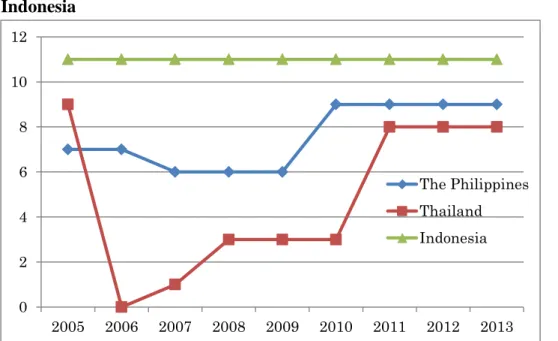
Various indicators imply the nature of electoral administrations in three countries. The Electoral Process Score of Freedom House shows the chronological changes as indicated in Figure 1.
Figure 1 Changes in Electoral Process Scores in the Philippines, Thailand and Indonesia
Source: Compiled by the author, based on the data of Freedom House.
“0” indicates the worst quality of elections, while “12” indicates the highest quality. The criteria of the Electoral Process Score are based on three following questions:
1. Is the head of government or other chief national authority elected through free and fair elections?
2. Are the national legislative representatives elected through free and fair elections? 3. Are the electoral laws and framework fair?7
The third question which addresses the nature of electoral administration though the Electoral Process Score itself is not limited to measuring the neutrality or capacity of the electoral process. Since the fairness of elections is mostly determined by the neutrality and capacity of electoral administration, the score can be a proxy for the nature of electoral administrations.
7 https://www.freedomhouse.org/report/freedom-world-2015/methodology#.UuBEBLQo 71I 0 2 4 6 8 10 12 2005 2006 2007 2008 2009 2010 2011 2012 2013 The Philippines Thailand Indonesia
7
When we take a look at the Electoral Process Score, it has been consistently high in Indonesia since 2005. The score significantly plunged in Thailand in 2006. This was caused by a coup and the subsequent administration change. The level has continued to rise since then, though it is still low. In sum, the electoral administration in Indonesia seems to be higher quality, followed by that in the Philippines, and then that in Thailand.
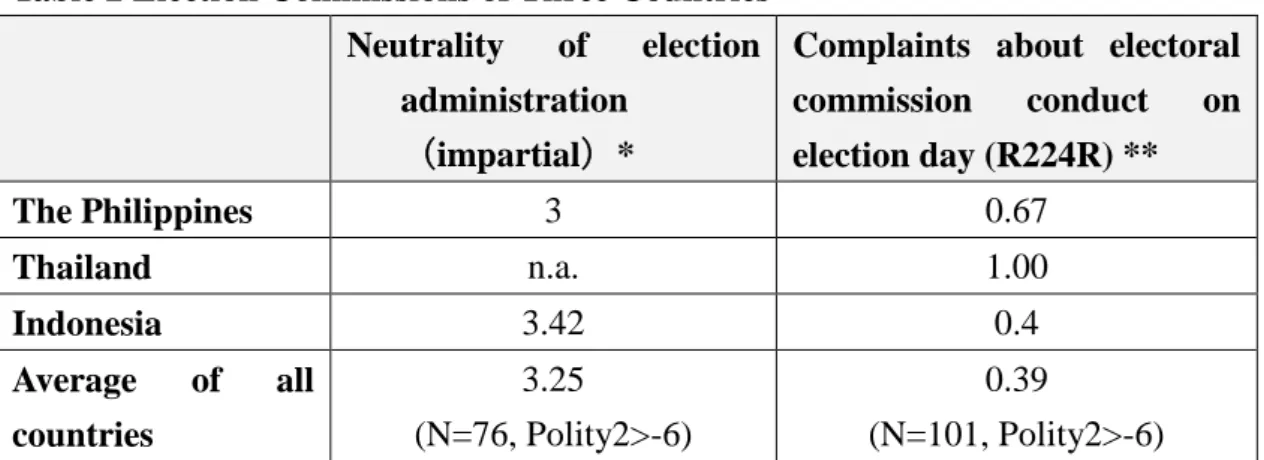
Aside from the Freedom House score, Norris, Martinez i Coma, and Frank (2014) and Kelley (2011) provide data on the quality of elections. Their datasets contain the score for the neutrality and capacity of election commissions.
Table 2 Election Commissions of Three Countries Neutrality of election
administration
(impartial)*
Complaints about electoral commission conduct on election day (R224R) ** The Philippines 3 0.67 Thailand n.a. 1.00 Indonesia 3.42 0.4 Average of all countries 3.25 (N=76, Polity2>-6) 0.39 (N=101, Polity2>-6)
* Norris, Martinez i Coma, and Frank (2014). Code: Strongly Disagree, 1; Disagree, 2; Neither agree nor disagree, 3; Agree, 4; Strongly Agree, 5.
** Kelley (2011). Average of evaluations of various organizations. Code: Good - no problems, 0; Low - minor problems only, 1; Moderate - moderate problems, 2; High - major problems, 3.
Source: Author.
Indonesia achieves a relatively better score for its election commission, followed by the Philippines and then Thailand. These evaluations match the Electoral Process Score of Freedom House.
In order to check the correlations between the Electoral Process Score and the stakes of politics, we plot countries in Figure 2, with the Electoral Process Score on the vertical axis and the Check and Balances Score (the Number of Veto Players) of the World Bank’s Dataset of Political Institutions (DPI) on the horizontal axis (Keefer 2012).
8
Figure 2 Electoral Process Score and the Number of Veto Players (2009)
N = 174, r = 0.52
Source: Compiled by the author.
It is predicted that, theoretically, a larger number of veto players bring about a better score for the Electoral Process because a larger number of veto players means a lower concentration of power. As a whole, Figure 2 shows the predicted trend. Furthermore, the positions of the three Southeast Asian countries do not contradict the theoretical prediction, though they do not fit the prediction perfectly.
In addition, if we compare the presidential powers particularly between the Philippines and Indonesia based on Kasuya (2013), the President of the Philippines has greater power. This fits the theoretical prediction, combined with the number of veto players.
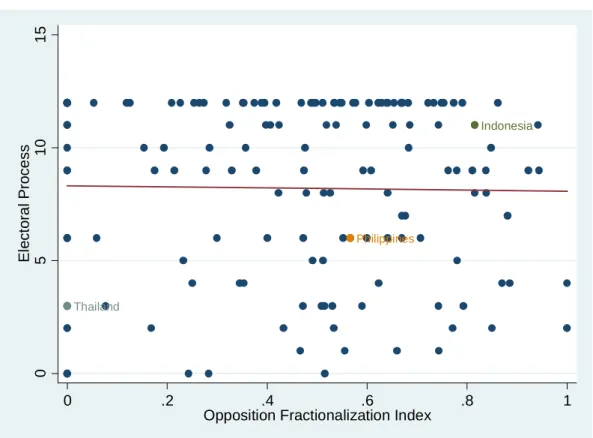
Meanwhile, we also check the correlations between the Electoral Process Score and the seriousness of the coordination problem within the opposition in Figure 3. We use the Opposition Fractionalization Index of the World Bank’s DPI here.8
8
The Opposition Fractionalization Index indicates the probability that two deputies
Indonesia Philippines Thailand 0 5 10 15 El e ct o ra l Pro ce ss 0 2 4 6 8
9
Figure 3 Electoral Process Score and Opposition Fractionalization (2009)
N=153, r = -0.02
Source: Compiled by the author.
Unlike Figure 2, Figure 3 does not show any correlation. If we follow the previous arguments, it is supposed that larger opposition fractionalization decreases the Electoral Process Score because it is more difficult to solve the coordination problem. However, we cannot find any correlation between the two variables. This does not necessarily support our argument of the correlation between the stakes of politics and the intensity of protest, or the argument on the information. Nonetheless, at least it indicates that the costs of facing protests are not an apparent cause for the establishment of neutral electoral administration in democracies.
In the following sections, we will examine the effects of the stakes of power through case studies on three countries. The three cases could be summed up as follows.
In the Philippines, Comelec or members of Comelec are often blamed for being partisan.
picked at random from among the opposition parties will be of different parties.
Indonesia Philippines Thailand 0 5 10 15 El e ct o ra l Pro ce ss 0 .2 .4 .6 .8 1
10
This is mainly caused by the high stakes of politics, particularly control over rents. Nevertheless, prohibition of reelection of the president weakens the president’s incentive to intervene in elections except for the midterm elections. In another aspect, the presidential term limit discourages the president from conducting serious electoral reforms because it has nothing to do with the interests of an incumbent who steps down after a single term. In addition, local political competitions seem to be a major cause of political intervention as the stakes of politics is so high at the local level.
In Thailand, partisanship in the ECT has been caused by the concentration of power, especially after the approval of the 1997 Constitution which adopted a majoritarian system and strengthened the prime minister’s status9. The ECT was established as an independent body and given strong regulatory power. This made the ECT itself a political player.
In Indonesia, the KPU is relatively neutral, though its capability is sometimes questioned. The stakes of power are relatively low as Indonesia has consensus-type political institutions with an institutionalized multi-party system. In addition, the relatively weakness of the president’s power lowers the stakes of politics (Kasuya 2013, Kawamura 2013).
4. The Philippines
Since the constitution prohibits reelection of the president, the president does not have an incentive to manipulate electoral administration in order to get reelected.10 The president does not have a strong incentive to help his/her party members win the presidential election either since political parties are fluid in the Philippines. Elections are competitions between individual politicians rather than parties. However, the term limit does not necessarily work to promote the neutrality of Comelec. Actually, single term presidency discourages the president’s serious reform of electoral administration because the result of the presidential election after his term ends does not affect his own
9
See Hicken (2009) for the effects of the 1997 Constitution. 10
The 2004 presidential election was an exception because the incumbent president, President Gloria Macapagal-Arroyo, was allowed to run. As vice president, she assumed the presidency after her predecessor, President Joseph Estrada, stepped down in the middle of his term. In such cases, the Constitution allows the incumbent to run.
11
political life. Since the authoritarian Marcos regime utilized Comelec as a part of its authoritarian institutions and such a historical background has influenced the nature of Comelec even after democratization, the lack of serious reforms causes Comelec’s problems to continue.
In addition, the president still has an incentive to intervene in the midterm elections as the results affect the president’s legislative agenda. Furthermore, local politics matter in determining the nature of Comelec. Local elections are competitions between local politicians to gain the control over the various interests in respective areas (McCoy 1993, Sidel 1999). The stakes of power in local politics are quite high, and so local politicians have strong incentives to manipulate the electoral administration.
If we take a look at the expected intensity of protests, the opposition’s protest can be controlled by the ruler at the national level. Since the party system is fluid, members of the opposition can be bought off. They can even join the winner’s party after the elections, even if they were once members of the rival parties.11 The street demonstration against the Estrada Administration in 2001 seems to be an exception in this sense. The protest movement removed President Joseph Estrada from office, and this indicates that the people’s extra-constitutional actions can threaten the administration. However, it was not based on electoral fraud but on apprehension over economic stagnation. His successor, President Gloria Macapagal-Arroyo, was able to survive the protest movement against her in 2005 prompted by her election rigging. In contrast, electoral fraud in local elections often causes intensified conflicts. Rivals of the winners often stage strong protests against electoral fraud when it occurs. Still, such protests do not discourage electoral fraudulence since the power provides the winner with large rents.
The evolution of the electoral administration in the Philippines was as follows, within the above-mentioned incentive structure.
The electoral administration was initially established under American colonial rule, and elections were administered by the Ministry of Interior in the beginning. The independent commission, Comelec, was established by the 1935 Constitution. Comelec
11
The majority bloc in the lower house, which is usually close to the president, kept around 80 percent of the total seats after democratization (Kawamura 2012). This was mainly in the form of a post-election coalition.
12
was strengthened after independence in 1946. By the 1973 Constitution under the authoritarian Marcos regime, Comelec was expanded and acquired a semi-judicial function in addition to its management function. Such consolidation worked for the Marcos regime, enabling it to manipulate the electoral process. Under the authoritarian rule, there were congressional elections twice (1978 and 1984) and presidential elections twice (1981 and 1986). In all the elections, President Marcos or his party won. Cases of massive electoral fraud (disenfranchisement, manipulation of counting, vote buying and violent intimidation) were observed.12 The most infamous case was the 1986 presidential election when Corazon Aquino, wife of assassinated Senator Benigno Aquino, Jr., ran against President Marcos. Some Comelec officials even walked out to protest the counting manipulation (Wurfel 1988, p. 300). Although the National Assembly declared that President Marcos won, it triggered a military coup and mass demonstration. Eventually, the authoritarian regime collapsed.
Politicians’ intervention in Comelec, which was enhanced under the Marcos administration, continued to exist even after democratization. Calimbahin (2009) points out three major problems with Comelec. First, political and economic elites and members of Comelec are in a patron-client relationship which allows those elites to interfere. Second, there exist patron-client networks within Comelec which promote private interests in official business. Third, Comelec itself suffers from inefficiency and incapability. Calimbahin claims that these characteristics were formed before democratization.
The intensity of politicians’ intervention can be translated as the level of corruption in Comelec. Social Weather Stations, Inc. (SWS), reports that Comelec had a bad reputation regarding corruption as of 2006. Although it improved in 2009, its bad reputation (i.e., Comelec is not sincere) still exceeded its good reputation (i.e., Comelec is sincere) by 8 points.13
The holding of fair elections was one of the major issues in the Philippines, as in other democratized countries. Drastic reforms in Comelec were also expected after
12
In the pre-authoritarian period, Comelec contributed to fair elections, such as the elections of the 1970 Constitutional Convention (Wurfel 1988, pp.105-106).
13
2008 Survey of Enterprises on Corruption: Anti-corruption sincerity ratings improved for only 8 out of 30 agencies; Transparent Accountable Governance: The 2009 SWS Surveys on Corruption.
13
democratization. However, instead of reforms in Comelec, endeavors to achieve fair elections were mainly carried out through integrating the private sector into the electoral process.
The private sector’s involvement in the electoral process can be traced back to the time of the democratic period just after independence. Violent intimidation and vote buying were rampant then. In order to support Comelec, the National Movement for Free Elections (NAMFREL) was established in 1951. Although it aimed to maintain fairness in elections, it was manipulated by the US government to cause Ramon Magsaysay to win the 1953 presidential election (Wurfel 1988, pp.104-105). A new NAMFREL was organized for the 1984 national assembly (Batasan Pambansa) elections. It was in charge of counting at the precinct level, independent of Comelec’s counting.14 President Marcos officially allowed civic groups to monitor the electoral process in order to trumpet his administration’s legitimacy. The 1985 Omnibus Election Code of the Philippines formally provided for the monitoring of civic groups. Discrepancies in counting between Comelec and NAMFREL made people doubt the fairness of the elections, and this eventually augmented the legitimacy of the Aquino government after democratization. The 1995 amendment to the 1991 Synchronized Election Code provides that a copy of election returns shall be given to a civic group.
While the private sector increased its presence, there were also attempts to reform Comelec itself, especially under the Aquino Administration. President Aquino appointed lawyers who were known for their integrity such as Hilario Davide, Jr., Haydee Yorak, and Christian Monsod as Comelec chairs. However, Davide and Yorac were transferred to other institutions shortly, and Monsod’s term was short as he was appointed just to finish his predecessors’ term (Calimbahin 2009).
In the 1995 senatorial elections just after Monsod retired, manipulation of counting as well as other kinds of electoral fraud were reported. Also, the presidents appointed people who were perceived as partisan as Comelec chairs.
Comelec is composed of seven commissioners with terms of seven years. No reappointment is allowed. Commissioners are required to be members of the bar and
14
The name was slightly changed. The new NAMFREL is the National Citizen’s Movement for Free Elections.
14
should have practiced more than ten years. The consent of the Commission on Appointments composed of selected senators and representatives is also necessary for their appointments. Despite these requirements, the president influences the selection since he/she holds the decisive power to appoint.15
Reforming Comelec has been a tough task. Therefore, the introduction in 2010 of an automated counting system that aims to prevent counting manipulation was a breakthrough in its history. Although there is still room for vote buying and intimidation, automated counting is expected to be effective for improving the quality of elections.16 The SWS surveys indicate that 54 percent of respondents were satisfied with the 2004 elections (35 percent were not satisfied) and 51 percent were satisfied with the 2007 elections (31 percent were not satisfied). After automation was introduced, the satisfaction rate increased to 75 percent in the 2010 elections (15 percent were not satisfied).17
5. Thailand
Thailand has experienced neither an enduring democracy nor an enduring authoritarian regime. Thai people had 15 constitutions from the first constitution after the 1932 revolution up to the 1997 Constitution. Although general elections were held 19 times during this period (Kokpol 2002), coups were repeatedly launched. In short, Thai politics has been very unstable, swinging between democracy and military rule. The electoral system before 1997 was bloc voting, where one district has several seats. The electoral administration was under the Ministry of Interior at that time.
The 1992 democratization, which was triggered by a bloody confrontation, produced a new type of constitution. The 1997 Constitution was different from the previous constitutions in many respects. First, it provided for an independent election commission. Second, it introduced majoritarian-type political institutions. This raised
15
For example, controversial appointments include Luzviminda Tancangco (by President Estrada) and Benjamin Abalos and Virgilio Garcilliano (by President Arroyo). 16
The Center for People Empowerment in Governance (n.d.) claims that there are still some problems in transparency.
17
Social Weather Stations. 2010. Second Quarter 2010 Social Weather Survey: 75% of Filipinos satisfied with the conduct of the May 2010 Elections.
15
the stakes of politics, and it eventually brought about the partisanship of the Election Commission of Thailand (ECT).
The majoritarian feature was mainly caused by the plurality (single member district) electoral system.18 In addition, the power of the prime minister was strengthened by two changes. First, the member of the parliament who is appointed to a Cabinet post loses his/her seat in the parliament. This discourages the cabinet member from rebelling against the prime minister because he/she has no place to return. Second, those who joined an accredited political party less than 90 days before the elections cannot run for the elections. Since elections must be held within 60 days from the dissolution of parliament, politicians cannot switch their affiliation after the dissolution. The prime minister can threaten those who seek to defect from the ruling party by dissolving the parliament (Hicken 2009, p.132).
Along with the political reform, the electoral administration was also separated from the Ministry of Interior. It was perceived then that the administration or the bureaucracy could influence the electoral process as long as the electoral administration was under the Ministry. The independent commission was established to preclude such a problem.19
The newly established ECT acquired greater power than the Ministry of Interior had before. Cases of violation of electoral rules used to be handled by the court, and proceedings tended to take a long time. In many cases, prosecutors could not sustain trials as they lacked of sufficient evidence.20 The 1997 Constitution gave the ECT the power to investigate violations of electoral rules. Moreover, the ECT can suspend the candidacies and accreditation of parties and nullify results where electoral rules are violated. In particular, the 2000 amendments to the Organic Law on the Elections gave the ECT the power to nullify the results and hold a second round of elections at the precinct level if the ECT recognizes electoral fraud in the precinct (yellow cards).
18
Proportional representation was also introduced, but single member districts were allotted more seats in the parliament.
19
Interview with Laddawan Tantivitayapitak (Vice Chairwoman of Political Development Council), September 7, 2011. She finds no strong opposition from the Ministry of Interior for the separation.
20
Most of the electoral fraud in Thailand is vote buying (Klein 1998). It is widely known that the networks of local politicians and “hua khanaen,” or brokers, play a crucial role in Thai elections (Ockey 2004).
16
Candidates who are suspected of violating electoral rules are not allowed to run in the second round of elections or in any elections within one year (red cards). Only one red card was issued in the 2000 senatorial elections. However, the ECT ordered 62 precincts to repeat elections. Then, it issued 52 red cards in the 2001 parliamentary elections (Kokpol 2002).21
The majoritarian-type political institutions of the 1997 Constitution were introduced to get rid of the problems caused by the previous bloc voting system. Political parties used to be loosely structured, and they depended on factions of local politicians. The prime minister’s leadership was weak because he/she needed to have coalitional partners to sustain the administration. The new political institutions brought about the strong leadership of the prime minister. In the 2001 parliamentary elections, Thai Rak Thai (TRT), the party established by Thaksin Shinawatra, gained almost half of the seats and organized its administration after absorbing small parties. In the 2005 elections, TRT occupied three-fourthsof the parliament.
The landslide victory of TRT intensified the conflict between the urban middle class who were weary of corruption scandals in the administration and rural farmers who supported Thaksin’s distributive policy to the rural areas. The military, supported by the urban middle class, launched a coup and expelled Thaksin in 2006. Since then, the pro-Thaksin Red Shirts group and the anti-Thaksin Yellow Shirts group continue to clash and deepen the social cleavage.
As the stakes of politics increased due to concentration of power and political groupings became polarized, the ECT’s strong power attracted intervention. The members of the ECT were initially composed of bureaucrats (the Ministry of Interior), judges, university professors, and NGO workers. As the crucial role of the ECT was recognized through elections, especially after the 2001 elections, Prime Minister Thaksin started placing the members who were close to him in the commission (Chambers 2006). Therefore, the 2005 elections in which TRT won a landslide victory were administered under the pro-Thaksin commission (Croissant and Pojar 2005).22
21
As for the 2000 senatorial elections and the 2001 parliamentary elections, see (Institute of Developing Economies (various years), Montesano (2001), 2002)). 22
It is also reported that politicians and bureaucrats intervened in the ECT at the local level (Achakorn Wongpreedee 2007, Nelson 2008).
17
The partisanship of the ECT intensified the struggle over the control of the ECT. Although TRT won the 2005 elections, the urban middle class started protesting against the administration after various scandals were revealed. In order to augment his legitimacy, Prime Minister Thaksin held parliamentary elections in 2006. Because the election results were not finalized in some areas, the Thaksin administration tried to hold elections again. However, the Constitutional Court announced that the 2006 elections were void due to mismanagement by the ECT and asked the ECT commissioners to resign. After the commissioners refused to resign, they were prosecuted for their alleged illegal favors to TRT members. All of them were convicted and removed from office. The military then launched a coup, and Prime Minister Thaksin was ousted.
Although the 2007 Constitution after the coup modified the 1997 Constitution, the ECT was still retained. However, the appointment process of the commissioners was changed. In the 1997 Constitution, the Senate chooses the commissioners from a list prepared by the selection committee and the Supreme Court. In contrast, in the 2007 Constitution, the Senate only approves the choice of the selection committee and the Supreme Court. Thus, the judiciary increased its influence in the appointment process. Of the five new ECT commissioners after the 2006 coup, three were judges, one was a prosecutor, and one was a university professor
The ECT showed its partisan tendencies against the Thaksin group along with the judiciary. The People Power Party (PPP), which succeeded TRT after the Constitutional Court dissolved TRT, gained support in rural areas in the 2007 elections.23 Nonetheless, the ECT issued yellow cards and red cards mostly to candidates of PPP. As a result, the PPP share in the parliament was reduced and became close to that of the Democratic Party (Ockey 2008). Although Samak Sundaravej of PPP assumed the premiership, he was removed from the office by the Constitutional Court, which claimed that he violated the constitution by accepting payments to appear on TV cooking shows while in office. Moreover, the Constitutional Court ordered the dissolution of PPP based on violations of electoral rules in the 2007 elections (Dressel 2010, Ginsburg 2009).
Surveys indicate that people recognized the ECT’s partisanship. The 2009 Asia
23
In 2007, the Constitutional Court ordered the dissolution of TRT and decided that 111 TRT members including Thaksin were not eligible for election for five years.
18
Foundation’s report shows that 67 percent of respondents see the ECT as biased (Asia Foundation 2009). In the 2010 surveys of the Asia Foundation, the ECT’s integrity rating was 42 percent in the South, where anti-Thaksin sentiment is strong, while it was 25 percent in the North, which is Thaksin’s bailiwick (Asia Foundation 2011). The judiciary including the ECT became politically active and revealed their preferences. This phenomena is called “Politicization of the Judiciary” (Ginsburg 2009).
6. Indonesia
The important factors determining the nature of the Indonesian electoral administration are consensus-type political institutions, the party system which reflects social cleavages, and the relative weakness of the presidential power.
As for political institutions, especially the electoral system, the president was initially elected by the People’s Consultative Assembly (Majelis Permusyawaratan Rakyat (MPR)) before the 2004 elections. Even after the direct election was introduced, presidential candidates had to be nominated by parties that hold more than 25 percent of the vote share or more than 20 percent of the seat share in the lower house. With proportional representation for its lower house elections, these institutional frameworks favored party coalitions (Kawanaka 2012). The administrations were supported by party coalitions of at least five parties during the Megawati Administration and at most seven parties during the Abdurrahman Wahid Administration and the first Yudoyono Administration. Since parties were institutionalized (cohesive and stable), partisan veto players were kept intact. The president cannot buy off members of other parties to join his party. In addition, as Kasuya (2013) indicates, the Indonesian president is the weakest among seven Asian presidents in terms of veto powers, executive decrees, budgetary power, referendum and dissolution of the congress.
These factors lower the stakes of politics and eventually prepare favorable circumstance for a neutral electoral administration. In addition, we need to pay attention to the fact that some experiences in the initial formation process of electoral administration determine the path of further developments. The problem of the partisanship of the first election commission in the 1999 elections and the corruption scandal of commissioners in 2005 set the direction of reform. It was widely accepted that the electoral administration should be free from partisanship and should be monitored to prevent
19 corruption.
In order to keep its neutrality and governance, the Indonesian electoral administration comprises various independent organizations, which are mainly the election commission, the supervising body, and the ethics committee. However, it took time for the electoral administration to become stabilized and capable because the electoral systems have been changed frequently since democratization.
The first elections after independence were held in 1955. However, President Sukarno suspended elections after he started his authoritarian rule in 1957. Even after President Suharto took power in 1965 and resumed elections, elections were strongly controlled by the administration. Indonesia adopted proportional representation in the post-independent era. The first election commission (Panitia Pemeilihan Indonesia (PPI)) was established in 1955 (Rüland 2001). The Suharto Administration established the Institute of General Elections (Lembaga Pemilihan Umum (LPU)) and placed PPI under LPU. LPU was headed by the Minister of Home Affairs and PPI was managed by interior bureaucrats and Golkar, a political organization to support the Suharto Administration (Haris 2004). Aside from these commissions, the Election Supervisory Committee (Panitia Pengawas Pemilu, Panwaslu) was established, but it was also under the Minister of Home Affairs and Golkar.
The 1955 elections produced a situation where four major political blocs competed and caused stagnation. Under the Suharto regime, the secular groups and the Islamic groups were integrated, respectively, and this laid the groundwork for the party system after democratization. Various political parties emerged from either the secular bloc or the Islamic bloc after 1998.
The electoral administration in the post democratization period was designed to deal with political competition within elections and to preclude the ruler’s intervention in elections. Actual institutional formation was a process of trial and error. The constitution was amended four times from 1999 to 2002. The elections in 1999, 2004, 2009, and 2014 were held under different electoral systems. As the institutional framework of elections changed, the organization of the electoral administration also changed.
Elections after democratization were mainly managed by the General Election Commission (Komisi Pemelihan Umum (KPU)) which was established by the 1999
20
General Election Law. The initial composition of the KPU was five commissioners recommended by the administration and forty eight commissioners representing political parties. This design was intended to prevent the administration’s intervention. It was also expected that party representatives in the KPU would watch out for each other and neutrality would be achieved. Nonetheless, each commissioner took partisan actions individually, and the KPU was not able to function in a neutral way (Harris, Wall, and Dahl 2001).
The partisanship of commissioners in the first KPU affected the direction of reform, which was to establish neutrality. The third constitutional amendment in 2001 provided the KPU as constitutional independent body. Before that, the amendment of the 1999 General Election Law in 2000 changed the composition of commissioners. The commissioners appointed by the government and party representative commissioners were abolished. The KPU comprised eleven non-partisan commissioners. The appointment process was also clearly defined. The House of Representatives (Dewan Perwakilan Rakyat (DPR)) appoint the commissioners from a list prepared by the president. The 2003 amendment of the General Election Law strengthened the autonomy of the KPU. Electoral management at the local level was transferred from the government to the KPU, and financial autonomy and regulatory power were augmented. The KPU members were not allowed to hold any government posts. The relationship between the KPU and the Election Supervisory Committee (Panwaslu) was also defined. The members of Panwaslu were appointed by the KPU, and they were from civic organizations, academic society, police and prosecutors (Carter Center 2005). The Constitutional Court’s role in elections was also provided in the 2003 Constitutional Court Law.
The first direct presidential election was held in 2004, and Yudhoyono won the race. Under his administration, the electoral administration was reformed again. The most serious impact was exerted by the corruption scandal of the KPU, where two commissioners, including the chair, were convicted. The corruption scandal led to the strict monitoring of financial management and eventually to inflexibility of fund release. The 2007 Election Administration Law again reorganized the KPU. The number of commissioners was decreased to seven with five year terms. It was clearly provided that commissioners must not hold any government offices or party affiliations. Furthermore, the appointment process was revised. Instead of presidential recommendation, the president appoints the selection committee which screens the candidates. Based on the
21
committee’s recommendation, DPR decides the commissioners. In addition, the fund disbursement process became strictly monitored. Aside from the KPU, the Election Supervisory Board (Badan Pengawasan Pemilu, Bawaslu) expanded its power, and the Honorary Council of Election Management Bodies (initially Dewan Kehormatan (DK) renamed to Dewan Kehormatan Penyelenggara Pemilu (DKPP) later) was established. Bawaslu investigates the cases of violations of electoral rules based on complaints, while DKPP investigates the wrongdoings committed by the members of the KPU and Bawaslu (Abdul Gaffar Karim 2014). In sum, the Indonesian electoral administration is composed of three organizations: KPU, Bawaslu, and DKPP. The 2009 elections were held under this administration, when President Yudhoyono was reelected.
The Indonesian electoral administration developed toward seeking neutrality and cleanness.24 However, it suffered from another type of problem. The vast land area and the large population size (171.3 million voters and 528,217 precincts in 2009) naturally cause inefficiency in electoral management. Moreover, as KPU commissioners were strictly required to be non-partisan and to be selected from outside the government, most of them were inexperienced and had less knowledge about election management (Mietzner 2012, Sukma 2010). The inflexible disbursement process was another cause of inefficiency, especially in renewal of the voters list (Khalik 2008). In addition to these problems, the 2009 elections were thrown into confusion caused by changes in the electoral system in terms of district magnitude and introduction of open list proportional representation (Schmidt 2010).25
Also, if we take a look at the local level, the situation was different from the national elections. The decentralization introduced by President Habibie and direct elections of local chief executives made the stakes of politics larger at the local level. The neutrality of the local election commissions was questioned by some observers (Carter Center 2005).26
24
Nonetheless, the corruption scandal of the Chief Justice of the Constitutional Court in 2013 was another significant occurrence. Akil Mochtar was accused of accepting bribery regarding an electoral dispute. He was finally removed from office.
25
The 2009 elections were seen as being more confusing than the 2004 elections, especially in misprinting, undersupply and misdistribution of ballots; delayed distribution of election materials; and inaccuracy of voters lists (Rondonuwu and Creagh 2009, Sukma 2010).
26
22
7. Conclusion
The electoral administration is crucial in democratic consolidation since people’s confidence in elections is the key to legitimacy and stability. This is also true in Southeast Asia. This paper investigates the determinants of the nature of electoral administrations in the region. We consider the nature of electoral administration as a result of strategic interactions between political players, and we emphasize the stakes of politics. Through case studies of the Philippines, Thailand and Indonesia, we found that the stakes of politics seem to determine the nature of electoral administrations. The large stakes in Thailand and the Philippines accentuate the partisan tendencies of the election commissions, while the lower stakes in Indonesia result in neutrality. In contrast, the expected intensity of protests against electoral fraud or the administration seems to have no critical impact in any of the countries. The intensity of protests actually reflects the stakes of power. The high stakes enhance protests in Thailand and the Philippines.
In addition, the three cases indicate that the neutrality and capacity of electoral administrations do not co-vary. The lower capacity and lower neutrality of the electoral administration in the Philippines are a result of politicians’ intervention. In Thailand, the high capacity of the electoral administration prepares the basis for partisanship since the electoral administration plays a crucial role in the electoral process. In Indonesia, lower capacity and high neutrality coexist.
References
Abdul Gaffar Karim. 2014. Understanding the Rquirements of Electoral Management Course for EMB in Indonesia. Jakarta: ACE Indonesia.
Achakorn Wongpreedee. 2007. "Decentralization and Its Effect on Provincial Political Power in Thailand." Asian and African Area Studies no. 6 (2):454-470.
Asia Foundation. 2009. Constitutional Reform and Democracy in Thailand: A National Survey of the Thai People. Bangkok: The Asia Foundation.
Asia Foundation. 2011. The 2010 National Survey of the Thai Electorate: Exploring National Consensus and Color Polarization. Bangkok: The Asia Foundation. Calimbahin, Cleo. 2009. An Institution Reformed and Deformed: The Commission on
Elections from Aquino to Arroyo. Chiba: Institute of Developing Economies. Carter Center. 2005. The Carter Center 2004 Indonesia Election Report. Atlanta.
23
Center for People Empowerment in Governance. n.d. Anaysis of Outstanding Technical Issues: Executive Summary.
Chambers, Paul. 2006. "Consolidation of Thaksinocracy and Crisis of Democracy: Thailand's 2005 General Election." In Between Consolidation and Crisis: Elections and Democracy in Five Nations in Southeast Asia, edited by Aurel Croissant and Beate Martin, 277-327. Berlin: Die Deutsche Bibliothek.
Croissant, Aurel, and Daniel J. Jr. Pojar. 2005. Quo Vadis Thailand? Thai Politics after the 2005 Parliamentary Election. Strategic Insights 4 (6).
Dressel, Björn. 2010. "Judicialization of Politics or Politicization of the Judiciary? Considerations from Recent Events in Thailand." Pacific Review no. 23 (5):671-691. doi: 10.1080/09512748.2010.521253.
Ginsburg, Tom. 2009. "Constitutional Afterlife: The Continuing Impact of Thailand's Postpolitical Constitution." International Journal of Constitutional Law no. 7 (1):83-105. doi: 10.1093/icon/mon031.
Haris, Syamsuddin. 2004. "General Elections under the New Order." In Elections in Indonesia: The New Order and Beyond, edited by Hans Antlöv and Sven Cederroth, 18-37. New York: Routledge Curzon.
Harris, Paul, Alan Wall, and Bob Dahl. 2001. Opportunity for Electoral Reform. Washington, D.C.: International Foundation for Election Systems.
Hicken, Allen. 2009. Building Party Systems in Developing Economies. New York: Cambridge University Press.
Institute of Developing Economies. various years. Yearbook of Asian Affairs (in Japanese). Chiba: Institute of Developing Economies.
Kasuya, Yuko. 2013. "A Framework for Analyzing Presidential-Legislative Relations in Asia." In Presidents, Assemblies and Policy-Making in Asia, edited by Yuko Kasuya, 10-39. New York: Palgrave Macmillan.
Kawamura, Koichi. 2012. "Executive-Legislative Relations." In Comparative Politics of Southeast Asia (in Japanese), edited by Masashi Nakamura, 45-76. Chiba: Institute of Developing Economies.
Kawamura, Koichi. 2013. "President Restrained: Effects of Parliamentary Rule and Coalition Government on Indonesia's Presidentialism." In Presidents, Assemblies and Policy-Making in Asia, edited by Yuko Kasuya, 156-193. New York: Palgrave Macmillan.
Kawanaka, Takeshi. 2012. "Election." In Comparative Politics of Southeast Asia (in Japanese), edited by Masashi Nakamura. Chiba: Institute of Developing Economies.
24
Kawanaka, Takeshi, and Yuki Asaba. 2013. "Electoral Administration as Self-enforcing Institutions: A Comparative Study of Korea and the Philippines." In Politics of Electoral Management: Comparative Study of Korean Model for Electoral Governance and Japanese Electoral Management (in Japanese), edited by Yutaka Onishi, 59-82. Tokyo: Yuhikaku.
Keefer, Philip E. 2012. Database of Political Institutions 2012 (updated Jan. 2013). edited by The World Bank: The World Bank.
Kelley, Judith. 2011. Data on International Election Monitoring: Three Global Datasets on Election Quality, Election Events and International Election Observation. Inter-university Consortium for Political and Social Research (ICPSR).
Khalik, Abdul. 2008. "Most voter lists remain invalid: Survey." Jakarta Post.
Klein, James R. 1998. The Constitution of the Kingdom of Thailand, 1997: A Blueprint for Participatory Democracy. In Working Paper No.8. Bangkok: The Asia Foundation.
Kokpol, Orathai. 2002. "Electoral Politics in Thailand." In Electoral Politics in Southeast & East Asia, edited by Aurel Croissant, 277-297. Singapore: Friedrich-Ebert-Stiftung, Office for Regional Co-operation in Southeast Asia. Magaloni, Beatriz. 2006. Voting for Autocracy: Hegemonic Party Survival and its
Demise in Mexico, Cambridge Studies in Comparative Politics. New York: Cambridge University Press.
Magaloni, Beatriz. 2010. "The Game of Electoral Fraud and the Ousting of Authoritarian Rule." American Journal of Political Science no. 54 (3):751-765. doi: 10.1111/j.1540-5907.2010.00458.x.
McCoy, Alfred W. ed. 1993. An Anarchy of Families: State and Family in the Philippines. Wisconsin: Center for Southeast Asian Studies, University of Wisconsin-Madison.
Mietzner, Marcus. 2012. "Indonesia's Democratic Stagnation: Anti-Reformist Elites and Resilient Civil Society." Democratization no. 19 (2):209-229.
Montesano, Michael J. 2001. "Thailand in 2000 Shifting Politics, Dragging Economy, Troubled Border." Asian Survey no. 41 (1):171-180.
Montesano, Michael J. 2002. "Thailand in 2001: Learning to Live with Thaksin?" Asian Survey no. 42 (1):90-99. doi: 10.1525/as.2002.42.1.90.
Nelson, Michael H. 2008. Thaksin’s 2005 Electoral Triumph: Looking Back From the Election in 2007. In Working Paper Series No. 98. Hong Kong: City University of Hong Kong.
25
Electoral Integrity, Version 2.5. edited by Harvard and Sydney Universities Electoral Integrity Project: Harvard Dataverse Network
Ockey, James. 2004. Making Democracy: Leadership, Class, Gender, and Political Participation in Thailand. Hawaii: University of Hawai'i Press.
Ockey, James. 2008. "Thailand in 2007: The Struggle to Control Democracy." Asian Survey no. 48 (1):20-28.
Onishi, Yutaka. 2013. "Democracy and Electoral Management." In Politics of Electoral Management: Comparative Study of Korean Model for Electoral Governance and Japanese Electoral Management (in Japanese), edited by Yutaka Onishi, 13-36. Tokyo: Yuhikaku.
Przeworski, Adam. 1991. Democracy and the Market: Political and Economic Reforms in Eastern Europe and Latin America, Studies in Rationality and Social Change New York: Cambridge University Press.
Rüland, Jürgen. 2001. "Indonesia." In Elections in Asia and the Pacific: A Data Handbook, Volume 2, South East Asia, East Asia, and the South Pacific, edited by Dieter Nohlen, Florian Grotz and Christof Hartmann, 83-128. New York: Oxford University Press.
Rondonuwu, Olivia, and Sunanda Creagh. 2009. "Voter row dogs final hours before Indonesia election." Reuters.
Schmidt, Adam. 2010. "Indonesia's 2009 elections: Performance Challenges and Negative Precedents." In Problem of Democratization in Indonesia: Elections, Institutions and Society, edited by Edward Aspinall and Marcus Mietzner, 100-121. Singapore: Institute of Southeast Asian Studies.
Shugart, Matthew Soberg , and John M. Carey. 1992. Presidents and Assemblies: Constitutional Design and Electoral Dynamics: Cambridge University Press. Sidel, John T. 1999. Capital, Coercion and Crime: Bossism in the Philippines. Stanford,
CA: Stanford University Press.
Simpser, Alberto. 2013. Why Governments and Parties Manipulate Elections: Theory, Practice and Implications. New York: Cambridge Unviersity Press.
Soga, Kengo. 2013. "Developments and Prospects of the Studies on Electoral Governance." In Politics of Electoral Management: Comparative Study of Korean Model for Electoral Governance and Japanese Electoral Management (in Japanese), edited by Yutaka Onishi, 37-58. Tokyo: Yuhikaku.
Sukma, Rizal. 2010. "Indonesia's 2009 Elections: Defective System, Resilient Democracy." In Problem of Democratization in Indonesia: Elections, Institutions and Society, edited by Edward Aspinall and Marcus Mietzner, 53-74.
26
Singapore: Institute of Southeast Asian Studies.
Tsebelis, George. 2002. Veto Players: How Political Institutions Work. Princeton, N.J.: Princeton University Press.
Weingast, Barry R. 1997. "The Political Foundations of Democracy and the Rule of Law." American Political Science Review no. 91 (2):245-263.
Wurfel, David. 1988. Filipino Politics: Development and Decay. Ithaca, New York: Cornell University Press.