Chapter IV Administrative Court and Lregal
Reform Since 1998 in Indonesia
権利
Copyrights 日本貿易振興機構(ジェトロ)アジア
経済研究所 / Institute of Developing
Economies, Japan External Trade Organization
(IDE-JETRO) http://www.ide.go.jp
シリーズタイトル(英
)
ASEDP
シリーズ番号
74
journal or
publication title
Reforming Laws and Institutions in Indonesia:
An Assessment
page range
83-111
year
2007
Chapter IV
ADMINISTRATIVE COURT AND LEGAL REFORM
SINCE 1998 IN INDONESIA
Anna Erlyana
I. INTRODUCTION
The enactment of Law No. 5 of 1986 on the Administrative Court has served to raise Indonesia’s international legal standing as a country based on the rule of law and a country with a modernized and functional law. The bill’s preparation began as long ago as 1948 by Wirjono Projodikoro and was later to be included in Law No. 14 of 1970 and re-emphasized in Peoples’ Consultative Council (Majelis Permusyawaratan Rakyat / MPR) Decree No. IV of 1978.
In 1982, a bill on the Administrative Court was submitted to the House of Representatives (Dewan Perwakilan Rakyat / DPR). However, the bill never managed to pass the DPR during the term of that DPR. In April 1986, the government proposed another more complete bill on the Administrative Court and this time the bill managed to navigate the DPR and was passed and subsequently enacted on 20 September 1986.1
The bill on the Administrative Court had endured a long journey. The purpose of the law is to stipulate the basic conditions under which a person may bring a claim where it is believed that government policies or actions are detrimental to the community or individuals within that community. The bill is also meant to highlight the government’s preparedness and readiness to be sued by individuals who may wish to bring a claim of this nature. The enactment of Law No. 5 of 1986 reflects an expansion of good political will on the part of government to be held accountable for its policies and actions. Many though questioned this goodwill and the preparedness of the government to be subject to the accountability mechanisms envisaged in the Law as it was a further 5 years before the Administrative Courts became a functioning reality. However, the government was relying on the ex nunc principle, which allows the government a period of 5 years after the enactment of the law to put into place all the necessary infrastructure and tools to adequately enforce the provisions of the law. This
phase included the education of judges and court officials among many other matters.
II. ADMINISTRATIVE COURT and PRACTICAL DEVELOPMENT
As the newest judicial branch of the court system when compared to the other three branches, the early years after the Administrative Court’s establishment were focused on developing administrative law consistency. The leaders of this development were the judges themselves, most of whom had many years of experience in civil proceedings. However, it is worth noting that at the time administrative law was an underdeveloped area of the law. Many law faculties did not teach administrative law and those that did were teaching it in an unsophisticated manner. Times have changed and administrative law is taught in a much more logical and sophisticated manner commensurate with the real needs of practice in the real world. Even after the 5 years of preparation judges of the Administrative Courts were still more comfortable with their civil proceedings knowledge and experience ans as a result Administrative Court proceedings took on a civil proceedings persona if for no other reason than it resembled civil courts more than it did the proceedings of the Military or Religious courts.
Once the law was passed and enacted the public discourse on the relationship between the government and its people continued unabated. This discourse culminated with a realization that Law No 5 of 1986 was no longer a suitable or an appropriate mechanism to be the fundamental legal basis for administrative law disputes.2 The reason the discourse continued unabated was
that there were myriad of new laws being issued such as Regional Regulations, regulations on taxes, and regulations on industrial relationships. Additionally, people were becoming increasing aware and more educated about the law and the delivery of justice. This increasing awareness manifested itself in knowledge that detrimental laws, regulations,and policies may be contested to test their validity. The idea of a Department or some other government agency being sued is no longer an unusual phenomenon, so much so that it is now frequently the case that individuals commence action against the office of the President, which never would have occurred under the more authoritarian control of the former President Soeharto.
In the period from 1991 through 1988, legal action taken against the Office of the President was excluded from the jurisdiction of the Administrative Court because of differing perceptions of Presidential Decrees as an object of claim3 and the Office of the President to whether it had legal standing 4 to appear
in an Administrative Court proceeding. The question became one of whether the obvious imperfections of Law No. 5 of 1986 were to be maintained in the face of the changing dynamic of the relationship between the government and its people. It was increasingly obvious that the legal awareness of the community was changing and expanding as was the community’s legal knowledge as a result of the burgeoning number of sources where legal information could be obtained.
Presidential regulation as a general regulation (regeling) is included in the hierarchy of laws or as laws that may be subject to judicial review in the Supreme Court if the contents of the regulations are deemed to be detrimental to society. If a Presidential Decree was to be categorized as a decision (beschikking) then any detriment that arises against an individual may be resolved through the application for annulment of the provision through the Administrative Court. However, it has become clear that Presidential Decrees are not always published in the State Gazette and that this is a frequent occurrence. Moreover, these Presidential Decrees have to a substantial extent (beleidsregel) have an impact on policy rules that cause harm or damage to the community as they tend to be ultra vires acts or acts that go beyond the authority that they have. Therefore, it is critical to determine when a Presidential Decree exceeds permissible authorities in order to determine where a claim is to be directed.
Three claims were submitted to the Administrative Court against the President. The objects of the claims are the Presidential Decrees:
1. Case No. 091/G.TUN/1998/PTUN-JKT; The Claimant is Gerakan Masyaraka Peduli Harta Negara (The Community Movement Concerned for State Assets);
t
2. Case No. 037/G.TUN/1997/PTUN-JKT; No. 113/B/1997/PT-TUN JKT: No. 130/K/TUN/1998; The Claimant is Wahana Lingkungan Hidup (WALHI / Indonesian Forum for Environment);
3. Case No. 088/G/1994/Piutang/PT-TUN JKT; No. 33/B/1995/PT TUN JKT; No. 89/K/TUN/1996; the Claimants are Wahana Lingkungan Hidup
(WALHI); Lembaga Alam Tropika (Indonesia Tropical Nature Institute);
Lembaga Pengembangan dan Sumber Daya Manusia (Development and
In Case No. 091/G.TUN/1998/PTUN-JKT; Gerakan Masyaraka Peduli Harta Negara against the President of the Republic of Indonesia, the President had issued 15 Presidential Decrees: Presidential Decree No. 14 of 1981; Presidential Decree No. 34 of 1988; Presidential Decree No. 28 of 1991; Presidential Decree No. 32 of 1991; Presidential Decree No. 20 of 1992; Presidential Decree No. 27 of 1992; Presidential Decree No. 42 of 1994; Presidential Decree No. 82 of 1995; Presidential Decree No. 83 of 1995; Presidential Decree No. 3 of 1996; Presidential Decree No. 12 of 1996; Presidential Decree No. 21 of 1996; Presidential Decree No.42 of 1996; Presidential Decree No. 93 of 1996; and Presidential Decree No. 74 of 1998.
t
The claim was submitted on 30 September 1998 but had already passed the stipulated time limitations for the submission of claims of this type.5 The
rationale behind this claim was that a Presidential Decree issued to supervise government agencies or administrative bodies, including the President, went beyond the authority that Presidential Decrees possessed with respect to legislating certain activities. However, after the fall of Soeharto, and a reinvigorating of the legal system saw this system place greater emphasis on the application of procedural rules more so than exclusively on ensuring justice was done. Therefore, the claimants made factual errors in their submission and it was this carelessness in naming the relevant Presidential Decrees that was to serve as their undoing. Moreover, the replacement of the team that was listed to handle the case indicated that there was a lack of serious consideration of the claim submitted.
Other issues with respect to this particular claim included that there was confusion where this claim should be heard, at least on the part of the claimants, and the claim was submitted to the Administrative Court for judicial review6,
when in fact that the law states that it is the Supreme Court that had judicial review powers for this type of claim. Another complication was that the claimant had failed to do sufficient research on the current status of some of the Presidential Decrees that they sort to have judicially reviewed. Some of the Presidential Decrees had already been annulled earlier under the Presidencies of Soeharto and B.J. Habibie7.
Unfortunately, the Court’s interpretation, based on the arguments submitted by the defendant, in this case was to classify Presidential Decrees at the same level as laws. This lack of legal consideration by the Court means that
the decision lacks the requisite legal authority that would serve to provide confidence in the ability of the court to decide these matters. However, this is no longer the position held generally or by the courts as it is now clear that a Presidential Decree may only be classified as a law where it is issued pursuant to a delegation of authority contained in a Statute and which is subsequently published in the State Gazette. For example, Presidential Decree No. 28 of 1991 amended Presidential Decree No. 20 of 1991 on the Reforestation Fund. This was then published in State Gazette No. 53 of 1991. Therefore, this type of Presidential Decree can be subject to judicial review at the Supreme Court.8
Class actions9, according to the Court are not recognized in the
Administrative Court’s Procedural Law. It was unfortunate that the Court failed to analyze or discuss the extent to which there is a prohibition, if any, against the use of excessive authority, which was the basis of the claim. The Claimants were arguing that the Presidential Decree in question had violated the principle prohibiting the use of authority ultra vires when it came to the special treatment or benefits provided to particular people or groups. The underlying premise of the claim was that a Presidential Decree of this type can lead to the downfall of the national economy.
In Case No. 037/G.TUN/1997/PTUN-JKT; which was appeal Case No.. 113/B/1997/PTUN-JKT, and which was appealed to the Supreme Court as Case No. 130/K/TUN/1998. The Claimant was Wahana Lingkungan Hidup (WALHI) and the Defendant was the President of the Republic of Indonesia. The object of the claim was Presidential Decree No. 93 of 1996 on the provision of a government loan to Kiani Kertas Ltd.10 The President was being sued because he
had decided to give IDR 250 billion or the equivalent of USD 250 million as a loan to Kiani Kertas Ltd. with interest to be paid every six months on 30 June and 30 December. The monies which were to make up the loan were transferred from the reforestation fund.
The claimant as a Non-Government Organization (NGO) contended that it had legal standing to bring the claim based on: Article 1(12) jo. Article 5 and Article 9; and Article 6 of Law No. 4 of 1982 on General Rules for Environmental Care. Furthermore, the Claimant relied upon a decision of the Central Jakarta District Court No. 820/PDT.6/1988/PN.JKT.PST, that holds that the regulation on reforestation does not delegate any authorities to the Defendant, particularly as it relates to how this reforestation fund may be used or allocated. Therefore, Presidential Decree No. 93 of 1996 violated the fundamental rules stated in its
own considerations.11 Further analysis of the Presidential Decree had assumed
authorities that were held by the Department of Finance and the Department of Forestry who had already confirmed a Joint Decision on the administration of the reforestation fund.12
The court rejected the arguments submitted by the Claimant based on an interpretation of final13 contained in the Presidential Decree which was held not
to be met. The Court held that the element of final would be satisfied if there was a joint cooperation agreement between the Department of Forestry and the Board of Directors of the bank that distributed the funds.14 The Defendant
submitted arguments that advanced the claim that the Administrative Court did not have the requisite jurisdiction to hear this case. There were two reasons advanced in support of this claim: the doctrine of actio popularis is not known by the Administrative Procedural Law and that the object of the claim is in the category of law because the respective Presidential Decree is merely enforcing Article 4(1) of the Constitution of the Republic of Indonesia and the Broad Outlines of the State Policy (Garis Besar Haluan Negara / GBHN).
The court had correctly clarified the elements of Article 1(3), particularly as it relates to the cumulative characteristics of the provisions and explaining in great detail that the element of “final“ could not be satisfied. The court also explained the dissolved doctrine,15 but the principle of prohibition against any
excessive use of authority that was the basis of the statement of the claim was left largely unaddressed and unresolved by the Court. In its prayer for relief, the Claimant described that the object of the claim is inconsistent with the law that it the basis for the issue of the relevant Presidential Decree.
In Case No. 088/G/1994/Piutang/PTUN-JKT which was appealed as Case No. 33/B/1995/PT TUN JKT to the High Court and then appealed to the Supreme Court as Case No. 89/K/TUN/1996. The Claimants were the NGO, Wahana Lingkungan Hidup (WALHI), Lembaga Alam Tropika (Indonesia Tropical Nature Insititute); Lembaga Pengembangan dan Sumber Daya Manusia (the Development and Human Resources Institute); and Yayasan Pelangi (Rainbow Foundation) and the Defendant in this case was the President of the Republic of Indonesia. The basis of the claim concerned the issue of Presidential Decree No. 42 of 1994 on A Government Loan to Industri Pesawat Terbang Nusantara Ltd. (Nusantara Aeroplane Industry Ltd.). The President decided to lend the company the amount of IDR 400 billion, or the equivalentof USD 40 million, interest free. The money was transferred from the reforestation fund. It was the Claimants
submission that the Presidential Decree violated the prevailing laws and regulations.16
The Defendant submitted that the Claimants could not bring the claim as the Administrative Procedural Law does not recognize class actions. Furthermore, the Defendant relied on the fact that none of the Claimants were donors to the reforestation fund. Finally, the Defendant relied on the determination that Presidential Decrees are classified as law and therefore the Administrative Court does not have the jurisdiction to hear the matter. The Court considered the submissions of the Defendant in considerable detail and held that two of the Claimants did not meet the legal standing requirements and referred to their respective activities and Articles of Association. The considerations were based on Law No. 4 of 1982 of General Rules for Environmental Care. Nevertheless, the Court failed to enumerate any considerations on the object of the claim and it is fair to say that the Court failed to address the merits of the claim in favor of co-opting the Defendants submissions as their decision. As noted in the previous case discussion, the Court chose not to address the prohibition against the excessive use of authority which was also a critical part of the Claimants submissions.
There are a number of conclusions that can be drawn from the above case analyses:
1. The Court held that it does not have the requisite jurisdiction to hear these cases. However, there is only one of the claims from the three cases submitted to the Administrative Court that could conceivably be considered by the Administrative Court for the purposes of judicial review; namely, Presidential Decree No. 28 of 1991 (State Gazette No. 53).The other Presidential Decrees in question are divided into two categories; the Presidential Decrees that are regulations but have not been published in the State Gazette and Presidential Decrees that are classified as policy. The following table highlights these distinctions: Table 1 Presidential Decrees as the object of the claim to the Administrative
Court
Year No Title Classification State Gazette No.
Year No Title Classification State Gazette No. Public Reserved Fund
Raising
1991 28
Amendment of Presidential Decree No. 29 of 1990 on
Reforestation Fund General Regulation LN. No. 53
20 Trade Regulation for National Clove Production. Policy Rules
- 1992
37 Power Generation by Private Company General Regulation - 1994 42
Government Loan to
Industri Pesawat Terbang
Nusantara Ltd.
General
Regulation -
82 Development of Peat Moss Terrain for Agriculture in
Central Borneo Policy Rules -
1995 83
The Establishment of the Presidential Fund Support for Development of Peat Moss Terrain for
Agriculture in Central Borneo
Policy Rules -
The Establishment of the Presidential Fund Support for Family Welfare
Entrepreneurship Credit
Policy Rules -
3
12 The Appointment and Establishment of Bintan Industry Ltd. Area.
General
Regulation -
21 Financial Supply for Family Welfare Entrepreneurship
Credit Policy Rules -
42
National Car Manufactures General
Regulation -
1996
93 Government loan for Kiani Kertas Ltd. Policy Rules - - 1998 74 Development of Peat Moss Terrain for Agriculture in
Central Borneo
General
Year No Title Classification State Gazette No.
(Source) Presidential D crees N : 34/1988; 28/1991; 20/1992;37/1992; 42/1994; 82/1995; 3/1996;12/1996; 21/1996;42/1996; 93/1996; 74/1998.
e o
2. The court held that the Presidential Decrees in question are regulative Presidential Decrees that fell under the category of law.
3. The Court also held that the object of the claim has not met the requirement of “final” since there was civil action that must be taken by the government before the Presidential Decree in question is effective. 4. The legal basis of a Presidential Decree, its enactment in the State
Gazette, and the substance contained in every Presidential Decree provides the means of identifying whether or not a Presidential Decree is to be characterized as a law. This is critical in determining whether the case is within the jurisdiction of the Supreme Court or the Administrative Court.
5. Interestingly, a general analysis of the Court’s judgment from the first instance to the Supreme Court highlights that the Court failed to consider the basic merits of the Claimants submissions, particularly the “interests” that were being advanced. The expansive meaning of “interest” is to be equated with that of an indirect interest. For instance if the Court had considered the more expansive meaning of “interest” then the legal basis for rejecting the actio popularis claim for legal standing despite the lack of any regulation at that time. The Court should have considered the Articles of Association and the annual activity reports of the various claimants.
III. The AMENDMENT of Law No. 5 of 1986 as Law No. 9 of 2004 on the ADMINISTRATIVE COURT
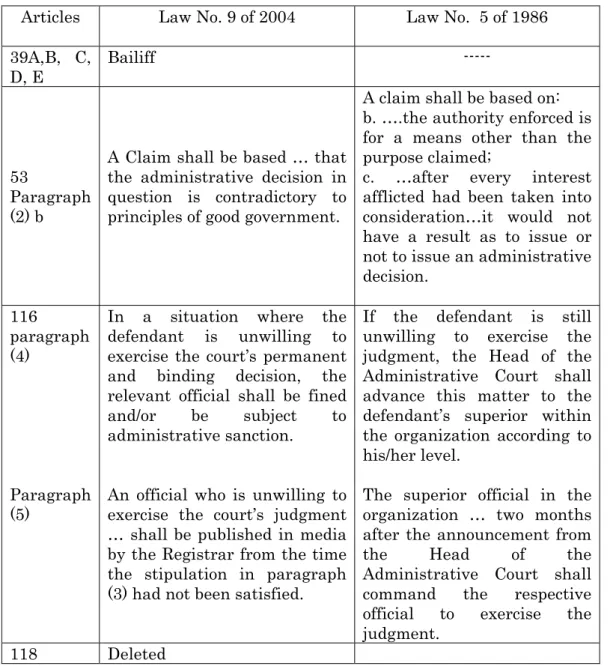
The Department of Justice drafted the amendment to Law No. 5 of 1986 in the period from 1999 to 2002 but it was not until 2004 that Law No. 9 of 2004 enacted by the DPR (House of Representatives). The following, Table 2, compares some of the more important differences between the two laws:
Table 2 Comparison between Law No.5 of 1986 and Law No. 9 of 2004
Articles Law No. 9 of 2004 Law No. 5 of 1986
39A,B, C,
D, E Bailiff ---
53
Paragraph (2) b
A Claim shall be based … that the administrative decision in question is contradictory to principles of good government.
A claim shall be based on: b. ….the authority enforced is for a means other than the purpose claimed;
c. …after every interest afflicted had been taken into consideration…it would not have a result as to issue or not to issue an administrative decision.
116
paragraph (4)
In a situation where the defendant is unwilling to exercise the court’s permanent and binding decision, the relevant official shall be fined and/or be subject to administrative sanction.
If the defendant is still unwilling to exercise the judgment, the Head of the Administrative Court shall advance this matter to the defendant’s superior within the organization according to his/her level.
Paragraph
(5) An official who is unwilling to exercise the court’s judgment … shall be published in media by the Registrar from the time the stipulation in paragraph (3) had not been satisfied.
The superior official in the organization … two months after the announcement from the Head of the Administrative Court shall command the respective official to exercise the judgment.
118 Deleted
(Source) Law No. 5 of 1986 and Law No. 9 of 2004.
Generally, Law No. 9 of 2004 as the amendment of Law No. 5 of 1986 was also related to Law No. 35 of 1999 jo. law No. 4 of 2004 on Basic Provisions of Judicial Power. Briefly, Law No. 4 of 2004 transferred the authority of Department of Justice to the Supreme Court in technical matters, such as organizational structure, management, and finance. These amendments were made in order to create an autonomous judiciary.
Based on the comparison in table 2 there are a number of observations that can be made:
A. Bailiff
In the thirteen years that the Administrative Court had been in operation, 1991 – 2004, all court documents were sent by Registered Mail through the closest post office to the Court. This meant that there were serious questions where the mail was delivered late or failed to be delivered at all, as this would have serious consequences with respect to time limitations for parties wishing to exercise their right to appeal.17
According to Article 65,18 it is clear that the Statute relies on the
reception theory. Simply, the summons or other court documents delivered once the receipt that the documents were delivered to the specified address is returned to the Court Registrar.19 The reception theory can provide legal certainty and
prevent some of the anxiety or risk associated with court proceedings, since the court will have a receipt and the relevant parties hold a receipt of the acceptance. However, the acceptance process tends to be lengthy and is susceptible to additional delay where registered mail goes missing. Some of the potential problems include the vast distances that mail must travel throughout the archipelago, seasonal weather, or even unclear destination addresses. With the introduction of the bailiff system it is expected that many of the previous problems associated with the use of registered mail will be overcome.
Nevertheless, Law No. 9 of 2004 does not explicitly refer to the bailiff within the Administrative Court organizational structure. Therefore, it is reasonable to assume that in spite of the expectations there will still be many teething problems in the implementation of the system:
1. According to Article 64,20 there is a need to carefully consider
whether the claimant has the material means to bring a claim or whether they are unable to bring a claim because of financial limitations, as some Provinces only have one Administrative Court to cover the whole Province. With regard to the time limitation of 6 days the question is what happens where the bailiff cannot meet with the defendant within the mandated period? As the object of the claim is related to an officer’s official duty and not as an individual, it is possible to have a receipt from the officer’s staff with the institutional stamp affixed onto the receipt.
However, since the jurisdiction of one Administrative Court is as wide as the province and the jurisdiction of one appellate court
could cover a number of provinces, there is an obvious need for increased cooperation between the Administrative Court and District Court, particularly when one considers that there is a District Court in each district in Indonesia. This is certainly a challenge for the Supreme Court in terms of its efforts in “the unification of judiciary”. There are issues that must be considered when assessing the effectiveness of cooperation between the Administrative and District Courts as any cooperation is likely to raise operational costs. There is currently a belief in the general public that the costs associated with the bailiff are sometimes above the officially announced cost that is usually included in the summons or the pronouncements of the court. Therefore, it is expected that if the bailiff of the District Court is also to assist the Administrative Court then these costs caould be conceivably much higher still.
This is likely to jeopardize the standing of the Administrative Court which over the 13 years of operation through 2004 it was recognized as a court that was considerably less expensive than the District Court.21
2. In the District Court, the bailiff had been regulated in HIR/Rbg22
(code of civil procedure). This stipulated the scope of duties and technical references which included the duty of executing judgments of the Court. Goods that could be subject to seizure are either tangible or intangible. Considering, that within the Administrative Court there are no tangible assets subject to seizure then the prayer for relief must then be an enforcement of the defendant’s obligations through an order of the court which may take the form of an annulment or the issue of an administrative decision23.
B. The Basis of the Claim
Interestingly the basis for lodging a claim changed with the removal of the principles regarding ultra vires or exceeding permissible authority and arbitrary use of authority from both the Law and the Elucidation to the Law.
These principles were replaced with the principles of good governance in the Article 53(3) of Law No. 9 of 2004 and its Elucidation refers to Law No. 29 of 1999 on State Operations that are Free from Corruption, Collusion, and Nepotism.
The court must be prudent in implementing Article 53(2) since there are different opinions regarding the binding power of an Elucidation of a Statute. The court could conceivably seek to implement the principle of lex pos iori derogat legi priori (recent regulations prevail over older regulations)
ter
24 as it
relates to Law No. 28 of 1999 and Law No. 5 of 1986. The inclusion of the good governance principles in the main text of Law No. 9 of 2004, particularly Article 53(2) could be interpreted in this way. In this view, the principle can be interpreted as an extension of both the earlier principles of excessive authority and arbitrary decisions, which were included in the Elucidation to Article 53(2) of Law No. 5 of 1986.
Nevertheless, and in contrast, the explanation of “good governance principles” in Law No. 28 of 1999 has served to lessen the value of these principles both in quantity and quality. There are only 6 principles included in Law No. 28 of 1999 (legal certainty; primacy of the rule of law; transparency; professionalism, and accountability). However, the development of administrative law in Indonesia over more than two decades saw these principles expand into 13 principles.25
The principles of good governance are classified into three basic categories:
a. Formal category regarding the preparation in the decision-making process. It is called a formal principle since it is frequently concerned with the procedural preparation in decision-making process. These principles play a role in the decision making process and are intended to prevent decision makers from breaching the pre-determined procedures. Included in this category are the principles of: 1) prudence; 2) fair play; and 3) a prohibition against confusing authority;
b. Formal category as it relates to the motivation in issuing a decision. This category is to highlight the considerations that went into the making of a decision and as such are the reasons that support the decision made; c. Substantial category relates to the substance of a decision. Included in
against excessive authority; fair play; reasonable expectation; and prohibition against arbitrariness.
From a quality point of view, the exclusion of the principles prohibiting the use of excessive authority and the prohibition of arbitrariness is problematic as there always remains the possibility that while performing there duties the officials or organization has a tendency to either use excess or authority or to act arbitrarily. In the thirteen years of its existence to 2004, the Administrative Court has been hearing and adjudicating administrative cases. However, when the courts found a violation of these principles, they have had difficulties in either proving or elucidating the intrinsic meaning of the principle of prohibiting excessive authority. An interesting question that arises is why the Indonesian Administrative Courts did not refer to the development of the French Administrative Courts as this may have made determinations regarding the burden of proof much easier?
In French administrative law, during the assessment of the government’s performance, where there is an allegation of detournement de pouvoir, in addition to the application of the legality principle, the court applies general moral principles of administration as well.26 Through the application of the
principle of detournement de pouvoir, the Administrative Court judge will seek and analyze the motives or background behind the government’s performance in making a decision. Although in its development, the French Administrative Court had difficulties as it attempted to reveal the background behind the decision-making process. Nevertheless, it did identify some steps that would make it less difficult:
a. There are sequences of proof that are able to persuade the judge that there is detournement de pouvoir
b. The alleged authority does not deny either the proof or the seriousness of the presupposition.27
Substantiation of detournement de pouvoir essentially is an effort to discover the truth behind the issue of an administrative decision (beschikking). Particularly, whether or not there is any other intention in executing its authority. In other words, the judges will assess the psychological and moral factors of the particular official, which might persuade them to issue the decision (beschikking) that they did. It is clear that the psychological factors are difficult
to scrutinize as it relates to the morality of the particular person but not to the administrative decision as the physical evidence itself.
Another approach is the annulment of the alleged decision. If the judges believe that the institution where the administrative decision is issued, has infringed the regulation of the delegation of authority, the court could annul the decision by concluding that the administrative decision is inconsistent with the existing law. Furthermore, if the judges are not satisfied by the consideration part of the decision, the court could annul the particular decision based on a violation of the principles of good governance.28
C. The Execution of Article 116
In relation to the content of Article 116 of Law No. 9 of 2004 it is not clear whether the institution where the official that is being fined is employed pays the fine levied or that the official is personally responsible for payment of the fine. For Bohtlink, it does not matter who the official is as it is common for that official to be replaced, promoted, or dismissed, but the position remains constant as the representative of the body. Therefore, the organization must also be included in the definition or provision.29 This “organization” is what represents the
government. Nevertheless, a distinction was made between an official and an organization. Simply, an official is someone who has acted on behalf of the organization or as the organization itself. Therefore, if P was a minister then the distinction between P as an individual and P as an official appears. Thus, P has two personifications, one as an individual and another as an organization or an official.
Logemann in essence agrees with Bothlink but states the relationship as one where if an official acts on in a particular role then it is the role itself that becomes the individual30. Logemann goes further to suggest that although an
official is representing a particular role, the role itself is bound by the obligations and authority to perform specific legal actions, including acting as a party in an Administrative Court proceeding.
Stroink agrees with the expression and definition of “role”, with some criticism.31 Firstly, Logemann gave a sociological review, not a juridical review of
the definition of “role”. From an administrative law point of view, not every role in an organization has the same interrelationship, although it is important to have authority to perform public legal actions. Secondly, it is not a personification of the role but personification of the quality. He argues that
quality in this case refers to the characteristics and composition of the individual bound with the authority to perform public legal actions. If a role or organization’s characteristics were attributed to human characteristics, then it would not have any interrelation to the characteristics of a particular official. Stroink suggests his own juridical definition of “role”, which is an authority that belongs to a particular person’s juridical power. According to public law, authority is a juridical power of an official position. Since an official position’s characteristics lie within the scope of public law, then it delivers a public authority, which is an authority to perform public legal actions. Thus, the interrelationship between the role and the official position is clear.
Announcement in media according to Article 116(4) and (5) of Law No. 9 of 200432 will possibly cost more since a one time announcement would not be
effective. There is no certainty as to who would be responsible for disbursing the cost. By appointing the Administrative Court to take responsibility of the expenses incurred would increase the burden on the state budget, and subsequently court fees would need to be higher to cover the additional costs. In the event that there was an intention to require the claimant to bear the cost and the claimant does not have the means to do so then it is unlikely that the provision could be properly enforced. It has been suggested that there could be increased cooperation between the Supreme Court and mass media outlets to reduce the costs of publication. The other alternative would be to increase the ability of the Supreme Court’s publishing functions so that this information is more easily accessible to the public.
D. The Abolition of Article 118
The abolition of Article 118 regarding third party interventions when the court judgment is going to be executed should be reconsidered, since the third party does not have any other chance to intervene during the hearing. It is expected that the judges in the Administrative Court will allow third parties to intervene,33 since the intervention is the only chance for the third party to avoid
any damage at the time when other party is likely to gain any benefit by the issuance of an administrative decision.
The role of the government, as the organizer of public welfare, means that it frequently issue regulations or decisions or policies where there is likely to be either benefit or detriment to the community at large or elements within that community. Therefore, it becomes increasingly obvious that a decision that
provides a benefit to one party may in fact be detrimental to another who may at some point in the future suffer damage as a result of the government action.
Based on the above discussion, the concept of the Object of a Claim in the definition at the General Provisions in Chapter I needs to be amended. Therefore, the chance for an administrative body to issue a decision that goes beyond its authority will be reduced. On the other hand, the scope for the Administrative Court as an institution for judicial supervision will be expanded to take into account the government’s performance with respect to the issue of decisions that affect the public interest.
The object of the claim has been stated in Law No. 5 of 1986, particularly Article 1(3), which is the same stipulation as in Law No. 9 of 2004. The object of a claim is “A decision of an administrative body is a written decision that has been issued by a body or an administrative official based on the existing law, with the characteristics of being certain, specific, individual, final, and cause legal consequences to an individual or a legal entity”. That concept is possible to be redefined as: an administrative decision is a written decision that performs a public legal action based on the existing law, with the characteristics of individual or/and general.
The definition would have an effect on the legal standing of the claimant, since there is a general legal norm that has come into force. Therefore, improving the chances that a class action would be able to successfully navigate through the administrative procedural law to reach a final and binding decision.
The procedural law system must provide enough infrastructure to support people in demanding their rights, either individual or entity rights. The justice delivery system that is not impartial would force people to seek justice outside of the court, which would cause significant disturbance to the society as a whole.34
Article 37 and the Elucidation of Law No. 23 of 1997 on Environmental Management introduced class actions as a means of resolving environmental disputes to the court. In 1999, with the enactment of Law No. 8 on Consumer Protection, class actions also became a means of resolving consumer disputes (Article 46(1)(b) and the Elucidation). Article 71(1) of Law No. 41 of 1999 on Forestry also recognizes class actions as does Article 37(1) of Law No. 23 of 1997. Supreme Court Regulation No. 2 of 1999 on Political Party Supervision, particularly in Article 1(d) jo. Article 5 and Article 23 regulates the filing of class action suits on behalf of others. Through Supreme Court Regulation No. 1 of 2002,
dated 26 April 2002, the procedure for filing a class action suit at the District Court is also regulated.
However, the deficiency of the regulations is not whether a class action is permissible under Indonesian law but more practical issues such as how to provide the legal representative with the proper authority to act on behalf of the people being represented. Article 4 of Supreme Court Regulation No. 1 of 2004 stipulates that there is no need for a letter of specific power of attorney.
A class action is described as a situation where a group of individuals have similar interests which can be heard as one case rather than multiple cases. The basic premise is that the suit filed must represent the interests being claimed by that particular group. The ability to represent the group interests is not based on whether the individuals of the group could represent themselves if they so desire but relates more to the efficient and effective administration of justice and for the purposes of expediting court administration.35 It would seem
that the stipulation above refers to the Campbell opinion which derives from the common law. In contrast the Indonesian civil procedural law requires that only an individual (person) and a legal entity through its attorney are eligible to be a party to and in a lawsuit. The class action principle in its most genuine sense does not give any legitima persona standi in judicio to a legal entity or corporation to represent a group’s interest. Therefore, in a theoretical sense any infringement of the principle of legitima persona standi in judicio will lead to the claim being rejected or Nie Ontvankelijk ve klaard t r (N.O).
In civil law countries, a class action is not recognized. Nevertheless, there is similar mechanism for bringing a suit that involves the interests of large number of people by a representation or actio popularis. An actio popularis suit is a suit that can be filed by any citizen and on that is regulated by the state.36
According to Kottenhagen-Edzes,37 in an actio popularis suit any person can file a
suit on behalf of the public interest based on the Niew BW (Article 1365 BW). In light of the fact that the primary provider of the public interest is one of the government’s duties, then it is not surprising that many actio popularis suits are directed towards the government.
There are a few similarities when comparing the principles of actio popularis and class action.38
1. Both principles allow a suit to be filed where the claim relates to the interests of a group of people and this suit may be filed by one or more people on the group’s behalf; and
2. Between the public and individual interests involved. The distinctions between both principles are:
1. In actio popularis the individual may have the right to file a suit as long as that particular individual is a member of a community and this does not require that this individual suffer direct damage;
2. In a class action only those individuals that are part of the relevant community and who suffers direct damage may commence the action; 3. A claimable interest in actio popularis is a public interest that is deemed
as interest held by every member of the community. In a class action a claimable interest is any similar interest that the community shares.
In common law systems, actio popularis is identical to a citizen lawsuit. Citizen lawsuits allow a member of society to file a suit, regardless of whether or not they suffer direct damage.39 In the Netherlands, the term of groep acties40
refers to a right of a legal entity to file a suit as a representative of a group of people, provided that there are similar interests being disputed and that these interests are stipulated in the group’s Articles of Association. However, a legal entity is not allowed to ask for compensation. The groep acties concept provides the right for filing a suit by a legal entity when representing the public interest or the interests of a group of people.
The principle of point d’interet point d’action is closely related to the principle of legitima persona standi in judicio, which is the eligibility or the right to appear as a party in a court proceeding.41 Generally, a party with a legal
interest has a right to appear in the court proceeding as a disputing party. Legal interest comprises of direct interests and indirect interests.42 In Indonesia’s civil
procedural law there are two methods to represent a party in a court proceeding43:
1. Appointment by statutory law and in this case the legal representative does not need a letter delegating the authority. 2. Appointment by the disputing parties and in this case the
disputing parties must provide a letter of delegation of authority before another can act on their behalf.
Generally, and has been noted previously, the Administrative Courts reject claims of the actio popularis type based on the lack of a specific provision
permitting it in the Administrative Procedural Law. The other general statement that can be made at this stage is that the Administrative Court is removing judicial review of Presidential Regulations from its jurisdiction by adopting the position that a Presidential Regulation is to be classified as law.
IV. PRESIDENTIAL REGULATIONS in the LAW on LEGISLATION DRAFTING
The Law on Legislation Drafting does not include Presidential Decrees in the hierarchy of laws.44 Presumably, after 1 November 2004, the issuance of a
Presidential Decree with the term “Decree” in its title would not be considered either as a regulation or one of the laws included in hierarchy of laws. The term of Decree refers to the issuance of a decision (beschikking) and/or the issuance of a policy rule (beleidsregel,).
The stipulation in Article 1(6) stipulates that a “Presidential Regulation is a regulation decided by the President to enforce the laws as required”, it could be interpreted that a regulation is issued by the President based only on a delegation of authority to enforce the law or a statute that it relates to. Another interpretation would be that a Presidential Regulation is a legitimate law. Therefore, the assertion that a Presidential Regulation is a policy rule (beleidsregel) based on discretional authority or a decision (beschikking) is not sustainable.
Moreover, Article 11 states that a “Presidential Regulation comprises of the material that is required by a law or material that is required in order to enforce a government regulation”. However, this stipulation is somewhat undermined by the Elucidation which states that “…The presidential regulation is formed in order to implement a law or government regulation either explicitly or implicitly ordered by the respective law or government regulation”. The use of “...or implicitly ordered…” creates space for the issue of a “Presidential Regulation”, which is not a regulation based on delegation of authority from a law or a policy rule (beleidsregel) based on discretional authority. This discretional authority had been written by the drafters, in this case the DPR into Article 17(3): “In a special circumstances, the DPR or President may propose a draft law not included in the National Legislation Program”. The Elucidation states that “special circumstances” are conditions that need to be regulated but not included in the National Legislation Program”.
Article 46(1)(c) stipulates that regulations published in the State Gazette of the Republic of Indonesia are to include Presidential Regulations, which consists of two basic types. First, Presidential Regulations that shall be published in the State Gazette are the ratifications of agreements between the Republic of Indonesia and other countries or international organizations. The second, are statements relating to states of emergency. However, it would be preferable if every regulation were published in the State Gazette, not only the two types above. Simply, if every regulation is published in the State Gazette it is much less likely that people will be unaware of regulations that are in force. The limitation on the publication in the State Gazette of these two types only will increase the difficulty for individuals and communities to provide any oversight with respect to the issue of Presidential Regulations.
V. CONCLUSION
In any process to establish good governance there are at least five main principles that need to be considered: fairness in procedural activities; transparency of the system; disclosure; accountability (public responsibility); and responsibility (receptive to the aspirations of the people). In establishing good governance there are four sectors that need to be prioritized: political, economy, legal, and the bureaucracy. From the legal aspect the needs include the development of legal instruments, an independent body for supervision, and consistency in enforcement of laws and human rights.
Improvement in the ability of the court system is needed to support a strong judicial system and therefore there is a need that all elements and levels of the State administrative system be based on the principles of good governance The development of the court system will require there to be renewed focus on the processes related to the recruitment of judges and officers of the court, the procedures for promotion, continuing legal education and training, and the remuneration system. Indonesia is no different from any other country in the world in that its people demand justice which is quick and fair at a reasonable cost.
In real terms this means that there is a need to develop a State administrative system which can provide clear and transparent procedures for the submission of complaints and for the appeal processes that may follow any decision in a court of first instance. It is clear from the discussion above that the
Administrative Court in Indonesia is not perfect, particularly when one considers the long length of time required for decisions to be handed-down. The Law states that the theoretical time required for a case to be resolved at the Administrative Court is between 4 and 6 months. However, the practical reality is that a case will take 3-5 years from the time it reaches the court of first instance any final and binding decision being handed-down by the Supreme Court. Finally, if the government is serious about the development of the Administrative Court then it must make more funding available to support the sorts of changes discussed in this article.
REFERENCES
Black, Henry Campbell. Black’s Law Dictionary. 6th ed. St. Paul Minn: West
Publishing Co, 1994.
Bothlingk, Frederik Robert. Het leerstuk der Vertegenmoordiging Toepassing op Ambtdragers in Nederland en in Indonesie. Juridische Backhandel en Uitgever: s’Gravenhage Jongbloed & Zoom, 1954.
Brown, L. Neville and John S. Bell. French Administrative Law, 4th ed. Oxford:
Clarendon Press, 1992.
Sundari.E. Pengajuan Gugatan Secara Class Action: Suatu Studi Perbandingan dan penerapannya di Indonesia (Class Action Suit: A Comparative Study and Implementation in Indon sia).e 1
c
st Edition, Yogyakarta: Universitas
Atma Jaya, 2002.
Gokkel, H.R.W & N. Van Der Wal. Juridische Latijn, vierde druk. Brussel: Tjeenk Willink, Alphen aan de Rijn, 1986.
Indroharto. Usaha Memahami Undang-Undang Peradilan Tata Usaha Negara (Understanding Administrative Court Procedural Law). Jakarta: Sinar Harapan, 1994.
JH.A, Logemann. Over de Theorie van Een Stellig Staatsre ht. Jakarta: Saksama, 1954. Indonesian translation by Makkatutu dan J.C Pangkarego,
Tentang Teori Suatu Hukum Tata Negara Positif (About Positive Administrative Law). Jakarta: Ichtiar Baru-VanHoeve, 1975.
Kusumaatmadja, Mochtar dan B. Arief Sidharta. Pengantar Ilmu Hukum Suatu Pengenalan Pertama Ruang Lingkup Berlakunya Ilmu Hukum.
(Introduction to Legal Science: First Introduction of the Scope of Legal Science). Book IBandung: Alumni, 2000.
Lotulung, Paulus Effendie. Penegakan Hukum Lingkungan oleh Hakim Perdata (The Enforcement of Environmental Law by Civil Law Judges). Bandung: Citra Aditya Bakti, 1993.
---. Beberapa Sistem Tentang Kontrol Segi Hukum Terhadap Pemerintah (Several Systems of Legal Supervision of Government). Jakarta: Bhuana Ilmu Populer, 1993.
Marbun, S.F. Peradilan Administrasi Negara dan Upaya Administratif di Indonesia (The Administrative Court and Administrative Recourse). Yogyakarta: Liberty, 1997.
Mertokusumo, Sudikno. Hukum Acara Perdata Indonesia (Civil Procedural Law of Indonesia). Fifth Ed. 1st Publishing. Yogyakarta: Liberty, 1998.
Santosa, Mas Achmad. Konsep dan Penerapan Gugatan Perwakilan (Concept and Implementation of Class Action). Jakarta: ICEL, 1997.
Soemaryono dan Anna Erliyana. Tuntunan Praktik Beracara di Peradilan Tata Usaha Negara (Practical Guide to Administrative Court Proceedings).
Jakarta: PT Primamedia Pustaka-kelompok Gramedia Majalah.
Stroink, F.A.M. Deconcentratie Citeertitel: het leestuk de concentratie .Vuga :Boekerij, 1966.
Majelis Permusyawaratan Republik Indonesia (MPR) Decree No. III/TAP/MPR/1978; Law No.14 of 1970; Law No. 14 of 1985 Law No. 5 of 1986 Law No. 9 of 2004 Law No. 10 of 2004
Government Regulation No. 63 of 1996 Presidential Instruction No. 6 of 1986
Presidential Decree No. 29 of 1990 (State Gazette No. 32 Enacted 1 July 1990) Presidential Decree No. 28 of 1991 (State Gazette No. 53 Enacted 5 July 1991) Presidential Decree No. 40 of 1993 (State Gazette No. 44 Enacted 18 May 1993) Presidential Decree No. 42 of 1994
Presidential Decree No. 20 of 1996 Presidential Decree No. 42 of 1996 Presidential Decree No. 93 of 1996
Presidential Decree No. 20 of 1998 Presidential Decree No. 21 of 1998 Presidential Decree No. 34 of 1988 Presidential Decree No. 87 of 1998 Presidential Decree No. 97 of 1998
Letter of Joint Decision of the Ministry of Forestry and the Ministry of Finance No. 169/Kpts-II/1990 – No: 456/KMK.013/1990.
Supreme Court Regulation No. 1 of 1993
Indonesian Chief Justice Decree No. KMA/027A/SK/VI/2000 of the Amendment of Chief Justice Decree No. KMA/ 015/SK/IX/1983
Indonesian Chief Justice Decree No. KMA/054/SK/X/1997.
Central Jakarta District Court Judgment No. 820/PDT.6/ 1988/PN.JKT.PST Jakarta Administrative Court Judgment No. 088/G/1994/Piutang/ PTUN-JKT Jakarta Administrative Court Judgment No. 094/G/1994/IJ/PTUN.JKT, dated
May 3 1995
Jakarta Administrative Court Judgment No. 037/G.TUN/1997/PTUN-JKT Jakarta Administrative Court Judgment No. 091/G.TUN/1998/PTUN-JKT Jakarta Appellate Administrative Court Judgment 33/B/1995/PT TUN JKT Jakarta Appellate Administrative Court Judgment 113/B/1997/PT TUN-JKT Supreme Court Judgment No.130/K/TUN/1998
Supreme Court Judgment No. 89/K/TUN/1996
NOTES
1The acknowledgment from the Government of Indonesia that the Administrative
Court bill was enacted into a statute on 20December 1986, delivered by Minister of Justice of the Republic of Indonesia, Ismail Saleh, S.H.
2 Statute No. 5 of 1986 jo. Statute No. 9 of 2004, Article 144.
3 Statute No. 5 of 1986 jo. Statute No. 9 of 2004, Article 1(3) states that:
Administrative decision is a written decision issued by an administrative body or an official based on valid regulations, with a certain and specific characteristic, individual and final that cause an occurrence of legal consequences.
4 Statute No. 5 of 1986 jo. Statute No. 9 of 2004, Article 53(1) states that: An
individual or legal entity who believes that their interest has suffered as a consequence of a particular administrative decision…
5 Statute No. 5 of 1986 jo. Statute No. 9 of 2004, Article 55 states that: Claims
shall be submitted within 90 days after an issuance or an acceptance of an Administrative Decision.
For parties mentioned in a claimable Administrative Decision, the 90-day limitation period is calculated from the day the respective Administrative Decision is received.
Under the condition that the claimed Administrative Decision falls within the categories of:
a. Article 3(2), the 90 days limitation period is calculated after the limitation period under this statute had passed, which is calculated from they day the application for an issuance of an administrative decision had been accepted.
b. Article 3(3), the 90 days limitation period is calculated after the four months limitation period had passed, which calculated from the day the application for an issuance of an administrative decision had been accepted.
Under the condition that the general regulations already stated that an administrative decision should be published, the 90-day limitation period is calculated after the respective decision had been published.
6 The claim was submitted on 30 September 1998, consequently it would refer to:
MPR Resolution No. III/MPR/1978; Statute No. 14 of 1970, Article 26; Statute No. 14 of 1985, Article 31, which bestows power and authority on the Supreme Court in order to carry out judicial review of regulations under the hierarchy of statutes. Supreme Court Regulation No. 1 of 1993.
7 Presidential Decree No. 42 of 1994 nullified by Government Regulation No. 63
of 1996; Presidential Decree No. 20 of 1996 nullified by Presidential Decree No. 21 of 1998; Presidential Decree No. 42 of 1996 nullified by Presidential Decree No. 20 of 1998; Presidential Decree No. 34 of 1988 nullified by Presidential Decree No. 97of 1998; Presidential Decree No. 93 of 1996 nullified by Presidential Decree No. 87 of 1998.
8 Supra Note 6
9 Central Jakarta District Court Judgment No. 820/PDT.6/1988/PN.JKT.PST 10 According to paragraph 4 of the company’s Articles of Association concerning
the capital structure of the company, it is known that Mohammad Hassan has 30% of the shares while 70% of the shares are owned by Lakemba Ltd. Hong Kong.
11 Presidential Decree No. 29 of 1990 (State Gazette No. 32, issued 1 July 1990); 11Presidential Decree No. 28 of 1991 (State Gazette No. 52, issued 5 July 1991); 11Presidential Decree No. 40 of 1993 (State Gazette No. 44, issued 18 May 1993).
These three presidential decrees are classified as general regulations (regeling) and were issued in the state gazette therefore they may be categorized as Laws.
12 Letter of Joint Decree Ministry of Forestry and Ministry of Finance No:
169/Kpts-II/1990 – No: 456/KMK.013/1990.
13 Presidential Decree No.93 of 1996, Article 3(1): Implementation of the financial
support sourced from reforestation fund as mentioned in Article 1 is to be executed by the Department of Forestry according to physical development of the paper plant, by transferring the fund from the Department of Forestry’s account to Kiani Kertas. Ltd’s account in the appointed bank as the clearing house.
14 Id.
15 Indrohartono, Usaha Memahami Undang-Undang Peradilan Tata Usaha
Negara (An Effort in Understanding the Administrative Court Statute), (Jakarta: Sinar Harapan, 1994), p. 117-118.
Every civil action by the government must be pre-conducted by an administrative decision to do a civil act either in the form of contract in general or other type of contract. After an administrative decision has been issued, subsequently any contract made by the government is allow to be formed.
It is possible that the future practice in the Administrative Court will incline to the doctrine that prevails in France, which considers that every contract made to the government is an administrative action, which in comply to public law and falls within the Administrative Court jurisdiction.
16 Presidential Instruction No. 6 of 1986 on Utilization of the Interest and
Clearing Account Service of the Reforestation Fund. This presidential
instruction intends to support the implementation of the reforestation program. The Department of Forestry had been appointed in order to manage all the interest and Clearing Account Service obtained from the reforestation insurance funds and forest rejuvenation funds.
17 Statute No. 5 of 1986 juncto Statute No. 9 of 2004, Article 108(2): In a condition
where a party or both parties are absent when a judgment is declared, by the order of the chief judge, this judgment will be announced through registered mail addressed to the relevant party.
18 Article 65: Summons for respective parties is valid, if both parties had accepted
the summons sent by registered mail.
19 Supra note 15, p.103. 20 Article 64:
Paragraph (1) Statute No. 5 of 1986 juncto Statute No. 9 of 2004: In
deciding the hearing day, a judge shall consider the distance between the hearing place and the relevant party’s domicile.
Paragraph (2): The time limit between a summons and a hearing day shall be not less than 6 days except in disputes being heard based on summary procedures.
21Official fee to file a lawsuit in the first instance is Rp. 200,000 (equivalent to
USD 21); second instance is Rp. 375,000 (equivalent to USD 40); Supreme Court is Rp. 400,000 (equivalent to USD 43) ; Civil Review (request civile) is Rp. 750,000 (equivalent to USD 80), based on Chief Justice Decree No. KMA/027A/SK/VI/2000 amending Chief Justice Decree No. KMA/ 015/SK/IX/1983 of Civil Suit Statutory Fees for Appeal Request to the Supreme Court and Civil Review. The last amendment is Chief Justice Decree: KMA/054/SK/X/1997. The official fee to request an appeal to the Supreme Court started prior to 1 April 2001 were changed to Rp. 750,000 (equivalent to USD 80); and a request for civil review from 1 November 2001 were increased to Rp. 2,750,000 (equivalent to USD 290).
22 HIR Article 195(1); Rbg Article 206; the Statute No. 4 of 2004 on the Supreme
Court, Article 36(3): Court registrar or bailiff serves the purpose of an official to execute the court’s judgment.
23 Statute No. 5 of 1986 as amended by the Statute No. 9 of 2004; Article 97
paragraph b and c juncto Article 166(3).
24 Mochtar Kusumaatmadja and B. Arief Sidharta, Pengantar Ilmu Hukum
Suatu Pengenalan Pertama Ruang Lingkup Berlakunya Ilmu Hukum. Buku I (Introduction to Legal Science, a First Introduction: The Scope of Legal Science, Book I), (Bandung: Alumni, 2000), p. 63.
e
25 S.F. Marbun, Peradilan Administrasi Negara dan Upaya Administratif di
Indonesia(Judicial Administrative, Public Administration and Administrative Efforts in Indonesia), (Yogyakarta: Liberty, 1997), p. 349-350. According to Crince Le Roy there are eleven principles: 1) legal certainty; 2) balance; 3) equality; 4) prudent; 5) motivation; 6) prohibition to confuse authorities; 7) fair play; 8) fairness; 9) reasonable expectation; 10) abolishing the consequences of nullified decision; 11) protection of beliefs. Kuntjoro Purbopranoto, Beberapa Catatan Tentang Hukum Tata Pemerintahan dan Peradilan Administrasi, (Several Notes on Administrative Law and Administrative Justice), (Bandung: Alumni, 1985), p. 47, adding two more principles: 12) judicious; 13) managing public interest.
26 L. Neville Brown and John S. Bell, French Administrative Law, 4th ed.,
(Oxford: Clarendon Press, 1992), p. 231-232
27 Paulus Effendie Lotulung, Beberapa Sistem Tentang Kontrol Segi Hukum
Terhadap pemerintah (Several Systems of Legal Supervision of Government), (Jakarta: Bhuana Ilmu Populer, 1993), p.14.
28 Indrohartono, Supra note 15, p. 175.
29 Frederik Robert Bothlingk, Het leerstuk der Vertegenmoordiging Toepassing
op Ambtdragers in Nederland en in Indonesie, (Juridische Backhandel en Uitgever: s’Gravenhage Jongbloed & Zoom, 1954)p.34-35.
30 Logemann, JH.A, Over de Theorie van E n Stellig Staatsrecht. (Jakarta:
Saksama, 1954) , translated by Makkatutu dan J.C Pangkarego, Tentang Teori Suatu Hukum Tata Negara Positif (Theory of Administrative Law), (Jakarta: Ichtiar Baru-Van Hoeve, 1975), p.117-120.
31 F.A.M Stroink, Deconcentratie Citeertitel: het leestuk de
deconcentratie ,(Vuga :Boekerij, 1966), p. 12.
32 Statute No. 9 of 2004, Article 116(4):
In a condition where the defendant is unwilling to exercise the court’s permanently binding decision, the particular official shall be fined and/or being imposed by an administrative sanction.
Statute No. 9 of 2004, Article 116(5):
An official that is unwilling to exercise the court’s judgment as stipulated in paragraph (4) shall be published in a local media by the registrar from the time the stipulation in the paragraph (3) had not been satisfied.
33 Statute No. 5 of 1986 juncto Statute No. 9 of 2004, Article 83:
During the hearing, every person that has an interest over a dispute involving other parties in an examined case…
See Soemaryono and Anna Erliyana, Tuntunan Praktik Beracara di Peradilan Tata Usaha Negara (Practical Guide in Administrative Court Proceedings), (Jakarta: Primamedia Pustaka-kelompok Gramedia Majalah.Ltd) p 101-102: “During a hearing”, the Statute does not describe; meanwhile there are many steps in an administrative court procedure. Regarding the term of “during a hearing”, when a third party could have an intervention?
If the judges gave a third party a bigger chance to intervene, it is possible that the judges will collect more information compared to seek it only by examining the two disputing parties.
34 E. Sundari, Pengajuan Gugatan Secara Class Action: Suatu Studi
Perbandingan dan penerapannya di Indonesia (Class Action Claims: A
Comparative Study and Implementation in Indonesia), First Edition,
r I
35Henry Campbell Black, Black’s Law Dictionary, 6th ed.,(St. Paul Minn: West
Publishing Co, 1994)p. 170。
36 H.R.W Gokkel & N. Van Der Wal, Juridische Latijn, vierde druk, (Brussel:
Tjeenk Willink, Alphen aan de Rijn, 1986), p.11.
37Paulus Effendie Lotulung, Penegakan Hukum Lingkungan oleh Hakim Perdata
(Environmental Law Enforcement By Civil Law Judges), (Bandung: Citra Aditya Bakti, 1993), p.57
38 E. Sundari, Supra note 34, p. 17.
39Mas Achmad Santosa, Konsep dan Penerapan Gugatan Perwakilan (Concept
and Implementation of Class Actions), (Jakarta: ICEL, 1997), p. 20.
40Paulus Effendie Lotulung, Supra note 38, p. 53.
41H.R.W Gokkel & N vaner Wal, Juridische Latijn, vierde dru, (Brussel: Tjeenk
Willink, Alphen aan de Rijn, 1986)., p.56
42Sudikno Mertokusumo, Hukum Aca a Perdata Indonesia ( ndonesian Civil
Procedural Law), 5th edition, 1st publishing, (Yogyakarta: Liberty, 1998), p.52.
See also the court consideration of “interest” regarding to quality assessment as a Claimant in the Administrative Court Judgment No. 094/G/1994/IJ/PTUN.JKT, dated May 3 1995.
42E. Sundari, Supra Note 34, p. 105.
See also the court consideration of “interest” regarding to quality assessment as a Claimant in the Administrative Court Judgment No. 094/G/1994/IJ/PTUN.JKT, dated May 3 1995.
43 E. Sundari, Supra Note 34, p. 105.
See also the court consideration of “interest” regarding to quality assessment as a Claimant in the Administrative Court Judgment No. 094/G/1994/IJ/PTUN.JKT, dated May 3 1995.
44 In Statute No. 10 of 2004, Article 7(1): Type and hierarchy of law:
a. The Constitution of The Republic of Indonesia 1945; b. Statutes/Government Regulation in Lieu of Law; c. Government Regulations;
d. Presidential Regulations; e. Regional Regulations;
In the Article 1 No. 6: Presidential Regulation is a regulation decided by the President to enforce the statutes as it required.
In Article 11: Presidential Regulation comprises of the material that required by a statute or material in order to enforce government regulation.
Elucidation:
As stated in the 1945 constitution, presidential regulation is a regulation formed by the president in order to perform state administration as attributed by Article 4(1) of 1945 Constitution of the Republic of Indonesia. The presidential regulation is formed in order to implement a statute or government regulation either explicitly or implicitly ordered by the respective statute or government regulation.
Article 17(3): In special circumstances, the People’s representatives (DPR) or president may propose a draft of statute outside the National Legislation Program.
Elucidation: In this stipulation, special circumstance is a condition that needed to be regulated, but not included in the National Legislation Program.
Article 46(1) c: Regulations issued in the state gazette of the Republic of Indonesia, includes:
c. Presidential Regulation concerning:
1. Ratification of an agreement between the Republic of Indonesia and other countries or international organization;
2. State of emergency statement.
Article 56: Every Presidential Decree…as stated in Article 54, with regulating characteristic, existed before this law, must be perceived as a regulation provided that the respective presidential decree is not contradicted to this statute.