ゝ
Abiesがr即αandTsuga
・sieboldiiforests in Shikoku*
(Forest
climaxes in Shikoku, Japan 1)
Tsugiwo Yamanaka
I. Introduction
AbiesfirniaandTsuga sieboldii are well・known conifers, which are distributed from the warm temperate to the cool temperate ,zone in Japan, and occupy vast areas in Kyushu, Shikoku, and middle Honshu. Therefore considerable attention has been paid to forests dominated by Abies firniaand TsMgasiebolぷi by a number of ecologists and phytosociologists.
In Shikoku, natural forests dominated by AbtesfirmaandTsugasieboldiioccur ex-tensively. Wada et al. (1939) reported various types of forests accompanied by Abies firr?laand Tstigasieboはa in the publication of the Kochi Regional Forestry ゛〇ffice.
Afterwards, such forests were studied and discussed by Sato (1946), NomotQ (1953), and Yamanaka (1953a, c, d, 1954, 1956, 1957a, b, 1960). Consequently it haS:become necessary to reconsider these forests in Shikoku from the phytosociological point of view. The present paper deals with the general consideration o£ Abies iirma and Tsuea siebol山i Iorests, with special reference to their floristic composition, classification・
vertical distribution, and relations between these forests and habitat conditions. Before going further the writer wishes to express his cordial thanks to Prof. Tokio
Suzuki of the Oita University for his advice, criticism, and encouragements. Thanks are also due to a number of persons who helped the writer in the field.
II.
Areas
and
methods
of study
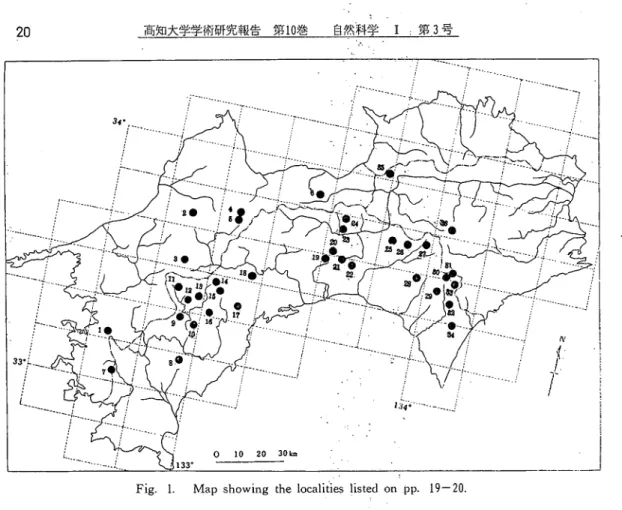
Areas of study. The actual data for the present paper were derived from the field work・ carried out in the localities listed below (cf. Fig. 1). But ・6e】d notes obtained from many other places were also used in the present consideration.
Ehime Pref.:0) Mt. Onigajo, Uwajima; (2) Mt. Saragamine near Matsuyamaバ3) Mt. Odamiyama, Oda- (4) Mt. Ishidzuchi, Saijo; (5) Mt. Omogo, Omogo; (6) Mt. Hanedzuru, Iyo-mishima; Kochi Pref.:(7) Mt. Sasa, Sukumo; (8)Tsudzuraeawayama Nationar Forest, Taisho; (9) Yokooyama National Forest, Yusuhara;呵 Kubotaniyama National Forest, Yusuhara; (H) Shimagawa, Yusuhara; 00 Mt. Serikawa, Yusuhara; (13 Hase, Yusuhara;㈲Goo, Higashitsuno; OS Mt. Irazu, Higashitsuno; ㈲Matsubakawayaraa National Forest, Kubokawai㈲Kudarukawayama National Forest, Oonomi; (13Mt. Yokogura, Ochi; (19)Mt. Kuishi near Kochi; & Kashiyama Pass near Kochi; ei) Kurotaki near Kochi; & Bishamonnotaki, Kitatakimoto near Kochi; <& Sakamoto, Motoyama; S-O Mt Shiraga, Motoyama; '29 Mt. Aozare, Ootoyo; W Sasa, Monobe; CT Mt. Shiraga (Okushiraga), Monobe; SS Higashigawa, Aki; &) Mt. Tengumori, Umaji; (30)Mt. Sembon, Umaji; (3!)Mt. Jinkichimori, Umaji; (33Mt. Kamedani, Umaji; 63) Mt. Gammaki, Umaji; (3* Agura, Kitagawa; Tokushima Pref.:叫
* This study was carried out partly by the Grant in Aid for Developmental ScientificResearch from the Ministry of Education.
20 高知大学学術研究報告 第10巻 自然科学 Iづ第3号
Fig. 1. Map showing the localities listed on ,t〕p.19-20.
Mt. Umpenji near Ikeda; &S) Mt. Tsurugi, Higashiiya.
Methods of study. This study was principally carried out using the phytosociological
method of the Ziirich-Montpellier School. Well-developeH and homogenous stands were
selected as sample plots, and 10×10 m or 20×:20 rri quadrats were used. The quantitative
estimation of component species in one plots was shown by the six c】ass dominance.
As to the total value of each species, the ten class cor!staricy and the coverage value
were used. The fidelity was essentially followed in the sense used by Braun・Blanquet
(1951), and an attempt of the quantitative determinatidn ’6f the fidelity proposed by
Horikawa and Sasaki (1959) using the relative average cover 'degree and relative presence
was useful for the present work. As for habitat√conditionsi the altitude, base rock,
topography, eχposition, steepness, etc. were recorded・ Finally. forests under consideration
were compared with other forests in Japan. And then tれe forest zones in Shikoku were
briefly discussed in the present paper.
Symbols used in tables. The stratification was shown "by numbers : (]) upper tree stratum
i
(above 8 m high), (2) lower tree stratum (2−8 m), (3) shrub stratum (0. 5-2 m), and (4) herb
stratum (below 0. 5 m). L and E indicate lianes and epiphytes respectively. The dominance of young
individuals in the lower strata was parenthesized.
Localities were also indicated by numbers which were interpreted in the list of the areas of study.
Abbreviations of base rocks are as follows : (A) andesites, (CS) crystalline schists, (D) diolite,
(G) granite and related rocks, (Q) quartzite, and (SS) shale and sandstone.
21
upper part of slope, and (r) ridge。
III. Classification and phytosociological consideration of
Abies firma and Tsuga sieboldii forests in Shikoku
As the result of this study, it was recognized that forests consisting mainly of Abies
firmaor Tsuga sieboldii in Shikoku were mostly found in the following six associations:
(1)Sakakieto-(Zy dob alaiiopsideはm,(2)1111cieto・Abieはm, (3)Lindereto・Cりptofnerietu,m.
(4)Carice£o-Tsuge£uin,(5)Pierideto-Tsugetum, and(6)Sasaniorpheto一Fagetum。
1. Sakakieto-Cyclobalemopsidetvun Suz. -Tok. (1952)
Abies firinaor Tswga sieboldii forests accompanied by Cy clohalanopsis saliciれ:a (C.
stenophylla), c.paucidenは£a・C. acwta,0r Disりril£7?l racemosum aiedeveloped in
the warm temperate zone, occurring in areas ranging from about 250 m t0 1000 m above
sea-level. The lower tree and shrub strata of these forests are mainly constituted by a
large number of evergreen trees and shrubs, such as Cleyera japonica(Sakakia ochnacea),
Symplocos tnyrtacea, 1111ciuin religiosum. Euりa japonica. Camellia japonica, lAachilus
iaponica, hleolitsea aciculaは, and others (Table 1). These constituents contain a number
of characteristic species of the Sakakie£0-Cyclobal・1oかsi&は,m and the Shiion sieboldii.
It is therefore asserted that these forests are to be included in
the Sakakieto・C:yclo-halanopsidetum which was first reported from the Boso Peninsula (Suzuki and Wada
1949) and was also recognized on the Izu Peninsula (Suzuki and Hatiya 1951) and in
south-western Shikoku (Nomot0 1953). Some communities described in theヽpublication of the
Kochi Regional Forestry Office belong certainly to this association.
Nomoto, who studied this association in south・western Shikoku, divided it into two
subassociations, namely, the diSりrietosum differentiated by Castanopsis cm;
Vacci?iiu≪i bracteatum and the ts砧getosuni di仔erentiated by Cyclobal・lopsis acuta,
Steiiuar£ia
inonadeり■>/ia, and S liimmia japonica.He also stated that the former was
found in lowl ands and the latter occurred at high altitudes.
The Sak{.
the Boso and Izu peninsulas in the following respects : は) the abundance ot Tsuga
siehnldii or Abies firina, (2) the indistinct occurrence of Cyclohal・Topsis forests
accom-panied by Aucuba iaponica, Maesa japonica, L)amnacanthus indicus, and Rumnhra
pseudoaristata, and (3) the luxuriance of Symplocos myはcea.The fact that this
asso-ciation in Shikoku mびstly forms Abie∫・or Tsuga-Cyclobal。1(ゆsis-lype forests is, as
already noticed by Nomoto (1953), the most remarkable feature of warm temperate forests
in Shikoku. It may be considered that some stands under consideration bear resemblance
to the Symがoceto-Tsugeはm. in Kyushu proposed by Suzuki et a1. (cf. Su芦iki and Masiba
1959), though this problem can not be concluded here. It will be reasonable at present
that the Sakaieto-C:yclobalanopsidetuni in Shikoku is regarded as the subassociation
syniplocetosimi including the variants of Disりrium racemosu‘in. Tsuga sieboldii, and
Cyclohal。Top sis acuは。The existence, of such forests in Shikoku will be significant
from the synchorological point of view, because the regional differences in Cyclo一
Kanto-Kinki-Shikoku-22 高知大学学術研究報告 第10巻 自然科学 I` 第3号
Kyushu areas (cf. Suzuki 1951, 1952, 1954b)。
In the south-eastern part of Shikoku, stands consisting mai 「y o1 TsMga sieboはii〇n
ridges or steep slope's are occasionally characterized byRhododendron serpyllifolit.ロn
and other ericaceous shrubs. These are to be regarded as the subassociation rhodoretosum
(Table 2). This subassociation contains a number of characteristic species of the
Pierideto-T sugetum or the Rhodoreto-Chaniaec,yparideはm which will be discussed later
on. Therefore 'it is possible that the rhodoretosum may be included in the Pieride£0,
Tsugeはm● ' The Saむ
Pacific side, and the occurrence on the Inland Sea side is・rather limitted. As it nas been
well established, the climate of the district south of the Shikoku mountain range shows the
typical Pacific-type, and the annual precipitation amoun・ts t0 2000 mm grn!ore. 0n the
contrary, the district surrounding the Inland Sea is characterized by comparatively 10w
annual precipitation, and the Lang's quotient in this district fa・11s below 100. Therefore,
the climatic conditions in the Inland Sea district is not always favourable for the estab・
lishment of the Abies fir ma- or Tsuea sieboldii-Cyclobala・・lopsis forests. Other exan!pies
indicate the similar tendency of forest climaxes in the Inland Sea district. For instance,
the R・uino hreto-Machileはm which is found along the Pacific coast of Shikoku is not
developed in the Inland Sea district and is replaced by a vicariant forest consisting
mainly oi Elaeocarpu・s sylvestrisvar. ellipticus, Actinodaphne lancifolia-, Ternstroe・,竃a
iaponica, Fassania glabra, etc. (Yamanaka 1957b). This forest indicates rather dry
characters compared with the typical 尺umohreto一Machileは・in. In places, however, Abies
iirmaor Tsuga sieboldii forests are of course found even in the Inland Sea district.
An example is found on Itsukushima (Miyaiima), Hiroshima Prefecture (Horikawa 1942,
Sato 1946, Tatewaki and Tsujii 1957), but such well-developed forests are not found on
the Inland Sea side of Shikoku proper. And it is worthy of particular attention that
extensive areas in this district are under cultivation or occupied by secondary forests.
It can be roughly explained from the above・mentioned facts that this association is mainly
preserved on the Pacific side of Shikoku。
0f the major constituents of this associatiotv, Cyclobalanopsis acuta \s more heliophilous
and xerophilous than C. paucidentata and C. salicina. Therefore stands dominated by
Cyclobalanopsis pauciden£a£a and C. salicina ate we1】developed in areas along streams
and are occasionally characterized by the moss forest type. On the contrary, middle
parts of slopes are generally occupied by mixed forests o! Ab・ies firma-OY Tsuga
sieboは行-Cyclobal。lopsis spp・, and stands composed o£ Tsuga sieholdii and Cy dob alanop sis
aCu£a trequently occur on and near ridges. Therefore the occurrence of
Cyd砧alanopsis-type forests is not always connected with fog or high precipitation. And then Cycl。・
halanopsis acuta χs generally found in uppermost parts of the warm temperate zone
and comes into frequent contar.t with the cool temperate forest. This fact, which is
already reported from various parts of the Pacific side (jf Japan (Sato 1946, Yoshii and
Yoshioka 1949, Yamanaka 1953a, 1956, Sasaki 1958, Yatoh 1958, Hara 1959), IS very
important from the viewpoint of the vertical distribution of forest climaxes. In short,
'iie.boldii forests in Shikoku (T.YAMANAKA) 2ろ
occurrence of various Abies- and Tsuga・Cyclobalanopsis forests. Thisproblem will be further discussed in the next chapter. ,・
2. Illicieto-AbietiirQ Suz. -Tok. et Hatiya (1951)
This association is found in areas ranging from about 800 m t0 1150 m above sea-level,
occurring just between the Sahakieto-Cyclobalanopsidetum and
the Sasainorpheto-Fagetum. Therefore th\s Abies firma forest in Shikoku contains characteristic species
of these two associations and forms the ecotone between the warm temperate and cool
temperate zones. This association in Shikoku is characterized by Abies firma. Symplocos
myrtacea・ Osmaれthus ilicifolius, Hydrangea luteovenosa, Schisandra nigra, and Hに
crenata(Table 3)。
Suzuki (1961), who studied this association in Japan, divided it into three
subasso-ciations, namely, the pieridetosum, stetvartietosum, andcyclobalanoかsidetosuin, and
discussed the floristic composition and geographical distribution. This Abies firma forest
in Shikoku contains differential species of above three subassociations presented by Suzuki.
However, the occurrence oi Cyclobalanopsis acuta.Kurya japonica, Camelliajaponica,
CinnanioTnum iaponicum, and l^eolitsea sericeasuggests that this forest belongs to the
subassociation りclobalanopsidetosuni。
This association occurs here and there in mountainous districts in Shikoku and usually
occupies gentle slopes. Stands accompanied by Tswga sieboldii is found on ridges,
steep slopes, or along streams. In such places, therefore, this association is occasionally
replaced by other forests, such as the Pierideto-Tsiふgetum or the Cariceto-Tsuffeはm.
5. Lindereto-Cryptomerietum Yamanaka, ass. nov。
As will be seen in the Yanaze district (Umaji),Cりptomeria iaponica occurs abundantly
in the south-eastern part of Shikoku where the climate is characterized by the highest
precipitation in Shikoku. In this district the annual rainfall amounts t0 3000 mm or
more, and the Lang's quotient indicates more than 200. It has been considered, that this
local climatic distinctiveness is the dominant cause of the occurrence o£Cりptomeria
-laponica.These forests were studied by a number of authors from the standpoints of
forestry and sylviculture. Nevertheless, little phytosociological consideration has been
available up to the present. ぺA^ada et a1. (1939) described several communities containing
Cりiptomer・ia japonica in the publication of the Kochi Regional Forestry O伍ce,and
the writer (Yamanaka 1954) also studied the forest vegetation in this district。
Forests dominated by CTyptoineria丿aponicawere reported from several parts of Honshu
and Kyushu. Maeda (1952) described tVie Cryかto・neriaJaponica-Plagiogyria matsi£?1!vreajia
association from Mt. Tateyama, middle Honshu. This association is a forest of the
Japan Sea type, containing characteristic species of the Saseto一Fagetum, and is quite
different from Cr:yptomeria japoTiica forests in Shikoku. The well-known Cりptoineria
japonica iorest on Yakushima, which is situated off Kyushu proper, is accompanied by
Tsuga sieboldii and Abies firnia, and the lower strata consist mainly of Sy・nplocos
myrtacea,L)aphnり'>hyUuni macropodum. Rhododendron tashiroi.・CIりera japonica.
24 ・高知大学学術研究報告 第10巻 自然科学 I 第3号・
will be said that the forest on Yakushima is not identical with that in the Yanaze district,
but fairly resembles the 1111cieto-Abietu-^肌 or the Safeafeieto-Cタc lobalanopsidetum.
¶ . il●
Forests accompanied by Cり・ptomeria Japonica \nthe Yahaze-district occur in extensive
・ ・ ・
areas ranging from the warm temperate to the ・むooドtempeΓate zone. According to
dif-ferences of altitudes and edaphic‘conditions, therefore, floristic compositi‘ons of these
forests are different from one another. And it”may be impossible to include them in
one and the sa‘me association. Stands at rather丿ow’ altitudes are to be included in・ the
Sakakieto-Cy clobalanopsidetuvi(cf. Table 1), and those' a’tダhigh altitudes belong mostly
゛tothe Sasaniorpheto-Fagetnm(Table 7). ,・ご
The lAdereto -Cryp£oineriet抑m* described here isフfound' locally and occupies rather flat
places where residua】soils are deeply deposited. A typical example is found on Mt.
Sembon. This stand is nearly a pure forest oICりptonieria japonica. attaining the height.
of 30 m or more, and the lower strata are predominated by LinderasericeavaT. ten‘UlS,
Uliciuin relieiosuin, Neoii£seaaciculata. Ski・rttmia:丿卯りnicavar.intermedia I. repeats,
and others. 0n the other hand, stands on Mt. Gammaki are accompanied by abundant Abies
兵r?几a and lack a number of evergreen trees and shrubs. Accordingly, this association
can be divided intこ)two subassociations, namely, the cyclqbalanopsidetosi£m and the
abietosum(Table 4). The former is similar to ・.伍e Sakakieto・Cy clobalanopsidetum,
and the latter resemb\es 1111cieto- Ahietuni.Thus, this 4・ssociation should be regarded
c i’
as the forest which is comparable to the 1111cieto・Abie£1ロm)n other districts, although
there are some questions remaining still unsolved・6n the.establishment of such forests.
4. Cariceto-Tsugetum Suzニtok. (1949)
This association is occasionally found in . places
between the Sakakieto-Cyclo- ダ
kほnopsidetum and the Sasai・norpheto一Fageはm, occurriれ忿 mostly from about 800 m to
1150 m above sea-level. The dominant tree is usuallダフでぶuga siebolぷi which represents
the outer physiognomy of forests. Several deciduou・s trees, such as Acersieboはianum,
Steiiiar£ia刀lonadelpha. Fag‘14s japonica, F. crenata.・Carがhus tscfiortosfeii, etc. are
often found in the upper tree stratum. The shrub and herb strata are generally
predomi-nated by Sasamoり・>ha purpurascens・ Carex re・りlit, Cヽ. morrぴxvii, etc., and other main
constituents axe Parabemoin trilobiini. 1111ciuni religiosum, Liれdera sericea, L. sericea
var.£e7iuis, andShiinmia iaponica vai. intermedia i'. repens. Sometimes Cyclobal・lopsis
gだcina is also found. The association table of thl・e Car ice to -Tsuee ttiin in Shikoku was
, g
already presented in the previous paper of the writer (Yamanaka 1956).
Among the constituents mentioned above. characteristic・ species of both the Sakakieto・
Cyclobal・lopsidetum and the Sasamo砂池to一Fage叫m are found. And then, Faeus
japonica, hindera se・ricea, Careエ reinii, and C. moΓかtuii- are to be enumerated as
characteristic species of this association. ・ly い
As compared with the Sakakieto-Cyclobalanoかsidetuin; and the Sasa刀10・Iゆheto-Fagetuni.
,t r . F . ・
this association occupies rather small areas in 巾e transition zone. It is often di伍cult
to observe distinct and well-developed stands of this association in Shikoku, and it is
* Cr:\ptomerietuv・l:yanazeanimi.nora. prov. (Yamanaka 1960)。p. p.
andTsttgasieboldii forests in・Shikoku (T.YAMANAKA) 25
a matter of りourse that such an association・in the ecotone is not found or:developed in
the district where
the warm
temperate
forest・ocとvipies
extensive areas. These problem
will be・discussed later on.
5. Pierideto-Tsugetura Yamanaka, ass. nov。
Tsuga sieboldiican grow in such special areas as ridges, steep slopes, rocky outcrops,
etc., and forms forests on various rocks and soils where climatic climaxes are not found.
In other words. Tsuga sieboldii forests frequently indicate the tendency to become
edaphic climaxes, and this association is an example. These forests occurring mostly in
the warm temperate and transition zones are accompanied by several other conifersi
such as Ch,面laecypa石so心証sa, Pinus pentaphyllavar. hhnekoinatsut I)。 densiflora.
Sciadopiりs 。er£icillata> and Pseudotsuea japonica.As compared with other forests
composed of Tsusa sieboldii〇T Abies firma. the floristic composition of these forests is
very characteristic in containing a large number of ericaceous plants, such as Rhododendron
me£tern・ichii, R. keishei, R. pe庇司ihyllum, R. dec・idrmn, R. ierpがli和昌um, Pieris
iaponica, Tritomodon cernuusv'AX. rubens, Lyonia ovalザol毎var. elliptica,Huge?"t・α
japonicavar. c・iliaris, and others. 。
Such forests in Shikoku were once included in the Rhodoreto・C hamaecyparidetum
which was named and tabulated in the previous paper of the writer (・Yamanaka 1957a),
but are usually lacking in such characteristic species as Thuja standishii^ Tsuga
diversiかdia,Rumohra mutica, and lieエrui
eration, it is now concluded that these are to be excluded from the Rhodore£o・Chama。
り夕αΓi&はmi, and the Pierideto・Tzugetuni ISdecribed here. characteristic species are
enumerated in Table 5. All stands, except those on Mts. Higashi-akaishi, Shiraga, and
Akahoshi, in the association table of the Rhodoreto-C hainaecyparidetuni*belong to this
new association. It may be possible to consider that this association is a variant of the
Rhodoreto-C haniae cyparidetumoccurring at low altitudes. Some stands of the Pinus
densifiora-Tsugasieboldii association reported by Yoshioka (1958) may be included in
this association. In Shikoku. forests accompanied by Pseudots・tigajaponicaoccur locally
in the Yanaze district, but similar stands are found on the Kii Peninsula, southern
Honshu (cf. Yatoh 1958). These stands can not be excluded from this association。
The Pierideto-Tsugeはm occurs on a small scale ill rather dry places where soils are
poor, shallow, and rarely podosolized. Similar forests are found on the Pacific side of
Honshu. An example is the Pieris jap・肩az subassociation of the Chamaec:yparis
obtusa- Runiohra mutica association reported by Maeda (1951) from middle Honshu. If the
Pieride£0-Tsugcはm is \nterpreted in a wide sense, such forests may be included in one
and the same association. Besides, the Jliccto-Tsugetu・?1 described by Horikawa and
Sasaki (1959) from the Chugoku mountain range resembles this association. These
Tsuga sieboldii iorests accompanied by C hainaecyparisobはsa should be excluded from
the Tsugion sieboldii.
* Jap. J. Ecol. 6、151 (1957). Stands on Mt. Higashi-akaishi should be treated as the Rhodoreto、
Chamaecyparidetumthujetosum.、subass. nov.、differentiated by Thuja stのidishii and Care.エ
26
S . I
高知大学学術研究報告 第10巻 自然科学 I 第3号
Suzuki (1954a) suggested that Chamaeり'*arts-type forests do“linated by Thuja standishii
andThuiopsis dolabrata var. hO7 「 「in Honshu belong probably to the Abietionwhich
includes the subalpine coniferous forests in Honshu and・Shikoku. But another inter・
。 / ●・
pretation can be given by which such C hamaecypdris一type forests are excluded from
the Ahietion and treated as an alliance, the C hamaeりparidion ohtusae.This problem
must be discussed in detail in another paper. ,。
■
6. Sasamorpheto -Fagetum Suz. .T。k. ■(1949)
●1 1
Forests dominated by Tsuga s祐boldii or Abieslfirniaoccur also at high altitudes over
about 1000 m above sea-level and are frequently accompanied by such deciduous trees as
Fagi£5 crenata・Quercus mongolicavar. grosseserra£a, Acer ’sieboldianum. S£eiuartia
mona高師ha, etc. which are characteristic, spfecies o卜伍eSμsamorpheto一Fageは<,in. The
shrub stratum is generally characterized by the abundant occurrence of Sasamo・ゆha
purpurascens or Sasa spp. Besides, many characteristic・ species of the
Sasainorpheto-Fage£覗m occur frequently or abundantly in these forestsレNotwithstanding the dominance
of Tsuea sieboldii or Abies fiiりna.there is thereforぐ no doubt that these forests are
included in the Sasamorpheto-Fageは・.ni. The Fc心沁crenata-Ts昭a sieboldi・i community
in the publication of the Kochi Regional Forestry Office・(1-939) indicates these forests.
The Sasamorpheto-Fageはm. \s the only climatic climkx in the cool temperate zone of
,1.Shikoku. The typical stand of this aSSつciation.・is O卜courseイthe Fagus・type deciduous
forest, but sometimes several conifers are abundantly found in places. In general Abies
jΓηlαand Tsuga sieboldii occur in lower parts りf this zone。and Abies homo図示IS
often dominant at rather high altitudes. On the other hand, the occurrence of the Tsuga
sieboldii forest in the cool temperate zone is more 6r l鴎s influenced by edaphic factors. ,
For instance, Tsuga sieboはHi forests in 山is zone are generally found on ridges or steep
q r.●.
slopes. Such forests are di仔erent in the floristic。composition from the typical stands
of theSasamorpheto一Fagetum.This di仔erence may suggest that such TsMga sieboldii
forests are regarded as the subassociation tsugetosutn(Table 6).
It is noticeable that the differential species of this subassociaticn contain a number (;f
characteristic species of the j)ieride£o-TsMgetum and theRhod。1・eto-C hamaeりparidetum.
The occurrence of similar Tsuga sieb。Z冶j forests was also reported by Suzuki et al.
(cf. Suzuki and Masiba 1959) from Kyushu, and a related subassociation, the abietosum.
was described from the Izu Peninsula (Suzuki andつHatiya 1951).
Fagus crenaはforests accompanied by Cりptoineriμlaponica 1n the Yanaze district
occur at high altitudes over about 1000 m above sea-level. Such examples can be seen
l
on Mts. Tengumori and Jinkichimori. These stands may also be treated as the
subasso-ciation cruptomerietosum(Table 7)。 。 ハ で
IV. P】:oblems on the forest zone
When Abiesfirma and Tsugasieboldii iorests ar、eいstudied、the arrangement of the forest zones requires reconsideration for the following reasons :
(1)Abies firniaandTsugasieholdii arewidely diμΓibリted 'in the warm temperate and d
2 0 0 0 1800 1600 1400 1200 1 0 0 0 8 0 0 6 0 0 4 0 0 2 0 0 (m)
and Tsitga sieboはii forests in Shikoku (T. Yamanaka)
一一 3 4 2 27 1 し。’E・j︰ 一∼ − ‘’/6 R8 7 g︶ R R II R5 1 2 13 4 5 6
Fig. 2. Schema showing the vertical ranges of major climaχ forests dominated
by(1) M-cichilus thunbergii.(2)Castanopsis cuspidata, (^)Cy clobalanopsisspp・,
(4)Abies firmaot Tsuga sieboldii.(5)Fagiis crenaはor Abies homolepis, and
(6)Abies sifeofeiana.
cool temperate zones.
(2) The intermediate zone between them has often been represented by such names as the Abies firmaforest zone (Yoshioka !953), the Abies {vrina-Tsueasieboldii forest zone,・ or the Tst£gioれs・ieboldii(Suzuki1952).
The forest zone of Japan was studied by Tanaka (1889), Honda (1912), Imanishi (1939), Nakano(1942), Kira (1949), and others. Many of them recognize an “intermediate” or a“transition” zone between the warm temperate and cool temperate zones. With respect to the vertical distribution of climax forests in Shikoku, Wada et al. (1939) divided them into the subtropical, warm temperate, cool temperate, and subarctic forests.
28 高知大学学術研究報告 第10巻 自然科学 I 第3号
一一 一一- -The distinct intermediate zone was not reported in this publication. Sato (1946) investigated
the vertical distribution of forests on Mt. Ishidzuchi, but detailed discussion .was not
done. Nomoto (1953) reported that the warm temperate forest in the south-western
Shikoku was in immediate contact with the lower limit of the cool temperate forest・
and that the association belonging to the Tsugionsieboldiiwas not found there. The
writer (Yamanaka 1956), on the contrary, recognized the occurrence of the CaパaZθ・
TsMgettim Vnthe mountainous district and arranged climax forests in Shikoku as follows:
(1) the warm temperate zone (Shiio7i sieboldii), (2) the transition zone (Tsttgtonsieboldii),
(3) the cool temperate zone (Fagioncrenaは;e),and the subarctic zone (Ahietum sikohianae)
(cf. Yamanaka 1960). However, the writer (Yamanaka 1953b) also reported the occurrence
of the mixed forest consisting of Abiesfirma, Faguscrcnata, andCyclobal・lopsisacuta
in places.
The vertical distribution of major climax forests in Shikoku is shown in Fig. 2. In
Region 1, the Ruりlohreto・Machileはm occurs mainly along coasts or in humid places.
and Cas£anopsisforests, such as the Rapanaeto-S hiietun!〇I Sy7ゆloceto・Shiieはm,
occupy hills or rather dry places. In Region 2. extensive areas are occupied by
Castan砂余forests, and the Sakakieto-Cyclobalanopsideはmoccurs loca】ly. In this
region, therefote. Cas£anopsis-C:yclobalanopsis〇r-Dist:yrium iorests are not rare (cf.
Yamanaka 1953b, 1956). and mixed forests oi Tsuga siebびIda,Casはnopsiscuspidata.
and C:^yclohal・loかsis spp. are occasionally found in places. In Region l,Abies
firma-or Tsugasieboはit-C\i clobalanopsisforests are frequently found in mountainous districts,
and in dry places are found Castanopsis forests。consisting mainly of Casはnopsis
cttやidata.var.s・ieholdi・i(Shiia sieboはa), accompanied by C:^■yclobalanopsisacuta. Region
4 is extensively occupied by mixed ・forests of Abies firma,Tsuga sieboldii, and
Cyclohalanopsisspp.as discussed before. These four regions are undoubtedly included
in the warm temperate zone. reaching altitudes of 800−1000 m above sea・level.
Fagus crりla£a {orestsdominate in Region 6 and 7, although Tsuga sieboldii or ノ1加心
firmど^ is locally abundant. And areas between about 1150 m and 1700 m above sea・level,
with the exception of a few mountains. belong to the cooトtemperate zone. The subarctic
(subalpine) zone appears at altitudes over 1700 m above sea-level (Yamanaka 1959).
The most difficult region from the viewpoint of forest zones is Region 5. This region,
ranging from about 800−1000 m to 1150 m above sea-level, is represented by forests
consisting of various trees. For the purpose of the investigation of this region, about
fifty mountains in Shikoku were examined. Consequently it has become clear that
forests at such a】titudes vary considerably according to the place. In general both warm
temperate and coo】temperate trees are found in・ this region, and the character of the
intermediate zone is not conspicuous. This tendency is characteristic of forests on the
Pacific side of south-western Japan, where the c!imate in winter is rather mild, and
will be well explained by the Kira's indeces based upon the accumulated temperature
(Kira 1949).
In such places, as can be seen on Mt. Kuishi near Kochi, there are occasionally
found mixed forests oi Abies jir・ma, Fagus crenata,and Cy clobalanopsisacu£a. These
siehfildiiforests in Shikoku (T. Yamanaka) 29
crenata iorest comes down to altitudes lower than 1000 m above seaぷ;vel. An example
of this case on observed on the Kashiyama Pass near Kochi. But the Abiesfirma forest
accompanied by Cyclobal・lopsis acuはIS stiH dominant in such an altitude, where the
Fasuscrenata iorest occurs very locally and is not well developec!.0n the other hand,
it is often found that Cyclohalanopsis acutacomesup to the Faguscrenataforest. On
Mt. Takatsuki in Uwajima, the Fagus crenata Iorest accompanied by Cyclobal・iot>sis
acuta is found even near the summit (1229 m above sea・level) (Yamanaka 1953a).
The Cariceto・Tsueetuni occurslocally in this region and is occasionally observed on
rather humid slopes along streams. In such places, stands of this association are often
found comming down to an altitude of about 700 m or up to an area of 1200 m above
sea・level. Nevertheless areas occupied by this association are very narrow and
frag-mentary, and this fact is to be considered as an example of the general tendency of
associations occurring in the prepheral region.
Thus, forests in such an ecotone vary considerably with topography and other edaphic
factors. Therefore occurrences of different forests are not a】ways explained by temperature
alone. This tendency is usually recognizable in the transition region of forest climaxes.
and each association in such areas is generally lacking in a large number of characteristic
species found in well-developed stands.
Summarizing the above consideration, this region in Shikoku is・concluded as follows :
(1) The warm temperate forest is gradually replaced by the cool temperate forest in areas
ranging from about 800 m to 1150 m above sea-level. These areas are to be the “transition”
zone, and the real distinct “intermediate” zone is hardly to be found in Shikoku.
(2) TheTllicie£o・-Ab・ietum and the Cariceto・TsMge£winare found in this zone, and such
deciduous trees as Fagusjaponica,Caリ)inustschonoskii.and Cど2staneどj crenata, are not
abundant in climaχ forests.
(3) In this zoneヽC:yclobalanopsisacu£a, C. salicaiui, and other warm temperate
ele-merits come into frequent contact with Faguscrena£a,etc.
(4) So far as Shikoku is concerned, to use the name “A6i.es firma forest zone” O「
“Abiesか-ma・Tsuea sieboldii forest zone”for this zone is liable to
cause misunder-standing, because these trees are abundantly found in other zones.
In conlusion, the forest zones in Shikoku are arranged and sum・marized as follows :
(1)The warm temperate zone. The climatic climax forests iri this zone are included
in the Shiion sieboldii, extending to altitudes of about 800−1000 m above sea・level. The
real warm temperate evergreen broad・leaved forests are found at low altitudes (lower
than about 300−600 m above sea-level)> consisting mainly of the Machilus thunherfiii
forest (the Ruinohreto-Mac hileはni) and Cdstanopsis forests (the Rapのlaeto・Shiietwn,
Syinploceto・S hiieはm, andBladhieto-Shiteは7??),occasionally containing Cyclobal。topsis
and£)i.sりriutn iorests.べA'^arm temperate evergreen mixed forests usually occur at rather
high altitudes (from about 250 m upwards) and are represented by the Sakakieto・
Cyclobal・lops・idetum. ,
(2) The transition zone.
(3) The coo! temperate zone.・The climatic climax in・this zone is the Sasamorかheto・
ろ0 高知大学学術研究報告 第10巻 自然科学 I 第3号
1000-1150 m to 1700 m above sea-level, is occasionally accompanied by Abies Rrnia,
TsMgasieboldtt. and C鳥がoineria丿aponicain lower parts' and Abies homolepisat higher
altitudes.
(4) The subarctic zone. The subarctic coniferous forest is represented by the Abie£t印1
−
sikokiajiae.which is found in areas higher than about 1700 m above sea-level.
Among these, the development of warm temperate mixed forests and the indistinctness
of the intermediate forest are stressed as characte片sties of the forest zones in Shikoku.
V. Conclusion and sunmia.ry
Abies firma and Tsuga sieboはi1 form an important part in the forest climaxes
of Shikoku. Different forests consisting main】y o1 Λhies firma and Ts・ugas・leholdii ate
found under different habitat conditions. These forests occur mostly in the following
six associations :
(1)The Sakaたieto-Cyclobalanopsidetuin accompaniedby Abies firmaor Ts・ugasieboldii
is the・ warm temperate mixed forest. In the warm temperete zone・this association
occupies the most eχtensive areas ranging from about 250 m to 800−1000 m above
sea- い
level, and is well developed on the Pacific side. This association in Shikolcu is generally
characterized by Abieぶ- or Tsuifa-Cyclobal。lopsisforests.
(2) The 1111cie£0-Abieはm occurs in the ecotone between the warm temperate and cool
temperate zones. Th\s Abi・firma forest in Shikoku is represented by the subassociatio・
りclobalanopsidetosum.
(3)The L,indereto-Cr:yj)£o‘・nerie£umnew】y described in this paper is found in the
Yanaze district and may be comparable to the 1111cieto-Abietum \n other districts. This
association can be divided into two subassociations, theりclobalanopsidetosui。<iand the
abietosum.
(4) The Caricet。・Tsugetuin is generally found in the transition zone. This association
is not well developed and occurs in rather small areas rang・ing for the most part from
about 800 m to 1150 m above sea-level.
(5) The Pierideto-Tsugetuni which is newly described in the present paper is an
edaphic climax occurring °ostly on rocky ridges or steep slopes in the ゛割r° temperate
and transition zones. This association contains a 】arge number of characteristic. species
of ericaceous plants.
(6) The Sasatnorpheto一凡zFたμ7zis the cool temperate deciduous forest occurring mostly
at altitudes between about 1000 m and 1700 m above sea-lev&\。 Tsugasieboldii oT Abies
firmaIS occasionally abundant in the 】ower parts of this forest zone, and such forests are
treated as a subassociation, the Sasaniorpheto・Fageはm£s雌邨£osum.The cryptomerietoium
loccurs in the Yanaze district.
On the basis of the floristic composition and vertica卜distribution of the above
asso-ciations, the forest zones in Shikoku were re-examined. Consequently it is emphasized
that the forest zones in Shikoku are characterized by (1) the great development of warm
temperate mixed forests accompanied by abundant Abies firinaandTsuea sieboldii and
205―268
sieboはa forests in Shikoku (T.YAMANAKA) ろ 1
the warm
temperate
forest is in contact with the cool temperate
forest.
References
(*ln Japanese only)
Braun-Blanquet, J. , 195 1 : Pflanzensoziologie.;
Hara, H. , 1959 : An outline of the phy togeog raphy of Japan. Distribution Maps of Flowering' Plants in Japan, 2, 1-94
Honda, S. , 1912 : Japanese forest zones (Revised edition)*.
Horikawa, Y. , 1942 : The vegetation of the Island of Itsukushima*. Ecol. Rev. 8, 101―120 & Y. Sasaki, 1959 : Phytosociologica】studies on the vegetation of Geihoku-district (the Sandankyo Gorge and its vicinity)。Hiroshima Prefecture. Sci. Res. Sandankyo Gorge and Yawata
High】and, 85-117
Imanishi, K. , 1939 : On the distributional region of the Northern Japanese Alps. Bull. Soc. Biogeogr.
Jap. 9, 133―144
Kira, T. , 1949 : T^orert zones of Japan*・
Kochi Regional Forestry Office, 1939 : Report on the forest vegetation in the district under the juris・
diction of the Kochi Regional Forestry Office*.
Maeda, T. , 1951 : Sociological study of Ch・・,・.ecがiarisobtusa forest and its Japan-sea elements.
Misc. Inform. Tokyo Univ. Forests N0. 8, 21-44
1952 : Sociological study of Cryptome‘ria・japonicaioreston Mt. Tateyama*. Midori 4
(4), 1-14
Nakano, H. , 1942 : Forest vegetation in Japan*. Bot. Mag. Tokyo 56, 186−190
Nomoto, N. , 1953 : The warm・temperate forest vegetation of south-western Shikoku. Bull. Tokyo
Univ. Forests N0. 43, 121―143
Sasaki, Y. , 1958 : Phytosociological studies on the forest vegetation of Mt. Mitoku, Pref. Tottori.
Seibutsugakkaishi of Hiroshima Univ・. 8, 16―28
Sato, W. , 1946 : Studies on the plant-climate in the south-western half of Japan, I ,Ⅲ*. J. Sci.
Kanazawa Normal Coll. 1, 1―59, 73―87
Suzuki, T. , 1949 : The temperate forest vegetation in the upper stream-area of River Tenryu.
Gijutsu- Kenkyu No. 1, 77―91
1951 : The warm-temperate forest vegetation of Osumi Peninsula. Bull. Tokyo Univ.
Forests N0. 41, 57―73
1952 : The forest climaxes in East Asia*.
1954a : Forest and bog vegetation within the Ozegahara Basin. Sci. Res. Ozegahara Moor
1954b : L'Alliance du Shiion Sieboldi. Vegetatio 5-6, 361―372
1961 : DasUlicie£o-Abietum.firinae Die japanische Tannenwaldassoziation in der
sub-montanen Vegetation sstufe. Res. Bull. Oita Univ. (Nat. Sci.) No. 10, 57―72
& K. Hatiya, 1951 : The forestvegetation of Izu Peninsula. Bull. Tokyo Univ. Forests
No. 39, 145―169
& S. Masiba, 1959 : Gleiderung der zonnalen Waldassoziation auf floristischen・Glundlage Vegetation aus dem Berg Itihusa. Res. Bull. Oita Univ. (Nat. Sci.) No. 8, 19―30
& K. Wada, 1949 : The warm temperate forest vegetation of Prov. Awa. Bull. Tokyo Univ. Forests No. 37, 115―134
Tanaka, Z. , 1887 : Vegetation zone of Japan (Revised edition)*.
Tatewaki, M. , 1957 : Tatewaki's iconography of the vegetation of the natural forest in Japan. (n) Island of Yakushima. Res. Bull. Coll. Exp. For. Hokkaido Univ. 18 (2), 53-148
& T. Tsujii, 1957 : (D The central Sanyd district. Ibid. 18 (1)、1−5、4
Yamanaka, T・ , 1953a : The vegetation of Uwajima city, Shikoku. Bull. Soc. PI. Ecol. 2, 156―161
1953b : The vegetation of Inan district. I. Bull. Fac. Educ. Kochi Univ. No. 3, 57―62
1953c : Studies on the ,・egetation of Mt. Ishidzuchi, Shikoku. Res. Rep. Kochi Univ.
2 (14), 1-11
1953d : The vegetation of Kashiyama Pass, Prov. Tosa, with special reference to the
Fagus-Abi。s-Cycl。balanopsis community*. Bull. Fac. Educ. Kochi Univ. No. 4, 51―54
1954 : Studies on the forest vegetation of Yanaze district, Shikoku, Japan. Res. Rep.
ろ2 高知大学学術研究報告 第10巻 自然科学∧I‘ 第3号
1956 : On the transition from the warm-temperate to the cool-temperate forest region
in Shikoku, Japan. Ibid. 5 (20), 1―6
6, 149―152
1957a : On the Chamaec yparisobtusaIorest in Shikoku, southern Japan. Jap. J. Ecol.
1957b : The forest vegetation of the Inland Sea district of Shikoku, Japan. Res. Rep.
Kochi Univ. 6(6),1−10
120−125
1959 : On the subalpine forest vegetation in Shikoku, Japan. Bot. Mag. Tokyo 72,
1960 : Review on the phytosociology of forest climaxes in Shikoku. Res. Rep. Kochi
Univ. (Nat. Sci. 1), 9, 63―68
Yatoh, K., 1958 : Materials for the botanical study on the forest flora of the KiレPeninsula. V.
Analysis and. classification of the forest communities*. Bull. Fac. Agr. Mie Univ. No. 18, 105―149
Yoshii, Y. & K. Yoshioka, 1949 : Profile of the vegetation of Japan. (0)*. Ecol. Rev. 12, 71-78
Yoshioka, K. , 1953 : Sociological studies of the forest in the Tohoku district. (3) Forest communities
and forest zones in the northern range of Abiesfirma, Bull.Soc. PI. Ecol. 3, 38―45
1958 : Eco】ogica】studiesof Japanese pine forests*.
- 一 一 一 一 一 一 | Locality Altitude ︵ヨ︶ Base rock Topography Exposition steepness 。紆魏滞肘報ぴ9 psidettiin ︷ykべいい心いJヽS吟声’S`々ごS C. paucidentata 2 Machilus japonica Daphniphyllum macropodiini 4 Plagiogyria adnata p. euphlebia Hymenop、lylLiim harhatii.m Plagiogyria japonica Mitchella repens v. imdulata Ahi.iUaea apictdata Major companions 1 Tsuga sieboldii L︶istyriuin racemosmn Abies firma Acer sieholdianum ChainaecyParis obtiisa 2 Cleyera japonica 1111ciufn religiosiim Eurya japonica Symplocos myrtacea Camellia japonica Pieris japonica Neolitsea aciculata Ilex pedunculosa Neoiitsea sericea Parabenzoin trilobum Cinnamomum japonicii.ni Syniplocos prunifolia Ligustruni j、iponicuin Rhododendron weyricliii Osinanthus ilicifolius Sapium japonicum Ilex crenata 。言H行球ドUus CaUicarpa moLlis 4 Skiminia japotiica v. tntermedia r. repens Ardisia japonica Mecodium poLyanthos Struthiopteris niponicd L L rachelospermum asiaticum Smilax china Schizophragnia hydrangeoides E Leinmaphylium microphyUuin t-n C) つ oo ふ (X) o α) 切切 r ∽㎝ r ∞ い召 帥∽ r ∞ `吝 切切 r C カ ← t _ n り 1 ( ⊃ O n ∼ a つ C / ) C ノ つ -C 刀 N45E N20E S35W S20E S40E 6 J e n 卜+ り ・・・十。4 ・+ ・・ い ︷十︸ い ` w ︵十︶ ↑ ↑ ︵十︶ 十 十 2 5 3 0 5 0 3 5 ・・十←`しj ・・ しj・w ` ︷十︸ ︸ ︷十︸ ͡͡ 十十十uc。Jω −・● ● ● ︵十︶ 心 +・・ ・・・+・十十・ 1 1 1 1 ! 1 1 1 − ﹄ 十 + W W ︵十︶ ● ● ● ● ● ● ● ● ● ● ● ← C O ‥‥札、。・ふ、Jに:4. ヽノヽノ ︵十︶ +● ●●●●● ● ● ● + ・ ・ ・ ・ W 心 ︵十︶ へ r゛ち こ・・十。-4、・・・・・●+●、。。 ・・●t、、+e、. w `-ノ ら ● ● ● ● ͡͡ +・ ・・・十十十 −− ︵十︶ 八 卜 l ヽ ) Q 一 心 ぺ 、 μ ロ。いい ・・・十・・ り ‥‥・十十こに乱。4 ‥・ −−− ︵十︶ ● ● ● + O ms S70W 20 ・・十・・・ ・l、、・・こ ・●・。、こ