The Two Bodhisattva Reliefs of Sokkuram Grotto:
Identifying the Figures of
Manjusr! and Samantabhadra
liM younG-aE
S
OKKURAMof the Unified Silla (Uk period (668-935) on account of its innovative (i/'ii'lU Grotto is an outstanding example of the Korean artand detailed construction and because it was made withextraordinary tech
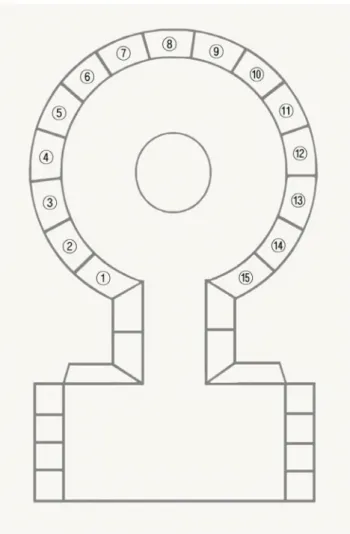
nical and sculptural finesse.1 As is already well known, Sokkuram is a man made grotto composed of a rectangular front chamber that is connected to a circular main chamber via a short corridor (fig. 1). The principal statue of
the Buddha, seated above a round pedestal, is situated at the center of the
main chamber and has a height of 340 centimeters. Surrounding the cen tral statue are fifteen reliefs that portray the figures of Brahma (Pomch’on &X) (fig. 1, no. 1), Indra (Intula (fig- 1, no. 15), ten monks (fig.
1, nos. 3-7, 9-13), and three bodhisattvas (fig. 1, nos. 2, 8, 14).2 The
THIS WORK WAS supported by the Dongguk University Research Fund of 2019. The
author has romanized the names of nationalheritage sites such as Sokkuram and Pulguksa
according to the McCune-Reischauer system for this paper. However, it should be noted
that according to the 2014 provisions of the Cultural Heritage Administration, Sokkuram
and Pulguksa are romanized as “Seokguram” and “Bulguksa” respectively. For the revised
romanization of other terms, please consult Muhwachaech’ong 2014. All photographs and drawings arebytheauthor unless otherwise specified.
1 The construction of Sokkuram Grotto is dated to approximately the mid to late eighth century during the Unified Silla period based on the Samguk yusa Avf (Memorabilia of the Three Kingdoms) by Iryon -A (1206-1289), the oldest and most detailedhistorical record on the subject.T no. 2039, 49: 1018a04.
2 There are also statuesof bodhisattvas situated in niches located intheupper portion of Sokkuram Grotto’s main chamber. However, the present text will focus only on the main chamber's panels ofbodhisattvareliefs.
The Eastern Buddhist 48/2: 69-92 ©2020The EasternBuddhist Society
Figure 1. Diagram of the interior of
Sokkuram Grotto, mid- to late-eighth century, national treasure no. 24, Kyongju City, South Korea.
present paper focuses on two of the bodhisattva reliefs, one of which fea tures a figure holding a scripture (fig. 1, no. 2; plate 1), while the other por trays a figure holding a small cup (fig. 1, no. 14; plate 2). If one divides the main chamber lengthwise through the middle, these two bodhisattva reliefs are situated in symmetrically corresponding locations. As for the remaining bodhisattva relief, it is located directly behind the central statue and por trays a figure with eleven heads in its crown (fig.l, no. 8; plate 3).
This third bodhisattva relief has already been firmly established as por traying the Eleven-Headed Avalokitesvara (Shibilmyon’gwanseumbosal
4—and thus there is no controversy over this figure’s identity.3 However, this is not the case with the first two reliefs as there are conflicting viewpoints regarding which bodhisattvas are portrayed in
3Forscholarly research on the subjectof the Eleven-HeadedAvalokitesvara of Sokkuram Grotto, see Kang Samhye2015.
LIM: TWO BODHISATTVA RELIEFS
71
each panel. To clarify, although it is agreed that the bodhisattvas Manjusri (Munsubosal TATlA) and Samantabhadra (Pohyonbosal
A'A
m'IA)
are the two figures in question, there are differences in opinion as to which of the bodhisattvas are featured in the respective reliefs, and these differing views are based on the objects that each figure holds. For example, some scholars identify the bodhisattva holding the “scripture” as Manjusri and the bodhisattva holding the “cup” as Samantabhadra, while the opposite is true for the counter viewpoint.4 It is difficult to determine which of the two arguments is superior, but there is agreement that the “scripture” and the “cup” are the key pieces of evidence in the identification of the bodhisattvas depicted. The fact that the same approach is taken by both sides reflects the general importance placed on the objects held by bodhisattva figures as important identifying factors.The array of objects held by the figures of bodhisattvas is diverse. They include precious jewels known as kundika (chongbyong a monk’s staff, as well as willow branches, lotus buds, and even lotus stems. Accord ingly, depending on the period of production, an image of a bodhisattva holding a kundika could be recognized as Avalokitesvara (Kwanseumbosal while a bodhisattva image holding a monk’s staff could be representative of Bodhisattva Ksitigarbha (Cicangposal JAATlA).5 How ever, it is definitively more accurate to identify images of bodhisattvas based on the observation of certain characteristics that are unique to each figure rather than to establish an identification that depends solely on the object each figure holds. For example, it is more prudent to identify the figure of Avalokitesvara by the small image of the Buddha featured in his crown which serves as a distinguishing characteristic. As for the bod hisattva Ksitigarbha, he is recognized by the presence of a hood or by his
4Scholars whoidentify the “scripture-bearingbodhisattva” in Sokkuram’s main chamber asthe bodhisattvaManjusri include Kim (2003, pp. 292-93) and I Juhyong (2016, p. 172).
Those who hold the opposite view and identify the same image as that of the bodhisattva
Samantabhadra include Hwang (1989, pp. 58-61), Mun (2000, pp. 262-64), and Ch’oe Songun (2003,pp. 132-37). The scholar Kang Ubang also considers the “scripture-bearing bodhisattva” to be Samantabhadra but adds that this is not a definitive fact (Kang Ubang
2000, pp. 220-23). In the 2008 exhibition catalogue published by the National Museum ofKorea (2008, pp. 138-39), the figures portrayed in the two bodhisattva reliefs are left
unidentified. The most recent scholarship to date identifies the “scripture-bearing bodhisat tva” as Samantabhadra and the “cup-bearing bodhisattva” as Manjusri (Chu 2015, pp.
llb-lS).
5For scholarly research that regardsthe presence ofakundika as an identifying indicator of the bodhisattva Avalokitesvara, see Kang Huijong 2010, p. 13.
signature bald head. Unfortunately, in the case of Sokkuram’s two contro versial bodhisattva reliefs, there are no distinct characteristics on which to base an identification. Both figures have similar appearances that are typical of bodhisattva images and are differentiated only by the object each bod hisattva holds. Naturally, scholarship on the subject of the two bodhisattva reliefs has focused on these objects, and thus the “scripture” and “cup” fea tured in the two images remain important evidence in the ongoing study of the sculpture in Sokkuram Grotto.
As previously established, the focus of this paper is to discuss the two bodhisattva reliefs in Sokkuram’s main chamber; each portray a figure hold ing either a “scripture” or a “cup” in their hand. If even one of the reliefs could be matched to either Manjusri or Samantabhadra, the two candidates that scholars agree upon, this would naturally solve the issue of which bod hisattva is depicted in the remaining relief. However, this has proven to be a difficult task due to a lack of evidence. There are no extant examples of bodhisattva images holding a scripture or a cup from the Silla dynasty outside of those in Sokkuram Grotto, nor are there any references to such images in historical records. Left without a domestic point of comparison, this paper seeks to study examples from other regions of East Asia that are contemporary to the Sokkuram reliefs. The identification of these external examples will provide crucial information that has the potential to solve the controversy over how the figures of the two reliefs in question should be interpreted. But beyond this central issue it is also a priority to evalu ate the close relationship between certain bodhisattvas such as Manjusri or Samantabhadra and the types of iconographic representations attributed to them. Moreover, this paper presents an opportunity to observe the various methods that have traditionally been utilized by scholars of Buddhist art history to understand the iconography of Sokkuram and also offers a new perspective in addition to the preexisting interpretive practices.
An Examination of Sokkuram’s Scripture-Bearing and Cup-Bearing Bodhisattva Reliefs
First, it is necessary to examine the bodhisattva that holds a scripture in his hand. The relief depicting the scripture-bearing bodhisattva is situated next to the relief of Brahma that is located to the immediate left when enter ing the main chamber (fig. 1, nos. 1-2; plate 4)—an important physical arrangement that will be further explored later in this article. The bodhisat tva stands barefoot on top of a lotus-shaped pedestal while turning his body
LIM: TWO BODHISATTVA RELIEFS
73
to the left towards the interior of the main chamber. The head nimbus is relatively large in comparison to the size of the bodhisattva’s head, which is adorned with a tiara decorated in designs of flowers. The figure also wears earrings and a necklace while the area spanning from chest to stomach is covered in beaded decoration. A long, thin garment covers the bodhi sattva’s entire body, and the figure’s right foot steps on a small portion of the fabric. Though the relief is made from durable granite that is difficult to carve, each feature is sculpted in great detail. Most importantly, the figure’s left hand is lifted as high as the shoulder and holds a long piece of scripture that is bound differently than the books of China and seems to have been modeled after Indian scriptures.6 In contrast, the bodhisattva’s right hand is empty and hangs down in a rather generic posture, although the third finger provides variation in that it is slightly folded.
Next, the bodhisattva holding a cup must be examined (fig. 1, no. 14; plate 5). The relief of the cup-bearing bodhisattva has been placed next to the relief of Indra (fig. 1, no. 15) that is to the immediate right when enter ing the main chamber; this layout will also be further discussed later in the article. The bodhisattva stands on top of a lotus-shaped pedestal and is aesthetically similar to the scripture-bearing bodhisattva. However, the tiara belonging to the cup-bearing bodhisattva is of a different shape and is particularly notable for the bird-wing-shaped decorations found on both sides. The bodhisattva’s right hand is held to shoulder level and the thumb and index finger are raised to support the small cup in the figure’s hand. The object is recognized as either a “cup” or a “bowl” depending on the scholar, but based on form and size it is unlikely that the object is a bowl.7 In addition to the object being too small to be a bowl, the manner in which the top portion flares slightly outwards is reminiscent of East Asian tea cups.
Scholars have already reached a consensus on the idea that the two bodhisattva reliefs in Sokkuram’s main chamber represent Manjusri and Samantabhadra.8 This agreement is based on the identification of the main chamber’s principal statue as being Sakyamuni Buddha (Sokkamonibul
6Indian-style sutras are made by drying largetree leaves and cutting them into rectangu
lar shapesto create the pageson which the text is written. Two holes are usually created in
the middle ofeach pageandastring is usedto tie severalpagestogether.
7For many Chinese examples, the object is viewed as a bowl rather than a cup. See An 2007, p. 259.
8 The scholars referenced in n. 4 all agree that the two bodhisattva images represent
('i-AT-'dA) who is depicted holding his hands in bhumisparsa mudra
(hangmach’okchiin It is typical for Sakyamuni to be
accompanied by Manjusri and Samantabhadra in sculptural representations, and on this point there has been no contention thus far.9 As for images of the two bodhisattvas produced during Tang China (618-907), and thus contemporary to the Sokkuram reliefs, Manjusri and Samantabhadra are portrayed riding a lion and an elephant respectively.10 It should be noted, though, that none of the reliefs in Sokkuram portray bodhisattvas riding animals of any kind. This is presumably due to the compositional difficul ties of sculpting the appearance of a figure astride an animal in the space provided by each relief panel. The circular main chamber of Sokkuram is made up of fifteen rectangular slabs that are positioned so that the longer side stands vertically (fig. 1, nos. 1-15). Each slab is about 90 centimeters in width and 220 centimeters in length. Even though only one image has been sculpted on each slab, the vertical slabs lack the space required to fit the forms of a lion or an elephant in addition to that of the bodhisattva fig ure. Additionally, all the slabs portray standing figures and thus it would have made the most sense to stay consistent in pose in order to achieve a visually balanced sculptural scheme. For these reasons, it is thought that the Sokkuram sculptors made a conscious decision not to follow the Chinese tradition of portraying Manjusri and Samantabhadra astride a lion and an elephant. However, without the presence of a bestial companion, there are no concrete indicators to help the viewer differentiate between two similarly straightforward representations of typical bodhisattvas. Therein lies the source of the controversy in identifying Sokkuram’s reliefs of Manjusri and Samantabhadra, as scholars have thus far formed their conclusions based on which of the bodhisattvas holds a scripture and which holds a cup—details that amount only to circumstantial evidence.
9 There have been different views in the past. For example, based on the existence of
sculpturalimagesof theBuddhaAmitabha(Amit'abul HW^#) inbhumisparsa mudra,the
Buddha statue in Sokkuram has been interpreted as a representation of Amitabha (Hwang
1978). However, because thereis no other evidence to supportthe identification ofthe prin
cipal image as Amitabha,there are no scholars of Buddhistart history that agree with this theoryat present.
10 It should benoted that these examples are infrequent but are also theonly iconicimages of the two bodhisattvas in attendance on a representation ofthe Buddha identified based on
monographic evidence alone. Evidence that supports the interpretation of the lion- and ele phant-ridingbodhisattvas asManjusriand Samantabhadra is typically found inthe historical record ofFoshuo tuoluoni ji jing T no. 901, 18: 0790a23. For researchon
LIM: TWO BODHISATTVA RELIEFS
75
As mentioned, scholars have split opinions regarding the identities of the two bodhisattva reliefs. First, the view asserting that the scripture-bearing bodhisattva is Manjusri must be examined.11 In one of the most representa tive texts regarding Manjusri, known as the Wenshushili wen jing
(Sutra of the Questions ofManjusri), it is written that “Manjusri’s right hand holds a Mahayana sutra.”12 Manjusri is also chief of all of the bod hisattvas, and as such, symbolizes complete wisdom, a characteristic that is appropriately represented by a scripture.13 In accordance with this view, the cup-bearing bodhisattva naturally represents Samantabhadra, and the round cup itself is interpreted as the harmony symbolized by Samantabhadra, who is often associated with Buddhist practice.14
In opposition to this argument, there are many scholars who view the cup-bearing bodhisattva as Manjusri.15 Although another sutra, the Fo
shuo Wenshushili banniepan jing (Sutra on Manjusri
Bodhisattva’s Nirvana), indeed states that the bodhisattva Manjusri holds a Mahayana sutra in his right hand, it must be noted that it also states that “he holds a bowl in his left hand.”16 Scholars interpret this to mean that the cup pictured in one of the bodhisattva reliefs is equivalent to the bowl men- honed in the text. Scholars in support of this argument also refer to the wall drawing of the Thousand Bowl-Bearer Manjusri (Ch. Qianbowenshu
K. Ch’onbalmunsu) at the temple Ci’ensi in Xi'an City, China.17 This drawing ofManjusri by Yuchi Yiseng (fl- mid. 7th c.) was rather famous at the time, and so it would have been widely known that Manjusri was depicted holding bowls in his hands just as in the Sokkuram representation of the bodhisattva portrayed holding a cup.18 Additionally, if the scripture-bearing bodhisattva were to be identified as Manjusri, its placement to the right of the Sakyamuni statue would be problematic (fig.
11 See n.4.
12 Wenshushili wen jing,T no. 468, 14: 497c20.
13 The fact that the bodhisattva Manjusri represents wisdom itself is mentionedin various sutras too numerous tobe examined in this paper. Representative examples are the Wens- hushili wen jing, Tno. 468, 14:497c20, andthe Foshuo Wenshushili banniepan jing, T no. 463, 14: 480cl2.
14 Han’gukpulgyoyon’guwon 1997, p. 52.
15 See n. 4.
16 Foshuo Wenshushili banniepan jing, Tno.463, 14: 480cl2.
17 Forevidencethat can befoundin sutrasregardingthe Thousand Bowl-Bearer Manjusri,
seeDashengyujia jin'gangxinghai manshushili qianbiqianbo dajiaowang jing
Tno.ll77A, 20: 724bl2.
Figure 2. Diagram of the interior of
Sokkuram Grotto. The triangle expresses the triad relationship of the principal icon, the scripture-bearing bod hisattva, and the cup bearing bodhisattva.
2). In East Asia, it is customary for Manjusn to be situated on Sakyamuni’s left-hand side because the bodhisattva symbolizes “wisdom itself” and is consequently considered to be of higher rank than the bodhisattva Samantabhadra, who represents “wisdom in practice.” In general, the left signifies elevated status in comparison to the right, an East Asian concept that will be further explored later in the text.
Unfortunately, there are no sculptural examples of Manjusn or Samantabhadra dating to the Unified Silla period with inscriptions confirming the identity of the subject portrayed. Samguk yusa TAu'li- (Memorabilia of the Three Kingdoms), the oldest Korean historical record related to Buddhism, does mention both Manjusn and Samantabhadra statues, but there is no description of the actual physical form of these examples. There are, however, rare instances of lion-riding Manjusn and elephant-Samantabhadra sculptures dating to the Unified Silla period that still exist on the Korean Peninsula. A representative example dating to the
LIM: TWO BODHISATTVA RELIEFS
77
late Unified Silla period, or ninth century, can be found at Pulguksa UlU'f located in Kyongju Wfl'l Province.19 Instead of Sakyamuni, an image of the Buddha Vairocana takes center place while the bodhisattvas Manjusri and Samantabhadra are situated to the left and right as attendant bodhisattvas. Regrettably, these extant sculptures have been significantly damaged and in their present condition only the lion and elephant portions of the statues can be readily observed. The upper portions depicting the forms of Manjusri and Samantabhadra have not survived, leaving scholars without a clue as to the original appearance of the statues. Therefore, although it is clear that Manjusri and Samantabhadra are the intended subjects of the Pulguksa examples, the general lack of relevant visual evidence in surviving examples of Silla-dynasty Buddhist sculpture does not aid in the task of revealing the identities of the Sokkuram bodhisattvas.
Returning to the main chamber of Sokkuram, it should be noted that there is another example of a scripture-bearing bodhisattva located in one of the niches of the chamber’s upper wall (plates 6 and 7). There are ten niches in total but only eight contain statues as the two located above the chamber’s entrance are presently empty.20 The niche occupied by the scripture-bearing bodhisattva is located right above the relief of the cup-bearing bodhisattva. The figure inside the niche is seated above a lotus-shaped pedestal, and his right hand holds a scripture while his left hand is placed above the knee. This figure is sometimes identified as Manjusri depending on the scholar, but it is more commonly referred to simply as the “niche bodhisattva sculp ture” without any specific identification.21
An Analysis of the Objects Held by Tang-Dynasty Images ofMahjusri and Samantabhadra
The concurrence of scripture-bearing and cup-bearing bodhisattva images such as in Sokkuram’s main chamber is a rare occurrence. One of the few confirmed examples can be found on the second door slab of the digong
19 There are a few surviving examples of “lion-riding Manjusri” and “elephant-riding
Samantabhadra” found in places such as Pulguksa and Popsusa but there are no
examples that havesurvived completely intact. SeeMun 1969.
20Most scholars agree that the two empty niches were once filledwith statues ofbodhi
sattvas that are now lost.However, thereis also arecent theorythata small stupa could have
alsostoodinthe niche atonepointintime.See Han 2015.
21 There isno agreement ofscholarly opinion regardingthe scripture-bearing bodhisattva in the niche.Thereare some whoview thisfigure as Manjusri (Pae 2008, p. 64). It is, how
(underground palace) affixed to the stupa ofFamensi in China. Each side of the door slab features a bodhisattva holding either a scripture or a cup (plates 8 and 9).22 When facing the slab, the left door portrays the cup bearing bodhisattva while the right door depicts the scripture-bearing bodhi sattva. It is highly likely that the bodhisattvas pictured are Manjusri and Samantabhadra but the problem remains in deciding which figure is which.23 The door slab of Famensi's digong was closed in the year 874 and remained so until its first excavation in 1987. It is difficult to determine the exact year when the door was created but based on stylistic characteristics and the door’s elaborate storage condition, the ninth century seems to be a reasonable postulation.24 Besides the Famensi door slab, there are also other instances of the scripture and cup-bearing bodhisattva pair such as the wall murals found in caves 341 and 419 of the Dunhuang Grottoes (plate 10). Notwithstanding these few exceptions, confirmed examples are exceedingly limited in number, indicating that the simultaneous por trayal of scripture and cup-bearing bodhisattvas was not a widely applied
subject.25 Most importantly, none of these examples have been positively matched to Manjusri or Samantabhadra. Furthermore, the right-left place ment of scripture and cup-bearing figures differs between the Famensi and Dunhuang cave bodhisattva pairs, an inconsistency that adds to the confu sion in identifying Manjusri and Samantabhadra.
Next to be examined are the Chinese examples that have been verified as either Manjusri or Samantabhadra because they are portrayed riding a lion and an elephant respectively. Images of the two bodhisattvas astride animals started to appear as a pair around the latter half of the seventh century.26
22 The first scholar to bring attention to the bodhisattva pair of Famensi was Song Chinhyop. Songinterprets the scripture-bearing bodhisattva as Manjusriandthe cup-bearing bodhisattva as Samantabhadra, andfurther exploreswhy Samantabhadra holds the object of acup. Song 2013, pp.2-4.
23 Based on the factthat the finger (bone) of Sakyamuni is stored behind the fourth and
innermost door, the two bodhisattvas portrayed on the door are viewed as Manjusri and
Samanta-bhadra. Wang 2005, p. 104; Song 2013, pp. 10-11.
24 Shaanxisheng KaoguYanjiusuo 2007. In the most recent catalogueofFamensi,the year
is given as874. Jiangqi 2014, p. 13.
25 The example inDunhuang cave number 341 was presented and researchedin detail by Song(2013).
26 Kojima 1995, p. 50. There are many examples, includingthe wall paintingof Manjusri and Samantabhadra located on the eastwall ofthe main chamber of Dunhuangcavenumber 331.
LIM: TWO BODHISATTVA RELIEFS
79
Based on excerpts that mention the breeding of lions and elephants,27 as well as the record stating “the elephant and lion were used as pedestals”28 in Luoyang qielan ji (Record of Buddhist Monasteries in Luo-yang) compiled in 547 of the Northern Wei period, it is also possible that lion- and elephant-riding images of Manjusri and Samantabhadra were already in existence by the sixth century. However, the earliest extant image has been dated to circa the eighth century. The animal-riding images of Manjusri and Samantabhadra appear in the form of both sculptures and wall murals, but in the case of sculptural depictions, the hands tend to be the most fragile and are usually the first element to be damaged. As a result, there are very few instances where the objects, if any, held in the hands of the bodhisattvas can be confirmed. This also applies to the earliest statues of animal-riding Manjusri and Samantabhadra with a reliable date. Produced in the year 725, the statues are depicted on one of the reliefs of the stone stupa located in Chengwu AA County, Shandong ifi A Province, and as men tioned, the hands of both bodhisattva figures along with any objects they may have held have been broken off.29 There are also statues of animal riding Manjusri and Samantabhadra dated to the year 782 at Nanchansi
■ii'i'v of Mount Wutai A^. Manjusri holds a ruyizhang (youijang),
a wish-granting wand, or scepter, while Samatabhadra holds a scripture.30 Some scholars utilize the Nanchansi statue of Samantabhadra (plate 11) as crucial visual evidence to support their claim that the scripture-bearing bod hisattva of Sokkuram is indeed Samantabhadra.31 However, this is a flawed argument in that the statue’s current appearance is not original on account of the numerous repairs that have been made to it over the centuries.32
27 “Thereis aplace locatedon the south road of Yongqiao where white elephantsand
lions are raised.”Luoyang qielan ji, Tno. 2092, 51: 1012a05.
28 Luoyang qielan ji, T no. 2092, 51: 1018b06. 29 Sun 2007, p.203,fig.29.
30Amongthese,the ruyizhang is a tool held by a speakerduring preachingthatis shaped
likea back scratcher with acurved end. After the mid-Tang dynasty, thereare alsoexamples wherethefigureholds a lotus flowerinstead ofaruyizhang.
31 Chu 2015,p. 111.
32 Ifthe sculpture standing atthe Great Buddha Hall of Nanchansi in Shaanxi KN Prov ince reconstructed in 782is examined, it can be observedthat the elephant-riding statueof
Samantabhadra holds a scripture. Although lion and elephant-riding images of Manjusri and Samantabhadraare found inside of the building, it ishighlylikely that they were notcreated
in the late eighth century, but instead during the large-scale reconstruction project carried
out in 1086 to repair thedamage to Nanchansi that occurred because ofthegreat earthquake in 1038 with a strength of7.5 to 10 (Qi and Chai 1980, p. 61). As there were many more
The wall paintings of the Dunhuang caves provide the greatest number of examples related to the subject at hand. Among these, it is important to focus on the objects held by the eighth- to ninth-century images of bodhi sattvas riding a lion and an elephant as these examples can be considered definite representations of Manjusri and Samantabhadra. In relation to the objects pictured, the Tang dynasty wall paintings of both bodhisattvas can be categorized into two general types. In the first type, the bodhisattvas do not hold any objects but instead hold their hands together with palms fac ing each other or with fingers folded and crossed. In the second type, the bodhisattvas hold either a ruyizhang or a cup. Wall paintings belonging to the first type are common in the Dunhuang caves but another noteworthy portrayal of empty-handed Manjusri and Samantabhadra can be found on the silver sarira reliquary excavated from the digong of Famensi.33 The sec ond type is the most frequently occurring and in these examples Manjusri usually holds the ruyizhang while Samantabhadra holds the cup. There
are also cases where the opposite is true (plate 12), as well as instances where both bodhisattvas hold identical cups (plate 13). In contrast, images of the scripture-bearing bodhisattva are all but absent from the sculptural and painted schemes of the Dunhuang caves. Furthermore, it can be firmly stated that with the exception of the few examples discussed thus far, por trayals of the pair of scripture and cup-bearing bodhisattvas as exemplified by the Sokkuram reliefs are extremely rare.
Returning to East Asia, depictions of the scripture-bearing bodhisattva are significantly sparse prior to the ninth century, and there is not enough evidence to confirm that the object of a scripture signifies the figure’s iden tity as Manjusri.34 On the other hand, there is an abundance of Tang-dynasty images of cup-bearing bodhisattvas. Interestingly enough, the cup-bearing bodhisattvas are oftentimes clearly identified by an accompanying cartouche or by the appearance of an animal, but the cup also appears in a variety
repairs completed afterthis as well, the present state ofthe sculpture is most likely notthat
of the original appearance. Forthese reasons, scholars cannot rely on the objects held by both bodhisattvas as evidence in support of their arguments.
33 For a sketch of this reliquary, see Shaanxisheng KaoguYanjiusuo 2007, vol. 1, plates
93-94.
34 The scripture-bearing bodhisattva that appears in depictions ofthe Eight Great Bod hisattvas such as the mandala wall painting (761-781) on the east wall of cave no. 25 of
Yulin Grotto or in the early ninth-century “Eight Great Bodhisattvas” mandala (color on
■ ■
Plate 2. Cup-bearing bodhisattva (detail), Sokkuram Grotto, height of relief 202 cm, mid- to late-eighth century.
Plate 1. Scripture bearing bodhisattva (detail), Sokkuram Grotto, height of relief 202 cm, mid- to late- eighth century.
Plate 3. Eleven-Headed Avalokitesvara, Sokkuram Grotto, height of relief 220 cm, mid- to late-eighth century.
bodhisattva (right), Sokkuram Grotto, height of Brahma relief 214.4 cm, mid- to late-eighth century.
Plate 5. Indra (right) and cup bearing bodhisattva (left), Sokkuram Grotto, height of Indra relief 211 cm, mid- to
Plate 6. Interior of Sokkuram Grotto, mid-
to late-eighth century.
Plate 7. Niche sculp ture of scripture bearing bodhisattva, Sokkuram Grotto, height 86 cm, mid- to late-eighth century.
Famensi, ca. ninth century, height of slab 90-91 cm. From Jiangqi 2014,p. 75.
Plate 9. Rubbing of the second door slab from the digong (un
derground palace) ofFamensi, ca. ninth century, height of slab 90-91 cm. From Shaanxisheng Kaogu Yanjiusuo 2007, plate 17.
Plate 10. Buddha assembly, mural painting, eastern wall ofMogao cave 341, early Tang dynasty. Scripture bearing and cup-bearing bodhisattvas pictured to the far left and right. From Dun huang Yanjiyuan 2003, plate 14.
Plate 11. Statue of Samanta- bhadra, Nanchansi, Mount Wutai, Shanxi Province, Chi na. From Zhongguo Siguan Diaosu Quanji Bianji Weiyua- nhui 2003, vol. 1, plate 225.
Plate 12. Manjusri (right) and Samanta
bhadra (left), High Tang period, Dunhuang cave 159. From Dun- huang Wenwu Yanji- usuol982-87, vol. 5, edited versions of plates 80 and 81.
Plate 13. Cup-bearing bodhisattva images to the left and right. From
Whitfield and the Brit ish Museum 1982, plate
State Hermitage Museum, Russia. From State Hermitage Museum of Russia 1997-98, vol. 1, plate 101.
colors on a silk banner, tenth c., 63.5 x 31.8 cm. Guimet Museum. From Gies 1995, plate 41.
Plate 16.
Manjusri (right) and Samanta- bhadra (left), full image of plate 12, High Tang period, Dun- huang cave 159. From Dunhuang Wenwu Yanji- usuo 1982-87, vol. 5, edited ver sions of plates 80 and 81.
Plate 17. Image ofBrahma located below Manjusri (detail of plate 16), High Tang period, cave no. 159. From Zhongguo Dun- huang Bihuaquanji Bianji Weiyuanhui 2006, vol. 7, plate 105.
Plate 18. Image ofBrahma with inscription of “Brahma” in Yulin Grotto cave no. 16.
From Zhongguo Dunhuang Bihuaquanji Bianji Weiyuan- hui 2006, vol. 9, plate 112.
Plate 20. Sculptural images of the vajrapani (detail), Horyuji. From Nara Rokudaiji Daikan Kankokai 2001; edited versions of plates 130 and 131.
LIM: TWO BODHISATTVA RELIEFS
81
of other forms.35 Besides Manjusn and Samantabhadra, the bodhisattva Avalokitesvara and the bodhisattva Moon-store (K. Wolchang bosal
Ch. Yuecang pusa) are also portrayed holding cups (plates 14, 15). As referenced earlier, there are also images that depict Manjusn and Samantabhadra each holding cups in their hands simultaneously (plate 13). Accordingly, as there are many types of bodhisattvas that are pictured hold ing cups, the object of a cup by itself is an insufficient signifier of Manjusn. The cup, like the scripture in East Asia, cannot be considered a special object exclusive to any one bodhisattva, and thus should not be the only characteristic used to identify a bodhisattva image.36
The object of a scripture appears in the hands of both Manjusn and Samantabhadra, while the cup can be found in the hands of the bodhisattvas Avalokitesvara, Moon-store, Manjusn, and Samantabhadra.37 It follows that there is no absolute rule that dictates the attribution of specific objects to certain bodhisattvas; thus, another means of identifying the Sokkuram reliefs ofManjusri and Samantabhadra is required.
Exploring the Concepts of “Left,” “Right,” and Circumambulation in Buddhist Art
If the bodhisattvas Manjusn and Samantabhadra cannot be identi fied by the objects they hold, the focus must be shifted to how they are positioned.38 In East Asia, Manjusn, the chief of bodhisattvas, is usually placed to the Buddha's left while Samantabhadra is found to the Buddha's right (fig. 3). This is due to the fact that after China’s Northern and Southern
35 Details regarding cup-bearing bodhisattvascan be found in Song 2013.
36The cup held by the bodhisattva is also sometimes identified as a depictionof glass cups
popularduring theTang dynasty. Taking into consideration that glass cups were excavatedfrom Famensi, this seems tobe a reasonable assumption. Chu2015, p. 109, n. 24; Song 2013, p. 47.
37 As was already examined in the examples ofKoryo Buddhist paintings, the Choson- period examplesof the scripture-bearing bodhisattva are notalways Manjusn. There are also instanceswhere Samantabhadra is holding a scripture. Thereis no particularreason that the scripture-bearing bodhisattva is required to represent a specific bodhisattva and be given a
special name. IJuhyong 2015,p. 127.
38The left-right images of Manjusn and Samantabhadra in the Great Vairocana Image
Shrine(Ch. Da Lushena Xiang Kan of FengxiansiTTtGrotto in Longmen
OR illustrate the difficulty in distinguishing between, and recognizing the proper identity of, each bodhisattva portrayed. Forthe most comprehensive scholarship regarding the Great
Figure 3. Diagram ofBuddha triad layout.
Samantabhadra
Indra
yzn Pt
main image)
ManjusriBrahma
yangdynasties, convention dictated the left to be of higher status than the right.39 A similar context can be found in the Tang dynasty Foshuo tuoluoni ji jing (Collection of Spells), a version of the Dharani-samuccaya
Sutra translated by Adiquduo (Skt. Atikuta) in 654. There it is
written: “Portray Manjusri bodhisattva to the left [of the Buddha] and por tray Samantabhadra to the right [of the Buddha],” and as such, the position of the bodhisattvas is regulated.40 The placement of Manjusri to the left and Samantabhadra to the right is a convention that can be confirmed in the Koryo iT'A period (918-1392); in Buddhist paintings as well as in other genres of East Asian Buddhist art, however, this placement is not entirely consistent. Although rare, there are instances where the bodhisattvas are depicted in opposite positions.41 Despite the existence of a few exceptions, the general rule is for Manjusri to be placed to the left of the principal icon while Samantabhadra is placed to the right. Furthermore, when naming the two bodhisattvas, Manjusri is first. Some scholars use this reasoning to argue that the cup-bearing bodhisattva to the left of the principal icon of Sokkuram Grotto is Manjusri (fig. 2).42
At thisjuncture it is necessary to discuss the positions of the Brahma and Indra reliefs inside the main chamber of Sokkuram. An early sutra states,
39 In East Asia, whether therightor leftis superior is differentaccordingto the time period.
Thus, while there is no absolute standard, the left wasstill more commonly considered to be higher-ranking than the right. DuringtheQin (221 BCE-206 BCE), Han M (202 BCE-220
CE), and Yuan (1271-1368) dynasties,theuse of theright handwas very important dueto the emphasis onwen A (literary arts). In contrast, therewere also periodswhere the concept ofwu A (martial arts) were emphasized, and so the left was more important (I Unju 1997,
p. 48). During the Han dynasty theright-hand side was more important, but as Buddhist art became more Chinesein nature,the left-hand side emerged as the higher-ranking position.
40 Foshuo tuoluoni ji jing, Tno. 901, 18: 790a23.
41 In the caseof the Eleven-Headed Avalokitesvara statue in cave no. 9 of the Tianlongshan Atllll Grotto, the opposite istrue as Manjusri is positioned tothe right ofAvalokitesvara.
LIM: TWO BODHISATTVA RELIEFS
83
“Brahma is to the Buddha’s right and Indra is to the left.”43 Gandharan and other Indian depictions of the two figures typically follow this written stan dard but the same cannot be said of East Asian images. Brahma is consid ered to be of higher status, and as such, it is more common to see Brahma placed to the left of the Buddha and Indra placed to the right. This is reflec tive of the East Asian view that the left-hand side is more prominent and of an elevated position in comparison to the right-hand side. This notion is also present when naming the two entities and thus Brahma precedes Indra. This positional hierarchy is similar to the one observed between Manjusri and Samantabhadra. However, in the main chamber of Sokkuram, the rule has not been applied to the reliefs of Brahma and Indra. Breaking from the pattern, the relief of Brahma is located to the right of the principal icon—an inconsistency that requires further explanation.
One of the main arguments of this paper is that the main chamber of Sokkuram should be understood differently from the concept of a Dharma Hall (poptang This is particularly evident in the path circling the principal icon that is created by the circular layout of the space. The intended circulation of the room and the arrangement of the sculptures sug gests that the chamber was planned around the yojap AIE (circumambula- tion around the image of the Buddha; Skt. pradaksina) ritual that took place during prayer services (fig. 4).44 Based on the grotto’s plan, routine worship of the various sculptures, including the central Buddha statue, would have taken place in the front chamber while the yojap ritual would have been car ried out through a procession around the circular main chamber. The ritual would have consisted of walking clockwise around the principal icon and then pausing in front of the icon to bow three times. This custom of walk ing around a subject of veneration three times in a clockwise fashion was an ancient, preexisting practice already popular at the time of Sakyamuni Buddha. References to the circumambulation of the Buddha can be found in various texts such as the Zengyi ahan jing (Numbered Dis courses), where it is written that, “In order to accept the teachings of vari ous monks, one bowed so that the head touched the floor in worship of the Buddha’s legs, circled the Buddha three times to the right, and went on one’s way.”45 Another states that, “In fear that the Buddha would not recognize
43 “Brahma is to the Buddha’s right while Indra, who holds a qauri (pulcha Ar: fly whisk), is to the Buddha’s left.”Zengyi ahan jing Tno. 125,2: 663b24.
44 Other scholars have also agreed that Sokkuram Grotto is a space for the yojap ritual.
See Kang Huijong 2011, p. 149; I Kison2007, pp. 1003-6. 45 Zengyi ahan jing, T no. 125, 2: 684cl62.
Figure 4. Diagram of the interior of Sokkuram Grotto with line indicat ing circumambulation around the Buddha im age.
him, [the king] completed the ritual by bowing so that his head touched the floor in worship of the Buddha’s legs and proceeding around to the right three times.”46 There are also many passages related to the circumambula tion of stupas, such as, “One must circle the stupa to the right”;47 or, “If one circles the stupa to the left, the deity guarding the stupa will be filled with wrath.”48
The circumambulation of stupas and buddha statues was clearly widely practiced in ancient Korea. There is a record stating that the Silla-dynasty monk T’aehyon /Ji't (n.d.) circled the central buddha figure of Yongjangsa
j
TKT
in Namsan Kyongju Province, as an act of worship in the twelfth year of King Kyongdok (r. 742-765; d.753), the same period as Sokkuram’s construction.49 Thus, it seems that at the very latest, yojap was widely practiced during the time of King Kyongdok, a perception that is evident in the circular layout of the main chamber of Sokkuram. Taking this into account, the arrangement of the sculptures in Sokkuram can bereinter-46Zhong benqi jing T no. 196,4: 52b02.
47 Yourao fota gongde jing Tno. 700, 16: 801c03.
48 Shifenlu T no. 1428, 22: 930c07. The samecontextcan be found inthe Fayuan zhulin “Ifonecircles the stupa to the left one will be rebuked bythe deity.” T no.
2122, 7853:582c06.
LIM: TWO BODHISATTVA RELIEFS
85
preted so that the relief of the scripture-bearing bodhisattva one sees upon entering the main chamber and turning to the left is understood to represent the chief bodhisattva Manjusri, and the relief of the cup-bearing bodhisattva one sees on the way out of the chamber after circling the principal icon is Samantabhadra. Here Manjusri symbolizes the wisdom of Sakyamuni after enlightenment, while Samantabhadra represents the aspiration to attain the station of bodhisattva and the practice of wisdom. In the main chamber of Sokkuram, one starts at the wisdom of Manjusri and finishes at the practice of Samantabhadra. The procession through Sokkuram can be understood according to the same context found in the sixty-volume Huayan jing
(Flower Ornament Sutra), which describes the fulfillment of the wishes of Sudhanakumara (Sonjaedongja ). beginning with an encounter with Manjusri and ending with a meeting ofSamantabhadra.50
The location of the Brahma relief alongside the scripture-bearing bodhi sattva plays an important role in identifying the figure holding the scripture as Manjusri. In the previously discussed Dunhuang wall paintings, there were many instances where depictions of Brahma and Indra were found underneath the bodhisattvas Manjusri and Samantabhadra as accompany ing figures. Manjusri is coupled with Brahma while Samantabhadra is seen with Indra. There are, however, scholars who view the figure accompanying Manjusri while holding a “short-handled fan” as Indra instead of Brahma (plates 16, 17). Regardless of the disparate opinions, there is an image of a figure holding a short-handled fan located in cave 16 of the Yulin Grotto that has a cartouche containing the name ofBrahma, thus confirming its identity (plate 18). Based on this identification, the figure accompanying Manjusri can only be Brahma.51
In the study of Sokkuram the same pattern can be observed. At the entrance of the main chamber, the bottle-bearing Brahma is situated next to Manjusri while Indra, bearing a vajra (kumgangjo ^^^), stands next to Samantabhadra. As is already well known, Brahma is frequently por trayed as an ascetic holding a bottle, while Indra often appears holding the
50 Related material can be found in Huayan jing, T no. 278, 9: 688bll, 783a07. For a
noteworthy,recently publishedstudythat examinesSokkuramin relation to Hwaom '7A (Ch. Huayan)thought, see Ch’oeYonsik 2015.
51 The figure depicted in Dunhuang caves 159 and 468 holding a “round short-handled
fan” situated below Manjusri is identified by some scholars as Indra (see Zhongguo Dun
huang Bihuaquanji Bianji Weiyuanhui 2006, caption for plates 105 and 152 [vol. 7]).How
ever, based upon the existence ofthe inscriptionnamo dafanwang ifLATttli. “Homageto
vajra, a symbol for lightning; this is a tradition that started in India but is also evident in many East Asian representations of the two figures.52 It follows that one could positively identify the visually correlative figures of Sokkuram Grotto’s main chamber in the same way; the figure holding the bottle is Brahma, and the figure holding the vajra is Indra.53 There is a parallel as Brahma is the highest-ranking of the devas and accompanies Manjusri, the chief of the bodhisattvas. Taking into account the fact that there is a hierarchy of sacred images in Buddhism, the only procession that makes sense would be for one to enter Sokkuram’s main chamber and first encounter Brahma and Manjusri, then to continue on by circumambulat ing the principal image of Sakyamuni and end up at the reliefs of Indra and Samantabhadra before exiting. In light of this interpretation, the departure from convention in the left-right placement of Manjusri and Samantabhadra is understood as a meaningful design rather than an irregularity.
The new theory proposed here is further supported by the two images of
the vajrapani (kumgangyoksa vajra warriors) placed outside of
the main chamber of Sokkuram. When facing the entrance of the grotto’s inner chamber, the vajrapani to the left, has an open mouth while the one to the right has a closed mouth (fig. 4, A, B; plate 19). This type of arrange ment, like many other components of Sokkuram, is atypical of East Asian representations of the vajrapani. From the perspective of the viewer facing the image, the placement of the vajrapani images in the exemplary East Asian temples is customarily reversed. In India, a vajrapani was originally a guardian figure, and thus its image was placed next to its ward, a bud- dha.54 However, as the images of vajrapani spread to China, their portrayal changed to include not one, but two, vajrapani figures in a single represen tation. Additionally, the Chinese portrayals of the two vajrapani differ from their Indian counterparts in that the two figures appear next to temple doors as protectors of the site rather than in attendance on a buddha. In other words, with the reassignment of vajrapani from being a single guardian of a lone buddha to being protector of the temple, the number of depicted figures changed from one to two. Accordingly, with the occurrence of vajrapani as a pair in China, the traditional Chinese concepts of yin B and yang
developed as additional components of vajrapani identity.55 In this man
52Foshuo tuoluoni ji jing, Tno. 901, 18: 805b.
53 Forresearch on theimages of BrahmaandIndraof SokkuramGrotto, seeHo 2005.
54 Im(Lim) 2007.
55 For a discussion ofthe vajrapani images as a pair symbolizing yinand yang, including
LIM: TWO BODHISATTVA RELIEFS
87
ner, the open-mouthed vajrapani represents “yang” and the closed-mouthed
vajrapani is associated with “yin,” as is also evident in the examples from
Sokkuram Grotto.56
Thus, when facing East Asian examples of the vajrapani pair, an open mouthed vajrapani is located to the right while a closed-mouthed vajrapani is usually placed to the left (plate 20). Seen from the perspective of the image itself, though, the most typical depiction would place the open-mouthed
vajrapani, which represents “yang,” to the principal image’s left-hand side
(the viewer’s right) and the closed-mouthed vajrapani, which represents “yin,” to the principal image’s right-hand side (the viewer’s left) (fig. 3).57 That the opposite is true for Sokkuram only reinforces the notion that we have here an instance of circumambulation around the principal image where the open mouthed vajrapani is the starting point and the closed-mouthed vajrapani
marks the end point. To summarize, the worshiper is greeted outside the entrance by the open-mouthed vajrapani, views the reliefs of Brahma and Manjusri once inside the main chamber, circles around the principal image of Sakyamuni, observes the reliefs of Indra and Samantabhadra on the way out, and ends the procession at the image of the closed-mouthed vajrapani.
Although there are no East Asian examples with layouts identical to that of Sokkuram Grotto, it is necessary to discuss other instances where the concept of circumambulation is employed. Notable examples include Kanjingsi A'A in the Longmen OM Grottoes and cave no. 33 of the Guangyuan Qianfoya of Sichuan HOI Province. Of these, the Kanjingsi Grotto is seen as a representative example of circumambulation as it contained a central statue of a seated buddha in addition to twenty-nine arhat (luohan M^) images on the lower portion of the cave’s encircling walls. However, although the arhat images have survived to the present day, the central buddha statue is presently missing and its existence can only be confirmed through a photograph taken in 1941.58 Therefore, the statue cannot be examined and the possibility remains that the statue was not an original element of the cave, in which case the layout of Kanjingsi Grotto cannot be considered an example of circumambulation. As for cave no. 33
56 It is customary to view the open-mouthed image as the start and the closed-mouthed imageas theend, but this paper seeks toextend this understanding to include theconcepts of yin and yang as applied to the open-mouthed and closed-mouthedvajrapanis respectively.
See too Im(Lim) 2009, pp.284-87.
57Im(Lim) 2009, pp.284-87.
58 Mizuno 1941, vol. 3, plate 108. The whereabouts of the missing buddha statue are
at Guangyuan Qianfoya, statues of a buddha and bodhisattvas are situated on the central pillar, creating a layout wherein the visitor is clearly meant to worship by circling the images in order to accumulate good karma. Such practices of worship via circumambulation were already being observed from the fourth century in the “pillar caves” of China and the “Western regions” (India and Central Asia). Though these “pillar caves” have layouts distinct from that of Sokkuram, their religious function remains fundamen tally the same.
Conclusion
There have been various conflicting interpretations concerning the scrip ture-bearing and cup-bearing bodhisattva reliefs found in the main chamber of the Sokkuram. This paper has attempted to solve the controversy over the identities of both bodhisattvas, which have thus far been identified according to the objects held in each figure’s hand.59 Identification via such objects has been an especially persistent approach used by scholars of Bud dhist art history because the two figures have no other special characteris tics distinguishing them from images of other bodhisattvas other than the “cup” and the “scripture” pictured in each relief. In truth, the use of objects as visual evidence in the investigation of a bodhisattva’s identity is only the first step of many in the process of art historical research. Despite this, the method was considered worthwhile if it could reveal the identities of the two bodhisattvas as such a discovery would also shed light on other impor tant aspects of Sokkuram, such as the original intent of the grotto’s creator. Ultimately, the objects, and thus the methods utilized by scholars, have proved insufficient to the task of determining the identities of the bodhisat- tvas.60 This has been primarily due both to the discrepancies between the visual images and what was found in the historical records, as well as to the inconsistencies in the images themselves.61
For these reasons, this study has shifted the focus from the objects held by the bodhisattvas to the arrangement and position of the two bodhisattva
59Fora viewpoint that asserts that images can be distinguished throughthe observation of
special objects or images, see McArthur2002, pp.26-41, 110-17.
60 Yang Huijong agrees with the sentiment thata bodhisattva’s identity cannotbe deter mined solelybythe presence of anobject. However, Yang arguesthe case for this througha
study of a Koryo-periodpainting of Amitabha and the EightGreat Bodhisattvas. See Yang 2008,p.78.
LIM: TWO BODHISATTVA RELIEFS
89
reliefs as well as to the rituals that would have taken place in Sokkuram at the time of their production. The layout of Sokkuram’s main chamber is designed so that a visitor could practice circumambulation of the principal image of Sakyamuni and in so doing earn merit. As a rule, circumambu lation of Buddhist images or stupas occurred three times in a clockwise direction. Taking this into consideration, the point of entry is the most appropriate location for images of the high-ranking Brahma and Manjusri while the exit is the suitable location for the images of Indra and Samanta bhadra. In conclusion, the principal statue of Sakyamuni in the center, and the two reliefs of Manjusri and Samantabhadra to the Buddha’s left and right, should not be viewed as the formation of a buddha triad similar to the arrangements found in a Dharma Hall. Rather, the placement of all three images is reflective of yojap, or circumambulation, of the principal image that starts with Manjusri, the symbol of wisdom, and ends with Samantab- hadra, who is representative of wisdom in practice. Thus, in answer to the ongoing question of how to identify the two bodhisattva reliefs located in Sokkuram’s main chamber, the scripture-bearing bodhisattva is Manjusri and the cup-bearing bodhisattva is Samantabhadra.
ABBREVIATION
T Taisho shinshu daizokyo 85 vols. Ed. Takakusu Junjiro JllAW and Watanabe Kaigyoku 1924-35. Tokyo: Taisho Issaikyo
Kankokai, 1924-32.
REFERENCES
AnKwisuk 2007.“Pulbarui tosangjongsongnip kwa chon’gae”
A AI4I (Iconographic Formation and Development of the Buddha’s Bowl). In
Shigang-munhwa ui chont'ong gwa haegyok MW, edited by HanChonghui
E®, pp. 243-75. Seoul: Yegyong.
Ch’oe Songun 2003. SokpulAB (Stone Buddha Images). Seoul:Han’girat’u. Ch’oe Yonsik 2015. “P’yohun ui ilsungsegyeron kwa Pulguksa Sokkuram” A®i|
A| BHW • AAA (One Vehicle World [Eka-yana Lokadhatu] Theory of
P’yohun andthe Founding ofPulguksaTemple and Sokkuram Grotto). Pulgyo hakpo
70, pp. 95-120.
Chu Suwan B^'W. 2015. “T’ohalsan sokkul Munsu Pohyon Bosalsang yon’gu” kbAA Aft AW WKWlSB ftft (Study of the Iconography of Manjusri and Samantabhadra
Dunhuang Wenwu Yanjiusuo 1982-87. Zhongguo shiku: Dunhuang Mogaoku 'I'lM/iM : (Chinese Buddhist Cave Temples: Dunhuang Mogaoku
Grotto). Vols. 1-5.Beijing: Wenwu Chubanshe.
Dunhuang Yanjiuyuan 2003.Dunhuang shiku quanji Aft (Complete Collection ofDunhuang Grotto). Vol. 10. Hong Kong: ShangwuYinshuguan.
Gies, Jacques. 1995. Les arts de L'asie centrale: Musee Guimet Pelliot Collection, vol. 2. Tokyo: Kodansha.
Han Chongho 2015. “Sokkuram Ch’onbulsot’ab ui ponganch’o chaego” -/iMY Y
BYBM VYY YY (Reconsideration of Enshrinement Space for the Small Pagoda
withCh’onbulin Sokkuram).Tongang misulsahak YYYYYV 17, pp. 593-620.
Han’gukpulgyoyon’guwon 1997. Seokguram -/iMlY (Sokkuram Grotto). Seoul: Ilchisa.
Ho Hyonguk WvM. 2005. “Sokkuram Pomch’on chesokch’onsang tosang ui kiwon kwa
songnip” VYY ftY • MWYB 0BBM MY (Iconography ofBrahma and Indra
in Sokkuram: Its Origin and Formation). Misulhak yon’gu 246/247, pp.
5-46.
Hwang Suyong YW. 1978. “Sokkurambonjon Amit’ayoraejwasang sogo” '/iM.lYMY-YM (Study of the Seated Amitabha of Sokkuram Grotto). Misulhak
yon’gu 136/137, pp. 92-95.
---. 1989. Seokguram (SokkuramGrotto). Seoul: Yorhwadang.
I Juhyong TYt? (Rhi Juhyung). 2011. “Tosanghak un chongmal chungyohan’ga? Milgyo ch’urhyon ijon pulsang ui chonmyong kyujong/p’anbyor e kwanhayo” MM
BftMM? : MM BBM SY HMM (Does Iconography Really Matter? The Iconographic SpecificationofBuddhaImages in Pre-EsotericBuddhistArt).
Misulsa wa sikakmunhwa YWMMBSMB 10,pp.220-63.
---. 2015. “Ch’ogi Taesungbulgyo wa posalsang” MM (Early
Mahayana and Bodhisattva Images in Indian Buddhism).Misulsa wa sikakmunhwa 15, pp.127-31.
---. 2016. “Seokguram” (Sokkuram Grotto). In Silla ui chogok kwa hoehwa
MB (Sculpture and Painting in Silla), vol. 19 ofSillasadaegye ft. Gyeongsangbuk-do: Tijain Kongbang.
I Kison MS®. 2007. “Han’gung kumdang ui P’yongmyon’gusong kwa Yebulgonggan: Yojap kwa yodo ui kaenyom ul chungshim uro” W-o|
M (FloorPlan and Space forWorship of BuddhaHalls in Korea: Focusing on Notions ofPradaksina and Pradaksina-Patha). Munhwa sahak
27,pp.991-1017.
I Unju MSB. 1997. “Chont’ongmunhwa sog esoui chwau kaenyom” MMM M Alft (Concepts of Left and Right in Traditional Korean Culture). Han'gung minsok'akpo 8, pp. 23-50.
Im Yongae MM ft [Lim Young-ae]. 2007. “Indo wa Kandara ui chipkumgangshin” MSB
MMMM (Vajrapani in Indiaand Gandhara).Kangjwa misulsa29,pp. 333-53. ---. 2008. “Sokkuramkumgangyoksasange kwanhan myot kajimunje” -/iMY
MM M MM (Several Questions on the Images ofVajrapani at Sokkuram).
Silla munhwa 32, pp. 199-224.
---. 2009. “Chungguksokkul ui kumgangyoksa: Pugwi hugi kumgangyoksa ui se gaji
LIM: TWO BODHISATTVA RELIEFS
91
> WWWA (Vajrapani in Chinese Buddhist Caves: With a Focus on Three Changes in
Vajrapani During the Late Northern Wei Period).Kangjwa misulsa32, pp.275-303.
Jiangqi A®, ed. 2014. Famensi zhenbao WAWWW. Xian: Sanqin Chubanshe.
Kang Huijong 2010. “T’ongilsilla kwanumbosalsang yon’gu shiron” W WA Wm (On Avalokitesvara Images in the Unified Silla Period). Inmun
nonch'ong AABm^ 63, pp. 3-33.
---. 2011. “Yegyong kwa sonob ul wihayo: Yojab ul wihan t’apk wa sang” # WWW ■ WA (Two Functions ofYojap Circumambulation of the BuddhaImage: The Act ofRespectful Bowing andthe Creationof Good Karma between
Buddhistsandthe Buddha). Misulsa wa sikakmunhwa 10, pp. 142-65.
Kang Samhye ATA. 2015. “T’ohamsansokkul ui shibilmyon’gwaumbosalsang yon’gu” ktAWASW 4—WA (Study of the Eleven-Headed Avalokitesvara of Mount Toham Cave Temple). Kangjwa misulsa 44, pp. 65-96.
Kang Ubang AAA. 2000. Popkong gwa changom: Han’guk kodae chogak ui wolliAAA
AW : AW (Art and Truth: The Principle of Ancient Korean Sculpture,
vol. 2). Seoul: Yorhwadang.
Kim Nina 4S®. 2003. Han’guk kodae pulgyojogak pigyoyon’gu AA A
KWA (Comparative Study of Ancient Korean Buddhist Sculpture). Seoul: Munye
Ch'ulp'ansa.
Kojima Aya AMA. 1995. “Kizo Fugen to kishi Monju no zuzo: Chugoku ni okeru seiritsu katei” (Iconography of Elephant riding Samantabhadra and Lion-riding Manjusri: The Process of its Establishment in
China).Bijutsushi AWW 137, pp. 43-59.
McArthur, Meher. 2002.Reading Buddhist Art: An Illustrated Guide to Buddhist Signs and Symbols. London: Thamesand Hudson.
McNair, Amy. 2007. Donors of Longmen. Honolulu: University ofHawai‘i Press.
Mizuno Seiichi zKBAr^. 1941. Ryumon sekkutsu no kenkyu ffiAASoWA (A Study of Longmen Grotto). 3 vols. Tokyo: Zayuho Kankokai.
Muhwachaech’ong AWAW (Cultural Heritage Administration). 2014. Munhwachae-myongch’ing yongmunp’yoki yongryechip AWAAffi AW WA (English Names for Korean Cultural Heritage). Daejeon: CHA.
MunMyongdae AAA. 1969. “Popsusaui Mahapilocana Samjonbul” AAAA
A AAli (The Mahavairocana Buddha Triad of Popsusa Temple). Komunhwa AWW 5 and 6, pp. 38-44.
---. 2000. T’ohamsansokkul ttAWA® (T’ohamMountain Grotto). Seoul: Hanon. Nara Rokudaiji Daikan Kankokai AAAAWAWWA#, ed. 2001.Nara rokudaiji daikan
AAAAWAW (Compendium ofthe Six Great Nara Temples), vol. 3, Horyuji AIAW. Tokyo: Iwanami Shoten.
National Museum of Korea HAWAW^is. 2008. Yongwonhan saengmyong ui ullim, T'ongilsilla chogak AAA AWW AW, (Echoes ofLife: The Enduring
Tradition of UnifiedSilla Sculpture). Seoul: National Museum of Korea.
Pae Chintal ®WA. 2008. “Sokpulsa tosanggo” AWT (Iconography of the Images at the Seokbulsa Cave . Misulsayon’gu AWAWA 22, pp. 55-72.
Pak Hyongkuk 2004. “Chugoku ni okeru kishiMonju to kizo Fugenno seiritsuto
ittsuika katei ni kansuru ichi shiron”
(The Formation and Pairing Process of Lion-riding Manjusri and
Elephant-ridingSamantabhadra in China). Mikkyo zuzo 23, pp. 1-25.
Qi Yingtao and Chai Zezun 1980. “Nanchansi dadian xiufu” ffiWSXSW
M (Restoration ofthe Main Buildingof NanchansiTemple). Wenwu 11, pp. 61-75. Shaanxisheng Kaogu Yanjiusuo 2007. Famensi kaogu fajue baogao
(Famen Temple Archaeological Excavation Report), vol. 1. Beijing: Wenwu Chubanshe.
Song, Chinhyop. 2013. “TransparentWisdom: The Bowl-Bearer Bodhisattva in Famensi.”
MA thesis, Seoul National University.
State Hermitage Museumof Russia, The, ed. 1997-98.Ecang dunhuang yishupin
SWS (Dunhuang Art Relics Collected in Russia). 2 vols. Shanghai: Shanghai Chinese
ClassicsPublishing House.
SunXiaogang 2007. Wenshu pusa tuxiangxue yanjiu AAiHilA iff* (AStudy of the Iconography of Manjusri). Lanzhou: GansuRenminMeishu Chubanshe.
Wang, Eugene Y. 2005. “Ofthe True Body: The Famen Monastery Relics and Corporeal Transformation inTang Imperial Culture.” In Body and Face in Chinese Visual Culture,
editedby Wu Hung and Katherine R. Tsiang, pp. 79-118. Cambridge: Harvard Univer
sity AsiaCenter.
Whitfield, Roderick, and the BritishMuseum. 1982. The Central Art of Central Asia: The Stein Collection in the British Museum, vol. 1. Tokyo: Kodansha.
Yang Huijong YAW. 2008. “Koryoshidae Amit’ap’altaebosalto tosang yon’gu”
HWIAAAAlS® ®A WA (A Study ofthe Eight GreatBodhisattvasin Koryo Buddhist
Painting).Misulsahakyon’gu, pp. 67-103.
Zhang Yanyuan YAW. 2008. Lidai Minghua Ji MAASS (Record of Famous Painters from All Past DynastiesinChina). Translated by Cho Songsik WWt. Seoul: Shigongsa. Zhongguo Dunhuang Bihuaquanji Bianji Weiyuanhui 2006.
Zhongguo Dunhuang bihuaquan (Complete Collection of Chinese
Dunhuang Wall Paintings). Tianjin: Tianjin RenminMeishu Chubanshe.
Zhongguo Siguan Diaosu Quanji Bianji Weiyuanhui 2003.
Zhongguo siguan diaosu quanji (Complete Collection of Chinese