論文
A Comparison of the Characteristics
of Tablet Terminals, Paper and PCs
as Learning Devices
AKAHORI Kanji
Abstract:
This paper investigates the medium of paper, PCs and tablet terminals as learning devices and describes the results of a comparative experiment that was conducted based on an experimental design in regards to the effectiveness and characteristics of the aforementioned media. A comprehension test and questionnaire were conducted on three groups. In the comprehension test, the medium of paper showed superior results in regards to basic problems, as well as knowledge and comprehension problems;whereas tablet terminals demonstrated excellent results in regards to applied problems, as well as comprehension and comprehensive problems. According to the results of the questionnaire, the media most likely to induce boredom was paper, while tablet terminals were the least likely to bring about boredom. It is predicted from the above that using paper and an tablet terminal in combination as learning devices will show the best learning effects.
1.Introduction
There is recognition among educators and those involved with education that paper is the best media as a learning material. This learning media will be referred to as either a media or device hereafter.
A great deal of literature has been published in relation to media and learning. For example, Kozma, R.B.(1991)has undertaken many reviews on the research of learning through books, television, computers and multimedia environments. Among these papers, the author has classified cognitive features according to the technologies, symbol systems and processing capabilities of each form of media.
In recent years, PCs, tablets terminals and the Internet have come to be used as learning devices, but recently, it is the tablet terminal that has been attracting interest. The tablet terminal is a slate information terminal, but is rapidly becoming popular as a device which allows the realization of electronic publishing. One of the features of the tablet terminal is its slate shape. However, the tablet terminal also has many other features: operability by touch control, an interface which allows the user to have a sense of turning a page similar to when using a book or notebook, the insertion of multimedia(e.g. photographs and video), and connectivity with the Internet. In particular, the tablet terminal is gaining popularity as a portable mobile information terminal.
At this point, the authors would like to give attention to a paper authored by Murphy, G.D.(2011). In this paper, the author looks at the tablet terminal as a next generation learning device appearing after the personal
computer. The features of next generation learning terminals such as the tablet terminal have been described as in the fact they are highly portable, are able to connect to the Internet, have a touchscreen interface(Meurant, 2010)and offer all the characteristics of a laptop computer(Melhuish & Falloon, 2010).
Attempts to utilize the tablet terminal as a learning device have only just begun and so there are very few research findings in regards to this media. In particular, very little is known about how such devices like this relate to memory, comprehension and retrieval in the learning process.
For example, Andersen, L.(2011)describes the cognitive characteristics of podcasts as a learning terminal with cognitive load theory. Moreover, in this paper, proposals are made for the design of lessons using multimedia.
In the past, the authors have conducted a comparative experiment on learning using paper, desktop PCs, tablet PCs and digital pens. The purpose of this experiment was to clarify whether differences in the input tool(pencils for paper, keyboards for desktop PCs, touch pens for tablet PCs and ballpoint pens for digital pens)exert an influence on memory, comprehension and character input in the learning process. The results of this experiment demonstrated that the same trends were seen in both paper and digital pens, while identical trends were also observed with desktop PCs and tablet PCs(Kato Y., Kato S., Akahori K., Yoshimoto M. & Sugiyama Y., 2010).
In this study, paper, desktop PCs and tablet terminals were compared in a comparative experiment conducted using these same learning materials.
This experiment was conducted to determine three items:(1)differences in reading ability when using learning materials on paper and when using materials on the screen of PC and tablet.(2)differences between turning pages when using paper, the operation of a mouse device when using a desktop PC and the action of touching a screen with a finger when using an tablet terminal, as well as(3)differences between text and diagrams on paper, and text, diagrams and video on desktop PCs and tablet terminals. Many previous research papers have focused on the development and practical application of devices, but there has not been much research directed at cognitive differences in the learning process. In this study, an experiment was conducted based on an experimental design with the same learning material used on the three aforementioned devices.
2.Development of learning materials
Electronic learning materials modeled on existing paper-based materials have been developed for use on tablet terminals and PCs. However, instead of electronic books which simply display the text of paper media on the screens of the aforementioned devices, basic functions geared toward learning have been developed with which it is conceivable to be installed in general electronic learning materials.
These learning materials were developed and broadcasted for the Open University of Japan. The copyright for these materials belongs to Akahori K.(Sugai K., Akahori K., Nojima E., 2002), Figure 1. Sample of learning
shown in Figure 1.
3. Research methodology
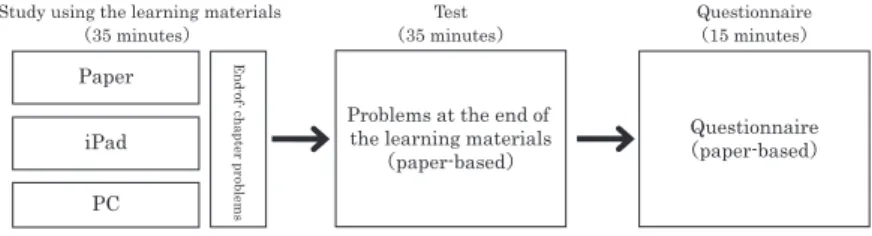
3.1 Experiment methodologyThe methodology of the experiment in this study is described below. An overview of this experiment methodology is illustrated in Figure 2. In this experiment, three types of learning material were prepared: paper materials, tablet terminal materials and PC materials. After this, a total of 60 test subjects were assembled and these were then divided into three groups of 20 with each group studying using a different form of media. Hereafter, these are referred to as the Paper Group, Tablet terminal Group and PC Group.
In regards to the attributes of the subjects, they were primarily students attending universities in the Tokyo Metropolitan Area and the bulk of these were either in their first or second year. These students were distributed among both arts and science majors, and they were equally divided between male and female. At the time of the recruitment of the test subjects, universities with a similar academic level at the time of entrance were selected. Accordingly, there is no major difference in the level of the universities.
The procedures of the experiment were as follows:
1. An explanation of the experiment methodology and the operation method of the learning materials by the researcher(5 minutes) 2.Study using the learning materials(35 minutes)
mutual consultations. In addition, subjects solved problems which had been set at the end of each of the five chapters that the learning materials consisted of. In the Tablet terminal Group and PC Group, it was possible for subjects to confirm whether or not their answers were correct immediately after they had solved the problems. The subjects could then proceed to the next chapter. In contrast to this, although subjects in the Paper Group solved problems at the end of each chapter they had studied in an identical fashion to the Tablet terminal Group and PC Group, it was only possible to confirm whether or not their answers were correct upon confirming with the list of correct answers that were distributed after they had finished studying the final chapter.
3. Answering problems at the end of the learning materials(35 minutes)
At the end of the learning materials, the subjects answered 15 problems consisting of multiple choice problems and written problems, and then these sheets were collected. The answer sheets were on paper regardless of which group the subjects belonged to and the test was administered under the same conditions.
4.Questionnaire survey(15 minutes)
Questionnaire forms consisting of 24 questions were distributed to the subjects. These were then collected upon their completion.
Study using the learning materials
(35 minutes) (35 minutes)Test (15 minutes)Questionnaire
Paper
Problems at the end of the learning materials
(paper-based) iPad PC Questionnaire (paper-based) En d- of- --ch ap te r p ro blem s
3.2 Analysis methodology
Analysis was conducted on both the subjects’ answers to problems and their replies to the questions on the questionnaire. Moreover, photographs were shot to document the conditions of the experiment.
1.Analysis of the answers to the problems
The problems consisted of end-of-chapter problems and problems at the end of the learning materials that were answered upon the conclusion of the subjects’ study. The end-of-chapter problems consisted of five multiple choice problems corresponding to each of the five chapters. On the other hand, the 15 problems at the end of the learning materials have been classified as follows according to the characteristics of the applicable questions. Analysis was then conducted on each of these differing classifications.
−A multiple choice problem or a written problem
− A basic problem described in the content of the learning materials or an applied problem not described therein
− A problem testing knowledge, a problem seeking comprehension or a problem seeking a comprehensive judgment
2.Analysis of the replies to the questionnaire
The 15 questionnaire items were all in the multiple choice format and the selection frequency of these was analyzed.
4. Results of the analysis
4.1 Results of the analysis of the problems 1.Results of the end-of-chapter problems
The average scores in relation to the five end-of-chapter problems for the Tablet terminal Group, PC Group and Paper Group are 8.9, 7.6 and 9.4 respectively. The total score for these problems was 10 points and on the whole these were answered correctly with 8.5 points being the average score across all the groups. The problems at the end of each chapter were set with the purpose of confirming the degree to which the subjects had comprehended the content of each individual chapter. Therefore the problems were created with the anticipation that at least 80% would be answered correctly by the subjects. The results demonstrate that subjects in the Paper Group were
able to answer the problems strongly, whereas those in the PC Group had inferior scores.
2.Results of the overall score
The average overall scores for the Tablet terminal Group, PC Group and Paper Group are shown in Figure 3. The average overall score that is discussed here refers to the 20 problems which are a combination of the five end-of-chapter problems and the 15 problems at the end of the learning materials. The total score for these 20 problems is 60 points.
Figure 3 reveals that while the subjects in the Tablet terminal Group and the Paper Group obtained similar scores, the average number of points was lower among the subjects in the PC Group. There is a necessity to consider these results in conjunction with the results of the analysis conducted on the questionnaire responses, but it is evident that subjects in the Tablet terminal Group obtained superior scores to those in the PC Group despite the fact that the text, diagrams, photographs and video were identical in both the Tablet terminal Group and the PC Group. Moreover, the subjects in
the Paper Group produced excellent results regardless of the fact that they did not have access to video in their learning materials. As will be discussed later in the considerations section of this paper, it is believed that the media of paper possesses characteristics that are inherently compatible with learning when compared to digital media.
34.3 31.6 35.0 0 10 20 30 40 50 60 iPad PC Paper
Figure 3. Results of the overall score 3.A comparison of the multiple choice and written problems
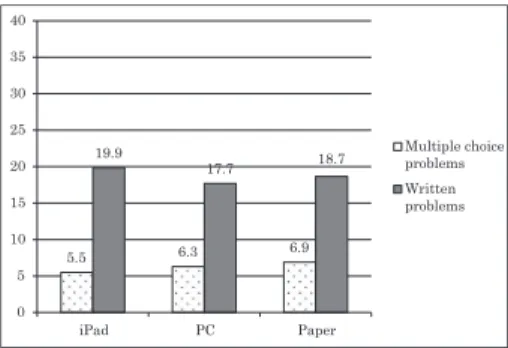
The average scores in the Tablet terminal Group, PC Group and Paper Group in regards to the multiple choice and written problems are shown in Figure 4. As illustrated in Figure 4, in regards to the multiple choice problems, subjects in Paper Group obtained higher scores than those in the Tablet terminal Group, while in regards to the written problems, the reverse was true, with subjects in the Tablet terminal Group demonstrating superior results to that of those in the Paper Group and the PC Group. The foregoing leads to the belief that not only do the characteristics of the media of paper and the characteristics of the tablet terminal differ, but that there is also a degree of variation among the characteristics possessed by the differing forms of digital media of the tablet terminal and the PC. The details of this will be discussed later in the considerations section of this paper.
5.5 6.3 6.9 19.9 17.7 18.7 0 5 10 15 20 25 30 35 40 iPad PC Paper Multiple choice problems Written problems
Figure 4. A comparison of multiple choice and written problems 4.A comparison of the basic and applied problems
The average scores in the Tablet terminal Group, PC Group and Paper Group in regards to the basic and applied problems are shown in Figure 5. As illustrated in Figure 5, in regards to the basic problems, subjects in the Paper Group produced higher scores than those in the Tablet terminal Group and the PC Group, while in regards to the applied problems, it was those in the Tablet terminal Group that were able to obtain superior results to subjects in the Paper Group and the PC Group. The foregoing leads to the belief that this is attributable to the difference in the characteristics of the various media as described in ‘3. A comparison of the multiple choice and written problems’.
7.8 8.6 9.7 17.6 15.4 15.9 0 5 10 15 20 25 30 iPad PC Paper Basic Applied
5. A comparison of the knowledge, comprehension and comprehensive problems
The average scores in the Tablet terminal Group, PC Group and Paper Group in regards to the knowledge, comprehension and comprehensive problems were compared. As a result, in regards to the knowledge problems, subjects in the Paper Group and PC Group obtained higher results than those in the Tablet terminal Group; in regards to the comprehension problems, subjects in the Tablet terminal Group and Paper Group produced better results to those in the PC Group; and in regards to the comprehensive problems, subjects in the Tablet terminal Group displayed superior results to those in the Paper Group and PC Group. The foregoing leads to the belief that this is attributable to the aforementioned differences in the characteristics of the various media.
6.Summary of the results of the analysis
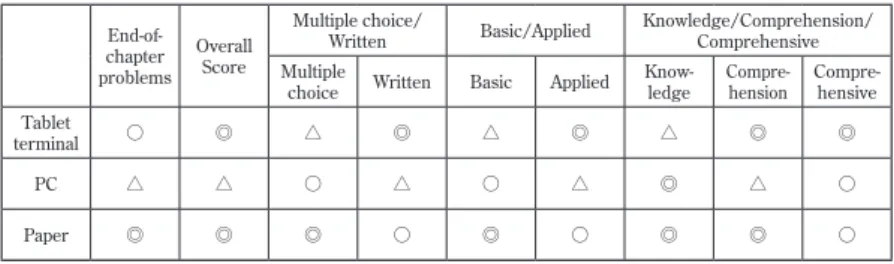
The analysis results for the aforementioned problems are summarized in Table 1. In this table, ◎ indicates that this was the highest score among all three groups;○ indicates that this was the next highest score among all the groups;and △ indicates the lowest score among all the groups. However, these symbols do not necessarily reveal the rankings of the three groups; instead, in the event that two of the three groups obtained more or less identical scores, the same symbol will be used for both.
It is possible to extract the following characteristics of the various forms of media from these results:
− The media of paper has superior results for the end-of-chapter, multiple choice problems, basic problems and knowledge/
comprehension problems. Thus, it is possible to conclude that the media of paper is effective in accurately memorizing and comprehending the contents of learning materials.
− Tablet terminals have superior results for the overall score, written problems, applied problems and comprehension/comprehensive problems. Thus, it is possible to conclude that the media of the tablet terminal is effective for individuals in thinking and making judgments on their own.
− Although identical text, diagrams, photographs and videos were loaded onto the PCs and tablet terminals, subjects in the PC Group were unable to show results as strong as those using tablet terminals and paper. Thus, there is a necessity to conduct further investigation into the media characteristics of PCs. This will be discussed later in the considerations section of this paper.
Table 1. Analysis results of the problems End-of- chapter problems Overall Score Multiple choice/
Written Basic/Applied Knowledge/Comprehension/Comprehensive Multiple
choice Written Basic Applied Know- ledge Compre-hension Compre-hensive Tablet
terminal ○ ◎ △ ◎ △ ◎ △ ◎ ◎
PC △ △ ○ △ ○ △ ◎ △ ○
Paper ◎ ◎ ◎ ○ ◎ ○ ◎ ◎ ○
4.2 Results of the analysis of the questionnaire
1.A comparison of media in regards to reading comprehension
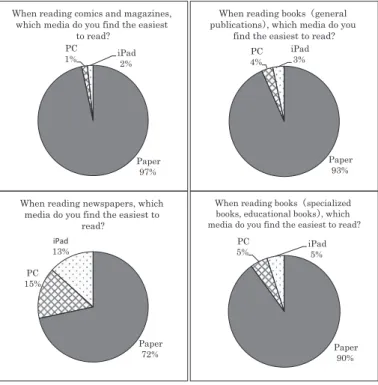
The selection frequency distribution for the Tablet terminal Group, PC Group and Paper Group in regards to reading comprehension is shown in Figure 6. As illustrated in Figure 6, the media of paper demonstrated a high selection frequency rate in regards to comics,
magazines, general publications, newspapers, specialized books and educational books. Paper 97% PC 1% iPad2% Paper 93% PC 4% iPad 3% Paper 72% PC 15% iPad 13%
When reading comics and magazines, which media do you find the easiest
to read?
When reading newspapers, which media do you find the easiest to
read?
Paper 90% PC
5% iPad5%
When reading books(general publications), which media do you
find the easiest to read?
When reading books(specialized books, educational books), which media do you find the easiest to read?
Figure 6. A comparison of media in regards to reading comprehension 2.A comparison of media in regards to underlining text
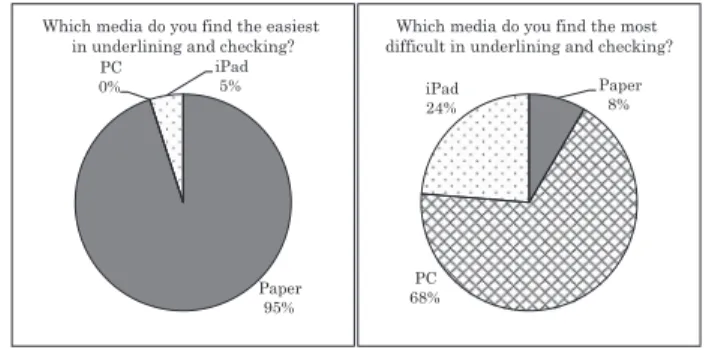
The selection frequency distribution for the Tablet terminal Group, PC Group and Paper Group in regards to underlining text is shown in Figure 7. As illustrated in Figure 7, paper is the media with which underling text is the easiest, while PCs are the media with which this is the most difficult. Accordingly, this is believed to be one of the reasons why subjects in the Paper Group obtained superior scores to those in the PC Group, because underlining important parts of the text in the learning process is a learning activity that is linked with
memorization and comprehension.
Paper 95% PC
0% iPad 5%
Which media do you find the easiest in underlining and checking?
Paper 8% PC 68% iPad 24%
Which media do you find the most difficult in underlining and checking?
Figure 7. A comparison of media in regards to underlining text 3.A comparison of media in regards to taking notes
The selection frequency distribution for the Tablet terminal Group, PC Group and Paper Group in regards to taking notes is shown in Figure 8. As illustrated in Figure 8, paper was found to be the media most conducive to taking notes, while PCs were revealed to be the media for which this was the least conducive. Accordingly, this is believed to be one of the reasons why subjects in the Paper Group obtained superior scores to those in the PC Group, because taking notes is an important activity in the learning process in a similar fashion to that of underling parts of the text.
Paper 90% PC
5% iPad5%
Which media is the easiest in writing notes in a book? Paper 12% PC 64% iPad 24%
Which media is the most difficult in writing notes in a book?
4. A comparison of media in regards to comprehension of learning content
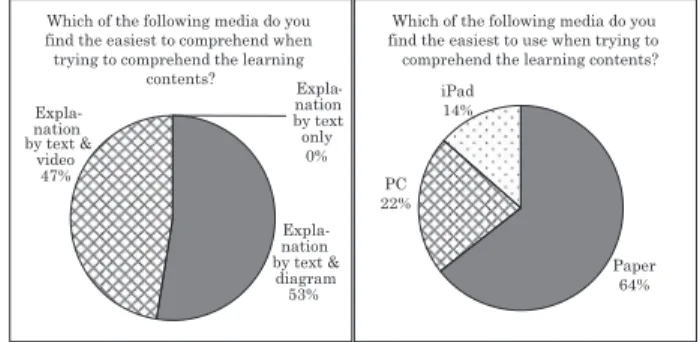
The selection frequency distribution for the Tablet terminal Group, PC Group and Paper Group in regards to comprehension of learning content is shown in Figure 9. As illustrated in Figure 9, explanations through text and diagrams have approximately similar levels of effectiveness to explanations using text and video. Accordingly, it is assumed that the effectiveness of video is at the same level as that of diagrams. Moreover, in regards to the comprehension of learning content, the media of paper proved superior to both the PC Group and the Tablet terminal Group. Thus, due to the fact that explanations through text and video have an information format that is common to both tablet terminals and PCs, it is believed that the differences with the media of paper cannot be explained by the information format (e.g. video), but rather the cause must lie elsewhere.
Expla-nation by text only 0% Expla-nation by text & diagram 53% -Expla nation by text & video 47%
Which of the following media do you find the easiest to comprehend when trying to comprehend the learning
contents? Paper 64% PC 22% iPad 14%
Which of the following media do you find the easiest to use when trying to comprehend the learning contents?
Figure 9. A comparison of media in regards to comprehension of the learning content
5.A comparison of media in regards to boredom and fatigue
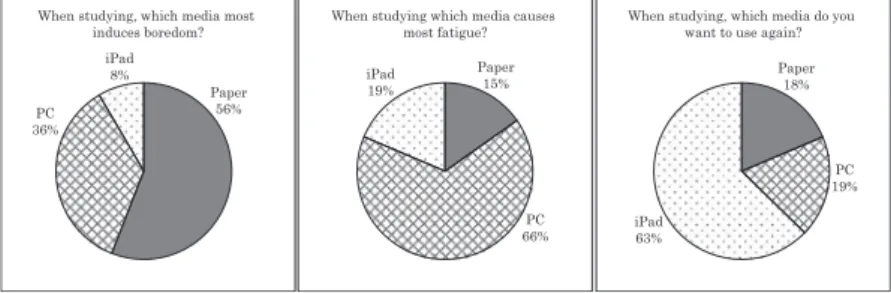
The selection frequency distribution for the Tablet terminal Group, PC Group and Paper Group in regards to boredom and fatigue is
shown in Figure 10. As illustrated in Figure 10, paper was the media most likely to induce boredom, while the media least likely to do so was the tablet terminal. In addition, PCs were the media most likely to cause fatigue, while the media subjects most desired to use again was the tablet terminal.
These results are thought to represent the characteristics of the various forms of media. That is, the media of paper possesses the characteristics of being easy to underline text and take notes, but at the same time it is possible to perceive that this is a form of media that causes fatigue and so requires a certain amount of perseverance in the learning process. On the other hand, while underlining text and taking notes with the tablet terminal is somewhat difficult, it does possess an effect in motivating users to study with it again. Consequently, tablet terminals are characterized by the fact they make it easier to learn without becoming tired of study and it is possible to perceive that learning with these devices is an enjoyable experience. Underlining text and taking notes is not so easy on a PC and at the same time it is likely to cause fatigue. Therefore, it is not possible to perceive that learning on PCs will be an enjoyable experience. The characteristics of the media like these are cited as the grounds for the difference in the average scores for the problems described in 4.1.
In other words, paper is an effective media in regards to basic problems and knowledge/comprehension problems; the tablet terminal is an effective media in regards to applied problems and comprehension/comprehensive problems; and it is not possible to find any notable characteristics with the media of PCs.
Paper 56% PC 36% iPad 8%
When studying, which media most induces boredom? Paper 15% PC 66% iPad 19%
When studying which media causes most fatigue? Paper 18% PC 19% iPad 63%
When studying, which media do you want to use again?
Figure 10. A comparison of media in regards to boredom and fatigue
5.Summary and considerations
The following summarizes the results of the aforementioned analysis. 1. The media of paper, tablet terminals and PCs demonstrated the
following characteristics from looking at the scores of the test problems to verify the learning effects:
− The media of paper demonstrated excellent results in regards to multiple choice problems, basic problems and knowledge/ comprehension problems.
− The tablet terminal demonstrated excellent results in regards to written problems, applied problems and comprehension/ comprehensive problems.
− The PC did not demonstrate any particularly excellent results. 2. The media of paper, tablet terminals and PCs demonstrated the
following characteristics from the results of the questionnaire in which subjects gave their responses to a comparison of media on a question sheet:
− The media of paper is effective when reading books and newspapers, when underlining and checking text and when taking notes. Paper also brings about the feeling that the user has studied.
− However, paper is the form of media most likely to induce boredom and PCs are the form of media most likely to cause fatigue; whereas the tablet terminal is characterized by the fact it is the form of media that subjects most desire to use again.
Accordingly, this demonstrates that paper is best for learning activities in which the content being studied is memorized or comprehended as knowledge in a predetermined scope. Nevertheless, unless the user has the motivation to study, they are likely to become bored by using paper and this makes continuous learning a challenge. On the other hand, the tablet terminal is best suited to problems in which an individual needs to comprehensively express their own thoughts and judgments. Tablet terminals are also characterized by the fact they encourage learners to continue with their studies. No particular special features were observed with PCs. The content installed on both tablet terminals and PCs is identical, so this difference is entirely due to the variation in the media. This difference is a point that is extremely interesting. That is, there is great variation in the learning effects due to the media and device even when the digital learning material is identical. The main difference between tablet terminals and PCs is the interface. The operations of tablet terminals are centered on touch control. In contrast to this, the operations of PCs rely mainly on the keyboard and mouse. Therefore, it is assumed that the effect of touching the screen of an tablet terminal directly with one’s fingers is greater than that with the keyboard and mouse of the PC. In regards to the media of paper, it is possible to write directly on to it with a pencil and it is also possible to touch it with one’s fingers. It may be true to say that the difference in direct contact like this is one of the primary factors that have an impact on learning effects.
Furthermore, the media of paper has the characteristic of being able to take an overall view in that it is possible to browse through all of the learning content. On tablet terminals and PCs, the learning material can be viewed only within a scope that is limited by the size of the screen, so these forms of media are inferior in terms of grasping an overall view of the content. In this respect, it is believed that paper is superior in terms of accurately memorizing and comprehending content described in learning materials. On the other hand, it is possible to load maps and videos onto tablet terminals and PCs which cannot be included in the format of paper. These forms of media can also contain a large amount of information with which it is possible for subjects to make judgments. Tablet terminals and PCs are also superior in terms of comprehensively expressing an individual’s ideas. Nevertheless, although there are significant differences between tablet terminals and PCs, it is assumed that these differences are attributable to whether or not it is possible to perform direct operations as outlined earlier.
However, the considerations described above still remain speculative, so there is a necessity to conduct further studies in the future to clarify what is causing these differences to occur.
In conducting this study, I would like to express my deep appreciation for the cooperation of Mr. Yasunori Wada of Kyocera Communication Systems, and Ms. Miho Furukawa of the Center for Research on Educational Testing.
References
Andersen, L.(2011), “Podcasting, Cognitive Theory, and Really Simple Syndication: What is the Potential Impact When Used Together?”, Journal of Educational Multimedia and Hypermedia, 20(3), 219-234.
Kato Y., Kato S., Akahori K., Yoshimoto M., Sugiyama Y.(2010)“Comparative analysis about the test using four kinds of media:digital pen, tablet PC, PC, and paper and pencil”, Proceedings of the 26th Annual Conference of the Japan Society for Educational Technology 2010, 681-682, in Japanese.
Kozma, R. B.(1991). “Learning with media.” Review of Educational Research, 61(2), 179-212.
Melhuish, K. & Falloon, G.(2010). “Looking to the future: m-learning with the iPad”. Computers in New Zealand Schools: Learning, Leading, Technology, 22(3), 1-16.
Meurant, R.(2010). “The iPad and EFL Digital Literacy” Communications in Computer and Information Science, 123, pp. 224-234. Springer-Verlag Berlin. Murphy G.D.(2011), “Post-PC devices:A summary of early iPad technology
adoption in tertiary environments”, e-Journal of Business Education & Scholarship of Teaching, Vol. 5, Iss. 1, pp. 18-32. http://www.ejbest.org
Sugai K., Akahori K., Nojima E.(2002). “Information Education -Educational Technology Approach-”, in Japanese, The Society for the Promotion of The Open University of Japan, http://www.ua-book.or.jp/