Invariant metrics on homogeneous spaces with equivalent isotropy summands
Marina Statha
∗Abstract. The space of G-invariant metrics on a homogeneous space G/H is in one-to-one correspondence with the set of inner products on the tangent space m ∼ = T
o(G/H), which are invariant under the isotropy representation. When all the isotropy summands are inequiv- alent to each other, then the metric is called diagonal. We will describe a special class of G-invariant metrics in the case where the isotropy representation of G/H contains some equivalent isotropy summands.
Even though this problem has been considered sporadically in the bibliography, in the present article we provide a more systematic and organized description of such metrics. This will enable us to simplify the problem of finding G-invariant Einstein metrics for homogeneous spaces. We also provide some applications.
1. Introduction
A homogeneous manifold M is a manifold which admits a transitive group of diffeomorphisms. However, in general there might be several dis-
2010 Mathematics Subject Classification. Primary 53C30; Secondary 53C25, 22E46, 20C30.
Key words and phrases. Homogeneous space; Einstein metric, isotropy representa- tion, compact Lie group.
∗
The work was supported by Grant #E.037 from the Research Committee of the
University of Patras (Programme K. Karatheodori). The author gratefully acknowledges very useful discussions and influence by professors Yusuke Sakane and Yurii Nikonorov.
She also expresses her gratitude to professor Andreas Arvanitoyeorgos for his constant guidence and support.
35
tinct transitive groups, i.e. non conjugate transitive subgroups of the diffeo- morphism group of M , and these subgroups can be abstractly isomorphic.
If we fix a compact Lie group G acting on a homogeneous manifold M, then after choosing a basepoint, we can write M as the coset space G/H, where H is the isotropy group at the basepoint. From the theorem of My- ers and Steenrod [15] it follows that the isometry group Iso(M) of M, is a Lie group and that the isotropy subgroup H is a closed compact subgroup of Iso(M ). One of the fundamental properties of a homogeneous space is that, if we know the value of a geometrical quantity at a given point, then we can calculate its value at any other point of G/H by using translation maps. Hence all calculations reduce to a single point which, for simplicity, can be chosen to be the identity coset o = eH ∈ G/H.
A Riemannian manifold (M, g) is called Einstein if the metric g satisfies the condition Ric(g) = λg for some λ ∈ R . We refer to [7] and [21], [22] for old and new results on homogeneoous Einstein manifolds. The structure of the set of invariant Einstein metrics on a given homogeneous space is still not very well understood in general. The situation is only clear for few classes of homogeneous spaces. For an arbitrary compact homogeneous space G/H it is not clear if the set of invariant Einstein metrics (up to isometry and up to scaling) is finite or not. A finiteness conjecture states that this set is in fact finite if the isotropy representation of G/H consists of pairwise inequivalent irreducible components ([9]).
A large class of homogeneous spaces are the reductive homogeneous
spaces. For these spaces there exists a subspace m of g such that g = h ⊕ m
and Ad(H)m ⊂ m. The tangent space of M at o is canonically identified
with m. A major class of reductive homogeneous spaces are the isotropy
irreducible homogeneous spaces. These spaces have been studied by J. Wolf
in [25], where he proved that if G/H is an isotropy irreducible homogeneous
space, then G/H admits a unique (up to scalar) G-invariant metric, which
is also Einstein. Later, M. Wang and W. Ziller in [23] and [24], gave a com-
plete classification of such spaces. The most important examples of isotropy
irreducible homogeneous spaces are the irreducible symmetric spaces, clas-
sified by E. Cartan in 1926. More generally, in [7] it is shown that a non
compact irreducible homogeneous space is symmetric. If the reductive ho-
mogeneous space is not isotropy irreducible, then its isotropy representation splits into a direct sum of irreducible subrepresentations. Examples of such spaces are the generalized flag manifolds, Wallach spaces, the projective space C P
2n+1and the Stiefel manifolds.
Generalized flag manifolds with two and four isotropy summands are classified using a method based on Riemannian submersions by A. Arvan- itoyeorgos and I. Chrysikos in [2], [3]. In general, homogeneous spaces with two irreducible isotropy summands were classified by W. Dickinson and M. Kerr in [11]. This classification is achieved under the assump- tions that G is a compact, connected and simple Lie group, H is a closed subgroup of G and G/H is simply connected. It should be noted that in this classification there is only one example of a homogeneous space having equivalent subrepresentations, namely the space SO(8)/ G
2∼ = S
7× S
7. The G-invariant Einstein metrics on this space as well as on the homogeneous spaces Spin(7)/ U(3) ∼ = S
7× S
6, Spin(8)/ U(3) ∼ = S
7× G
+2( R
8) and on the Stiefel manifold V
2R
n+1∼ = SO(n + 1)/ SO(n − 1), where the isotropy representation splits into equivalent subrepresentations, were classified by M. Kerr in [14]. The Allof-Wallach spaces W
k,l= SU(3)/ SO(2) when (k, l) = (1, 0) and (k, l) = (1, 1) are two examples of homogeneous spaces with equivalent subrepresentations. In general, the space of invariant Rie- mannian metrics on W
k,l, is parametrized by four positive parameters. For (k, l) = (1, 0) and (k, l) = (1, 1) this space depends on 6 and 10 positive real numbers, respectively. By using the variational approach Yu. Nikonorov in [16] proved that there are at most two invariant Einstein metrics on W
1,1. Morever, he constructed a new invariant Einstein metric on W
1,0which is not diagonal with respect to the Ad(T )-invariant decomposition of SU(3), where T is a maximal torus in SU(3).
Finally, A. Arvanitoyeorgos, Yu. Nikonorov and V. V. Dzhepko proved
that for s > 1 and k > l ≥ 3 the Stiefel manifold SO(sk + l)/ SO(l)
admits at least four SO(sk + l)-invariant Einstein metrics, two of which
are Jensen’s metrics. The special case SO(2k + l)/ SO(l) admitting at least
four SO(2k+l)-invariant Einstein metrics was treated in [4]. Corresponding
results for the quaternionic Stiefel manifolds Sp(sk +l)/ Sp(l) were obtained
in [5]. Recently, it was proved by A. Arvanitoyeorgos, Y. Sakane and the
author in [6], that the Stiefel manifold V
4R
n∼ = SO(n)/ SO(n − 4) admits two more SO(n)-invariant Einstein metrics and that V
5R
7∼ = SO(7)/ SO(5) admits four more SO(7)-invariant Einstein metrics.
In the present paper we study G-invariant metrics on homogeneous spaces G/H for which the isotropy representation contains equivalent subrepresen- tations or isotropy summands. For such spaces the diagonal metrics are not unique. We odserve that the normalizer N
G(H) acts on the space of all G- invariant metrics M
Gby isometries, and we can choose a subgroup K of N
G(H) such that the action of K on M
Gdetermines a subset of M
G. Our approach is analysized in Section 3 and is summarized in the following Theorem:
Theorem 1.1. Let M = G/H be a homogeneous space of a compact semisimple Lie group G and let K be a closed subgroup of G such that H ⊂ K ⊂ N
G(H), where N
G(H) is the normalizer of H in G.
(1) The non trivial action (φ, A) 7→ φ ◦ A ◦ φ
−1of the set Φ
K= {φ = Ad(k) |
m: k ∈ K } ⊂ Φ = { ϕ = Ad(n) |
m: n ∈ N
G(H) ⊂ Aut(m), on the set M
Gof all G-invariant metrics on G/H is well defined.
(2) The set ( M
G)
ΦK= { A ∈ M
G: φ ◦ Aφ
−1= A for all φ ∈ Φ
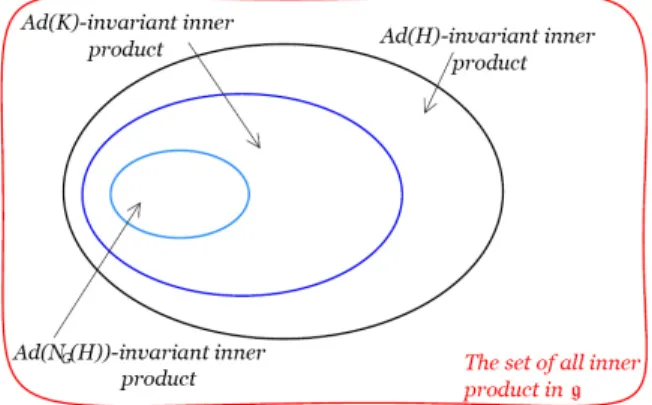
K} of fixed points of the action in (1) determines a subset of all Ad(H)-invariant inner products on m, called Ad(K)-invariant inner products. This set in turn, determines a subset M
G,Kof M
G.
Theorems of the above type are useful for the study of geometrical problems (e.g. finding G-invariant Einstein metrics) on homogeneous space whose isotropy representation contains equivalent summands (see for example [6]).
The paper is organized as follows: In Section 2 we recall some useful results from representation theory. In Section 3 we analyse the action of the normalizer N
G(H) on the set of M
Gof all G-invariant metrics on G/H.
By restricting this action to a closed subgroup K of G such that H ⊂ K ⊂ N
G(H), we obtain a subset M
G,Kof all G-invariant metrics M
G. As a consequence, various geometrical objects (such as Ricci tensor) are easier to by described. In Section 4 we relate such a choice of subgroup K (i.e.
H ⊂ K ⊂ N
G(H)) to Riemannian submersions K/H → G/H → G/K.
2. Review of representation theory
A finite dimensional (real or complex) representation of a Lie group G is a homomorphism φ : G → Aut(V ), where V is a finite dimensional (real or complex) vector space. The dimension of the representation is the dimension of the vector space V . If there is no non trivial subspace W ⊂ V with φ(W ) ⊂ W then the representation φ called irreducible. The complexification of a real representation φ : G → Aut(V ) is defined as the complex representation φ ⊗ C : G → Aut(V ⊗ C).
Definition 2.1. Two representations φ
1: G → Aut(V
1) and φ
2: G → Aut(V
2) are called equivalent (φ
1∼ = φ
2or V
1∼ = V
2) if V
1and V
2are G- isomorphic, i.e. there exists a linear isomorphism f : V
1→ V
2such that f(φ
1(g)v) = φ
2(g)f (v), for all g ∈ G and v ∈ V
1. Such an f is also called G-equivariant map (or intertwining map).
A useful observation is the following.
Theorem 2.2. (Schur’s Lemma) If φ : G → Aut(V ) is an irreducible complex representation and f ∈ Hom(V, V ) is a G-equivariant map, then f = cId for some c ∈ C .
For every representation φ : G → Aut(V ) of a compact topological group G there exists a G-invariant inner product ⟨· , ·⟩ on V , i.e. ⟨ φ(g)u, φ(g)v ⟩ =
⟨ u, v ⟩ , for all g ∈ G and u, v ∈ V . From this it follows that any rep- resentation of a compact topological group is a direct sum of irreducible representations i.e. φ ∼ = φ
1⊕ · · · ⊕ φ
n: G → Aut(V
1⊕ · · · ⊕ V
n), where each of φ
i: G → Aut(V
i) (i = 1, 2, . . . , n) is irreducible.
If φ is a real (resp. complex) irreducible representation and ⟨· , ·⟩
1, ⟨· , ·⟩
2are two G-invariant inner products (resp. hermitian inner products) on V , then from the above theorem it follows that ⟨· , ·⟩
1= c ⟨· , ·⟩
2, for some c ∈ R (resp. c ∈ C ). Therefore, if φ ∼ = φ
1⊕ · · · ⊕ φ
nand assuming that φ
iare mutually inequivalent, then all G-invariant inner products on V are given by
⟨· , ·⟩ = x
1⟨· , ·⟩|
V1+ · · · + x
n⟨· , ·⟩|
Vn, x
i∈ R , i = 1, . . . , n
where ⟨ V
i, V
j⟩ = 0 for i ̸ = j. Any other G-invariant inner product on V
can be expressed as ( · , · ) = ⟨ A · , ·⟩ , where A : V → V is a positive definite, symmetric, G-equivariant linear map.
If φ
iand φ
jare equivalent for some i and j, then the above inner prod- uct is not unique, and ⟨ V
i, V
j⟩ does not necessarily vanish, thus the matrix of the operator A has some non zero non diagonal elements. To find the number of non diagonal elements, we need to determine the dimension of the space of intertwining maps between the pairs of equivalent representa- tions. For example, let φ
1∼ = φ
2and φ
i, i = 1, 2 be irreducible as real representations. The complexification of φ
1is not necessarily irreducible.
After complexifying φ
1, there are three possibilities ([14]):
1. If φ
1⊗ C is irreducible, we call φ
1orthogonal.
2. If φ
1⊗ C = ψ ⊕ ψ ¯ and ψ is not equivalent to ¯ ψ, we call φ
1unitary.
3. If φ
1⊗ C = ψ ⊕ ψ ¯ and ψ is equivalent to ¯ ψ, we call φ
1symplectic.
The space of intertwining maps is 1-dimensional in the orthogonal case, 2- dimensional in the unitary case, and 4-dimensional in the symplectic case.
Thus if in the decomposition of V = V
1⊕ V
2⊕· · ·⊕ V
nwe have r equivalent summands (or modules), then the number of non diagonal elements in the orthogonal case is
r(r2−1), in the unitary case it is r(r − 1) and in the symplectic case it is 2r(r − 1). In the present article we describe a special class of G-invariant metrics on a homogeneous spaces G/H which contain equivalent isotropy summands.
Definition 2.3. The adjoint representation of G is the homomorphism Ad ≡ Ad
G: G → Aut(g) given by Ad(g) = (dI
g)
e, where I
g: G → G, x 7→
gxg
−1, and g is the Lie algebra of G.
Denote by ˜ λ
nthe standard representation of GL
nR and by λ
nthe stan-
dard representation of SO(n) (or O(n)). It is λ
n= ˜ λ
n|
SO(n): GL
nR →
Aut( R
n). Then the adjoint representation Ad
SO(n)of SO(n) (or O(n)) is
equivalent to ∧
2λ
n, where ∧
2denotes the second exterior power of λ
n.
Also, we have that Ad
U(n)⊗C = µ
n⊗ µ ¯
nand Ad
Sp(n)⊗C = S
2ν
n, where
µ
n= ˜ µ
n|
U(n): GL
nC → Aut( C
n), ν
n= ˜ ν
n|
Sp(n): GL
nH → Aut( H
n).
Here ˜ µ
n, ˜ ν
nare the standard representations of GL
nC and GL
nH re- spectively, and S
2is the second symmetric power of ν
n. Recall that if π : G → Aut(V ), π
′: G
′→ Aut(W ) are two representations of G and G
′respectively, then the following identities are valid:
∧
2(π ⊕ π
′) = ∧
2π ⊕ ∧
2π
′⊕ (π ⊗ π
′), S
2(π ⊕ π
′) = S
2π ⊕ S
2π
′⊕ (π ⊗ π
′).
Let M be a smooth manifold and let G be a Lie group acting on M on the left by the map α : G × M → M, (g, m) 7→ α(g, m) = gm. For all g ∈ G, let α
g: M → M be the corresponding diffeomorphism of M. If H = { g ∈ G : gp = p } is the isotropy subgroup at the point p ∈ M , then the isotropy representation of H at p is the homomorphism
θ : H −→ Aut(T
pM )
h 7−→ (dα
h)
p: T
pM → T
pM, (1) where T
pM is the tangent space of M at the point p. In the case where the above action is also transitive, i.e. for p, q ∈ M there exists g ∈ G such that q = gp, then M is diffeomorphic to the homogeneous space G/H, where H is the isotropy subgroup at the identity coset o = eH. By (1) the isotropy representation of G/H is the homomorphism
Ad
G/H: H −→ Aut(T
o(G/H))
h 7−→ (dτ
h)
o: T
o(G/H) → T
o(G/H),
where τ
h: G/H → G/H, gH 7→ hgH . A large class of homogeneous spaces are the reductive homogeneous spaces. For such spaces there exists a subspace m of the Lie algebra g such that g = h ⊕ m and Ad(h)m ⊂ m for all h ∈ H, that is m is Ad(H)-invariant. If the subgroup H is compact such decomposition always exists. Then we have a canonical isomorphism m ∼ = T
o(G/H) given by X ↔ X
o∗= d
dt (exp(tX ))o |
t=0, where exp(tX ) is the one parameter subgroup of G generated by X.
The next proposition is useful to compute the isotropy representation of
the reductive homogeneous space ([1]).
Proposition 2.4. Let G/H be a reductive homogeneous space and let g = h ⊕ m be a reductive decomposition of g. Let h ∈ H, X ∈ h and Y ∈ m.
Then
Ad
G(h)(X + Y ) = Ad
G(h)X + Ad
G(h)Y that is, the restriction Ad
GH
splits into the sum Ad
H⊕ Ad
G/H. We give some examples of computations.
Example 2.5. We consider the homogeneous space G/H = SO(k
1+ k
2+ k
3)/(SO(k
1) × SO(k
2) × SO(k
3)) with k
1, k
2, k
3≥ 2, which is an example of a generalized Wallach space ([18]). These spaces were recently classified independently by Yu. Nikonorov in [17] and Z. Chen, Y. Kang, K. Liang in [10]. Let σ
i: SO(k
1) × SO(k
2) × SO(k
3) → SO(k
i) be the projection onto the factor SO(k
i), (i = 1, 2, 3) and let p
ki= λ
ki◦ σ
i. Then we have the following:
Ad
GH
= ∧
2λ
k1+k2+k3H
= ∧
2(p
k1⊕ p
k2⊕ p
k3) = ∧
2p
k1⊕ ∧
2p
k2⊕ ∧
2p
k3⊕ (p
k1⊗ p
k2) ⊕ (p
k1⊗ p
k3) ⊕ (p
k2⊗ p
k3).
Observe that the dimension of the representation ∧
2p
k1⊕ ∧
2p
k2⊕ ∧
2p
k3is (
k12
) + (
k22
) + (
k32
) , which is equal to the dimension of the adjoint representa- tion of H = SO(k
1) ×SO(k
2) × SO(k
3), Ad
H: SO(k
1) ×SO(k
2) × SO(k
3) → Aut(so(k
1) ⊕ so(k
2) ⊕ so(k
3)). Therefore, the isotropy representation of G/H is given by
Ad
G/H∼ = (p
k1⊗ p
k2) ⊕ (p
k1⊗ p
k3) ⊕ (p
k2⊗ p
k3), (2) which is a direct sum of irreducible and non equivalent subrepresentations of dimensions k
ik
j, i ̸ = j. The tangent space m of G/H decomposes into three Ad(H)-invariant submodules m = m
12⊕ m
13⊕ m
23.
Let us consider the case where H
1= SO(l
1) × SO(l
2) × SO(l
3) and l
1+l
2+l
3< k
1+k
2+k
3− 1. Then we see that the isotropy representation of the homogeneous space G/H
1contains some equivalent subrepresentations.
Indeed, Ad
GH1
= ∧
2λ
l1+l2+l3H1
= ∧
2(p
l1⊕ p
l2⊕ p
l3⊕ 1
n) = ∧
2p
l1⊕ ∧
2p
l2⊕ ∧
2p
l3⊕ ∧
21
n⊕ (p
l1⊗ p
l2) ⊕ (p
l1⊗ p
l3) ⊕ (p
l2⊗ p
l3)
⊕ (p
l1⊗ 1
n) ⊕ (p
l2⊗ 1
n) ⊕ (p
l3⊗ 1
n)
= ∧
2p
l1⊕ ∧
2p
l2⊕ ∧
2p
l3⊕ 1 | ⊕ · · · ⊕ {z 1 } (
n2)
⊕ (p
l1⊗ p
l2) ⊕ (p
l1⊗ p
l3)
⊕ (p
l2⊗ p
l3) ⊕ p
l1⊕ · · · ⊕ p
l1| {z }
n
⊕ p
l2⊕ · · · ⊕ p
l2| {z }
n
⊕ p
l3⊕ · · · ⊕ p
l3| {z }
n
.
where n = (k
1+ k
2+ k
3) − (l
1+ l
2+ l
3) and 1
n= 1 | ⊕ · · · ⊕ {z 1 }
n−
times
. As before, the representation ∧
2p
l1⊕ ∧
2p
l2⊕ ∧
2p
l3is the adjoint representation of H
1= SO(l
1) × SO(l
2) × SO(l
3), thus the isotropy representation of the homogeneous space G/H
1is
Ad
G/H1= 1 ⊕ · · · ⊕ 1 ⊕ (p
l1⊗ p
l2) ⊕ (p
l1⊗ p
l3) ⊕ (p
l2⊗ p
l3)
⊕ p
l1⊕ · · · ⊕ p
l1⊕ p
l2⊕ · · · ⊕ p
l2⊕ p
l3⊕ · · · ⊕ p
l3.
Observe that the last 3n representations of dimensions l
i, (i = 1, 2, 3) are equivalent. Thus the tangent space of G/H
1decomposes into a sum of (
n2
) + 3n + 3 Ad(H
1)-invariant submodules m
i. Similar result is true if we take H
2= SO(m
1)×SO(m
2) with m
1+m
2< k
1+k
2+k
3−1, or H
3= SO(d) with d < k
1+ k
2+ k
3− 1. In the special case where H
4= SO(k
3), then the homogeneous space G/H
4is the Stiefel manifold V
k1+k2R
k1+k2+k3. In this case the isotropy representation is given as follows:
Ad
GH4
= ∧
2λ
k1+k2+k3H4
= ∧
2(λ
k3⊕ 1
k1+k2)
= ∧
2λ
k3⊕ ∧
21
k1+k2⊕ (λ
k3⊕ 1
k1+k2)
= ∧
2λ
k3⊕ 1 | ⊕ · · · ⊕ {z 1 } (
k1+2k2)
⊕ λ
k3⊕ · · · ⊕ λ
k3| {z }
k1+k2
= Ad
SO(k3)⊕ 1 ⊕ · · · ⊕ 1 ⊕ λ
k3⊕ · · · ⊕ λ
k3,
hence the isotropy representation is Ad
G/H4= 1 ⊕ · · · ⊕ 1 ⊕ λ
k3⊕ · · · ⊕ λ
k3,
where the last k
1+k
2representations are equivalent. Analogous results can
be obtained for G = SU(k
1+ k
2+ k
3) or Sp(k
1+ k
2+ k
3). We summarize
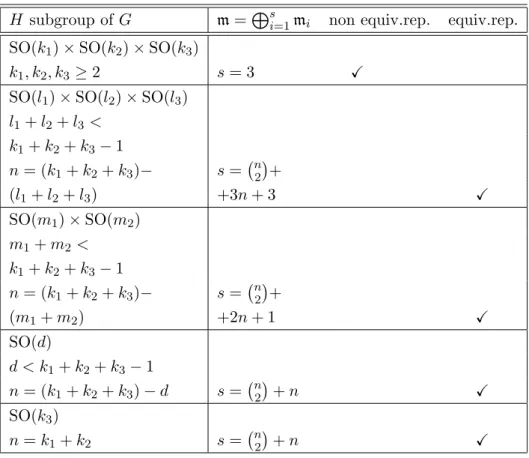
the above computations in the following table:
H subgroup of G m = ⊕
si=1
m
inon equiv.rep. equiv.rep.
SO(k
1) × SO(k
2) × SO(k
3)
k
1, k
2, k
3≥ 2 s = 3 ✓ SO(l
1) × SO(l
2) × SO(l
3)
l
1+ l
2+ l
3<
k
1+ k
2+ k
3− 1
n = (k
1+ k
2+ k
3) − s = (
n2
) +
(l
1+ l
2+ l
3) +3n + 3 ✓
SO(m
1) × SO(m
2) m
1+ m
2<
k
1+ k
2+ k
3− 1
n = (k
1+ k
2+ k
3) − s = (
n2
) +
(m
1+ m
2) +2n + 1 ✓
SO(d)
d < k
1+ k
2+ k
3− 1
n = (k
1+ k
2+ k
3) − d s = (
n2
) + n ✓
SO(k
3)
n = k
1+ k
2s = (
n2
) + n ✓
Table 1: The number of isotropy summands for the homogeneous space G/H = SO(k
1+k
2+k
3)/H. The four last spaces contain equivalent isotropy summands.
In the last four cases the complete description of Ad(H
i)-invariant inner products is much more difficult, because ⟨m
i, m
j⟩ are not necessarily zero for i ̸ = j.
Example 2.6. We compute the complexified isotropy representation of the Stiefel manifold V
kH
n∼ = Sp(n)/ Sp(n − k), i.e. Ad
Sp(n)/Sp(n−k)⊗C : Sp(n − k) → Aut(m ⊗ C ). It is
Ad
Sp(n)⊗C
Sp(n−k)
= S
2ν
nSp(n−k)
= S
2(ν
n−k⊕ 1
k⊕ 1
k)
= S
2ν
n−k⊕ S
2(1
k⊕ 1
k) ⊕ (ν
n−k⊗ (1
k⊕ 1
k))
= S
2ν
n−k⊕ 1 | ⊕ · · · ⊕ {z 1 } (
2k+12)
⊕ ν
n−k⊕ · · · ⊕ ν
n−k| {z }
2k
= Ad
Sp(n−k)⊗C ⊕ 1 ⊕ · · · ⊕ 1 ⊕ ν
n−k⊕ · · · ⊕ ν
n−k,
so from Proposition 2.4 we have that Ad
Sp(n)/Sp(n−k)⊗C = 1 ⊕ · · · ⊕ 1 ⊕ ν
n−k⊕ · · · ⊕ ν
n−k. Therefore the complexified tangent space m ⊗ C of Sp(n)/ Sp(n − k) can be written as a direct sum of (
2k+12
) and 2k complex subspaces, of dimensions 1 and 2(n − k) respectively.
Example 2.7. Consider the projective space C P
2n+1∼ = Sp(n+ 1)/ Sp(n) × U(1). Then according to Proposition 2.4 the complexified isotropy repre- sentation of this space is determined by the equation
Ad
Sp(n+1)⊗C
Sp(n)×U(1)
= (Ad
Sp(n)×U(1)⊗C ) ⊕ (Ad
Sp(n+1)/Sp(n)×U(1)⊗C ).
Observe that the dimension of the adjoint representation of Sp(n) × U(1) is 2n
2+ n + 1. We now compute,
Ad
Sp(n+1)⊗C
Sp(n)×U(1)
= S
2ν
n+1Sp(n)×U(1)
= S
2(ν
n⊕ µ
1⊕ µ ¯
1)
= S
2ν
n⊕ S
2µ
1⊕ S
2µ ¯
1⊕ (ν
n⊗ µ
1) ⊕ (ν
n⊗ µ ¯
1) ⊕ (µ
1⊕ µ ¯
1)
= (
S
2ν
n⊕ (µ
1⊗ µ ¯
1) )
⊕ S
2µ
1⊕ S
2µ ¯
1⊕(ν
n⊗ µ
1) ⊕ (ν
n⊗ µ ¯
1)
= Ad
Sp(n)×U(1)⊗C ⊕ S
2µ
1⊕ S
2µ ¯
1⊕ (ν
n⊗ µ
1) ⊕ (ν
n⊗ µ ¯
1),
where the fourth equality holds because the dimension of S
2ν
n⊕ (µ
1⊗ µ ¯
1) is equal to the dimension of the adjoint representation of Sp(n)×U(1). Hence, the isotropy representation decomposes into a sum of four irreducible sub- representations of dimensions 1, 1, 2n and 2n respectively, that is
Ad
Sp(n+1)/Sp(n)×U(1)⊗C = S
2µ
1⊕ S
2µ ¯
1⊕ (ν
n⊗ µ
1) ⊕ (ν
n⊗ µ ¯
1).
Thus, the complexified tangent space m ⊗ C of Sp(n + 1)/ Sp(n) × U(1) is
written as a direct sum of four complex subspaces as m⊗C = p
1⊕p
2⊕p
3⊕p
4.
The real subspace m splits into two real subspaces of dimension 2 and 4n
respectively, i.e. m = m
1⊕ m
2, where m ⊗ C = p
1⊕ p
2and m
2⊗ C = p
3⊕ p
4.
It is worth mentioning that W. Ziller in [26] proved that the projective
space C P
2n+1∼ = Sp(n + 1)/ Sp(n) × U(1) admits precisely two Einstein
metrics.
In general all Lie groups G which act on the projective spaces C P
n, H P
nand C
αP
2where classified by Onishchik [19], according to the following table:
G H G/H isotr. repr.
SU(n + 1) S(U(1) × U(n)) C P
nirreducible Sp(n + 1) Sp(n) × Sp(1) H P
nirreducible
F
4Spin(9) C
aP
2irreducible
Sp(n + 1) Sp(n) × U(1) C P
2n+1m = m
1⊕ m
2Table 2: Transitive actions on projective spaces.
Observe that in the first three cases the isotropy representations are irreducible, which means that the only G-invariant metric on these spaces is the standard homogeneous Riemannian metric (i.e. the metric induced by the negative of the Killing form B of g). By J. Wolf ([25]) this metric is Einstein.
3. A special class of G-invariant metrics on G/H
Let G be a compact Lie group and H a closed subgroup so that G acts almost effectively on G/H. Let g, h be the Lie algebras of G and H and let g = h ⊕ m be a reductive decomposition of g with respect to some Ad(G)-invariant inner product on g, i.e. Ad(h)m ⊂ m for all h ∈ H where m ∼ = T
o(G/H), o = eH. For G semisimple, the negative of the Killing form B of g is an Ad(G)-invariant inner product on g, therefore we can choose the above decomposition with respect to this form. A Riemannian metric g on a homogeneous space G/H is called G-invariant if the diffeomorphism τ
α: G/H → G/H, τ
α(gH) = αgH is a isometry. The following proposition gives a description of G-invariant metrics on homogeneous spaces.
Proposition 3.1. Let G/H be a homogeneous space. Then there exists a one-to-one correspondence between:
1. G-invariant metrics g on G/H
2. Ad
G/H-invariant inner products ⟨· , ·⟩ on m, that is
⟨ Ad
G/H(h)X, Ad
G/H(h)Y ⟩ = ⟨ X, Y ⟩ for all X, Y ∈ m, h ∈ H and
3. (if H is compact and m = h
⊥with respect to the negative of the Killing form B of G) Ad
G/H-equivariant, B-symmetric
1and positive definite operators A : m → m such that
⟨ X, Y ⟩ = B(A(X), Y ).
We call such an inner product Ad
G(H)-invariant, or simply Ad(H)-invariant From the above proposition we can see that the set of all Ad(H)-invariant inner products on m can be parametrized by Ad(H)-equivariant, symmetric and positive definite operators A : m → m. Thus we have
M
G←→
{
A : m → m Ad(H)-equivariant, symmetric and positive definite operator
} .
It is clear that if m decomposes into a direct sum of Ad(H)-invariant irre- ducible and pairwise inequivalent modules m
iof dimension d
i(i = 1, . . . , s), that is m = m
1⊕ · · · ⊕ m
s, then all Ad(H)-invariant inner products on m are given by
⟨· , ·⟩ = x
1( − B) |
m1+ · · · + x
s( − B ) |
ms, x
i∈ R
+, i = 1, . . . , s.
In this case the matrix of the operator A with respect to some ( − B)- orthonormal adapted basis B of m is given by
[A]
B=
x
1Id
d10 . ..
0 x
sId
ds
.
In this case the G-invariant metrics are called diagonal. However, if the decomposition of m contains r equivalent orthogonal modules m
i, then the matrix of the operator A with respect to some ( − B)-orthonormal adapted basis D of m is given by
[A]
D=
x
1Id
d1α
12Id
d1· · · α
1sId
d1α
12Id
d2x
2Id
d2· · · α
2sId
d2.. . .. . . .. .. . α
1sId
dsα
2sId
ds· · · x
sId
ds
.
1
Or B ( · , · )-self-adjoint endomorphisms m.
The number of α
ijis
r(r2−1). For the unitary and symplectic case, we consider for simplicity the case where the decomposition of m contains two equivalent modules, say m
1∼ = m
2, of dimension d. Here there are two and four non diagonal elements respectively. For example in the unitary case, the matrix of the operator A with respect to some ( − B)-orthonormal adapted basis D of m is given by linear combinations of the matrices
J
1= (
0 α
1Id
2dα
1Id
2d0
)
, J
2=
0 0 0 α
2Id
d0 0 − α
2Id
d0
0 − α
2Id
d0 0
α
2Id
d0 0 0
,
α
1, α
2∈ R
+. The idea behind our approach is to try to eliminate some of the non diagonal elements in the above matrix, and restrict the study to the diagonal metrics. For the same problem in the case of a Lie group, K. Y.
Ha and J. B. Lee in [13] classified the left-invariant Riemannian metrics for each simply connected three-dimensional Lie group up to automorphism.
The main idea there was to identify all automorphisms of the Lie algebra of these groups, and then define an action of the automorphism group on the set of all left invariant inner products on the Lie algebras of these Lie groups
2. More precisely, let G be a Lie group and g the corresponding Lie algebra of G. Let M be the set of all left invariant inner products of g.
Then Aut(g) acts on M by
Aut(g) × M → M, (ϕ , ⟨·, ·⟩) 7→ ⟨
ϕ
−1· , ϕ
−1· ⟩ .
Under this action we can define an equivalence relation ∼ on M as follows:
⟨·, ·⟩ ∼ ⟨·, ·⟩
′⇐⇒ there exists ϕ ∈ Aut(g) such that ⟨·, ·⟩
′= ⟨ϕ
−1· , ϕ
−1·⟩.
Now, let G/H be a homogeneous space (H is the isotropy subgroup at the identity coset eH ) with reductive decomposition g = h ⊕ m with respect to some Ad(G)-invariant inner product of g. Let Aut(G, H ) be the set
2
In general, the group of automorphisms of a Lie group G defines an action on the set of all metrics on G by Aut(G) × { metrics on G } → { metrics on G } , (θ, g( · , · )) 7→
θg(·, ·) := g
θ(dθ
−1·, dθ
−1·). Note that if the metric g is left-invariant, then the metric g
θis not necessarily left-invariant.
of all automorphisms of G which preserve the group H. It can be shown that if ϕ ∈ Aut(G, H), then ϕ induces a G-equivariant diffeomorphism ˜ ϕ : G/H → G/H. Then it is easy to see that this G-equivariant diffeomorphism defines an action on the set of all G-invariant metrics M
G, transforming each G-invariant metric g into a metric isometric to it. In general, every G-equivariant diffeomorphism of G/H is a right translation by an element of N
G(H), and for some α ∈ N
G(H) the map α 7→ R
α, where R
α: G/H → G/H is G-equivariant and sends each gH to gα
−1H. This induces an isomorphism of N
G(H)/H onto the group of Aut(G/H) ([8]). Next, we describe when the set Aut(G/H) ∼ = N
G(H)/H defines an action on the set of all G-invariant metrics M
Gof a homogeneous space G/H.
First we recall the following fact. Let G
1and G
2be Lie subgroups of a Lie group G. If G
1⊂ G
2, then G
1is a subgroup of the Lie group G
2, and g
1⊂ g
2. Conversely, if g
1⊂ g
2and the group G
1is connected, then G
1⊂ G
2. From this we have:
Lemma 3.2. (cf. [12]) Let G be a Lie group and H be a closed, connected subgroup of G, with g and h the corresponding Lie algebras. Then the group N
G(H) = {g ∈ G : gHg
−1= H} is equal to the group N
G(h) = {g ∈ G : Ad(g)h ⊂ h } .
Proof. We need to show that (a) N
G(H) ⊂ N
G(h) and (b) N
G(h) ⊂ N
G(H).
For (a), let g ∈ N
G(H). Then gHg
−1= H and by the above fact we have that ghg
−1= h, i.e. Ad(g)h = h, hence g ∈ N
G(h). For (b), if g ∈ N
G(h) then Ad(g)h ⊂ h. Since Ad(g)h is the Lie algebra of gHg
−1and H is connected it follows that gHg
−1⊂ H. Obviously H ⊂ gHg
−1, hence we obtain that g ∈ N
G(H).
The following proposition is central in our study.
Proposition 3.3. Let n ∈ N
G(H) and Ad(n) : g → g. Then the operator Ad(n)|
m: m → g takes values in m, that is ϕ = Ad(n)|
m∈ Aut(m). Also, (Ad(n) |
m)
−1= (Ad(n) |
m)
t.
Proof. Let n ∈ N
G(H) and Y ∈ h. Using Lemma 3.2, for any subspace h
of g, the normalizer N
G(h) is given by N
G(h) = { g ∈ G : Ad(g)h ⊂ h} =
N
G(H). Therefore, it follows that
Ad(n)Y ∈ h. (3)
Let X ∈ m = h
⊥. Then by using (3) and the Ad(G)-invariance of B we obtain that
B(Ad(n)
−1X, Y ) = B(Ad(n)
−1X, Ad(n)
−1Ad(n)Y ) = B(X, Ad(n)Y ) = 0, hence Ad(n)
−1X ∈ m. Finally, for n ∈ N
G(H) and using the Ad(G)- invariance of B, we have that B(Ad(n) |
mX, Ad(n) |
mY ) = B(X, Y ). Since in general it is B(Ad(n) |
mX, Ad(n) |
mY ) = B(X, (Ad(n) |
m)
tAd(n) |
mY ), it follows that (Ad(n)|
m)
−1= (Ad(n)|
m)
t.
Consider the set Φ = { ϕ = Ad(n) |
m: n ∈ N
G(H) } . Then by Proposition 3.3 Φ is contained in Aut(m), hence we can define the isometric action
3Φ × M
G→ M
G, (ϕ , A) 7→ ϕ ◦ A ◦ ϕ
−1≡ A. ˜ (4) Lemma 3.4. The action of Φ on M
Gis well defined.
Proof. We need to show that the operator ˜ A is
(a) Ad(H)-equivariant, i.e. Ad(H) ◦ A ˜ = ˜ A ◦ Ad(H) or Ad(H) ◦ A ˜ ◦ Ad(H)
−1= ˜ A and
(b) B -symmetric and positive definite.
For (a), let n ∈ N
G(H) and we compute:
Ad(H) ◦ A ˜ ◦ Ad(H)
−1= Ad(H) ◦ (
Ad(n) ◦ A ◦ Ad(n)
−1)
◦ Ad(H)
−1= Ad(Hn) ◦ A ◦ Ad(Hn)
−1= Ad(nH) ◦ A ◦ Ad(nH)
−1= Ad(n) ◦ (
Ad(H) ◦ A ◦ Ad(H)
−1)
◦ Ad(n)
−1= Ad(n) ◦ A ◦ Ad(n)
−1= ˜ A.
3