physiological functions of this pathway. Fig. 2 shows our finding that this neural axis plays an important role in fat mobilization during fasting2).
When the hepatic branch of the vagus nerve is surgically removed (hepatic vagotomy, HVx), the decline in visceral fat (epididymal-area fat) during fast-ing becomes moderate (Fig. 3). Similar results were obtained even when the ascending neuronal path of the hepatic branch of the vagus nerve was interrupted by capsaicin (Cap). Notably, effects on adipose tissue were limited only to visceral fat; no effects were seen for subcutaneous fat. Whole-body changes in energy metabolism were analyzed using gas expiration analy-sis. Although no differences were observed for oxygen consumption rates, significant differences were observed for respiratory quotient (RQ) and fat utiliza-tion rates, with the hepatic vagotomy group (HVx group) showing reduced fat utilization during fasting.
For adipose tissue, promoted lipolysis caused by the activation of sympathetic nerve pathways was observed; we were able to visualize a significant decline in cAMP signals in the HVx group using an in vivo imaging system, wherein cAMP signaling — the intra-cellular second messenger in sympathetic nerve activa-tion — was visualized by luminescence.
Further, detailed investigation of temporal changes in the output of hepatic-origin fasting-response neuronal signals revealed that differences between the HVx and control group (Sham group) In 2006, Katagiri et al. of Tohoku University
reported in Science Magazine the existence of a liver-brain-adipose-neural axis (Fig. 1)1). They discovered a control mechanism wherein when there is an excess accumulation of neutral fat in the liver (i.e., fatty liver), the hepatic branch of the vagus nerve sends sig-nals to break down fats; after passing through the liver-brain-adipose-neural axis, these signals finally activate the sympathetic nervous system to enhance lipolysis in white adipose tissue.
This important discovery proved that with hyperalimentation, afferent nerve signals (vagal nerve signals) transmitted by hepatic proliferator-activated receptor-γ (PPARγ) accelerate lipolysis and energy consumption, and contribute to the maintenance of body-weight homeostasis during the amelioration of diabetes.
Hepatic-origin Autonomic Nervous System Signaling with Glycogen Depletion
After the discovery of the liver-brain-adipose-neural axis, we sought to learn more about the related
Hepatic Control of Energy Metabolism via the Autonomic Nervous
System
Naoya Yahagi
Nutrigenomics Research Group, Faculty of Medicine, University of Tsukuba, Tsukuba, Japan
Although the human liver comprises approximately 2.8% of the body weight, it plays a central role in the control of energy metabolism. While the biochemistry of energy substrates such as glucose, fatty acids, and ketone bodies in the liver is well understood, many aspects of the overall control sys-tem for hepatic metabolism remain largely unknown. These include mechanisms underlying the ascertainment of its energy metabolism status by the liver, and the way in which this information is used to communicate and function together with adipose tissues and other organs involved in energy metabolism.
This review article summarizes hepatic control of energy metabolism via the autonomic nervous sys-tem.
Key words: Autonomic nerves, Energy metabolism, Liver, Adipose tissue, Lipolysis
Address for correspondence: Naoya Yahagi, Nutrigenomics Research Group, Faculty of Medicine, University of Tsukuba, Tsukuba, Japan
E-mail: [email protected] Received: June 30, 2016
Accepted for publication: July 11, 2016 Copyright©2017 Japan Atherosclerosis Society
metabolites, is the key to triggering the neurocircuitry. Thus, the glycogen quantity itself, and not the glyco-gen degradation product should be monitored.
These experimental results revealed that glycogen storage levels in the liver are monitored by some kind of mechanism. When glycogen stores are nearly depleted during starvation, the liver-brain-adipose-neural axis is activated and fat utilization is acceler-ated; thereby, the energy source shifts from carbohy-drates to fats.
Hepatic-origin Autonomic Nervous System Signals with Excess Glucose and
Amino Acids
In addition to their analysis of hepatic-origin autonomic nervous system signals after accumulation of excessive fatty acids, Katagiri et al. analyzed and recently reported the effects of neuronal signals on white and brown adipose tissue after excessive glucose uptake, and after excessive uptake of amino acids (AAs) by the liver3, 4).
According to their report, when there is an excess of hepatic glucose uptake, neural modulation sup-started occurring at the same time when glycogen
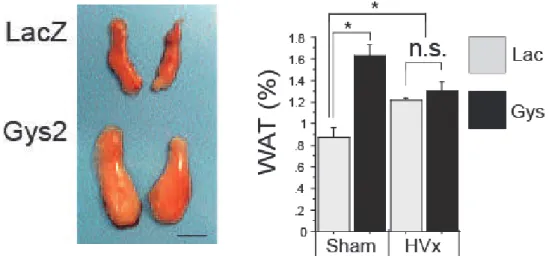
storage was depleting. We observed that when the overexpression of glycogen synthase 2 (Gys2) was induced using adenovirus and glycogen was pre-loaded, lipolysis was suppressed, and the difference between the two groups was canceled by the HVx (Fig. 4). Conversely, when the Gys2 was knocked down by RNA interference, the decrease in liver gly-cogen content caused further acceleration of lipolysis during fasting.
The next question we addressed was how the decline in stored glycogen was recognized within the liver. In particular, we wondered whether the deple-tion of glycogen itself could be detected, or a decline in the quantity of glycogen degradation products (e.g., glucose-1-phosphate) had to be detected. To deter-mine this, we performed RNA interference on a gly-cogen phosphorylase liver-type gene (Pygl); adenoviral shRNA (Pygl-i) was expressed in the liver, which tar-gets Pygl. When glycogenolysis was suppressed by this RNA interference, the liver glycogen content was ele-vated and this in turn led to a decrease in lipolysis in the adipose tissue. This result demonstrates that the shortage of glycogen, but not that of the downstream
Fig. 1. Mechanism of accelerated lipolysis in fatty liver diseases
Cited from: Yamada T. Inter-organ communications mediate crosstalk between glucose and energy metabolism. (Review) Diabetol Int. 4(3): 149-155. 2013
EnergyExpenditure EnergyIntake
Fattyliver Lipolysis
Sympatheticnerve
Wholebodyinsulinsensitivity Vagal nerve
considered responsible for reduced energy consump-tion in response to increased energy uptake. From this perspective, it can be considered as an economizing mechanism at the individual organism level.
When the same method is used to induce excess hepatic expression of SNAT2, an AA transporter, an unexpected result was a marked presentation of hyper-triglyceridemia (Fig. 6)4). Excess AA uptake in the liver activates mTORC1/S6K, and neuronal signals presses thermogenesis in brown adipose tissue (BAT)
(Fig. 5). That is, when there is excessive glucokinase expression in the liver that accelerates glucose uptake, changes in glycometabolism occur in the liver. Signals elicited from these changes are communicated via vagal afferent nerves, which when received, reduce sympathetic nervous activity from the medulla oblon-gata to BAT; thermogenesis in BAT is suppressed, and fat accumulation is accelerated. This mechanism is
Fig. 2. Glycogen shortage during fasting triggers liver.brain. adipose neurocircuitry to facilitate fat utilization
Cited from; Izumida Y et al: Glycogen shortage during fasting trig-gers liver-brain-adipose neurocircuitry to facilitate fat utilization. Nat Commun. 2013; 4: 2316.
Liver-Brain-Adipose neurocircuitry
Starvation
Glycogen FFA
glycerol
Sympathetic nerve Vagal nerve
Fig. 3. Selective HVx preserves fasting fat pad mass
Cited from; Izumida Y et al: Glycogen shortage during fasting trig-gers liver-brain-adipose neurocircuitry to facilitate fat utilization. Nat Commun. 2013; 4: 2316.
Sham
HVx
Cap
Fig. 4. Hepatic glycogen loading cancels liver.brain.adipose axis activation
Cited from; Izumida Y et al: Glycogen shortage during fasting triggers liver-brain-adipose neurocir-cuitry to facilitate fat utilization.
Fig. 5. Hepatic glucokinase modulates obesity predisposition by regulating BAT thermo-genesis via neural signals
Cited from: Yamada T. Inter-organ communications mediate crosstalk between glucose and energy metabolism. (Review) Diabetol Int. 4(3): 149-155. 2013
Glucokinase
Energy intake
Vagal nerve Sympathetic nerve activity
BAT
Body weight gainĺObesity
Thermogenesis
Fig. 6. link between hepatic AA metabolism and WAT function
understanding their mechanisms, to using this infor-mation for therapeutic applications.
References
1) Uno K, Katagiri H, Yamada T, Ishigaki Y, Ogihara T, Imai J, Hasegawa Y, Gao J, Kaneko K, Iwasaki H, Ishihara H, Sasano H, Inukai K, Mizuguchi H, Asano T, Shiota M, Nakazato M, Oka Y: Neuronal pathway from the liver modulates energy expenditure and systemic insulin sensi-tivity. Science 2006; 312: 1656-1659
2) Izumida Y, Yahagi N, Takeuchi Y, Nishi M, Shikama A, Takarada A, Masuda Y, Kubota M, Matsuzaka T, Nak-agawa Y, Iizuka Y, Itaka K, Kataoka K, Shioda S, Niijima A, Yamada T, Katagiri H, Nagai R, Yamada N, Kadowaki T, Shimano H: Glycogen shortage during fasting triggers liver-brain-adipose neurocircuitry to facilitate fat utiliza-tion. Nat Commun. 2013; 4: 2316
3) Tsukita S, Yamada T, Uno K, Takahashi K, Kaneko K, Ishigaki Y, Imai J, Hasegawa Y, Sawada S, Ishihara H, Oka Y, Katagiri H: Hepatic glucokinase modulates obe-sity predisposition by regulating BAT thermogenesis via neural signals. Cell Metab. 2012; 16: 825-832
4) Uno K, Yamada T, Ishigaki Y, Imai J, Hasegawa Y, Sawada S, Kaneko K, Ono H, Asano T, Oka Y, Katagiri H: A hepatic amino acid/mTOR/S6K-dependent signalling pathway modulates systemic lipid metabolism via neuro-nal signeuro-nals. Nat Commun. 2015; 6: 7940
5) Imai J, Katagiri H, Yamada T, Ishigaki Y, Suzuki T, Kudo H, Uno K, Hasegawa Y, Gao J, Kaneko K, Ishihara H, Niijima A, Nakazato M, Asano T, Minokoshi Y, Oka Y: Regulation of pancreatic beta cell mass by neuronal sig-nals from the liver. Science 2008; 322: 1250-1254 originating from there pass through the hepatic
branch of the vagus-brain-sympathetic nerve axis; this in turn was found to suppress adipocyte lipoprotein lipase (LPL) and triglyceride degradation in the blood.
Although hyperalimentation is considered to lead to hyperlipidemia, it is now clear that autonomic reg-ulation is one of the involved mechanisms.
Conclusions
Katagiri et al. have also reported that hepatic activation of extracellular regulated kinase (ERK) sig-naling induced pancreatic beta cell proliferation5); these signals were also relayed along the hepatic branch of the vagus-brain-sympathetic nerve axis.
Conventionally, organs involved in energy metabolism such as the liver, adipose tissue, etc., are considered to be linked, and work together via humoral factors such as insulin and glucagon. In real-ity, however, stored energy quantities within each of these organs fluctuate temporally. Linking these organs so that they can effectively function together, as described above, fine-tuning the regulatory mecha-nisms mediated via the autonomic nervous system plays an essential role.