MATSUOKA, Aoi
Kyushu University
MIYAOKA, Hiroshi
Kyushu University
SHIMOJI, Michinori
Kyushu University
The present study discusses the issue of non-canonical argument marking in Japanese dialects with a special focus on the stimulus argument of adjectival experiencer constructions (e.g. ‘thunder’ in ‘I’m afraid of thunder’). The stimulus argument in question is canonically marked by the nominative case, but in many Kyushu and other western Japanese dialects it is also marked by the dative case. By focusing mainly on the Omae dialect of Shiiba Village, Miyazaki Prefecture, we discuss the following facts about non-canonical dative marking (NCDM) patterns in Japanese dialects: (1) NCDM is not a unique phenomenon of Omae, but is found across western Japanese dialects, especially Kyushu dialects and Shikoku dialects, (2) NCDM is restricted to experiencer constructions and is not found in other two-place adjectival sentences like the double subject construction, (3) NCDM is most likely to occur in a sentence where the predicate is a negative psych adjective like ‘feel afraid’, ‘feel uncomfortable’, etc.
Keywords: experiencer, stimulus, dative, non-canonical argument marking, Japanese dialect
1. Introduction 2. Previous studies 3. NCDM in Omae
4. NCDM from a typological perspective 5. Cross-dialectal comparison
6. Conclusion
1. Introduction
The present study discusses the issue of non-canonical argument marking in Japanese dialects with a special focus on the stimulus argument of adjectival
MATSUOKA, Aoi,MIYAOKA, Hiroshi and SHIMOJI, Michinori. 2019. “‘I'm Afraid of Thunder’: The Dative Stimulus Construction in Japanese Dialects”. Proceedings of International Symposium “Approaches to Endangered Languages in Japan and Northeast Asia (Poster Session)”. pp.39–49. [Permanent URL:
https://doi.org/10.15026/94153]
experiencer constructions, as illustrated in (1) from the Omae dialect of Shiiba Village, Miyazaki Prefecture.
(1) oraa kaminari{=ga/=ni} ozyee.
1SG.TOP thunder{=NOM/=DAT} afraid.NPST ‘I’m afraid of thunder.’
In Omae, the stimulus argument, like kaminari ‘thunder’ in (1), is canonically marked by the nominative case marker =ga, just as in the case of most Japanese dialects (including Standard Japanese); however, it may also be marked by the dative case marker =ni as a non-canonical option. Non-canonical dative marking like in (1), in which one argument of a two-place adjectival sentence may receive non-canonical dative marking as opposed to canonical nominative marking will henceforth be called Non-Canonical Dative Marking (NCDM). The present paper demonstrates the following three facts about NCDM by focusing mainly on Omae.
(2) NCDM is not a unique phenomenon of Omae, but is found across western Japanese dialects, especially Kyushu dialects and Shikoku dialects.
(3) NCDM is restricted to a certain subtype of two-place adjectival sentences.
Specifically, it only occurs in a transitive adjectival sentence (TA sentence), which requires an experiencer and a stimulus as its required arguments, as illustrated in (1).
(4) NCDM is most likely to occur in a TA sentence where the predicate is a negative psych adjective like ‘feel afraid’, ‘feel uncomfortable’, etc.
2. Previous studies
No previous work exists for NCDM as such, even though it is possible to find examples of what we call NCDM in past descriptions of individual dialects or in cross- dialectal works, text materials, etc. (see Figure 1 and Table 1).
Fig. 1 The prefectures where dialects with NCDM are spoken Table 1 Adjectives that occur with NCDM in Japanese dialects
# prefecture Place adjectives sources
1 Toyama Himi City poor at NHK (1966: 34)
2 Nagano the north troublesome Fujiwara (1997: 419)
3 Yamanashi Kitatsuru County Like NHK (1967: 454, 457)
4 Tottori Yazu County poor at,
like Fujiwara (1981: 72)
5 Shimane
Okinoshima
like, dislike, good at, poor at
Hiroto (1949: 82), Kanbe (1978: 446) Izumo City,
Aki City,
Nita County Like Fujiwara (1981: 198)
6 Okayama Kibi County good at Makimoto (1925: 44)
7 Tokushima Kaifu County, Iya
like, good at, afraid
Kanazawa (1960: 206), Kanazawa (1961: 90), Doi (1997a: 27)
8 Kochi Agawa County,
Tosa County etc.
like, dislike, afraid, good at
Doi (1958: 268), Doi (1997b: 57)
9 Oita whole area Like Fujiwara (1997: 419),
Mikaziri (1937: 59)
10 Saga Kitagata of Takeo City afraid,
noisy, etc. our field data 11 Miyazaki Oteno of Shiiba Village Afraid Kaneda (to appear) 12 Kagoshima Sato of Koshikishima afraid, etc. Kubozono (2018)
Each of these works identified just a few attested examples of NCDM, with a simple descriptive observation that nominative marking in Standard Japanese is somehow replaced by dative case in the dialects concerned. No detailed analysis has been made
about in which cases NCDM is possible and in which cases it is impossible in individual dialects, why NCDM occurs, how it is characterized in general linguistics, whether NCDM is a shared retention/innovation of a certain historical group or a parallel development, etc. The upshot is that almost everything has been left untouched for any aspect of NCDM except for its seemingly ‘weird’ dative case-marking for the stimulus argument, compared to the nominative marking expected of ‘standard’ Japanese.
3. NCDM in Omae 3.1. Classification of two-place adjectival sentences
This section gives a descriptive overview of NCDM in Omae. To describe NCDM precisely, it is crucial to distinguish between two types of two-place adjectival sentences: the Double Subject (DS) type and the Transitive Adjectival (TA) type.
In a two-place adjectival sentence of the DS type, the two arguments exhibit a kind of whole–part relationship, as illustrated in (5) to (7).
(5) oraa zu=no ityaa.
1SG.TOP (my) head=NOM hurt.NPST
‘I have a headache (lit. My head hurts).’ (object and its part) (6) oraa oya=ga byooki=wai.
1SG.TOP (my) parent=NOM ill=SFP
‘My parent is ill (lit. As for me, (my) parents are ill).’ (possessor and possessed)
(7) oraa se=no takyaa=wai.
1SG.TOP (my) height=NOM tall=SFP
‘I’m tall (lit. As for me, (my) height is tall).’ (theme and its related property) In semantic terms, the DS-type sentences do not consist of two independent arguments; the existence of the whole (i.e., the first argument in each example, ora) is a logical pre-requisite for the existence of its part (i.e., the second argument, zu in (5), oya in (6), and se in (7)). Morphosyntactically, one diagnostic for identifying the DS type is to see whether the first argument and the second argument can be connected by the genitive =no, which turns the two argument NPs into one. DS-type sentences are thus quite like monovalent (i.e., intransitive) sentences, both in semantic and morphosyntactic terms.
By contrast, a TA-type sentence takes two arguments which are semantically independent of each other, that is, the experiencer and the stimulus.
(8) oraa oya=ga ozyee.
1SG.TOP (my) parent=NOM afraid.NPST Experiencer Stimulus
‘I’m afraid of my parent.’
(9) oraa hanako=ga suki=wai.
1SG.TOP hanako=NOM love=SFP Experiencer Stimulus
‘I love Hanako.’
(10) oraa mizu=ga hosi-i.
1SG.TOP water=NOM want-NPST Experiencer Stimulus
‘I want some water.’
Note that the two arguments of a sentence of the TA type can never be turned into a single NP with the genitive =no. They are clearly divalent (transitive) even though they are non-verbal sentences. In fact, a certain kind of stimulus argument, especially a human stimulus like oya ‘parent’ in (8) and hanako ‘Hanako’ in (9), behaves like a direct object in a usual transitive sentence in that it can be followed by =no koto (see Kishimoto 2004 for issues relating to this test as a diagnostic for direct objecthood in Standard Japanese). Previous studies also noted that the stimulus argument of a certain kind of TA-type sentence may be marked by the accusative marker. For example, the stimulus argument mizu ‘water’ in (10) may be marked by the accusative =oba. These facts support the view that sentences of the TA type are transitive.
The most important fact about NCDM in Omae is that it is restricted to occurring in the TA type. Thus, in the following pair of sentences, of which (11) is of the DS type and (12) is of the TA type, DM is only possible in (12).
(11) oraa oya{=ga/=*ni} ozyee.
1SG.TOP (my) parent{=NOM/=DAT} scary.NPST ‘As for me, my parent is scary.’
(12) oraa oya{=ga/=ni} ozyee.
1SG.TOP (my) parent{=NOM/=DAT} afraid.NPST ‘I’m afraid of my parent.’
In (11), the first argument oraa ‘as for me’ and the second argument oya ‘parent’ are of the possessor–possessed relationship, and it is possible for them to be connected by the genitive marker =ga1 (ora=ga oya ‘my parents’). The adjective ozyee ‘scary’
describes the property of the second argument alone, with the first argument serving as the topic of the sentence. By contrast, (12) is a TA-type sentence in which the same adjective ozyee ‘be afraid (of something)’ now functions as a transitive adjective, taking the experiencer argument (which is the locus of the emotion denoted by the adjective) and the stimulus argument (which is the cause of the emotion). It is impossible for the two arguments to be connected with a genitive if the semantic interpretation of (12) is intended.
The fact that NCDM is found in TA-type sentences but not in DS-type ones is not self-evident and requires an explanation. It will be discussed in Section 5.
3.2. Semantic type of the predicate
Another important fact about NCDM is that it is not regularly found in all TA-type sentences. Roughly speaking, NCDM is more likely to occur with emotion predicates, as in the examples noted above, than in bodily sensation predicates, as in (13).
(13) oraa tyuusya{=no/=*ba/=*ni} ityaa.
1SG.TOP injection{=NOM/=ACC/=DAT} painful.NPST ‘The injection hurts me.’
Not all emotion predicates allow NCDM, as illustrated in (14) below. Note that in this particular example, the accusative may be used instead. In Section 4, we will discuss complementary distribution of dative and accusative in the marking of the stimulus argument, a very important feature which allows for an understanding of the underpinnings of NCDM.
(14) oraa hanako{=ga/=ba/=*ni} nikii.
1SG.TOP Hanako(person){=NOM/=ACC/=DAT} hate.NPST ‘I hate Hanako.’
1 In Omae dialect, the genitive marker and the nominative marker take the same morpheme =ga. The genitive marker is distinct from the nominative marker in terms of its intonation.
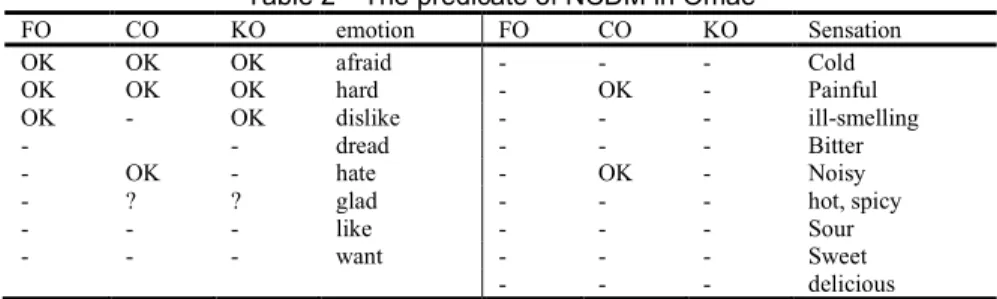
Speakers’ judgments about which predicate allows or disallows NCDM varies considerably from one speaker to another. Table 2 lists the results of our elicitation in which three speakers of Omae (FO, CO, and KO) were asked to judge whether or not a given adjective may allow NCDM. Eight emotion adjectives and nine sensation adjectives were chosen for this elicitation. The blank cell indicates that the datum has not yet been collected.
Table 2 The predicate of NCDM in Omae
FO CO KO emotion FO CO KO Sensation
OK OK OK afraid - - - Cold
OK OK OK hard - OK - Painful
OK - OK dislike - - - ill-smelling
- - dread - - - Bitter
- OK - hate - OK - Noisy
- ? ? glad - - - hot, spicy
- - - like - - - Sour
- - - want - - - Sweet
- - - delicious
Table 2 enables us to suggest two important generalizations about NCDM in Omae:
(15) If a speaker allows NCDM for any of the sensation adjectives, then they allow NCDM for at least one of the emotion adjectives. Thus, there is a hierarchical relationship between the two lexical classes of adjectives in terms of the likelihood of NCDM use: Emotion > Sensation.
(16) NCDM is more likely to occur with a stimulus argument that is depicted as evoking a ‘negative’ emotion or sensation (e.g. ‘afraid’, ‘dislike’, ‘painful’, etc.) than with one that is depicted as evoking a ‘positive’ emotion or sensation (e.g.
‘glad’, ‘want’, ‘like’, ‘sweet’, ‘delicious’). Again, we can postulate a hierarchical relationship: Negative stimuli (i.e., stimuli that causes negative effects on the experiencer) > Positive stimuli (i.e., stimuli that causes positive effects on the experiencer). In other words, a speaker who allows NCDM for the lower end of the hierarchy always allows NCDM for the higher end.
4. NCDM from a typological perspective
NCDM poses a number of theoretical-typological questions. What makes it particularly interesting cross-linguistically is the fact that it is the stimulus, not the experiencer, which is dative-marked. In a cross-linguistically common pattern, the experiencer is non-canonically marked, typically with the dative case (e.g., Haspelmath
2001). We naturally wonder what is the motivation for the cross-linguistically rarer non-canonical marking and why the dative case is used for this purpose. In this section we suggest a hypothesis so that the above-mentioned questions can be answered.
We claim that the use of the dative case for the stimulus argument is synchronically well motivated if we pay attention to the semantic similarity between the stimulus argument of TA-type sentences and the passive agent of a passive sentence. As an initial approximation, let us characterize the stimulus argument and the passive agent as
‘secondary agents’, in the sense that they have the semantic properties of an agent but they are syntactically not coded as the subject of a sentence. Let us consider (17), which illustrates NCDM of a TA-type sentence, and (18), which illustrates dative-marking of a passive agent.
(17) oraa kaminari=ni ozyee.
1SG.TOP thunder=DAT afraid.NPST ‘I’m afraid of thunder.’ (NCDM for the stimulus) (18) tubo=no taroo=ni war-are-ta.
vase=NOM Taroo(person)=DAT break-PASS-PST
‘The vase was broken by Taroo.’ (dative-marking for the passive agent) (17) depicts a situation where the experiencer ora (first person) feels afraid due to the stimulus kaminari ‘thunder’. What is notable about the experiencer is its lack or considerable reduction of agency. In fact, it is more like a patient in the sense that the experiencer is emotionally affected. In (17), it is the stimulus argument kaminari
‘thunder’ that is more like an agent: it causes the emotion of fear on the part of the experiencer, and it is an instigator of the emotion/sensation event concerned, a feature crucially pertaining to a prototypical agent (Dowty 1991, Naess 2007).
In this way, we associate NCDM in (17) with the dative-marking in passive constructions as in (18), with the assumption that dative-marking in this language functions to indicate a secondary agent, i.e., a non-subject agent or agent-like argument, i.e., the stimulus kaminari in (17) and the agent taroo in (18). Our analysis accords well with the fact that NCDM is possible only in TA-type sentences and not in DS-type sentences (Section 3.1): there is no agent-like argument in DS-type sentences. Also, as we noted in Section 3.2, NCDM shows complementary distribution with accusative marking. This is a natural result of the analysis that NCDM functions to mark an agent, given that accusative prototypically marks a patient.
5. Cross-dialectal comparison
The two hierarchical generalizations suggested for Omae (Section 3.2) hold for at least two other dialects of Kyushu that we surveyed: the Kitagata dialect of Takeo City (Saga), and the Sato dialect of Koshikishima Island (Kagoshima). The Sato data are from Kubozono (2018). Table 3 compares the results of the elicitation of NCDM where we asked the speakers to judge whether or not NCDM may occur with each of the adjectives listed. The symbols ‘O’, ‘K’ and ‘S’ represent Omae, Kitagata, and Sato respectively. Blank cells indicate that the data have not yet been collected.
Table 3 The predicates with NCDM in Omae, Kitagata and Sato
O K S emotion O K S sensation
OK OK OK afraid - OK OK painful
OK OK OK dislike - OK astringent
OK OK hard - OK ill-smelling
- OK OK glad - OK noisy
- OK dread - - OK cold
- OK hate - - bitter
- OK troublesome - - delicious
- like - - hot, spicy
- - sweet
It is unclear at this stage how to interpret the above hierarchies. Haspelmath (2001:
8) suggests that the stimulus argument of an emotion predicate is more likely to be treated like an agent than that of a sensation predicate, with the assumption that emotion is less rational and is uncontrollable, making the experiencer less like an agent, though Haspelmath is cautious about this assumption itself. At any rate, if this is a cross- linguistically valid analysis, the hierarchy of Emotion > Sensation can be interpreted as a hierarchy of stimulus arguments that are likely to behave like agents, and our analysis explains why Emotion is higher than Sensation: dative-marking functions to mark an agent-like argument. However, as Haspelmath himself admits, we need to be cautious about the way agency is discussed here, as it is difficult to argue for or against the claim objectively.
6. Conclusion
The present study has examined a cross-linguistically rare pattern of non-canonical argument marking found in Omae and other western Japanese dialects: NCDM, non- canonical dative-marking of the stimulus argument of adjectival experiencer constructions. NCDM in Omae is restricted to sentences of what we call the TA (transitive adjective) type, which take an experiencer and a stimulus as required arguments; NCDM is not found in sentences of the DS (double subject) type. We
argued that this restriction can be explained by assuming that dative marking indicates a ‘secondary agent’. Since the stimulus behaves like an agent, as it emotionally or sensationally affects the experiencer, there is a motivation for NCDM in TA-type sentences, while there is no motivation for NCDM in DS-type sentences, as there is no agent-like argument. We also suggested two hierarchies that describe the likelihood of the occurrence of NCDM: Emotion > Sensation, and Positive stimuli > Negative stimuli.
A speaker who allows NCDM for the lower end of these hierarchies always allows NCDM for the higher end.
Our survey of NCDM is still ongoing and our suggested analyses may well be subject to modifications and refinement when new data are added. As noted in Section 2, NCDM is not a unique phenomenon of Omae but is found across western Japanese dialects. It is therefore necessary to broaden our focus to integrate these other dialects into our analysis in future research.
Abbreviation
1 first person ACC accusative case
DAT dative case NOM nominative case
NPST non-past PASS passive
PST past SFP sentence final particle
SG singular TOP topic
References
David, Dowty. 1991. “Thematic proto-roles and argument selection”. Language 67(3). pp.547–619.
Doi, Shigetoshi. 1958. Tosakotoba. Kochi: Kochishiritsu Shimin Tosyokan. [in Japanese]
———. 1997a. “Shikokuno Hogen”. In Inoue Fumio Shikoku Hogenko. Tokyo: Yumani Syobo. pp.15–34. [in Japanese]
———. 1997b. “Tosano Hogen”. In Inoue Fumio Shikoku Hogenko. Tokyo: Yumani Syobo. pp.35–74. [in Japanese]
Fujiwara, Yoichi. 1981. Chugoku San’indo Niyochi Hogen. Tokyo: Miyai Syoten. [in Japanese]
———. 1997. Nihongo Hogen Zisyo: Syowa Heiseino Seikatsugo. Tokyo: Tokyodo Syuppan. [in Japanese]
Haspelmath, Martin. 2001. “Non-canonical marking of core arguments in European languages”. In Alexandra Y.
Aikhenvald, R.M.W. Dixon, and Masayuki Onishi (eds.) Non-canonical Marking of Subjects and Objects.
Amsterdam: John Benjamin. pp.53–85.
Hiroto, Atsushi. 1949. Sanin Hogenno Gohoo: Izumo, Oki, Iwami, Hoki. Tottori: Shimane Shinbunsya. [in Japanese]
Kanazawa, Osamu. 1960. Awakotobano Jiten. Tokushima: Tokushimaken Kyoikuiinkai. [in Japanese]
———. 1961. Awakotobano goho. Tokushima: Tokushima Chuo Kominkan Fuzoku Tosyokan. [in Japanese]
Kanbe, Hiroyasu. 1978. Okihogenno Kenkyu. Tokyo: Kazama Syobo. [in Japanese]
Kaneda, Akihiro. to appear. “Miyazakiken Shiibason Kakuno Syoso”. In Nobuko Kibe, Shiro Takeuchi, and Michimori Shimoji (eds.) Nihongono Kakuhyogen. Tokyo: Kuroshio Syuppan. [in Japanese]
Kubozono, Ai. 2018. “Kagoshimaken Satohogenno Keyoshino Tokutyo”. 43rd Kyushu Hogen Kenkyukai. [in Japanese]
Makimoto, Kusuroo. 1925. Kibigun Minyosyu. Tokyo: Kyodo Kenkyusya. [in Japanese]
Mikaziri, Hiroshi. 1937. Oitakenhogenno Kenkyu. Tokyo: Hobundo. [in Japanese]
Næss, Åshild. 2007. Prototypical Transitivity. Amsterdam: John Benjamin.
Nihon Hoso Kyokai (ed.). 1966. Zenkoku Hogen Siryoo 3. Tokyo: Nihon Hoso Kyokai Syuppankai. [in Japanese]
——— (ed). 1967. Zenkoku Hogen Siryoo 2. Tokyo: Nihon Hoso Kyokai Syuppankai. [in Japanese]