13
On Complement Clauses of Utterance Verbs in Fijian
†Susumu OKAMOTO
(Tokyo University of Foreign Studies)
Keywords: Fijian, ditransitive, alignment, complement clause
1. Introduction
The purpose of this paper is twofold. First, we examine Fijian verbs which express “giving information or instructions about something to someone orally” such as “teach” or “command”
(hereafter called “utterance verbs1”) and analyze them as ditransitive constructions. Second, we claim that a clause with an utterance verb is not an adverbial clause but a complement clause which functions as a T argument.
The organization of the paper is as follows. In section 2, we provide some preliminaries on Fijian. In section 3, we describe utterance verbs in Fijian as ditransitive constructions. In section 4, we will provide several pieces of syntactic evidence that a clause within an utterance construction is a complement clause. Finally, we present conclusions in section 5. Examples without sources were collected through elicitation with a consultant LG (male, born in 1962).
2. Preliminaries
2.1. Typological overview
Fijian is an Oceanic language (Austronesian, Malayo-Polynesian) with a basic word order of VPA.
The phoneme inventory is as follows: /p, b [mb] , t, d [nd], k, q [ŋg], r, dr [nr], v [β], f, c [ð], j [tʃ], z [ndʒ], m, n, g [ŋ], l, w, y, a, e, i, o, u/. Note that a predicate may consist of more than one phonological word.
There are two noun classes in Fijian: common nouns and proper nouns / pronouns. These two noun classes show different morphosyntactic behaviors, especially when they function as a P argument. This is shown in Table 1.
Table 1: Morphosyntactic differences between common nouns and proper nouns / pronouns Common noun (1a) Proper nouns / pronouns (1b)
Article ✓ none
Verbal form √-TRANSITIVIZER2+3SG object maker √-TRANSITIVIZER
Position of P outside predicate inside predicate
† This paper is a revised and expanded version of a presentation made at the 155th Meeting of the Linguistic Society of Japan. I would like to thank those who provided me with many helpful and constructive comments.
1 It is true that “teach” or “command” can also be used for non-oral communication. In this paper, however, we regard “utterance” as the prototypical meaning of these verbs.
2 The transitivizer is generalized as -Ci, -Caki, where C indicates a lexical-determined consonant (Milner 1956: 27).
3
ウズベク語の過去形動詞+処格を用いた条件用法
日高 晋介
(東京外国語大学大学院)
キーワード:ウズベク語,過去形動詞,条件
1. はじめに
本稿はウズベク語の過去形動詞+処格 -gan-daの条件用法について、テキスト調査とエ リシテーション調査を用いて、実際にどのように用いられているのかを検証する。先行研 究によれば、-gan-daは時間節を表す用法と条件を表す用法を持つという。-gan-daを用い た条件用法について、先行研究間 (Kononov 1960: 413-5, Bodrogligeti 2003: 1249-54) で記述 の齟齬が見られる。果たしてどちらの記述が現実に即しているのだろうか。
本稿の構成は次の通りである。2 節で先行研究の記述を参照し問題提起を行う。続く 3 節で調査と分析を行い、4節で考察を述べる。最後に5節で本稿のまとめを述べる。
本稿の例文番号、グロス、日本語訳はことわりのない限り筆者による。なお、ウズベク 語の表記は、先行研究の表記法に関わらず、ラテン文字正書法に統一する。
2. 先行研究
2.1節で時間節について、2.2節で条件表現について、それぞれ先行研究の記述を参照す る。
2.1. 時間節
Kononov (1960: 378) は、時を表す拡張状況語 (Развернутое обстояство) として、-gan-da, 動名詞+処格 -(i)sh-da を挙げている (それぞれ (1) と (2) を参照されたい)。Bodrogligeti (2003: 601-606) は -gan-daと、現在進行形動詞+処格 -yotgan-daの例 (3) を挙げている。
ただし、-gan-da以外は条件用法を持たない (2.2節で -gan-daの条件用法について述べる)。
(1) Lekin maktab-dan qayt-ish-im-da, Saydakbar o‘z xat-i-ning but school-ABL return-VN-1SG.POSS-LOC NAME REFL letter-3SG.POSS-GEN
natija-si va javob-i-ni so‘ra-gan-i-da, haligi vokea-ni result-3SG.POSS and answer-3SG.POSS-ACC ask-PTCP.PAST-3SG.POSS-LOC that event-ACC
un-ga ayt-ib ber-di-m.
3sg-DAT say-CVB give-PAST-1SG
「しかし、私が学校から帰る時に、サイドアクバルがその手紙の結果と返事を尋ねた
ら、その出来事を彼に言ってあげた。」(Kononov 1960: 378)
14 (1) a. Common nouns
[ eratou saa rogo-ca tiko ]Predicate na no-na vosa
3PA ASP hear-TR+3SG CNT ART PC-3SG speech “They hear his speech”
b. Proper nouns / pronouns
[ eratou saa rogo-ci Samu tiko ]Predicate
3PA ASP hear-TR PN CNT “They hear Samu” (Milner 1956: 54)
2.2. Prefix VAKA-
Fijian VAKA-3 is a prefix from which a verb (2a), an adjective (2b) and an adverb (2c) are derived.
Above all, the following section deals with the function as transitivizer (or causative) like (2a).
(2) a. vaka-mate-a b. na vosa vaka-Viti c. saa taba-ki vaka-vula CAUS-die-TR+3SG ART speech ADJVZ-Fiji ASP print-PASS ADVLZ-month “to kill” “Fijian language” “It is printed every month”
(Milner 1956: 66, 103)
3. Analysis as ditransitive
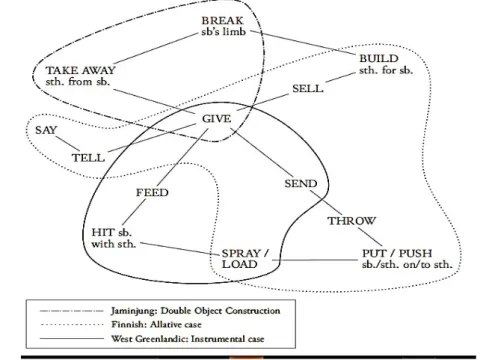
Malchukov et al. (2010: 55), in their cross-linguistic study of ditransitive verbs, regard “give” as the prototypical ditransitive verb and show that ditransitive constructions may cover “teach” or “tell”
(Figure 1).
Figure 1: The semantic map of ditransitive construction (Malchukov et al. 2010: 55)
3 This prefix has two allomorphs: vaka- and vaa-. The latter appears only if the following morpheme is velar. In this paper, we use VAKA- as a representative form.
15
3.1. Alignment of ditransitive verbs in cross-linguistic perspective
According to Malchukov et al. (2010), there are two basic alignment types of ditransitive constructions in terms of the encoding of T (theme) and R (recipient) compared to the mono-transitive P (patient): indirective alignment and secundative alignment (Figure 2).
Figure 2: Two major alignments (Malchukov et al. 2010: 5)
3.2. Alignment of utterance verbs in Fijian
In Fijian, the alignment of the prototypical ditransitive verb soli-a “give” is indirective. In (3), the T argument appears without any preposition like a P argument, while the R argument appears with a preposition, ki. Henceforth, R and T indicate R and T, respectively.
(3) au aa soli-a ki na gone R na ivola T
1SG PST give-TR+3SG to ART child ART book “I gave a book to the child”
On the other hand, the alignment of VAKA-derived verbs is secundative, which has already been pointed out in previous literature, such as Dixon (1988: 50) and Schütz (2014: 61). In (4), the R argument appears in the same position as a P argument (see also (1b)), while the T argument co-occurs with a preposition, e.
(4) e vaa-kani koya R e na dalo T
3SG CAUS-eat.TR 3SG with ART taro “She feed him with taro” (Schütz 2014: 61)
However, in my corpus4, not only the secundative alignment (5) but also the indirective alignment (6) is observed for one of the VAKA-derived utterance verbs, vaka-vuli-ca “teach” and its variations vaka-vu~vuli-taka, vaka-taa-vuli-ca, vaka-taa-vu~vuli-taka5. The ratio of the former and the latter is approximately 55:45.
4 I have been creating a Fijian corpus by collecting sentences from Nai Lalakai, weekly articles written in Fijian. In this work, I used 1,526 articles (from July 4th, 2016 to June 26th, 2017, 864,973 words).
5 The alignment alternation was observed in the following verbs: vaka-vuli-ca “teach” (and its variation), vaka-ro-ta “command”, vaka-tuku~tuku-taka “report” and vaka-sala-taka “advise”.
16 (5) Secundative
e dau vaka-taa-vuli-ci ira na gonelalai R e na wilivola T
3SG HAB CAUS-ARTIFICIAL-learn-TR 3PL ART child with ART reading
“He teaches children how to read” (aug_08_2016_19_4)
(6) Indirective
(... ) vaka-taa-vuli-ca vei keda R e dua na lesoni T CAUS-ARTIFICIAL-learn-TR+3SG to 1PL.INCL 3SG one ART lesson
“(...) taught a lesson to us” (jul_04_2016_16_28)
The markings of these two alignments are shown in Table 2. Ø indicates a lack of morphological marking. The difference of ki and vei reflects noun classes. That is to say, the former is used with common nouns and place names and the latter with pronouns and personal names.
Table 2: Flagging of VAKA-derived utterance verbs
R P T
secundative Ø e
indirective ki / vei Ø
This alternation is observed only with VAKA-derived verbs with the meaning of utterance.
VAKA-derived verbs other than utterance verbs such as vaka-isulu-taka “dress someone” have only the secundative alignment (7a) and the indirective alignment is unacceptable (7b). Hereafter * indicates that a sentence is ungrammatical.
(7) a. Secundative
e aa vaka-isulu-taki au R e na isulu lokaloka T
3SG PST CAUS-clothes-TR 1SG with ART clothes purple “(lit.) They dressed me with purple clothes”
b. Indirective
* e aa vaka-isulu-taka vei au R na isulu lokaloka T <indirective>
3SG PST CAUS-clothes-TR+3SG to 1SG ART clothes purple
In addition, underived utterance verbs such as tuku-na “tell” have only the indirective alignment (8a), while the secundative alignment is ungrammatical (8b).
17 (8) a. Indirective
au aa tuku-na vei iratou R na ke-mu italanoa T <indirective>
1SG PST tell-TR+3SG to 3PA ART PC-2SG story “I told your story to them”
b. Secundative
* au aa tuku-ni iratou R e na ke-mu italanoa T
1SG PST tell-TR 3PA with ART PC-2SG story
On the one hand, VAKA-derived utterance verbs are peculiar in that there is no morphological change to the verb when the alignment alternation takes place. On the other hand, verbs which express throwing motion, for instance, must take different transitive suffixes when the alignment alternation takes place (Okamoto 2016: 378-379). (9a) is the secundative alignment of viri-ka/-taka
“throw” and (9b) is the indirective one, where one can see the morphological difference between the two.
(9) a. e viri-ka na gone R e na polo T <secundative>
3SG throw-TR+3SG ART child with ART ball “(lit.) He threw-at the ball to the child”
b. e viri-taka na polo T ki na gone R <indirective>
3SG throw-TR+3SG ART ball to ART child “He threw the ball to the child”
To sum up, only VAKA-derived utterance verbs have the alternation of two alignments without a morphological change to the verb. This is shown in Figure 3. Further research is needed to clarify semantic and pragmatic differences between the two alignments.
Figure 3: Alignment patterns of VAKA-derived verbs and utterance verbs INDIRECTIVE
Utterance Verb
SECUNDATIVE VAKA-derived Verb
VAKA
-derived Utterance Verb BOTH18 4. Complement clause as T
Several semantic classes exist for complement-taking predicates (CTPs) (Noonan 2007: 53). An utterance verb is considered to be one of them (Dixon 2006: 28-30, Noonan 2007: 121, Schmidtke-Bode 2014: 42).
In Fijian, vakarota “command” often has a complement clause as T argument in both secundative alignment (10a) and indirective alignment (10b).
(10) a. Secundative
aa qai vaka-ro-ti ira R tale vakarua ko Morgan mera voleni T
PST then CAUS-command-TR 3PL again twice PRP PN COMP+3PL fall_in
“(and) Morgan commanded them twice to fall in” (oct_10_2016_23_13)
b. Indirective
vaka-ro-ta talegaa vei ira R na cauravou mera yalomatua T
CAUS-command-TR+3SG also to 3PL ART young_man COMP+3PL responsible
“(He) commanded young people to be responsible” (nov_28_2016_14_8)
As can be seen in (10), a complement clause is marked by me6, which expresses the event should happen (Dixon 1988: 271). This accords with a cross-linguistic tendency for CTPs like
“command” to take a potential clause (Dixon 2006: 29).
4.1. Complement clause and complement strategy
A complement clause is often defined as a clause which functions as an argument of a higher clause (Dixon 2006: 15, Noonan 2007: 52). In addition to complement clauses, Dixon (2006: 33) proposes complement strategies, which are constructions other than complement clauses in which a verb of the restricted set is linked to that of the unrestricted one. Complement strategies include serial verb, relative clause, nominalization, apposition, clause linking, and purposive linking7.
Among these strategies, Goemai (Afroasiatic, Chadic, West Chadic A, Angas-Goemai, Southern Branch) makes use of purposive linking. In (11), the phrase “that I should come” is expressed not by a complement clause but by a purposive clause marked by de . . . yi, which is used for a different subject, TAM, or polarity from that of the first clause (Hellwig 2006: 220).
(11) ni kʼwal ndoe hen de hen wul yi 3SG talk CONJ 1SG PURP 1SG arrive SUB
“He persuaded me that I should come” (Hellwig 2006: 220)
6 Whether me functions as a complementizer or not is discussed in the following sections.
7 Croft (2001: 351-352) states that from the diachronic point of view, complement clauses often arise from purposive clauses.
19
In Fijian, a complement clause in (12) is marked with the same marker as a purposive clause in (13). Thus, it can be assumed that a clause with me is not a complement clause but a purposive clause. As a matter of fact, Dixon (2006: 39) states that purposive linking is often observed with utterance verbs like “command.”
(12) au vaka-ro-ta vei Jone me lako mai 1SG CAUS-command-TR+3SG to PN COMP.3SG go hither “I commanded John to come”
(13) au lako ki Suva meu voli-a na ivola 1SG go to Suva SUB+1SG buy-TR+3SG ART book “I went to Suva (in order) to buy the book”
Nagaya (2017) claims that in Tagalog a clause marked by linker is not complement clause. He points out several reasons. Linker clauses, for example, lack a morphological marker when they are in focus. In addition, when the content of a linker-clause is asked, not only “what” but also “how”
can be used. In the following sections, we make use of his syntactic tests and claim that a me-clause in an utterance verb is a complement clause, that is to say embedded, by showing (i) that it can be an S of the passive construction and (ii) that it is replaced by “what” not “how.” Note that in section 4.2 and 4.3 we deal only with the indirective alignment.
4.2. Voice operation
In this section, we show that a me-clause in utterance verbs can be an S argument of the passive construction. In Fijian, passivization is marked by attaching a suffix to the verb8. (14) is a passivization of (12) (= (14b)). Because only a P argument can be an S of a passive clause (Dixon 1988: 222), a me-clause with utterance verbs (of the indirective alignment) is a complement clause.
(14) a. e vaka-ro-ti vei Jone R me lako mai S
3SG CAUS-command-PASS to PN COMP.3SG go hither “(lit.) To come was commanded to John”
b. au vaka-ro-ta vei Jone R me lako mai T
1SG CAUS-command-TR+3SG to PN COMP.3SG go hither “I commanded John to come”
8 The passive suffix is formally the same as the transitive one (cf. (10a) and (14a)). In this paper, we use glosses based on functions of morphemes.
20
For the purpose of comparison, we provide an example of the passivization of a common noun P (15a) ((15b) is its transitive alternative).
(15) a. e vaka-vuli-ci vei Jone R na vosa vaka-Viti S
3SG CAUS-learn-PASS to PN ART speech ADJVZ-Fiji “Fijian language is taught to John”
b. au vaka-vuli-ca vei Jone R na vosa vaka-Viti T
1SG CAUS-learn-TR+3SG to PN ART speech ADJVZ-Fiji “I taught Fijian language to John”
A me-clause in (13), on the other hand, cannot be an S of a passive clause because lako “go” is intransitive.
4.3. Replacement by “what”
In this section, we claim that a clause of utterance verbs is embedded by showing that it is replaceable with “what.” (16a) is the question counterpart of (12) (= (16b)), where the me-clause is replaced with cava “what”. Unlike Tagalog, vakacava “how” is not used with the same meaning with (16a).
(16) a. na cava T o vaka-ro-ta vei Jone R ? ART what 2SG CAUS-command-TR+3SG to PN
“What did you command John?”
b. au vaka-ro-ta vei Jone R me lako mai T
1SG CAUS-command-TR+3SG to PN COMP.3SG go hither “I commanded John to come”
In the question counterpart of (13), on the other hand, although the me-clause is replaced with cava “what,” there must be kina within the clause (17a). kina appears when a prepositional phrase or a subordinate clause is fronted (Milner 1956: 49, glossed KINA). Because a question without kina is ungrammatical like (17b), it can be said that the me-clause in (13) is not a core argument.
(17) a. na cava o lako kina ki Suva ? b. * na cava o lako ki Suva ? ART what 2SG go KINA to Suva ART what 2SG go to Suva “Why do you go to Suva?”
21 4.4. Complement clause in secundative alignment
The syntactic tests shown in the above two sections reveal that me-clauses are embedded. However, these tests do not apply to the secundative alignment.
First, it is not a T argument but an R argument that becomes an S argument of the passive construction (18a) ((18b) is its transitive alternative).
(18) a. e vaka-ro-ti o Jone S me lako mai T
3SG CAUS-command-PASS PRP PN COMP+3SG go hither “John was commanded to come”
b. au vaka-ro-ti Jone R me lako mai T
1SG CAUS-command-TR PN COMP+3SG go hither “I commanded John to come”
Second, since a T argument is a prepositional phrase, kina appears when its content is asked.
That is to say, as shown in (19), its interrogative construction is the same form as that of a purposive clause.
(19) na cava o vaka-ro-ti Jone kina ? ART what 2SG CAUS-command-TR PN KINA
“What did you command John?” or “Why did you command John?”
Thus, it cannot be accurately concluded from the syntactic tests given in this paper that a me-clause is a complement clause.
5. Conclusion
The paper’s claims are summarized as (20):
(20) a. VAKA-derived verbs whose meaning is an utterance such as “teach” or “command” have the alternation of two alignments: secundative and indirective. These verbs are peculiar in that the alternation involves no morphological change to the verb.
b. The clause of an utterance verb, at least in indirective alignment, functions as a core argument of a higher clause for the following reasons: (i) in the passive construction, a clause can be an S argument, and (ii) in the interrogative construction, a clause is replaced by “what” without kina.
22
Further research is needed. First, in this paper, we do not provide any explanation as to why utterance verbs have the alternation of alignments. Second, we do not explore the internal structure of a complement clause. It is expected that a complement clause has more morphosyntactic constraints than a main clause does (Dixon 2006: 21-22, Malchukov 2006). Finally, we have to explain the distinction between a prepositional phrase and an adverbial clause in order to prove that a T argument in secundative type is an argument of the verb.
Abbreviations
- morpheme boundary INCL inclusive
+ fusion KINA kina
1,2,3 1st, 2nd, 3rd person PA paucal
ADJVZ adjectivizer PASS passive
ADVLZ adverbalizer PC possessive classifier
ART article PL plural
ARTIFICIAL artificial PN personal name
ASP aspect PRP proper article
CAUS causative PST past
CNT continuous PURP purposive
COMP complementizer SG singular
CONJ conjunction SUB subordinator
HAB habitual TR transitivizer
References
Croft, William (2001) Radical Construction Grammar: Syntactic Theory in Typological Perspective.
Oxford: Oxford University Press.
Dixon, R. M. W. (1988) A Grammar of Boumaa Fijian. Chicago: The University of Chicago Press.
Dixon, R. M. W. (2006) Complement clauses and complementation strategies in typological perspective. In: R. M. W. Dixon and Alexandra Y. Aikhenvald (eds.) Complementation: A Cross-Linguistic Typology, 1-48. Oxford: Oxford University Press.
Hellwig, Birgit (2006) Complement clause type and complement strategies in Goemai. In: R. M. W.
Dixon and Alexandra Y. Aikhenvald (eds.) Complementation: A Cross-Linguistic Typology, 204-223. Oxford: Oxford University Press.
Malchukov, Andrej (2006) Constraining nominalization: function/form competition. Linguistics 44 (5), 973-1009.
Malchukov, Andrej and Martin Haspelmath and Bernard Comrie (2010) Ditransitive constructions:
a typological overview. In: Andrej Malchukov and Martin Haspelmath and Bernard Comrie (eds.) Studies in Ditransitive Constructions: A Comperative Handbook, 1- 64. Berlin: De Gruyter.
23
Milner, George B. (1956) Fijian Grammar. Suva: Government Press.
Nagaya, Naonori (2017) On the nature of complementation in Tagalog. Handout at the International Conference on Role Reference Grammar 2017.
Noonan, Michael (2007) Complementation. In: Timothy Shopen (ed.) Language Typology and Syntactic Description Vol 2, 52-150. Cambridge: Cambridge University Press.
Okamoto, Susumu (2016) Ditransitive verbs and throwing verbs in Fijian. The 152nd LSJ Meeting Handbook, 376-381.
Schütz, Albert J. (2014) Fijian Reference Grammar. Honolulu: Pacific Voices Press.
Schmidtke-Bode, Karsten (2014) Complement Clauses and Complementation Systems: A Cross-Linguistic Study of Grammatical Organization. PhD dissertation, University of Jena.
Online material
The Fiji Times Online | Nai Lalakai Online: http://nailalakai.fijitimes.com/ (accessed 9/30/2017)
24
フィジー語の発言動詞の補文節について
岡本 進
(東京外国語大学大学院 博士後期課程)
キーワード:フィジー語,複他動詞,アライメント,補文節
本稿ではフィジー語の「教える」、「命じる」のような動詞(以下発言動詞とする)を複他 動詞として分析する。そのうえで発言動詞に現れる節は副詞節ではなく、上位節の項とし て機能していると主張する。
発言動詞では indirective 型(R(ecipient)項が目的語)と secundative 型(T(heme)項が目的語) の両方のアライメントが観察される。ただしすべての発言動詞でこのアライメントの交替 が見られるわけではなく、使役化接頭辞 VAKA- を伴う発言動詞でのみ許容される。これ らの動詞は形態変化なしにアライメントが交替するという点で特異である。
発言動詞はそのT項が補文節として現れることが多い。補文節の標示が目的を表す副詞 節のそれと同形であるため、発言動詞の節は補文節ではないとも分析できる。しかし本稿 は、発言動詞に現れる節は「埋め込まれている」と主張する。その根拠として、補文節が 態の操作を被ることが挙げられる。さらに、補文節の内容を尋ねる疑問文において、必須
項と同じ “what” を用いることからも、発言動詞の補文節は項として埋め込まれていると
いえる。