self‑determined forms of L2 motivation:
Applying self‑determination theory in the Japanese University EFL context
著者 Agawa Toshie, Takeuchi Osamu
journal or
publication title
Language Education & Technology
volume 54
page range 135‑166
year 2017
URL http://hdl.handle.net/10112/11409
Pedagogical Intervention to Enhance Self-determined Forms of L2 Motivation: Applying Self-determination
Theory in the Japanese University EFL Context
AGAWA, Toshie TAKEUCHI, Osamu
Language Education & Technology
2017
(let) THE JAPAN ASSOCIATION FOR LANGUAGE EDUCATION AND TECHNOLOGY
Pedagogical Intervention to Enhance Self-determined Forms of L2 Motivation: Applying Self-determination Theory in the Japanese
University EFL Context
AGAWA, Toshie Seisen University TAKEUCHI, Osamu
Kansai University
Abstract
The primary objective of this paper is to investigate the influence of pedagogical intervention on the L2 motivation of Japanese university students. It consequently examines the sensitivity of the new questionnaire developed by Agawa and Takeuchi (2016c). A quasi-experimental study was conducted to compare two types of instructions: conventional instructions used in test-preparation courses (contrast group [CG]) and instructions based on self-determination theory (SDT) (treatment group [TG]). In the CG, 23 students worked on tasks similar to TOEFL and lELTS questions.
In the TG, 24 students received instructions designed to satisfy their needs for autonomy, competence, and relatedness. The newly developed questionnaire based on SDT was conducted at the beginning and end of the academic year. The results indicated that, in the TG, the students' needs were more satisfied after the intervention. They also showed that, after the treatment period, their self-determined forms of motivation significantly increased. Meanwhile, in the CG, neither the degree of students' needs satisfaction nor motivation intensity showed a significant difference. These results suggest that fulfilling the needs could help enhance Japanese EFL learners' motivation. The results also demonstrate the sensitivity of the new questionnaire in measuring changes in the needs fulfillment degrees and L2 motivation intensities among Japanese university students.
Keywords: L2 motivation, Japanese university EFL context, pedagogical intervention, self-determination theory, new questionnaire
Pedagogical Intervention to Enhance Self-determined Forms of L2 Motivation: Applying Self- determination Theory in the Japanese University EFL Context
1. Introduction
In second language acquisition (SLA) research, second/foreign language (L2) learners' motivation is one of the most abundantly investigated areas (for a review, see Lasagabaster, Doiz, & Sierra, 2014). One of the most established and influential theories in the field is self-determination theory (SDT) (Deci & Ryan, 1985, 2000, 2002). SDT was originally a large-scale theory used to explain human motivation in general. The versatile nature of the theory has allowed researchers in various domains (e.g., sports and physical activity, religion, health and medicine, and virtual environment) to use it to look into people's motivation in different situations. In addition to being versatile, SDT is one of the most empirically tested motivational theories and has been verified in various domains (Deci & Ryan, 2008). Many SLA researchers have applied the framework to the language-learning context, thereby helping to illuminate L2 motivation processes (Comanaru & Noels, 2009; Jones, 2009;
Noels, 2003, 2013; Noels, Pelletier, Clement, & Vallerand, 2000; Wu, 2003). SDT studies have been conducted in many countries, including Japan in the field of EFL. The vast majority of such studies conducted in Japan have used or adapted one questionnaire (Hiromori, 2006a) and yielded results both in line and out of line with the theory. The mixed results encouraged researchers to uncover the cause of such inconsistencies (Agawa & Takeuchi, 2016a, 2016b), which resulted in proposing a newly developed questionnaire to more accurately gauge Japanese university EFL learners' psychological needs and motivation (Agawa & Takeuchi, 2016c). The current study uses the newly developed questionnaire to evaluate the influence of pedagogical intervention based on SDT. The purposes of the study are (1) to investigate the impact of pedagogical intervention on L2 motivation of Japanese university students and (2) consequently to examine the sensitivity of the new questionnaire in measuring changes in the needs fulfillment degrees and of L2 motivation intensities among Japanese university students.
2. Literature Review and Research Rationale
2.1 Self-determination Theory
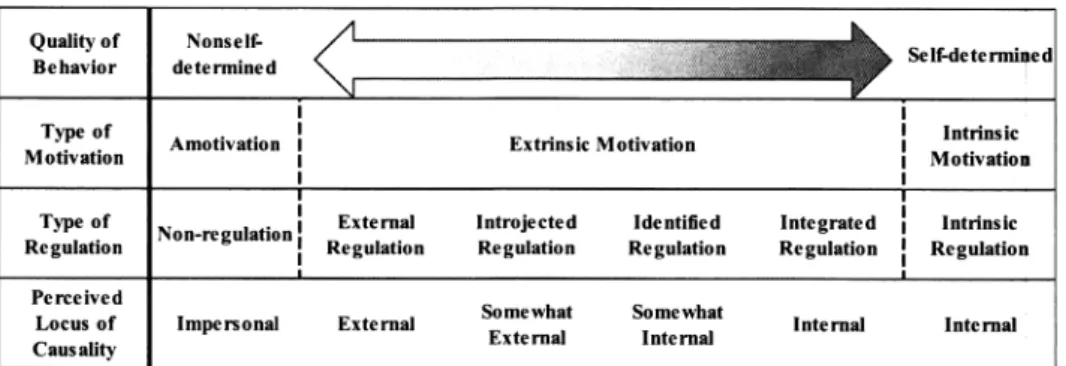
According to SDT, motivation resides along a continuum, with intrinsic motivation at one end, extrinsic motivation in the middle, and amotivation at the other end (see Figure 1). Intrinsic motivation refers to the motivation to engage in something because the action itself is enjoyable and satisfying, whereas extrinsic motivation is a drive to do something for an independent outcome (Deci & Ryan, 2000). Deci and Ryan postulated four regulations within extrinsic motivation, depending on the degree of
- 136 -
intemalization involved in the action: integrated, identified, introjected, and external. As their labels suggest, integrated regulation is the most self-determined form of regulation, whereas external regulation is the least autonomous. Placed at the opposite end of the scale from intrinsic motivation is amotivation, a state of no regulation/motivation.
SDT presupposes the existence of three basic psychological needs: the need for autonomy, competence, and relatedness. SDT offers different types of motivation and degrees of regulation to demonstrate how we can be motivated, depending on the extent to which our needs are satisfied; the more individuals' innate psychological needs of autonomy, competence, and relatedness are fulfilled, the more their behavior is intrinsically motivated.
The need for autonomy is defined as individuals' desire for "being the perceived origin or source of one's own behavior" (Deci & Ryan, 2002, p. 8). Deci and Ryan further explained that autonomy pertains to acting from interest and integrated values;
thus, "when autonomous, individuals experience their behavior as an expression of the self, such that, even when actions are influenced by outside sources, the actors concur with those influences, feeling both initiative and value with regard to them" (p. 8).
Interpreted in the Japanese EFL context, the need for autonomy is defined as the learners' desire to engage in English learning autonomously for their actions to be more self-determined and to take responsibility for their actions (Hiromori, 2006a). In other words, it has been understood as the learners' desire to determine their actions regarding English learning and take responsibility for their own studies. This definition is reflected on widely used questionnaire items (Hiromori, 2006a, 2006b; Tanaka &
Hiromori, 2007) to measure the degree of Japanese EFL learners' autonomy needs fulfillment, such as "I am free to express my ideas and opinions on English learning,"
"My teacher asks for the opinions of students about the content and/or procedure of the class," and "My teacher always decides what to study in the English course" (reversed item).
The need for competence refers to a person's desire to feel "effective in one's ongoing interactions with the social environment and experien[ce] opportunities to exercise and express one's capacities" (Deci & Ryan, 2002, p. 7). Applied to the English learning setting in Japan, such needs are interpreted as individuals' desire to be able to understand and make themselves understood in English based on their capability and confidence to complete English assignments and tasks successfully (Hiromori, 2006a). These definitions are the basis of questionnaire items commonly used to measure the degree of competence needs satisfaction of Japanese EFL learners, such as
Pedagogical Intervention to Enhance Self-determined Forms of L2 Motivation: Applying Self- determination Theory in the Japanese University EFL Context
"I think I can get a good grade in English" and "I feel a sense of achievement in the English course."
Finally, the need for relatedness is expressed in the desire to feel "cormected to others, to car[e] for and [be] cared for by those others, [and] to hav[e] a sense of belongingness both w^ith other individuals and with one's community" (Deci & Ryan, 2002, p. 7). In the English learning setting in Japan, these needs can be translated as wanting to connect with other classmates and the teacher as well as engage in English learning cooperatively with other classmates and the teacher (Hiromori, 2006a).
Questionnaire items reflecting this definition include "I work hand-in-hand with my friends on a group activity" and "I get along with my friends during an English class"
(Hiromori, 2006a, 2006b).
Self-determination theory: SDT
Quality of
Behavior
dftemtatd Self-determined
Type of
Motivation Amotivation Extrinsic Motivation Intrinsic
Motivation
Type of
Regulation Non-regulation External Introjected Identified Integrated Regulation Regulation Regulation Regulation
Intrinsic Regulation Perceived
Locus of Causality
^ ^ , Somewhat Somewhat , ^ . . . .
Impersonal External , . Internal Internal
External Internal
Figure 1. The self-determination continuum, with types of motivation, types of regulation, and locus of causality. Adapted from Deci, E. L., and Ryan, R. M., (Eds.), 2002, Handbook ofself-determination research, p. 16.
2.2 Research Based on SDT in the Japanese EFL Context
In the era of globalization, a strong emphasis is placed on English in the Japanese formal educational setting; it is one of the three main subjects in junior and senior high schools, and almost all universities require English language courses for at least first- and second-year students, regardless of their majors. However, students are not always willing to learn English; some students even experience demotivation when learning English (Agawa & Ueda, 2013; Kikuchi, 2015). Given such circumstances, EFL learners' motivation is of great interest to many researchers and practitioners in Japan, and more knowledge on this matter has been actively sought by using various theoretical frameworks. SDT has become one of the most frequently employed
- 138 -
motivation theories in research on L2 motivation in Japan, as the theory enables researchers to investigate several types of motivation/regulations on a continuum beyond the intrinsic-extrinsic dichotomy. The vast majority of such studies have used the questionnaire originally developed by Hiromori (2006a). In fact, all the SDT-based survey studies discussed in this subsection (except for Agawa & Takeuchi, 2016a) used or adapted Hiromori's questionnaire.
Hiromori (2006a) was the pioneering researcher who applied SDT in the Japanese EFL context. He developed a questionnaire to measure EFL learners' psychological needs fulfillment and motivation and collected data from university students. He then used a structural equation modeling (SEM) analysis to confirm the causal relationship between the fulfillment of innate needs and motivation as hypothesized in the theory. Yet the model's goodness of fit was relatively poor (GFI
= .75, AGFI = .70, CFI = .82, RMSEA = .09).^ In another study (Otoshi & Heffeman, 2011), data were collected at two universities, and participants were either business or English majors. The results yielded a somewhat acceptable level of fit indices of the model; however, the sufficiency of autonomy needs did not display a causal relationship with intrinsic motivation as SDT posits. Moreover, Agawa and Takeuchi's (2016a) study, in which 317 participants from academically varied universities responded to a questionnaire, found that autonomy needs fulfillment has a negative impact on the intrinsic motivation of Japanese L2 learners and, furthermore, might even demotivate them. The fit indices of the model reached an acceptable level in the study.
Some studies have sought to determine if pedagogical interventions to fulfill English learners' three basic needs improve their intrinsic motivation. Dei (2011), Hiromori (2006a, 2006b), and Tanaka and Hiromori (2007) demonstrated that satisfying the innate needs could generally enhance English learners' motivation. Conversely, Maekawa and Yashima (2012) did not observe an increase in their participants' self- determined regulations in their L2 study, although the participants' psychological needs were successfully satisfied.
2.2.1 Studies by Agawa and Takeuchi
The mixed results presented by previous research are confusing for researchers and practitioners and do not provide conclusive suggestions on how to successfully motivate Japanese EFL learners. Aiming to tackle these problems, Agawa and Takeuchi launched a series of studies. First, in order to probe the cause of the inconsistency, they conducted an interview study in which they re-examined the meanings of satisfying
Pedagogical Intervention to Enhance Self-determined Forms of L2 Motivation: Applying Self- determination Theory in the Japanese University EFL Context
Japanese university EFL learners' need for autonomy, competence, and relatedness (Agaw^a & Takeuchi, 2016b). The analysis of the data revealed two points v^orth mentioning: (a) whereas the fulfillment of autonomy—^meaning freedom of choice—
might motivate some L2 learners, it can demotivate others in the context; and (b) a good relationship with the teacher may motivate learners whereas a good relationship with other classmates can have a positive or marginal impact on L2 motivation, depending on the individual learner. Drawing on these results, Agawa and Takeuchi concluded that the mixed results in previous studies may have been due to the commonly used questionnaire based on the assumption that autonomy fulfillment equals giving a choice and that relatedness fulfillment is brought about only by a good student-student relationship. They argued the need to consider (1) a redefinition of L2 learners' autonomy need; (2) an amendment of autonomy-related items based on the redefinition;
and (3) the addition of items to measure the teacher-student relationship when improving the commonly used questionnaire in the Japanese EFL setting.
Reflecting the three points argued by Agawa and Takeuchi (2016b), a new SDT- based questionnaire was developed (Agawa & Takeuchi, 2016c). Following the criteria presented by Domyei and Taguchi (2010) and Sakai and Koizumi (2014), the questionnaire was carefully developed by taking several steps. Agawa and Takeuchi also examined the validity and reliability of the new instrument using experts' judgment, exploratory factor analysis, and reliability computation. The results showed that the new questionnaire had higher validity and reliability than the questionnaire previously used widely in the field. Nevertheless, the researchers pointed out that the new instrument required more tests by using different samples to further check its validity.
In order to further validate the new questionnaire, Agawa and Takeuchi (2017) used a different sample from that of their preceding study (i.e., Agawa & Takeuchi, 2016c). Questionnaire data were submitted to confirmatory factor analysis and SEM.
The results of the analyses demonstrated validity evidence of the new questionnaire in a sample different from the one used to develop the instrument; furthermore, the results suggested the validity of SDT in the Japanese university EFL context. Therefore, by using the new instrument, one may be able to obtain results consistently in line with SDT. The study concluded that the new questionnaire more effectively assesses the L2 motivation of Japanese university students with various characteristics. As posed in Agawa and Takeuchi (2016b), the conventional questionnaire may have been one of the causes behind the mixed results; the mixed results obtained in existing studies investigating whether pedagogical intervention to fulfill English learners' three basic
- 140 -
needs improved their self-determined forms of motivation. As mentioned in the Literature Review and Research Rationale section of this paper, determining how to facilitate EFL learners' motivation has been of great interest to many researchers and practitioners in Japan. Once the new questionnaire, which may have higher validity and reliability than the conventional one, was developed, the effectiveness of pedagogical interventions needed to be examined again using the new instrument. To this end, this study aims to (i) investigate the influence of SDT-based pedagogical intervention on L2 motivation of Japanese university students and (ii) consequently examine the sensitivity of the new instrument to changes in the needs fulfillment degrees and L2 motivation strength in Japanese university students.
3. Method
3.1 Participants
This study was conducted in classes that the first author of this paper taught—
namely, English classes offered at a private undergraduate medical school located in the greater Tokyo area. The participants were selected for the intervention study because the first author, a practitioner as well as researcher, was deeply interested in enhancing her own students' motivation to learn English.
At the school where the first author taught English, compulsory test-preparation courses are offered to first- and second-year students as part of the university's efforts to develop students' English skills in order to produce graduates active in the global community. The school focuses on TOEFL and lELTS because certain scores are necessary if students intend to engage in clinical clerkships and/or research activities abroad. Approximately 20% of undergraduate students participate in a program abroad.
For example, in 2015, five second- and third-year students participated in a medical program offered at a university in the United States. More students participate in clerkships abroad when they are in their fifth year; approximately 20 students join such a program every year. Most of the programs are two to four weeks long.
Two of the compulsory test-preparation classes, which the first author of this paper taught, were chosen for the study because the course objectives were virtually the same and students' characteristics were similar. One class (contrast group [CG]) was a preparation course for TOEFL and lELTS. It included 23 second-year students (16 males and 7 females; 19 to 22 years old). Their average TOEFL ITP score was 532 at the beginning of the 2015 academic year, when the author started to teach the class. The other class (treatment group [TG]) was a compulsory preparation course for TOEFL and
Pedagogical Intervention to Enhance Self-determined Forms of L2 Motivation: Applying Self- determination Theory in the Japanese University EFL Context
contained 24 first-year students (11 males and 13 females; 18 to 21 years old). Their average TOEFL IT? score v^as 553 at the beginning of the 2015 academic year.
According to the Educational Testing Service (2004), the standard error of TOEFL IT?
is 13 points. This means that, with a probability of 95%, a score on the TOEFL can fluctuate by 25 points (1.96x13) v^ithout making a significant difference, indicating that the CG's and TG's TOEFL scores (532 and 553, respectively) may be considered
nondifferent.
All the medical students at the university spend their first year on campus in Chiba and then move to the campus in central Tokyo; therefore, the CG's classes took place in Tokyo and the TG's in Chiba. Although they v^ere studying on different campuses w^hen the data wqvq gathered, students in both groups shared a lot of characteristics, such as their general interests in health and v^ellness, active engagement in club activities, future goals of becoming a doctor, and—most importantly—strength
of L2 motivation.
Before the pedagogical intervention w^as administered, the CG's and TG's strength of the four motivation types in SDT and the degree of the needs fulfillment WQYQ measured. The survey was administered with their written consent. The consent form included an explanation of the study, confidentiality of research information, and
the first author's contact information. The questionnaire,^ which was developed in
Agawa and Takeuchi (2016c), consisted of the Psychological Needs Scale, English Learning Motivation Scale, and a section asking for participants' demographic information. Two-tailed /-tests found no statistically or practically^ significant differences between the two groups (t (45) = .64, p = .53, r = .10 for autonomy; t (45) = -.91,/? = .37, r = .14 for competence; t (45) = -.32, p = .76, r = .05 for relatedness; t (45)= -.41, /? = .68, r = .06 for intrinsic motivation; t (45) = 1.41, /? = .17, r = .21 for identified regulation; t (45) = -1.29, p = .21, r = .19 for extemal regulation; t (45) = .39, p = .70, r = .06 for amotivation)."^ The results indicated that, in addition to the characteristics mentioned above, the groups were considered similar with regard to the
needs and motivational characteristics.
3.2 Procedures
Both the CG and TG received instructions from the first author of this paper in a compulsory test-preparation course for TOEFL (for TG) and for TOEFL and lELTS (for CG). The courses were offered from April 2015 to January 2016, during which the
students received different kinds of instructions.
- 142 -
The CG received conventional test-preparation classes in which students answered questions and checked their answers before the instructor explained the answers. This type of instruction for test-preparation has been widely employed in many universities in Japan. According to a previous study conducted by one of the authors (Agawa, 2008), in which she asked university students about their perceptions of an English test-preparation course, 74% of the participants responded that they associated a test-preparation course with instructor-led lecture style instruction. Therefore, the CG in this study received what the vast majority of university students expect from a test- preparation course.
The TG received instruction designed to satisfy their needs for autonomy, competence, and relatedness. For example, following suggestions put forth by Reeve (1996) and Reeve and Jang (2006) on autonomy support, the instructor explained the rationale, value, and significance of tasks used in the classes. According to Reeve and Jang, teachers can promote students' perceived autonomy through instructional efforts to explain why a particular course of action might be useful, because providing a rationale enables students to internalize the value of actions. In other words, providing rationales can help students build their new integrated values (i.e., identified regulation) with which they can experience an inner locus of causality.
In the TG's class, the instructor also used cooperative pair and group work because cooperative learning (CL) can bring greater leamer-centeredness and learner direction (Crandall, 1999), thereby fostering learner autonomy. CL can also help fulfill learners' needs for competence and relatedness; in CL, students are placed in an environment in which they need to accept and support each other to complete a task. In such an environment of mutual acceptance and support, learners tend to have higher self-efficacy (Johnson, Johnson, & Taylor, 1993; Nichols & Miller, 1994). One of the cooperative tasks used in the TG's class was as follows. Students worked in a pair and one of them ("speaker") made a short speech on a TOEFL-type topic (e.g., Talk about an interesting tourist attraction you have been to. Describe it and say why it was interesting). While the speaker is giving a speech, the other student in the pair ("listener") worked as a time keeper and, more importantly, listened to the speech, taking mental notes of the good points and the issues that could be improved. When time was up, the listener gave comments and feedback to the speaker so that he or she could perform better the next time. The speaker and listener switched roles and repeated the same procedure. Through such an activity, students were able to support and learn from each other in a non-threatening, autonomy-supportive environment.
(Dg
I
'd•2S
•S3
ss;(NW22C/3O
u;=)"Ss•sSGC3ECLhB^5
<DCZl
c3w <DO<DfS
oo
bt)obo
Oh Table1
CharacteristicsofInstructionsoftheContrastGroupandTreatmentGroup
ContrastGroup
•Testpreparationcourse(TOEFL/IELTS)
•One-year(two-semester)compulsorycourse
•Metonceaweek,fora90-minutesession
•Conventionaltest-prepinstructions
Instructor-frontedstyle
Studentsansweredthequestions,checkedtheanswers,
thentheinstructorexplainedpoints.
Allfourskills(i.e.,reading,listening,writing,and
speaking)werecovered.
Inmostofthesessions,commercializedtest-preparation
textbookswereused.
Sometimes,authenticreadingandlisteningmaterialswereusedsuchasnewspaperarticlesandTEDtalks.
Therationalefordoingacertaintaskwasnotgivento
students.
Areflectionsheetwasnotused.
Nopairorgroupworkexceptforspeakingexercises. TreatmentGroup
•Testpreparationcourse(TOEFL)
•One-year(two-semester)compulsorycourse
•Metonceaweek,fora90-minutesession
•Instructionsdevisedtofulfillthethreeneeds
Tofulfilltheautonomyneeds,theinstructor...
explainedtherationale,valueandsignificanceoftasks(Reeve,1996)^(Reeve«&
Jang,2006).
triedtoacceptstudents'feelings,includingthenegativeonestowardsEnglishlearning(Reeve,1996)^(Reeve&Jang,2006).
consideredthestandpointofstudents(Reeve,1996)^(Reeve&Jang,2006).
askedforstudentsopinionsandlistentowhatstudentssaid(Reeve&Jang,2006).
gaveverbalencouragementtostudents(Reeve&Jang,2006).
triednottoforcealearningobjectivetostudents(Deci,Vallerand,Pelletrier&
Ryan,1991).
askedstudentstocreatealearnerportfolio(Murphey&Jacobs,2000;Nakata,
2007,2010).
askedstudentstofilloutareflectionsheetattheendofeachsession(Murphy«&Jacobs,2000)(forsamplereflectionsheets,seeAppendix).
respondedtostudents'commentsand/orquestions.
Tofulfillthecompetenceneeds,theinstructor...
repeatedthesametypeoftasks(Maekawa&Yashima,2012).
usedcooperativepairandgroupwork(Johnson,D.W.,&Johnson,R.T.,2003).
adjustedthepacinganddifficultyoftasksbasedonthefeedbackfromthestudents
aswellastheinstructor'sinstinct.
Tofulfilltherelatednessneeds,theinstructor...
usedcooperativepairandgroupwork(Johnson,D.W.,&Johnson,R.T.,2003).
usedactivitiesinwhichstudentscouldgettoknowwitheachother(Johnson,D.W.,&Johnson,R.T.,2003). Questionaire
ItemCode
A-2
A-3
A-3A-1,A-6
A-4A-1,A-5
A-2A-5,A-6
A-2,A-6
C-1,C-2,C-3
C-1,C-2,C-3
R-3R-1,R-2
The instructor also asked students to fill out a reflection sheet at the end of each session, which was expected to produce at least two benefits. First, based on students' comments on the sheet, the instructor could learn what they perceived to be easy and/or difficult during each session, thereby enabling the instructor to promptly adjust the pacing and difficulty of tasks. Two approaches can be employed to mitigate the difficulty of a challenging task: making the task itself easier and giving students an opportunity to engage in the same type of task again at a later point. As for the second approach, Maekawa and Yashima (2012) successfully enhanced their participants' sense of competence by repeating a presentation task a few times over the course of nine months. Thus, a reflection sheet can function as an important means for obtaining useful information that enables instructors to better fulfill students' needs for competence.
Second, by filling out the sheet, students have the opportunity to practice monitoring their learning, which helps develop their learner autonomy (Murphey &
Jacobs, 2000). Similarly, students were asked to create a learner portfolio. A learner portfolio is also useful for enabling students to monitor their learning, thereby helping them develop their autonomy (Murphey & Jacobs, 2000).
The detailed characteristics of instructions given to both the CG and TG are shown in Table 1. In the table, next to the description of instructions given to the TG, the needs items to be enhanced are listed. The needs items of the questionnaire (i.e..
Psychological Needs Scale) are shown in Table 2, with a code assigned to each item.
Sample reflection sheets are included in the Appendix.
3.3 Data Collection and Analysis
3.3.1 Data collection
The questionnaire, which used five-point Likert scales, was administered to both the CG and TG at the beginning (Time 1) and end (Time 2) of the academic year. Time 1 data were collected in April 2015; Time 2 data were collected in January 2016. At the beginning of the questionnaire, the instructions clarified that the questionnaire was not a test, nor would it be included in participants' course grades.
Pedagogical Intervention to Enhance Self-determined Forms of L2 Motivation: Applying Self- determination Theory in the Japanese University EFL Context
Table 2
Psychological Needs Scale Items with Codes
Item Code
Factor Question Items
Autonomy I think n^ English instmctor respects our opinions about class. A-1 My English instmctor e)q)lains the value and^or meaning of activities and assignments. A-2 I think n^ English instmctor understands students' feelings. A-3 My English instmctor si^ports us inlearning English A-4 My instructor takesstudents' viewpoints into consideration inclass. A-5 I think myEnglish instructor's demeanor makes it easy for students to ask questions. A-6 Competence I think I sometimes gain a sense offiilfillment when n^ efiforts bearSuit inEnglish class. C-1
I think I sometimes feel a senseof achievement inEnglish class. C-2 I think I can get a satisfying gradeinEnglish C-3 Relatedness I think there isa cozy atmosphere inn^ English class. R-1
I getatong with myfriends who are inthe same English course. R-2 I think n^ English class has a cooperative atmosphere during pairand groiq) work. R-3
3.3.2 Analysis
Questiormaire data taken at Time 1 and Time 2 were compared using a mixed two-way repeated analysis of variance (ANOVA) including two variables. The between-subjects factor was "group," which had two levels: the CG and the TG. The within-subjects factor was "time," which also had two levels (i.e.. Time 1 and Time 2).
As mentioned in the Participants section, no significant differences were found between the two groups in terms of motivation and needs fulfillment before administering the
intervention.
4. Results and Discussion
4.1 Descriptive Statistics
Table 3 shows the descriptive statistics based on the questionnaire data collected from the CG and TG at Time 1 and Time 2. It also shows the Cronbach's alpha values for each factor included in the questionnaire. The values range between .98 and .67. The lowest value of the range (a = .67) may not seem acceptable to some researchers.
However, Domyei and Taguchi (2010) claimed that internal consistency estimates for scales used in the L2 research tend to be low because short scales are typically used.
Generally, L2 researchers want to measure various aspects of L2 learning, which is highly complex, in one questionnaire. They use short scales so that participants do not
- 146 -
Table3
DescriptiveStatisticsofQuestionnaireDataCollectedbeforeandaftertheAcademicYear
autonomyconpetencerelatednessintrinsicidentifiedextemalamotivation
Mean(SD) a Mean
a(SD) Mean
(SD) a Mean
a(SD) Mean
a(SD) Mean
a(SD) Mean
a(SD)
ContrastTimel3.61
.93 3.263.743.283.942.671.80
(0.82)(0.95)(0.73) .76(0.96)(0.80)(0.94)(0.76)
Time23.612.903.593213.693.002.30
(1.02)(1.03)(0.93)(1.00)(1.05)(0.97)(1.01)
TreatmentTime13.73
(0.49) .76 3.06
(0.80) 3.68
(0.53) .67 3.17
(0.73) 4.22
.76(0.50) 2.35
(0.75) 1.73
.86(0.55)
Time24.37
(0.39) 3.50
(0.55) 4.49
(0.46) 3.99
(0.69) 4.60
(0.41) 2.35
(1.16) 1.49
(0.52)
Pedagogical Intervention to Enhance Self-determined Forms of L2 Motivation: Applying Self- determination Theory in the Japanese University EFL Context
have to spend an unrealistically long time to complete them. However, this means lower reliability coefficients in a construct. Domyei and Taguchi pointed out that a researcher should be alarmed if the Cronbach's alpha does not reach .60 in a scale. As the lowest alpha value in this study exceeded .60, all the constructs were considered to have high to acceptable internal reliability.
The means at Times 1 and 2 reveal the different motivation-related changes the two groups experienced during the academic year. As for the CG, the degree of autonomy needs satisfaction seems to have stayed at the same level while that of competence and relatedness seems to have decreased. The CG's self-determined forms of motivation tended to stay at the same level or decrease slightly. In addition, their external regulation as well as amotivation tended to increase. Meanwhile, regarding the TO, the degree of all three needs fulfillment increased. The TG's self-determined forms of motivation seem to have been enhanced while their external regulation and
amotivation seem to have decreased.
In the following subsections, the results of the ANOVAs are presented to statistically compare the CG and TG and discuss their motivation-related changes over
time.
4. 2 Psychological Needs
Data collected via the Psychological Needs Scale were used in the ANOVA.
Table 4 presents the summarized results. A few types of effect sizes are available for
ANOVAs, such as eta squared (rj^), partial eta squared (rjp^), and generalized eta squared (r|G^). The third one (r|G^) was selected for this study because (a) it can provide
more valid estimates of effect size for two-way, repeated measures designs than the other two indices (Hirai, 2012; Olejnik & Algina, 2003) and, (b) with rjo^ values, a rule of thumb can be applied to evaluate the practical significance of ANOVA results (Bakeman, 2005; Hirai, 2012). For simple main effect, however, xf was used because (1) a commonly used effect size for the simple main effect is r (Mizumoto & Takeuchi, 2008), which is actually the same as r|, and (2) by using r\^ (i.e., r^) effect sizes across this study can be compared easily, as the same guidelines are adopted for evaluating and rj^. The guidelines for evaluating effect sizes using rio^ and rj^, which are based on Bakeman (2005), are shown in Table 5. The figures and tables presented in this section illustrate the changes of needs fulfillment for autonomy (Figure 2 and Table 6), competence (Figure 3 and Table 7), and relatedness (Figure 4 and Table 8) of the TGand CG.
- 148 -
Table 4
Selected Results of ANOVAs Evaluating the Effects of Group (CG and TG) and Time (Time 1 and Time 2) Variation on Psychological Needs
Need Interaction
(Time x Group)
Sinple Main Effect
autonomy
p <.05,iiG' = .058
ContrastTreatment
Time 1 vs. Time 2 Time 1 vs. Time 2
n.s., Ti^ =.000 p <.001,ii' =.562
Time 2 contrast vs. treatment p <.m,^=.232
competence
p <.05, t\G^ =.053
ContrastTreatment
Time 1 vs. Time 2 Time 1 vs. Time 2
n.s., 11^ =.060
<.05,11^ =.182
Time 2 contrast vs. treatment
n.s., T|^ =.100
relatedness
p <.05,iiG^ =.101
ContrastTreatment
Time 1 vs. Time 2 Time 1 vs. Time 2
n.s,. r\ = .016
p <.001,ti^ =.539
Time 2 contrast vs. treatment
p <.001,11^ =.282 Note, p =significance level; n.s. =nonsignificant; r|G^ =generalized eta squared; \\ =eta squared
Table 5
Effect Size Evaluationfor Two-way Repeated Measures ANOVAs
tiG^ or Ti2value
Evaluation.020 small
.130 medium
.260 large
Note. The evaluation is based on Bakeman (2005).
4.2.1 Autonomy
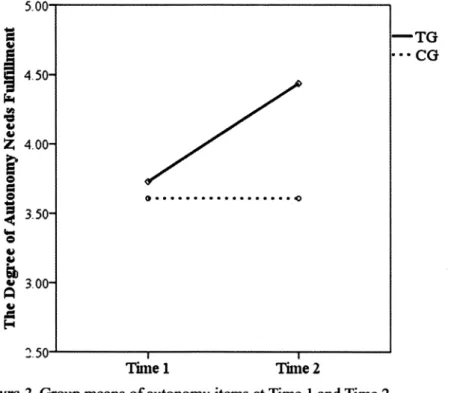
The interaction of group by time was significant for autonomy needs fulfillment
{F (1, 45) = 6.14, p < .05, riG^ == .058). Further analysis showed a significant simple
main effect of time on the satisfaction of autonomy needs for the TG, with a large effectsize (ri^ = .562). This caused a significantdifference between the two groups at Time 2
with quite a large effect size (r|^ = .232). As for the CG, no significant simple main
effect of time existed on the fulfillment of the needs. Based on the results, it can be argued that, on one hand, the TG—^who received a pedagogical intervention to fulfill thePedagogical Intervention to Enhance Self-determined Forms of L2 Motivation: Applying Self- determination Theory in the Japanese University EFL Context
needs for autonomy—could understand and accept the value of English learning better.
On the other hand, the CG—^who did not receive instructions to fulfill the basic needs—
did not increase their understanding of the value of learning English.
5M
Z 4.00-
Time 1 Unie 2
Figure 2. Group means of autonomy items at Time 1 and Time 2.
Table 6
Summary ofANOVA Evaluating the Effects of Group (CG and TG) and Time (Time 1 and 2) Variation on SDT Constructs on autonomy (A)
Source df MS F P IJG2
Between Subjects
Group 5.292 1 5.292 10.298 .002 .100
Error 23.123 45 .514
Within Subjects
Time 2.946 1 2.946 6.141 .017 .053
Timex Group 2.946 1 2.946 6.141 .017 .058
Error (Time) 21.590 45 .480
Total 55.898 93.000
Note. SS = sum of squares; df = degree of freedom; MS = mean square; F = F statistic; /? = significance level, = generalized r) squared.
- 150 -
4.2.2 Competence
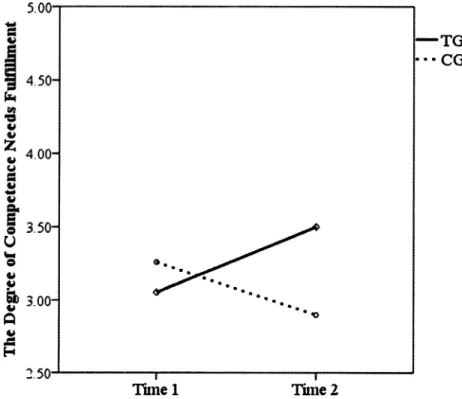
For competence, the interaction of group by time was significant (F (1, 45) =
5.02,/? < .05, r|G^ = .053). Furtherresearch indicated a significant simple main effect of
time on the satisfaction of competence needs for the TG; however, no significant differences were found between the CG and TG at Time 2. In addition, no significant simple main effect of time existed on the fulfillment of competence needs for the CG.The results suggested that, through the instructions designed to reinforce their sense of achievement, students in the TG were able to feel more competent in English. On the contrary, the CG did not enhance their confidence in English; in fact, some might have lost it. Yet the difference between the two groups did not reach significance at Time 2.
This may be because the TG's needs fulfillment was slightly lower than that of the CG at the beginning and, thus, required a greater increase in the TG or a greater decrease in the CG to make the gap significant.
5.00"
-s
Hine 1 Time 2
Figure 3. Group means of competence items at Time 1 and Time 2.
Pedagogical Intervention to Enhance Self-determined Forms of L2 Motivation: Applying Self- determination Theory in the Japanese University EFL Context
Table 7
Summary ofANOVA Evaluating the Effects of Group (CG and TG) and Time (Time 1 and 2) Variation on SDT Constructs on competence (C)
Source 55 df MS F P rjG2
Between Subjects
Group .922 1 .922 1.354 .251 .013
Error 30.615 45 .680
Within Subjects
Time .040 1 .040 .052 .821 .000
Timex Group 3.822 1 3.822 5.016 .030 .053
Error (Time) 34.287 45 .762
Total 69.685 93.000
Note, SS = sum of squares; df = degree of freedom; MS = mean square; F = F
statistic; p = significance level, r|G^ = generalized r| squared.
4.2.3 Relatedness
The interaction of group by time was also significant for relatedness needs (1, 45) = 11.09, p < .05, r|G^ = .101). In terms of the satisfaction of relatedness needs for TG, the simple main effect of time was significant, with a large effect size of — .539.
This contributed to a significant difference between the two groups at Time 2. There was no significant simple main effect of time on the fulfillment relatedness needs for the CG. The results indicated that the cooperative pair and group work used throughout the course for the TG successfully tightened the bond among the classmates in the group.
Regarding the CG, because these students studied individually most of the time during the course, they might not have ever considered learning English by working together
with others.
- 152 -
5.00"
4.50-
4.00-
3.50-
4^
Sb
4^
Q 3.00-
2.50
Figure
Time 1 Time2
4. Group means of relatedness items at Time 1 and Time 2.
Table 8
SummaryofANOVA Evaluating the Effects of Group (CG and TG) and Time (Time 1 and 2) Variation on SDT Constructs on relatedness (R)
Source df MS F P i2g2
Between Subjects
Group 4.078 1 4.078 8.928 .005 .079
Error 20.556 45 Abl
Within Subjects
Time 2.563 1 2.563 5.357 .025 .047
Timex Group 5.305 1 5.305 11.090 .002 .101
Error (Time) 21.527 45 .478
Total 54.029 93.000
Note. SS = sum of squares; df = degree of freedom; MS = mean square; F = ¥
statistic; p = significance level, r|G^ = generalized r| squared.
euoc
a<
1
•Sc15
SuiCNWo^
£D^I
•| §
CcdSCIh(D^ll
1>C00(DO
^1
cda 8§
§><DB^a Table9
SelectedResultsofANOVAEvaluatingtheEffectsofGroup(ContrastandTreatment)andTime(Time1andTime2)Variationon
Motivation
Motivation
/Regulation Interaction
(TimexGroiy) MainEffectSinpleMainEffect
intrinsic
p <.05, riG^
=.054 ContrastTreatment Time1vs.Time2
Time1vs.Time2 n.s.,\\=.004
p < .05, ri^ = .453
Time2contrastvs.treatment
n.s., r|^ = .156
1LO1 identified
n.s.
Group p < .001, riG^
=.140externaln.s.
Groupp < .05, r|G^ =
.061 amotivationp < .05, riG^
=.035 ContrastTreatment
Time2 Time1vs.Time2
Time1vs.Time2
contrastvs.treatment
n.s., r|^ = .113 n.s., r|^ = .099 p <.05,ti^ = .211
22Note,p=significancelevel;n.s.=nonsignificant;qo=generalizedetasquared;r|=etasquared
4.3 English Learning Motivation
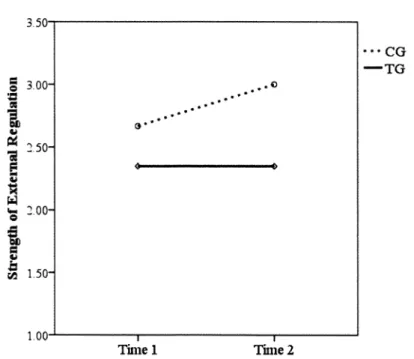
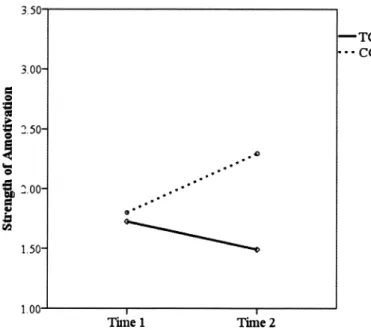
Mixed two-way repeated measures ANOVAs were also applied to data collected via the English Learning Motivation Scale. The selected results are summarized in Table 9. The figures and tables presented in this section illustrate the changes in intrinsic motivation (Figure 5 and Table 10) and identified regulation (Figure 6 and Table 11), external regulation (Figure 7 and Table 12), and amotivation (Figure 8 and Table 13) of the TGand CO.
4.3.1 Intrinsic motivation
The interaction of group by time was statistically significant (F(l, 45) = .498, p
< .05, rjG^ =.054) for intrinsic motivation. Furtheranalysis revealed a significant simple main effect of time on the TG, with a medium to large effect size (r|^ = .453). Although
no statistically significant differences were found between groups at Time 2, medium effect size (r|^ =.156) indicated practical significance of the difference between the CG and TG. No significant differences were found in the CG over time. It can be inferred from the results that, although the TG—^whose needs were more fulfilled—increased intrinsic motivation and thus enjoyment of learning English, the CG—^whose needs fulfillment stayed at the same level—did not experience changes in intrinsic motivation to learn English.5.00'
Tiine 1 Time 2
Figure 5. Group means of intrinsic motivation at Time 1 and Time 2.
Pedagogical Intervention to Enhance Self-determined Forms of L2 Motivation: Applying Self- determination Theory in the Japanese University EFL Context
Table 10
Summary ofANOVA Evaluating the Effects of Group (CG and TG) and Time (Time 1 and 2) Variation on SDT Constructs on intrinsic motivation (IM)
Source df MS F P i1g2
Between Subjects
Group 2.281 1 2.281 3.455 .070 .032
Error 29.700 45 .660
Within Subjects
Time 3.874 1 3.874 4.807 .034 .051
Timex Group 4.013 1 4.013 4.980 .031 .054
Error (Time) 36.261 45 .806
Total 76.129 93.000
Note. SS = sum of squares; df = degree of freedom; MS = mean square; F = F
statistic; p = significance level, rjc^ = generalized r| squared.
4.3.2 Identified regulation
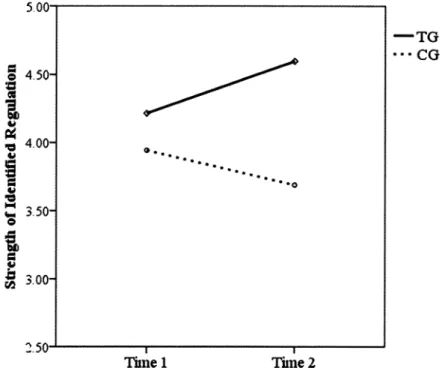
As for identified regulation, the interaction of group by time was not found.
Further analysis with post-hoc Tukey showed that differences between the CG and TG reached a significant level (F(l, 45) = 20.729,p < .001, =.140) at Time 2, with a medium effect size. When considering the descriptive statistics, it can be understood that this result stemmed from the shght decrease in the CG's identified regulation over time and the increase in the TG's identified regulation, both of which occurred at the same time. Similar to what was discussed in the Intrinsic Motivation subsection, it is reasonable to argue that the TG, whose needs were more fulfilled, acknowledged and accepted the importance of learning English and thus improved the identified regulation to learn the language. On the contrary, the CG—^whose needs fulfillment remained at the same level or even decreased—did not gain their acceptance or understanding of the rationales for learning English.
4.3.3 External regulation
The interaction of group by time was not found for external regulation either.
Further analysis with Tukey indicated that, at Time 2, differences between the CG and TG reached a significant level with a small to medium size effect (F(l, 45) = 7.835, p
< .05, TjG^ =.061). Figure 7 illustrates that the CG's external regulation increased
whereas that of the TG remained the same. In addition, the CG's external regulation was slightly higher than that of the TG to begin with. These results contributed to the significant gap revealed between the two groups at the end of the year. By design, the CG students received few rationales for the tasks on which they were asked to work and- 156 -
few opportunities from the instructor to express their feelings and opinions. Because of such instructions, students in the CG may have felt pushed to study English.
5 00'
o 4.50-
Hme 1 Time 2
Figure 6. Group means of identified regulation at Time 1 and Time 2.
Table 11
Summary ofANOVA Evaluating the Effects of Group (CG and TG) and Time (Time 1 and 2) Variation on SDT Constructs on identified regulation (ID)
Source 55 df MS F P ijg2
Between Subjects
Group 8.205 1 8.205 20.729 .000 .140
Error 17.813 45 .396
Within Subjects
Time .097 1 .097 .144 .706 .002
Timex Group 2.372 1 2.372 3.534 .067 .045
Error (Time) 30.204 45 .671
Total 58.691 93.000
Note. SS = sum of squares; df = degree of freedom; MS = mean square; F = F
statistic; p = significance level, r|G^ = generalized r| squared.
Pedagogical Intervention to Enhance Self-determined Forms of L2 Motivation: Applying Self- determination Theory in the Japanese University EFL Context
3.50-
S 1.50-
Tinie 1 Time 2
Figure 7. Group means of extemal regulation at Time 1 and Time 2.
Table 12
Summary ofANOVA Evaluating the Effects of Group (CG and TG) and Time (Time 1 and 2) Variation on SDT Constructs on external regulation (EX)
Source 55 df MS F P ijg2
Between Subjects
Group 5.551 1 5.551 7.835 .008 .061
Error 31.880 45 .708
Within Subjects
Time .652 1 .652 .559 .459 .007
Timex Group .652 1 .652 .559 .459 .008
Error (Time) 52.556 45 1.168
Total 91.291 93.000
Note. SS = sum of squares; df = degree of freedom; MS = mean square; F = ¥
statistic; p = significance level, r|G^ = generalized rj squared.
4.3.4 Amotivation
The interaction of group by time was statistically significant with a small effect
size (F(l, 45) = 5.004,/? < .05, r|G^ =.035). Further analysis revealed the significant
simple main effect of group {p < .05, = .211) at Time 2, with a medium to large effect size. The CG's amotivation slightly increased over time, but the increase did not reach a significant level. The TG's amotivation slightly decreased over time, but the decrease158 -
did not reach significance. The significant difference found between the two groups at Time 2 was due to the CG and TG moving away from each other. Ahhough the changes in both groups were statistically nonsignificant, with each group's scores changing in different directions, the gap between the two became significant. It might also be worth mentioning that the trend in the changes was in line with the findings in the other motivation/regulations, indicating that the TG could decrease their amotivation whereas the CG could increase it slightly thanks to the instructions provided.
3.50"
3.00-
i
2.50-2.00-
I
1.50-
1.00-
Time 1 Tinie 2
Figure 8. Group means of amotivation at Time 1 and Time 2.
Table 13
Summary ofANOVA Evaluating the Effects of Group (CG and TG) and Time (Time 1 and 2) Variation on SDT Constructs on amotivation (AM)
Source 55 df MS F P i]g2
Between Subjects
Group 4.537 1 4.537 10.132 .003 .081
Error 20.151 45 .448
Within Subjects
Time .404 1 .404 .648 .425 .007
Timex Group 3.121 1 3.121 5.004 .030 .035
Error (Time) 28.061 45 .624
Total 56.275 93.000
Note. SS = sum of squares; df = degree of freedom; MS = mean square; F = F statistic; p = significance level, = generalized q squared.
Pedagogical Intervention to Enhance Self-determined Forms of L2 Motivation: Applying Self- determination Theory in the Japanese University EFL Context
5. Conclusion
Given the results of pedagogical intervention based on SDT, the TG students'
needs v^ere more satisfied than those of the students who did not receive SDT-based
instructions (i.e., the CG). Furthermore, after the treatment period, the TG's intrinsic motivation increased significantly and the identified regulation showed an increasing trend. However, in the CG, neither the degree of students' needs satisfaction nor their motivation intensity showed a significant difference. These results indicate the effectiveness of SDT-based intervention to enhance Japanese university students' motivation to learn English. The results also demonstrated that the new questionnaire is sensitive to measuring changes in Japanese university students' needs fulfillment degrees and L2 motivation intensities.
The findings of the study offer theoretical and practical implications. From a theoretical point of view, the current study further verified the applicability of SDT and the newly developed questionnaire in the Japanese university EFL setting. As the new questionnaire was based on the amended definitions of the constructs, the results of this study showed the validity evidence of the polished definitions as well. In particular, the definition of autonomy needs, which was majorly revised in the process of developing the questionnaire, seems to better reflect the Japanese university EFL learners' perception of autonomy support.
In practical terms, this study demonstrated that SDT is indeed a useful framework for enhancing Japanese university EFL learners' motivation. Moreover, it provided some examples that language instructors can try in the classroom or use for finding new teaching ideas.
However, the current study used a limited number of participants at a single institution. In addition, the type of English classes was limited to a test-preparation course. Furthermore, only the first author, who was specialized in this subfield, offered the treatment to the participants. Replication studies are necessary before generalizing the results. Possible future participants for such a study include students with different academic interests and future career plans that may affect the traits of their L2 motivation. Regarding possible types of English classes and instructors for future replication studies, conversation, writing, and reading classes taught by different instructors may be used.
- 160 -
Acknowledgments
The authors are grateful to the anonymous reviewers for their constructive suggestions on an earlier draft of this article.
This work was partially supported by JSPS KAKENHI Grant Number 26370705.
Notes
1. Based on Asano, Suzuki, and Kojima (2005), an adequate model fit is indicated by GFI values > .90, CFI > .90, and RMSEA < .10.
2. The questionnaire used in this study is available from the first author upon request.
3. A statistically significant difference shows that the mathematical probability of difference between two or more variables is higher than a certain level (usually .05), which means that the probability of a relationship due to random chance is a certain (usually 5) percent. A practically significant difference indicates that the difference between variables is meaningful beyond the likelihood of chance and, thus, has a real-world application.
4. Mizumoto and Takeuchi (2008) offered the guidelines of r = .10, .30, and .50 as representing small, medium, and large effects, respectively.
References
Agawa, T. (2008). Gakushusha chushin no shikakushikentaisaku kouza: Group work dounyu no teian [Bringing student-centeredness into test-preparation classrooms: Introducing group activities]. Keisen University Bulletin, 20, 293- 311. Retrieved from http://ci.nii.ac.jp/naid/l 10006603042
Agawa, T., & Takeuchi, O. (2016a). VaHdating self-determination theory in the Japanese EFL context: The relationship between innate needs and motivation.
The Asian EFL Journal Quarterly, 18, 7-33. Retrieved from http://asian-efl joumal.com/9452/quarterly-joumal/2016/02/volume-18-issue-1 -march-2016- quarterly-j oumal/
Agawa, T., & Takeuchi, O. (2016b). Re-examination of psychological needs and L2 motivation of Japanese EFL leamers: An interview study. The Asian EFL Journal Professional Teaching Articles, 89, 74-98.
Agawa, T., & Takeuchi, O. (2016c). A new questionnaire to assess Japanese EFL leamers' motivation: Development and validation. ARELE (Annual Review of English Language Education in Japan), 27, 1-16.
Pedagogical Intervention to Enhance Self-determined Forms of L2 Motivation: Applying Self- determination Theory in the Japanese University EFL Context
Agawa, T., & Takeuchi, O. (2017). Examining the validation of a newly developed motivation questionnaire: Applying self-determination theory in the Japanese university EFL context. JACET Journal, 61, 1-22.
Agav^a, T., & Ueda, M. (2013). How Japanese students perceive demotivation toward English study and overcome such feelings. JACET Journal, 56, 1-18.
Asano, H., Suzuki, T., & Kojima, T. (2005). Nyumon Kyobunsan Kouzoubunseki no Jissai [Introductory guide: Practical matters about structural equation modeling].
Tokyo: Kodansya.
Bakeman, R. (2005). Recommended effect size statistics for repeated measures designs.
Behavior Research Methods, 37, 379-384. doi:10.3758/BF03192707
Comanaru, R., & Noels, K. (2009). Self-determination, motivation, and the learning of Chinese as a heritage language. The Canadian Modern Language Review, 66,
131-158. doi: 10.3138/cmlr.66.1.131
Crandall, J. (1999). Cooperative language learning and affective factors. In J. Arnold (Ed.), Affect in language learning (pp. 226-245). Cambridge, England: Cambridge University Press.
Deci, E. L., & Ryan, R. M. (1985). Intrinsic motivation and self-determination in human behavior. New York, NY: Plenum Press.
Deci, E. L., & Ryan, R. M. (2000). The "what" and "why" of goal pursuits: Human needs and the self-determination behavior. Psychological Inquiry, 11, 227-268.
doi: 10.1207/S15327965PLI1104_01
Deci, E. L., & Ryan, R. M. (Eds.). (2002). Handbook of self-determination research.
Rochester, NY: University of Rochester Press.
Deci, E. L., & Ryan, R. M. (2008). Facilitating optimal motivation and psychological well-being across life's domains. Canadian Psychology, 49, 14-23.
Dei, Y. (2011). Pedagogical intervention to enhance EFL students' motivation: An attempt based on self-determination theory. Journal of Kansai University Graduate School ofForeign Language Education and Research, 10, 1-19.
Domyei, Z., & Taguchi, T. (2010). Questionnaires in second language research:
Construction, administration, andprocessing (2nd ed.). London: Routledge.
Educational Testing Service (ETS). (2004). Mapping TOEFL, TSE, TWE, and TOEIC on the Common European Framework: Executive summary. Princeton, NJ:
Author. Retrieved from http://vv^w.besig.org/events/iateflpce2005/
ets/CEFsummaryMarch04.pdf
- 162 -