Instructions for use T itle On convexity of simple closed frontals
A uthor(s ) F ukunaga,T omonori; T akahashi,Masatomo
C itation Hokkaido University Preprint S eries in Mathematics, 1073: 1-9
Is s ue D ate 2015-6-19
D O I 10.14943/84217
D oc UR L http://hdl.handle.net/2115/69877
T ype bulletin (article)
Tomonori Fukunaga and Masatomo Takahashi
June 6, 2015
Abstract
We study convexity of simple closed frontals in the Euclidean plane by using the curvature of Legendre curves. We show that for a Legendre curve, the simple closed frontal is convex if and only if the sign of both functions of the curvature of the Legendre curve does not change. We also give some examples of convex simple closed frontals.
1
Introduction and main result
In the classical differential geometry of regular curves, we can analyze global properties of curves, such as convexity, width and rotation number by using the curvature (cf. [4],[5]). One of well-known result is a characterization of convexity of simple closed regular curves by using the curvature (cf. [5]):
Theorem 1.1 A simple closed regular curve is convex if and only if its curvature κ has a constant sign; that is, κ is either always non-positive or always non-negative.
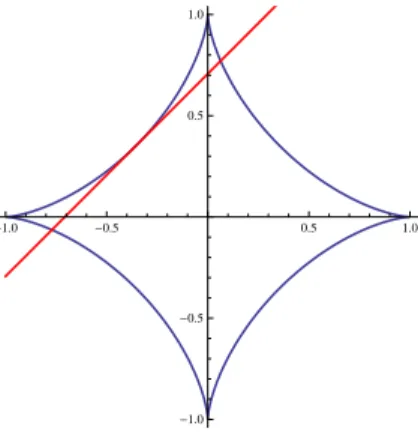
When we consider singular curves, the above theorem does not hold; that is, there is a simple closed singular curve with the curvature is always non-positive except singular points, but the curve is not convex (the curve divided by a tangent line). For example, let γ : [0,2π]→R2 be
the astroidγ(t) = (cos3t,sin3t). The curvatureκ of γ is given byκ(t) =−2/(3|sin 2t|) except
four singular points and diverges to −∞ at each singular points. Hence, κ has the constant sign. However, this curve is not convex, see Figure 1.
In the present paper, we give a characterization of convexity for a special class of singular curves called frontals by using the curvature of Legendre curves which has introduced in [3].
LetI be an interval. We say that (γ, ν) :I →R2×S1isa Legendre curveif (γ(t), ν(t))∗
θ= 0 for allt ∈I, where θ is the canonical contact form on the unit tangent bundle T1R2 =R2×S1
andS1 is the unit sphere (cf. [1],[2]). This condition is equivalent to ˙γ(t)·ν(t) = 0 for allt ∈I, where·is the Euclidean inner product onR2. We say thatγ :I →R2 isa frontal if there exists
a smooth mapping ν:I →S1 such that (γ, ν) is a Legendre curve.
Let (γ, ν) : I → R2 ×S1 be a Legendre curve. If γ is a regular curve around a point t0,
then we have the Frenet frame along γ. On the other hand, if γ is singular at a pointt0, then
2010 Mathematics Subject classification: 58K05, 53A04, 57R45
-1.0 -0.5 0.5 1.0
-1.0
-0.5
0.5 1.0
Figure 1: The tangent line att = 3π/4 of the astroidγ(t) = (cos3t,sin3t) divide the curve.
we can not define the Frenet frame. However, ν is always defined even if t0 is a singular point
of γ. Therefore, we have a frame along a frontal γ as follows. We put on µ(t) = J(ν(t)). We call the pair {ν(t),µ(t)} a moving frame along the frontal γ(t) in R2 and we have the Frenet
formula of the frontal (or, the Legendre curve) which is given by
˙
ν(t) ˙
µ(t)
=
0 ℓ(t)
−ℓ(t) 0
ν(t)
µ(t)
,
whereℓ(t) = ˙ν(t)·µ(t). Moreover, there exists a smooth function β(t) such that
˙
γ(t) = β(t)µ(t).
The pair (ℓ, β) is an important invariant of Legendre curves (or, frontals). We call the pair (ℓ(t), β(t))the curvature of the Legendre curve (with respect to the parameter t).
Remark 1.2 Let (γ, ν) : I → R2×S1 and (γ, ν) : I → R2×S1 be Legendre curves whose
curvatures of Legendre curves are (ℓ, β) and (ℓ, β) respectively. Suppose that (γ, ν) and (γ, ν) are parametrically equivalent via the change of parameter t : I → I;u 7→ t(u) with ˙t(u) > 0, that is, (γ(u), ν(u)) = (γ(t(u)), ν(t(u))) for allu∈I. Then, we have
ℓ(u) =ℓ(t(u)) ˙t(u), β(u) =β(t(u)) ˙t(u).
Hence the curvature of the Legendre curve is depended on a parametrization.
Definition 1.3 Let (γ, ν) and (eγ,νe) : I → R2 ×S1 be Legendre curves. We say that (γ, ν)
and (eγ,νe) are congruent as Legendre curves if there exists a congruence C on R2 such that
e
γ(t) =C(γ(t)) = A(γ(t)) +b and eν(t) = A(ν(t)) for all t∈I, where C is given by the rotation
A and the translation b on R2.
Then we have the following theorems.
Theorem 1.4 (The Existence Theorem, [3]) Let (ℓ, β) : I →R2 be a smooth mapping. There exists a Legendre curve (γ, ν) :I →R2×S1 whose associated curvature of the Legendre curve
curves whose curvatures of Legendre curves (ℓ, β) and (eℓ,βe) coincide. Then (γ, ν) and (eγ,eν)
are congruent as Legendre curves.
For n ∈ N∪ {0}, we say that a Legendre curve (γ, ν) : [a, b] → R2 ×S1 is Cn-closed if (γ(k)(a), ν(k)(a)) = (γ(k)(b), ν(k)(b)) for all k ∈ {0,· · · , n}, where γ(k)(a), ν(k)(a), γ(k)(b) and
ν(k)(b) mean one-sidedk-th differential. Similarly, we say that a Legendre curve (γ, ν) : [a, b]→
R2×S1 is C∞
-closed if (γ(k)(a), ν(k)(a)) = (γ(k)(b), ν(k)(b)) for all k ∈ N∪ {0}. In this paper,
we say that (γ, ν) is a closed Legendre curve, if the curve is at least C1-closed. Note that if
(γ, ν) is a closed Legendre curve, the domain of the curve can be extended from [a, b] to R so
that (γ, ν)([a, b]) = (γ, ν)(R) and the extended map (γ, ν) : R → R2×S1 is at least C1 map.
Moreover, a frontal γ : [a, b] →R2 is simple closed if for t1 < t2, we have γ(t1) = γ(t2) if and
only ift1 =a and t2 =b
We define a convex frontal in the Euclidean plane. From now on,I is a closed interval. Let (γ, ν) : I → R2 ×S1 be a Legendre curve. We denote the tangent line at t of γ by Lt, that
is, Lt = {λµ(t) +γ(t) | λ ∈ R}. Any tangent line Lt divides R2 into two half-planes H+ and
H− such that H+∪H− =R2 and H+∩H− =Lt. By using ν, the half-planesH+ and H− are
presented byH+={x∈R2 | (x−γ(t))·ν(t)≥0} and H− ={x∈R
2 | (x−γ(t))·ν(t)≤0}.
For a Legendre curve (γ, ν) :I →R2×S1, we say that (γ, ν) is a convex Legendre curve(or, γ
is aconvex frontal) ifγ(I)⊂H+ for any tangent line of γ orγ(I)⊂H− for any tangent line of
γ. Note that if γ is a regular curve, then µ(t) is equal to the unit tangent vector of γ atγ(t) up to sign. Therefore, γ is a convex curve as a frontal if and only if γ is a convex curve as the usual mean whenγ is a regular curve (cf. [5]).
By definition, convexity of a Legendre curve is preserved under a congruence as Legendre curves. Moreover, if (γ, ν) :I →R2×S1 is a convex Legendre curve, then (γ◦u, ν◦u) :I → R2×S1 is also convex for a change of parameter u:I →I and any smooth function u:I →I
as well.
The main result of this paper is stated as follows:
Theorem 1.6 Let (γ, ν) : I → R2×S1 be a closed Legendre curve with the curvature (ℓ, β)
which the frontal γ is simple closed. Suppose that zeros ofℓ and of β are isolated points. Then the frontal γ is convex if and only if the curvature satisfy one of the following condition:
(i) Both of ℓ(t) and β(t) are always non-negative,
(ii) ℓ(t) is always non-negative and β(t) is always non-positive,
(iii) Both of ℓ(t) and β(t) are always non-positive,
(iv) ℓ(t) is always non-positive and β(t) is always non-negative.
We prove this theorem in Section 2. Moreover, we give examples of convex simple closed frontals in Section 3.
Acknowledgement. The first author was partially supported by JSPS KAKENHI Grant
2
Proof of the main result
Let (γ, ν) : I → R2×S1 be a closed Legendre curve with the curvature (ℓ, β). In this paper,
we assume that zeros ofℓ and β are isolated points. First, we prove that if the sign of ℓ or the sign of β change, then the frontalγ is not convex.
Lemma 2.1 Let(γ, ν) :I →R2×S1 be a closed Legendre curve. If the sign ofℓ(t)or the sign
of β(t) change, then the frontal γ is not convex.
Proof. Let t0 ∈ I be a point such that the sign of ℓ or the sign of β change, that is, locally
ℓ(t) > 0 (respectively, ℓ(t) < 0) if t < t0 and ℓ(t) < 0 (respectively, ℓ(t) > 0) if t > t0, or
β(t) > 0 (respectively, β(t) < 0) if t < t0 and β(t) < 0 (respectively, β(t) > 0) if t > t0.
Convexity of the frontal does not change by a congruence of Legendre curves, hence we may assumeγ(t0) is the origin of the Euclidean plane without loss of generality.
If the sign of γ(t)·ν(t0) change around t0, thenLt0 divide the frontalγ. To prove that the
frontalγ is not convex, we show that the sign of γ(t)·ν(t0) changes around t0.
By the definition of β, we have
d
dt(γ(t)·ν(t0)) =β(t)µ(t)·ν(t0).
Since kµ(t)k = kν(t0)k = 1, there is a smooth function ϕ such that µ(t)·ν(t0) = cosϕ(t).
Moreover, by the definition ofℓ, we have
−ϕ˙(t) sinϕ(t) = d
dt(µ(t)·ν(t0)) = −ℓ(t)ν(t)·ν(t0). (1)
Since cosϕ(t0) = µ(t0)·ν(t0) = 0, we have sinϕ(t0) = ±1. Substitute t0 for the equation (1),
we obtain
˙
ϕ(t0) = ±ℓ(t0). (2)
First, we consider the case of the sign ofℓchanges and the sign ofβ does not change around
t0. In this case, ˙ϕ(t0) = 0 by (2). Sinceν(t)·ν(t0) is a continuous function andν(t0)·ν(t0) = 1,
we have ν(t)·ν(t0) > 0 around t0. By the equation (1), the sign of ˙ϕ(t) changes around t0.
This conclude that the sign of cosϕ(t) does not change around t0. Hence µ(t)·ν(t0) ≥ 0 or
µ(t)·ν(t0)≤0 around t0. Moreover, since the sign of β does not change around t0, we obtain
(d/dt)(γ(t)·ν(t0)) ≥ 0 or (d/dt)(γ(t)·ν(t0))≤ 0, that is, γ(t)·ν(t0) is a monotone function
around t0. By the assumption γ(t0) = 0, we have γ(t0)·ν(t0) = 0 and the sign of γ(t)·ν(t0)
changes aroundt0. Therefore, γ is not convex.
Second, we consider the case of the sign of β changes and the sign of ℓ does not change around t0. By the equation (1), the sign of ˙ϕ(t) does not change around t0, that is, ˙ϕ(t) is a
monotone function aroundt0. This conclude that the sign of cosϕ(t) changes aroundt0. Hence
the sign of µ(t)·ν(t0) changes around t0. It follows that the sign of (d/dt)(γ(t)·ν(t0)) does
not change around t0. By the same argument of the first case,γ is not convex.
Finally, we consider the case of the signs of ℓ and β changes around t0 simultaneously. We
prove by a contradiction. Assume that the frontalγ is a convex curve. Since the signs ofℓ and
β change aroundt0, similar to the first and second cases, the sign of (d/dt)(γ(t)·ν(t0)) changes
aroundt0. Moreover,
d
changes aroundt0. Hence,γ is contained a quadrant in the {ν(t0),µ(t0)}-plane around t0.
By differentiating µ(t)·ν(t0), we have
d
dt(µ(t)·ν(t0)) = −ℓ(t)ν(t)·ν(t0). (3)
By the equation (3), the sign of (d/dt)(µ(t)·ν(t0)) changes aroundt0 and (d/dt)(µ(t0)·ν(t0)) =
0. Therefore,t0 is a local maximal or local minimal point ofµ(t)·ν(t0). It follows that for any
ε >0, there exist t1 ∈(t0−ε, t0) andt2 ∈(t0, t0+ε) such that
µ(t1)·ν(t0) =µ(t2)·ν(t0) (4)
Since {ν(t0),µ(t0)} is a basis on R2, there exist smooth functions λ and η such that µ(t) =
λ(t)ν(t0) +η(t)µ(t0). By the equation (4), we have λ(t1) = λ(t2). Moreover, since µ(t1) and
µ(t2) are unit vectors, we have λ2(t1) +η2(t1) = λ2(t2) +η2(t2). Hence, η(t1) = ±η(t2). By
the definition of η, we have η(t0) = 1. It follows that both η(t1) and η(t2) are positive. Thus
η(t1) = η(t2) and hence µ(t1) =µ(t2). It follows thatLt1 is parallel toLt2. Since zeros ofβ are
isolated points, by change of the choice of t1 and t2 if we need, we may assume γ(t1)6=γ(t2).
Now suppose thatLt1 =Lt2. Since we assumeγ is a convex curve, the curve lies on one-side
of Lt1(= Lt2) and tangent at t1 and t2. Since zeros of ℓ are isolated points, Lt1 is a double
tangent line of γ. It follows that, there exists a point t3 around t1 or t2 such that Lt3 divide
γ(I). This contradict to convexity ofγ. Hence, we have Lt1 6=Lt2.
On the other hand, when Lt1 6=Lt2, we obtain
γ(I)⊂ {x∈R2|(x−γ(t1))·ν(t1)≥0} ∩ {x∈R2|(x−γ(t2))·ν(t2)≥0}
or
γ(I)⊂ {x∈R2|(x−γ(t1))·ν(t1)≤0} ∩ {x∈R2|(x−γ(t2))·ν(t2)≤0}
by the definition of the convex. The tangent line Lt1 or Lt2 divide γ(I), since γ lies on a
same side of half-planes which are divided by Lt1 and Lt2. This contradict to convexity of γ.
Therefore,γ is not convex. ✷
In the rest of this section we prove that if the signs of ℓ and β does not change, then the simple closed frontal γ is convex. In order to prove this claim, we prepare some lemmas and notations.
Lemma 2.2 Let(γ, ν) :I →R2×S1 be a Legendre curve with the curvature (ℓ, β). If β(t)≥0
for all t∈I or β(t)≤0 for all t∈I, then there is the smooth mapΦ(γ, ν) :I →S1 such that
Φ(γ, ν) = ˙γ/kγ˙k on I\ Zβ, where Zβ ={t∈I | β(t) = 0}.
Proof. By the definition of β, we obtain
˙
γ(t)
kγ˙(t)k =
β(t)
|β(t)|
µ(t)
kµ(t)k =
β(t)
|β(t)|µ(t) = sign(β(t))µ(t)
on I \ Zβ, where sign(β(t)) is the sign of β(t). Therefore, we can extend this function to
I if and only if sign(β(t)) is a constant map on I \ Zβ. By the assumption, we may define Φ(γ, ν)(t) = sign(β(t))µ(t). Here we also denote sign(β(t)) by 1 if β(t) ≥ 0 for all t ∈ I and
We denote the set of closed Legendre curves (γ, ν) with β(t) ≥ 0 (respectively, β(t) ≤ 0) for all t∈ I by R+ (respectively, R−), and R+∪ R− by R. For a Legendre curve (γ, ν)∈ R,
we define a smooth function θ : I → R such that Φ(γ, ν)(t) = (cosθ(t),sinθ(t)) by Lemma
2.2. Same as the case of regular curves, for a Legendre curve (γ, ν)∈ R, we call the degree of Φ(γ, ν) the rotation index of the Legendre curve (γ, ν).
Lemma 2.3 If (γ, ν)∈ R, then ℓ(t) =−sign(β(t)) ˙θ(t).
Proof. Suppose (γ, ν)∈ R, we have
µ(t) = sign(β(t))Φ(γ, ν)(t) = sign(β(t))(cosθ(t),sinθ(t))
and
ν(t) =J−1
(µ(t)) = sign(β(t))(sinθ(t),−cosθ(t)).
Then ˙µ(t) = −sign(β(t)) ˙θ(t)ν(t). By the definition of ℓ, we obtain ℓ(t) =−sign(β(t)) ˙θ(t). ✷
Lemma 2.4 Let (γ, ν) : I → R2 ×S1 be a Legendre curve with (γ, ν) ∈ R. Then there is a
point t0 ∈I with the property that γ(I) lies entirely to one side of Lt0.
Proof. Let (x, y) be a coordinate on R2 and let γ(t0) = p be a point which has maximum
height, that is,y-coordinate is maximum in γ(I). Without loss of generality, we may assumep
is the origin of the Euclidean plane and (γ, ν)∈ R+. Since the sign of β does not change and
µ(t0)·µ(t0) = 1, we have
d
dt(γ(t)·µ(t0)) =β(t)µ(t)·µ(t0)≥0
aroundt0. If the sign of (d/dt)(γ(t)·ν(t0)) does not change around t0, thenγthrough the origin
from the second quadrant to the fourth quadrant or the third quadrant to the first quadrant of the {ν(t0),µ(t0)}-plane. This contradict to p has maximum height. Hence, the sign of
(d/dt)(γ(t)·ν(t0)) change around t0. This meansγ lies on the under half-plane divided byLt0.
Moreover, ifLt0 does not coincides with the x-axis, this contradict to p has maximum height.
Therefore,Lt0 coincides with thex-axis. By the above, Lt0 coincides with the x-axis and γ(I)
lies on under thex-axis. Therefore, t0 is a required point. ✷
The rest of the proof is similar to the case of regular curves (see [5]).
Lemma 2.5 Let (γ, ν) :I →R2×S1 be a Legendre curve which the frontal γ is simple closed and (γ, ν)∈ R. Then the rotation index of the Legendre curve (γ, ν) is equal to ±1.
Proof. Letp=γ(t0) be a point on γ(I) with the property thatγ(I) lies entirely to one side of
Lt0. Such a point t0 is always exists by Lemma 2.4.
Now we setI = [0, L]. Consider the triangular regionT :={(t1, t2)∈R2 |0≤t1 ≤t2 ≤L}.
By a reparametrization of (γ, ν), we may assume t0 = 0, that is, γ(0) = p. We define a map
Σ :T →S1 by
Σ(t1, t2) =
Φ(γ, ν)(t) (if t1 =t2 =t),
−Φ(γ, ν)(0) (if t1 = 0 and t2 =L),
γ(t2)−γ(t1)
kγ(t2)−γ(t1)k
C = (L, L). Since the restriction of Σ to the segmentAC is equal to Φ(γ, ν), the degree of this map is equal to the rotation index of (γ, ν).
Moreover, consider the restriction of Σ to the segment AB ∪ BC. Set the angle from Φ(γ, ν)(0) to −Φ(γ, ν)(0) is equal toπ. Since
Σ|AB(t1, t2) = Σ(0, t) = (γ(t)−γ(0))/kγ(t)−γ(0)k,
Σ|AB covers one half of S1. Similarly,
Σ|BC(t1, t2) = Σ(t, L) = (γ(L)−γ(t))/kγ(L)−γ(t)k,
Σ|BC covers other half ofS1. Hence, the degree of the restriction of Σ to the segmentAB∪BC is equal to±1 (the sign depends on an orientation of γ).
Note that the restriction of Σ to the segment AB∪BC is homotopic to the restriction of Σ to the segment AC, that is, Φ(γ, ν). Because the rotation index is preserved under homotopy,
the rotation index of the frontalγ is equal to ±1. ✷
The following lemma is the sufficient part of the main theorem.
Lemma 2.6 Let (γ, ν) :I →R2×S1 be a closed Legendre curve which the frontal γ is simple closed. If the signs of ℓ and β does not change, then the frontal γ is convex.
Proof. By Lemma 2.3, the sign ofℓ(t) does not change if and only if θ is a monotone function on I. Suppose that γ is not convex. There is a point γ(s0) ∈ γ(I) such that Ls0 divide γ
to γ1 ⊂ H+ and γ2 ⊂ H−. By the mean value theorem, there are two points γ(s1) ∈ γ1
and γ(s2) ∈ γ2 such that θ(s1) = θ(s0) up to ±nπ, Ls1 6= Ls2, θ(s2) = θ(s0) up to ±nπ and
Ls2 6=Ls0, Ls1 for some integer n.
Two of the three points γ(s0), γ(s1) and γ(s2) must have tangents point in the same
di-rection. Thus, there are two points si < sj such that Φ(γ, ν)(si) = Φ(γ, ν)(sj) and θ(si) =
θ(sj)±2nπ for some integer n. Sinceθ is monotone and γ is simple closed, n ∈ {0,1,−1} by Lemma 2.5. If n = 0, then θ(si) = θ(sj), that is, θ is constant on the closed interval [si, sj]. This contradict toLsi 6=Lsj. Ifn=±1, thenθ is constant on the setI\[si, sj]. This contradict
toLsi 6=Lsj. Therefore, the frontalγ is convex. ✷
We prove the main theorem as follows.
Proof of Theorem 1.6By combining Lemmas 2.1 and 2.6, we obtain Theorem 1.6. ✷
3
Examples
We show some examples of simple closed frontals and discuss on convexity of them.
Example 3.1 Consider a closed Legendre curve (γ, ν) : [0,2π]→R2×S1 defined by
γ(t) = (cos3t,sin3t), ν(t) = (sint,cost).
Example 3.2 Consider a closed Legendre curve (γ, ν) : [0,2π]→R2×S1 defined by
γ(t) =
1 3cos
3t,sint− 1
3sin
3t
, ν(t) = (cost,sint).
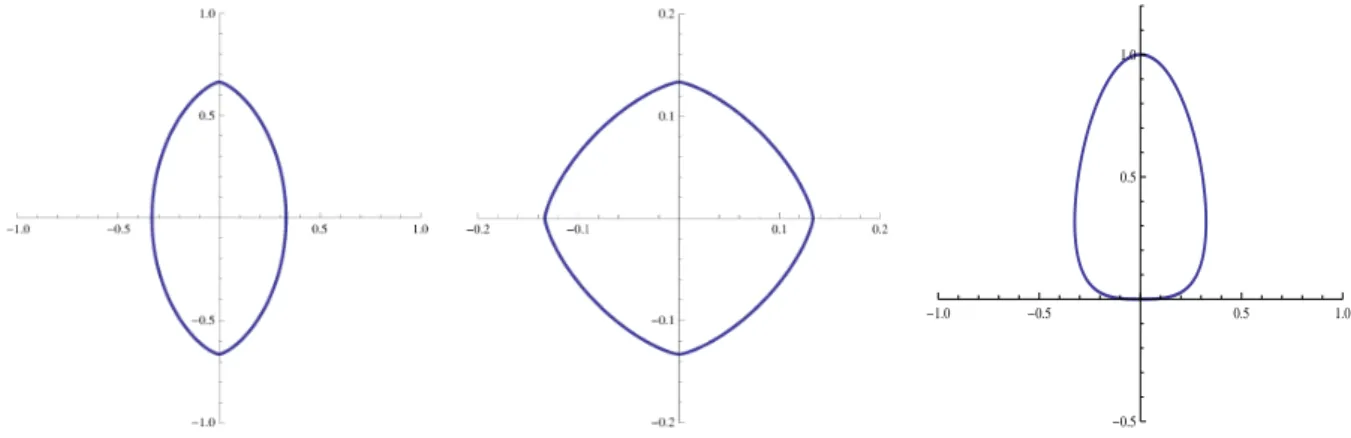
Then the frontalγ is simple closed. Since µ(t) = (−sint,cost), the curvature of the Legendre curve is given by (ℓ(t), β(t)) = (1,cos2t). By Theorem 1.6, γ is a convex frontal, see Figure 2
left.
Example 3.3 Consider a closed Legendre curve (γ, ν) : [0,2π]→R2×S1 defined by
γ(t) =
1 3cos
3t−1
5cos
5t,1
3sin
3t− 1
5sin
5t
, ν(t) = (cost,sint).
Then the frontalγ is simple closed. Since µ(t) = (−sint,cost), the curvature of the Legendre curve is given by (ℓ(t), β(t)) = (1,cos2tsin2t). By Theorem 1.6, γ is a convex frontal, see
Figure 2 center.
Example 3.4 Consider a closed Legendre curve (γ, ν) : [0, π]→R2×S1 defined by
γ(t) = costsin3t,sin8t, ν(t) = p 1
(8 sin5tcost)2+ (3−4 sin2t)2(8 sin
5tcost,4 sin2t−3).
Then the frontalγ is simple closed. Since
µ(t) = p 1
(8 sin5tcost)2+ (3−4 sin2t)2(3−4 sin
2t,8 sin5tcost),
the curvature of the Legendre curve is given by
ℓ(t) = 8 sin
4t(16 sin4t−30 sin2t+ 15)
(8 sin5tcost)2+ (3−4 sin2t)2 ,
β(t) = −sin2t
q
(8 sin5tcost)2+ (3−4 sin2t)2.
Note that 16 sin4t−30 sin2t+ 15 = (4 sin2t−15/4)2 + 15/16 > 0. By Theorem 1.6, γ is a
convex frontal, see Figure 2 right.
-1.0 -0.5 0.5 1.0
-0.5 0.5 1.0
[1] V. I. Arnol’d, Singularities of Caustics and Wave Fronts. Mathematics and Its Applications 62
Kluwer Academic Publishers (1990).
[2] V. I. Arnol’d, S. M. Gusein-Zade and A. N. Varchenko, Singularities of Differentiable Maps vol. I. Birkh¨auser (1986).
[3] T. Fukunaga and M. Takahashi, Existence and uniqueness for Legendre curves. J. Geometry,
104 (2013), 297–307.
[4] C. G. Gibson, Elementary geometry of differentiable curves. An undergraduate introduction. Cambridge University Press, Cambridge, (2001).
[5] A. Gray, E. Abbena and S. Salamon, Modern differential geometry of curves and surfaces with
Mathematica. Third edition. Studies in Advanced Mathematics. Chapman and Hall/CRC, Boca
Raton, FL, (2006).
Tomonori Fukunaga,
Kyushu Sangyo University, Fukuoka 813-8503, Japan E-mail address: [email protected]
Masatomo Takahashi,