Corresponding author: Chika Tanimura, PhD [email protected]
Received 2018 December 26 Accepted 2019 January 25
Abbreviations: AGFI, adjusted goodness-of-fit index; CFI, com-parative fit index; GAINA, Good Ageing and Intervention against Nursing care and Activity decline; GFI, goodness-of-fit index; LS, locomotive syndrome; MI, modification indices; QOL, quality of life; RMSEA, root mean square error of approximation; VAS, visual analogue scale
A Path Model Analysis of the Causal Relationship between Self-care Agency and
Healthy Behavior in Community-dwelling Older People from the GAINA Study
Chika Tanimura,* Hiromi Matsumoto,† Junko Yoshimura,* Yasuko Tokushima,* Yoko Yamamoto,* Yukiko Fujihara,* Masayuki Miyoshi‡§ and Hiroshi Hagino*||*School of Health Science, Tottori University Faculty of Medicine, Yonago 683-8503, Japan, †Department of Rehabilitation, Faculty of Health Science and Technology, Kawasaki University of Medical Welfare, Kurashiki 701-0193, Japan, ‡Division of Medical Education Department of Social Medicine, School of medicine, Tottori University Faculty of Medicine, Yonago 683-8504, Japan, §General Center for Medical Education, Tottori University Faculty of Medicine, Yonago 683-8504, Japan, and ||Rehabilitation Division, Tottori University Hospital, Yonago 683-8504, Japan
ABSTRACT
Background Self-care agency is an important deter-minant of self-care behavior. The purpose of this study was to identify the causal relationship between self-care agency and healthy behavior, and to construct a con-ceptual model of healthy behavior among older people living in a rural community.
Methods This study was conducted as a cross-sectional survey at the Hino, a town in western Tottori Prefecture, Japan. Participants who were enrolled in the Good Ageing and Intervention against Nursing Care and Activity Decline (GAINA) study from 2014 to 2018 (467 new participants) were initially investigated. Of 398 participants aged ≥ 65 years, 5 were excluded due to missing data, and thus 393 were analyzed. Nurse re-searchers conducted face-to-face interviews with partici-pants to check the accuracy of data obtained from a self-administered questionnaire, which included demograph-ic information, physdemograph-ical condition (comorbidities, knee pain, low back pain, and locomotive syndrome), healthy behavior, and self-care agency. Correlations among variables were investigated by Pearson’s correlation coefficient analysis, and path analysis was performed to assess causal relationships.
Results A total of 393 persons (160 men and 233 women) were investigated, ranging in age from 65 to 92 years, with a mean age of 75.1 years (SD: 6.9 years). Path analysis revealed poor fit of a model in which pain and locomotive syndrome were factors inhibiting healthy behavior. When the model included only self-care
agency, the indices of model fit were almost satisfactory (Goodness-of-fit index = 0.967, Adjusted goodness-of-fit index = 0.900, Comparative fit index = 0.951, and Root mean square error of approximation = 0.088), and the coefficient of determination (R2) was 0.38. The
self-care agency items with the greatest influence on healthy behavior were the ability to “grasp the techniques/tips needed to maintain health,” and the ability to “persist with healthy behavior.”
Conclusion Self-care agency can promote healthy behavior among community-dwelling older people. Regardless of physical problems such as pain and lo-comotive syndrome, older people have the potential to adopt positive healthy behavior if they acquire self-care agency.
Key words community-dwelling older people; healthy behavior; self-care agency; path analysis
The concept of self-care agency was introduced by Orem as one of the components of self-care nursing theory.1
According to this theory, self-care agency is defined as one’s ability and willingness to engage in self-care behaviors, which help maintain well-being, functioning, and health, even in individuals with chronic illness.1
Additionally, self-care activities alleviate symptoms and complications of diseases, shorten recovery, and reduce hospital stay durations and rehospitalization rates.2 Since
anxiety and depression are negatively associated with a healthy diet and the frequency of exercise,3 enhancing
care agency to initiate and continue positive self-care healthy behaviors, such as those regarding diet or exercise, could help improve one’s psychological state.
While self-care agency has been shown to be a factor promoting healthy behavior, other studies have investigated the factors that interfere with the acquisition of healthy behavior. Several studies have found that physical factors such as pain and fatigue inhibit the
performance of regular exercise by middle-aged and older people.4, 5 In particular, many older people have
musculoskeletal and other diseases. Thus, despite a desire to engage in exercise and physical activities, these conditions might make it difficult to continue healthy activities due to pain or fatigue.
In consideration of the above mentioned background, we hypothesized that pain and locomotive disabilities or comorbidities are factors that inhibit healthy behavior among community-dwelling older people; however, we also hypothesized that individuals with high self-care agency might learn and engage in healthy behaviors. Finally, we surmised that each component of self-care agency might synergistically influence healthy behavior in a sequential manner, rather than each component affecting healthy behavior in parallel. Accordingly, we aimed to develop a comprehensive sequential model of the associations between pain, locomotive syndrome (LS) as an indicator of physical frailty, comorbidities, and components of self-care agency. Many of the previous studies on factors associated with healthy behavior were based on qualitative approaches and/or univariate and multiple regression analyses. While it is possible to iden-tify a causal relationship by multiple regression analysis, the assumed relationship is simplistic because a number of independent variables are identified as the predictors of a single dependent variable. Moreover, no previous study has investigated which components of self-care agency specifically influence healthy behavior, or how and to what degree. Determining the detailed process by which components of self-care agency affect healthy behaviors may reveal how health education should be conducted. Therefore, this study was performed using path analysis to identify the causal relationship between self-care agency and healthy behavior, and to develop a conceptual model of healthy behavior among older people living in a rural community.
SUBJECTS AND METHODS Setting and participants
This study analyzed participants enrolled in the Good Ageing and Intervention against Nursing Care and Activity Decline (GAINA) study.6–9 The GAINA study,
which began in 2014, is a population-based prospective study of the residents of Hino, a rural town in western Tottori Prefecture, Japan. In 2016, Hino had 3,352 residents and an aging rate of 45.0%. Inclusion criteria included the ability to (i) walk at the time of the sur-vey and (ii) understand and sign an informed consent form. Individuals who were receiving nursing care insurance were excluded from the study. We recruited community-dwelling individuals who underwent a
local government medical check-up between May 2014 and May 2018, and 467 consented to participate in the GAINA study (new participants for 2014–18). Of these, 398 individuals aged ≥ 65 years were investigated in this cross-sectional study and 393 persons were analyzed after 5 with missing data were excluded.
Data collection
Nurse researchers conducted face-to-face interviews with the participants to verify the accuracy of data from the self-administered questionnaire, which covered the following four areas. Participants were asked to fill out a self-administered questionnaire covering four topics (demographic information, healthy behavior, self-care agency, and locomotive syndrome) and to bring it with them to a local government medical check-up. Unclear or blank answers were corrected during a 10-minute interview with a nurse researcher on the day of the med-ical check-up, and the completed questionnaire was used for the analysis.
Background information
Information on age, gender, current employment, family structure, medications, and physical condition (comor-bidities, knee pain, and low back pain) was provided by the participants using a specified form. Knee pain and low back pain were assessed on a 100-mm horizontal visual analogue scale (VAS).
Healthy behavior
To assess ongoing healthy behavior, we asked the par-ticipants whether they incorporated health-maintenance activities into their daily lives. They responded using a 5-point Likert scale: (i) disagree, (ii) somewhat disagree, (iii) neither agree nor disagree, (iv) somewhat agree, or (v) agree. Thus, higher scores meant that participants were better at incorporating healthy behaviors into their daily lives.
Self-care agency
Self-care agency is the ability to engage in self-care, which is assessed based on aspects of behavior and cog-nition. To develop a scale appropriate for assessing self-care agency in community-dwelling older individuals in a rural area, we conducted a literature review regarding self-care agency in patients with chronic illness.6, 10 We
constructed a self-care agency scale based on the results of a confirmatory factor analysis that comprised three factors consisting of a total of 15 items. The factors were “acquisition and maintenance of health management methods,” “avoiding overwork,” and “reinforcement of one’s support system.” These factors had high Cronbach’s
alpha coefficients and the indices of fit were satisfactory for this scale; therefore, this scale has a certain level of reliability and the construct validity. Participants were asked to rate each item on the following 5-point Likert scale: (i) disagree, (ii) somewhat disagree, (iii) neither agree nor disagree, (iv) somewhat agree, or (v) agree. Higher scores on the scale corresponded to higher self-care agency.
Locomotive syndrome
The evaluation of LS was performed using the five-question Geriatric Locomotive Function Scale.11
This is a validated, self-administered, written ques-tionnaire in Japanese that is considered to be a reliable, evidence-based method for identifying older adults at risk of developing increased dependency on others and adults who require nursing care due to locomotive dys-function associated with musculoskeletal disorders. It is relatively comprehensive, consisting of five items graded on a 5-point scale ranging from no impairment (0 points) to severe impairment (4 points). In this study, a score of more than 6 out of 20 was grounds for diagnosing LS. A score of 5 points or less indicated no LS.
Data analysis
Summary statistics were calculated for all parameters. Correlations among variables were investigated by Pearson’s correlation coefficient analysis. Path analysis, which allows for indirect and integrated effect evalua-tion, was conducted to assess causal relationships. We decided to use path analysis because constructing a model with path coefficients allows for simultaneous analysis of causal relations among all variables as well as examination of the goodness-of-fit of the model.12 In
order to assess the fit of the model, the goodness-of-fit index (GFI) was used to assess its explanatory power, and the adjusted goodness-of-fit index (AGFI) was used to delineate its stability. In addition, the comparative fit index (CFI) and root mean square error of approxima-tion (RMSEA) were used as indicators of comparative fitness. Values indicating the acceptability of a model were previously specified as ≥ 0.9 for GFI and AGFI, ≤ 0.1 for RMSEA,13 and ≥ 0.95 for CFI.14 The significance
of parameter estimates (path coefficients, correspond-ing to t-values) was assessed by dividcorrespond-ing the values of non-standardized coefficients by the value of the standardized error. If a t-value is over 1.96, the path can be judged as statistically significant (P < 0.05). Model fit and loading path coefficients were calculated with a maximum likelihood estimator.15 When the model
provided inadequate fit indices, we examined the mod-ification indices (MIs) for each parameter to improve
the model fit. Another means of improving the model fit is to use test statistics. Smaller test statistic values indicate weaker influence, and thus represent paths and correlations that can be ignored. Using these indices and values, researchers discussed and made model revisions to construct a reasonable and realistic model. All data were analyzed using SPSS statistical software (version 22 for Windows; IBM, Tokyo, Japan) and Amos (version 20 for Windows; IBM, Tokyo, Japan).
Ethical considerations
This study was approved by the ethics committee of the Faculty of Medicine, Tottori University, Tottori, Japan (No. 2354). The objectives, potential impact, methods, risks, and benefits of the study were included in the doc-ument used to help explain the study to potential partici-pants. All participants gave written informed consent.
RESULTS
Characteristics of the participants
The characteristics of the participants are summarized in Table 1. A total of 393 persons were enrolled in this study, including 160 men and 233 women aged 65–92 years (mean age: 75.1 years; SD: 6.9 years). Compared to male participants, a significantly higher proportion of female participants were taking hypnotics and osteopo-rosis medications (P < 0.001), while compared to female participants, a higher proportion of male participants were taking diuretics (P < 0.001). Among comorbidities, the prevalences of knee osteoarthritis and osteoporosis were significantly higher among female participants than male participants (P < 0.001). Moreover, a significantly higher proportion of female participants had LS com-pared to male participants (P = 0.021). When healthy be-havior was assessed, we found that a significantly higher proportion of female participants had acquired healthy behavior (P = 0.004).
Self-care agency
Answers to the questions about self-care agency are list-ed in Table 2. The majority of the participants answerlist-ed either “agree” or “somewhat agree” to each question. The top five self-care agency items with a high percent-age of “agree” and “somewhat agree” answers were as follows: “I do not want to do anything that might dam-age my health” (93.3%), “I pay attention to my dam-age-related decline in physical strength” (91.6%), “I take a rest if I notice something different [about my health]” (90.6%), “I keep my health in mind when I do things” (88.0%), and “I try to notice deterioration of my condition as soon as possible” (87.3%). On the other hand, “I grasp the techniques/tips needed to maintain my health” achieved
Table 1. Participant characteristics, n = 393
Total
(n = 393) Male(n = 160) Female(n = 233) P value
Age (years) 75.1 (6.9) 75.2 (6.8) 75.0 (7.0) 0.812
Family structure (%)
Living alone 73 (18.6) 23 (14.4) 50 (21.5)
0.087
Living with family 320 (81.4) 137 (85.6) 183 (78.5)
Jobs (%)
Yes 164 (41.7) 77 (48.1) 87 (37.3)
0.037*
No 224 (57.0) 81 (50.6) 143 (61.4)
No response 5 (1.3) 2 (1.3) 3 (1.3)
Medication use (multiple answers possible) (%)
Analgesics 97 (24.7) 33 (20.6) 64 (27.5) 0.153
Hypnotics 56 (14.2) 9 (5.6) 47 (20.2) 0 < 001**
Diuretics 32 (8.1) 24 (15.0) 8 (3.4) 0 < 001**
Steroids 13 (3.3) 6 (3.8) 7 (3.0) 0.777
Osteoporosis medications 50 (12.7) 5 (3.1) 45 (19.3) 0 < 001**
Comorbidities (multiple answers possible) (%)
Visual problems 93 (23.7) 34 (21.3) 59 (25.3) 0.398 Hearing problems 87 (22.1) 41 (25.6) 46 (19.7) 0.176 Meniere’s disease 31 (7.9) 9 (5.6) 22 (9.4) 0.187 Knee osteoarthritis 77 (19.6) 18 (11.3) 59 (25.3) 0 < 001** Hip osteoarthritis 18 (4.6) 4 (2.5) 14 (6.0) 0.140 Osteoporosis 51 (13.0) 2 (1.3) 49 (21.0) 0 < 001**
Spinal canal stenosis 73 (18.6) 33 (20.6) 40 (17.2) 0.313
Rheumatoid arthritis 11 (2.8) 5 (3.1) 6 (2.6) 0.764
Previous surgery for musculoskeletal disease 69 (17.6) 23 (14.4) 46 (19.7) 0.180
Previous fractures 79 (20.1) 26 (16.3) 53 (22.7) 0.125
Fall during the past 1 year 81 (20.6) 35 (21.9) 46 (19.7) 0.614
LS ≥ 6(%) 93 (23.7) 28 (17.5) 65 (27.9) 0.021*
Knee and low back pain (VAS; mm/100 mm) 22.3 (26.9) 20.6 (25.6) 23.5 (27.8) 0.240
Healthy behavior (%) 289 (73.5) 105 (65.6) 184 (79.0) 0.004**
Values are means (± SD) for continuous variables and number (%) for categorical data. Significance of differences was evaluated by the chi-square test or unpaired Student’s t-test. *P < 0.05, **P < 0.01. LS, locomotive syndrome; VAS, visual analogue scale.
the lowest percentage of “agree” and “somewhat agree” responses (62.4%).
The mean (and SD) score divided by each item number for the “acquisition and maintenance of health management methods,” “avoiding overwork,” and “rein-forcement of one’s support system” subscales were 4.26 (SD 0.64), 4.35 (SD 0.68), and 3.97 (SD 1.04), respectively. Healthy behavior model for community-dwelling older people
We performed path analysis to investigate our initial hypothesis that knee pain, back pain, LS, and
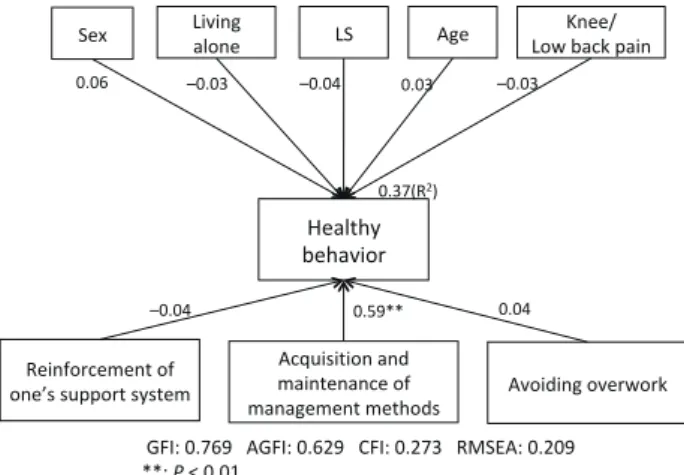
comor-bidities were factors that inhibited healthy behavior among community-dwelling older people, while self-care agency promoted healthy behavior. The results are summarized in the initial path diagram shown in Fig. 1. The fit indices of this model were unacceptable (GFI = 0.769, AGFI = 0.629, CFI = 0.273, and RMSEA = 0.209). Since the path coefficient between healthy behavior and physical issues such as pain and LS was low, we con-cluded that physical issues did not directly affect healthy behavior. Therefore, in the next step we verified only the relationship between self-care agency and healthy behavior, but this model was also unacceptable (Fig. 2).
Only the path coefficient for one of the three subscales of self-care agency, “acquisition and maintenance of health management methods,” was significant (Fig. 2). We had previously analyzed the correlations between the three subscales; therefore, our next step was to conduct another path analysis, this time using the factor relationships of the self-care agency subscales. The fit indices were almost satisfactory (GFI = 0.999, AGFI = 0.995, CFI = 1.000, and RMSEA = 0.000), and the coefficient of determination (R2) was 0.37 (Fig. 3). Of
the self-care agency subscales, only the “acquisition and maintenance of health management methods” directly affected healthy behavior (path coefficient 0.61, P < 0.01). The other two domains did not directly affect healthy behavior. Therefore, it was considered that there was an association between each observed variable (item) of this domain and healthy behavior. Pearson’s correlation analysis was used in the preliminary path analysis of self-care, and items showing a significant correlation with healthy behavior (correlation coefficient ≥ 0.3) were selected for the model. The results are summarized in the path diagram shown in Fig. 4. The indices of fit were not satisfactory for this model (GFI = 0.676, AGFI = 0.553, CFI = 0.203, and RMSEA = 0.175). Path
coeffi-cients for the influence of knee pain, back pain, LS, and comorbidities on healthy behavior also showed no signif-icant differences, with low values ranging from 0.01 to 0.09. In the final step, with reference to the MIs and path coefficient values, we repeated the analysis by systemati-cally removing paths and variables with large MI values. Additionally, we created new paths and referenced the previously determined theoretical basis of the causal model for self-care and healthy behaviors, which posited that knowledge and techniques increase self-efficacy, for example the awareness of the importance of healthy behaviors and confidence and the promotion of behav-ioral change.16, 17 We improved the model while focusing
on correlations among each of the self-care items, and constructed the model shown in Figure 5. With this final model, the indices of fit were almost satisfactory (GFI = 0.967, AGFI = 0.900, CFI = 0.951, and RMSEA = 0.088). In addition, all of the path coefficients were significant (Fig. 5). Among the self-care agency subscales, the ability to “do what is needed to maintain health” (0.30) and the will to “persist with healthy behavior” (0.28) had the strongest influence on the adoption of healthy behavior. In addition, the path from “realize the need for healthy behavior” to the ability to “do what is needed to
Table 2. Answers to the self-care agency questionnaire
Self-care agency Agree/ Somewhat agree Neither agree nor disagree Disagree/ Somewhat disagree
Acquisition and maintenance of health manage-ment methods
1. I want to follow through with my goals for
main-taining my health 303 (77.1) 70 (17.8) 20 (5.0)
2. I maintain a good relationship with my illness to
best manage my health 309 (78.8) 61 (15.5) 23 (5.8)
3. I keep my health in mind when I do things 346 (88.0) 30 (7.6) 17 (4.3) 4. I do not want to do anything that might damage my
health 369 (93.9) 15 (3.8) 9 (2.3)
5. I realize the need to perform specific actions to be in
better condition 337 (85.8) 41 (10.4) 15 (3.8)
6. I grasp the techniques/tips needed to maintain my
health 245 (62.4) 98 (24.9) 50 (12.7)
7. I try to notice deterioration of my condition as soon
as possible 343 (87.3) 32 (8.1) 18 (4.6)
Avoiding over-work
8. I avoid places that are unhealthy 297 (75.6) 69 (17.6) 27 (6.8)
9. I pay attention to my age-related decline in physical
strength 360 (91.6) 19 (4.8) 14 (3.6)
10. I take a rest if I notice something different about
my health 356 (90.6) 15 (3.8) 22 (5.6)
11. If I don’t feel well, I ease up on my work or
house-work as appropriate 327 (83.3) 32 (8.1) 34 (8.6)
12. I try not to force myself 334 (85.0) 36 (9.2) 23 (5.8)
Reinforcement of one’s support system
13. There is someone who stops me when I am about
to do something bad for my health 285 (72.5) 44 (11.2) 64 (16.3)
14. People around me provide cooperation and
encour-agement 299 (76.1) 57 (14.5) 37 (9.4)
15. I have someone who understands my needs and
gives me a boost 276 (70.2) 68 (17.3) 49 (12.5)
GFI: 0.769 AGFI: 0.629 CFI: 0.273 RMSEA: 0.209 **; P < 0.01 Healthy behavior Reinforcement of one’s support system Avoiding overwork Acquisition and maintenance of management methods LS Sex Living alone
–0.03
–0.04 0.04
Age Low back pain Knee/ –0.04 0.37(R2) –0.03 0.03 0.06 0.59** Fig. 1. GFI: 0.676 AGFI: 0.553 CFI: 0.203 RMSEA: 0.175 **; P < 0.01 Healthy behavior Realize the need for healthy behavior Maintain a good relationship with one's illness Avoid damaging one’s health Persist with healthy behavior Recognize a decline of physical strength Avoid places that are unhealthy Grasp the techniques/tips needed to maintain health LS
Sex Living alone
–0.01 0.16** 0.31** 0.30** 0.05 –0.06 0.16** 0.12**
Age Low back pain Knee/
–0.04 0.26(R2) –0.01 0.02 0.09* Fig. 4. GFI: 0.752 AGFI: 0.176 CFI: 0.417 RMSEA: 0.464 **; P < 0.01 Healthy behavior Reinforcement of the support system Avoiding overwork Acquisition and maintenance of management methods –0.03 0.04 0.37(R2) 0.60** Fig. 2. GFI: 0.999 AGFI: 0.995 CFI: 1.000 RMSEA: 0.000 **; P < 0.01 Healthy behavior Reinforcement of the support system Avoiding overwork Acquisition and maintenance of management methods 0.22** 0.52** 0.37(R2) 0.61** 040(R2) 0.36** Fig. 3.
Fig. 1. Initial model of healthy behavior among community-dwelling
older people. R2 is the proportion of the variance in the
depen-dent variable that is predictable from the independepen-dent variables. Numerical values are path coefficients (standardized). Error vari-ables are omitted. This model was not acceptable. AGFI, adjusted of-fit index; CFI, comparative fit index; GFI, goodness-of-fit index; LS, locomotive syndrome; RMSEA, root-mean-square error of approximation.
Fig. 4. Fourth model of healthy behavior among
community-dwelling older people. R2 is the proportion of the variance in
the dependent variable that is predictable from the independent variables. Numerical values are path coefficients (standardized). Error variables are omitted. This model was not acceptable. AGFI, adjusted goodness-of-fit index; CFI, comparative fit index; GFI, goodness-of-fit index; LS, locomotive syndrome; RMSEA, root-mean-square error of approximation.
Fig. 2.Second model of healthy behavior among community-dwelling older people. R2 is the proportion of the variance in
the dependent variable that is predictable from the independent variables. Numerical values are path coefficients (standardized). Error variables are omitted. This model was not acceptable. AGFI, adjusted goodness-of-fit index; CFI, comparative fit index; GFI, goodness-of-fit index; RMSEA, root-mean-square error of approximation.
Fig. 3. Third model of healthy behavior among community-dwelling
older people (acceptable model). R2 is the proportion of the
variance in the dependent variable that is predictable from the independent variables. Numerical values are path coefficients (standardized). Error variables are omitted. This model was ac-ceptable. AGFI, adjusted goodness-of-fit index; CFI, comparative fit index; GFI, goodness-of-fit index; RMSEA, root-mean-square error of approximation.
maintain health” had the highest path coefficient (0.34), with a coefficient of determination (R2) of 0.38.
DISCUSSION
This study was performed to identify the causal rela-tionship between self-care agency and healthy behavior, and to develop a conceptual model of healthy behavior among older people living in a rural community. While we initially suspected that pain and LS would inhibit healthy behavior among older individuals, the model based on the hypothesis that physical factors influence healthy behavior did not show sufficient fit indices.
Instead, we obtained better fit indices for a different model of the relationship between self-care agency and healthy behavior, indicating a good fit between our data and the alternate model. This result suggested that older people who have acquired self-care agency can adopt healthy behavior, including pain control and regulation of physical function, regardless of the presence or absence of physical problems. According to a previous qualitative study, people found it difficult to engage in healthy behavior in their daily lives for reasons such as “my back and hip hurts,” “I feel pain when I walk,” or “I don’t have the strength to move due to fatigue.5 ”
However, those findings conflicted with those of the present study. This difference may be due to the fact that the qualitative study had a small number of participants; thus, the findings may not necessarily be universally applicable. However, the participants in this study attended a local government medical check-up and had a relatively higher level of health awareness. Thus, the participants had less severe pain and dysfunction, which could have resulted in the non-significant association between physical problems and healthy behaviors.
This study revealed that several factors were import-ant for maintaining health among community-dwelling older people, including the following: “acquisition and maintenance of health management methods,” such as knowledge and skills to implement appropriate diet and exercise therapy despite physical problems; the “ability to grasp the techniques/tips needed to maintain health” in daily life; and the will to “persist with healthy behav-ior.” We also found that the self-care agency items were correlated with each other, and thus mutually enhanced self-care agency. For example, the most important factor for increasing the “ability to grasp the techniques/tips needed to maintain health” in daily life was to “realize the need for healthy behavior.” One useful model for promoting healthy behavior is the Health Belief Model (HBM), which was originally developed in the 1950s to predict whether individuals would remain engaged in programs to prevent and detect disease.18, 19 The HBM
consists of the following five constructs that are thought to influence the likelihood of an individual engaging
in a given health behavior so as to avoid an undesirable health outcome: perceived susceptibility (perception of the likelihood that one will experience the outcome in question), perceived severity (perception of the seri-ousness of consequences associated with the outcome), perceived benefits (potential advantages of engaging in healthy behavior, including the perceived efficacy for preventing the undesired outcome), and perceived barriers (perceived obstacles to engaging in the healthy behavior).20 According to this model, recognizing the
necessity for healthy behavior requires acknowledging both perceived severity (“If I continue this unhealthy habit, I might harm my health.”) and perceived suscep-tibility (“If I continue this unhealthy habit, I might get sick...”), which suggests that education promoting a sense of threat or crisis (“This is scary, I must do something about it.”) is important.
A positive response to statements on wanting to “maintain a good relationship with one’s illness” and a strong desire to “avoid damaging one’s health” were oth-er factors that had a direct influence on healthy behavior, although the influence was not as strong. These results suggest that to increase people’s interest in their health and their desire to manage it, healthcare professionals must implement interventions aimed at enhancing moti-vation and concern regarding healthy behavior.
Self-care agency is an operational concept that encompasses cognition, attitude, knowledge, and moti-vation. These variables can be directly manipulated by healthcare professionals and can be increased by nursing
Fig. 5. Final model of healthy behavior among community-dwelling older people (acceptable model). R2 is the proportion of the variance
in the dependent variable that is predictable from the independent variables. Numerical values are path coefficients (standardized). Error variables are omitted. “Persist with healthy behavior” and “Realize the need for healthy behavior” were correlated (0.28, path omitted). “Realize the need for healthy behavior” and “Maintain a good relationship with one’s illness” were correlated (0.28, path omitted). Numerical values are path coefficients (standardized). Error variables are omitted. This model was acceptable. AGFI, adjusted goodness-of-fit index; CFI, comparative fit index; GFI, goodness-goodness-of-fit index; RMSEA, root-mean-square error of approximation.
GFI: 0.967, AGFI: 0.900, CFI: 0.951, RMSEA: 0.088 **; P < 0.01 Healthy behavior Realize the need for healthy behavior Maintain a good relationship with
one's illness damaging one’s Avoid
health Persist with healthy behavior Recognize a decline of physical strength Avoid places that are unhealthy Grasp the techniques/tips needed to maintain health 0.15** 0.28** 0.30** 0.16** 0.18** 0.24** 0.38(R2) 0.34** 0.14** 0.27** 0.38** 0.17** Quickly notice deteriorat-ion of one’s condition 0.22** 0.23** 0.29** 0.17** Fig. 5.
support; thus, it is important to note that they were identified as variables associated with healthy behavior in this study. For healthcare support, it might be helpful to use Keller’s ARCS Model of Motivational Design Theories, which proposes four factors that promote and sustain motivation in the learning process: attention, relevance, confidence, and satisfaction (ARCS).21 We
previously reported on the effects of a learner-focused health classroom setting based on an ARCS model of instructional design, and found that the setting improved self-efficacy, promoted the use of knowledge and skills related to health, and led to an improved understanding of the importance of health management.22 These
find-ings suggested that an ARCS model could be applied to a health classroom setting. Therefore, when providing health education for older people in the community, healthcare professionals first need to attract their atten-tion when introducing the topic so that participants are engaged and interested. To encourage participants to meet the objectives specified by the action plan, health-care professionals should aim to promote goal orienta-tion and to enhance participants’ feelings of confidence, significance, and relevance with regard to performing healthy behavior.
In conclusion, this study showed that self-care agency promoted healthy behaviors among community-dwelling older people. The first novel finding was that regardless of the presence or absence of physical issues such as pain and LS, older people have the potential to adopt healthy behaviors if they acquire self-care agency. Second, although the factor relationships of self-care agency and healthy behavior have been shown on their own, we demonstrated a synergistic association between the components of self-care agency, including the aware-ness of the importance of healthy behaviors and a strong desire to engage in these behaviors.
LIMITATIONS OF THIS STUDY
There were several limitations to this study. It used a cross-sectional design; therefore, a prospective lon-gitudinal study will be needed in the future to obtain data for constructing a more accurate causal model. Furthermore, the coefficient of determination of the present model was 0.38, which is not particularly large; thus, it is likely that other factors also influence healthy behavior. In addition to self-care agency, a future study should examine the influence of a combination of other variables that stimulate behavioral changes, including self-efficacy. There is also a need to assess various categories of healthy behavior, such as those related to diet, motor activity, and medication, and to examine the factors that influence each of these behaviors.
Another limitation is the possibility of selection bias due to the fact that relative to individuals who did not attend medical check-ups, the participants were more aware of their health status and possessed a greater knowledge about healthy behaviors. This should be taken into account when generalizing our findings. To mitigate selection bias, a similar study in the future should enroll participants who have not attended a local government medical check-up.
Acknowledgments: We would like to thank the Hino Town office
for their help with participant recruitment. The authors sincerely acknowledge the contributions of all GAINA study staff members involved in this study. The authors also thank Takashi Wada, Yuki Kitsuda, Shinji Tanishima, Kenji Moriwaki, Eri Kobayashi, Kyohei Nakata, Takeshi Sota, Taro Omori, Tomoyuki Makabe, Tetsuji Morita, Akihiro Matsuura, Naoyuki Nakaso, Nao Nakata, Tomoko Akita, and Takuya Sugimura for their technical support and assistance with data collection, and Ryoko Ikehara for her secretarial assistance.
This study was supported by a Ministry of Education, Culture, Sports, Science and Technology Grant (Chino Kyoten Seibi Jigyou) and a Grant-in-Aid from the Japanese Society for Musculoskeletal Medicine, and Chiiki Kouken Jigyou from Tottori University.
The authors declare no conflicts of interest.
REFERENCES
1 Orem D. Nursing Concepts of Practice, 6th ed. St. Louis: Mosby; 2001.
2 Britz JA, Dunn KS. Self-care and quality of life among pa-tients with heart failure. J Am Acad Nurse Pract. 2010;22:480-7. PMID: 20854640.
3 Rafael B, Konkolÿ Thege B, Kovács P, Balog P. Anxiety, depression, health-related control beliefs, and their association with health behavior in patients with ischemic heart disease. Orv Hetil. 2015;156:813-22. PMID: 26038948.
4 Justine M, Azizan A, Hassan V, Salleh Z, Manaf H:Barriers to participation in physical activity and exercise among middle-aged and elderly individuals. Singapore Med J. 2013;54:581-6. PMID: 24154584.
5 Itedan K, Oka M. Factors for non-implementation of walking exercise in type 2 diabetes patients. Ann Gunma Health Sci. 2017;37:79-88. Japanese.
6 Tanimura C, Matsumoto H, Tokushima Y, Yoshimura J, Tanishima S, Hagino H. Self-care agency, lifestyle, and phys-ical condition predict future frailty in community-dwelling older people. Nurs Health Sci. 2018;20:31-8. PMID: 29115022. 7 Matsumoto H, Hagino H, Osaki M, Tanishima S, Tanimura
C, Matsuura A, et al. Gait variability analysed using an accel-erometer is associated with locomotive syndrome among the general elderly population: The GAINA study. J Orthop Sci. 2016;21:354-60. PMID: 27020175.
8 Tanishima S, Hagino H, Matsumoto H, Tanimura C, Nagashima H. Association between sarcopenia and low back pain in local residents prospective cohort study from the GAINA study. BMC Musculoskelet Disord. 2017;18:452. PMID: 29141602.
H, Hagino H. Sarcopenia is a risk factor for falling in inde-pendently living Japanese older adults: A 2-year prospective cohort study of the GAINA study. Geriatr Gerontol Int. 2017;17:2124-30. PMID: 28517243.
10 Honjo, K. Revision of the self-care agency questionnaire for patients with chronic illness. Japan Journal of Nursing Science. 2001;21:29-39. Japanese.
11 Seichi A, Hoshino Y, Doi T, Akai M, Tobimatsu Y, Iwaya T. Development of a screening tool for risk of locomotive syndrome in the elderly: The 25-question geriatric locomotive function scale. Journal of Orthopaedic Science. 2012;17:163-72. PMID: 22222445.
12 Toyoda H. Covariance Structure Analysis: Structural Equation Modeling (Application). Tokyo: Asakura Pulishing Co., Ltd.; 2000. Japanese.
13 Toyoda H. Covariance Structure Analysis (A Primer): Structual Equation Modeling, 1st ed. Tokyo: Asakura Publishing; 2007.
14 Hu L, Bnetler PM. Cutoff criteria for fit Indexes in covariance structure analysis; Conventional criteria versus new alter-natives. Structural Equation Modeling. 1999;6: 1-55. DOI: 10.1080/10705519909540118.
15 Arbuckle JL, Wothke W. Amos 4.0 User’s Guide, 1st ed. Chicago: SmallWater Corporation; 1999.
16 Bourbeau J, Nault D, Dang-Tan T. Self-management and behavior modification in COPD. Patient Edu Couns. 2004;52:271-7. PMID: 14998597.
17 Bandura A. Self-efficacy: toward a unifying theory of behav-ior change. Psychol Rev. 1977; 84:191-215. PMID: 847061. 18 Becker MH, Maiman LA. Sociobehavioral determinants of
compliance with health and medical care recommendations. Med Care. 1975;13:10-24. PMID: 1089182.
19 Rosenstock IM, Strecher VJ, Becker MH. Social learning the-ory and the health belief model. Health Educ Q. 1988;15:175-83. PMID: 3378902.
20 Gerend MA, Shepherd JE. Predicting human papillomavirus vaccine uptake in young adult women: comparing the health belief model and theory of planned behavior. Ann Behav Med. 2012;44:171-80. PMID: 22547155.
21 Keller, John M. Development and use of the ARCS model of instructional design. Journal of instructional development. 1987;10:2-10. DOI: 10.1007/BF02905780.
22 Tanimura C, Noguchi Y, Miyoshi M, Oba K. Efficacy of a health classroom setting to improve self-efficacy of health management––project for educational support based on instructional design. Healthcare Professional Journal. 2016;72:936-44. DOI: 10.11477/mf.1664200564. Japanese.