On
Styles
of
$\lambda 2$-Terms
-Extended
Abstract
$*$
-Ken-etsu Fujita (Gunma
University)
December 26,
2014
Abstract
Traditionally, two styles of$\lambda$
-termswithtypesarewell known, i.e., the
Church and Curry styles. We still have other styles, e.g., de Bruijn
ver-sion, domain-free style, and type-free stylefor polymorphic$\lambda$
-calculus$\lambda 2.$ Itis known thatsomeoffundamentalpropertieshold for $\lambda 2$in any known
style, but others depend on styles. In order to capture existing styles
in a uniform way, styles of $\lambda 2$-terms are introduced by giving abstract
term-trees with indices, and terms in already known styles are obtained
aswell-typed partially annotated terms following the styles. Next, the
no-tion of partially annotated terms isalso defined for $2nd$-orderexistential
$\lambda$
-calculus $\lambda^{\exists}$
We establish a systematic relationship between $s$-style $\lambda 2$
and $s$-style $\lambda^{\exists}$
via CPS-translations, which revealsthe refined
correspon-dencebetweentypeannotations and domains ofabstractions. This study
makes fundamentalproperties parametric, and provides newinsight and
foundations for investigating which annotations cause the differences in
fundamental properties.
1
Introduction
Following the founders,wehavetwostyles of$\lambda$-terms with types, i.e.,theexplicit
typing(Churchstyle) and theimplicit typing (Curry style). Termsinthe style of
Church [4, 2] are well-typed terms where each variable is attached to a unique
$\backslash$
type. The use of explicit typing provides the property that the terms enjoy
uniqueness of types. On the other hand, terms in the style of Curry [11, 1, 17]
are the same as those of untyped $\lambda$-calculus, and type inference or checking
guarantees that terms are well typed. This style of implicit typing forms a
common basis for functional programming. In addition, pseudo-terms \‘a la de
Bruijn [2] are well known, and this notion can be extended to systems with
higher order types and dependent types. Each style has its own advantages
depending on the context under which terms are used.
*Thisworkwaspartly supportedbyGrants-in-Aid for Scientific Research KAKENHI (C) 25400192, and by the Kayamori Foundation of Informational Science Advancement.
In this paper,
we
are
interested in polymorphic $\lambda$-terms where typesare
defined from type variables denoted by $X,$$Y,$ $Z$ using constructors $arrow and\forall$: $A, B ::=X|(Aarrow B)|\forall X.A$
The notation $FV(A)$ denotes the set oftype variables appearing freely in type $A$
.
We write $A_{1}\equiv A_{2}$ for the syntactical identity under renaming of boundvariables.
In order to define Church-style terms for polymorphic $\lambda$-calculus A2,we use
thefollowing syntax for rawterms, where each variable is attached to a unique
type so that we have $A\equiv B$ for the same variable $x$ such
as
$x^{A}$ and $x^{B}$, andattached types are included in the syntax of terms.
$M, N ::=x^{A}|\lambda x^{A}.M|MN|\Lambda X.M|M[A]$
The notation $FV(M)$ denotes the set of term variables appearing freely in term
$M$
.
Then Church-styleterms for $\lambda 2$ aredefined inductively as follows:
$\vdash ch^{X^{A}:A}$
$\frac{\vdash_{Ch}.M:B}{\vdash_{Ch}\lambda x^{A}M:Aarrow B}$ $\frac{\vdash_{Ch}M:Aarrow B\vdash_{Ch}N:A}{\vdash_{Ch}MN:B}$
$\frac{\vdash_{Ch}M:A}{\vdash_{Ch}\Lambda X.M:\forall X.A}(Ch)^{*} \frac{\vdash_{Ch}M:\forall X.A}{\vdash_{Ch}M[B]:A[X:=B]}$
where the mark (Ch)$*$
denotesthe variable condition that $X\not\in FV(B)$ for each
type $B$ such that $x^{B}\in FV(M)$
.
On the other hand, pseudo-terms \‘a la de Bruijn [1, 2] are defined for A2,
where free variables do not get ornamented with types, and type assignment rules are defined as usual.
$M,$$N$ $::=x|\lambda x$:A.M $|MN|\Lambda X.M|M[A]$
Finally, the system oftype assignment for Curry-style terms [1, 17] of $\lambda 2$ is
defined
as
well, wherea
context denoted by $\Gamma$or
$\Sigma$ isa set of declarations of
the form $x:$ $A$ with distinct variables. We write $\Gamma(x)=A$ for $(x:A)\in\Gamma$, and $FV(\Gamma)$ for $\bigcup_{(x:A)\in\Gamma}FV(A)$
.
$\Gamma,$$x:A\vdash c_{u}x$: $A$
$\frac{r\vdash c_{u}^{M:Aarrow B\Gamma\vdash c_{u}N:A}}{\Gamma\vdash c_{u}MN:B}$
$\frac{A\vdash c_{u}M:B}{\Gamma\lambda x.M:Aarrow B}$ $\frac{\Gamma\vdash c_{u}M:A}{r\vdash c_{u}^{M:\forall X.A}}(Cu)^{*}$ $\frac{\Gamma\vdash c_{u}M:\forall X.A}{r\vdash c_{u}^{M:A[X:=B]}}$
where (Cu)$*$
denotes the variable condition $X\not\in FV(\Gamma)$
.
In the
case
of A2, we still have other styles, for example, domain-free style (df) [3, 8], type-free style (tf) [9], and so on. It is well known thatsome
funda-mentalproperties hold for $\lambda 2$ in any known style, butothers depend
on styles.
For instance, inhabitation problems
are
independent of styles. The subjectfor Curry-style [16]. Moreover, type-related problems are sensitive to styles.
The type-checking and type-inference problems are known to be decidable for
$\lambda 2$-terms in the Church style or the de Bruijn version, but undecidable for the Curry style byWells [17].
In order to capture existing styles in a uniform way, we introduce styles of
$\lambda$-terms by giving abstract term-trees with indices Thenwe can obtain$\lambda$
-terms
not only in already known styles but also in new ones as partially annotated
terms that are
erasures.
Now, we can compare terms in different styles in auniform framework. Next, the notion of pseudo-terms for fully annotated $\lambda-$ terms is also defined for 2nd order ex\’istential $\lambda$-calculus $\lambda^{\exists}$
.
We establish asystematic relationship between $s$-style $\lambda 2$
and $s$-style
$\lambda^{\exists}$
via CPS-translations
(seeFig. 1), whichreveals the refined correspondence betweentypeannotations
and domainsofabstractions. This study provides new insight and foundations for investigatingwhichannotations
cause
thedifferencesin decidabilityoftype-related problems which
are
made parametricwith respect to styles.In this study, annotations play three roles. The first role is that type
an-notations work as hints or aguide through hard typability. The second is that
terms in a certain style are introduced, based on the style, by fully annotated
terms, and thenfundamentalproperties canbe parametric withrespect to
well-ordered styles. The third and pivotalroleis that annotation information makes
it possible to establish natural CPS-translations from pseudo-terms of$\lambda 2$ into
those of the 2nd order existential system $\lambda^{\exists}$
, without referring to derivations.
In previous work [6], we studied a neat CPS-translation from the Church-style
$\lambda 2$ into $\lambda^{\exists}$
, where polymorphic functions are interpreted byabstract datatypes
[12], and the translation has been defined by induction on the structure of the
derivations. In order to relatetype-related problems with eachother, however,
translations between $\lambda 2$ and $\lambda^{\exists}$
should be defined by pseudo-terms, because
definitions ofsuch problems are usually given in terms ofraw terms. This idea leads to a framework for reductions from $\lambda 2$
to $\lambda^{\exists}$
families, such that some
properties for $\lambda 2$ with a certain style are reduced to those for $\lambda^{\exists}$
with the
cor-responding style, and in turn that other properties for $\lambda^{\exists}$
parametrized with styles are reduced to those for $\lambda 2$
with the corresponding style.
Fig. 1 shows a brief outline of this idea, where $*^{s}$ is a CPS-translation from
$s$-style $\lambda 2$
into $s$-style
$\lambda^{\exists}$
, and $\#^{S}$ is its inverse translation from a CPS-calculus of$\lambda^{\exists}$
in $s$-style backto$s$-style A2. Here, styles $s$ and$t$ rangeover not only
well-known stylessuch
as {Ch,
df,tf,Cu}
but also intermediate systems between thefully annotated terms and Curry terms. Hereafter, we write $||_{s}^{t}$ for an
era-sure mapping from $t$-styleterms to $s$-style terms, and in this case we say that
style $t$ is greater than style $s$, denoted by $s<t$
.
The well-known forgetful map$||_{s}^{fu11}$ is a homomorphism from fully annotated terms to $s$-style, which
erases
some informationin fully annotated terms, and provides more abstract$\lambda$-terms
with
an
intermediate structure in $s$-style. Theerasure
map preserves typing.Moreover, thesoundness$of*^{S}(\#^{t})$ guaranteesthat the composition of the
trans-lations $||_{s}^{t}and*^{s}$ $(\#^{t}$ and $||_{s}^{t})$ constitutes ahomomorphic projectionof$t$-styleto
$s$-style. The systematic correspondence presents a bird’s-eye view of the whole
$||_{g}^{fu11}$ $||_{cu}^{s}$
$\lambda 2$ : Fully annotated style
$arrow$
$s$-style$arrow$
Curry$*fu11\downarrow\uparrow\#^{fu11}$ $*^{9}I\uparrow\#^{s}$ $*^{cu}I\uparrow\#^{cu}$
$\lambda^{\exists}(CPS)$ : Fully annotated style
$arrow^{||_{\epsilon}^{fu11}}$
$s$-style
$arrow^{||_{cu}^{s}}$
Curry Figure 1: Systematic relationship between $\lambda 2$ and $\lambda^{\exists}$
with various styles
type annotations and decidability of type-related problems for the systems with
various styles.
The paper is organized
as
follows. In Section 2, we first introduce fullyannotated A2, and styles of terms are introduced in terms of abstract term-trees with indices. Then partially annotated $\lambda 2$ is defined by using erasure based
on styles, which makes fundamental propertiesparametric with respect to
well-ordered styles. Secondly we introduce fully annotated $\lambda^{\exists}$
as
the counterpartof full $\lambda 2$
in Section 3. In Section 4, we present a framework that connects
fundamental properties systematically between $\lambda 2$ and $\lambda^{\exists}$
families by
means
of CPS-translations. Then we verify fundamental properties preserved under thetranslations, and show, in a uniform way, decidability results on type-related
problems for $\lambda 2$ and $\lambda^{\exists}$
with various styles. In Section 5, we give concluding
remarks.
2
Fully
annotated
and partially annotated
$\lambda 2$2.1
Fully
annotated
$\lambda 2$First we introduce $\lambda 2$-terms in fully annotated style (simply called full A2). Pseudo-terms for full $\lambda 2$ and the system oftype assignment are defined as
fol-lows. A context denoted by $\Gamma$
is defined as usual, and
we
write $dom(\Gamma)$ for$\{x|(x:A)\in\Gamma\}$
.
Let $S$ be a set ofterm variables, $\Gamma\uparrow S$ denotes the contextwhose domain $dom(\Gamma\uparrow S)$ is restricted to $S.$
$M,$$N$ $::=x|\lambda x$:$A$
.
$M^{B}|M^{A}N^{B}|\Lambda X.M^{A}|M^{A}[B]$$\overline{\Gamma,x:A\vdash_{fu11\lambda 2}x:A}$ (var)
$\frac{\Gamma,x:A\vdash_{fu1.1\lambda 2}M:B}{\Gamma\vdash_{fu11\lambda 2}\lambda x:AM^{B}:Aarrow B}(arrow I)$ $\frac{\Gamma\vdash_{ful1\lambda 2}M:Aarrow B\Gamma\vdash N:A}{\Gamma\vdash_{fu11\lambda 2}M^{(Aarrow B)}N^{A}:B}(arrow E)$
$\frac{\Gamma\vdash_{ful1\lambda 2}.M:A}{\Gamma\vdash_{fu11\lambda 2}\Lambda XM^{A}:\forall X.A}(\forall I)^{\star}$ $\frac{\Gamma\vdash_{fu11\lambda 2}M:\forall X.A}{\Gamma\vdash_{ful1\lambda 2}M^{\forall X.A}[B]:A[X:=B]}(\forall E)$
where$\star$ meansthat thevariable condition $X\not\in FV(\Gamma)$ is imposed on $(\forall I)^{\star}.$
Derivations are uniquely represented by well-typed full $\lambda 2$-terms. Proposition 1 Let$M$ be a
full
$\lambda 2$-term that isnota
variable.If
$\Gamma_{1}\vdash_{fu11\lambda 2}M$ :$A_{1}$ and$\Gamma_{2}\vdash_{fu11\lambda 2}M$ : $A_{2}$, then$A_{1}\equiv A_{2}$ and $\Gamma_{1}\uparrow FV(M)=\Gamma_{2}\uparrow FV(M)$
.
Given awell-typed termof full A2, the Church-style term can be defined by
Definition 1 $(|\cdot|_{ch}^{fu11}$ and $\Gamma)$ 1. $|x|_{ch}^{fu11}=x$ $x^{\Gamma}=x^{\Gamma(x)}$
2. $|\lambda x:$A.$M^{}$ $|_{ch}^{fu11}=\lambda x$:A.$|M|_{ch}^{fu11}$
$(\lambda x:A.M)^{\Gamma}$ $=$ $\lambda x$:A.$M^{\Gamma}$
3. $|M^{A}N^{B}|_{ch}^{fu11}=|M|_{ch}^{fu11}|N|_{ch}^{fu11}$
$(MN)^{\Gamma} = M^{\Gamma}N^{\Gamma}$
4.
$|\Lambda X.M^{A}|_{ch}^{fu11}=\Lambda X.|M|_{ch}^{fu11}$ $(\Lambda X.M)^{\Gamma}$ $=$ $\Lambda X.M^{\Gamma}$5. $|M^{A}[B]|_{ch}^{fu11}=|M|_{ch}^{fu11}[B]$ $(M[A])^{\Gamma} = M^{\Gamma}[A]$
Proposition 2
If
$\Gamma\vdash_{fu11\lambda 2}M$ : $A$, then we have $\vdash ch(|M|_{ch}^{fu11})^{\Gamma}$ : $A.$Church-style terms are represented by well-typed and partially annotated $\lambda 2-$
termswith theerasure and $\Gamma$. In thisway, $\lambda 2$-terms in well-known stylewill be
obtainedfrom full $\lambda 2$ byerasing, based onstyles representing patterns of terms.
2.2
Styles of
$\lambda 2$-terms
and
partially
annotated
terms
In order to represent styles ofterms, we introduce term constructors with
in-dices. General styles of $\lambda 2$-terms will be defined from the set of term trees that are well labelled with indices. A syntax of term trees is defined from term
constructors
var,$\lambda$,@,$\Lambda$, and $@_{T}.$$t\in \mathcal{T}ree ::=var|\lambda.t|@.(t_{1}, t_{2})|\Lambda.t|@_{T}.t$
A syntax of styles of $\lambda 2$-terms is defined by term trees together with indices, denoted by $n$ and $i$ that range overthe set of natural numbers.
$s,$$t\in Style$ $::=$ $var(n)|\lambda(n, n).s|$ @$(n, n).(s, s)|\Lambda(i, n).s|@_{T}(n, i).s$
Here, the indices inindexed constructorsinformally
mean
that how many piecesof information are included in terms, and type annotations will be assigned
following indices of styles soon.
We define a surjective mapping from Style to $\mathcal{T}ree$, called an erasure
map-ping.
Definition 2 (Erasure from styles to term-trees)
$|var(n)|=var$; $|\lambda(m, n).s|=\lambda.|s|$; $|$@$(m, n).(s, t)|=@.(|s|, |t|)$;
$|\Lambda(i, n).s|=\Lambda.|s|$; $|@_{T}(m, i).s|=@_{T}.|s|.$
Definition 3 (Order on styles) We
define
a binary relation $s\leq t$ on-stylespointwise as
follows:
1.
If
$n_{1}\leq n_{2}$ then$var(n_{1})\leq var(n_{2})$.
2.
If
$s_{1}\leq s_{2}$ with $|s_{1}|=|s_{2}|,$ $m_{1}\leq m_{2}$, and $n_{1}\leq n_{2}$ then $\lambda(m_{1}, n_{1}).s_{1}\leq$ $\lambda(m_{2}, n_{2}).s_{2}.$3.
If
$s_{1}\leq s_{2}$ with $|s_{1}|=|s_{2}|,$ $t_{1}\leq t_{2}$ with $|t_{1}|=|t_{2}|,$ $m_{1}\leq m_{2}$, and$n_{1}\leq n_{2}$4.
If
$s_{1}\leq s_{2},$ $i_{1}\leq i_{2}$, and $n_{1}\leq n_{2}$ then $\Lambda(i_{1}, n_{1}).s_{1}\leq\Lambda(i_{2}, n_{2}).s_{2}.$5.
If
$s_{1}\leq s_{2},$ $m_{1}\leq m_{2}$, and$i_{1}\leq i_{2}$ then $@_{T}(m_{1}, i_{1}).s_{1}\leq@_{T}(m_{2}, i_{2}).s_{2}.$Note that the relation
on
styles forms apartial order.Forgeneral styles, weconsider subsets of Style, which are bijective to$\mathcal{T}ree.$
Definition 4 (General styles) A subset$St$
of
$\mathcal{S}tyle$ is a general style,if for
each tree $t\in \mathcal{T}ree$, there exists a unique style $s\in St$ such that $|s|=t.$
A partial order
on
general styles can be defined naturally.Definition 5 (Order
on
general styles) Let $St_{1},$ $St_{2}$ be general styles. $We$define
$St_{1}\leq St_{2}$if
$s_{1}\leq s_{2}$for
each$s_{1}\in St_{1}$ and $s_{2}\in St_{2}$ such that $|s_{1}|=|s_{2}|.$Note that
an erasure
mapping $||_{St_{1}}^{St_{2}}$ is induced fromgeneral styles $St_{1}\leq St_{2}$:
e.g., if $\lambda(m_{1}, n_{1}).t_{1}\leq\lambda(m_{2}, n_{2}).t_{2}$, then
erase
annotationsso
that,the values $m_{2},$$n_{2}$ decrease to $m_{1},$$n_{1}$, respectively. In turn, a pre-order on styles is ingeneralinduced from the identity mapping and thecompositionoftwo
erasures.
Moreover, ifonehas an erasure that maps$St_{1}$ to$St_{2}$ then anorder is naturally
induced such that $St_{2}\leq St_{1}$, since there exists a unique style for each term
tree.
We define a binary relation on terms and styles such that a term $M$ has a
style $s\in St$, denoted by $M::s.$
$x:$: var(O) $x^{A}:$: var(l)
$\overline{\lambda x:}$A.$M^{B}::\lambda(1,1).sM::s$ $\overline{\lambda x:}$A.$M::\lambda(1,0).sM::s$ $\frac{M::s}{\lambda x.M^{B}::\lambda(0,1).s}$ $\frac{M::s}{\lambda x.M::\lambda(0,0).s}$
$\frac{M::sN::t}{M^{A}N^{B}::@(1,1).(s,t)}$ $M^{A}NM$ $sN::.t@(1, 0)(s, t)$ $MN^{B}M$ $sN::.t@(0, 1)(s, t)$ $MN::@(0,0)(s, t)M::sN:.:t$
$\frac{M::s}{\Lambda X.M^{B}::\Lambda(2,1).s}$ $\frac{M::s}{\Lambda X.M::\Lambda(2,0).s}$ $\frac{M::s}{\Lambda.M^{B}::\Lambda(1,1).s}$ $\frac{M::s}{\Lambda.M::\Lambda(1,0).s}$
$\frac{M::s}{M^{B}::\Lambda(0,1).s}$ $\frac{M::s}{M::\Lambda(0,0).s}$ $\frac{M::s}{M^{A}[B]::@_{T}(1,2).s}$ $\frac{M::s}{M[B]::@_{T}(0,2).s}$
$\frac{M::s}{M^{A}[]::@_{T}(1,1).s}$ $\frac{M::s}{M[]::@_{T}(0,1).s}$ $\frac{M::s}{M^{A}::@_{T}(1,0).s}$ $\frac{M::s}{M::@_{T}(0,0).s}$
We concentrate the paper mainly on styles such that each term constructor
has fixed indices for simplicity and direct connection to already existing ones.
This form of stylescan be representedby the following tuples:
Definition 6 $($Church, $de$ Bruijn, $domain-$free,
$type-$free, Curry styles $\lambda 2)$ $\bullet$
Pseudo-terms
for
Churchstyle$\lambda 2$: $\langle$var(l),$\lambda(1,0)$,@$(0,0)$,$\Lambda(2,0)$,@$\uparrow$$(0, 2)\rangle$ $\bullet$ Pseudo-terms
for
de Bruijnstyle$\lambda 2$: $\langle$var(O),$\lambda(1,0)$,@$(0,0)$,$\Lambda(2,0)$,$@_{T}(0,2)\rangle$
$\bullet$ Pseudo-terms
for
domain-free
style$\lambda 2$: $\langle$var(O),$\lambda(0,0)$,@$(0, 0)$,
$\bullet$ Pseudo-terms
for
type-free style$\lambda 2$: $\langle$var(O),$\lambda(0,0)$,@(O, O),$\Lambda(1,0)$,$@_{T}(0,1)\rangle$$\bullet$ Curry style
$\lambda 2$
: $\langle$var(O),$\lambda(0,0)$, @(O, O),$\Lambda(0,0)$,$@_{T}(0,0)\rangle$
We define terms ofpartially annotated $\lambda 2$ (partial $\lambda 2$
) by deleting some
anno-tations from full $\lambda 2$ following style
$s$, called $s$-style $\lambda 2$-terms. In this way, we consider all styles between full and Curry-styles, where Curry-style is the least style, and the style of full $\lambda 2$ is the greatest. Under the order, Definition 1 (Church) is available not only for full $\lambda 2$ but also for any style $s$ greater than
or equalto that of de Bruijn.
For any style $s\geq$ Curry, one can naturallydefine the system oftype
assign-ment for $s$-style terms $M$ under a context $\Gamma$ as an erasure of the system for
full A2, written by$\Gamma\vdash_{s}M$ : $A$
.
For any style $s\geq$ type-free,one
hasa
naturalformof generation (inversion) lemma called syntax directed, such that from the
shape of an $s$-style term $M$ of $\Gamma\vdash_{s}M$ : $A$, one can uniquely determine which
rule should be applied to derive the judgement.
Proposition 3 (Generation lemma for $s\geq type$-free) Let $s\geq type$-free.
(1)
If
$\Gamma\vdash_{s}x:$ A then $\Gamma(x)=A.$(2)
If
$\Gamma\vdash_{s}$ Ax.M: $A_{1}$ then$\Gamma,$$x:A_{0}\vdash_{s}M:A_{2}$ and$A_{1}=(A_{0}arrow A_{2})$for
some
$A_{0},$$A_{2}.$
(3)
If
$\Gamma\vdash_{s}M_{1}M_{2}$ : $A_{1}$ then $\Gamma\vdash_{S}M_{1}$ : $A_{0}arrow A_{1}$ and $\Gamma\vdash_{s}M_{2}$ : $A_{0}$for
some
$A_{0}.$(4)
If
$\Gamma\vdash_{s}\Lambda.M:A_{1}$ then $\Gamma\vdash_{s}M:A_{2}$ and$A_{1}=\forall X.A_{2}$ with $X\not\in FV(\Gamma)$for
some $A_{2}.$
(5)
If
$\Gamma\vdash_{S}M[]$ : $A_{1}$ then$\Gamma\vdash_{S}M$ : $\forall X.A_{2}$ and $A_{1}=A_{2}[X :=A]$for
some
$A,$$A_{2}.$
Recall that a similar generation lemma holds for Curry-style $\lambda 2[1$, 17$]$
.
Foruniqueness oftypes, we need more annotations than those in the style of
type-free.
Proposition 4 (Uniqueness of types for $s\geq$ deBruijn) For any style $s\geq$
deBruijn,
if
$\Gamma\vdash_{s}M:A_{1}$ and $\Gamma\vdash_{s}M:A_{2}$, thenwe have $A_{1}\equiv A_{2}.$Proposition 5 (Erasure and lifting for $s\geq$ Curry) Let$s,$$t$ be styles with Curry $\leq$
$s\leq t.$
(1)
If
$\Gamma\vdash_{t}M:$ A then$\Gamma\vdash_{s}|M|_{s}^{t}:A.$(2)
If
$\Gamma\vdash_{s}M$ : A then there exists a$\lambda 2$-term$N$ in$t$-style such that $|N|_{s}^{t}=M$
and$\Gamma\vdash_{t}N:A.$
Inhabitation problem by $s$-style $\lambda 2$-terms $(IHP(s))$ is defined as follows: Given a type $A$, determine whether there exists a closed $\lambda 2$-term $M$ in
$s$-style such
that $\vdash_{s}M:A.$
3
Existential
$\lambda^{\exists}$in
fully
and
partially
annotated
styles
Secondly we define the 2nd order existential type system $\lambda^{\exists}$
that is logically a subsystem of minimal logic consisting of falsity, negation, conjunction, and 2nd-order existential quantification. It is known that $\lambda 2$ can be Galois embedded into $\lambda^{\exists}[7]$, which can be applied to connect fundamental properties with each
other between $\lambda 2$ and $\lambda^{\exists}$
.
We introduce fully annotated $\lambda^{\exists}$$($full $\lambda^{\exists})^{1}$
that is the counterpart of the full $\lambda 2.$
1. $\lambda^{\exists}$
-types $A,$$B$ $X|\perp|\neg A|(A\wedge B)|\exists X.A$
2.
Pseudo-terms
for full $\lambda^{\exists}$$M, N ::= x|\lambda x:A.M|MN^{A}|\langle M, N\rangle^{A}| (let \langle x:A, y:B\rangle=M in N)$
$\langle A, M\rangle^{B}| (let \langle X, y:B\rangle=M in N)$
3. Inference rules for full $\lambda^{\exists}$
-terms
$\overline{\Gamma,x:A\vdash_{ful1\lambda^{\exists}}x:A}$ (var)
$\frac{\Gamma,x:A\vdash_{ful1\lambda^{\exists}}M:\perp}{\Gamma\vdash_{fu11\lambda^{\exists}}\lambda x:A.M:\neg A}(\neg I)$
$\frac{\Gamma\vdash\exists M:\neg A\Gamma\vdash_{fu11\lambda}N:A}{\Gamma\vdash_{fu11\lambda}\exists MN^{A}:\perp}(\neg E)$ $\frac{\Gamma\vdash_{fu11\lambda}\exists M:A\Gamma\vdash_{fu11\lambda^{\exists}}N:B}{\Gamma\vdash_{fu11\lambda}\exists\langle M,N\rangle^{(A\wedge B)}:A\wedge B}(\wedge I)$
$\frac{\Gamma\vdash M:A_{1}\wedge A_{2}\Gamma,x:A_{1},y:A_{2}\vdash N:B}{\Gamma\vdash_{fu11\lambda^{\exists}}(1et\langle x:A_{1},y:A_{2}\rangle=MinN):B}(\wedgeE)$
$\frac{\Gamma\vdash_{ノ}fu11\lambda^{\exists}M:A[X:=B]}{\Gamma\vdash_{fu11\lambda^{\exists}}\langle B,M\rangle^{\exists X.A}:\exists X.A}(\exists I)$ $\frac{\Gamma\vdash_{fu11\lambda}\exists M:\exists X.A\Gamma,x:A\vdash N:B}{\Gamma\vdash_{fu11\lambda}\exists(1et\langle X,x:A\rangle=MinN):B}(\exists E)^{\star}$
where$\star$means that the variable condition $X\not\in FV(\Gamma, B)$ is imposed. Following the idea ofpartialA2, partially annotated$\lambda^{\exists}$
(partial$\lambda^{\exists}$
)isdefined
aswell, and for this, styles are also defined for $\lambda^{\exists}$
where $n,$$i$ range over the set
ofnatural numbers:
$s,$$t\in Style$ $::=$ $var(n)|\lambda(n).s|$ @(n).$(s, t)|pa\dot{\ovalbox{\tt\small REJECT}}r(n).(s, t)|\ovalbox{\tt\small REJECT}et(n, n).(\mathcal{S}, t)$
$pair_{T}(i, n).s|Iet_{T}(i, n).(s, t)$
A binaryrelation between terms and styles is partly listed together with
infer-ence rules:
$\frac{\Gamma\vdash_{\lambda^{\exists}}M:\exists X.A\Gamma,x:A\vdash N:B}{\Gamma\vdash_{\lambda}\exists(1et\langle X,x:A\rangle=MinN):B}Iet_{T}(2,1)$ $\frac{\Gamma\vdash_{\lambda^{\exists}}M.\exists X.A\Gamma,x:A\vdash N:B}{\Gamma\vdash_{\lambda}\exists(1et\langle X,x\rangle=MinN):B}Iet_{T}(2,0)$
$\frac{\Gamma\vdash_{\lambda^{\exists}}M:\exists X.A\Gamma,x:A\vdash N:B}{\Gamma\vdash_{\lambda^{\exists}}(1et\langle x:A\rangle=MinN).B}Iet_{T}(1,1)$
$\frac{\Gamma\vdash_{\lambda^{\exists}}M:\exists X.A\Gamma,x:A\vdash N:B}{\Gamma\vdash_{\lambda^{\exists}}(1et\langle x\rangle=MinN):B}Iet_{T}(1,0)$
1Full$\lambda^{\exists}$
$\frac{\Gamma\vdash_{\lambda}\exists M:\exists X.A\Gamma,x:A\vdash N:B}{\Gamma\vdash_{\lambda}\exists N[x:=M^{A}]:B}Iet_{T}(0,1)$ $\frac{\Gamma\vdash_{\lambda^{\exists}}M:\exists X.A\Gamma,x:A\vdash N:B}{\Gamma\vdash_{\lambda}\exists N[x:=M]:B}Iet_{T}(0,0)$
An order on styles is naturally defined as well. Note that some of partial $\lambda^{\exists}$
already appeared in the literature, e.g., $\langle pa\ovalbox{\tt\small REJECT} r_{T}(0,0)$, $Iet_{T}(0,0)\rangle$ in
Srensen
andUrzyczyn [16], where
$\frac{\Gamma\vdash M:A[X:=B]}{\Gamma\vdash\langle B,M\rangle:\exists X.A}$ pai$r_{T}(2,0)$ $\frac{\Gamma\vdash M:A[X:=B]}{\Gamma\vdash\langle M\rangle:\exists X.A}pa\dot{\ovalbox{\tt\small REJECT}}r_{T}(1,0)$ $\frac{\Gamma\vdash M:A[X:=B]}{\Gamma\vdash M:\exists X.A}$ pa$\prime r_{T}(0,0)$
4
Systematic relationship between
$s-\lambda 2$and
$s-\lambda^{\exists}$Next we introduce translations $*,$$\#$ between the full $\lambda 2$ and the full $\lambda^{\exists}$
, and
moreover, by using the erasure map, the translations can be modified
system-atically for partial $\lambda 2$
and $\lambda^{\exists}$
in $s$-style, including domain-free, type-free, and
Curry $\lambda 2$
and $\lambda^{\exists}$
respectively, denoted by $*^{s},$$\#^{s}$
.
Note that the followingdef-inition of CPS-translation reveals an interesting correspondence between type
annotations of full $\lambda 2$ and domains of abstractions of$\lambda^{\exists}.$
4.1
CPS-translation from full
$\lambda 2$into full
$\lambda^{\exists}$Definition 7 (CPS-translation $*$ from $\lambda 2$ into
$\lambda^{\exists}$
) In the following, $*^{fu11}$ may
be written simply $by*$, and$a$ is a
fresh
variable.$X^{*}=X,$ $(Aarrow B)^{*}=(\neg A^{*}\wedge B^{*})$, $(\forall X.A)^{*}=\exists X.A^{*}.$
1. $(x^{A})^{*}=(x^{\neg A^{*}}a)$,
2. $(\lambda x: A.M^{} )^{*}=(let\langle x:\neg A^{*}, a:B^{*}\rangle=a in M^{*})$,
3. $(M^{A}N^{B})^{*}=M^{*}[a :=\langle\lambda a:B^{*}.N^{*}, a\rangle^{A^{*}}],$
4. $(\Lambda X.M^{A})^{*}=(let\langle X, a:A^{*}\rangle=a in M^{*})$,
5. $(M^{A}[B])^{*}=M^{*}[a :=\langle B^{*}, a\rangle^{A^{*}}].$
Proposition 6 (Soundness offull $\lambda 2$ )
If
$\Gamma\vdash_{fu11\lambda 2}M:A$, then we have $\neg\Gamma^{*}\vdash_{fu11\lambda^{\exists}}\lambda a:A^{*}.M^{*}$ : $\neg A^{*}.$Proof.
By induction on the derivation. $\square$Note that the target calculus is essentially the full $\lambda^{\exists}$
, although the variable $a$
in $(xa)$ has no annotations; substituted instances of$a$ with pair(l), $pair_{T}(1,1)$
alwayshave an annotation.
For an inverse translation, we define a subcalculus that properly includes
CPS-images of $\lambda 2$-terms and types, called CPS-terms and CPS-types respec-tively.
CPS-types:
$A,$$B$ $::=X|(\neg A\wedge B)|\exists X.A$
Table 1: Refined correspondence between $s$-style$\lambda 2$ and $s^{*}$-style $\lambda^{\exists}$
which two kinds ofvariables, denoted by$x,$$y$ and $a$ respectively, are used, and
CPS-types are denoted by $A^{*},$$B^{*}.$
CPS-terms:
$P$ $(x^{\neg A}C)|(\lambda a:A^{*}.P)C|$ $(let \langle x:\neg A^{*}, a:B^{*}\rangle=C in P)$ $(let \langle X, a:B^{*}\rangle=C in P)$
$C$ $::=a|\langle x^{\neg A},$$C\rangle^{B^{*}}|\langle\lambda a:A^{*}.P,$$C\rangle^{B^{*}}|\langle A^{*},$$C\rangle^{B^{*}}$
Here, arestriction
on
occurrences
of thecontinuation
variable$a$ is imposed,suchthat $P$ and $C$ involve exactlyone freeoccurrence of$a$, namely, a linearvariable.
The categories
are
closed under substitutions such as $P[x:=\lambda a:A^{*}.P’],$$P[a:=$$C],$$C[x:=\lambda a:A^{*}.P’],$$C[a:=C$ An inverse $\#^{ful1}$ is defined for CPS-types and
CPS-terms, where a continuation $C$ is inverse translated to a term-context $c\#$
with a hole $[]$, which is defined as usual.
Definition 8 (Inverse translation $\#^{fu11}$)
$x\#=X,$ $(\neg A\wedge B)^{\#}=(A\#arrow B\#)$, $(\exists X.A)^{\#}=\forall X.A\#.$
(1) (a) $(x^{\neg A}C)^{\#}=C\#[x^{A^{\#}}]$, (b) $((\lambda a: A.P)C)^{\#}=C[P],$
(c) $(let \langle x:\neg A, a:B\rangle=C in P)^{\#}=C[\lambda x:AP],$
(d) $(let \langle X, a:A\rangle=C in P)^{\#}=C\#[\Lambda X.P\# A^{\#}]$;
(2) (a) $a\#=[]$, (b) $(\langle\lambda a: A.P, C\rangle^{B})^{\#}=C\#[[]^{B^{\#}}P\# A\#],$
(c) $(\langle A, C\rangle^{B})=C[[]^{B^{\#}}A].$
Next section, we show the completeness of the full $\lambda 2$
with respect to the
full $\lambda^{\exists}$
such that $\Gamma\vdash_{fu11\lambda 2}M$ : $A=\neg\Gamma^{*}\vdash_{ful1\lambda^{\exists}}\lambda a:A^{*}.M^{*}$ : $\neg A^{*}$, based on
which the completeness of$s-\lambda 2$ with respect to $s-\lambda^{\exists}$
will be obtained.
4.2
Correspondence between
$s$-style
$\lambda 2$and
$s^{*}$-style
$\lambda^{\exists}$Althoughwe haveobserved the dual correspondence between $\lambda 2$ and $\lambda^{\exists}[6$, 7$],$
the introduction of full annotations establishes much detailed and informative
correspondence between partial $\lambda 2$ and partial $\lambda^{\exists}$
.
Let $s$ bea
style of partial$\lambda 2$ with
$s=\langle\lambda(n_{1}, n_{2})$,$@(n_{3}, n_{4})$,$\Lambda(i_{1}, n_{5})$, $@_{T}(n_{6},$$i_{2}$
From Definition 7 for full$\lambda 2$withanerasuremapping,onehasa CPS-translation
$*^{S}$ from
$s$-style $\lambda 2$
into $t$-style $\lambda^{\exists}$
such that
$t=\langle\lambda(n_{4})$,@(O), pair$(n_{3})$,1et$(n_{1}, n_{2})$,$pair_{T}(i_{2}, n_{6})$,$1et_{T}(i_{1},$$n_{5}$
From
now
on, we may write simply $s^{*}$ for such a target style $t$, and $*for*^{s}.$Moreover, with the help of erasure, the inverse $\#$ for full
$\lambda^{\exists}$
is available as well to each instance of$s^{*}$-style $\lambda^{\exists}$
.
The refined correspondence between partial $\lambda 2$ and $\lambda^{\exists}$is summarized in Table 1. We show instances of partial $\lambda 2$ and $\lambda^{\exists}$
.
See$\bullet$ De Bruijn
$\lambda^{\exists}=$
$\langle$var(O),$\lambda(0)$, @(O), pair(O),let$(1, O)$,$pair_{T}(2,0)$,$1et_{T}(2,0)\rangle$
$\bullet$ Domain-free$\lambda^{\exists}=\langle var(0)$,$\lambda(0)$,@(O), pair(O),let$(O, 0)$,$pair_{T}(2,0)$,$1et_{T}(2,0)\rangle$
[13]
$\bullet$ Hole-application$\lambda^{\exists}=\langle var(0)$,$\lambda(0)$,@(0), pair(O),let$(1, 0)$,$pair_{T}(1,0)$,$1et_{T}(2,0)\rangle$
$\bullet$ Type free
$\lambda^{\exists}=$
$\langle$var(O),$\lambda(0)$, @(O), pair(O),let$(1, O)$,$pair_{T}(1,0)$,$1et_{T}(1,0)\rangle$
$\bullet$ $Curry^{+\Lambda(1,0)}\lambda 2=$ $\langle$var(O),$\lambda(0,0)$,@(O, O),$\Lambda(1,0)$,$@_{T}(0,0)\rangle$
$Curry^{+1et_{T}(1,0)}\lambda^{\exists}=\langle var(0)$,$\lambda(0)$,@(O), pair(O),let$(O, 0)$,$pair_{T}(0,0)$,$1et_{T}(1,0)\rangle$
$\bullet$ $Curry^{+\Lambda(0,1)}\lambda 2=$ $\langle$var(O),$\lambda(0,0)$,@(O, O),$\Lambda(0,1)$,$@_{T}(0,0)\rangle$
$Curry^{+1et_{T}(0,1)}\lambda^{\exists}=\langle var(0)$,$\lambda(0)$,@(O), pair(O), let(O, 0),$pair_{T}(0,0)$,$1et_{T}(0,1)\rangle$
Note that the systems of$Curry^{+}\lambda 2$ and$\lambda^{\exists}$
seemtobenot found in theliterature
upto our knowledge. Inparticular, $\lambda^{\exists}$
systemsin $s$-style with $s\geq Curry^{+}$ play
an important role here.
4.3
A systematic
reduction
from partial
$\lambda 2$into partial
$\lambda^{\exists}$We introduce a framework that
can
relate systematicallycorresponding systems between $\lambda 2$ and $\lambda^{\exists}$.
Inthe following,we
show commutativity of the translations$*,$$\#$ and
erasure
$||$; lifting of CPS-terms in $s$-style up to those in $t$-style with$s\leq t$; and a back translation $\#$ from full
$\lambda^{\exists}$
to full $\lambda 2.$
Proposition 7 $($Commutativity $of$translations $*, \# and$ erasure $||)$ (1)
Let$M$ be a $\lambda 2$-term $M$ in $t$-style and$s\leq t$
.
Then we have $(M^{*^{t}})^{\#^{t}}=M$and$(|M|_{s}^{t})^{*^{S}}=|M^{*^{t}}|_{s}^{t}.$
(2) Let $P,$$C$ be $CPS$-terms
of
$t\cdot$style$\lambda^{\exists}$
with $s\leq t$. Then $(|P|_{S}^{t})\#^{q}=|P\#^{t}|_{s}^{t}$
and $(|C|_{s}^{t})^{\#^{8}}=|c\#^{t}|_{s}^{t}.$
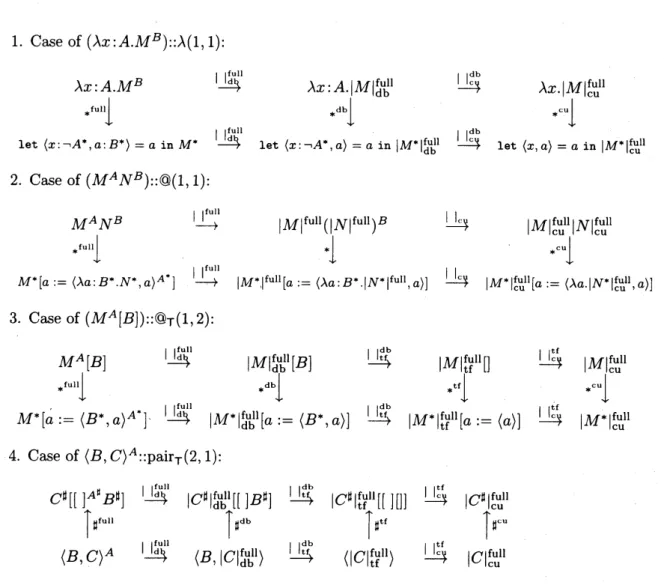
Proof.
By induction onthe structures. We show some of thecases in Fig. 2. $\square$$\lambda 2$ has the lemma of lifting as in [1], i.e., Proposition 5 ($s\geq$ Curry): If
$\Gamma\vdash_{s-\lambda 2}N$ : $A$ then there exists a term $M$ in the full $\lambda 2$ such that $|M|_{s}^{ful1}=N$
and $\Gamma\vdash_{fu11\lambda 2}M$ : $A$
.
Here, CPS-terms in style $s\geq Curry^{+1et_{T}(1,0)}$ or $s=$$Curry^{+\ovalbox{\tt\small REJECT} et_{T}(0,1)}$
have the following lemma that plays an important role. We
write CUR for the set $\{s|s\geq Curry^{+\Lambda(1,0)}\}\cup\{Curry^{+\Lambda(0,1)}\}$, and CUR* for $\{s|s\geq Curry^{+1et_{T}(1,0)}\}\cup\{Curry^{+1et\uparrow(0,1)}\},$
Proposition 8 (Key proposition: lifting CPS-terms and types for $s\in C\cup R^{*}$)
Let $s\in C\cup R^{*}$
(1)
If
$\Gamma,$$a$ : $A\vdash_{s-\lambda^{\exists}}P$ : $\perp$ in $s$-style$\lambda^{\exists}$
, then there exist a $CPS$-term $Q$
in the
full
$\lambda^{\exists}$, a $CPS$-type $A’$, and $\Gamma’$ consisting
of
$CPS$-types such that1. Case of$(\lambda x: A.M^{B})::\lambda(1,1)$:
$\lambda x$:A.$M^{B}$ $||_{d}d^{fu11}$ $\lambda x$:$A$
.
$|M|_{db}^{fu11}$$\underline{||_{c*\prime}^{db}}$
$\lambda x.|M|_{cu}^{fu11}$
$*full\downarrow *db\downarrow *^{Cu}I$
let $\langle x:\neg A^{*},$$a:B^{*}\rangle=a$ in $M^{*}$
$|\underline{|_{dQ}^{fu11}}$
let $\langle x:\neg A^{*},$$a\rangle=a$ in $|M^{*}|_{db}^{fu11}$
$\underline{||_{c}^{db}R}$
’ let $\langle x,$$a\rangle=a$ in $|M^{*}|_{cu}^{fu11}$
2. Case of$(M^{A}N^{B})::@(1,1)$:
$M^{A}N^{B} | arrow|^{fu}|l |M|^{fu11}(|N|^{ful1})^{B} \frac{||_{c*}}{\prime} |M|_{cu}^{fu11}|N|_{cu}^{fu11}$
$*full\downarrow *I *^{cu}I$
$M^{*}[a:=\langle\lambda a:B^{*}.N^{*}, a\rangle^{A}.]$ $|arrow|^{ful1}$ $|M^{*}|^{fu11}[a:=\langle\lambda a:B^{*}|N^{*}|^{fu11}, a\rangle]$ $\underline{||_{c}v}$
’
$|M^{*}|_{cu}^{fu11}[a:=\langle\lambda a.|N^{*}|_{cu}^{fu11}, a\rangle]$
3. Caseof $(M^{A}[B])::@_{T}(1,2)$:
$M^{A}[B] |_{\frac{1_{d}^{fu1}4}{}}^{1} |M|_{db}^{fu11}[B] arrow^{||_{tf}^{db}}|M|_{tf}^{fu11}[] \frac{||_{c}^{tf}v}{} |M|_{cu}^{fu11}$
$*full\downarrow *^{db}\downarrow *^{tf}\iota *^{cu}I$
$M^{*}[a:=\langle B^{*}, a\rangle^{A}.].$ $|\underline{|_{d}^{fu11}4}$
’
$|M^{*}|_{db}^{fu11}[a:=\langle B^{*}, a\rangle]$ $arrow^{||_{tf}^{db}}$
$|M^{*}|_{tf}^{fu11}[a:=\langle a\rangle]$
$\frac{||_{cg}^{tf}}{\prime}$
$|M^{*}|_{cu}^{fu11}$
4. Caseof $\langle B,$$C\rangle^{A}::pair_{T}(2,1)$:
$c\#\#\#$ $|\underline{|_{d1_{\mathfrak{i}}}^{fu11}}$
$|c\#\#$
$||^{db}arrow^{tf}$$|C\#|_{tf}^{fu11}[[$
$\underline{||_{c}^{tf}v}$
’ $|C\#|_{cu}^{fu11}$
$\uparrow\#^{fu11} \uparrow\#^{db} \uparrow\#^{tf} \uparrow\#^{cu}$
$\langle B,$$C\rangle^{A}$ $|\underline{|_{dQ}^{fu11}}$ $\langle B,$$|C|_{db}^{fu11}\rangle$ $arrow^{||_{tf}^{db}}$ $\langle|C|_{tf}^{fu11}\rangle$ $\underline{||_{c}^{tf}v}$ ’ $|C|_{cu}^{fu11}$
lifting $||^{-1}$
$\Gamma\vdash_{t-\lambda 2}N$ : $A$for $\exists$ $t$-style$N$ s.t. $|N|=M$
$-$
$\Gamma\vdash_{s-\lambda 2}M$ : $A$CPS-trans. $*^{t}I$ $\downarrow(a)$
erasing $||$
$\neg\Gamma^{*},$$a:A^{*}\vdash_{t-\lambda^{\exists}}N^{*}:\perp$
$arrow$
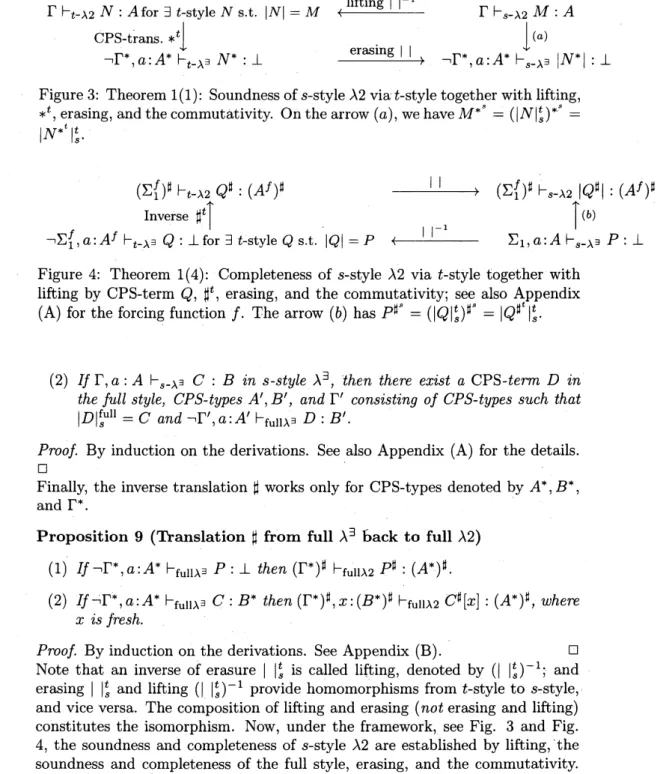
$\neg\Gamma^{*},$$a:A^{*}\vdash_{s-\lambda^{\exists}}|N^{*}|:\perp$Figure3: Theorem 1(1): Soundness of$s$-style$\lambda 2$
via$t$-style togetherwith lifting, $*^{t}$,
erasing,andthecommutativity. On thearrow$(a)$, we have$M^{*^{S}}=(|N|_{s}^{t})^{*^{s}}=$
$|N^{*^{t}}|_{s}^{t}.$
$(\Sigma_{1}^{f})^{\#}\vdash_{t-\lambda 2}Q^{\#}:(A^{f})^{\#} arrow (\Sigma_{1}^{f})^{\#}\vdash_{s-\lambda 2}|Q^{\#}|:(A^{f})^{\#}$
$11$
Inverse $\#^{t}\uparrow$ $\uparrow(b)$
$\neg\Sigma_{1}^{f},$$a:A^{f}\vdash_{t-\lambda^{\exists}}Q:$ lfor $\exists t$-style $Q$ s.t. $|Q|=P$
$-$
$\Sigma_{1},$$a:A\vdash_{s-\lambda^{\exists}}P:\perp$ $||^{-1}$Figure 4: Theorem 1(4): Completeness of $s$-style $\lambda 2$ via $t$-style together with
lifting by
CPS-term
$Q,$ $\#^{t}$, erasing, and the commutativity;see
also Appendix (A) for the forcing function $f$.
The arrow (b) has $P\#^{s}=(|Q|_{s}^{t})^{\#^{s}}=|Q^{\#^{t}}|_{s}^{t}.$(2)
If
$\Gamma,$$a:A\vdash_{s-\lambda^{\exists}}C:B$ in $s$-style$\lambda^{\exists}$
, then there exist a $CPS$-term $D$ in
the
full
style, $CPS$-types $A’,$$B’$, and$\Gamma’$ consistingof
$CPS$-types such that$|D|_{s}^{fu11}=C$ and$\neg\Gamma’,$$a:A’\vdash_{fu11\lambda}\exists D$ : $B’.$
Proof.
Byinduction on the derivations. See also Appendix (A) for the details.$\square$
Finally, the inverse translation $\#$ works only for CPS-types denoted by $A^{*},$$B^{*},$
and $\Gamma^{*}.$
Proposition 9 (Translation $\#$ from full
$\lambda^{\exists}$
back
to full $\lambda 2$) (1)If
$\neg\Gamma^{*},$$a:A^{*}\vdash_{fu11\lambda^{\exists}}P:\perp then$ $(\Gamma^{*})^{\#}\vdash_{fu11\lambda 2}P\#$ : $(A^{*})\#.$(2)
If
$\neg\Gamma^{*},$$a:A^{*}\vdash_{ful1\lambda^{\exists}}C$ : $B^{*}$ then$(\Gamma^{*})^{\#},$$x:(B^{*})\#\vdash_{fu11\lambda 2}C\#[x]$ : $(A^{*})^{\#}$, where$x$ is
fresh.
Proof.
By induction on the derivations. See Appendix (B). $\square$Note that an inverse of
erasure
$||_{s}^{t}$ is called lifting, denoted by $(||_{s}^{t})^{-1}$; anderasing $||_{s}^{t}$ and lifting $(||_{s}^{t})^{-1}$ provide homomorphisms from $t$-style to $s$-style,
and vice versa. The composition of lifting and erasing (noterasing andlifting)
constitutes the isomorphism. Now, under the framework, see Fig. 3 and Fig.
4, the soundness and completeness of $s$-style $\lambda 2$ are established by lifting, the
soundness and completeness of the full style, erasing, and the commutativity.
This idea is applied to connect type-related problems parametrized with styles
by the following theorem.
Theorem 1 (1) For any $s\geq$ Curry,
if
$\Gamma\vdash_{s-\lambda 2}M:$ A then$\neg\Gamma^{*},$$a:A^{*}\vdash_{s^{*}-\lambda^{\exists}}$(2) For any style $s^{*}\in$ CUR*,
if
$\neg\Gamma^{*},$$a:A^{*}\vdash_{s^{*}-\lambda^{\exists}}M^{*}$ $:\perp then$we
have $\Gamma\vdash_{s-\lambda 2}M:A.$(3) For any style $s\in$ CUR with style @(n,O)2, we have $\Gamma\vdash_{s-\lambda 2}M:$ $A$
for
some type $A$
if
and onlyif
$\neg\Gamma^{*}\vdash_{s-\lambda^{\exists}}$ Aa.M* : $B$for
some
type $B.$(4) For any style $s\in$ CUR, we have $\Gamma\vdash_{s-\lambda 2}M:$ $A$
for
some context $\Gamma$ and type $A$if
and onlyif
$\Sigma\vdash_{s-\lambda^{\exists}}M^{*}$ : $B$for
some context $\Sigma$and type $B.$
Proof.
(1) Suppose that $\Gamma\vdash M$ : $A$ in $s$-style A2. Then, by Proposition 5(lifting), there exists
a
full $\lambda 2$-term $N$, such that $|N|_{s}^{fu11}=M$ and $\Gamma\vdash N$ : $A$in full $\lambda 2$
.
Thus, from Proposition 6, $\neg\Gamma^{*},$$a:A^{*}\vdash N^{*}fu11$ $:\perp in$ full $\lambda^{\exists}$.
Hence, by erasing, $\neg\Gamma^{*},$$a:A^{*}\vdash|N^{*^{fu11}}|_{s}^{fu11}:\perp$ in the $s$-style$\lambda^{\exists}$
, where $|N^{*^{fu11}}|_{S}^{ful1}=$ $(|N|_{s}^{fu11})^{*^{s}}=M^{*^{S}}$ by Proposition 7, see also Fig. 3.
(2) Suppose that $\neg\Gamma^{*},$$a:A^{*}\vdash M^{*}q$ $:\perp$ in $s$-style
$\lambda^{\exists}$
.
Then, from Proposition8, there exists a CPS-term, to say $Q$ in full $\lambda^{\exists}$
, such that $|Q|_{s}^{ful1}=M^{*^{8}}$ and
$\neg(\neg\Gamma^{*})^{f},$$a:(A^{*})^{f}\vdash Q$ $:\perp$ in full $\lambda^{\exists}$
, where $\neg(\neg\Gamma^{*})^{f}=\neg\Gamma^{*}$ and $(A^{*})^{f}=A^{*}.$
See also Appendix (A) for thefunction$f$forcingnon CPS-types intoCPS-types.
Hence, from Proposition 9, we have $(\Gamma^{*})^{\#}\vdash Q^{\#^{ful1}}$ : $(A^{*})^{\#}$ in full A2, where
$(A^{*})\#=A$ and $(\Gamma^{*})^{\#}=\Gamma$
.
Therefore, byerasing, weobtain $\Gamma\vdash|Q^{\#^{fu11}}|_{s}^{ful1}:$ $A$ in$s$-styleA2, where $|Q^{\#^{ful1}}|_{s}^{fu11}=(|Q|_{s}^{fu11})^{\#^{s}}=(M^{*^{S}})^{\#^{s}}=M$ by Proposition 7.
(3) Similarly to the above. For domain-free abstraction $\lambda a.M^{*}$ with style $\lambda(0)$,
it is enough to have style @(n, O) from Table 1. (4) $(\Rightarrow$$)$ is the same
as
done in (1) above.($\Leftarrow$): Suppose that there exist $\Sigma$ and $B$ such that $\Sigma\vdash M^{*}$ : $B$ in $s$-style
$\lambda^{\exists}.$
From the definition of $M^{*}$,
we
should have $B=\perp$ and $\Sigma=\Sigma_{1},$$a:$$A$ for some$\Sigma_{1}$ and $A^{3}$, such that $\Sigma_{1},$$a:A\vdash M^{*}$ $:\perp$ in $s$-style
$\lambda^{\exists}$
. Thus the samemethod
used in (2) above proves this part, as shown in Fig. 4. $\square$
Corollary 2 The $CPS$-translation is
an
order-embedding with respect to theorder on styles $s\in C\cup R.$
Proof.
Let $s\in C\cup R$.
From Theorem 1 $(1,2)$ and Table 1, an $s$-style $\lambda 2$ is embedded into$s^{*}$-style$\lambda^{\exists}$suchthat$\Gamma\vdash_{s-\lambda 2}M:$ $A$iff$\neg\Gamma^{*},$$a:A^{*}\vdash_{s-\lambda^{\exists}}M^{*}$ $:\perp.$
Let $s\leq t$. Then$t$-style $\lambda 2$ is embedded into $t^{*}$-style $\lambda^{\exists}$
as
well with$s^{*}\leq t^{*}.$ $\square$4.4
Application
to fundamental properties
preserved
un-der
the translations:
decidability
correspondence
be-tween
problems
As a by-product, decidability of the following type-related problems between
$s$-style $\lambda 2$ and
$s$-style
$\lambda^{\exists}$
is preserved by Theorem 1.
Definition 9 $(TCP(s), TIP(s), TPP(s))$
2SeeTable 1, where style @(n, O) correspondsto domain-freestyle$\lambda(0)$.
3Ingeneral, $\Sigma_{1},$$A$may not consist only of CPS-types, but this isovercomebythe forcing
(1) Type checking problem
of
$s$-style terms$TCP(s)$ : Given an $s$-style $\lambda$-term$M$, a type $A$, and a context $\Gamma$
, determine whether $\Gamma\vdash_{S}M:A.$
(2) Type
inference
problemof
$s$-style $\lambda-terms(TIP(s))$ : Given an $s$-style$\lambda$-term $M$
and a context $\Gamma$, determine whether$\Gamma\vdash_{s}M:$ $A$
for
some type$A.$
(3) Typability problem
of
$s$-style terms $(TPP(s))$: Given an $s$-style $\lambda$-term$M$, determine whether$\Gamma\vdash_{s}M:$ $A$
for
some context $\Gamma$ and type $A.$ For any style $s\in CUR,$$TCP(s)$ follows Theorem 1(1)(2);for style$s$with@(n, O),TIP$(s)$ follows Theorem 1(3); and for style $s\in$ CUR, $TPP(s)$ follows Theorem
1 (4). Therefore, the decidability relationship between type-related problems
are
summarized
as
follows.Proposition 10 (Decidability correspondence between $\lambda 2$ and $\lambda^{\exists}$
) 1.
For any style $\mathcal{S}\in$ CUR, the undecidable results
of
$TCP(s)$for
$s$-style $\lambda 2$ imply thosefor
$s^{*}$-style $\lambda^{\exists}$. In turn, the decidable results
of
$TCP(s^{*})$for
$s^{*}-\lambda^{\exists}$
imply those
for
$s-\lambda 2.$2. For any style $s\in CUR$ with @(n, O), the undecidable results
of
TIP$(\mathcal{S})$for
$s$-style $\lambda 2$ imply those
for
$s^{*}$-style $\lambda^{\exists}.$3. For any style $s\in$ CUR, the undecidable results
of
$TPP(s)$for
$s$-style $\lambda 2$ imply thosefor
$s^{*}$-style $\lambda^{\exists}.$Not only already known examples but also new ones follow Proposition 10. For
example, the undecidable results of TCP(df A2) in Fujita and Schubert [8] and
TCP$(tf-\lambda 2)[9]$ canbe applied to show the corresponding results of$TCP(df-\lambda^{\exists})$
and $TCP(tf-\lambda^{\exists})$ respectively. Undecidability ofTIP$(df-\lambda^{\exists})$ and TIP$(tf-\lambda^{\exists})$
are
derived from that ofthe corresponding TIP$(df-\lambda 2)[8]$ and TIP$(tf-\lambda 2)[9]$
.
Theundecidable results of TPP(ha A2), $TPP(df-\lambda 2)[8]$, and $TPP(tf-\lambda 2)[9]$ imply
those of $TPP(ha-\lambda^{\exists})$, $TPP(df-\lambda^{\exists})$ in Nakazawa et al. [13], and $TPP(tf-\lambda^{\exists})$
respectively.
5
Concluding remarks
Fundamental properties are dependent on styles or representations of terms,
and many formulations of terms
are
introduced and studied under variouscon-texts. There have been a number of noteworthy investigations including, e.g.,
partial type-reconstruction by Pfenning [14]; explicit type scheme annotations
by Odersky and L\"aufer [10]; bidirectional type-checking of predicative System
$F$ by Dunfield and Krishnaswami [5] and references therein.
In ordertocapture existing styles in a uniform way, we introduced styles of terms by giving abstract term-trees withindices, whichpresentabird’s-eye view of notonlyexisting systems but also
new
ones such as $Curry^{+}$-styles in Sectionbyredu$\acute{c}ing$
the
semi-unification
problem followingWells [17],see Appendix
(C) for the details.As an application to decidability of type-related problems, it is worthwhile
to investigate intermediate structures between decidable and undecidable
sys-tems. For this principal objective, the notion of fully annotated and partially
annotated $\lambda 2$-terms based on styles is useful, and moreover, we introduced the counterpart systems partial $\lambda^{\exists}$
(2nd order existential type systems) and the
framework that handles both $\lambda 2$ and $\lambda^{\exists}$
families systematically by
means
oftranslations. The CPS-translation provides a natural interpretation from $\lambda 2$ into$\lambda^{\exists}$
, such thattype annotations of$\lambda 2$ correspondtodomains of abstractions of $\lambda^{\exists}$
. At the current stage, Theorem 1$(2,3,4)$ excludes the Curry style, since
the key proposition Proposition 8 (Lifting CPS-terms) would become the most
involved for the Curry-style $\lambda^{\exists}$
with the style $Iet_{T}(0,0)$
.
Further studiesare
needed for this
case.
As
further
work, the notion of styles should be extended to systems withdeponent types, and the promising is the application to reduction properties,
e.g., the Church-Rosser property is challenging.
References
[1] H. P. Barendregt: Lambda calculi with types, In S.Abramsky et al.
edi-tors, Handbook
of
Logic in Computer Science, Vol. II, pp. 117-309, OxfordUniversity Press, 1992.
[2] H. P. Barendregt, W.Dekkers, R.Statman: Lambda Calculus with Types,
Cambridge University Press, 2012.
[3] G.Barthe, M. H.
Srensen:
Domain-Free Pure Type Systems,Lecture Notesin Computer Science 1234 (LFCS 1997), pp. 9-20, 1997.
[4] A. Church: A
formulation
of
the simple theoryof
types, J. Sym. Logic 5,pp. 56-68, 1940.
[5] J. Dunfield, N. R.Krishnaswami: Complete and easy bidirectional
type-checking
for
higher-rankpolymorphism, Proc. 18th ACM SIGPLAN ICFP,pp. 429-442, 2013.
[6] K. Fujita: Galois embedding
from
polymorphic types into existential types,Lecture Notes in Computer Science3461 (TLCA 2005), pp. 194-208, 2005.
[7] K.Fujita: $CPS$-translation as adjoint, Theoret. Comput. Sci. 411 (2), pp.
324-340, 2010.
[8] K. Fujita, A. Schubert: Partially typed terms between Church-style and
Curry-style, Lecture Notes in Computer Science 1872 (IFIP TCS 2000),
[9] K. Fujita, A. Schubert: The undecidability
of
type related problems intype-free
style System $F$, Leibniz International Proceedings in Informatics 6(RTA 2010), pp. 103-118, 2010.
[10] M.Odersky, K.L\"aufer: Putting Type Annotations to Work, Proc. 23rd
ACM Symposium on Principles of Programming Languages, pp. 54-67,
1996.
[11] D. Leivant: Polymorphic type inference, Proc. 10th ACM Symposium on
Principles ofProgramming Languages, pp. 88-98, 1983.
[12] J.C. Mitchell, G. D. Plotkin: Abstract types have existential types,
ACM
Trans. Program. Lang. Syst., 10-3, pp. 470-502, 1998.
[13] K. Nakazawa et al.: Undecidability
of
type-checking indomain-free
typedlambda-calculi with existence, Lecture Notes in Computer Science 5213
(CSL 2008), 478-492, 2008.
[14] F. Pfenning: On the undecidability
of
partial polymorphic typereconstruc-tion, Fundamenta Informaticae 19 (1,2), pp. 185-199, 1993.
[15] D.Prawitz: Natural Deduction, A
Proof
Theoretical Study, Almqvist&
Wiksell, 1965.
[16] M. H.$s_{\emptyset rensen}$, P. Urzyczyn: Lectures on the Curry-Howard Isomorphism,
Vol. 149, Studies in Logic and the Foundations ofMathematics, Elsevier
Science Inc., 2006.
[17] J. B. Wells: Typability and type checking in system F are equivalent and
undecidable, Ann. Pure Appl. Logic 98, pp. 111-156, 1999.
Appendix
A
Proposition
8
(Lifting
CPS-terms and types
for style
$t\in CUR^{*}$)
(1) If$\Gamma,$$a:A\vdash_{t-\lambda^{\exists}}P:\perp in$ $t$-style $\lambda^{\exists}$
, then there exist a CPS-term $Q$ in the
full style, a CPS-type $A’$, and a context $\Gamma’$
consisting of CPS-types such
that $|Q|_{t}^{ful1}=P$ and $\neg\Gamma’,$$a:A’\vdash_{fu11\lambda}\exists Q$ $:\perp.$
(2) If$\Gamma,$$a:A\vdash_{t-\lambda^{\exists}}C:B$ in $t$-style $\lambda^{\exists}$
, then there exist a CPS-term $D$ in the
full style,. a CPS-type $B’$, and a context $\Gamma’$ consisting of CPS-types such that $|D|_{t}^{fu11}=C$ and $\neg\Gamma’,$$a:A’\vdash_{fu11\lambda}\exists D$ : $B’.$
Proof.
First wedefine a functionthat forces nonCPS-types into CPS-types, asfollows:
2. $(\neg A)^{f}=A^{f}$;
3. $(\exists X.A)^{f}=\exists X.A^{f}$;
4. $(A\wedge B)^{f}=\neg A^{f}\wedge B^{f}$;
5. $\perp f=Z$ where $Z$ is a fixed and fresh type variable.
Note that we have $A^{f}=A$ for any CPS-type $A$
.
Now we prove the followingstatement byinduction
on
the derivations.(1) If$\Gamma,$$a:A\vdash_{t-\lambda^{\exists}}P:\perp$ in $t$-style $\lambda^{\exists}$
, then there exists a CPS-term $Q$ in the
full style such that $|Q|_{t}^{ful1}=P$ and $\neg\Gamma^{f},$$a:A^{f}\vdash_{fu11\lambda}\exists Q:\perp.$
(2) If$\Gamma,$$a:A\vdash_{t-\lambda^{\exists}}C:B$ in $t$-style $\lambda^{\exists}$
, then there exists
a
CPS-term $D$ inthefullstyle suchthat $|D|_{t}^{ful1}=C$ and $\neg\Gamma^{f},$$a:A^{f}\vdash_{fu11\lambda}\exists D:B^{f}.$
Note that for style $t\geq$ tf, the system $t-\lambda^{\exists}$
is so-called syntax directed, for
instance see Proposition 3 (Generation lemma), so that the lifting lemma holds
naturally. Moreover, the lemmaholds for systems with style$t\geq Curry^{+1et_{T}(1,0)}$
as
well. In addition, $Curry^{+1et_{T}(0,1)}-\lambda^{\exists}$ also enjoysthe property. We show someof thecases here.
1. Case $P$ of$(xC)$; var(O) and @(O):
$\frac{\Gamma,x:\neg B\vdash x:\neg B\Gamma,x:\neg B,a:A\vdash C:B}{\Gamma,x:\neg B,a:A\vdash xC:\perp}(\neg E)$
Note that $\neg(\neg B)^{f}=\neg B^{f}$ for any $\lambda^{\exists}$
-type $B$
.
From the inductionhy-pothesis,
we
havea CPS-term $D$ in the full style such that $|D|=C^{f}$ and$\neg\Gamma^{f},$$x:\neg B^{f},$$a:A^{f}\vdash D$ : $B^{f}$
.
Hence, $\neg\Gamma^{f},$$x:\neg B^{f},$$a:A^{f}\vdash xD$ $:\perp$ by $(\neg E)$, where $|xD|=xC.$
2. Case of $(let \langle x, a\rangle=C in P)::Iet(O, 0)$:
$\frac{\Gamma,a:A\vdash C:A_{1}\wedge B\Gamma,x:A_{1},a:B\vdash P:\perp}{\Gamma,a:A\vdash 1et\langle x,a\rangle=CinP:\perp}(\wedge E)$
From the induction hypotheses, we have CPS-terms $D$ and $Q$ in the full
style such that$\neg\Gamma^{f},$$a:A^{f}\vdash D$ : $(A_{1}\wedge B)^{f}$ and $\neg\Gamma^{f},$$x:\neg A_{1}^{f},$$a:B^{f}\vdash Q$ $:\perp,$
together with $|D|=C$ and $|Q|=P$ , where $(A_{1}\wedge B)^{f}=\neg A_{1}^{f}\wedge B^{f}.$
Thus, $\neg\Gamma^{f},$
$a$ : $A^{f}\vdash$ let $\langle x:\neg A_{1}^{f},$$a:B^{f}\rangle=D$ in $Q:\perp$ by $(\wedge E)$, where $|let\langle x:\neg A_{1}^{f},$$a:B^{f}\rangle=D$ in $Q|=$ $(let \langle x, a\rangle=C in P)$
.
3. Case of $($let $\langle a\rangle=C$ in $P)::Iet_{T}(1,0)$:
$\frac{\Gamma,a:AC:\exists X.B\Gamma,a:B\vdash P:\perp}{\Gamma,a\vdash 1et\langle a\rangle=CinP:\perp}(\exists E)$
From induction hypotheses,we have CPS-terms$D$ and $Q$ in the full style
such that $\neg\Gamma^{f},$$a:A^{f}\vdash D:\exists X.B^{f}$ and $\neg\Gamma^{f},$$a:B^{f}\vdash Q:\perp$, together with
$|D|=C$ and $|Q|=P$
.
Hence, $\neg\Gamma^{f},$$a:A^{f}\vdash let\langle X,$$a:B^{f}\rangle=D$ in $Q:\perp$4. Case of$(let \langle X, a\rangle=C in P)::Iet_{T}(2,0)$ follows the same pattern as the
above.
5. Case$C$ ofa::var(O) is verified by $\neg\Gamma^{f},$$a:A^{f}\vdash a:A^{f}$ by using (var).
6. Case $of\langle\lambda a.P,$$C\rangle::pa\ovalbox{\tt\small REJECT} r(0)$:
$\frac{\frac{}{}(\neg I)\Gamma,a:AP:\perp\Gamma\vdash\lambda a\neg A_{1}\Gamma,a:A\vdash C:B}{\Gamma,A\vdash\langle\lambda a.P,C\rangle:\neg A_{1}\wedge B}(\wedge I)$
From the induction hypotheses, we have CPS-terms $D$ and $Q$ in the full
style suchthat $\neg\Gamma^{f},$$a:A_{1}^{f}\vdash Q:\perp and\neg\Gamma^{f},$$a:A^{f}\vdash D$ : $B^{f}$, together with
$|D|=C$ and $|Q|=P$
.
Thus, $\neg\Gamma^{f},$$a:A^{f}\vdash\langle\lambda a:A_{1}^{f}.Q,$$D\rangle$ : $(\neg A_{1}\wedge B)^{f}$ by$(\neg I)$ and $(\wedge I)$, where $(\neg A_{1}\wedge B)^{f}=\neg A_{1}^{f}\wedge B^{f}$, and $|\langle\lambda a:A_{1}^{f}.Q,$$D\rangle|=$
$\langle\lambda a.P, C\rangle.$
7. Case of$C::pair_{T}(0,0)$:
$\frac{\Gamma,a:A\vdash C:B[X:=A_{1}]}{\Gamma,a:A\vdash C:\exists X.B}(\exists I)$
From the induction hypothesis, we have a CPS-term $D$ in the full style
such that $\neg\Gamma^{f},$$a:A^{f}\vdash D$ : $(B[X:=A_{1}])^{f}$, together with
$|D|=C$, where
$(B[X :=A_{1}])^{f}=B^{f}[X :=A_{1}^{f}]$, provided that the variable $X$ is different
fromthe distinguished variable$Z$
.
Hence, $\neg\Gamma^{f},$$a:A^{f}\vdash\langle A_{1}^{f},$$D\rangle^{\exists X.B^{f}}$ : $\exists X.B^{f}$by $(\exists E)$, where $|\langle A_{1}^{f},$$D\rangle^{\exists X.B^{f}}|=|D|=C.$
8. Cases of $\langle C\rangle::pa\ovalbox{\tt\small REJECT} r_{T}(1,0)$ and $\langle A_{1},$$C\rangle::pair_{T}(2,0)$:
9. Case of$Curry^{+/et_{T}(0,1)}-\lambda^{\exists}$, in particular, $(\exists E)$ with style $Iet_{T}(0,1)$:
Since variable $a$ is a linearvariable, intowhich a CPS-term attached with
a type is substituted, one can decomposethe judgement $\Gamma,$$a:A\vdash P[a:=$
$C^{B}]\backslash :\perp$ into $\Gamma,$$a:A\vdash C$ : $\exists X.B$ and $\Gamma,$$a:B\vdash P:\perp$; and the judgement $\Gamma,$$a:A_{1}\vdash C_{2}[a:=C_{1}^{A_{2}}]$ : $B$ into $\Gamma,$$a:A_{1}\vdash C_{1}$ : $\exists X.A_{2}$ and $\Gamma,$$a:A_{2}\vdash C_{2}$ : $B$
.
Then follow thesame
pattern as theabove4.
$\square$B
Proposition 9
(Translation
$\#$from full
$\lambda^{\exists}$
back
to
full
$\lambda 2$)
Let $A^{*},$ $B^{*}$ be CPS-types and $\Gamma^{*}$ be a context consisting of CPS-types.
(1) If$\neg\Gamma^{*},$$a:A^{*}\vdash_{ful1\lambda^{\exists}}P:\perp$ then ($\Gamma^{*})^{\#}\vdash_{fu11\lambda 2}P\#$ : $(A^{*})^{\#}.$
4Although the decomposition may not beunique, $e.g_{\rangle}$take$P[a:=C_{1}^{B_{1}}[a:=C_{2}^{B_{2}}$ each
decomposition can be related by the so-called permuted conversion or structural reduction [15].
(2) If$\neg\Gamma^{*},$$a:A^{*}\vdash_{ful1\lambda^{\exists}}C$ : $B^{*}$ then $(\Gamma^{*})^{\#},$$x:(B^{*})^{\#}\vdash_{fu11\lambda 2}C\#[x]$ : $(A^{*})^{\#}$, where
$x$ is fresh.
Proof.
By induction on the derivations. We showsome of thecases
here.1. Case of $(let \langle x:\neg A_{1}^{*}, a:A_{2}^{*}\rangle=C in P)$:
$\frac{\neg\Gamma^{*},a:A^{*}\vdash C:\neg A_{1}^{*}\wedge A_{2}^{*}\neg\Gamma^{*},x:\neg A_{1}^{*},a:A_{2}^{*}\vdash P:\perp}{\neg\Gamma^{*},a:A^{*}\vdash 1et\langle x:\neg A_{1}^{*},a:A_{2}^{*}\rangle=CinP:\perp}(\wedge E)$
From the induction hypotheses, we have$\Gamma^{*\#},$$x:(A_{1}^{*\#}arrow A_{2}^{*\#})\vdash C\#[x]$ : $A^{*\#}$
and$\Gamma^{*\#},$$x:A_{1}^{*\#}\vdash P\#:A_{2}^{*\#}$
.
Then$\Gamma^{*\#}\vdash\lambda x:A_{1}^{*\#}.P\# A_{2}^{\#}$ : $A_{1}^{*\#}arrow A_{2}^{*\#}$, and$\Gamma^{*\#}$$\vdash C[\lambda x:A_{1}^{*\#}.P]:A^{*\#}.$
2.
Case
$of\langle A_{2}^{*},$$C\rangle^{\exists X.A}i$:$\frac{\neg\Gamma^{*},a:A^{*}\vdash C:A_{1}^{*}[X:=A_{2}^{*}]}{\neg\Gamma^{*},a:A^{*}\vdash\langle A_{2}^{*},C\rangle^{\exists X.A_{1}^{*}}:\exists X.A_{1}^{*}}(\exists I)$
From the induction hypothesis, we have$\Gamma^{*\#},$$x$:$(A_{1}^{*}[X :=A_{2}^{*}])^{\#}\vdash C\#[x]$ : $A\#.$
And we also have $x:\forall\dot{X}.A_{1}^{*\#}\vdash x^{\forall X.A}i^{\#}A_{2}^{*\#}$ : $A_{1}^{*\#}[X:=A_{2}^{*\#}]$, where $A_{1}^{*\#}[X :=A_{2}^{*\#}]=$ $(A_{1}^{*}[X :=A_{2}^{*}])^{\#}.$
Hence, $\Gamma^{*\#},$$x:\forall X.A_{1}^{*\#}\vdash C\#[x^{\forall X.A_{1}^{*\#}}A_{2}^{*\#}]$ : $A^{*\#}$with$C\#[x^{\forall X.A}i^{\#}A_{2}^{*\#}]=(\langle A_{2}^{*}, C\rangle^{\exists X.Ai})^{\#}[x].$
$\square$
C
TCP
for
a variant
of
$Curry^{+\Lambda(1,0)}-\lambda 2$is
unde-cidable
We write $\vec{\forall}.A$
for the universal closure of $A$, i.e., $\vec{\forall}.A=\forall X_{1}\ldots X_{n}.A$ for
$FV(A)=\{X_{1}, . . . , X_{n}\}$, and accordingly put the following rule $(\vec{\forall}I)$ with style
$\Lambda(1,0)$ to$\lambda 2$:
$\frac{\Gamma\vdash M:A}{\Gamma\vdash\vec{\Lambda}.M:\vec{\forall}.A}(\vec{\forall}I)::\Lambda(1,0)$
where $X\not\in FV(\Gamma)$ for each $X\in FV(A)$
.
Let $A_{1},$ $A_{2},$ $B_{1},$ $B_{2}$ be $\lambda 2$-types, and
$X,$$X_{1},$ $X_{2},$$Y$ be fresh type variables. Then, as done in Wells [17], the
semi-unification problem (SUP) is reduced toTCP of the variant of$Curry^{+\Lambda(1,0)}-\lambda 2.$
Proposition 11 An instance
of
$SUP\{A_{1}\leq B_{1}, A_{2}\leq B_{2}\}$ has a solutionif
and only
if
$b$ : $\forall X.(Xarrow X)arrow Y,$$c:\vec{\forall}.(B_{1}arrow X_{1})arrow(X_{2}arrow B_{2})arrow(X_{1}arrow$$X_{2})\vdash b(\lambda x.\vec{\Lambda}.cxx):Y$ in $Curry^{+A(1,0)}$-A2.
Proof.
Followingthe proofof Theorem 4.1 in Wells [17]. $\square$ThispropositionimpliesthatTCPfor the variant of$Curry^{+\Lambda(1,0)}-\lambda 2$is
undecid-able, and that of the corresponding$Curry^{+1et_{T}(1,0)}-\lambda^{\exists}$ also becomesundecidable