New scheme for
pricing Bermudan
options
under
stochastic volatility
model
Masahiro Nishiba
Tokyo
Institute of Technology
2-12-1
Ookayama Meguro-ku
Tokyo
152-8552
Japan
E-mail:
[email protected]
January
30,
2012
Abstract
The author considersstochasticvolatility models and introducesanew
schemefor pricing Bermudan options under stochastic volatility models. Hisapproach is the asymptotic expansion method which is basedon Malli-avin calculus.
1
Introduction
The valuation of Bermudanoptions is veryimportant problem inoption pricing
theory. The values of Bermudan options in stochastic volatility models
are
calculated with the regression method developed by Longstaff and Schwartz [3].
This method is not suitable forparallel computing.
In this paper, we introduce a new scheme for pricing Bermudan options.
This scheme isvery universal and
can
beappliedtoproblemswe can
not developrecombiningtrees. For example,we canapply to evaluations of derivatives under
SV models.
Our scheme has two keys. One is to derive
an
approximate formula of thejoint distribution function ofstochastic processes using the asymptotic
expan-sion method. The other is to develop recombining treewith the idea of binning
[2] using the approximate joint distribution function. Using the recombining
three, we evaluate derivatives like Bermudanoptions under stochasticvolatility
models. Ourscheme is suitable for parallel computing.
The structure of this paper is
as
follows. The next section reviews thestochastic volatility models which arewidely accepted infinancial industry and
applies the asymptotic expansion method to the model. The 3rd section
de-scribes how to deriveourapproximateformulaof the joint distributionfunctions
joint distribution function of
SABR
model. The 5th section presents numericalresults of
our
new
scheme. The final sectionconcludes.
2
Stochastic
volatility
model
2.1
Definition of
stochastic
volatility
model
Let $(\Omega,\mathcal{F},$$\mathbb{P},$ $\{\mathcal{F}_{t}\}_{0\leq t\leq T})$ be
a
complete probability space satisfying the usualhypotheses and$T\in$ ($0$, oo)denotes
some
fixed horizon of economy. Let $(W_{1}(t), W_{2}(t))$,$0\leq t\leq T$, be
a
2-dimensional correlated Brownian motion with correlationgiven by $\rho:[0, T]arrow[-1,1]$ such that
$d\langle W_{1},$$W_{2}\rangle_{t}=\rho(t)dt$
.
(1)Weconsider the following stochastic differential equation for X and $Y$:
$dX(t)$ $=$ $B(t, X(t), Y(t))dW_{1}(t)$ , (2)
$dY(t)$ $=$ $M(t, Y(t))dt+D(t, Y(t))dW_{2}(t)$, (3)
$(X$ (0) $, Y(0))$ $=$ $(x_{0}, y_{0})\in \mathbb{R}\cross \mathbb{R}$, (4)
Suppose $B,$ $M$ and $D$ satisfy
some
regularity conditions.2.2
Asymptotic expansion of
stochastic
volatility
model
We consideran perturbedstochastic process defined
as
the followingstochasticdifferential equation:
$dX^{\epsilon}(t)$ $=$ $\epsilon B(t, X^{\epsilon}(t), Y^{\epsilon}(t))dW_{1}(t)$ , (5)
$dY^{\epsilon}(t)$ $=$ $M(t, Y^{\epsilon}(t))dt+\epsilon D(t, Y^{\epsilon}(t))dW_{2}(t)$ , (6)
$(X^{\epsilon}(0), Y^{\epsilon}(0))$ $=$ $(x_{0}, y_{0})\in \mathbb{R}\cross$ R. (7)
We want to calculate
an
approximate solution of this model by using theasymptotic expansion approach. Byresults of [5], we havethe followinglemma.
Lemma 2.1. $X^{\epsilon}(t)$ and $Y^{\epsilon}(t)$ have following approximate solutions as $\epsilonarrow 0$
respectively.
$X^{\epsilon}(T)$ $=$ $\sum_{i=0}^{N}\epsilon^{i}X_{i}(T)/i!+o(\epsilon^{N})$, (8)
where $X_{i}(T)= \frac{d^{i}X^{\epsilon}(T)}{d\epsilon^{i}}$ $\epsilon=0$ $Y_{i}(T)=\frac{d^{i}Y^{\epsilon}(T)}{d\epsilon^{i}}$ , $\epsilon=0$ (10) (11)
for
$i=0,1,$$\ldots,$$N$.
Here,
we can
calculate $X_{i}(T)$ and $Y_{i}(T)$ analytically. Examples of $Y_{i}(T)$are
as
follows:$Y_{1}^{\epsilon}(T)$ $=$ $\tilde{M}(T)\int_{0}^{T}\tilde{M}(t_{1})^{-1}D(t_{1}, Y_{0}(t_{1}))dW_{2}(t_{1})$ (12)
$Y_{2}^{\epsilon}(T)$ $=$ $\tilde{M}(T)\int_{0}^{T}\tilde{M}(t_{1})^{-1}Y_{1}(t_{1})^{2}M_{y,y}(t_{1}, Y_{0}(t_{1}))dt_{1}$,
$+$ 2$\tilde{M}(T)\int_{0}^{T}\tilde{M}(t_{1})^{-1}Y_{1}(t_{1})D_{y}(t_{1}, Y_{0}(t_{1}))dW_{2}(t_{1})$ (13)
$Y_{3}^{\epsilon}(T)$ $=$ $\tilde{M}(T)\int_{0}^{T}\tilde{M}(t_{1})^{-1}Y_{1}(t_{1})^{3}M_{y,y,y}(t_{1}, Y_{0}(t_{1}))dt_{1}$ ,
$+$
3
$\tilde{M}(T)\int_{0}^{T}\tilde{M}(t_{1})^{-1}Y_{1}(t_{1})Y_{2}(t_{1})M_{y,y}(t_{1}, Y_{0}(t_{1}))dt_{1}$,$+$ 3$\overline{M}(T)\int_{0}^{T}\tilde{M}(t_{1})^{-1}Y_{1}(t_{1})^{2}D_{y,y}(t_{1}, Y_{0}(t_{1}))dW_{2}(t_{1})$,
$+$ 3$\tilde{M}(T)\int_{0}^{T}\tilde{M}(t_{1})^{-1}Y_{2}(t_{1})D_{y}(t_{1}, Y_{0}(t_{1}))dW_{2}(t_{1})$ (14)
where
$\tilde{M}(T)$ $=$ $\exp(\int_{0}^{T}M_{y}(t_{0}, Y_{0}(t_{0}))dt_{0})$
.
(15)And examples
of
$X_{i}(T)$are
as
follows:$X_{0}^{\epsilon}(T)$ $=$ $x_{0}$ (17) $X_{1}^{\epsilon}(T)$ $=$ $\int_{0}^{T}B(t_{0}, Y_{0}(t_{0}), X_{0}(t_{0}))dW_{1}(t_{0})$ (18)
$X_{2}^{\epsilon}(T)$ $=$ 2 $\int_{0}^{T}X_{1}(t_{0})B_{y}(t_{0}, Y_{0}(t_{0}), X_{0}(t_{0}))dW_{1}(t_{0})$ (19) $+$ 2 $\int_{0}^{T}Y_{1}(t_{0})B_{x}(t_{0}, Y_{0}(t_{0}), X_{0}(t_{0}))dW_{1}(t_{0})$ (20)
$X_{3}^{\epsilon}(T)$ $=$
3
$\int_{0}^{T}X_{1}(t_{0})^{2}B_{y,y}(t_{0}, Y_{0}(t_{0}), X_{0}(t_{0}))dW_{1}(t_{0})$ (21) $+$ 3 $\int_{0}^{T}X_{2}(t_{0})B_{y}(t_{0}, Y_{0}(t_{0}),X_{0}(t_{0}))dW_{1}(t_{0})$ (22)$+$ 6 $\int_{0}^{T}X_{1}(t_{0})Y_{1}(t_{0})B_{x,y}(t_{0}, Y_{0}(t_{0}), X_{0}(t_{0}))dW_{1}(t_{0})$ (23)
$+$ 3 $\int_{0}^{T}Y_{1}(t_{0})^{2}B_{x,x}(t_{0}, Y_{0}(t_{0}), X_{0}(t_{0}))dW_{1}(t_{0})$ (24)
$+$ 3 $\int_{0}^{T}Y_{2}(t_{0})B_{x}(t_{0}, Y_{0}(t_{0}), X_{0}(t_{0}))dW_{1}(t_{0})$ (25)
3
Approximation formula of the joint
distribu-tion funcdistribu-tion
We have to calculate conditionalexpectationsto derive
an
approximate formulaofthe joint distribution function. The next theorem is very useful to calculate
conditional expectations.
Theorem 3.1. Let $f\in L^{2}(T^{n})$
for
$n\geq 1,\dot{d}_{1}\in L(T)$for
$1\leq j\leq m$.
Let$\{W_{i}\}_{i=1,\ldots,n}$ be
an
n-dimensional correlated Brownian motion and $\{Z_{i}\}_{i=1,\ldots,m}$be
an
m-dimensional correlated Brownian motion. We denote $(t_{1}, t_{2}, \ldots, t_{n})$ by(t).
$E[\int_{0}^{T}\int_{0}^{t_{1}}\cdots\int_{0}^{t_{\mathfrak{n}-1}}f(t)dW_{n}(t_{n})\cdots dW_{2}(t_{2})dW_{1}(t_{1})|$
$\{\int_{0}^{T}q_{1}^{1}(t)dZ_{1}(t),$$\ldots,$$\int_{0}^{T}q_{1}^{m}(t)dZ_{m}(t)\}=\{c_{1}, \ldots, c_{m}\}]$
where
$d\langle W_{i},$$Z_{j}\}$ $=$ $\rho_{i,j}dt$, (27)
$\Sigma_{c}$ $=$ $\{\int_{0}^{T}q_{i}(t)q_{j}(t)dt\}_{i,j=1,\ldots,m}$, (28) $\tilde{\Sigma}(t)$ $=$ $\{\rho_{i,j}q_{j}(t_{i})\}_{i=1,\ldots,n,j=1,\ldots,m}$ , (29) $\mu(t)$ $=$ $\Sigma_{c}^{-1t_{\Sigma(t)}^{\sim}}$, (30) $\Sigma(t)$ $=$ $-\tilde{\Sigma}(t)\Sigma_{c}^{-1}\tilde{\mathfrak{T}}(t)$, (31)
$m(\xi;\mu(t), \Sigma(t))$ $=$ $\exp(\mu(t){}^{t}\xi+1/2\xi\Sigma(t){}^{t}\xi)$, (32)
$\tilde{H}_{n}(\mu(t), \Sigma(t))$ $=$ $\frac{d^{n}m(\xi;\mu.(t),\Sigma(t))}{d\xi_{1}\cdot\cdot d\xi_{n}}|_{\xi=0}$
.
(33)Let $X_{G}^{\epsilon}(T)=(X^{\epsilon}(T)-X_{0}(T))/\epsilon$ and $Y_{G}^{\epsilon}(T)=(\sigma^{\epsilon}(T)-\sigma_{0}(T))/\epsilon$
.
Wewant toderivethejointdistribution functionof$X_{G}^{\epsilon}(T)$and$Y_{G}^{\epsilon}(T)$
.
Let$\varphi_{X_{G)}Y_{G}}$ :$\mathbb{R}\cross \mathbb{R}arrow \mathbb{R}$ bea characteristic function of$X_{G}^{\epsilon}(T)$ and $Y_{G}^{\epsilon}(T)$
.
Proposition 3.1. $\varphi_{X,Y}$ has an approximate expression
as
follows:
$\varphi_{X_{G},Y_{G}}(\xi_{1}, \xi_{2})$ $=$ $\sum_{i=0}^{N}\frac{\epsilon^{i}}{i!}\frac{d^{i}E[\exp(\sqrt{-1}\xi_{1}X^{\epsilon}(T)+\sqrt{-1}\xi_{2}Y^{\epsilon}(T))]}{d\epsilon^{i}}\epsilon=0+o(\epsilon^{N})$
(34)
for
$(\xi_{1}, \xi_{2})\in \mathbb{R}\cross$R.In case that $N=2$,
$\varphi_{X_{G},Y_{G}}(\xi_{1}, \xi_{2})$ $=$ $E[N(T)]+\frac{\sqrt{-1}}{2}E[(\xi_{1}X_{2}(T)+\xi_{2}Y_{2}(T))N(T)]$
$+ \frac{\sqrt{-1}\epsilon}{6}E[(\xi_{1}X_{3}(T)+\xi_{2}Y_{3}(T))N(T)]$
$- \frac{\epsilon^{2}}{8}E[(\xi_{1}X_{2}(T)+\xi_{2}Y_{2}(T))^{2}N(T)]+o(\epsilon^{2})$ (35)
where
$N(T)=\exp(\sqrt{-1}\xi_{1}X_{1}(T)+\sqrt{-1}\xi_{2}Y_{1}(T))$ . (36)
By using the inversion formulas of characteristic functions, we get an
approxi-mateformula of the joint probability density function of$X_{G}^{\epsilon}(T)$ and $Y_{G}^{\epsilon}(T)$
.
prob-ability density
function
$f_{X_{G},Y_{G}}$as
follows:
$f_{X_{G},Y_{G}}(x,y)$ $=$ $n(x, y; \Sigma)-\frac{1}{2}\frac{d}{dx}\{E^{c}[X_{2}(T)]n(x,y;\Sigma)\}-\frac{1}{2}\frac{d}{dy}\{E^{c}[Y_{2}(T)]n(x,y;\Sigma)\}$
$- \frac{1}{6}\frac{d}{dx}\{E^{c}[X_{3}(T)]n(x,y;\Sigma)\}-\frac{1}{6}\frac{d}{dy}\{E^{c}[Y_{3}(T)]n(x, y;\Sigma)\}$
$+ \frac{1}{8}\frac{d^{2}}{dx^{2}}\{E^{c}[X_{2}(T)^{2}]n(x, y;\Sigma)\}+\frac{1}{8}\frac{d^{2}}{dt^{2}}\{E^{c}[Y_{2}(T)^{2}]n(x,y;\Sigma)\}$
$+ \frac{1}{4}\frac{d^{2}}{dxdy}\{E^{c}[X_{2}(T)n(x, y;\Sigma)]Y_{2}(T)\}$ , (37)
for
$(x, y)\in \mathbb{R}\cross \mathbb{R}$, where$E^{c}[\cdot]$ $=$ $E[\cdot|(X_{1}(T), Y_{1}(T))=(x, y)]$ , (38)
$n(x,y_{)}\cdot\Sigma)$ $=$ $\frac{1}{2\pi\sqrt{|\Sigma|}}\exp(-[x, y]\Sigma^{-1t}[x,y])$ , (39)
$\Sigma$ $=$ $[_{E[X_{1}(T)Y_{1}(T)]}E[X_{1}(T)^{2}]$ $E[X_{1}(T)Y_{1}(T)]E[Y_{1}(T)^{2}]]$
.
(40)Then, $X^{\epsilon}(T)$ and $Y^{\epsilon}(T)$ have a 3rd order $appro\mathfrak{X}mate$joint distribution
func-tion$F_{X,Y}$
as
follows:
$F_{X,Y}(x, y)= \int_{0}^{x-X_{0}(T)}\int_{0}^{y-Y_{0}(T)}f_{X_{G},Y_{G}}(v, w)dwdv$ (41)
We
can
calculateconditional expectationsinthe abovelemma by usingThe-orem 3.1.
4
Pricing
Bermudan
options
We introduce
a new
scheme for pricing Bermudan options under stochasticvolatility models in this section. In order to clarify the dependency of the
variables,
we use
notationsas
follows:$F_{X,Y}(x_{0}, y_{0}, T, x, y)$
$=\mathbb{P}(X(T)\leq x,$$Y(T)\leq y|X(0)=x_{0},$$Y(0)=y_{0})$ . (42)
$\mathbb{P}_{X,Y}(x_{0}, y_{0}, T, l_{x}, u_{x}, l_{y}, u_{y})$
$=\mathbb{P}(l_{x}\leq X(T)\leq u_{x},$$l_{y}\leq Y(T)\leq u_{y}|X(0)=x_{0},$$Y(0)=y_{0})(43)$
We approximate $\mathbb{P}_{X,Y}(x_{0}, y_{0},T, l_{x}, u_{x}, l_{y}, u_{y})$ using results of Section 3. First,
we
have an approximate joint distribution functionof$X$ and $Y$ by Proposition3.2. Second, we calculate conditional expectations in the approximate joint
distribution function using Theorem 3.1. Thenwehavean approximate formula
4.1
Bermudan
options
Let $T$ be $[T_{0}=0, T_{1}, T_{2}, \ldots, T_{n}, \infty]$ for $n\geq 1$ and $\mathcal{T}$ be
a
set of stopping time$\tau$ : $\Omegaarrow$T. We want to calculate avalue $V(t)$ that is defined as follows:
$V(t)$ $=$ $\sup_{\tau\in \mathcal{T}}E[C(\tau, X(\tau), Y(\tau))|\mathcal{F}_{t}]$
.
(44)Weconsider this option in this section.
4.2
New scheme
Let X be $[x_{1}, x_{2}, \ldots, x_{N}]$ and $Y$ be $[y_{1}, y_{2}, \ldots, y_{M}]$ for $N\geq 1$ and $M\geq 1$
respectively. We define $a_{i}$ for $0\leq i\leq N$ and $b_{j}$ for $0\leq j\leq M$
as
follows:$a_{i}$ $=$ $\{\begin{array}{ll}-\infty i=0(x_{i}+x_{i+1})/2 i=1,2, \ldots, N-1,\infty i=N\end{array}$ (45)
$b_{i}$ $=$ $\{\begin{array}{ll}-\infty i=0(x_{i}+x_{i+1})/2 i=1,2, \ldots, M-1.\infty i=M\end{array}$ (46)
We calculate the value$V(k, i,j)$of theoptionat time$T_{k}$ and $(X (T_{k})Y(T_{k}))=$
$(x_{i}, y_{j})$ as follows:
when $k=n$,
$V(k, i,j)$ $=$ $C(T_{k}, x_{i}, y_{j})$, (47)
otherwise,
$V(k, i,j)$ $=$ $\max(C(T_{k}, x_{i}, y_{j}),\sum_{\overline{i}=1,\overline{j}=1}^{N,M}V(k+1,\tilde{t},\tilde{j})\mathbb{P}(i,j, k+1, \tilde{i},\tilde{j}))$ ,
(48)
where
$\mathbb{P}(i,j, k+1,\tilde{i},\tilde{j})=\mathbb{P}(x_{i},$$y_{i},$$T_{k+1}-T_{k},$$a_{\overline{i}-1},$$a_{\overline{i}},$$b_{\overline{j}-1},$$b_{\overline{j}})$
.
(49)Derivatives
are
valued in this scheme by the usual backwardinductionmethod.Since a direct construction ofa multidimensional tree would not lead to
recom-bining nodes, thecomputational effort wouldgrownexponentially in thenumber
Table 1: Parameter
$\frac\frac{(i)1000.30.31.00.21.00.01x_{0}y_{0}\alpha\beta\rho\epsilon r}{(ii)1000.30.30.50.2100.01}$
5
Numerical result
To test the validity of the
new
scheme,we
consider Bermudan and Europeanput option under the SABRmodel
as
follows:$dX^{\epsilon}(t)$ $=$ $\epsilon Y^{\epsilon}(t)X^{\epsilon}(t)^{\beta}dW_{1}(t)$ , (50) $dY^{\epsilon}(t)$ $=$ $\epsilon\alpha Y^{\epsilon}(t)dW_{2}(t)$ , (51)
$d\langle X^{\epsilon},$$Y^{\epsilon}\rangle_{t}$ $=$ $\rho dt$, (52)
$(X^{\epsilon}(0), Y^{\epsilon}(0))$ $=$ $(x_{0}, y_{0})\in \mathbb{R}^{+}\cross \mathbb{R}^{+}$, (53) $S(T)$ $=$ $\exp(rT)X^{\epsilon}(T)$
.
(54)Let execution times of Bermudan options be $T=\{1.0,2.0$, 3.0,4.0$\}$ and the
maturity ofEuropean option be $T=4.0$
.
We calculate followingvalues.$Put_{Eur}$ $=$ $E[\exp(-rT)(K-S(T))^{+}]$ , (55)
$Put_{Ber}$ $=$ $\sup_{\tau\in \mathcal{T}}E[\exp(-r\tau)(K-S(\tau))^{+}]$ , (56)
where $\mathcal{T}$ is
a
set ofstopping time$\tau$ : $\Omegaarrow T$ and $K$ is strike.
In the test ofthe
new
scheme,we
set $N=100$ and $M=50$, and define$x_{1}$,$x_{N},$ $y_{1}$ and $y_{M}$
as
follows:$x_{1}$ $=$ $E[X^{\epsilon}(T)]+5E[(X^{\epsilon}(T)-X_{0}(T))^{2}]^{1/2}$ (57)
$x_{N}$ $=$ $E[X^{\epsilon}(T)]-5E[(X^{\epsilon}(T)-X_{0}(T))^{2}]^{1/2}$ (58) $y_{1}$ $=$ $E[X^{\epsilon}(T)]+5E[(X^{\epsilon}(T)-X_{0}(T))^{2}]^{1/2}$ (59)
$y_{M}$ $=$ $E[Y^{\epsilon}(T)]-5E[(X^{\epsilon}(T)-X_{0}(T))^{2}]^{1/2}$ (60) (61)
The model parameters used in thetest
are
given in Table 1. Weuse a
4th orderasymptotic expansion for the joint distribution function and
an
approximatecumulative bivariate normal probabilities[l].
We
use
values whichare
calculated in Monte Carlo simulationsas
bench-marks. In thesimulations,
we
useNinomiya-Victoir scheme[4]as a
discretizationscheme with 8 timesteps per
a
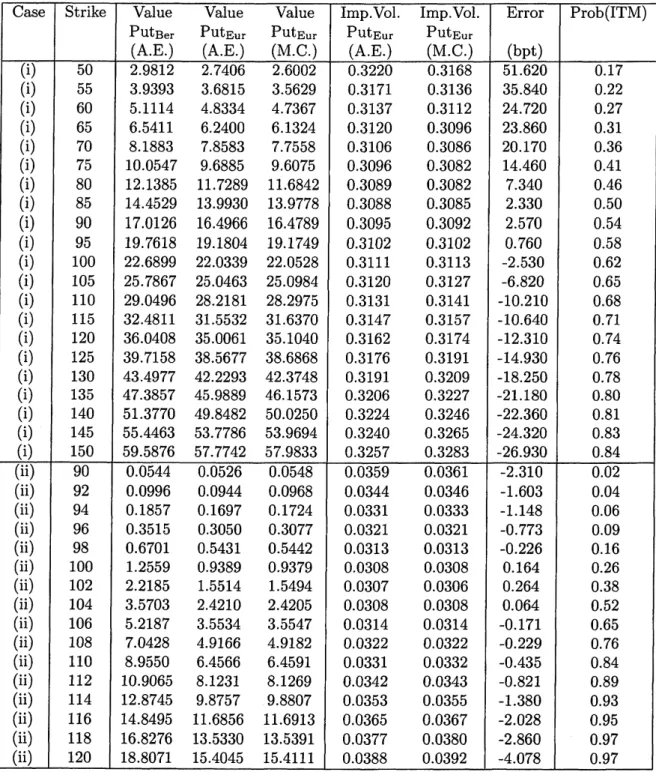
year and generate $10^{7}$ paths in each simulation.Results
are
in Table 2. We compareour
estimationsof values byan
A
Proof of Theorem
3.1
A.l
preliminaries
Lemma A.1. Fixed $T\in(0, \infty)$
.
Let $T=[0, T],$ $\mu$ be the Lebesgue measure, $f_{n}\in L^{2}(T^{n}, \sigma(T)^{n}, \mu^{n})$for
$n\geq 1$ and $(W_{1}, W_{2}, \ldots, W_{n})$ bea
n-dimensionalcorrelated Brownian motion. We denote by $\mathcal{E}_{n}$ the set
of
elementaryfunctions
of
theform
$f( t)=\sum_{i_{1},\ldots,i_{n}=1}^{k}c_{i_{1}\cdots i_{n}}1_{A_{:_{1}}\cross\cdots xA_{i_{n}}}(t)$ (62)
where $A_{1},$
$\ldots,$$A_{k}$ are pairwise-disjoint sets belonging to $\sigma(T)$, and the
coeffi-cients $c_{i_{1}\cdots i_{n}}$
are zero
if
any twoof
the indices $i_{1},$ $\ldots,$$i_{n}$are
equal. Then thereexists a sequence $\{f_{n}^{(l)}\}_{l\in N}\in \mathcal{E}_{n}$ such that $f_{n}^{(l)}\nearrow f_{n}$ and
$E[\int_{0}^{T}\cdots\int_{0}^{T}f_{n}^{(l)}(t)dW_{n}(t_{n})\cdots dW_{1}(t_{1})|\mathcal{G}]arrow$
$E[\int_{0}^{T}\cdots\int_{0}^{T}f_{n}(t)dW_{n}(t_{n})\cdots dW_{1}(t_{1})|\mathcal{G}](a.s.)$ , (63)
where $\mathcal{G}\subset\sigma(T)$
.
A.2
Proof
(64)
We
use
symbols in Lemma A.l. We set $\mathcal{G}$as
follows:$\mathcal{G}=\{(\int_{0}^{T}q_{1}^{1}(t)dZ_{1}(t),$
$\ldots,$$\int_{0}^{T}q_{1}^{m}(t)dZ_{m}(t))=(c_{1}, \ldots, c_{m})\}$
.
Then
we
have$E[\int_{0}^{T}\cdots\int_{0}^{T}f_{n}^{(l)}(t)dW_{n}(t_{n})\cdots dW_{1}(t_{1})|\mathcal{G}]$
$=$ $\sum_{i_{1},\ldots,i_{n}=1}^{k}c_{i_{1}\cdots i_{n}}E[l_{0}^{\tau_{1_{A}}}:_{n}(t)dW_{n}(t)\cdots\int_{0}^{T}1_{A_{1_{1}}}(t)dW_{1}(t)|\mathcal{G}]$
$=$ $l_{0}^{T} \cdots l_{0}^{T}\sum_{i_{1},\ldots,i_{n}=1}^{k}G_{1}\cdots i_{n}1_{A_{:_{1}}\cross\cdots\cross A}:_{n}(t)\hat{H}_{n}(\mu(t), \Sigma(t))dt_{n}\cdots dt_{1}$
$=$ $\int_{0}^{T}\cdots\int_{0}^{T}f_{n}^{(l)}(t)\hat{H}_{n}(\mu(t), \Sigma(t))dt_{n}\cdots dt_{1}$ (65)
We define $f_{n}(t)$
as
follows:$f_{n}(t)=1_{\{t_{n}\leq\cdots\leq t_{1}\}}(t)f(t)$ , (67)
then
we
have Theorem3.1.
References
[1] Z. Drezner. Computation of the bivariate normal integral. Mathematics
of
Computation, $32(141):277-279$, 11978.
[2] Christian P. Fries. Pricing options with early exercise by monte carlo
simu-lation: An introduction. Working Paper, 2005.
[3] Francis A. Longstaff and Eduardo S. Schwartz. Valuing american options
by simulation: A simple least-squares approach. The Review
of
FinancialStudies, 14:113-147, 2001.
[4] Syoiti Ninomiya and Nicolas Victoir. Weak approximation of stochastic
differential equations and application to derivative pricing. Applied
Mathe-matical Finance, 15:107-121,
2008.
[5] Akihiko Takahashi, Kohta Takehara, and Masashi Toda. Computation in