1 緒 言
皮膚は脂質、コラーゲン、その他タンパク質を 主体とし、多量の水分を含有する複雑な構造を有 した皮膜状の物質である。化粧品はこの中を障害 物を回避し、特定の官能基を有する物質と相互作 用くり返しながら内部に浸透していく。その浸透 能は皮膚を構成する化合物の化学構造や高次構造 に著しく依存する。化粧品の浸透性能を明らかに
するにあたり、皮膚のすべての構造と化学組成を 明らかにし化粧品の各成分の運動を逐次追うこと は不可能である。そこでこのように複雑な系を解 析するには、皮膚をブラックボックスとして取り 扱う方法と皮膚をモデル化して取り扱う方法が考 えられる。本研究では後者の方法を用いて化粧品 の安全性を解析する上で重要と考えられる基礎的 知見を得ることを目的とする。
化粧品の多くは弱電解質であることが知られて おり、また皮膚を構成する脂質やタンパク質は正 や負の荷電基を有していることが知られている。
このことは水溶液中の弱電解質が正または負の固 定荷電基が分布する水のチャネル内を移動すると 考えることができる。しかしながらこのような系 ではチャネル内における弱電解質の性質を決定す
The transport phenomena of weak electrolytes through a charged membrane as a model of skin has been studied in order to understand the basical behavior of cosmetics in the skin. The membrane potential across positively charged and negatively charged membranes was measured for acetic acid and glycine methyl ester hydrochloride aqueous solutions as model materials of cosmetics. The anion-to-cation mobility ratios in the membrane were determined. In the case of acetic acid solutions in a positively charged membrane, the ratios were about 0.0001- 0.001 times larger than those in water. On the other hand, they were about 10000 times larger than in water if a negatively charged membrane was employed. It is suggested that the transport phenomena of weak electrolyte ions in a charged membrane can be explained by the above-described transport theory.
The dissociation constant of acetic acid as a weak electrolyte in an ion-exchange membrane was estimated using the Donnan equilibrium theory. The total concentration, C
0, which represents the sum of the dissociated proton concentration and carboxyl concentration of undissociated electrolyte in the membrane, was determined by neutral titration in order to use it for the calculation. The apparent dissociation constants of acetic acid,K, in the negatively charged membrane were on the order of 10
-4and were larger than that in water (=1.73x10
-5). K( increased with an increase in the concentration in external solution and decreased with the fixed charge density increase. The larger dissociation constant in the membrane compared with that in water suggests the existence of an interaction between the solute and the membrane other than that with the electric field.
The glycine and leucine permeability coefficients, P, through a negatively membrane were measured as a function of HCl concetration, C
HCl, from 0 to 10
-1mol/l for three different interfacial conditions. Amino acid transport phenomena remarkably depended on the interfacial condition between the membrane and the external solution. The lowest P was obtained at C
HCl=0 for both sides of the membrane, and generally P increases with an increase in C
HCl. In case of the glycine, the lowest P had been obtained if C
HClon the glycine source side was 10
-1mol/l and that on the opposite side was 0. The highest P was obtained if C
HClon the amino acid source side was 0 and that on the opposite side was 10
-1mol/l. The P values of glycine had been explained by the transport mechanism based on the interfacial chemical reaction (protonation, deprotonation or ion-exchange) and the ionic tranport across a charged membrane.
They, however, are remakably affected by the physicochemical properties of the membrane such as hydrophobicity, molecular size, etc..
及び水の浸透と安全性に関する基礎的研究
東京工業大学 工学部有機材料工学科
谷 岡 明 彦
Fundamental study on penetration of cosmetics and water through lipid-skin model for safty
Akihiko Tanioka
Department of Organic and Polymeric
Materials, Faculty of Engineering,
Tokyo Institute of Technology
ることは非常に困難であるから、皮膚外で生じる 現象を観察することによって内部の状態を推定す ることになる。本研究では電荷を有した膜を皮膚 モデルの基本単位と考え、このような膜における 弱電解質やアミノ酸の挙動を理論的及び実験的に 解析した(1−5)。
2 実 験 2. 1 試 料
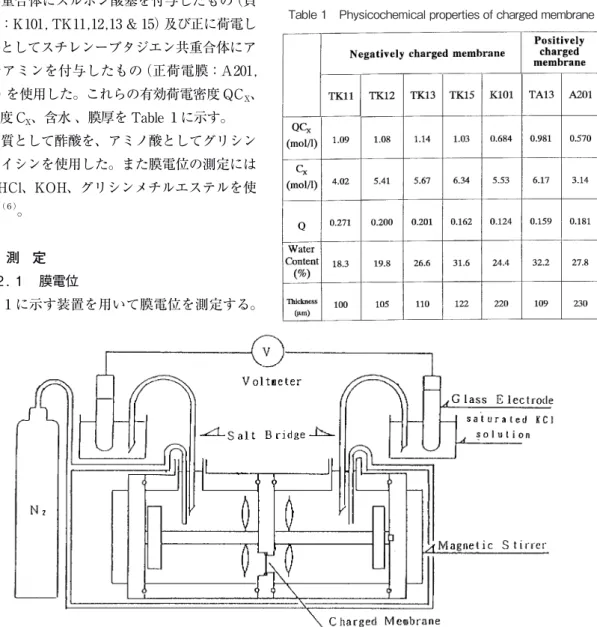
負に荷電した試料としてスチレンジビニルベン ゼン共重合体にスルホン酸基を付与したもの(負 荷電膜:K101, TK11,12,13 & 15)及び正に荷電し た試料としてスチレンーブタジエン共重合体にア ルキルアミンを付与したもの(正荷電膜:A201, TA13)を使用した。これらの有効荷電密度 QCX、 荷電密度 CX、含水 、膜厚を Table 1に示す。
弱電解質として酢酸を、アミノ酸としてグリシン 及びロイシンを使用した。また膜電位の測定には KCl、HCl、KOH、グリシンメチルエステルを使 用した(6)。
2. 2 測 定 2. 2. 1 膜電位
Fig. 1に示す装置を用いて膜電位を測定する。
測定セルの中央に膜をセットし、右側セル濃度を 0.01mol/L に固定し、左側セル濃度を 0.001 − 2.0mol/L の濃度範囲で変化させ 23℃にてイオン メータを使用して測定した。電極には銀/塩化銀 電極を使用し、飽和 KCl 水溶液中に浸し、セル と塩橋により連絡した。
まず膜の有効荷電密度 QCXを求めるために KCl 水溶液中で膜電位を測定した。次に QCXの pH 依存性を調べるために HCl 水溶液及び KOH 水溶液中において膜電位を測定した。さらに HCl
Table 1 Physicochemical properties of charged membrane
Fig. 1 Apparatus for membrane potential measurements.
+ KCl 及び KOH + KCl 水溶液中においても同様 の測定を行った。弱電解質による膜電位の測定に は酢酸水溶液を使用した。酢酸の解離状態を変え るために HCl または KOH を膜の両側に加えたこ の時の濃度は 0.001mol/L であった。弱電解質の 結果とを比較するために、有機酸塩であるグリシ ンメチルエステル塩酸塩水溶液についても膜電 を 測定した(6,7− 16)。
2. 2. 2 透過係数
Fig. 2 に 測 定 装 置 を 示 す。 右 側 の セ ル に 0.87mol/L の酢酸水溶液、左側のセルにイオン交 換水を注入し、10 分おきに2時間、左側セルの 比伝導度を測定した。この比伝導度を別に作製し た校正曲線から左側セル濃度に換算した。さら に、左セル濃度の変化量から、膜におけるイオ ンの流束が求められ、この値から透過係数を計 算した(6)。
アミノ酸の透過実験にはグリシン、L−ロイシ ンを使用した。左右同体積のガラス製の2室セル を用い各室の水溶液にそれぞれ電極を浸せきし て pH をモニタ−した。左側セルに 0.05M アミ ノ混合水溶液を右側セルにはイオン交換水を入 れ、両側のセルから一定時間毎に一定量を採取し これを測定試料とした。また pH の調整には HCl を用い次の3種類の境界条件を設定した。
実験⒜:セルの両側の pH を変化させる(両側 に加える HCl 濃度は同一)。
実験⒝:セルの左側はアミノ酸水溶液のみと し、右側の pH を変化させる。
実験⒞:セルの右側はイオン交換水のみとし、
左側(アミノ酸側)の pH を変化させ る。
使用した pH は 1.0、2.0、4.0、5.9(イオン交換水)
であった。
アミノ酸透過量の測定は液体クロマトグラフ
(Inertsil Ph 5.0)を使用し、ラベル化せずアミノ 酸溶液を直接測定した(17,18)。
2. 2. 3 中和滴定 ⑴ 3成分イオン系
3成分イオン系では、膜を 1mol/L の KCl に 24 時間以上浸せきし、対イオンを負荷電膜は K+、 正荷電膜は Cl−に置き換えた。次にイオン交換水 中で撹拌し、伝導度が十分小さくなるまでイオン 交換水を取り換えて洗浄した。このような膜を濃 度 C0の酢酸水溶液 400mL に 24 時間以上浸せき し平衡になるまで十分な時間放置した。有効荷電 密度は膜電 から決定されるために、C0は膜電 と 同じ濃度範囲ではなくてはならない。そこで膜電 の測定と同じ 0.001mol/L 〜 2.0mol/L の濃度範 囲の 10 種類の C0で測定を行った。
上記の平衡状態にある膜を取り出して表面 の酢酸を拭い、4 枚全てを 2mol/L の KCl 溶液 100mL に浸し、膜ごとの溶液を KOH 溶液で中 和滴定した。この測定により、膜中の濃度 C0が 求められる。KOH 溶液は酢酸の濃度に応じて、
0.01mol/L 〜 0.2mol/L の濃度のものを使用した。
この時、濃度の小さいものは、2mol/L の KCl 溶 液 100mL に対するブランク滴定を行い、滴定値 を補正した(19)。
⑵ 2成分イオン系
2成分イオン系では、負荷電膜は 1N の HCl、
アニオン交換膜は 1mol/L の CH3COOK に 24 時 間以上浸せきし、対イオンをH+、または CH3COO−
Fig. 2 Apparatus for permeability coefficient measurements
に置き換えた。次に、膜をイオン交換水中に浸せ きして撹拌を行い、pH が中性付近になるまでイ オン交換水を取り換えながら洗浄した。このよう な膜を、3成分イオン系と同様に濃度 C0mol/L の 酢酸水溶液と平衡状態におき、0.1 または 0.2mol/
L の KOH で中和滴定し、C0を決定した。
更に荷電密度と膜中の解離定数を比較検討する ため、荷電密度(イオン交換容量)の異なる膜に ついても同様の実験を行った(19)。
⑶ 膜中の解離定数の決定
中和滴定により決定した C0、Q、CXを用いて解 離定数の計算を行った。3成分イオン系では次式 を用いて C1を計算した。
この値から、膜中のイオン濃度を求め次式から 膜中の解離定数を定めた。ここで求めた解離定数 は活量係数を1として取り扱っているため、真の 解離定数とは異なり、見かけの解離定数となって いる。
C1(V5 m2 −Ve2Q2)+C14{VeQ2VmCX+2K(Vm2− Ve2Q2)}
+ C13K(K−2C0)(Vm2− Ve2Q2)+C12K{Q2VmCX(VmCX
− KVe)−2KC(V0 m2− Ve2Q2)}+ C1K{C0Q2VmC(2VX eK
− VmCX)+ KC0(V2 m2− Ve2Q2)}− VeQ2VmCXK2C02= 0 ⑴ 3 結果と考察
3. 1 膜電
膜に発生する電位 Δφ はドナン電位 ΔφDonと 拡散電位 Δφdiffの和として次式で表すことができ る。
⑵ ここで Ziは外部溶液中のイオンの価数、CXは 膜固定荷電密度、ZXは固定荷電基の価数、C' 及び C" はそれぞれ左水槽及び右水槽のイオン濃度、C' 及び C" は膜のそれぞれ膜の左側及び右側界面の イオン濃度、ωiはイオン移動度、F はファラデー 定数、R は気体定数、T は絶対温度である。膜透
過係数は次式で表すことができる。
ここで d は膜の厚みである。また W 及び Q は 次式となる。
W =(1-ω−/ω+)/(1+ ω−/ω+) Q = (γ+γ−)/(k+k−)
ここで ω−、ω+はそれぞれアニオンとカチオ ンの移動度、γ−、γ+はそれぞれアニオンとカチ オンの活 係数、k−、k+はそれぞれアニオンとカ チオンの分配係数である。
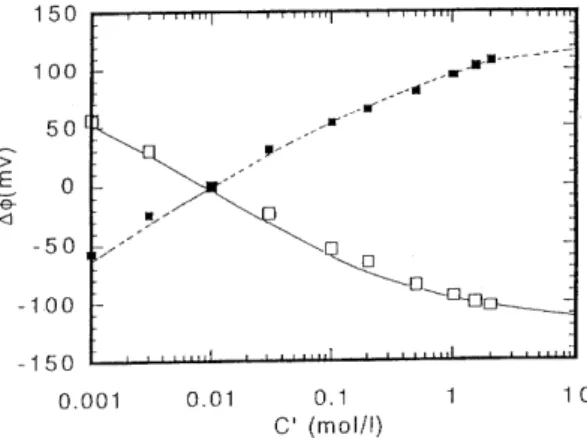
Fig. 3に KCl 水溶液を使用して求めた正荷電膜 及び負荷電膜における膜電 を示す。実線及び点線 は得られた実験データに(2)式を適用した結 で あり、非常に良い一致を示している。これらから 膜中のアニオンとカチオンの移動度の比(ω−/ω+) を計算したところいずれの膜においても水溶液中 の値と変わらなかった。さらに有効荷電密度 QCX を求めたところ正荷電膜に対しては 0.570mol/L、
負荷電膜に対しては 0.684mol/L となった。これ らの値は HCl や KOH、さらには KCl-HCl や KCl- KOH 系においても大きな変化は見られなかった。
これらのことから膜の物理化学的性質は pH によ る変化を受けないと考えられる。
Δφ=Δφ
Don+Δφ
diff=− Z RT ln
3F
C
3( ' − √
2ZZX3CX22Z3
ZXCX
( ) ( ) +
CQ3 2)
C
3( " − √
2Z3ZXCX2
2ZZXC3X
( ) ( ) +
CQ3' 2)
F
Σ
Zi2ω
i ( ) Ci -C i'RT
Σ
Ziω
2 i ( ) Ci -C i'ln Σ
Zi 2ω
i Ci 'Σ
Zi 2ω
i CiP=
2
d(
ω ω
++ω
+ω
-RTC-)( ) Ci -C X i'{ √ ( ) 1+QC2C X √ ( )
1+ QC2C X2 Wln( √ ( ) √ ( )
1+ QC1+QC2C 2C XX22+W +W ) }
Fig. 3 Membrane potential Δφas a function of logarithmic KCl concentration C'. □ for positively charged mem- brane, and ■ for negatively charged membrane.
√
⑶
⑷
⑸
Figs. 4と5に正荷電膜及び負荷電膜における、
酢酸、酢酸/塩酸、酢酸/苛性カリ系における膜 電 と酢酸濃度との関係を示す。これらの系では膜 の片側の酢酸濃度は 10-3mol/L に保たれ、もう一
Fig. 4 Membrane potential Δφas a function of logarithmic acetic acid concentration C' in the system of positively charged membrane. □ shows acetic acid, and ■ shows acetic acid mixed with HCl. HCl concentration in both sides of the membrane 10
-3mol/L. ○ shows acetic acid mixed with KOH. KOH concentration in both sides of the membrane is 10
-3mol/L. Acetic acid concentration C' is varied from 10
-3to 2 mol/L, and C" is kept constant at 10
-2mol/L. Lines are calculated results.
Fig. 5 Membrane potential Δφas a function of logarithmic acetic acid concentration C' in the system of negatively charged membrane. □ for acetic acid, ■ acetic acid mixed with HCl. HCl concentration in both sides of the membrane is 10
-3mol/L. ○ shows acetic acid mixed with KOH. KOH concentration in both sides of the membrane is 10
-3mol/L. Acetic acid concentration C' is varied from 10
-3to 2 mol/L, and C" is kept constant at 10
-2mol/L.
Lines are calculated results.
ωCH3COO- ωH+
( )
Table 2 Mobility Ratio of H
+to CH
3COO
-方の濃度は 10−3mol/L から 2mol/L まで変えられ た。また酸及びアルカリの濃度は膜の両側で一定 10−3mol/L に保たれた。図中における実線、点線、
一点鎖線は式(1)に基づく理論曲線である。こ の時カチオン及びアニオンの濃度は解離平衡を考 慮して求めた。理論値と実験曲線は非常に良い一 致を示しており、これらからそれぞれの膜におけるカ チオン(H+)とアニオン(CH3COO−)の移動度の 比を求めることができ Table 2に示す。水中での 比は ωCH3COO-/ωH+= 0.12 であり、正荷電膜、負 荷電膜共に著しく異なった値を示す。正に荷電し た膜内ではアニオンの移動度が著しく減少し(1000
〜 10000 分の1)、負に荷電した膜内ではカチオン の移動度が著しく減少すること(1000 〜 10000 分 の1)を示唆している。膜中の固定荷電基に対す る対イオン ωcounter及び副イオン ωcoの移動度は 次式で近似される。
ここで ωcounterは対イオンの、ωcoは副イオンの 水中における移動度、Ccoは副イオンの膜中にお ける濃度である。この式によると膜中のイオンは それと逆符号の固定荷電基の影響を著しく受ける ものと考えられる。
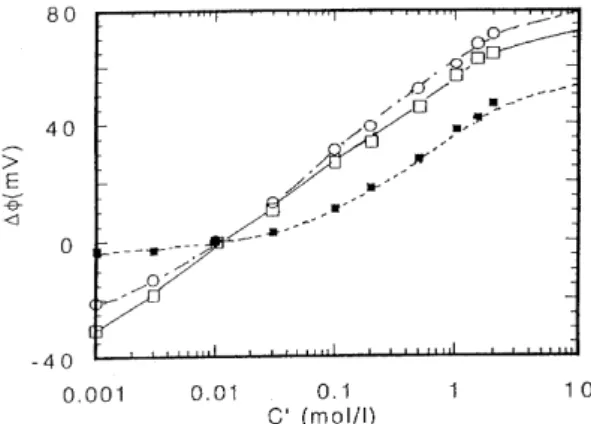
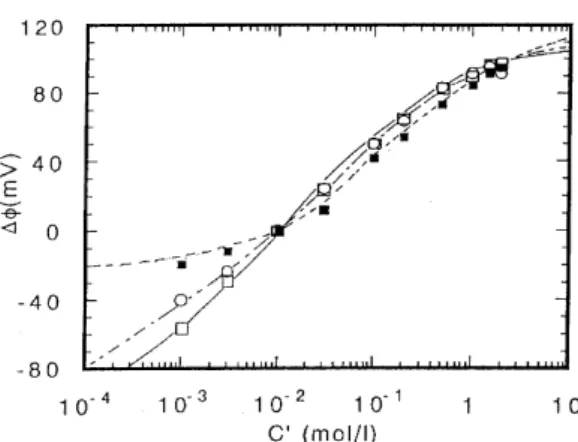
Figs. 6と7に正荷電膜及び負荷電膜における、
グリシンメチルエステル塩酸塩、グリシンメチル エステル塩酸塩/塩酸、グリシンメチルエステル 塩酸塩/苛性カリ系における膜電 とグリシンメチ
ω
counter=ω
counter Cco+ CxC
co+ φC
xω
co=ω
co⑹
⑺
ルエステル塩酸塩濃度との関係を示す。酢酸をグ リシンメチルエステル塩酸塩に置き換えた以外 実験条件は同じである。図中における実線、点線、
一点鎖線は式(1)に基づく理論曲線である。理 論値と実験曲線は非常に良い一致を示しており、
これらからそれぞれの膜におけるカチオン(H3+
NCH2COOCH3)とアニオン(Cl−)の移動度の比 を求めることができ Table 3に示す。水中にお けるこれらのデータがないことから比較のため にトリメチルアンモニウムクロライド及び塩化ア ンモニウムにおける水中での値ωCl−/ωN(CH3)4+=1.7 及び ωCl−/ωNH4+=1.0 を同時に示す。これらの結
、移動度の比に大きな違いは見られなかった。こ のことはグリシンメチルエステル塩酸塩が強電 解質としてふるまっていることを示している。
Table 4に正荷電膜及び負荷電膜における酢 酸の透過係数を示す。この値を式(5)に適用し、
ω+ω−/(ω++ ω−)を求め、Table 2におけ る移動度の比 ω−/ω+とからカチオンとアニオ ンの移動度 ω+、ω−を求め Table 5に示す。こ
れらの結 によるといずれの膜においても膜の固定 荷電基に対する対イオンの移動度よりもプロトン の移動度が著しい影響を受けることが明らかとな った。荷電膜における弱電解質の輸送に関しては 飽和現象モデルや界 動力学モデル等が考えられて
Fig. 6 Membrane potential Δφ as a function of logarithmic
glycine methyl ester hydrochloride concentration C' in the system of positively charged membrane. □ for glycine methyl ester hydrochloride, and ○ for glycine methyl ester hydrochloride mixed with HCl. HCl concentration in both sides of the membrane is 10
-3mol/L. ■ for glycine meth- yl ester hydrochloride mixed with KOH. KOH concentra- tion in both sides of the membrane is 10
-3mol/L. Glycine methyl ester hydrochloride concentration C' is varied from 10
-3to 2 mol/L, and C" is kept constant. Lines are cal- culated results.
Fig. 7 Membrane potential Δφas a function of logarithmic glycine methyl ester hydrochloride concentration C' in the system of negatively charged membrane. □ shows glycine methyl ester hydrochloride, and ○ shows glycine methyl ester hydrochloride mixed with HCl. HCl concen- tration in both sides of the membrane are 10
-3mol/L.
■ shows glycine methyl ester hydrochloride mixed with KOH. KOH concentration in both sides of the membrane is 10
-3mol/L. Glycine methyl ester hydrochloride con- centration C' is varied from 10
-3to 2 mol/L, and C" is kept constant. Lines are calculated results.
Table 3 Mobility Ratio of H
+ 3NCH
2COOH
3to Cl
-Table 4 Permeability Coefficients of Acetic Acid (P
CH3COOH) at 0.87mol/L
ωH3+NCH2COOH3
ωCl−
( )
いるが、プロトンの輸送現象も含めてさらに考察 しなければならない。また浸透圧による水の輸送 がプロトンに与える影響も考慮しなければならな い(6,20 − 24)。
3. 2 荷電膜中のイオン濃度と弱電解質の見か けの解離定数
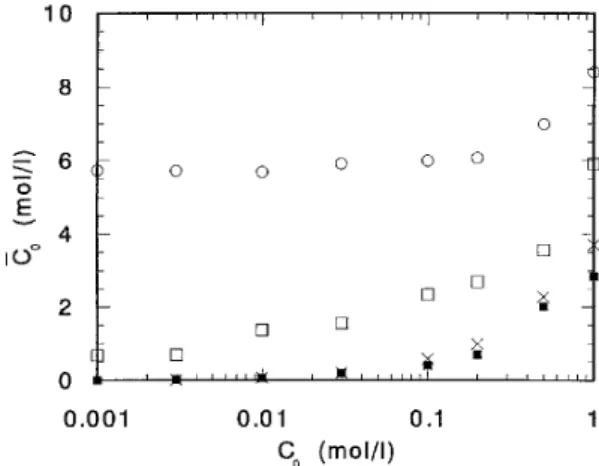
外部溶液濃度に対して、中和滴定により決定 した膜中の水素イオン濃度と未解離の酢酸のカ ルボキシル基の濃度の和 C0をプロットしたもの を Fig. 8に示す。□、■がそれぞれ3成分系の 負荷電膜と正荷電膜における結 、○、× がそれ ぞれ2成分系の負荷電膜と正荷電膜における結果 である。これらの濃度から計算した膜内の各成分
の濃度を、Fig. 9〜 Fig.12 に示す。荷電密度を考 慮するといずれの系においても、電気的中性条件 の成立していることが確認できた。また外部溶液 濃度が 1.0mol/L まで大きくなっても、副イオン 濃度は極めて小さい濃度となり、副イオンに対す る Donnan 排除が強電解質系よりも顕著に現れた。
Table 5 Ion Mobility ω
+and ω
-(mol cm
2J
-1S
-1) De- termined by Permeability Equation due to the Permeabil- ity Coefficient Measurements
Fig.9 Concentrations of H
+, CH
3COO
-, K
+and CH
3COOH in negatively charged membrane are plotted as a function of the total concentration in the external solution (C
0) for K101-ternary ionic system, where □ corresponds to H
+, ■ CH
3COO
-, ○ CH
3COOH and X K
+.
Fig.10 Concentrations of H
+, CH
3COO
-, Cl
-and CH
3COOH in positively charged membrane are plotted as a function of the total concentration in the external so- lution (C
0) for A201-ternary ionic system, where □ cor- responds to H+ , ■ CH
3COO
-, ○ CH
3COOH and
◇ Cl
-.
Fig.8 The total concentrations of dissociated and undisso- ciated acetic acid (C
0= C
1+C
s) in the charged exchange membrane determined by titration are plotted as a func- tion of the total concentration in the external solution (C
0), where □ corresponds to K101 in ternary ionic system,
■ A201 in ternary ionic system, ○ K101 in binary ionic
system and X A201 in binary ionic system.
これは、外部溶液中の解離したイオン濃度が小さ いためである。3成分系では、膜内の対イオン が外部溶液の H+または CH3COO−と置き換わ る を見積もることができる。強電解質溶液では 1.0mol/L の時、ほとんど全ての対イオンが置き 換わるが、弱電解質の場合、1.0mol/L でも、約 半分の対イオンが置き換わるにとどまっている。
このことも、弱電解質の解離したイオンが少ない ことに起因している。Fig. 9、Fig.10 をもとに解
離定数を求め Fig.13 に示す。いずれの系におい ても、図中に実線で示した水中 25.5℃における 酢酸の解離定数(1.73×10⁻⁵)より大きい。この ような解離定数の上昇の原因としては、膜の、物 理的構造、化学的構造、固定荷電基の影響等が考 えられる(19)。
3. 3 荷電膜中の弱電解質の真の解離定数 膜中の真の解離定数 Kthは膜中の活 を aiとおく
と次式で与えられる。
ここで γi及び Ciはそれぞれ膜中の活 係数及び 濃度である。また外部水溶液中の解離定数 Kthと の間に次の関係が成立する。
ここで γi及び Ciはそれぞれ外部溶液中の活 係 数及び濃度、kiは分配係数である。このことから、
膜中の解離定数はカチオン、アニオン、未解離の 中性分子の分配係数に対応して変化する。分配 係数は膜相が固定電荷を持たない時に、各イオン または中性分子が水相、膜相に分配される割合を 示し、溶液の濃度や電位には依存しない量である。
Fig.11 Concentrations of H+, CH3COO- and CH3COOH in negatively charged membrane are plotted as a function of the total concentration in the external solution (C
0) for K101-binary ionic system. □ corresponds to H
+, ■ CH
3COO
-and ○ CH3COOH.
Fig.12 Concentrations of H
+, CH
3COO
-and CH
3COOH in positively charged membrane are plotted as a function of the total concentration in the external solution (C
0) for A201-binary ionic system. □ corresponds to H+ , ■ CH
3COO
-and ○ CH
3COOH.
Fig.13 Apparent dissociation constants in charged mem- brane are plotted as a function of the total concentration in the external solution (C
0) , where □ corresponds to K101 in the ternary ionic system, ■ A201 in ternary ionic system, ○ K101 in binary ionic system and X A201 in binary ionic system.
K
th= a
a+sa
-= γ γ
+C+γ
sC-sC-K
th= k
+k
ksγ
-Cs+γ
C+s C-= k k
+ks-aa+sa-k
sk
+k-= K
th⑻
⑼
従って膜中の解離定数は外部溶液の溶質濃度に依 存せず、一定となることが確認された。
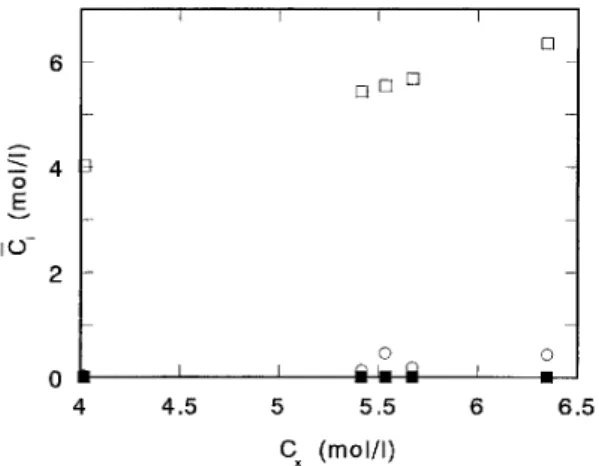
3. 4 荷電基の異なる膜における解離定数 負荷電膜における2成分系で、荷電密度の異 なる膜を使用し、外部溶液濃度を 0.1mol/Lとし て、見かけの解離定数をもとに見かけの解離定数 を計算した。この時の膜内のイオン及び、未解離 の中性分子の濃度は Fig.14 に、見かけの解離定数 は Fig.15 に示す。また見かけの解離定数は、正荷 電膜の結 も合わせて Table 6に示す。Fig.14 によ
ると膜中の対イオンの量は、固定荷電基の量に応 じて増加しており、副イオンの量はほとんど変化 しない。また中性分子の量は 0.03mol/L(TK11)
から 0.43mol/L(TK15)までかなり大きく変化し た。しかし Fig.13 において、負荷電膜の場合、中 性分子の活 係数が解離定数に大きく影響した濃度 は 0.47mol/L(C0=0.1mol/L)以上である。故に ここで取り扱う系では中性分子の活量係数もほぼ 一定であると考えられる。Fig.15、Table 5をみる と、全ての荷電膜において、解離定数は水中に比 べて大きくなっており、荷電膜中で解離定数は増 加することが荷電密度の異なる膜についても確認 された。また荷電基の量に注目すと、Fig.15 の結 は荷電密度の増加に伴い、解離定数が減少してい る。従って、固定荷電基は解離を押さえる効果が あると考えられる(19)。
3. 5 アミノ酸の透過
Fig.16、Fig.17 に負荷電膜におけるグリシン及 びロイシンの透過係数を pH の関数として示す。
pH の変化と共に透過係数は変化するが、膜の両 界面における pH の境界条件に著しく依存する。
グリシン及びロイシン共に実験 ⒜ で pH=5.9 の時 透過係数が最も小さく pH が減少すると透過係数 が増加する。最大の透過係数は実験 ⒝で pH=1 の 時得られた。またグリシンの場合実験 ⒞ で pH=1 場合透過係数が著しく減少し実験⒜ で pH=5.9 の 時と同様の値になった。pH が減少すると実験⒜ 、
⒝、⒞ 間で透過係数の違いが著しくなる。pH=
Fig.14 Concentrations of H
+, CH
3COO
-and CH
3COOH in negatively charged membrane equilibrated with 0.1mol/L acetic acid solution are plotted as a function of the fixed charge density (C
X), where □ corresponds to H
+, ■ CH
3COO
-and ○ CH
3COOH.
Fig.15 The dissociation constants in charged membrane equilibrated with 0.1mol/L acetic acid solution are plot- ted as a function of the fixed charge density(C
X).
Table 6 Apparent dissociation constant K in nega-
tively charged membrane equilibrated with 0.1mol/L
CH
3COOH
1の時、透過係数は実験⒝>実験⒜>実験⒞の順 番であった。
アミノ酸は等電点付近の水溶液中で R-C(NH3+) HCOO−、酸性溶液中で R-C(NH3+)HCOOH と なる。HCl 水溶液中ではプロトン、アミノ酸カチ オン、塩素イオン、中性アミノ酸が存在しこれら がお互いに影響しあいながら荷電膜の中を移動す る。これらの輸送はドナン平衡、ネルンスト—プ ランクのイオン輸送の式、膜界 でのプロトン化及 び脱プロトン化を支配する反応速度論により説明
される。従って NaCl 存在下ではアミノ酸はほと んど透過せず実験⒜の HCl 濃度0の時とほぼ同一 になった(17、18)。
4 結 論
以上の結果から皮膚のように電荷を持った媒体 中を化粧品のような弱電解質が移動する時は、強 電解質の移動とは著しく異なることが明らかとな った。特に媒体内のプロトンが他の分子の移動に 大きく影響を与えている。このことに対して本研 究では媒体中の固定荷電基とプロトン との電気的な相互作用が原因であると 考えた。一方媒体と外部相界 におけ るプロトンと弱電解質との反応が支配し ているとの考え方もある。また式(1)
には考慮しなかったが浸透圧による水 の移動も無視することができない。こ れらのメカニズムを明らかにすること は皮膚における化粧品の安全性を考慮 する上で非常に重要であると考える。
5 本研究に関係する投稿論文 1)M.Kawaguchi, T.Murata and A.Tanioka, "Membrane potentials in charged membranes separating solutions of weak electrolytes", J.Chem.Soc.,Faraday Trans., 93, 1351-1356, 1997
2)A.Tanioka, M.Kawaguchi, M.Hamada and K. Yoshie, "Dissociation constant of weak electrolyte in charged mem brane", J. Phys. Chem.,102, 1730- 1735, 1998
3)M. Minagawa and A. Tanioka, "Leu cine transport through cation ex change membranes: effect of HCl con centration on interfacial transport", J.
Colloid & Interface Sci., 1998, in press
Fig.17 Permeability coefficients of leucine obtained for c
A= 5×10
-2mol/
l in the experiments (a) , (b) and (c) as a function of pH. Experiment (a) indicated by square ( □ ), experiment (b) circle ( ○ ) and experiment (c) rhombus ( ◇ ).
Fig.16 Permeability coefficients of glycine obtained for c
A= 5×10
-2mol/
L in the experiments (a) , (b) and (c) as a function of pH. Experiment (a)
indicated by square ( □ ), experiment (b) circle ( ○ ) and experiment (c)
rhombus ( ◇ ).
参考文献
(1)F.Helfferich, Ion Exchange, McGraw-Hill, New York, 1962
(2) N.Lakshminaranaiah, Transport Phenomena in Membranes, Academic Press, New York, 1969
(3)R.Schloegl, Stofftransport durch Membranen, Steinkopff, Darmstadt, 1964
(4)A.Katchalsky and P.F.Curran, Non-equilibrium Thermodynamics in Biophysics, Harvard Univ.
Press, Cambridge, 1967
( 5 )R. B.Gennis, Biomembrane, Molecular Structure and Function, Springer, New York, 1989
(6)M.Kawaguchi, T.Murata and A.Tanioka, J.Chem.Soc.,Faraday Trans., 93, 1351, 1997
(7) T.Teorell, Proc.Soc.Exptl.Biol., 33, 282 , 1935
(8)T.Teorell, Progress Biophysics Biophysical Chem., 3, 305, 1953
(9)K.H.Meyer and J.F.Sievers, Helv.Chim.Acta., 19, 649, 665, 987, 1936
(10)F.G.Donnan, Z.Electrochem, 17, 572, 1911
(11)F.G.Donnan, Z.Physik.Chem., A168, 369, 1934
(12)W.Nernst, Z.Phys.Chem., 2, 613, 1888
(13)W.Nernst, Z.Phys.Chem., 4, 129, 1889
(14)M.Planck, Ann. Physik. Chem., 39, 161, 1890
(15)M.Planck, Ann. Physik. Chem., 40, 561, 1890
(16)N.Lakshminarayanaiah, Equations of Membrane Biophysics, Academic Press, Orlando, 1984
(17)M. Minagawa, A. Tanioka, P. Ramirez amd S.
Mafe, J. Colloid and Interface Sci., 188, 176, 1997
(18)M. Minagawa and A. Tanioka, J. Colloid &
Interface Sci., 1998, in press
(19)A.Tanioka, M. Kawaguchi, M. Hamada and K.
Yoshie, J. Phys. Chem.,102, 1730-1735, 1998
(20)M.Higa, A.Tanioka and K.Miyasaka, J.
Membrane Sci., 37, 251, 1988
(21)M.Higa, A.Tanioka and K.Miyasaka, J.
Membrane Sci., 49, 145, 1990
(22)W.Pusch, Desalination, 59, 105, 1986
(23)Y.Toyoshima, Y.Kobatake and H.Fujita, Trans. Faraday soc. Faraday Soc., 63, 2814, 1967
(24)N.Kamo, Y.Toyoshima, H.Nozaki and Y.Kobatake, Kolloid-Z. U. Z Polymere, 248, 914, 1971