• 検索結果がありません。

Serum pentosidine concentration is associated with radiographic severity of lumbar spondylosis in a general Japanese population

N/A
N/A
Protected

Academic year: 2021

シェア "Serum pentosidine concentration is associated with radiographic severity of lumbar spondylosis in a general Japanese population"

Copied!
23
0
0

読み込み中.... (全文を見る)

全文

(1)

Serum pentosidine concentration is associated with radiographic severity of lumbar spondylosis in a general Japanese population

㸦᪥ᮏேࡢ୍⯡ᆅᇦఫẸ࡟࠾ࡅࡿኚᙧᛶ⭜᳝⑕࡜⾑Ύ࣌ࣥࢺࢩࢪࣥ⃰ᗘࡢ㛵㐃㸧

⏦ ㄳ ⪅ ᘯ๓኱Ꮫ኱Ꮫ㝔་Ꮫ◊✲⛉

ᶵ⬟෌ᘓ࣭෌⏕⛉Ꮫ㡿ᇦ 㐠ືᶵ⬟⑓ែಟ᚟Ꮫᩍ ⫱ ◊ ✲ ศ 㔝

Ặ ྡ ༓ⴥ ኱㍜

ᣦᑟᩍᤵ ▼ᶫ ᜤஅ

(2)

Objective: To investigate the relationship between the radiographic severity of lumbar spondylosis (LS) and serum bone metabolic markers.

Methods: A total of 681 individuals volunteered for this study (269 men, 412 women;

age: 54.9 ± 14.3; body mass index [BMI]: 23.1 ± 3.3 kg/m

2

). Lateral lumbar radiographs were evaluated in each intervertebral section (L1/2 to L5/S1) using the Kellgren-Lawrence grade (KL). If at least one intervertebral section was graded as KL 2 or greater, the participants were considered to have LS. The summation of each section of intervertebral section was used as the radiographic severity value of LS. In addition, bone status was evaluated with an osteo-sono index (OSI) at the calcaneus. Serum bone alkaline phosphatase (Pg/mL), N-telopeptide of type I collagen (nMBCE/L), and pentosidine (pmol/mL) concentrations were examined and used as the bone metabolism index. Stepwise multiple linear regression analysis was conducted with the radiographic severity value of LS as the dependent variable and age, sex, BMI, OSI, and the value of serum bone metabolic markers as the independent variables.

Results: The total number of LS participants was 470 (69.0%); the frequency of LS was higher in men (n = 198) than in women (n = 272; P = Ȥ

2

test). The mean severity value of LS was 7.1 ± 4.4, and the mean value of pentosidine was 120.7 ± 54.8 pmol/mL. On multiple regression analysis, age (B = 0.190, E = 0.611), sex (men = 1, women = 2; B = í E = í %0, % = 0.185, E = 0.136), and pentosidine (B = 0.009, E = 0.115) were significantly correlated with the severity of LS.

Conclusion: Serum pentosidine concentration was positively correlated with the radiographic severity of LS in this cross-sectional study.

ABSTRACT

(3)

Lumbar spondylosis is a common form of lumbar-spine diseases, which presents as degenerative changes in the lumbar spine. Several pathological findings are characteristic of lumbar spondylosis, such as the degeneration of the lumbar disc or facet joint, osteophyte formation, vertebral body sclerosis, and the hypertrophy of supporting ligaments. Lumbar spondylosis negatively affects the function of the lumbar spine and can result in the loss of spinal mobility [1] and the deformity of sagittal alignment [2,3]. In addition, lumbar pain can occur because of lumbar-disc [4] or facet joint degeneration [5], and spinal canal stenosis [6]. A large-scale cohort study in our country that examined the prevalence of lumbar spondylosis suggested that this condition is present in 70.2% of the overall population, (80.6% in men, and 64.6% in women) [7]. Thus, lumbar spondylosis threatens the health status of active individuals, especially in the older population.

Several factors have been identified as risk factors of lumbar spondylosis, including age and sex. These factors were shown to affect the incidence and progression of lumbar spondylosis in a recent domestic cohort study [8]. Bone metabolism is one of the factors that correlate with the pathological changes in lumbar spondylosis. A high bone mineral density (BMD) in the lumbar body and femoral neck has been shown to be correlated with osteophyte enlargement when evaluated with Nathan’s classification [9].

In a more recent study, high lumbar-vertebral BMD was found to be associated with lumbar disc degeneration, when assessed with magnetic resonance imaging [10].

Although the actual BMD seems to affect the pathological changes of lumbar

spondylosis, little is known about how lumbar spondylosis pathologically changes in accordance with endogenous bone formation and absorption which regulate the degree of BMD, including bone fragility. Therefore, the aim of the current study was to elucidate whether serum bone formation, absorption, and bone fragility markers are associated with the radiographic severity of lumbar spondylosis in the general Japanese population. The hypothesis proposed in this study is that serum bone alkaline

phosphatase (BAP: bone formation marker), N-telopeptide of type I collagen (NTX:

bone absorption marker), and pentosidine (bone fragility marker [11]) are associated with the radiographic severity of lumbar spondylosis.

INTRODUCTION

(4)

Outline of the Iwaki Health Promotion Project

The Iwaki Health Promotion Project is a health-check program designed to improve the average life span. This program was initiated in 2005, and it has been conducted over a 10-year-period. Approximately 1000 adults, aged 20 years and older, living in the Iwaki area of Hirosaki city, Japan, participate every year. In addition to orthopedic specialist, physicians, general surgeons, gynecologists, urologists, psychiatrists, dermatologists, and dentists are involved in this project. As one aspect of the multiple-focused check, we collect biochemical and biomechanical data related to spine disorder [12-14], including several parameters of bone metabolism.

Participants

A total of 1016 individuals participated in the Iwaki Health Promotion Project from 2012. All participants answered questionnaires about their medical history, family history, health-related quality of life, and occupation. Occupation was divided into blue-collar (manual, protective, and service workers) or white-collar (professionals, managers, businesspersons) according to the Warner index of status characteristics [15].

We excluded participants who had a history of cancer, liver or kidney disorders,

rheumatoid arthritis, or any previous operations involving the lumbar spine. In addition, we also excluded those who did not answer the questionnaire entirely, and those who did not undergo radiographic or blood examination. Finally, out of 1016 participants, we included 681 participants (20–90 years; 269 men and 412 women) as the subjects in the present study. If the participants had ever been diagnosed with diabetes mellitus by a physician, they were defined as having a history of diabetes mellitus regardless of current therapy. The Ethics Committee of Hirosaki University, Graduate School of Medicine approved this study, and all participants provided written informed consent before participation. The current study was a cross-sectional survey.

MATERIALS AND METHODS

(5)

Assessment of radiographic lumbar spondylosis and vertebral fracture

Plain radiographs of the lateral lumbar spine were taken, with the participants standing naturally, their forearms crossed, and their hands on their chest. A two examiner (GK, 12-year-career spine surgeon; DC, 7-year-career orthopaedic surgeon) assessed the images based on the Kellgren-Lawrence (KL) grade [16] in each intervertebral section (L1/2, L2/3, L3/4, L4/5, L5/S1). If at least one intervertebral section was assessed as KL 2 or greater, the participants were considered to have lumbar spondylosis [7]. In

addition, to determine the radiographic severity of lumbar spondylosis, the examiners summed the values of KL in each of the intervertebral sections. According to this summed value, 0 corresponded to normal lumbar spine and 20, most degenerative lumbar spine (Figure 1). In our preliminary data of 50 adults (average age: 50.4 ± 14.8 years old), the intra-rater reliability of this measurement: Intraclass Coefficient

Correlation [ICC (1,1)] in GK was 0.902 (95% CI: 0.834–3”DQG'&

was 0.862 (95% CI: 0.798–3”0RUHover, the inter-rater reliability: ICC (2,1) in GK and DC was 0.780 (95% CI: 0.307–3”0RUHRYHUZHalso determined whether or not the participants had compressive vertebral fracture (VFx) in the lateral lumbar radiographs. The presence of VFx in T12 to L5 was defined as a compressive deformity where less than 20% of the height was found than in the adjacent uncompressed vertebra [17].

Assessment of bone status and serum bone metabolic markers

We conducted quantitative ultrasound assessment of the calcaneus to calculate the osteo-sono assessment index (OSI; AOS-100NW, Hitachi Aloka Medical, Ltd., Tokyo).

The OSI was calculated using the following formula: TI × SOS

2

(TI: transmission

index, SOS: speed of sound). We collected blood samples early in the morning (before

breakfast), and these were immediately centrifuged. Serum samples were extracted,

placed in freeze packaging, and transferred to a deep freezer. The serum creatinine

concentration (Cre; mg/dL, EIA; LSI Medience Corp., Tokyo, Japan) was used to assess

renal function, while serum BAP (Pg/mL, CLEIA; LSI Medience Corp., Tokyo, Japan)

was utilized in the assessment of bone formation. The serum NTX concentration

(6)

(nMBCE/L, EIA; LSI Medience Corp., Tokyo, Japan) was analyzed to measure the degree of bone absorption. In addition, the serum pentosidine concentration (pmol/mL, HPLC; LSI Medience Corp., Tokyo, Japan) was evaluated to determine the level of bone fragility, which was related to the formation of abnormal cross-links in collagen [11,18].

Statistical analysis

The data were analyzed using SPSS ver. 22.0 (SPSS Inc., Chicago, IL, USA). The mean age, body mass index (BMI), OSI, and serum bone metabolic markers between males and females were compared with the Mann-Whitney U test. In each sex, we also compared the mean age, BMI, OSI, and serum bone metabolic markers among non-OXPEDU VSRQG\ORVLV JURXS /6 í DQG OXPEDU VSRQG\ORVLV JURXS /6 ZLWK WKH Mann-Whitney U test. Differences in lumbar spondylosis, occupation (white- or blue-collar), diabetes mellitus, oral medication for osteoporosis, and VFx were analyzed ZLWK D Ȥ

2

and Fisher’s exact test. We conducted logistic regression analysis with the presence of lumbar spondylosis as the dependent variable and age, sex, BMI, occupation, history of diabetes mellitus, oral medication for osteoporosis, presence of VFx, OSI, and the serum values (Cre, BAP, NTX, and pentosidine,) as the independent variables. In addition, multiple linear regression analysis was performed with the severity value of lumbar spondylosis as the dependent variable and age, sex, BMI, occupation, diabetes mellitus, and oral medication use for osteoporosis, presence of VFx, OSI, and the serum values (Cre, BAP, NTX, and pentosidine,) as the independent variables. In both regression analyses, the significant independent variables were examined using the stepwise method. P-YDOXHV ” ZHUH FRQVLGHUHG VWDWLVWLFDOO\

significant.

(7)

Comparison of demographic data, the radiographic severity value, and the prevalence of lumbar spondylosis and vertebral fracture

The mean ± SD age of the male and female participants were 53.7 ± 14.7 and 55.7 ± 14.0 years; this was not a significant difference. The mean BMI of male and female were 23.7 ± 3.1 and 22.6 ± 3.3 kg/m

2

, respectively (P < 0.001, Mann-Whitney U test). The total number of participants with lumbar spondylosis was 470 (69.0%), with the frequency being higher in males (n = 198, 73.6%) than in females (n = 272, 66.0%;

P = Ȥ

2

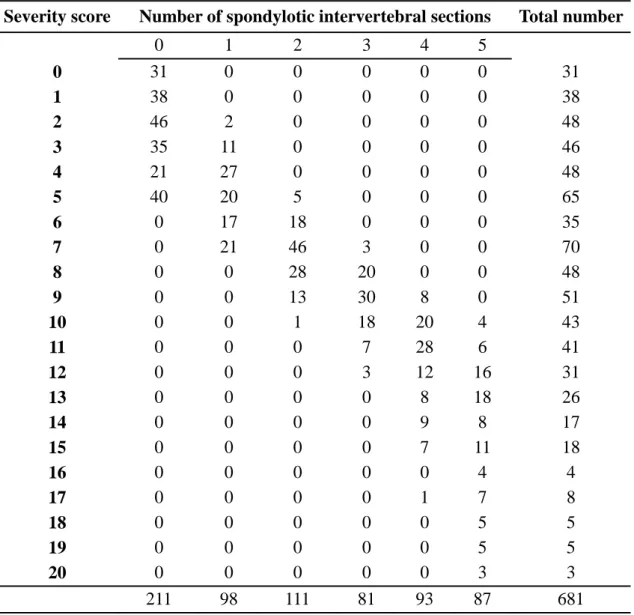
test; Table 1). The overall mean severity value of lumbar spondylosis was 7.2 ± 4.5; the mean value of 7.7 ± 4.4 in males was significantly higher than that of 6.8 ± 4.4 in female (P = 0.006, Mann-Whitney U test). In accordance with this new method of scoring the severity of lumbar spondylosis, if the severity value was 6 or greater, it meant the presence of at least one intervertebral section in which spondylotic change was definite (KL is 2 or greater). Severity values between 2 and 5 indicated the absence of definitive lumbar spondylosis. The proportion of those with KL 2 or greater intervertebral sections was 4.2% with the severity value of 2, 23.9% with a value of 3, 56.3% with a value of 4, and 38.5% with a value of 5 (Table 2). In the male population, there were no differences in the frequency of occupation, diabetes mellitus, those taking RUDOPHGLFDWLRQVIRURVWHRSRURVLVDQGYHUWHEUDOIUDFWXUHEHWZHHQ/6íDQG/62QWKH other hand, all parameters werH PRUH IUHTXHQW LQ /6 WKDQ LQ /6 í LQ IHPDOH population (Table 1).

The mean values of BMI, OSI, Cre, and pentosidine were significantly higher in males than in females. In LS – population, the mean BAP and NTX value in males were significantly higher than in females. In male population, the mean age and SHQWRVLGLQH LQ /6 ZDV VLJQLILFDQWO\ KLJKHU WKDQ WKDW RI /6 í ,Q IHPDOHV WKH PHDQ DJH %0, %$3 DQG 17; LQ /6 ZHUH VLJQLILFDQWO\ KLJKHU WKDQ WKDW LQ /6 í WKH opposite was found with respect to OSI (Table 3).

RESULTS

(8)

Multiple regression models for elucidating the factors correlated with the radiographic severity of lumbar spondylosis

According to the stepwise logistic regression analysis, only the variables of age and sex were statistically significant in the overall population. Moreover, in the multiple linear regression model, age, sex, BMI, and serum pentosidine concentration were significantly correlated with the radiographic severity of lumbar spondylosis by the stepwise method. Hence, according to this stepwise method, both regression models showed that all other variables (occupation, history of diabetes mellitus or taking oral osteoporosis medicine, presence of VFx, OSI, and serum BAP and NTX concentration) were statistically insignificant. For example, according to the large beta coefficient (B = 0.010), an increase in serum pentosidine concentration of 100 pmol/mL is associated with a one increase in the radiographic severity of lumbar spondylosis (Table 4; Figure 2). For this overall study population, the multiple linear regression analysis produced the following formula to estimate the radiographic severity value of lumbar spondylosis:

>6HYHULW\YDOXHRIUDGLRJUDSKLFOXPEDUVSRQG\ORVLV@ í + 0.190 × [Age] – 0.900

× [Sex; men: 1, women: 2] + 0.185 × [BMI] + 0.009 × [pentosidine]. Based on this

formula, a 60-year-old woman with a BMI of 25 kg/m

2

and with a serum pentosidine

level of 150 pmol/mL would have an estimated radiographic severity value of 9.2, for

example. As indicated by the coefficient of determination (R

2

= 0.457; Table 4), this

formula is accountable for 45.7% of the radiographic severity values of lumbar

spondylosis in this study.

(9)

In the current study, the relationships between serum bone metabolic markers and the radiographic severity of lumbar spondylosis in a general Japanese population were determined. The prevalence of lumbar spondylosis in the current population was similar to that of a previously reported large cohort study [7]. Additionally, the frequency of lumbar spondylosis was higher in men than in women. The present study also indicated that age, sex, BMI, and serum pentosidine concentration (i.e., the marker of bone fragility) were positively correlated with the radiographic severity of lumbar spondylosis. Based on the standardized E-coefficient, age was the strongest factor correlated with the radiographic severity of lumbar spondylosis. Occupation, history of diabetes mellitus or taking oral osteoporosis medicine, presence of vertebral fracture, osteo-sono assessment index of calcaneus, level of serum bone formation marker, and level of bone absorption marker (e.g., BAP and NTX concentrations) did not correlate with the radiographic severity of lumbar spondylosis in the regression model of this study.

The current study introduced a novel method of evaluating the radiographic severity of lumbar spondylosis by the summation of the KL grades in each intervertebral lesion. The logistic regression analysis showed that serum pentosidine concentration was statistically insignificant if the presence of radiographic lumbar spondylosis was defined as the dependent variable. On the other hand, using the linear regression analysis, the radiographic severity value of lumbar spondylosis was significantly correlated with serum pentosidine concentration. These conflicting results reflected the differences in the definition of lumbar spondylosis. The presence of lumbar spondylosis was determined by the presence of at least one KL 2 or more severe intervertebral sections in the lumbar spine. This “presence” of definitive lumbar spondylosis further consisted of various severities of lumbar spine degeneration. Herein, the “presence” of lumbar spondylosis included the severity of 7 (L1/2 = 0 + L2/3 = 2 + L3/4 = 1 + L4/5 = 1 + L5/S1 = 3) and 20 (all intervertebral discs = 4), for example, by using the novel method explained in the current study. However, these different severities of lumbar spondylosis are considered the same, i.e. “presence” of lumbar spondylosis. In our study, we could detect the significant correlation between lumbar

DISCUSSION

(10)

spondylosis and serum pentosidine concentration in the population of those having more severe degenerated spondylosis (Figure 2). However, this new method was less effective in evaluating the presence and severity of lumbar spondylosis in the early stages of lumbar spondylosis (Table 2).

Previous studies have been limited to only presenting the relationship between serum bone metabolic markers and lumbar spondylosis [19, 20]. Another past study has suggested that serum BAP concentrations were lower in women with lumbar spondylosis than in those without lumbar spondylosis [19]. Therefore, data from the current study provide a conflicting interpretation compared to these previously reported results. However, the previous study’s test population primarily consisted of obese women [19]. A more recent study has shown that obesity is associated with the reduction of serum bone formation markers such as osteocalcin [21]. Therefore, it is important to pay attention to the interpretation of serum bone formation markers especially in an obese population. In the current study, the mean age, serum BAP, and NTX concentration were significantly higher in females with lumbar spondylosis than in those without lumbar spondylosis. However, it is important to note that age was a confounding variable, with high values of BAP and NTX in participants with lumbar spondylosis, such that almost all women with lumbar spondylosis were menopausal and were more likely to have a high bone turnover [22-24]. However, when we conducted stepwise multiple linear regression analysis, only age, sex, and BMI were found to be statistically significant variables; neither BAP nor NTX was significantly correlated with the radiographic severity of lumbar spondylosis, as assessed by the KL grade.

Conversely, Ichchou et al., showed that serum CTX-I concentration correlated with the radiographic severity of peripheral lumbar osteophytes using a categorical grade in postmenopausal women [20]. The role of serum bone formation and absorption markers in lumbar-spine degeneration is still controversial and as a result, future work is required to determine the correlation between the pathological effect of bone formation and absorption in lumbar spondylosis.

Pentosidine is one of the advanced glycation end-products (AGEs) that are

produced by the Maillard reaction (a non-enzymatic reaction between sugars and

proteins). Serum pentosidine concentrations are considered to increase with

hyperglycemia [25], renal disorder [26], and the consumption of AGEs-rich food [25],

(11)

and these have the potential to induce oxidative stress and accelerate aging [27]. In the field of bone metabolism, pentosidine is associated with bone fragility, making abnormal collagen cross-links [11]. Current results allow us to speculate that more severe lumbar spondylosis associates with having an abnormal bone quality in lumbar spine. In addition, previous studies have shown that AGEs can cause chondrocytes to develop several catabolic factors such as MMPs and ILs [28-32]. Moreover, when AGEs accumulated in the cartilage it results in the loss of tissue elasticity. In the case of knee osteoarthritis, when performing skin biopsy, the cutaneous concentration of AGEs is found to be associated with the development of peripheral osteophytes [33]. Even the serum concentration of AGEs is consistently associated with the degenerative changes in the lumbar spine. Therefore, on the basis of these studies, it is likely that AGEs have the potential to develop lumbar spondylosis including cartilage degeneration and osteophyte formation.

It is important to consider the limitations in the current study. First, this study was a cross-sectional design as opposed to longitudinal. Second, the participants in this study were healthy and therefore, the prevalence of diabetes mellitus was low (5.4%) and the influence of AGEs may be underestimated because hyperglycemia is associated with the increase of serum pentosidine concentration [25]. Third, as described previously, the radiographic findings (e.g., disc space narrowing, osteophyte, and vertebral body sclerosis) were assessed comprehensively [16], and therefore, we could not evaluate the state of ligament hypertrophy by using magnetic resonance imaging.

Moreover, we could evaluate only sagittal lumbar radiograph. Further studies are needed to assess coronal image, including the whole spine. Lastly, we did not include measures of pain in the low back or leg that may be associated with lumbar spine stenosis. Therefore, the pain status associated with lumbar spine stenosis should be considered in future studies, as this has been shown to be correlated with hypertrophy of the supporting ligaments [6, 34]. Despite these limitations, this study is noteworthy as it suggests that adequate control of the metabolism of AGEs may inhibit the development of lumbar spondylosis. Additionally, serum pentosidine concentration may have the potential as a biomarker of lumbar spondylosis. However, future research is required to clarify the detailed mechanism of bone metabolism and lumbar-spine degeneration.

In conclusion, the relationship between several serum bone metabolic markers

(12)

and the radiographic findings (including disc space narrowing, osteophyte severity, and vertebral body sclerosis) were evaluated in a general Japanese population. Although a cross-sectional study, serum pentosidine concentration was positively correlated with the radiographic severity of lumbar spondylosis. However, serum bone alkaline phosphatase and NTX concentration were not correlated with lumbar spondylosis.

ACKNOWLEDGEMENTS

We are exceedingly grateful to all participants in the Iwaki Health Promotion Project and to the staff of our department who conducted interviews and collected data. This study is supported in part by the Ministry of Education, Culture, Sports, Science, and Technology of Japan (No. 18200044), the Japanese Society for the Promotion of Science (No. 21500676), Karoji Memorial Fund for Medical Research (No.

5310139302), and JOA-Subsidized Science Project Research from the Japanese Orthopaedic Association.

Competing interests: There are no competing interests to declare.

Authors’ roles: Study design: DC. Study conduct: DC and ES. Data collection: DC and GK, and IT. Data analysis: DC, GK, and ES. Data interpretation: DC, KW, and ES.

Drafting manuscript: DC. Revising manuscript: KW, TT, GK, and ES. Approving final version of manuscript: SN and YI.

Funding: The Ministry of Education, Culture, Sports, Science, and Technology of Japan (No. 18200044), the Japanese Society for the Promotion of Science (No.

21500676), Karoji Memorial Fund for Medical Research (No. 5310139302), and

JOA-Subsidized Science Project Research from the Japanese Orthopaedic Association.

(13)

REFERENCES

1. Kong MH, Morishita Y, He W, et al. Lumbar segmental mobility according to the grade of the disc, the facet joint, the muscle, and the ligament pathology by using kinetic magnetic resonance imaging. Spine (Phila Pa 1976). 2009;34:2537–44.

2. Barrey C, Jund J, Noseda O, Roussouly P. Sagittal balance of the pelvis-spine complex and lumbar degenerative diseases. A comparative study about 85 cases.

Eur Spine J. 2007;16:1459–67.

3. Kalichman L, Li L, Hunter DJ, Been E. Association between computed tomography-evaluated lumbar lordosis and features of spinal degeneration, evaluated in supine position. Spine J. 2011;11:308–15.

4. de Schepper EI, Damen J, van Meurs JB, et al. The association between lumbar disc degeneration and low back pain: the influence of age, gender, and individual radiographic features. Spine (Phila Pa 1976). 2010;35:531–6.

5. Kalichman L, Hunter DJ. Lumbar facet joint osteoarthritis: a review. Semin Arthritis Rheum. 2007;37:69–80.

6. Schneck CD. The anatomy of lumbar spondylosis. Clin Orthop Relat Res.

1985;193:20–37.

7. Yoshimura N, Muraki S, Oka H, et al. Prevalence of knee osteoarthritis, lumbar spondylosis, and osteoporosis in Japanese men and women: the research on osteoarthritis/osteoporosis against disability study. J Bone Miner Metab 2009;9:620–8.

8. Muraki S, Akune T, Oka H, et al. Incidence and risk factors for radiographic lumbar spondylosis and lower back pain in Japanese men and women: the ROAD study. Osteoarthritis Cartilage. 2012;20:712–8.

9. Miyakoshi N, Itoi E, Murai H, Wakabayashi I, Ito H, Minato T. Inverse relation

between osteoporosis and spondylosis in postmenopausal women as evaluated by

bone mineral density and semiquantitative scoring of spinal degeneration. Spine

(Phila Pa 1976). 2003;28:492–5.

(14)

10. Salo S, Leinonen V, Rikkonen T, Vainio P, Marttila J, Honkanen R, et al.

Association between bone mineral density and lumbar disc degeneration.

Maturitas. 2014;79:449–55.

11. Saito M, Marumo K. Collagen cross-links as a determinant of bone quality: a possible explanation for bone fragility in aging, osteoporosis, and diabetes mellitus. Osteoporos Int. 2010;21:195–214.

12. Numasawa T, Ono A, Wada K, et al. Simple foot tapping test as a quantitative objective assessment of cervical myelopathy. Spine (Phila Pa 1976). 2012;37:108–

13.

13. Kumagai G, Ono A, Numasawa T, et al. Association between roentgenographic findings of the cervical spine and neck symptoms in a Japanese community population. J Orthop Sci. 2014;19:390–7.

14. Sasaki E, Ono A, Yokoyama T, et al. Prevalence and symptom of ossification of posterior longitudinal ligaments in the Japanese general population. J Orthop Sci.

2014;19:40í

15. Warner WL, Meeker M, Eells K. Social Class in America. New York: Science Research, 1949.

16. Kellgren JH, Lawrence JS. Radiological assessment of osteo-arthrosis. Ann Rheum Dis. 1957;16:494í502.

17. Orimo H, Shiraki M, Hayashi Y, et al. Effects of lD-Hydroxyvitamin D3 on Lumbar Bone Mineral Density and Vertebral Fractures in Patients with Postmenopausal Osteoporosis. Calcif Tissue Int. 1994;54:370–6.

18. Odetti P, Fogarty J, Sell DR, Monnier VM. Chromatographic Quantitation of Plasma and Erythrocyte Pentosidine in Diabetic and Uremic Subjects. Diabetes.

1992;41:153–9.

19. Peel NF, Barrington NA, Blumsohn A, Colwell A, Hannon R, Eastell R. Bone mineral density and bone turnover in spinal osteoarthrosis. Ann Rheum Dis.

1995;54:867–71.

20. Ichchou L, Allali F, Rostom S, et al. Relationship between spine osteoarthritis, bone mineral density and bone turn over markers in post menopausal women.

BMC Women’s Health. 2010;10:25.

21. Papakitsou EF, Margioris AN, Dretakis KE, et al. Body mass index (BMI) and

(15)

parameters of bone formation and resorption in postmenopausal women. Maturitas.

2004;47:185–93.

22. Garnero P, Sornay-Rendu E, Chapuy MC, Delmas PD. Increased bone turnover in late postmenopausal women is a major determinant of osteoporosis. J Bone Miner

Res. í

23. Chaki O, Yoshikata I, Kikuchi R, et al. The predictive value of biochemical markers of bone turnover for bone mineral density in postmenopausal Japanese

women. J Bone Miner Res. í

24. Scariano JK, Garry PJ, Montoya GD, Wilson JM, Baumgartner RN. Critical differences in the serial measurement of three biochemical markers of bone turnover in the sera of pre- and postmenopausal women. Clin Biochem.

í

25. Sugiyama S, Miyata T, Ueda Y, et al. Plasma levels of pentosidine in diabetic patients: an advanced glycation end product. J Am Soc Nephrol. 1998;9:1681–8.

26. Miyata T, Iida Y, Horie K, Cai Z, Sugiyama S, Maeda K. Pathophysiology of advanced glycation end-products in renal failure. Nephrol Dial Transplant. 1996;11 Suppl 5:27–30.

27. Koschinsky T, He CJ, Mitsuhashi T, et al. Orally absorbed reactive glycation products (glycotoxins): an environmental risk factor in diabetic nephropathy. Proc Natl Acad Sci USA. 1997;94:6474–9.

28. Yamagishi S. Role of advanced glycation end products (AGEs) and receptor for AGEs (RAGE) in vascular damage in diabetes. Exp Gerontol. 2011;46:217–24.

29. Loeser RF, Yammani RR, Carlson CS, et al. Articular chondrocytes express the receptor for advanced glycation end products: Potential role in osteoarthritis.

Arthritis Rheum. 2005;52:2376–85.

30. Steenvoorden MM, Huizinga TW, Verzijl N, et al. Activation of receptor for advanced glycation end products in osteoarthritis leads to increased stimulation of chondrocytes and synoviocytes. Arthritis Rheum. 2006;54:253–63.

31. Rasheed Z, Akhtar N, Haqqi TM. Advanced glycation end products induce the

expression of interleukin-6 and interleukin-8 by receptor for advanced glycation

end product-mediated activation of mitogen-activated protein kinases and nuclear

factor-ț% LQ KXPDQ RVWHRDUWKULWLV FKRQGURF\tes. Rheumatology (Oxford).

(16)

2011;50:838–51.

32. Chen YJ, Sheu ML, Tsai KS, Yang RS, Liu SH. Advanced glycation end products induce peroxisome proliferator-DFWLYDWHG UHFHSWRU Ȗ GRZQ-regulation-related inflammatory signals in human chondrocytes via Toll-like receptor-4 and receptor for advanced glycation end products. PLoS One. 2013;8:e66611.

33. Vos PA, Welsing PM, deGroot J, et al. Skin pentosidine in very early hip/knee osteoarthritis (CHECK) is not a strong independent predictor of radiographic progression over 5 years follow-up. Osteoarthritis Cartilage. 2013;21:823–30.

34. Abbas J, Hamoud K, Masharawi YM, et al. Ligamentum flavum thickness in

normal and stenotic lumbar spines. Spine (Phila Pa 1976). í

(17)

Table 1: Comparison of prevalence of radiographic lumbar spondylosis, occupation, diabetes mellitus, oral osteoporosis medication, and vertebral fracture between male and female populations

Male (n = 269) Female (n = 412)

/6í LS + /6í LS + (n = 71) (n = 198) (n = 140) (n = 272)

Occupation

None 13 21 24 87

White 13 28 39 29

Blue 45 149 77 156

*

Diabetes mellitus í 69 182 139 254

+ 2 16 1 18

*

Oral osteoporosis medication í 71 198 138 244

+ 0 0 2 28

*

Vertebral fracture í 71 194 140 255

+ 0 4 0 17

*

Statistical analysis was conducted using the Ȥ

2

and Fisher’s exact test. If at least one intervertebral section is determined as showing Kellgren-Lawrence grade 2 or greater, the subject was defined as having lumbar spondylosis. The prevalence of radiographic lumbar spondylosis in males was significantly higher than that in females (P = 0.036).

*

The significant difference in the prevalence of each parameter between LS – and LS + was set at P ” 0.01. LS: lumbar spondylosis; White: White-collar occupation;

Blue: Blue-collar occupation.

(18)

Table 2: Frequency of spondylotic intervertebral sections in each radiographic severity score of lumbar spondylosis

Severity score Number of spondylotic intervertebral sections Total number

0 1 2 3 4 5

0 31 0 0 0 0 0 31

1 38 0 0 0 0 0 38

2 46 2 0 0 0 0 48

3 35 11 0 0 0 0 46

4 21 27 0 0 0 0 48

5 40 20 5 0 0 0 65

6 0 17 18 0 0 0 35

7 0 21 46 3 0 0 70

8 0 0 28 20 0 0 48

9 0 0 13 30 8 0 51

10 0 0 1 18 20 4 43

11 0 0 0 7 28 6 41

12 0 0 0 3 12 16 31

13 0 0 0 0 8 18 26

14 0 0 0 0 9 8 17

15 0 0 0 0 7 11 18

16 0 0 0 0 0 4 4

17 0 0 0 0 1 7 8

18 0 0 0 0 0 5 5

19 0 0 0 0 0 5 5

20 0 0 0 0 0 3 3

211 98 111 81 93 87 681

Radiographic severity score of lumbar spondylosis was determined by the summation of

Kellgren-Lawrence (KL) grade from L1/2 to L5/S1 (0: normal; 20: most spondylotic

lumbar spine). If any intervertebral section from L1/2 to L5/S1 is determined as

showing Kellgren-Lawrence grade 2 or greater, this section was defined as a

spondylotic section.

(19)

Table 3: Comparison of demographic data, serum creatinine, and bone metabolic markers between male and female populations

Male Female

/6í LS + /6í LS + LS severity 2.6 ± 1.7 9.5 ± 3.6

††

2.4 ± 1.6 9.1 ± 3.6

††

Age 41.3 ± 12.3 58.2 ± 12.9

††

45.6 ± 11.8

**

60.9 ± 12.2

*, ††

BMI 23.5 ± 3.8

**

23.8 ± 2.8

**

21.6 ± 2.7 23.1 ± 3.5

††

OSI 3.0 ± 0.5

**

2.8 ± 0.4

**

2.6 ± 0.3

††

2.4 ± 0.3

Cre 0.8 ± 0.1

**

0.8 ± 0.1

**

0.6 ± 0.1 0.6 ± 0.1

BAP 14.0 ± 4.6

*

14.6 ± 5.0 13.0 ± 5.5 15.8 ± 6.6

††

NTX 18.6 ± 4.4

*

18.0 ± 4.5 17.6 ± 7.0 18.6 ± 6.0

Pentosidine 121.5 ± 34.7

**

137.1 ± 54.4

**, †

107.2 ± 30.2 116.4 ± 65.7

Statistical analysis is conducted by the Mann-Whitney U

test.

*

P ” 0.05;

**

P ” 0.01;

P ” 0.05;

††

P ” 0.01. Asterisks indicate a significant

difference between males and females in the LS – and LS + group; daggers indicate a

VLJQLILFDQWGLIIHUHQFHLQ/6íDQG/6EHWZHHQWKHVH[HV If at least one intervertebral

section is determined as showing Kellgren-Lawrence grade 2 or greater, the subject is

defined as having LS. In addition, we defined the LS severity value as the summation of

the Kellgren-Lawrence grade in each intervertebral section of the lumbar spine (range: 0

to 20). LS: lumbar spondylosis; OSI: osteo-sono assessment index; Cre: serum

creatinine concentration (mg/dL); BAP: serum bone alkaline phosphatase concentration

(Pg/mL); NTX: serum N-telopeptide of type I collagen concentration (nMBCE/L). The

unit of serum pentosidine concentration is pmol/mL.

(20)

Table 4: Analysis of the factors correlated with the radiographic severity value of lumbar spondylosis

R

2

: 0.457㻌㻌 B E P-value 95%CI

Invariable í7.213 í <0.001 í9.522 - í4.904

Age 0.19 0.611 <0.001 0.172 - 0.208

Sex í0.900 í0.099 0.001 í1.426 - í0.374

BMI 0.185 0.136 <0.001 0.107 - 0.264

Pentosidine 0.009 0.115 <0.001 0.005 - 0.014

We define LS severity value as the summation of the Kellgren-Lawrence grade in each intervertebral section of the lumbar spine (range: 0 to 20). Multiple regression analysis was performed with this radiographic severity value of lumbar spondylosis as the dependent variable. Age, sex (1: male; 2: female), BMI, the prevalence of occupation (blue- or white-collar), diabetes mellitus, and those taking oral medicine for osteoporosis, vertebral fracture, OSI, and the value of serum samples (Cre, BAP, NTX, and pentosidine) are the independent variables. Significant independent variables were selected by the stepwise method. R

2

: coefficient of determination (adjusted), B:

regression coefficients,E: standardized regression coefficients. OSI: osteo-sono

assessment index; Cre: serum creatinine concentration (mg/dL); BAP: serum bone

alkaline phosphatase concentration (Pg/mL); NTX: serum N-telopeptide of type I

collagen concentration (nMBCE/L). The unit of serum pentosidine concentration is

pmol/mL.

(21)

FIGURE LEGENDS

Figure 1: Example of radiographic image for measuring severity of lumbar spondylosis.

We summed the Kellgren-Lawrence grade (KL) of each intervertebral section in L1/2 to L5/S1, and we determined this summation value as the severity value of lumbar spondylosis. A: Almost normal case; its severity is determined as 0. B: Severe case; its severity is determined as 15 (L1/2 = KL 1 + L2/3 = KL 2 + L3/4 = KL 4 + L4/5 = KL 4 + L5/S1 = KL 4). Intervertebral disc height of the lumbar spine had diminished, and the vertebral body developed sclerosis and remarkable paravertebral osteophytes especially in the lower section of the lumbar spine.

Figure 2: Scattergram of the relationship between radiographic severity of lumbar spondylosis and serum pentosidine concentration.

Y-axis indicates the radiographic severity of lumbar spondylosis (the summation of the

Kellgren-Lawrence grade in each section of intervertebral section: L1/2 to L5/S1; this

value ranges from 0 to 20). X-axis indicates serum pentosidine concentration

(pmol/mL). According to the large beta of multiple regression model in serum

pentosidine concentration (B = 0.010), an increase of 100 pmol/mL is associated with

that of one grade in the radiographic severity of lumbar spondylosis (Table 4).

(22)

Figure 1

(23)

Figure 2

Table 1: Comparison of prevalence of radiographic lumbar spondylosis,  occupation, diabetes mellitus, oral osteoporosis medication, and vertebral fracture  between male and female populations
Table 2: Frequency of spondylotic intervertebral sections in each radiographic  severity score of lumbar spondylosis
Table 3: Comparison of demographic data, serum creatinine, and bone metabolic  markers between male and female populations
Table 4: Analysis of the factors correlated with the radiographic severity value of  lumbar spondylosis R 2 : 0.457㻌㻌 B E P-value 95%CI Invariable í7.213 í &lt;0.001 í9.522 - í4.904 Age 0.19 0.611 &lt;0.001 0.172 - 0.208 Sex í0.900 í0.099 0.001 í1.426 - í0

参照

関連したドキュメント

We measured blood levels of adiponectin in SeP knockout mice fed a high sucrose, high fat diet to examine whether SeP was related to the development of hypoadiponectinemia induced

A simple but remarkable relationship between the distribution of occupation times and passage times was discovered by Dassios [see Dassios (1995)] who pursued the investigations

For staggered entry, the Cox frailty model, and in Markov renewal process/semi-Markov models (see e.g. Andersen et al., 1993, Chapters IX and X, for references on this work),

Keywords and Phrases: moduli of vector bundles on curves, modular compactification, general linear

This, together with the observations on action calculi and acyclic sharing theories, immediately implies that the models of a reflexive action calculus are given by models of

In this paper we prove the existence and uniqueness of local and global solutions of a nonlocal Cauchy problem for a class of integrodifferential equation1. The method of semigroups

More precisely, the category of bicategories and weak functors is equivalent to the category whose objects are weak 2-categories and whose morphisms are those maps of opetopic

For a fixed discriminant, we show how many exten- sions there are in E Q p with such discriminant, and we give the discriminant and the Galois group (together with its filtration of