ANALYTICAL SCIENCES JUNE 2010, VOL. 26 715
Introduction
High-performance liquid chromatography (HPLC) coupled with an electrospray ionization mass spectrometric (ESI-MS) method is a proven technique for the quantitative determination of drugs in biological matrices. Generally, ESI-MS results in protonated molecules, [M+H]
+, in the positive-ion mode; however, for some molecules the formation of alkali metal ion adducts, like [M+Na]
+or [M+K]
+, instead of proton addition are often observed. When the process is not controlled, facile adduct formation can lead to large variations and unreliable results during the quantitative method development of drugs with LC/ESI-MS.
1,2Modulating the temperature or voltage for the ESI condition is insufficient to completely suppress the formation of alkali metal ion adducts.
3Neubauer and Anderegg reported that the addition of sodium acetate to the HPLC mobile phase during an LC/ESI-MS experiment encourages the formation of sodium adduct ions.
4Jemal et al. demonstrated that a rugged LC/ESI-MS bioanalytical method can be developed by utilizing an electrospray-generated sodium-ion adduct of the analyte for selected-ion monitoring.
3Wujcik and Kadar showed the utility of the sodium adduct as a means to enhance the stability of sulopenem prodrug in both in-source collision-induced dissociation (CID) and thermolysis.
5However, the non-volatile nature of a sodium buffer makes it unsuitable to be used with LC/ESI-MS methods. Although Li and coworkers reported that the summation of the proton, ammonium and sodium ion adducts could provide more reproducible results for the quantification of ginkgolides or bilobalide,
1the addition of the responses of the different MS/MS traces complicates matters when performing selective reaction monitoring (SRM).
2In addition, the summation approach assumes that the response factor for all adduct ions is equal.
Stefansson et al. demonstrated that primary alkylamines as
additives to the electrosprayed solution were effective for inhibiting the sodium adduction for model compounds, such as artemisinin.
6Furthermore, Zhao et al.,
7Mortier et al.,
2and Karnes’ group
8,9reported the same usefulness of alkylamines for simvastatin, paclitaxel, and docetaxel, respectively.
Teshima et al. investigated an application of 1-alkylamines for quantitative analysis using LC/ESI-MS,
10–12while other chemicals have been studied as well.
13,14The aforementioned mobile-phase additive is useful for regulating the multimer and improving the sensitivity of detection.
15On the other hand, another approach is to completely exclude alkali metal ions from the HPLC mobile phase. This seems to be quite laborious due to an ubiquitous presence of sodium, often originating from the glassware, stainless-steel, and/or as impurity in chemicals or solvents, even when being ultra pure, thoroughly deionized water is used.
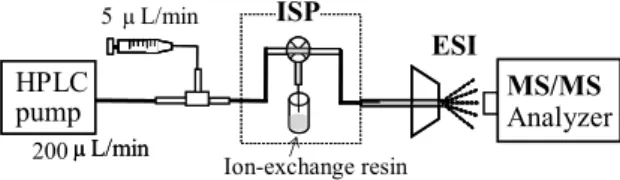
6We have recently examined the mass spectra of the electrochemical oxidation products of nifedipine so as to improve the sensitivity using electrochemistry/ESI-MS coupled with an ion suppressor (ISP) device. It was found that the sodium ion adduct of nifedipine was eliminated with ISP, even though the intensity of the sodium ion adduct was relatively low compared to the protonated molecule in the mass spectra without ISP.
16Huber and coworkers demonstrated that on-line cation-exchange resins with triethylammonium ions were useful for suppressing the sodium adduct formation of oligonucleotides in negative-ion ESI-MS.
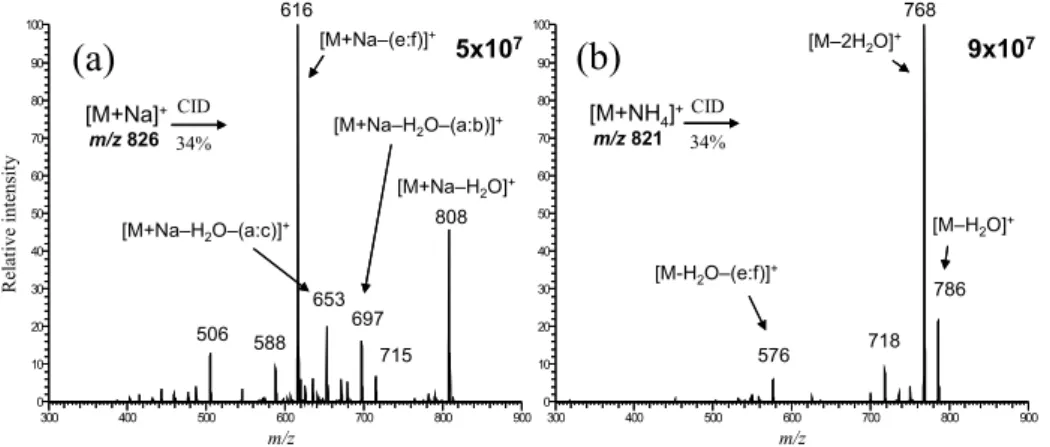
17,18Herein, a macrolide immunosuppressive drug, tacrolimus, was selected as a model compound that can easily form the sodium adduct ion derived from the ESI process in the positive-ion mode.
19,20In this report, an on-line ISP technique is described as a simple and new way to eliminate alkali metal ion adducts derived from the positive-ion ESI process.
2010 © The Japan Society for Analytical Chemistry
†