Acta med. Nagasaki. 18 : 13-25
Development of Sarcomata in the Livers of Albino Rats Given Sodium Nitrite and Dimethylamine (Report 1)
Kazuko OKA*, Kazuko BETTO*, and Issei NISHIMORI**
*Nagasaki prefectural Women's Junior College
**Nagasaki University School of Medicine
Received for publication, February 1, 1974
It is a well-known fact that dimethylnitrosamine (DMNA) causes the formation of liver cancer. And it is also recognized that DMNA is generated from dimethylamine in food and nitrite, a food additive, and that it is produced secondarily in the stomach. But there is a report that shows that albino rats practically given dimethylamine and sodium nitrite have developed no cancer. Therefore, in order to see whether the report is right or not, the present authors kept albino rats for 78 days giving them various degrees of con- centration of sodium nitrite and dimethylamine solutions diluted with drinking water. As the result, no formation of tumours was found in the livers of those rats. But the decrease
in the vitamin A content of their livers was observed, which suggested the disturbance of the liver function. Then in expectation of the probability that a longer period of adminis- tration of sodium nitrite and dimethylamine and a higher concentration of sodium nitrite might develop liver cancer, the authors kept rats for 410 days giving them higher concen- trations of sodium nitrite (15 g/l and 30 g/l) as well as an ordinary concentration of it
(5 g/l ), together with dimethylamine. The rats given sodium nitrite at higher concent- rations died of methaemoglobinemia in a week or two, but the ones given at an ordinary concentration survived. One rat died on the 318th day, in whose liver a tumour was ob- served to have grown. Some tumours were also found in the spleen and the mesentery, which are considered to be metastatic tumours. One of the animals killed on the 410th day was found to have developed a tumour in the liver alone, which suggests that these tu- mours were liver-idiopathic. These tumours are conjectured through a pathohistological examination to be fibrous sarcomata of vascular origin. Judging from these results, the warning that these substances in food, i.e. dimethylamine and sodium nitrite, when they are ingested for a long time regardless of their quantities, will possibly cause the develop- ment of tumours in the liver cannot be disregarded.
*岡 和 子,別 当 和 子 **西 森 一 正
INTRODUCTION
In 1956, MAOEE, P. N. et al. 1) reported that, when albino rats of the Porton strain were given food containing dimethyinitrosamine (DMNA), most of the animals developed cancers in their livers. They2) also stated that, even a Very small amount of 2 p.p.m. of this substance caused to generate cancers in 60 weeks when it was given to rats. In 1957, there took place in Norway an accident in which a large number of cattle died of an acute liver disorder. ENDER, F. et al.3> published in 1964 their report that the couse of their death had been DMNA which was generated in the reaction of dimethylamine contained in herring upon the nitrite added to them as a preservative.
Since then many studiesU-14) have been reported about the carcinogenicity of DMNA.
On the other hand, it has been reported that dimethylamine or diethvlamine is harder to be transformed into nitrosamine than diphenylamine because the amine of the former has a considerably strong alkalinity. At present the addition of nitrite to foodstuffs (below 70 mg/'kg in residue as nitrite radicals) is admitted. Though these foodstuffs, with a weak acidity of about pH 5.015), do not give to nitrite a very suitable condition (pH 3.6) for its transfor- mation into nitrosamine, it is said that if these foodstuffs contain a considerably large amount of secondary amine, there is every probability that n.itroso compounds are produced in the foodstuffs15), as is shown by the fact that there has been an occurrence that 80 p.
p.m. of DMNA was detected in Frankfurt sausage"). Moreover, the human stomach shows a strong acidity of pH 1.2-2.015), giving a very favourable condition for the transfor- mation of dimethylamine into nitrosamine, and so SANDER, J. et al.") and LIJINSKY, W. et al.") have warned that tumours may be formed by DMNA produced secondarily when secondary amine contained in foodstuffs and nitrite used as a food additive are taken into a human body together. At present in Japan, nitrite is used as an additive to various kinds of food, and dimethylamine is also contained in large amounts in some of processed marine products and agricultural products"). Consequently these two substances are likely to be taken together. and the resulting dangerousness should be considered. Therefore, the main object of this work is to re-examine the negative results of the experiments with a.1- bino rats reported by SANDER, J. et al.") and DRUCKREY, H. et al.') on the formation of liver cancer by DMNA which is said to be produced secondarily when sodium nitrite and dimethylamine are taken together continuously. Moreover sake', to which salicylic acid as well as nitrate is added, is liable to be taken together with processed marine products and agricultural products, and so dimethylamine contained in those processed foodstuffs is thought to be given a favourable condition for its transformation into a nitroso compound.
Accordingly an examination in the case that dimethylamine was taken together with sali- cylic acid was made additionally.
As experiental materials, albino rats of the Wistar strain were used. First, in order to know the pH in the stomach of the rat, it was measured with pH test paper in the stomachs of two rats. The result was 1.2-1.5, and so the yield in the secondary produc- tion of DMNA in the rat's stomach may be thought not to be so widely different from
that in the human stomach, 45% at pH 1.2-2. Therefore the study was decided to be made by using albino rats to examine how many days it would take them to develop tu- mours in the livers when sodium nitrite and dimethylamine were given to them. Further- more, the vitamine A content of the liver was determined in order to examine whether the development of tumours in the liver would have any influence upon it.
MATERIALS AND METHODS
In experiment 1, male albino rats of the Wistar strain weighing approximately 50g were fed for a week with MF solid food (manufactured by the Oriental Yeast Industry Co, Ltd.), and after that the rats were divided into six experimental groups of five each as shown in Table 1. Besides them, another group of five rats was prepared as a control group. Three of the six experimental groups were given sodium nitrite of concentrations of 0.5g/l, 2.5g/l, and 5.0g/1 respectively, and dimethylamine of a concentration of 4 cc/1 each. The other three experimental groups were treated in the same way as the former three, and besides, were given salicylic acid of a concentration of 1 g/1 each. The sub- stances to be administered were diluted with drinking water to their respective concentra- tions. At first the solution of these substances was given to each of the animals by 20 cc a day. But after a month passed, 25 cc were given to each every day. After giving the solution of these substances, the animals were free to drink ordinary drinking water for the rest of the day. They were fed with MF solid food as much as they wanted, and they were weighed every day. On the 78th day, they were decapitated and bled under anaesthesia with ether, and the livers were taken out by means of laparotomy. A part of each liver was used to determine the vitamin A content with the Carr-Price reaction, and the other larger part was used. to make a histological specimen, which was subjected to the haematoxylin-eosin staining, the Sudan III staining, and the silvering staining for a pathohistological study.
Experiment 2 was performed in expectation of the probability that a longer period of administration of those substances might generate liver tumours though the result of experiment 1 failed to show the formation of any tumours. Albino rats were given a mix- ture of 5g,/1 sodium nitrite and 4 cc/1 dimethylamine prepared by diluting with drinking
Table 1 Agent Concentration of Solutions Administered to
Each Group in Experiment I
Group A B C D E F G
Sodium 0.5 g/1 2.5 g/1 5 .O g/1 0.5 g/1 2.5 g/1 5.0 g/1 0 g/1 Nitrite Dimethyl- 4 cc/1 4 cc/1 4 cc/1 4 cc/1 4 cc/1 4 cc/1 0 cc/1
amine
Salicylic 1 g/1 1 g/1 1 g/1 0 g/1 0 g/1 0 g/1 0 g/1
Acid
water for 41.0 days as much as they wanted. On the other hand, as it was expected that the exasperation. of the functional disturbance of the liver by the administration of a high- er concentration of sodium nitrite might accelerate the development of liver tumours by DMNA, and that the administration of a larger amount of sodium nitrite might increase the amount of MINA generated secondarily, sodium nitrite of concentrations of 15 g/l and 30 g/l, as well as 5 g/l, with dimethylamine of a concentration of 4cc/1 mixed to each were given to another two experimental groups, respectively. Besides them a control group was prepared. That is, male albino rats of the Donryu strain weighing about 100 g each, were equally divided into three experimental groups consisting of four rats and a control group consisting of three (one of the four was not healthy with small body-weight and so omitted from the experiment). At the end of the experimental period, all the animals were decapitated, and the livers were taken out by means of laparotomy. Vitamin A was deter- mined by a part of the liver, and the most part of the liver was subjected to staining in.
the methods shown in experiment 1 to make the pathohistological examination of the liver.
Table 2 Agent Concentration of Solutions Administered to
Each Group in Experiment II
Group A B C D
Sodium Nitrite 5 g/1 15 g/1 30 g/1 0
Dimethyl-amine 4 cc/1 4 cc/1 4 cc/1 0
RESULTS
Experiment 1
1) External symptoms and body-weight
The rats of the groups given 5 g/1 sodium nitrite solution began to show symptoms of a skin disorder on the 10th day after the commencement of the experiment. On the 78th day, an especially remarkable disorder was observed on their skins, regardless of the presence of salicylic acid. Their body coat had lost luster and got much disturbed. One was bleeding from the limbs. Another was dead with its eyes starting out of their sockets.
Besides, there was one which had died with the belly swallen with ascites.
The change of the mean body-weight of each experimental group maintained for 78 days is shown in Fig. 1. And the mean body-weight and the standard deviation of each experimental group on the 78th day are shown in Table 3. As for the difference between the mean body-weights of the experimental groups on the 78th day, they were examined repeatedly at a level of significance of 5%18) as shown in Table 4 and the groups whose mean values could not be recognized to be equal to the others were picked up. As the result, the experimental groups given 0.5 g/1 and 2.5 g/1 sodium nitrite solutions, as well as the corresponding groups given salicylic acid, showed no difference from the control group in the mean body-weight. But the mean body-weights of the experimental groups
DAYS
Fig. 1 Changes of the mean body weights of various groupslin experiment I
Table 3 Body Weights, Mean Weights and Standard Deviations in Each Group at 78th Day on Experiment I
Experimental Mean of the Standard
Group Body weight Body Weight (g) Deviation
339
295
A 295 297.4 22.01
280
278 300 308
B 239 289.2 31.82
269
330 190
C 281 216.0 40.58
175 320 329
D 333 310.0 24.45
302
266 328
E 294 294.0 22.22
266
217
F 236 228.3 8.18
232
321
G 312 333.3 24.09
367
given 5g/l sodium nitrite solution were observed to be different from those of the other groups, showing a bad influence of the substance upon the growth of the animals unlike the result of the 3g/l administration reported by SANDER, J. et al. 101 As for the influence
of salicylic acid, it was not observed that there was any difference between the body-weight of a group given salicylic acid and that of the corresponding group given no salicylic acid as shown in Table 4.
Table 4 Significant Difference of Mean Body Weight among the
Various Experimental Groups on 78th Day in Experiment I
Experimental U. D. U. D. Mark of Difference
Groups Among Groups (F) Within Group between Groups C * )
ABC G 7 .44
DEF
A B G 1.47
D E
C 0.19 F
U . D . Unbiased Estimate Deviation
2) The vitamin A content of the liver
The amount of the vitamin A contained in 1g of the liver from each rat on the 78th day is given in Table 5. Like in the case of body weight, the mean vitamin A contents were examined by employing the method of analysis of variance, 18) and the groups whose mean values were observed to be different from the others were picked up. As the result, it can be said that the vitamin A contents in the 5g/l sodium nitrite groups were espe- cially small, regardless of the addition of salicylic acid. On the other hand, the standard Table 5 Amount of Vitamin A Contained in Liver on 78th
Day in Experiment I I.U./g
A B C D E F G
1 38.2 20.8 14.2 42.3 32.0 14.7 39.2
2 45.8 25.5 18.5 38.0 32.0 13.1 43.9
3 33.8 22.8 17.4 42.4 36.8 18.9 34.1
4 58.5 24.7 16.2 44.3 - - -
5 20.1 29.1 - 40.0 30.4 -
Mean 39.3 24.4* 16.6** 41.4 32.8 15.6** 39.1
S.D 12.74 2.94 1.59 2.18 2.40 2.45 4.00
S. D Standard Deviation
F = 10.88 ... Ratio of the Among Group Unbiased Deviation and Within Group Unbiasee Deviation
** Shows the Difference between Mean Value with No Asterisk and That with One Asterisk.
Shows the Difference between Mean Value with No Asterisk and That with Two Asterisks.
deviation of the vitamin A content in each group showed the largest value. in the 0.5 g/l sodium nitrite and salicylic acid group. And it was noted that, of all the salicylic acid groups, the 2.5 g/1 sodium nitrite group had a smaller mean vitamin A content than the corresponding group without salicylic acid or the control group.
3) Pathohistology of the liver
In order to examine the disturbance of liver function histologically, tissue specimens were prepared from the livers and stained with haematoxylin-eosin, Sudan III, and silver- ing. But no remarkable symptoms of disease were found, nor was the slightest sign of the formation of tumours in every specimen. And sodium nitrite of a concentration of 5 g/l which had had a bad influence upon growth or salicylic acid were not observed to have accelerated the formation of tumours.
Experiment 2
1) External symptoms and body-weight
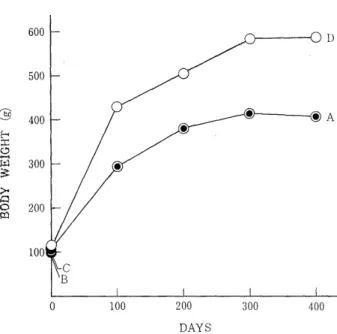
This experiment was made in expectation of the probability that the administration of a higher concentration of sodium nitrite for a longer period than experiment 1 might cause the formation of cancer in the liver. The change of the mean body-weight in each experimental, group is shown in Fig. 2.
In the groups which were given higher concentrations of sodium nitrite, 15g/l and 30 g/l, every animal got weak rapidly and had a skin disorder which had been found in experiment I. And these animals showed a rapid decrease in body-weight, and all the rats in the 15g/l group died between the 8th day and the 14th day, and all in the 30g,/l group between the 10th day and the 14th day. In the 5 g/l group, one died on the 318th day,
DAYS
Fig. 2 Daily changes of mean body weights of various groups in experiment II
and two survived till they were decapitated on the 410th day. The intake of sodium ni- trite and the body-weight on the 100th day are shown in Table 6.
Table 6 Body Weights, Mean Weight Standard Deviations and
Intake of the Sodium Nitrite in A and D Groups on 100th
Day in Experiment I
Experimental Body Mean Body Standard Intake of Intake of
Group Weight (g) Weight (g) Deviation Water (cc) Nitrite Sodium (g)
358 27 0.14
A 236 296 46.73 30 0.15
302 27 0.14
445 40
D 390 428 27.18 41
450 30
2) The vitamin A content in the liver.
Only the 5 g/1 sodium nitrite group survived for a long time (410 days), and the vitamin A contents of their livers were measured, and compared with those of the control group. The results are shown in Table 7, and the comparison of the mean content of the sodium nitrite group with that of the control group shows that the former was about a half of the latter.
Table 7 Amount of Vitamin A Contained in Liver in
Experiment II
. Group A (I.U./g) D (I.U./g) No
1 13.6 30.0
2 19.2 31.4
Mean 16.4 30.7
3) Pathohistology of the liver
In order to make a close examination of the symptoms of disease in the liver of the rats, tissue specimens were prepared from the livers. A pathohistological examination was made concerning the rat which had died on the 318th day and the ones which had been decapitated on the 410th day in the 5 g/l sodium nitrite group, and the ones which had died in the early stage of the experiment in the 15 g/l and the 30 g/l groups. In the groups given higher concentrations (15 g/1 and 30 g/l) of sodium nitrite, no remarkable change was found in the liver tissue of every individual, nor was any formation of tu- mours. On the other hand, one of the rats of the 5 g/1 sodium nitrite group which were decapitated on the 410th day was found to have developed a tumour in the liver tissue. But in the other organs, mainly the mesentery or the spleen, the development of such a tumour was not found. Furthermore, in this group, the rat which died on the 318th day had developed an especially big tumour of 3.5 x 2.1 cm in diameter as shown in Fig. 3, and
Fig. 3 Liver sarcoma (3.5 x 2. lcm)
Almost all the hepatic tissue is attacked by this sarcoma. X 400
Fig. 4-a The liver stained with haematoxylin-eosin .
Spindle cells are proliferating sarcomatously. X 160
Fig. 4-b The liver stained with haematoxylin-eosin . X 400
Fig. 5 Reticulin fibers, forming a netwo'k, seem
to be of vascular origin. X 400
almost all the ordinary liver tissue was attacked by this tumour. In this rat, some more tumours were found in the mesentery and the spleen as well. The tissue of this tumour
is illustrated in the following figure. Fig. 4-a is the picture of the tissue stained with haeinatoxylin-eosin, showing young cells with spindle nuclei and cytoplasm arranged flow- ingly. The magnified picture of Fig. 4-a is Fig. 4-b. Non-epithelial tissue with cells of various sizes is seen, which shows the form of a fibrous sarcoma of vascular origin. And Fig. 5 shows the tissue stained by silvering, in which a remarkable increase of silverophil-
ic fibers which are peculiar to a sarcoma but not seen in a cancer is observed. That explains clearly that the tumour is not a cancer but a sarcoma. And this sarcoma is met- astatic as stated above. In the other rat, no tumours were found. In the control group, no abnormal symptoms were noticed in their livers.
DISCUSSION
Experiment 1
In the rats of the 5g/l sodium nitrite groups, some skin disorder was noted, which is presumed to have been due to the decrease in vitamin A.
And this degree of concentration of salicylic acid cannot be said to have had any influence upon the growth of the rats in this experimental period.
It is known that the liver, which is the storage of vitamin A, will reduce its vitamin A content easily with the decline of its function. And the fact that the vitamin A content in the 5 g/l sodium nitrite group was especially small is thought to be that this concentration of sodium nitrite had a bad influence upon the function of the liver lowering its capacity of vitamin A, considering that sodium nitrite is liable to cause acute hepatitis"). But some otherr examinations of the liver function need to be performed as well. As for the relation between the addition of salicylic acid and the vitamin A content, the former is not thought to have had such a great influence upon the latter.
The pathohistological study of the liver showed no marks of the formation of tu- mours in any specimens. More study needs to be made concerning the fact that there were no remarkable symptoms with pathohistological abnormality even in the groups whose vi- tamin A contents were clearly different from the others.
Experiment 2
In the 15g/l and the 30g/l sodium nitrite groups, every rat showed a rapid decrease in body-weight, and died with skin disorders. They are considered to have died of met- haemoglobinemia caused by sodium nitrite. In the 5g/l sodium nitrite group, three sur- vived for a long time, but it is of great interest that one that died on the 318th day and one of those that were killed on the 410th day did not show any decrease in their body- weight in spite of the fact that they had developed sarcomata in their livers.
The fact that the vitamin A content of the liver in the 5 g/l sodium nitrite group was about half of that in the control group is considered to be due to the lowering of the liver function caused by the development of tumours.
The pathohistological study of the liver showed no remarkable symptoms nor the formation of tumours in the dead rats in the group given higher concentrations (15g/l and 30g/1) of sodium nitrite, which is considered to indicate that their death might be caused by methaemoglobinemia due to the virulence of sodium nitrite as stated before. But it cannot be concluded because the examination on methaemoglobinemia has not been per- formed.
The tumours found in one of the rats which were killed on the 410th day, and in the rat which died on the 318th day in the 5 g/l sodium nitrite group were of the same pathohistological structure, and judging from the fact that one of them developed its tu- mour in the liver alone, these tumours are considered to have been liver-idiopathic. From the fact that the rat which died on the 318th day was found to have developed tumours in the mesentery and the spleen, it was judged that these tumours were metastatic sarco- mata.
Though SANDER, J. et al.,") and DRUCKREYO, et al, reported as stated bofore that the administration of dimethylamine and nitrite for 6 months to albino rats had failed to form tumours, the present experiment showed that the administration of these substan- ces for a longer period caused the development of liver tumours. Therefore it is clear that dimethylamine and sodium nitrite are the generators of tumours. And as LIJINSKY, W. et al.") pointed out, the possibility of tumours being developed by a long-term adminis- tration regardless of the amount is undeniable.
The formation of liver sarcomata has been reported by MATSUYAMA, et al. 19) and TAKAYAMA, et al.,") to have successfully been performed only by the experiment of the administration of other substances. The case of the development of a sarcoma in the liver is comparatively rare. And it has been difficult to clarify the mechanism of the development of sarcomata in this experiment, and the conclution cannot yet be obtained. But at present a long-term experiment with sodium nitrite of concentrations of 0.5g/l and 5g/l is being conducted for implantation and some other studies.
REFERENCES
1) MAGEE, P.N., & BARNES, J . M . , Brit. J. Cancer, 10, :11. 1956 2) MAGEE, P.N., & BARNES, J.M., Brit. J. Cancer, 21, :559. 1967
3) ENDER, F. , HAVRE, G., HELGEBOSTAD, A . , KOPPANG, N . , MADSEN, R, &
CEH, L., Naturwissenschaften, 51. :637, 1964
4) MAGEE, P.N., & HULTIN, T . , Biochem. J., 83, 106. (1962) 5) MAGEE, P.N., & FARBER, E . , ibid., 83. :114, 1962
6) DRUCKREY, H . , STEINHOFF, D . , BEUTHNER, H . , SCHNEIDER, H . , & KLARNER, P . , Arzneimittelforschung., 13. :320, 1963
7) MAGEE, P.N., & BARNES, J .M . , Adv. Cancer RES., 10 :163, 1967
8) DRUCKREY, H . , PREUSSMANN, R . , IVANKOVIC, S . , & SCHMAHIL, D. Z Krebs- jorsch. , 69 :103, 1967
9) SANDER, J . , Arch. Hyg. Bakt., 151 :22 1967
10) SANDER, J . , SCHWEINSBERG, F . , & MENZ, H .P . , Hoppe-Seyler•s Z. Physiol.
Chem., 349, :429. 1968
11) SANDER, J . , Hoppe-Seyler's Z. Physiol. Chem., 349, 1691 1968
12) LIJINSKY, W . , TOMATIS, L . , & W ENYON, C . E .M . , Proc. Soc. Exp. Biol. &
Med. 130, :945, 1969
13) SEN, N.P., SMITH, D.C., SCHWINGHAMER, L., & MARLEAU, J.J., J. Assoc.
Off. Anal. Chem., 52 :47, 1969
14) TAKAYAMA, S . , & OOTA, K . , GANN, 54 :465, 1963 15) TANIMURA, A . , Chorikagaku, 5 :19, 1972 (Japanese)
16) FIDDLER, W., PIOTROOSKI, E.G., PENSABENE, J.W., DOERR, R.C., &
WASSERMAN, A .E. , J. Food Science, 37' :668, 1972
17) LIJINSKY, W . , & EPSTEIN, S .S . , Nature, 225 :21, 1970
18) SEIKOSHA, S-500 Standard Program Library (Statistics), the Hattori Jewelry Store, Tokyo, 845310200 :112, 1972 (Japanese)
19) MATSUYAMA, M . , SAKAI, I . , MAEKAWA, A . , & HORII, H . , Bull. Nagoya Mun. Univ., 12 :1271, 1962 (Japanese)