developing technologies on female and male students in high school biology classes from each gender perspective
著者 Okumura Jin‑Ichi, Kumano Yoshisuke journal or
publication title
Bulletin of the Faculty of Education, Shizuoka University. Educational research series
volume 51
page range 143‑158
year 2019‑12
出版者 静岡大学学術院教育学領域
URL http://doi.org/10.14945/00026962
Action research on the differences in influence of classroom experiments and developing technologies on female and male students in high school
biology classes from each gender perspective.
Jin-Ichi Okumura1,2, Yoshisuke Kumano3
奥 村 仁 一1,2 ,熊 野 善 介2
(令和元年12月2日受理)
ABSTRACT
In the Course of Study for high school science in Japan, changes were implemented to encourage teaching and learning content that reflects scientific developments, and schools were asked to do more experiments and observations in science classes. However, the results of the international survey by the Organization for Economic Cooperation and Development (OECD) show that, in 2015, the differences in average scores for scientific literacy between female and male students in Japan were higher than other countries. Therefore, in this action research we implemented five experiments on DNA in high school biology classes, in cooperation with a university. We analyzed questionnaires that the students took to clarify how they felt about these experiments.
The results from the analysis of these questionnaires showed that male students were more interested in the technological aspects of these experiments and female students were drawn to the comprehensive aspects. Furthermore, female students showed interest in the experiments that connected either with themselves or connected to their own life. From these considerations, we will observe different educational effects in the high school biology classroom that produce a difference of experimental interests in males and females.
1.Introduction
The Abe Cabinet emphasizes the "active participation of women" in the basic plan of science and technology. Since 2006, the Ministry of Education has been supporting junior and high school females who are aiming at science fields as "measures for promoting women's activities in science and technology". However, according to the "Publication of School Basic Survey” (Ministry of Education, 2015) the proportion of female college students represented in the survey in 2015 was 43.1%, but the proportion of female students from the survey in the Department of Sciences was lower than the population of male students. To add to this, the proportion of female researchers in Japan is lower than that in other countries.
1 Northern Arizona University Center for Science Teaching and Learning
2 Shimizu Sakuragaoka High School
3 Shizuoka University Graduate School of Science and Technology, Graduate School of Education
The OECD’s Programme for International Student Assessment (PISA) in 2015, combined with the results of the survey for scientific literacy, found that the gender differences in scores resulted in an average score of “4” in OECD member countries. On the other hand, in Japan the gender differences in scores was a score of "14", with statistically significant differences between a male score of "545" and a female score of
"532" (OECD, 2015). And the gender differences of the three competencies to be investigated are a 25 point difference in the "scientifically explain phenomena" area, a 3 point difference in the "create and plan scientific inquiries" area, and a 9 point difference in
"scientifically interpret data and evidence" area.
Adachi (2012) examined the gender differences in determinant factors of interest in science and technology and showed that experiences in childhood are important, especially in the field of technology. Adachi also pointed out that the effect on occupation selection after these experiences in childhood garnered interest in the appropriate opportunities for each gender, especially in the selection of technical occupations.
Inada (2013a) pointed out that females clearly show their likes and dislikes depending on the content of the science learning, suggesting that the role played by science teachers is important for increasing the number of females who like science.
Meanwhile, the Course of Study for high school science in Japan showed one of the educational goal is "to increase the interest in living things and biological phenomena while trying to relate to daily life and society". These guidelines also showed that it is important to generate student interest in science studies through learning content related to real life. In addition, it is important for students to study the latest information reflecting the rapid advances in life science in recent years. In effect, the textbooks certified by the Government contain numerous descriptions of the latest information, exploration activities, experiments and observations on DNA, and other advanced research.
Okumura & Kumano (2018) categorized the experiment in STEM education in biology area for two types, one is DMA (Direct Modification Artificially) and the other is IMA (Indirect Modification with Artifact). They pointed out DMA such as gene or DNA experiments are difficult to understand not only for students but also for teachers.
In Japan, there were some research papers written about experiments that reflected the progress and development of life sciences; they had been written about the development of teaching materials, understanding of learning content, and the changes of interest in learning for students ( e.g. Isagi & Matumoto, 2005 ; Takano, 2011 ; Katayama, 2012 ; Yamada, 2015 ; etc). But there were not as many reports written about the effectiveness of experiments and in changing the student's awareness after the implementation of this learning content from the viewpoint of each gender.
Therefore, in this research we conducted experiments on genes to compare and analyze gender differences in student consciousness from questionnaires given after the experiment.
2.Purpose of this research
In this research, we conducted five different experiments on genes and aimed to investigate whether gender differences can be seen in the interests of students depending on the method of operation and characteristics of the experiments. In addition, if gender interest differences were seen, further analysis was carried out with the aim of clarifying in practice what kind of differences they were.
Furthermore, from the viewpoint of gender, we considered effective implementation of
"experiments based on the development of science and technology" in high schools in Japan, especially focused on the way experimental classes can promote female interest in science learning. These five experiments were part of a series, shown in a paper published in 2018 (Okumura).
3.Contents of the experiment course and research method
In 2011, 2012, and 2013, we conducted an experiment series, "What is DNA?", in collaboration with Ushimaru Laboratory of the College of Science, Shizuoka University.
Participating students were chosen from student requests (Table 1), but many of them were also chosen science subjects.
During the 3 years, each year we introduced the following courses:
(1) Preliminary lecture 1: Lecture on genetic information at a high school level was given because there are differences in participant understanding based on grade level and their existing knowledge.
(2) Preliminary lecture 2: From a professor of the university on more advanced scientific information to deepen the students’ knowledge beyond the level of high school. By experiencing the opportunity to learn highly advanced knowledge from the university professor, I further stimulated the interest of science and motivated students to perform the experiments.
(3) Experimental course:
We carried out five experiments over two days in the university laboratory.
Experiment 1: "Extract gene" – DNA was extracted from chicken liver and broccoli.
The experiment demonstrated how to extract and visualize DNA and was conducted through basic operations such as mixing a ground sample with saline solution, filtering with filter paper, overlaying with ethanol, and extracting DNA strands by entangling the strands around a glass rod. This DNA experiment was relatively basic, easy to
Table 1. The Number of participating students in each academic year (High schools in Japan are usually 3 years and 1st grade to 3rd grade are equivalent to the 10th grade to 12th grade in the United States)
understand and conduct, and it can be carried out in the science lab of a high school.
Experiment 2: "Gene transfer" – Genes of Aequorea Victoria green fluorescent protein (GFP), yellow fluorescent protein (YFP), and red coral (Paracorallium japonicum) fluorescent protein (RFP) were introduced into E. coli. The experimental procedures were also simple such as mixing reagents or reaction with heating, but it is necessary to perform experimental operations continuously for a fixed time. Many things that students had never dealt with such as reagents and gene solutions used and learning concepts with high difficulty were necessary for understanding the purpose of the operation and principles of chemical reactions.
Experiment 3: "Observation of genetically abnormal organisms" – A normal strain and a mutant strain of yeast, previously prepared, were observed with an optical microscope and students sketched yeast of genetic abnormality. Handling of the microscope was also taught in the high school science classes.
Experiment 4: "Extraction and analysis of my own DNA" – The DNA of students’ cells, collected from oral mucosal cells, were amplified by PCR method, and analyzed by electrophoresis. Using various reagents, it was necessary to operate 15-minute cultures and 5-second centrifugation, continuously. A highly carcinogenic reagent such as ethidium bromide solution was also used. It was difficult for the high school students to understand the purpose and principle of experimental operation.
Experiment 5: "Observation of transected cells" – The introduction of E. coli and the GFP gene, in Experiment 2, was observed with a fluorescence microscope. Because the operation of the fluorescence microscope was conducted by college students, high school students examined the observations and information. Since the fluorescent protein actually glows, and the expression of the trait by the transgene can be visually confirmed, the observation result itself is easy to understand. But if the content of Experiment 2 is not understood, the result is difficult for students to make sense.
Conclusion, Presentation: The students reflected, summarized, and presented on the experiment in groups. In addition, they debated about topics that concerned them, related to DNA. The topic for 2011 and 2012 was "genetically modified foods", and in 2013 the topic was “prenatal diagnosis of genes".
A selective questionnaire about Experiments 1 through 5 was conducted immediately after the end of the course, and an open response questionnaire was also conducted. In the open response questionnaire, students could write comments freely.
The selective questionnaires were analyzed by the χ2 test focusing on gender differences.
The open response questionnaires were analyzed by quantitative text analysis using a KH-coder (Higuchi, 2012) in conjunction with qualitative analysis and were analyzed for gender differences.
4.Results and discussion
In the selective questionnaire, we asked six questions about the experiment (Table 2) such
Table 2. Question contents of selective questionnaire
as "Which experiment was the most impressive (great, fun) in this course?" and students answered with “Experiment 1 to 5” or “I do not know (or there is no answer)”. In addition, the open response questionnaire was carried out as "Please feel free to write any thoughts, such as your impressions".
(1) Selective questionnaire
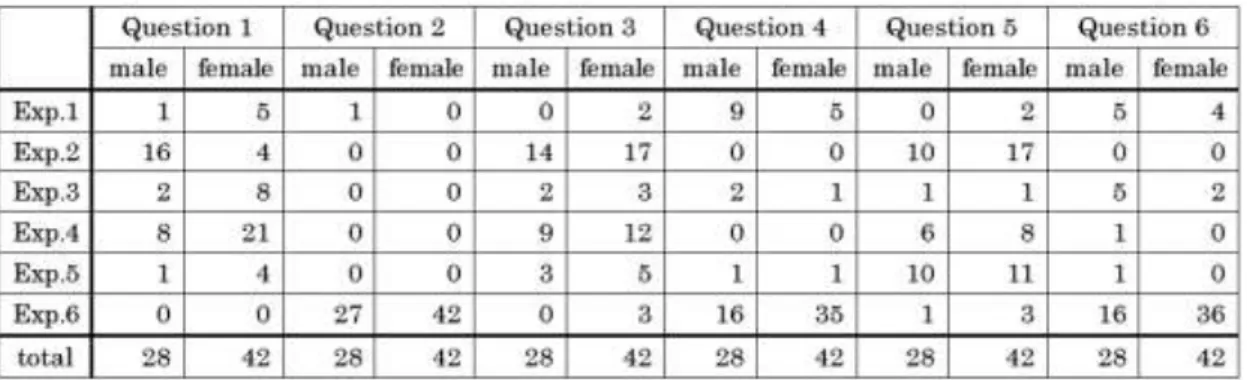
The results of the questionnaire (the number of men and women) are shown in Table 3.
In addition, in order to analyze whether there was a difference between female and male responses to each question, the implementation of the χ2 test were obtained (Table 4).
In Question 1: "What is the most impressive (great, fun) experiment in this course?" the most frequent answer for males was Experiment 2: “Gene transfer" at 16/28 (57.1 %).
For the females, most answered Experiment 4: “Extraction and analysis of my own DNA”
at 21/42 (50%). And a majority of the females also answered Experiment 3: “Observation of genetic abnormal organisms" at 8/42 (19%).
Table 3. Results of selective questionnaire (number of men and women)
Table 4. Analysis results of gender differences in selective questionnaires (by χ2(chi)-square test)
As a result of the χ2 test, a significant 1% difference was observed between females and males. Therefore, it was inferred that the response to which experiment was impressive (great, fun) by females and males was different.
Question 3: "Which experiment was the most difficult in this course?" Experiment 2:
“Gene transfer” appeared most frequently in both females and males (females: 17/42 or 40.5%, males: 14/28 or 50%), followed by Experiment 3: “Observation of genetically abnormal organisms” (females: 12/42 or 28.6%, males: 9/28 or 32.1%). There was no significant difference in the responses of males and females in the χ2 test. It was observed that the same tendency was seen in both sexes in the experiments which they felt were the most difficult.
Question 5: “What was the most difficult experiment to understand the content of the experiment in this course?" showed that both females and males answered Experiment 2.
The number of this answer in females was 17/42 (40.5%) and in males was 14/28 (50%).
The experiment that females said was second most challenging was Experiment 5 (11/42 or 26.2%), and males responded with Experiment 4 (6/28 or 21.4%). There was no significant difference in gender in the χ2 test, so there was no difference in the responses of females and males for Question 5.
In Question 2, Question 4, and Question 6, most females and males answered "I do not know (or there is no answer)", and it was found that there was no gender difference from the χ2 test result.
From these results in the selective questionnaire there was no difference between females and males in "feeling of experimental operation" or "difficulty in understanding the contents of the experiment", but it was inferred that there was a difference between females and males in the experiment responses of "it remained in the most memorable" and "it was fun".
(2) Open response questionnaire A. Quantitative analysis
We digitized the description of the questionnaire and carried out text mining analysis by using a KH-coder by gender.
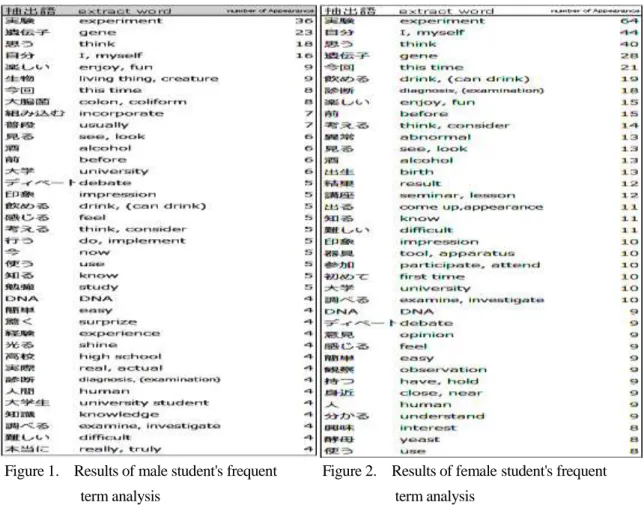
A frequent word analysis (Figure 1) showed that among males the total number of extracted words was 2,007 (71.7 words per person) and the number of different words was 456 (16.3 words per person). The word that most frequently occurred was "experiment" (36 times), the second most frequent word was "gene" (23 times), and the third most frequent word was "think" (18 times). On the other hand, in females (Figure 2), the total number of extracted words was 4,772 (113.6 words per person) and number of different words was 678 (44.1 words per word). The most frequently occurring word was "experiment" (64 times) , similar to males, the second most frequent word was "I, myself" (44 times), and the third most frequent word was "think" (40 times). Inada (2011) pointed out that females are more advanced in writing ability and descriptive power than males, and it was thought that the same tendency was shown in this practice because of the difference of words used
Figure 1. Results of male student's frequent Figure 2. Results of femalestudent's frequent
term analysis term analysis
between females and males.
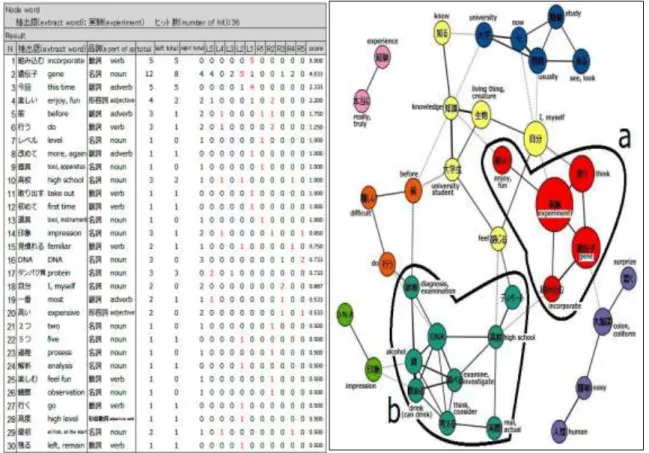
The collocation statistics and the co-occurrence network analysis were carried out to investigate how used "experiment", which was the most used word for both females and males, was used. In males, analysis by the collocation statistics (Fig. 3) showed that
“experiment” was strongly associated with "incorporate" and "gene", which formed a context, and even in the co-occurrence network analysis (Fig. 4) the word "experiment"
showed strong ties with terms such as "incorporate", "think", and "enjoy, fun". It was inferred that there was a lot of description about Experiment 2: “Experiment incorporating genes" (the “a” section, to the right, in Figure 4). Also it was shown that there was a description about Experiment 4: “Extraction and Analysis of My DNA" (The “b” section, to the lower left, in Fig. 4).
On the other hand, the females' collocation statistics (Figure 5) demonstrate a connection of the word “experiment” and "this time", "tool, apparatus", and "enjoy, fun", etc. The statistics showed how the context was formed. Other than these connections, the co-occurrence network analysis (Figure 6) shows a connection with the terms "think" and
"DNA”. It seemed that females were more likely to have positive impressions of the entire experiment course rather than that of specific experiments, and females wrote their impressions what they thought and felt (see the right upper section of “a” in FIG. 6).
For descriptions of specific experiments, there was a relation between Experiment 3:
Figure 3. Result of the Collocation statistics analysis Figure 4. Result in male students of the with the word “experiment” in male students Co-occurrence network Analysis
Figure 5. Result of the Collocation statistics analysis Figure 6. Result in female student’s of the with the word “experiment” in female students Co-occurrence network Analysis
“Observation of genetically abnormal organisms" and the description of a word group (see the lower right of section "b" in FIG. 6). There was also a relation between Experiment 4:
“Extraction and analysis of my own DNA" and the words group (see the lower middle of section "c" in FIG. 6).
Furthermore, there was a group of words (the lower middle section of "d" in Fig. 6) that were not set as questionnaire choices, but there seemed to be descriptions about the debate implemented in this experimental course; it was inferred that those were statements about the debate with the theme "prenatal diagnosis" that students did.
From the analysis results of the open response questionnaire, it was inferred that Experiment 2: “Gene transfer" was most impressive for males because there were many descriptions aboutExperiment 2 as well as the results of the males’ answers to Question 1 of the selective questionnaire. On the other hand, it was suggested that, for females, there were many descriptions such as impressions, thoughts, etc. of the whole comprehensive course more than specific experiments.
Adachi (2012) investigated interests of college students and college graduates in science and technology, showing that interests in technical fields are higher for males than for females. According to this research there is a tendency for males to show interest in experiments involving technical genetic manipulation in biotechnology such as in Experiment 2: “Gene transfer".
Nakazawa (2008), on the other hand, shows that females tend not to prefer learning based on formal and mechanical procedures. The number of the females who chose Experiment 2, which performed operations according to already determined procedures, were less than that of males for Question 1.
However, many females answered Experiment 4 for Question 1 as the most impressive (great, fun).
In Experiment 4, there were many complicated operations such as PCR amplification and electrophoresis, which are performed according to the procedure. It was found that in Experiment 4 the result of female interest in this experiment was not consistent with the report from Nakazawa.
In addition, the results for females showed that there was a relatively large number of comments on the debate about "prenatal diagnosis", which was not included in the choice questionnaire.
b. Qualitative analysis
We analyzed qualitatively the content written in the open response questionnaire and examined the details of their responses.
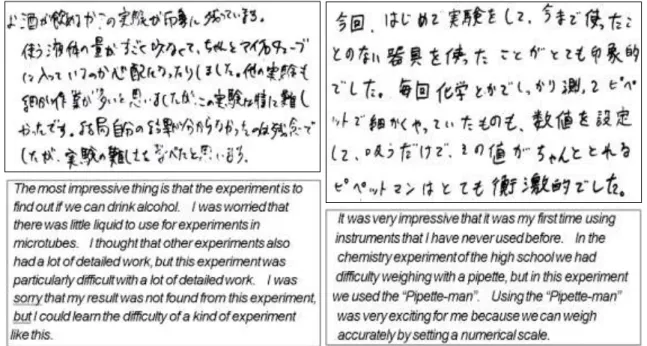
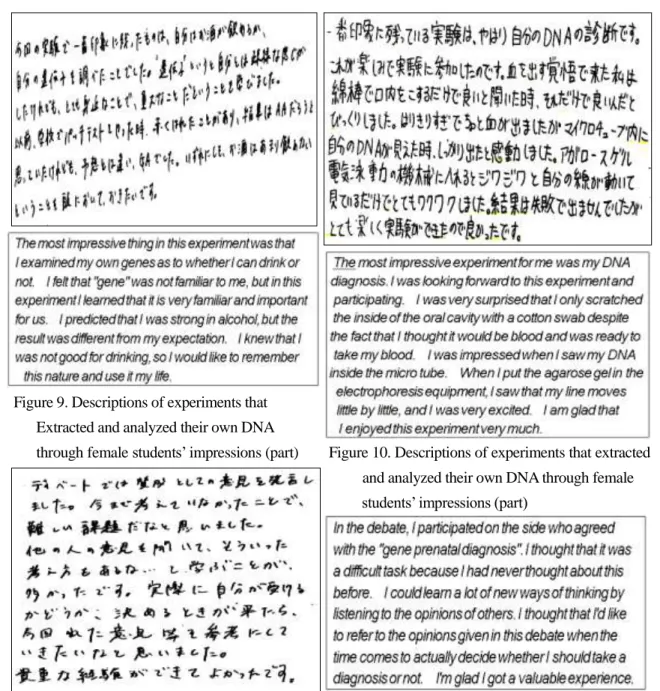
Many descriptions of gene introduction experiments presumed to be frequently described in quantitative analysis were found in the male responses (Fig. 7). A plurality of descriptions ("b" in Fig. 4) on extraction and analysis of “Own DNA” (Experiment 4), indicated by co-occurrence network analysis, were also seen (Fig. 8). Although it was not shown much in quantitative analysis, there were also several descriptions of handling of
experimental instruments (Fig. 9, 10). As shown in Adachi (2012) and Nakazawa (2008), many male students were impressed with the techniques, operations, and experiments that would be operated one after the other in a fixed time it was found that Adachi and Nakazawa’s findings were backed up. It was observed in female students that there were many impressions about what they thought and felt with these experiences (Fig. 11).
But from the Co-occurrence network analysis (Fig. 6), there were some descriptions about Experiment 3: “Observation of genetically abnormal organisms" and Experiment 4:
“Extraction and analysis of my own DNA" that were also seen (Figs. 13 and 14). In both the selective questionnaire and the quantitative analysis of the open responses in Experiment 4 it was presumed that the female students were strongly impressed and they were highly interested with that experiment, but this conjecture is different from the results of Adachi (2012) and Nakazawa (2008), where it was shown that the female students’
interest in the technical field was lower when compared with males, and there was a tendency for females not to like learning based on mechanical procedures.
However, in the qualitative analysis of the open response part, the males’ descriptions concerning Experiment 4 were more frequently relating to the experimental manipulation (Fig. 8), but the majority of the descriptions by the female students regarding Experiment 4 leaned toward an interest concerning their own genes/DNA, or they wanted to know whether their genes are strong for alcohol consumption. So the reason female students had strong positive impression relatively with Experiment 4 was inferred due to the contents of these description that were written based on the strong interest inthemselves.
Inada (2011) focused on the fact that the characteristics of female interests are stronger
Figure 7. Descriptions of experiments that Figure 8. Descriptions of the impressions from extracted and analyzed their own DNA through male students regarding the operation of the males' impressions (part) instruments (part)
Figure 9. Descriptions of experiments that Extracted and analyzed their own DNA
through female students’ impressions (part) Figure 10. Descriptions of experiments that extracted and analyzed their own DNA through female
students’ impressions (part)
Figure 11. Descriptions on debate as seen in female students' impressions (part)
than men's interest in concrete, realistic, and familiar events in other foreign studies. Then, when studying teaching practice focusing on relevance to everyday life, it shows that learning in a context where females can feel the necessity to learn is effective in Japan also.
Even though Experiment 4 was conducted continuously and mechanically, it was found thatfemale students (like males) were impressed and interested because it was a study that related to themselves and required knowledge of necessary information about themselves.
In the open response from female students, there were descriptions about debates which were not subject to survey in the selective questionnaires. From the emergence term in quantitative analysis, it was inferred that the debate topic was "prenatal diagnosis" (“d” sign in Fig. 6), but in qualitative analysis the discussion of "prenatal diagnosis of genes" was also confirmed. Despite being the topic of “genetically modified food” in 2013 and 2012
(corresponding to 20 female students), the topic was "prenatal diagnosis" only in 2013 (corresponding 22 female students). The statements about the female students' debate were only about "prenatal diagnosis" (this was seen 14 times in the descriptions of 13 female students).
For male students, the phrase "debate" was used five times; there was one use corresponding to "prenatal diagnosis", two uses of "genetically modified food", and two cases which cannot be specified either way.
However, it was found that it was not possible to compare males and females due to differences in the topics, because the number of female and male participants with differences in debate opinions between the topic of "maternal diagnosis" and "prenatal diagnosis" was too large (corresponding 10 males and 22 female students).
However, within the female students, it was seen by comparison that the tendency toward
"prenatal diagnosis" was greater than"genetically modified food”.
In addition, the reason why there was a lot of discussion about "prenatal diagnosis"
versus“genetically modified food”, in female students(FIG. 11), was that there was a high likelihood that these female students had experienced something related to this topic in their own lives as shown in Inada (2011), which also shows that there were a lot of descriptions about the Experiment 4 by female students.
5.Summary
(1) From the results of the selectivequestionnaire, although there was no genderdifference in other questions, a significant difference was seen between males and females in Question 1 asking for an impressive (great, fun) experiment. There were many responses of Experiment 2: “Experiments to incorporate genes" in male students, and in females there were many responses of Experiment 4: “My Genes Extraction and Analysis" for Question 1.
(2) From the quantitative analysis of the open response questionnaire, there were many descriptions about Experiment 2 and about Experiment 4 in male students. In both of these experiments, there were many experimental instructions that must be carried out one after another in a short period of time, and these instructions included new reagents and instruments that had never been used before by students. So it was found to be difficult for students to understand the content of the experiment.
(3) On the other hand, female students had many impressions such as what they thought and felt for the whole experiment. In addition, their impressions of Experiment 2, 3, and 4 were seen.
(4) From the qualitative analysis of the open response questionnaire, descriptions concerning the operation of the instruments were characteristically seen in male students.
(5) In female students there were impressions about the topic of "prenatal diagnosis", even though it was not an option of selective questionnaire.
(6) In addition, from female students' descriptions about Experiment 4: “Extraction and
analysis of my DNA", it was found that female students showed interest in experiments related to themselves. Many of the descriptions concerning males' impression of Experiment 4 related to the experimental operation itself.
6.Consideration
In the selective questionnaire there was only a significant difference between female and male students in Question 1, which asked what experiment the students found to be the most impressive and fun . This result suggests that there is a difference between female and male students in terms of interest in experiments, which includes all of the experiments they did related to the study of DNA.
Experiment 2, which the males found to be the most impressive, and Experiment 4, which the females found to be the most impressive, both share the fact that the experiment is performed with technical and mechanical procedures, continuously, for a short amount of time.
However the purpose of the experiment, and the samples used for the experiment, were different. Experiment 4 incorporates genes into E.coli and Experiment 2 extracts and analyzes the students’ own genes.
On the other hand, in the results from the open response questionnaire, it was shown that male students were more interested in the technical content of experimental operations and the equipment used in the experiment, etc., but females showed more interest in the whole experiment rather than a specific experiment. Moreover, it was suggested that females were interested in experiments that related to themselves and their daily lives. It was shown that females do not like learning based on technical and mechanical procedures (Adachi, 2012;
Nakazawa, 2008), but that their interests are strongly shown in experiments associated with themselves and their daily lives (Inada , 2011).
Therefore, from the viewpoint of gender, it is effective to make lesson plans with experiments that are strongly related to students' real lives in order to promote females' science learning, and to make and implement lesson plans for STEM related subjects with an “experiment based on the development of science and technology". So in this study Experiment 4: “Extraction and analysis of my own DNA " was thought to have a high effect of stimulating interest and attention of female students.
Sasakawa & Ono (2009) said that experiments of students’ own genetic analysis are effective for high school students to discover their own genes and DNA and to think about social problems related to life science.
It is thought that similar results were obtained from this study, and furthermore, it seems that the experiment that carry out the students’ own genetic analysis have the possibility of being highly effective in motivating learning, especially in females.
Moreover, an "experiment based on the development of science and technology" is more advanced than conventional biological experiments, so it is difficult to understand and consider the contents of the experiment (Ito & Otaka, 2010).
And, it was shown that guiding the students before and after the experiment was important because it was difficult to tie down the students’ knowledge with the result of the experimental operation (Takano et al., 2011).
It was inferred that it is necessary for STEM related subjects to incorporate ideas such as presenting the topics which are most relevant to students’ real lives and society.
In a study based on a research review paper by Brotman & Moore, Nakazawa (2008) showed that the relationships between science education and gender are based on research themes from four different perspectives (equity and access, curriculum and pedagogy, the nature and culture of science, and identity). Nakazawa states that these four perspectives need to be linked.
The study conducted in this paper is considered to be a practical study from the perspective of curriculum and pedagogy, from Nakazawa's four perspectives. However, since this is a case study from a single research perspective, it is unclear what causes the differences between female and male preferences, presented in the results of this study, and further research is considered necessary.
7.Future tasks
Inada (2013) said that an important role of science teachers is to increase career path options for females in science fields, and leading to effective practice by teaching methods and materials that take suit of the females' their way of thinking and direction of interest. In addition, Kono (2013) points out that collaboration between school teachers and researchers is very weak in Japan, and action research on female students who interact with science content is particularly lacking.
In this study, there were only two 1st grade participating students who didn’t choose a science or literature path of study and most other participants, accounting for the majority (97%), chose biology (and other life sciences) by the 2nd grade.
From now on, I will study the way experimental experience learning in upper high school biology classes is effected by the viewpoint of gender perspective for 1st grade students who haven’t decide their course or study yet. I will conduct action research on effective teaching practices with the purpose of helping females find interests in science, and to increase their choice of career paths in science fields.
Acknowledgments
I would like to thank Dr. T. Ushimaru of Faculty of Science Shizuoka University for his cooperation in the planning and implementation of the experiment. And thanks to Mr. R. D. Woodruff Ⅱ and Mr. T.
Warren for their help in editting.
I also thank Dr. P. M. Dass of Northern Arizona University for their valuable advice and guidance.
References
Adachi, T. (2012). Self-efficacy and the gender gap as determinants of interest in a science and technology career. The Japanese Journal of Psychology, Vol. 83, No. 5, pp. 479-488
Andoh, H., & Tsuchida, S. (2011). Development for Teaching Material on Extracting DNA and Research of the Consciousness on DNA for Junior High School Students. Journal of Hokkaido University of Education (Education) Vol.62. No.1, 187-195
Higuchi, K. (2012). Procedure and Actualization of Metric Text Analysis in Social Survey - Focusing on Free Response of Questionnaire - (Chapter 10). : Ishida, M., & Mingzhe, J. “Corpus & Text Mining”
119-128, Kyoritsu Shuppan Co., Ltd.
Inada, Y. (2011). Women’s Interest in Biological Physics. Journal of the Physics Education Society of Japan, Vol.59, No.3, 165-170
Inada, Y. (2013). A Practical Study on the Improvement of Girls’ Feelings and Attitudes Toward Science Learning : The Case of “Electric Current” in Lower Secondary Science. Journal of Research in Science Education, Vol.54, No.2, 149-159
Isaji, K., & Matsumoto, S. (2005). Development of teaching material for DNA extraction method practicable at high school. Annual report of the Faculty of Education, Gifu University, Vol.7, 69-78.
Ito, T., & Ohtaka, I,. (2010). Student Understanding of Meaning of the Experiment in the Genetic Recombination Experiment : Evidence from the Questionnaire of Students Who Joined a Summer Program at a University. Journal of Research in Science Education, Vol.51, No.1, 1-11.
Kainuma, K., Saitoh, J., Harada, K., & Kobayashi, K. (2003). The Ability of Junior and Senior High School Students to Comprehend Principles of Recombinant DNA through Laboratory Experiments.
Journal of Science Education in Japan, Vol.27, No.3, 212-222.
Kawano, G. (2013). Describing the advance to university in science and engineering from a gender perspective - present situation and issues. National Institute of Science and Technology Policy Presentation, 296, June 2013.
http://hdl.handle.net/11035/2379
Kuriyama, K., & Hirayama, N. (2016). The Component of Preference for Science Learning in Junior High School Students. Bulletin of Aichi Univ. of Education, 65 (Humanities and Social Sciences), 1-7.
Ministry of Education, Culture, Sports, Science and Technology (2015). Announcement on FY2015 School Basic Survey(confirmed values).
Nakazawa, C. (2008). Discussion of Practices and Researches in Science Education from the Gender Perspective. Japanese Journal of International Society for Gender Studies, Vol.6, 61-77.
OECD (2018). PISA 2015 Result, Volumes I-V.
http://www.oecd.org/pisa/pisa-2015-results-in-focus.pdf
Okumura, J., & Kumano, Y. (2016). Action Research on Expansion of Biological Knowledge and Changes in the Scientific and Engineering Thought Processes in High School Students in the Avian Embryonic Experiment Based on a Bio-STEM Perspective. Journal of Science Education in Japan, Vol.40, No.1, 21-29.
Okumura, J. (2018). Action Research on Advanced Science Experimant Methodology and Influence on
Students’ Sense of Fun and Motivation in Upper Secondary School Biology. Journal of Research in Science Education, Vol.59, No.1, 11-25
Sasakawa, Y., & Ono, M. (2009). Research on the Current Situation of and Teachers' Attitudes towards Human Genome Analysis Experiments in High Schools. Journal of Science Education in Japan, Vol.33, No.3, 248-260.
Tkakno, M., Oshima, T., Okuda, H., Yamanoi, T., & Takemura, M. (2011). Development of visualized teaching material for DNA replication introducing DNA fibers and its application on high school students with the support of SPP. Japanese Journal of Biological Education, Vol.51, No.3, 66-78.
Yamada, M., Yamamoto, T., & Isozaki, T. (2015). A Study on Learning Processes for Understanding Genetic Recombination and Genome Editing :Implications from “Genome Editing Using Site Specific Nucleases and its Application in Animals”. Theory and research for developing learning systems¸ Vol.2, 119-129.