Japanese‑style Doctor of Education Program : Attempts of Aichi University of Education and Shizuoka University
著者 Nishimiya Hideki, Noji Tsuneari, Ito Takahiro, Shirahata Tomohiko, Shimbo Atsushi, Kumakura Hiroyuki
journal or
publication title
教科開発学論集 = Studies in subject development
volume 4
page range 193‑199
year 2016‑03‑31
出版者 Graduate School of Education Cooperative
Doctoral Course Aichi University of Education
& Shizuoka University
URL http://hdl.handle.net/10297/9420
【 研究ノート・資料 】
Aiming at the Establishment of a New Japanese-style Doctor of Education Program:
Attempts of Aichi University of Education and Shizuoka University
Hideki Nishimiya
1, Tsuneari Noji
1, Takahiro Ito
1,
Tomohiko Shirahata
2, Atsushi Shimbo
2and Hiroyuki Kumakura
21
Faculty of Education, Aichi University of Education
2
Academic Institute College of Education, Shizuoka University
Abstract
The purposes of this study are to introduce our newly established doctoral program and to discuss what the program aims at with some issues to be improved in the future. In April 2012, Aichi University of Education and Shizuoka University cooperatively began a new doctoral program; Cooperative Doctoral Course in Subject Development (CDCSD). Students fulfilling the course requirements are expected to receive a degree of Doctor of Education, which we would like to abbreviate as “DoE” in this paper because this DoE is fundamentally different from the Ed.D. or Ph.D. administered in America.
The faculty members have been trying to establish a new type of Doctor of Education, which we believe is suitable for Japan. The main purpose of CDCSD is to foster teachers who can teach at university-level teacher training programs in Japan. In other words, we would like to foster university professors who have a wide range of academic knowledge. Thus, graduates from the program are required to have both theoretical and applied knowledge of their specialized fields, and also teach university students in undergraduate and Master level programs.
Keywords
Cooperative Doctoral Course in Subject Development, Doctor of Education (DoE), new type of doctoral program
1.INTRODUCTION
After a long-term discussion and negotiation with the MEXT (the Ministry of Education, Culture, Sports, Science and Technology), in April 2012, Aichi University of Education (AUE) and Shizuoka University (SU) were accepted to establish and jointly began a new doctoral program in the Graduate School of Education, which is called Cooperative Doctoral Course in Subject Development (CDCSD) in English. This is a nation-wide new type of doctoral program initiated at university faculty of education. Then, the purposes of this paper are to introduce this newly established doctoral program, CDCSD, and to discuss what the program aims at accomplishing with some issues to be improved in the future.
2.OUTLINE OF THE PROGRAM 2.1 Purposes of the Program
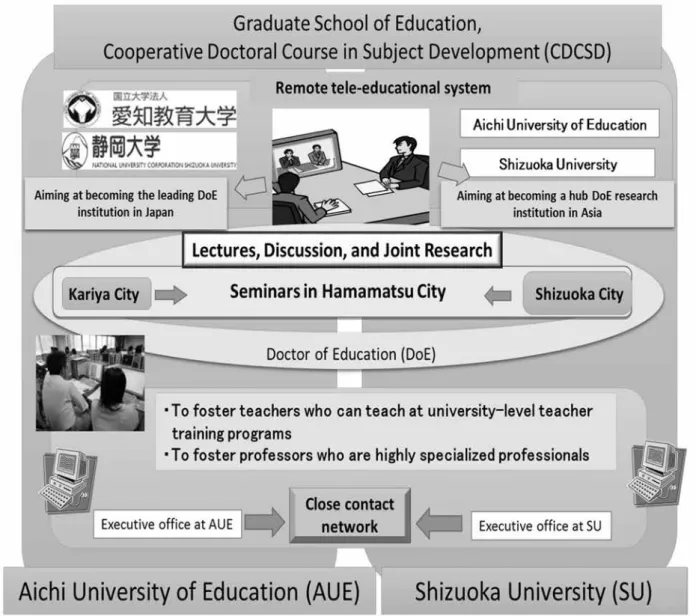
First of all, we explain the outline of our doctoral program in this section. Figure 1 shows the outline of the program. As mentioned above, this three-year- doctoral program takes a system of joint-education of the two universities: AUE and SU with equal responsibilities, cooperatively administer one doctoral program.
Our motivation of setting up this new doctor of education program is partially related to social circumstances under which education in Japan is placed. We have a lot of issues and problems that we are facing within education. In Japan teachers are required to have high qualifications and abilities in their specialty areas as well as to appropriately cope with children’s psychological aspects such as, for example,
bullying and truancy. It is a pressing need for us to foster teacher’s teachers. That is, university professors who can suitably teach college students wishing to be teachers at elementary and secondary schools.
Thus, the objectives of establishing this doctorate program is to foster teachers who can teach at university-level teacher training courses in Japan. That is, we would like to foster professors (or instructors) who are highly specialized professionals. This means that graduates from the program are expected to have both theoretical and applied knowledge of their specialized fields, and are also expected to teach university students in undergraduate and Master level teacher training courses. We would also like CDCSD to become a leading institution of DoE not only in Japan but also in Asia. These are our main reasons why we established CDCSD.
2.2 Learning Style
Since there is about 160km distance between the two universities, we make use of a remote learning system. Therefore, students in the lecture room at SU, for example, can take lectures offered at AUE without physically going there. Students and teachers at both universities can communicate through this remote educational system. We also can hold faculty meetings by using this remote tele-communication system.
2.3 Credits
Let us discuss our academic calendar. We can see it in Figure 2 and Table 1. In Table 1, “*” means
“obligatory subject”, and “#5” indicates that we have one main advisor and at least four sub-advisors for the dissertation. Also “No.” indicates the number of the professors who takes charge of the lectures.
Graduate students enrolled in the program are
Figure 1. Cooperative Doctoral Course in Subject Development (CDCSD)
expected to complete course work (20 credits) and a dissertation to receive their doctorate. The students will receive a “Doctor of Education” degree (literally translated from Japanese into English). This Doctor of Education, however, is qualitatively different from that of an Ed.D. received in America. It is also different from a Ph.D. We are aiming at formulating a new type of Doctor of Education suitable for the Japanese society and Japanese educational environment. Our course name is “Subject Development.” Thus, in terms of the abbreviation of our doctorate, the authors have decided to use DoE, not Ed.D. or Ph.D.
2.4 The necessity of “Subject Development”
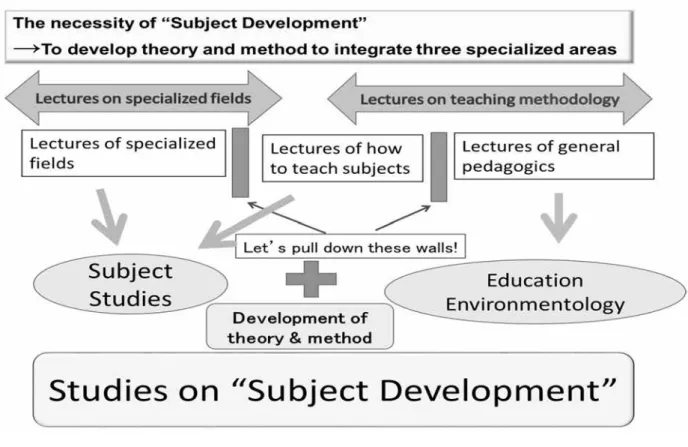
In order to establish a new type of doctoral program whose aim is to foster teachers who can teach teacher- training courses in universities, the aims of our program must have a unique identity differing from those of other faculties such as department of science and department of literature as well as different from existing Ed.D. and Ph.D. programs. That is one of the reasons why we decided to call our doctoral program
“Subject Development.” See Figure 2 and Figure 3.
In Japan, there are three areas to learn when college students receive a school teacher license. They are the followings:
(1) a.lectures of specialized fields b.lectures of how to teach subjects c.lectures of general pedagogics
All of them are important academic areas to learn before becoming a teacher. However, it seems that these three lecture areas have not necessarily been taught systematically at university. There might be several reasons for this, but we think that one of the reasons is that some professors have only taught narrow areas of what they are interested in and ignore the mission of department of education, which is “to foster teachers with balanced knowledge of the three learning areas and apply them for teaching at school.”
Moreover, some students at departments of education do not evenly study the three areas but unevenly study only one area. They sometimes study only one specific research area in which they are interested.
This student’s attitude may be all right for students studying at department of literature or department of science, but not good for students at department of
education. See Figure 4.
We have to remove these barriers lying between the three fields. It is a matter of course that doctoral students must focus on the narrow topic of their specialized field when they write their dissertations.
But at the same time, they need to acquire a wide range of knowledge covering a whole field of education, in particular, professors at university fostering future teachers.
Thus, we figured out some way not to narrow down doctoral students’ knowledge as well as professors’
attitudes toward our program. That is, we developed a system of unique coursework. We classified the coursework into three sub-sections. Look at Figure 2 and Table 1 again. They are the followings:
(2) a.Coursework A: Basics
b.Coursework B: Research specifics c.Coursework C: Application d.Dissertation
Students are required to take some classes which are not directly related to their dissertation topics, but we believe are related to the study of “Subject Development.” We also believe that the classes we devised are important for the understanding of “Subject Development,” and also believe that by studying these subjects, students can acquire a wide range of knowledge necessary for teaching at teacher training courses in the future.
We also use a sort of “team teaching” style as a teaching method for some lectures. For example, in Coursework A: Basics, we serve a lecture, Principles of Subject Development, which is one of the obligatory lectures. We taught the lecture with eight professors in 2015, and six professors taught Implementation of Subject Development as well, as shown in Table 1. Since both of them are obligatory classes, every student must take them and they are expected to meet and talk with a variety of professors and students with different academic backgrounds in the classes.
We provide another unique coursework, which is Coursework C: Application. It includes Subject Development Seminar I for the 1st year students, Subject Development Seminar II for the 2nd year students, and Subject Development Seminar III for the 3rd year students. These are classes which all the professors and students assemble together in the
Figure 2. Academic Calendar and Coursework of CDCSD
Table 1. Coursework and credits required
Figure 3. Why we established Subject Development
Figure 4. Barriers of the three lecture areas
same presentation room in Hamamatsu City and listen to and discuss students’ oral presentations for their dissertation.
There is another attempt. The professors in CDCSD work together when students complete their dissertations. Other than a chief advisor, as a sub- advisor, we usually have over three professors for one student. Although sometimes academic fields of the sub-advisors are not always related to a student’s academic field directly, we do believe that it is worthy of listening to and getting some useful comments from these professors.
These are what we are doing to establish a doctoral program with a new concept in the field of education in Japan.
2.5 Ed.D. in Japan
In Japan, we have several universities which serve doctoral programs at graduate school of education.
Graduate students belonging to these programs, with some exceptions, are supposed to receive a Ph.D.
degree, not an Ed.D. degree. This is likely influenced from the American academic degree standard. There, an Ed.D. is regarded as one grade lower than a Ph.D.:
Ed.D. is not an academic degree. Therefore, professors at faculties of education in Japan have long avoided giving their graduate students a certificate named Ed.D. It seems that this is one of the reasons why an Ed.D. degree is not well known and its content has not been well understood in Japan.
Although our CDCSD doctoral program gives students Doctor of Education, as we mentioned earlier, the content and aims are quite different from those in America (see Table 2). We are trying to make a new type of Doctor of Education which is qualitatively different not only from an Ed.D. but also from a Ph.D.
in America.
In Table 2, we present the differences of the three doctoral degrees. We can see the differences among the three degrees from the points of both educational policy and purposes of the programs. The aim of our DoE program is to integrate theory and practice. We would like to adopt good points of both Ed.D. and Ph.D.
programs. In terms of theory, we have our doctoral students with profound academic knowledge of their fields, teaching specialized subjects, and educational practices. In the practical domain, we hope that students acquire an ability to teach subjects, manage classrooms, and provide guidance to students, to name a few.
These are our hopes for the doctoral students. That is why we expect that our students should be highly specialized professionals, and they should have practical teaching abilities.
3.ACHIEVEMENTS AND ONGOING TASKS
Three and a half years have passed since we established CDCSD in 2012. This year, in March 2015, two graduate students received a doctorate. They are the first students that received doctor’s degree at our program. We are very proud of this result and do hope that more and more students get a DoE from this time on.Now, Let us discuss some issues we are facing now.
First of all, among the faculty members involving CDCSD, they have not come to a whole agreement of what the new academic field “Subject Development” is.
In particular, the differences between the conventional Ph.D. and Ed.D. programs and our new-type of Doctor of Education programs still need to be discussed in order to establish a leading program.
The second issue is that we should emphasize the originality of the program and the well-designed course requirements. From now on, we have some things to
Table 2. Comparison of the three doctorate degrees
reform. Therefore, we will raise three major things to be reformed as soon as possible:
(a) We need to initiate a multiple academic advisor system for doctoral students.
(b) We need to establish joint research projects among professors between the universities.
(c) We need to determine suitable subject matter for the DoE dissertation.
4.SUMMARY
Let us briefly summarize the crucial points in this paper. One, we have demonstrated a new-type of doctorate program (DoE) offered at Aichi University of Education and Shizuoka University. Two, this doctoral program should be completely different from those of traditional degrees. And three, we are trying to aim at integrating three academic fields together. They include lectures of specialized fields, lectures of how to teach subjects, and lectures of general pedagogics.
We hope that our trial to establish a new type of Doctor of Education Program will act as a stimulus to think over a degree and a program of doctor of education in Japan.
Note:
This is a revised paper the authors presented at The 10th East Asia International Symposium on Teacher Education held in Nagoya, Japan on October 31st, 2015.
REFERENCES
Shirahata, T. & Shimbo, A. (2013). Developing faculty who can instruct teacher-training courses: The establishment of a new Japanese-style Ed.D.
Program. Presented at Indonesia University of Education, Dec. 24, 2013. Bandung, Indonesia.
Shirahata, T.,Nishimiya, H., Shimbo, A. & Noji, T.
(2014). Looking back two and a half years after the establishment of a new doctoral program, Cooperative Doctoral Course in Subject Development, for consideration of its future direction. Presented at the Annual Meeting of 2014 Japan Association of Universities of Education (JAUE). Sendai Kokusai Center, October, 18. (presented in Japanese)
Shirahata, T., Shimbo, A. & Kitayama, A. (2015).
Consideration of the Future Direction of Cooperative Doctoral Course in Subject Development: Based on Investigation into the Actual States of Doctor of Education (Ed.D.) Programs in the USA and Japan.]
Studies in Subject Development, Vol.3, 181-188.
(written in Japanese)
Shirahata, T. (2015). Comments on the way in which teaching of subject should be taught: from the perspective of Cooperative Doctoral Course in Subject Development. The Bulletin of Japanese Curriculum Research and Development, vol.37, No.4, 93-98. (written in Japanese)
Shimbo, A., Takane, S., Nagakura, M. & Shirahata, T.
(2015). Some features of Doctor of Education in the US for the comparison with Cooperative Doctoral Course in Subject Development. Presented at the Annual Meeting of 2015 Japan Association of Universities of Education (JAUE). Ohmiya Sonic City, October, 10. (presented in Japanese)
【Hideki Nishimiya