Designing and Supporting Significant Study Abroad Experiences
著者(英) Brent Allen Jones, Brian Leacock journal or
publication title
Hirao School of Management review
volume 9
page range 1‑21
year 2019‑03‑31
URL http://doi.org/10.14990/00003228
Hirao School of Management Review 第9巻
Designing and Supporting Significant Study Abroad Experiences
Brent A. Jones
Hirao School of Management, Konan University Brian Leacock
Gustavson School of Business, University of Victoria
【Abstract】
In this paper, we outline current support systems and implementation strategies for helping students make the most of study abroad experiences in terms of developing intercultural competencies and marketable skills that will help them gain employment and succeed in the workplace. Key concepts are discussed within a wider framework that is being proposed for improving the overall trajectory of the study abroad experience.
Additionally, we outline programs in two countries, which apply these design principles, and briefly discuss measurement protocols.
【Keywords】
Intercultural Competencies, Intercultural Sensitivity, Study Abroad, Reflective Practice
1. Introduction
Increased internationalization in economic, social and political spheres has resulted in greater interpersonal cross-cultural contact. Many leading edge business schools, keenly attuned to the importance of intercultural awareness, strive to internationalize their learning environments and ultimately develop learners’ ability to operate within culturally complex situations. This internationalization takes many forms, but one instrumental mechanism is the development of student mobility programs (i.e.
short or long-term study abroad) to ensure international exposure. In line with these trends, the Gustavson School of Business (GSB) at the University of Victoria has developed an undergraduate exchange program in which approximately 85% of business students study abroad for one term in the fourth year of their commerce degree. Similarly, the Hirao School of Management (HSM) at Konan University in Japan dispatches business students to multiple locations around the world to secure direct overseas experience. Both programs recognize and value the development of intercultural competencies.
To increase the intensity of cross-cultural exposure and truly enhance the student’s intercultural effectiveness, GSB and HSM are exploring innovative study abroad platforms by: (1) reconsidering reflective practice within international mobility endeavors; (2) considering metrics to measure intercultural competencies (to determine the effectiveness of pedagogical approaches); and (3) enhancing (incrementally and systematically) a learning platform that bridges culture and language as part of the full international experience from pre-departure to post-return.
Organizing study abroad experiences for university students continues to be a major focus at both the institutional and department level globalization efforts in Japan, North America and other parts of the world. However, just sending students abroad is now recognized as not enough to ensure development of intercultural competencies (Vande Berg, 2009). In this paper, we introduce a potentially powerful means of improving the effectiveness of study abroad programs and a model for inter-institutional collaboration. We begin by outlining key concepts that have contributed to our understanding of study abroad and intercultural competencies (See, for example, Deardorff, 2009). We then introduce efforts at our institutions and how reflection has been designed into these programs. We conclude with discussion of efforts/challenges regarding measurement of intercultural competencies. We also discuss how this inter- institutional collaboration has informed our pedagogical and administrative efforts for study abroad.
2. Key Concepts
In this section, we outline key conceptual frameworks that continue to inform our work in preparing learners for overseas studies. We begin with two models that are especially relevant, the Developmental Model of Intercultural Sensitivity (DMIS) developed by Milton Bennett (1993), and Cultural Intelligence (CQ) proposed by Earley
and Ang (2003). We then look at reflective practice and reflective journaling as they inform our reflective learning by design (RLD) platform (discussed below).
2.1 Developmental Model of Intercultural Sensitivity (DMIS)
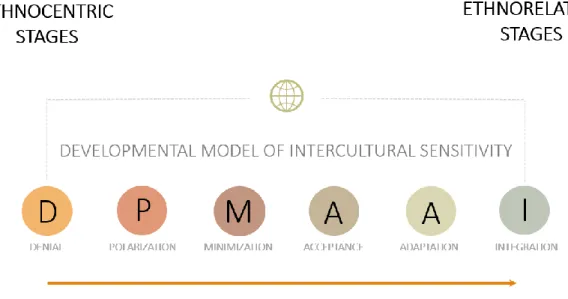
In regard to study abroad, we need to ask ourselves how we can structure programs so that our students have the opportunity to develop intercultural sensitivity. But how do we know if students are gaining greater intercultural skill? How do we support development in such a way as to shift the student’s perspective from ethnocentric (viewing the world from a single cultural lens) to an ethnorelative perspective (viewing societal interactions from multiple cultural perspectives)? By considering the multiple stages of development as proposed by the DMIS (Fig. 1) we can design and develop reflective learning modules or coaching sessions based specifically on the stage of development of the individual student.
Fig. 1. DMIS as proposed by Bennett, 1993.
Milton Bennett developed the DMIS as a conceptual framework to understand people’s response to cultural difference and commonality. Based in cognitive psychology and constructivism, the model has six stages of development, with each consecutive stage to the right demonstrating a higher degree of sensitivity to cultural difference. The model is predictive in that one’s stage of development predicts anticipated responses (attitudes and behaviors) to cultural difference.
The first three stages of the model are anchored in an ethnocentric viewpoint, where the individual tends to understand cultural difference from a single cultural perspective. The last three stages (on the right-hand side of the model) indicate a degree of ethno-relativism, or a capacity to understand cultural difference from a multicultural perspective. By using this underpinning framework, it is possible to construct reflective learning strategies to aid students on study abroad programs to move along the continuum
in a guided and meaningful manner. Since each stage of development requires a different form of learning, the approach is best implemented as one-on-one teaching, training or coaching sessions.
As students move along the stages of development on the DMIS, their view of the world tends to shift towards increasingly complex and nuanced understandings. From an ethnocentric perspective (left hand side of the model), students may reside in denial, polarization, or minimization. From an ethnorelative perspective (right hand side of the model), students may reside in acceptance, adaptability, or even integration stages.
In the denial stage of development, the student is not aware of cultural differences due to limited exposure or isolation from different cultural milieus. Often the individual is raised in a homogeneous cultural group. Individuals at this stage tend to ignore the reality of diversity and are often characterized by well-meant but stereotypical and superficial statements of tolerance. Also at this stage, an individual’s understanding of difference is minimal at best. Bennett suggests that people in denial tend to have limited pieces of stereotypical knowledge about a given country or culture. Coaching to move the students from the denial stage to the next involves helping them to develop better skills of categorical discriminations and reflection to enhance thinking related to cultural difference.
In polarization the student becomes aware of cultural difference but tends to conceptually understand this difference in a positive or negative framing. In fact, the polarization stage is often characterized by recognition of cultural differences coupled with negative evaluations of those whose culture is different from one’s own. Three areas of defense are typically found: denigration or derogation, superiority, and sometimes reversal (Bennett, 1993). Denigration or derogation refers to belittling or actively discriminating against another person from a different cultural group. Superiority assumes extreme ethnocentrism to the point where one looks down on another group, where as reversal refers to evaluating one’s own culture as inferior to another.
In minimization the student moves beyond judging cultural difference and tends to interact with others by identifying them as individuals. They may still recognize and accept superficial cultural differences such as eating customs, greetings and so forth, yet they tend to feel that all humans are essentially the same – in a sense adapting universalism. It is difficult to shift students from this stage because they essentially self- judge and feel that they are acting in a culturally appropriate manner. Coaching to shift the students to an ethnorelative perspective is important as they may ignore the influence of culture and tend to feel that everyone has the same cognitive approaches for classifying the external context.
A shift to ethnorelative stages represents a significant change in the student’s worldview. In fact, students in the ethnorelative stages tend to seek ways to adapt to cultural difference. They have a deeper understanding that others may have different culturally based behaviors and values. The first stage of ethnorelative understanding is where the student shifts to acceptance, a stage best described as learning based on a
recognition of difference. At this stage the individual is open to and appreciates the importance of learning about other cultural norms. It is important to note that acceptance does not imply that students need to be in agreement or attempt to adopt the cultural differences they identify. It is considered appropriate that cultural difference exists and that one may have different preferences from others. At this stage of development there is minimal adaptation of one’s behavior to cultural difference.
In adaptation the student is able to adapt naturally to different cultural contexts.
They see cultural categories as more flexible and thus become more competent in their capacity to communicate and/or navigate across cultural lines. At this stage of development, the student is adept at using empathy to connect with others from a different cultural context and they are able to shift the frame of reference so as to understand alternative conceptualizations of the world. Coaching students at this stage involves ensuring direct interaction with cultural difference, facilitating multicultural group discussions, emotional intelligence training to hone empathy, and finally reflective practice for sense making.
The last stage of the DMIS is integration, which is not normally achieved via coaching/training, but is the result of an individual simultaneously having two (or more) cultural profiles at the same time. This stage reflects individuals who have multiple frames of reference and have the capacity to identify with and move freely across two or more cultural identities. An example of this might be a child who has parents of two different cultural heritages or when a child grows up in a different cultural context (e.g.
second generation immigrants in Canada).
It is important to recognize that intercultural development and movement along the different stages of the DMIS is neither a simple nor easy process but takes time, exposure, guidance, coaching, and reflective learning. Without these elements of education, the student may not advance their intercultural competencies and in fact may become locked into an earlier stage of development.
2.2 Cultural Intelligence (CQ)
The Cultural Intelligence (CQ) framework provides a way of assessing and improving effectiveness for interacting and navigating culturally diverse situations. The model is rooted in rigorous, academic research and can be used as a coaching method for developing intercultural competencies for students studying abroad. Christopher Earley and Soon Ang introduced the concept of cultural intelligence (CQ) in 2003 and defined it as an individual’s ability to adapt successfully to a new cultural setting. They posited that CQ is related to emotional intelligence (EQ) but extends beyond one’s own cultural group. People with high EQ can assess the emotions, wants, and needs of others (as well as their own internal emotional state), whereas individuals with high CQ are attuned to the emotions, values, beliefs, attitudes, and languages of people from different cultures.
In a sense, they have the knowledge to interact with empathy and understanding across cultural lines.
In this model, high CQ does not indicate that the student is an expert in every culture but rather they have the capacity to use observation, empathy, and intelligence to
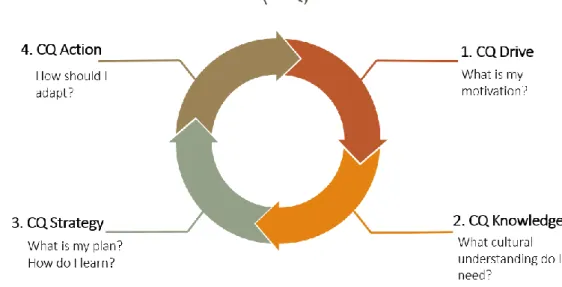
‘read’ people from different cultural contexts. The student also understands the contextual codes to enhance their effectiveness and interactions with others. There are four stages of development in the CQ framework (Fig. 2): CQ Drive (being motivated to learn about a new cultural context), CQ Knowledge (learning process to understand different cultural contexts including their values), CQ Strategy (planning for cultural engagement), and CQ Action (adapting proactively to cultural difference and commonality). As there are multiple sub-composite scales (see, for example, Livermore, 2015), it is possible to coach the study abroad student specific to their identified weaknesses.
Fig. 2. CQ Framework as proposed by Earley and Ang, 2003.
CQ Drive (motivation) is best described as the student’s interest and comfort level with engaging in culturally diverse settings. Key sub-composite components include intrinsic motivation (securing personal enjoyment/satisfaction), extrinsic motivation (gaining external benefits from cultural engagement), and self-efficacy (having the belief in one’s capacity to be successful in cross-cultural interactions). Generally speaking, CQ Drive often gets overlooked as the students participating in overseas programs most likely have a higher degree of motivation and comfort with cultural diversity. But as educators seeking to have meaningful impact with all students we should consider those who are not participating in overseas programs. Is there a way to support these students in the development of intercultural competencies? How can we energize and motivate these students to embrace multicultural contexts so that they can learn to adapt to new and diverse settings?
CQ Knowledge (cognition) is the student’s knowledge about cultural similarities and differences. Most pre-departure orientations tend of focus on this aspect, as it is the
easiest component to train to. The goal with CQ Knowledge is not to become an expert in every culture, as this simply is not possible, but to focus on core cultural differences and to understand how the cultural context influences people’s thinking and behavior.
Cultural knowledge may include general information (business norms, socio-linguistic features, and societal values) but it is recommended to use a well-established (anchored in research) framework such as the GLOBE model (Appendix 1). This will enable the students to have a rich, well-structured understanding of culture that can be used as they transition from one cultural context to another.
CQ Strategy (meta-cognition) is how the student thinks about culturally diverse experiences. This dimension of the framework is the hardest to coach as it requires the student to understand how they make judgments about their own thought processes, as well as those of individuals from culturally different groups. With this meta-cognitive skill, students will have an increased capacity to cross-check and plan accordingly for cross-cultural interactions to enhance effectiveness. Within this stage, reflective learning becomes a key component of coaching to support the student in adjusting their mental maps as they encounter cultural diversity.
CQ Action (behavior) is the student’s capability to adapt their behavior appropriately to different cultural contexts. It requires the student to have a flexible repertoire of responses to cultural variance, all while remaining authentic. Behavioral adaptation may include modifying communication approaches (such as direct/indirect style and adjusting for high/low cultural contexts) and other behavioral dimensions.
Again, the GLOBE research is powerful in providing students with a nine-dimension framework for understanding cultural difference.
The four components of Drive, Knowledge, Strategy, and Action combine to constitute the student’s overall cultural intelligence quotient. By coupling reflective learning with coaching, a student can maximize the effectiveness of the learning of cultural competency skills.
2.3 Reflection in the Learning Process
We understand reflection and reflective practice as being central to the learning/developmental process for all stakeholders in study abroad endeavors. For learners, educators and administrators, this reflection is crucial to improve the structures, platforms and processes that promote meaningful, lasting change (i.e. learning).
Reflection is also a key component of learning cycles described by several authors (Dewey, 1933; Kolb, 1984; Rodgers, 2006). Dewey (1933), for example, defined reflection as the “active, persistent and careful consideration of any belief or supposed form of knowledge in the light of the grounds that support it and the further conclusions to which it tends.” Carol Rodgers (2002) distilled from writings by Dewey four criteria she feels characterize his concept of reflection and the purposes it serves.
1. Reflection is a meaning-making process that moves a learner from one
experience into the next with deeper understanding of its relationships with and connections to other experiences and ideas. It is the thread that makes continuity of learning possible, and ensures the progress of the individual and, ultimately, society. It is a means to essentially moral ends.
2. Reflection is a systematic, rigorous, disciplined way of thinking, with its roots in scientific inquiry.
3. Reflection needs to happen in community, in interaction with others.
4. Reflection requires attitudes that value the personal and intellectual growth of oneself and of others.
Karen Osterman and Robert Kottkamp (1993) define reflective practice as “a means by which practitioners can develop a greater level of self-awareness about the nature and impact of their performance, an awareness that creates opportunities for professional growth and development.” Rodgers (2002) views the function of reflection being meaning making, or the formulation of “the ‘relationships and continuities’ among the elements of an experience, between that experience and other experiences, between that experience and the knowledge that one carries, and between that knowledge and the knowledge produced by thinkers other than oneself.” (pg. 848)
Kolb (1984) also recognized the value of peer or group reflection, “to learn from their experience, teams must create a conversational space where members can reflect on and talk about their experience together.” Research shows that learning is most effective under certain criteria: it is experiential (often problematic), it can personally engage the person who is in the position of learning, and the desire to learn is tied in with a need to learn. Learners who find themselves actively engaged in a collaborative effort with their educator and peers will have a more effective and authentic experience. Experiential learning (Kolb, 1984) is a combination of four stages that work together in a cycle, those four stages being: concrete experience, observation and reflection, abstract reconceptualization, and experimentation (Kolb, 1984).
2.4 Reflective Journaling
Reflective journaling has become a popular approach to promoting reflection for teachers and learners (Marsh, 1998), and for learning in a broad range of disciplines (Fenwick & Parsons, 2000; Stevens & Cooper, 2009). Francis (1995), for example, describes journaling for pre-service teachers as a means for reflecting on teaching plans, professional development, events which influence personal views of teaching, and as a critical summary of professional reading. In addition to learning how to write and preparing for assignments or examinations, there is evidence that reflection can develop
students’ critical thinking skills and metacognition (Northern Illinois University, n.d.).
Bean (1996) cautions though that reflective journals or learning logs should fit the teacher’s teaching style and fit with course learning goals and objectives.
3. Current Study Abroad Initiatives 3.1 GSB: Reflective Learning by Design
Reflective Learning by Design (RLD) is a supplementary enhancement program for outbound exchange students from GSB. RLD is designed in such a way that allows students to collaborate with faculty to delve deeper into concepts pertaining to intercultural development and cultural dexterity. Students begin the program prior to their semester abroad with a group session developing their intercultural awareness, with the option of furthering this process through an individual session. While on exchange, students apply the cultural practices of RLD through additional ‘mini-projects’ to more fully enrich the experience that they are obtaining abroad. Upon return, RLD students meet a carefully constructed list of objectives put in place by the GSB, inclusive of orienting or mentoring future students who have been selected to participate in the program in their upcoming year.
The purpose of the RLD program is to further develop students’ cultural competencies through reflective learning processes. Throughout the program and upon completion, students receive:
Individualized intercultural coaching using the Intercultural Development Inventory (IDI)
A personalized cultural dexterity session using the Cultural Intelligence (CQ) framework
Opportunities to meet and network with international business leaders
Personal letters of recommendation, tailored to any employer
LinkedIn recommendations that cater to the student’s intercultural competencies
Certificate of completion of the program
3.1.1 Timeline at a Glance
The timeline for RLD is designed to expand and enrich learning opportunities by spreading the learning window over approximately two years. For reference, students in GSB begin their core business classes in the fall of year three of their studies.
September (year 3) - Promotional activities to introduce outbound exchange opportunities
September to December (year 3) - Series of activities to establish expectations
Late March (year 3) - Application for the RLD program opens
Early April (year 3) - Introductory luncheon to discuss the program in detail
Early April to beginning of August - Intercultural coaching sessions with International Exchange Advisor
September to December (year 4) - a range of mini projects
Early November (year 4) - Cultural Intelligence (CQ) assessment and coaching
Early January (year 4) - Luncheon with International Business faculty
3.1.2 Pre-Departure
Establishing Expectations - There are a series of activities that occur prior to the actual exchange term in year four of the student’s degree program. Each of the activities has a specific purpose but overall has the impact of prompting outbound students to clarify their expectations for the exchange term. The process starts early in the academic year (September) with a series of promotional events to introduce the overseas exchange program. Promotion is multifaceted but since many students select the GSB due to its robust exchange program the school normally secures participation rates that exceed 85%
of the student body. Within the Canadian context, this rate of participation is exceptionally high as the national average for business schools is just 6% and for university exchange participation is slightly less than 3% (CBIE, 2016).
One of the initial projects that helps with the establishing of expectations is the Why Me Why Exchange project which is part of the application process. For this project students consider multiple dimensions of why they want to study overseas. The second significant event is the International Exchange Forum in November where incoming exchange students attend a forum and share information with our students who are considering outbound exchange. This direct sharing of information helps to ensure that outbound students have realistic expectations regarding their academic experience overseas.
Intercultural Competency Coaching - To maximize the opportunity for reflective learning, students selected to go on exchange have an opportunity to complete the Intercultural Development Inventory (IDI) and sign up for a one-on-one coaching sessions with a member of the International Programs Office. Coaching sessions explore the concept of cultural competencies using the DMIS model (Bennett, 2009). The personal nature of the coaching sessions ensure that students receive feedback specific to their own stage of development.
3.1.3 Fieldwork - Study Abroad
The fieldwork components for the RLD project were conceptualized around three questions. First, how do we increase student awareness of themselves as cultural beings?
Second, how can we enhance their awareness of others in their own cultural context? And finally, how do we develop their capacity to bridge the cultural differences between the self and the other? With these questions in mind we referenced the four components of Kolb’s learning model to design several activities. The design principles included: (1) building on prior coursework/experience; (2) linking to future coursework/activity; (3) incorporating the framing of behaviors, attitudes, values; (4) ensuring a suitable suite of activities; (5) achieving reflective staying power; and finally (6) developing activities that are interesting, fun, and not too time-consuming.
The first in-country activity is the reflective photo essay in which the students are simply asked to look at their current photos or to take a photo that captures a special moment while on exchange. The students are told that the moment might be a certain city view, meeting someone from the host country, or trying a new food item, and then asked to state in approximately 50 words how the image has impacted their life, mindset, or outlook on the world. The results are phenomenally beautiful and reflective. For the second in-country activity we ask the students to contribute to our Gustavson School of Business’s sustainability blog. Since GSB’s largest contribution to greenhouse gas emissions is travel associated with international exchange we deem this an important focus point, as sustainable business practices are part of our core values. (We have a faculty group dedicated to sustainability research.) The stated goal of the blog is to try collectively as a student body to counterbalance our emissions from exchange by creating meaningful, thought-provoking and intriguing dialogue supplemented with photographs, videos, social media, and web-based materials that highlight sustainability initiatives around the world. For the third in-country activity the students are encouraged to consider the development of cross-cultural competencies as one of the critical outcomes from an exchange term abroad. Students are simply asked to reflect on the skills that they are developing and translate their overseas experiences into employability skills (competency based statements) that they would articulate to a potential employer. These three core activities constituted the in-country activities, which link to the follow-up engagement once they return to Canada.
3.1.4 Follow-up
To maximize the learning potential, we have constructed a two-step follow-up (post-exchange term) as part of the RLD program. The first stage is the creation of an opportunity for the students to reflect on their exchange and then communicate their experience to future students. This, of course, achieves a secondary aim of supporting the establishment of expectations for the next group (following year) of outbound exchange students. The second stage of follow-up is designed to assist the students in networking and discovering the value of the learning that occurred while on exchange.
All returning students are asked to prepare a reflective essay and report on their time aboard. This report is then uploaded to our course management platform for future student access. In addition to the written submission, students are provided with multiple
opportunities (that they can opt into) for them to network with business professors, student colleagues, and the community so that they can share their experiences. In addition to the face-to-face opportunities, students often embrace digital platforms to share their stories with colleagues and the wider world.
3.2 HSM: Philippines Study Tour
In this section, we outline a short-term study abroad experience in the Philippines that has been developed for interested students at the HSM, with emphasis on how reflective journaling and debriefing sessions have been adopted to deepen the impact of study abroad and more fully develop intercultural competence. HSM began developing the Philippines Study Tour (PST) in 2009 as a two-credit fieldwork project, with the requirement of twenty or more hours of pre-departure preparation, forty or more hours of fieldwork, and twenty or more hours of follow-up (discussed further below). The program was designed around various learning objectives, including (1) gaining an understanding of conditions for indigenous youth and former street children; (2) creating and evaluating lessons for these children related to culture, arts, language and science; (3) analyzing economic and social conditions in cities and the countryside; and (4) interacting with students at various colleges and universities for cultural and academic exchange activities.
Learning outcomes target knowledge and skills emphasized at HSM, namely conceptual and procedural knowledge related to management, economics and liberal arts.
From the beginning, we chose to focus on economic and social conditions in the Philippines, with an emphasis on management of NGOs and NPOs working with indigenous youth and former street children. Our main collaborator in the Philippines has been BUKID Foundation (http://www.geocities.jp/bukidfound/), which is mainly involved in education projects working with indigenous Mangyan children on the island of Mindoro and also runs hygiene and livelihood projects for these communities. We have also been hosted each year by the House of Refuge (http://www.houseofrefugeph.org/) and Virlanie Foundation (http://www.virlanie.org/), which are facilities working with abandoned, orphaned or neglected children in Metro Manila. In the following sections, we describe each phase of the project. The frameworks for developing these activities were the Integrated Course Design model (Appendix 2), proposed by L. Dee Fink (2009) and the Service Learning model (Appendix 3) described in Kaye (2010).
3.2.1 Pre-Departure
Twenty contact hours with the organizing faculty member are scheduled in early February just prior to our visit to the Philippines. Typically, these twenty hours are spread out over five or six days, and involve four main pursuits: (1) gathering information about the Philippines and our various host entities and institutions; (2) compiling this and other key information into a Pre-Departure Manual; (3) preparing activities for indigenous children and/or former street children; and (4) preparing and practicing two presentations
for our hosts in the Philippines. The first presentation is a slideshow that introduces Japan, the region of Japan where our university is located, the city where our campus is located, Konan University and the HSM. The second is a cultural presentation that normally consists of Japanese songs and dances.
Interspersed among the above pursuits are short mini lectures by the CUBE faculty member on topics such as Filipino history, politics, society and culture, as well as intercultural communication. Participants also decide on a driving question related to their studies and/or personal interests. This individual research project requires preparatory background reading during the pre-departure phase, gathering of data during the fieldwork portion, and writing up findings for their final report. Included in all of the above endeavors is the drawing out and clarifying of learner expectations and assumptions, both of which are then addressed during the fieldwork via reflective journaling and debriefing sessions.
3.2.2 Fieldwork - Study Abroad
We normally schedule our eight to ten-day visit to the Philippines in mid to late February or early March. The fieldwork part of the project is organized jointly by the HSM faculty member and faculty/staff at our main host institution, Pasig City University (PLP). A formal welcome event and orientation are normally held on the first day at PLP.
We then spend three to five days in the Mangyan village of Banilad on the island of Mindoro and/or at various shelters for former street children such as House of Refuge and Virlanie in and around Manila. Throughout the fieldwork phase, students are required to reflect on their experiences in a reflection journal and to meet with the instructor to discuss their progress, problems and other relevant matters. Students are required to write three B-5 pages in their journal per day (with 2 pages of Japanese and 1 page of English), with the only guidance being to go beyond description and to include some level of analysis and connecting their experiences to current or past studies. During the meetings with the instructor, guidance focuses on delving deeper into each experience and identifying gaps in their own knowledge, as well as challenging their assumptions and stereotypes. The framework for these meetings was adapted from the descriptive feedback sessions discussed in Rodgers (2006).
In addition to conducting lessons and spending time with the children, HSM students normally interview house parents and administrators at the three core host organizations and other NGOs/NPOs we visit. These semi-structured interviews focus on finding out about routines, support structures and challenges. Other activities in the Philippines include company visits and structured trips to local open-air markets as well as mega shopping centers. Again, the aim of these activities is to gain insight into social and economic issues in the host country.
Throughout the fieldwork portion of the program, we are accompanied by students and faculty from our main host university and/or the growing list of local partner institutions (e.g. San Beda University, De La Salle University, University of the
Philippines). These interactions can range from informal chat sessions to highly structured learning activities. A few recent examples include:
Health and hygiene workshops conducted with local nursing students for indigenous families or former street children;
Business competition involving teams composed of both HSM and host institution students;
Amazing Race aimed at learning about local history and culture, again with teams composed of students from HSM and the host institution.
3.2.3 Follow-up
After returning to Japan, students are involved in several follow-up activities, some in groups and others individually. A typical year would involve the following:
Debriefing interviews
Writing thank-you emails
Writing up final report (with introduction, reflections on each experience, and conclusion)
Preparing posters with select photos and impressions
Preparing multimedia presentations for HSM faculty and students and the community
During our first meeting upon returning to Japan, students interview each other in a semi-structured debriefing session based on a list of starter questions (Appendix 4).
These interviews are digitally recorded, transcribed and included as an appendix in our published report. Students then work in teams to write thank-you emails to each of our hosts and supporters. Throughout the follow-up phase of the project, students are writing up their final report. Students are guided to write up separate reflection papers on each part of our fieldwork (i.e. work with the NGOs/NPOs, company visits, student activities and interactions), and then to write up their introduction and conclusion. The individual reports are combined into a comprehensive collection (including an advisor’s report and other support documents) that is printed, bound and kept in the media center at the HSM.
Two tasks are assigned to provide students with an opportunity to express their creativity.
The first one is an individual poster, where they gather a few select photos from the fieldwork and accompany this with their impressions (250-300 words). The second one involves students working in groups of three or four on a multimedia presentation that can be delivered on campus or in the community as well as uploaded to our Youtube channel (https://tinyurl.com/cube-channel) and archived for future reference.
3.3 Measuring Intercultural Competencies
In order to objectively measure the impact of international study the GSB reviewed a multitude of cultural competency frameworks with self-assessment measures.
The first instrument used was the Global Mindset Inventory (Javidan & Bowen, 2015) developed by the Thunderbird School of Global Management (now part of Arizona State University) for the assessment of graduate level MBA students. Due to cost and structural limitations, GSB shifted to the Intercultural Development Inventory (IDI) and used a pre/post assessment design to measure the students’ intercultural competencies on the DMIS framework (Bennett, 2009). This data was used as part of the assurance of learning measures for AACSB accreditation for business schools. With growing concern for US based servers and data protection for Canadian citizens, GSB shifted to Thomas’s Short Form Cultural Intelligence (SFCQ) model (Thomas et al., 2016).
Over the past eight years all measurements have clearly indicated the positive impact of overseas study in the development of intercultural competencies. At this stage, the newest research endeavors will focus on pre/post assessment for undergraduate and graduate students across four different academic programs using the SFCQ. This research will also strive to determine antecedents of cultural competency development at the individual level of analysis. It is anticipated that this data will influence pedagogical approaches at the program and individual level.
4. Conclusion
It is now commonly understood that just sending students abroad does not ensure increased intercultural competencies or intercultural sensitivity. In this paper we have attempted to introduce key concepts and considerations regarding improved learning trajectories in these two areas and at the same time outline examples of how reflective practice has been designed into international mobility initiatives at our respective institutions. Specifically, we have discussed how the developmental model of intercultural sensitivity (Bennett, 2009) and cultural intelligence (Earley & Ang, 2003) have provided conceptualizations of intercultural competencies and informed our respective programs. Additionally, we have highlighted the importance of reflective practice (Kolb, 1984; Rodgers, 2002) within the context of intercultural competency development via study abroad programs. We have also briefly touched on the importance of measuring outcomes of our various endeavors, but not just to appease administrators or external bodies. We view measurement as an important element of our pedagogical approaches to intercultural competencies. It is hoped that the above discussion provides readers with some food for thought when designing their own international mobility programs and/or assessing existing programs.
In terms of inter-institutional collaboration, the current project has provided a platform for the two authors to discuss and critique their respective programs, and has
informed their respective pedagogical and administrative efforts surrounding study abroad. And while there were several areas of overlap in terms of both general understanding and approaches to supporting study abroad endeavors, this collaboration helped both identify personal blind spots and add to our developing understanding of the complexities of helping learners toward improved intercultural competencies and awareness.
References
Bean, J. C. (1996). Engaging ideas: The professor’s guide to integrating writing, critical thinking, and active learning in the classroom. San Francisco, CA: Jossey-Bass Publishers.
Bennett, M. J. (2009). Defining, measuring, and facilitating intercultural learning: A conceptual introduction to the intercultural education double supplement.
Intercultural Education, 20 Suppl 1, 1-13.
Canadian Bureau of International Education. (2016). A World of Learning: Canada’s Performance and Potential in International Education 2016. Retrieved from https://app.cbie.ca/adm/app/comm/awol-2016-en.pdf
Deardorff, D. K. (2009). The Sage Handbook of Intercultural Competence. Thousand Oaks: SAGE Publications, Inc.
Dewey, John. (1933). How we Think: A Restatement of the Relation of Reflective Thinking to the Educative Process. Boston: DC Heath and Company.
Earley, P. C. & Ang, S. (2003). Cultural intelligence: Individual interactions across cultures. Stanford Business Books: Stanford.
Fenwick, T., & Parsons, J. (2000). The art of evaluation: A handbook for educators and trainers. Toronto: Thompson Educational Publishing.
Fink, L. D. (2003). Creating Significant Learning Experiences: An integrated approach to designing college courses. San Francisco, CA: John Wiley & Sons, Inc.
Francis, D. (1995) The reflective journal: A window to preservice teachers’ practical knowledge. Teaching and Teacher Education, 11(3), 229–241.
Javidan, M., & Bowen, D. (2015). The Global Mindset: A New Source of Competitive Advantage. Rotman Management, 42–47.
Kaye, C. B. (2010). The complete guide to service learning: Proven, practical ways to engage students in civic responsibility, academic curriculum, and social action (2nd ed.). Minneapolis, MN: Free Spirit Publishing.
Kolb, D. (1984). Experiential learning: Experience as a source of learning and development. Englewood Cliffs, NJ: Prentice Hall.
Livermore, D. (2015). Leading with cultural intelligence: The new secret to success (2nd Ed.). New York: AMACOM.
Marsh, S. (1998). Widening the lens of diversity: Motivating reflective journal writing.
Paper presented at the meeting of the American Educational Research Association (AERA), San Diego, CA. Retrieved December 1, 2018 from http://files.eric.ed.gov/fulltext/ED418425.pdf
Northern Illinois University, Faculty Development and Instructional Design Center (n.d.).
Reflective Journals and Learning Logs. Retrieved December 1, 2018 from http://facdev.niu.edu.
Osterman, K. & Kottkamp, R. (1993). Reflective practice for educators: Improving schooling through professional development. Retrieved January 12, 2019, from http://www.itslifejimbutnotasweknowit.org.uk/files/RefPract/Osterman_Kottkamp _extract.pdf
Rodgers, C. (2002). Defining reflection: Another look at John Dewey and reflective thinking. Teachers College Record, 4(4), 842–866.
Rodgers, C.R. (2006). Attending to student voice: The impact of descriptive feedback on learning and teaching. Curriculum Inquiry, 36(2), 209-237.
Stevens, D., & Cooper, J. (2009). Journal keeping: How to use reflective writing for effective learning, teaching, professional insight, and positive change. Sterling, VA: Stylus Publications.
Thomas, D., & Liao, Y. (2015). Cultural Intelligence: A Theory-based, Short Form Measure. Journal of International Business Studies. Vol. 46 Issue 9, 1099-1118.
Vande Berg, M. (2009). Intervening in student learning abroad: A research-based inquiry.
Intercultural Education, 20 (supplement 1–2), 15–27.
Appendix 1 - GLOBE Model (https://globeproject.com/results)
The GLOBE study was the culmination of a ten-year quantitative survey-based study of societal culture, organizational culture, and attributes of effective leadership in 62 societies around the world. Ground breaking in scale and scope, the project features results based on data from 17,300 middle managers in 951 organizations in the food processing, financial services, and telecommunications industries as well as archival measures of country economic prosperity and the physical and psychological well-being of the cultures studied. The study redefined scholarly understanding of how culture and leadership vary by national culture.
Appendix 2 - Planning your course: A decision guide (Source: Fink, 2003) Initial Phase: Building Strong Primary Components
1. Where are you? Size up the situational factors, including specific context, general context, nature of the subject, student characteristics, teacher characteristics and special pedagogical challenges.
2. Where do you want to go? What are your learning goals for the course? Ideally, what would you like students to get out of this course in terms of different kinds of learning: Foundational knowledge, Application, Integration, Human Dimension, Caring, and Learning how to learn:
3. How will the students and you know if they get there? How will you know if the students have achieved these goals? What kinds of feedback and assessment would be appropriate?
4. How are you going to get there? Select or develop learning activities that reflect the principles of active learning.
5. Who and what can help? Find resources.
Intermediate Phase: Assembling the Components into a Dynamic, Coherent Whole 6. What are the major topics in this course? Create a thematic structure for the course.
7. What will the students need to do? Identify the specific learning activities necessary for the desired kinds of learning and put them into an effective instructional strategy.
8. What is the overall scheme of learning activities? It can be helpful to create a
diagram of the course structure and the instructional strategy, and then find ways to enhance the way these two components work together.
Final Phase: Taking Care of Important Details
9. How are you going to grade? Develop you grading system.
10. What could go wrong? Debug the design by analyzing and assessing this “first draft” of the course.
11. Let students know what you are planning. Now write the syllabus.
12. How will you know how the course is going? How it went? Plan an evaluation of the course itself and of your teaching performance.
Appendix 3 - The Five Stages of Service Learning (Source: Kaye, 2010) Inventory and Investigation
Using interviewing and other means of social analysis, students:
catalog the interests, skills, and talents of their peers and partners
identify a need
analyze the underlying problem
establish a baseline of the need
begin to accumulate partners
Preparation and Planning
With guidance from their teacher, students:
draw upon previously acquired skills and knowledge
acquire new information through varied, engaging means and methods
collaborate with community partners
develop a plan that encourages responsibility
recognize the integration of service and learning
become ready to provide meaningful service
articulate roles and responsibilities of all involved
define realistic parameters for implementation
Action
Through direct service, indirect service, research, advocacy, or a combination of these approaches, students take action that:
has value, purpose, and meaning
uses previously learned and newly acquired academic skills and knowledge
offers unique learning experiences
has real consequences
offers a safe environment to learn, to make mistakes, and to succeed
Reflection
During systematic reflection, the teacher or students guide the process using various modalities, such as role play, discussion, and journal writing. Participating students:
describe what happened
examine the difference made
discuss thoughts and feelings
place experience in a larger context
consider project improvements
generate ideas
identify questions
encourage comments from partners and recipients
receive feedback
Demonstration
Students showcase what and how they have learned, along with demonstrating skills, insights, and outcomes of service provided to an outside group. Students may:
report to peers, faculty, parents, and/or community members
write articles or letters to local newspapers regarding issues of public concern
create a publication or Web site that helps others learn from students’ experiences
make presentations and performances
create displays of public art with murals or photography
Appendix 4 – Philippines Study Tour 2018 Debriefing Prompts
1. What are some of the reasons that you signed up for the Philippines Study Tour (PST)?
2. What do you remember about the Pre-Departure meetings? What else should we study or prepare before visiting the Philippines?
3. What were some of your first impressions of the Philippines? How did what you see/hear align with your preconceptions about the Philippines before going?
4. What were some of your impressions of the PLP Nursing activity (activity and the children)?
5. Describe the activities and your impressions of our first meeting with PLP students.
6. Talk about our visit to Oryspa (www.oryspa.com) and the talk by CEO Sherill Quintana.
7. What were some of your impressions of Virlanie (the facility and the children)?
8. What were some of your impressions of House of Refuge (the facility and the children)?
9. Talk about our trip to Batangas (Lemery Beach & Taal Tour).
10. Share your thoughts about our visit to San Beda College (http://www.sanbeda.edu.ph/).
11. Overall, what were the most rewarding or useful experiences during the study tour?
12. Do you have any regrets or unfulfilled expectations?
13. What message do you have for the organizers and future participants?