熊本大学学術リポジトリ
A Method for Determining the 1‑Octanol/Water Partition Coefficients of Volatile
Hydrocarbons
journal or
publication title
Analytical Sciences
volume 10
number 4
page range 655‑657
year 1994‑08
URL http://hdl.handle.net/2298/10999
doi: 10.2116/analsci.10.655
ANALYTICAL SCIENCES AUGUST 1994, VOL. 10 655
Notes
A Method for Determining the 1-Octanol/Water Partition Coefficients of Volatile Hydrocarbons
Isao Sanemasa, Ji-Shi Wu and Toshio Deguchi
Department of Chemistry, Faculty of Science, Kumamoto University, Kurokami, Kumamoto 860, Japan
Keywords 1-Octanol/water partition coefficient, normal-alcohol/water partition coefficient, volatile hydrocarbon
It is a common practice to use the 1-octanol/water partition coefficient (Kow) as a measure of lipophilicity.1 Organic compounds with large Kow values are liable to bioconcentrate in living tissue and to adsorb on soil.2 The solubilities of various hydrocarbons in water have also been correlated to their Kov/ values.3
There are several techniques to determine ^ow: a generator-column4, reversed-phase HPLC5, centrifugal partition chromatography6, and a shake-flask. Of these, although the last one is classic, it is still the most popular and widely applicable method. The shake- flask method is literally based on shaking a solute with two immiscible solvents, 1-octanol and water, in a flask.
Once the partition equilibrium is attained, the solute concentration in one or both phases is measured. The main disadvantage of this shake-flask method is the formation of emulsions during shaking, which affects the observed Kow values; the aqueous phase often needs to be centrifuged to remove most of the small 1-octanol droplets. In order to avoid this problem, a "slow- stirring method" has recently been proposed.7
Stable and hydrophobic nonelectrolytes are generally more or less volatile. The new method proposed here is applicable to such solutes. This method is based essentially on the same principle as the shake-flask method, but the 1-octanol phase is not allowed to contact directly with water. Instead, air is bubbled through the 1-octanol phase, in which the solute of interest has been dissolved, so as to produce a solute vapor. The vapor is introduced into a separate water phase and circulated in a closed system. The partition equilibrium of the solute between the 1-octanol and water phases can be attained within a relatively short time; 1-octanol droplets are not observed in the water phase.
Experimental Reagents
All of the reagents were of analytical reagent grade and
used as received. Deionized distilled water was used throughout the experiments. Each hydrocarbon was dissolved in water-saturated 1-octanol to prepare the sample solution: 0.0100 M (1 M=l mol/dm3) for bi- phenyl, naphthalene, phenanthrene, and 1,4-dichloro- benzene, 0.0500 M for pyrene, and 0.100 M for the other hydrocarbons.
Apparatus andprocedure
The device used to equilibrate volatile hydrocarbons between 1-octanol and water was essentially the same as that mentioned in a previous paper;8 polytetrafluoroeth- ylene (PTFE) film and a trap were removed from the device for the present use. The device consisted of three parts: a cylindrical separatory funnel (6.5cmi.d., 600 cm3 capacity), a test-tube (2.8 cm i.d.X25 cm), and a Viton diaphragm airpump (Iwaki Co., AP-032Z). The three parts were connected with PTFE tubings to make a closed system. To the funnel and the test-tube were attached jackets, through which water was made to flow so as to maintain the temperature of each content at 25.0+0.1° C. The device was placed in a room where the temperature was held at a temperature higher than 25° C.
Water, which had been saturated with 1-octanol, was placed up to 400 cm3 in the funnel, and a 20 cm3 portion of the 1-octanol sample solution was added to the test- tube. Using the pump, air was bubbled through the sample solution via a glass capillary. The resulting solute (and 1-octanol) vapor was dispersed in water via a glass capillary and circulated in the closed system. The flow rate of the airpump was set at 100 to 500 cm3/min by regulating the voltage applied to the pump.
After a prescribed vapor-circulation period, a 50 to
300 cm3 portion of the aqueous phase, depending on the
concentration of the solute in the aqueous phase and on
the detector sensitivity, was withdrawn to an extraction
funnel, in which a 5 cm3 portion of cyclohexane had been
placed in advance. The cyclohexane extract was
analyzed with a Hitachi (Model 100-50) spectropho-
tometer at an appropriate wavelength for each hydro-
656 ANALYTICAL SCIENCES AUGUST 1994, VOL. 10
carbon. Calibration graphs were prepared for each hydrocarbon by shaking the same volume of water as that used in practice with 5 cm3 cyclohexane solutions of a hydrocarbon of known concentration. The concentra tion of the hydrocarbon in the 1-octanol phase was not measured in this work; it was shown by preliminary runs that the hydrocarbon concentration in the 1-octanol sample solution did not change appreciably after vapor- circulation runs. The 1-octanol/water partition coef ficient is defined as the ratio of the molar concentration of solute in 1-octanol saturated with water to its concentration in water saturated with 1-octanol, under equilibrium conditions.
Results and Discussion
Nine hydrocarbons were used as solutes in this work.
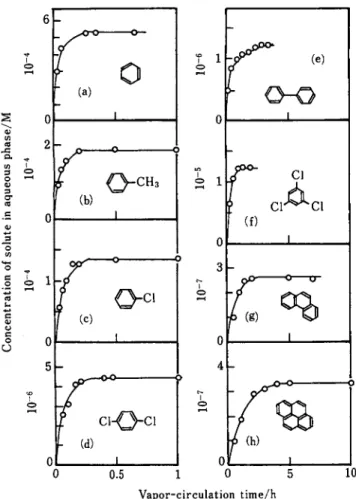
The concentrations of the solutes in the aqueous phase are shown in Fig. 1 as a function of the vapor-circulation time; the time to attain a constant value depended on the solute used. It took at longest 4 h in the case of pyrene.
Q. „.
O ^
OO
iz 1
0 5
(a)
(b) Q~CH3
(c)
CM 7-C1 (d)
1 -
r i
0
(e)
(f)
(h)
0 0.5 1 0 5
Vapor-circulation time/h
10
Fig. 1 Concentration of the solute in the aqueous phase vs. the vapor-circulation time. Organic phase, 1-octanol.
Solute: benzene (a), toluene (b), chlorobenzene (c), 1,4- dichlorobenzene (d), biphenyl (e), 1,3,5-trichlorobenzene (f), phenanthrene (g), and pyrene (h).
The conventional shake-flask method may reduce the time to attain the partition equilibrium of a solute between aqueous and octanol phases when the two phases are vigorously shaken. Particular attention, however, should be paid during the shake-flask so as not to produce any emulsions.
Miller et al. have prepared aqueous solutions in equilibrium with 1-octanol containing a solute by gentle stirring for at least 24 h with a PTFE-coated magnetic stirrer without breaking up the 1-octanol/water interface or by gentle shaking for 24 h and then leaving it to settle for at least 48 h before making an analysis.3 They reported that no emulsion formation was observed in the aqueous phase. However, the formation of emulsions was suggested by Bruijn et al.1, who proposed the slow- stirring method. The basis for this suggestion is that the equilibrium concentration of 1-octanol is considerably lower in water prepared by the slow-stirring method than in water prepared by the method of Miller et al. The slow-stirring method requires one to several days to reach partition equilibrium.
The 1-octanol/water partition coefficients determined in this work are given in Table 1 together with literature values taken from two groups. Our data are in reasonable agreement with the literature values.
Taking biphenyl as a test solute, we measured the concentration of this solute both in water and in water saturated in advance with 1-octanol. The difference was found to be negligible. This observation agrees with the experimental results of Miller et al.3
In an attempt to demonstrate that the present vapor- circulation method is also applicable to organic solvents other than 1-octanol, the partition coefficients of naphthalene and chlorobenzene between water and normal alcohols of C4 to C7 have been determined.
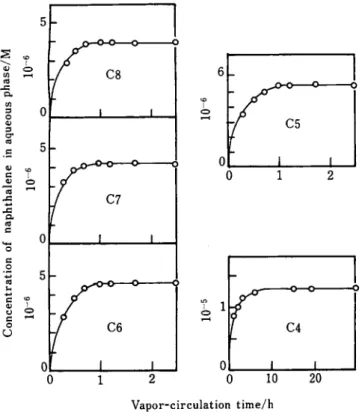
These alcohols were saturated with water; water was saturated in advance with an alcohol of interest. The concentrations of naphthalene in the aqueous phase are shown in Fig. 2 as a function of the vapor-circulation time. A constant concentration of naphthalene in the aqueous phase, which increases as the number of carbon of alcohol decreases, is reached after 1 h for Cs to C5 alcohols, while it takes 6 h for 1-butanol. The partition coefficients of naphthalene and chlorobenzene calculated
Table 1 Logarithms of 1-octanol/water partition coefficients of selected solutes at 25° C
Solute Benzene Toluene Chlorobenzene
1,4-Dichlorobenzene Naphthalene Biphenyl
1,3,5-Trichlorobenzene Phenanthrene
Pyrene
This work 2.26±0.01 2.73±0.01 2.88±0.01 3.35±0.01 3.40±0.01 3.95±0.02 3.91±0.01 4.57±0.02 5.17±0.01
Ref. 3 2.13 2.65 2.98 3.38 3.35 3.95 4.02 4.57 5.18
Ref. 7 2.186±0.009 2.786±0.005 2.898±0.004 3.444±0.030
4.008±0.022
4.189±0.019
4.562±0.006
ANALYTICAL SCIENCES AUGUST 1994, VOL. 10 657
a c
Oo