recognition of uncertainty in illness, and self‑care behavior in adults with type 2 diabetes
著者 丸山 育子
著者別表示 MARUYAMA Ikuko journal or
publication title
博士論文本文Full 学位授与番号 13301甲第5087号
学位名 博士(保健学)
学位授与年月日 2020‑03‑22
URL http://hdl.handle.net/2297/00060031
Original Article Journal of Wellness and Health Care Vol.43 ⑵ 45〜54 2019
そ の 他
Introduction
The purpose of treating diabetes is to prevent or slow the progression of the condition’s related complications.
To achieve this, it is important patients receive appropriate treatment and implement self-care behavior.
However, with type 2 diabetes, symptoms characteristic
Department of Chronic Care, Division of Health Sciences, Graduate School of Medical Science, Kanazawa University Fukushima Medical University, School of Nursing
1 ) School of Health Sciences, College of Medical, Pharmaceutical and Health Sciences, Kanazawa University
Relationships among the state of trust, recognition of uncertainty in illness, and self-care behavior in adults with type 2 diabetes
Ikuko Maruyama,Michiko Inagaki
1),Keiko Tasaki
1),Tomomi Horiguchi
1),Yuya Asada
1)Abstract
Purpose: This study was performed to quantitatively verify the relationships among the
“trust state” of patients with type 2 diabetes, recognition of disease uncertainty, and self- care behavior.
Method: The present study based on Mishel’s theory of uncertainty in illness had a cross- sectional survey design. A questionnaire was developed to identify the state of trust. The study population consisted of adults with type 2 diabetes. A total of 204 questionnaires were distributed, and 125 completed questionnaires were recovered (response rate 61%).
Participants had an average age of 53.6 (SD 9.6) years and included 71 men (62.8%) and 42 women (37.2%). State of trust, awareness of disease uncertainty, and self-care behavior were evaluated using the questionnaire. To classify the state of trust, the factor structure was confirmed by exploratory factor analysis of the state-of-trust questionnaire. One-way analysis of variance and multiple comparisons were used to examine each relationship.
Results: The number of items in the state of trust questionnaire was changed from ten to six. As a result of the promax rotation of the main factor method, the following three factors were extracted: “wants compatible doctors,” “trusts doctor easily,” and “receive medical care at one’s own convenience.” Cluster analysis using factor scores of six items and three subscales from the state of trust questionnaire created four clusters. The numbers of participants per cluster were as follows: cluster 1 (high scores for “wants compatible doctors” and “trusts doctors easily”), 22 (19%); cluster 2 (low scores for
“wants compatible doctors,” “trusts doctors easily,” and “receive medical care at one’s own convenience”), 18 (16%); cluster 3, (low score for “wants compatible doctors,” but not for “trusts doctors easily”), 21 (19%); cluster 4 (lower score for “trusts doctors easily”
than “wants compatible doctors”), 52 (46%). For each of the four clusters for the state of trust, the mean total score of uncertainty in illness perception was not equally distributed.
Therefore, Welch’s test was performed, which revealed significant differences in self-care behavior and meals between clusters 1 and 4 (p < 0.0001).
Conclusion: The high rate of meals in cluster 1 suggested that creating a state of trust, i.e.,
“wants compatible doctors” and “trusts doctors easily,” is important in nursing. Education for diabetes patients should consider their state of trust.
KEY WORDS
Type 2 Diabetes mellitus, classify the state of trust, recognition of uncertainty in illness, self-care behavior
of the disease rarely develops before the related complications become serious. Therefore, patients are less likely be aware they are diabetic
1)2). Additionally, patients often do not feel the complications will worsen once they appear
3). As a result, patients tend to behave in ways that interfere with the treatment, and they do not comply with recommended self-care behavior, which is a problem when providing medical care for diabetes
4)5).
In response to this problem, medical practitioners have been providing education and psychological support to patients, but this does not solve the problem entirely
6). Therefore, the present study focused on
“uncertainty,”
7)as it relates to patients with chronic diseases and defined in a previous study
8). The study interviewed patients who were being treated for chronic diseases and qualitatively analyzed patient behavior in response to uncertainty. The findings showed that patients commonly felt they did not understand diabetes well; therefore, these patients were aware of the uncertainty in life with diabetes.
Further, the phenomenon that allows “trust” to be created between patients and medical professionals to manage the uncertainty of life in diabetes was examined. “Trust,” as defined in this study, has three factors: having a medical professional who specializes in diabetes treatment, practicing self-care behavior, and feeling that one’s body is responding to self- management.” These factors are influenced by patients’
relationships with doctors and medical staff, creating a “state of trust.” There are three states of trust: “I am able to manage my condition, and medical professionals are there to advise me,” “I am completely dependent on a doctor,” and “I am can take care of myself and do not need professional medical assistance.”
According to the findings of previous studies, the result of this mindset was a patient with diabetes who felt he or she lived with many uncertainties
7). However, this presents the question of how patients with diabetes should respond to that feeling of uncertainty. New research findings are needed to provide clarity on this issue. In particular, the state of trust indicates how a patient will relate to a medical professional, and there has been no research on this topic in the literature so far. Mishel advocates for the importance of dealing with uncertainty in illnesses and treatment outcomes
9). This
theory initially focused on patients in the acute phase an illness, but more recent literature has proposed that this topic is also important in the treatment of chronic diseases
10-13).
Therefore, the present study was based on the uncertainty in illness theory proposed by Mishel.
We created a questionnaire that identifies the “state of trust” of patients with type 2 diabetes, and quantitatively verifies the relationships among the state of trust, recognition of uncertainty in illness, and self- care behavior. These factors are important, as they can confirm the uncertainty in illness theory as it relates to patients with type 2 diabetes, and a new method for establishing the relationship between medical professionals and patients can be proposed.
Conceptual framework of this study and operational definitions of terminology
The present study was designed based on Mishel's uncertainty in illness theory. “State of trust” used my bulletin as a result of previous research
8). First, a questionnaire was created to categorize the factors related to the state of trust. Next, the relationship between the recognition of illness uncertainty and self- care behavior was analyzed to confirm whether the state of trust was established. A conceptual diagram of the study design is shown in Figure 1.
Mishel's uncertainty in illness theory
9)posits that patients take some action to cope with the recognition
Figure 1 . Conceptual diagram Figure 1 . Conceptual diagram
Coping :
state of trust Cluster 1
Coping :
state of trust Cluster 2
Coping :
state of trust Cluster3
Adaptation:
Self‐care behavior 1
:
:
Uncertainty of life with type 2 diabetes
Adaptation:
Self‐care behavior 2 Adaptation:
Self‐care behavior 3
Relationships among the state of trust, recognition of uncertainty in illness, and self-care behavior in adults with type 2 diabetes
of uncertainty in their illness, and this results in adaptive behavior. In the present study, “adaptation”
was defined as the implementation of self-care behavior.
The present study aimed to accomplish the following goals:
1. Create a questionnaire that assesses the state of trust in the relationship between the patient and health care provider.
2. Classify the state of trust.
3. Clarify the relationships among typified state of trust, awareness of uncertainty in illness, and self-care behavior.
Methods 1. Study design
In this cross-sectional study, data were collected using a questionnaire and analyzed statistically. The study was conducted between July and September 2018.
2 .Selection of target location and survey distribution
The nurses in charge of facilities that provided outpatient services to individuals with diabetes were requested to cooperate in the survey. Seven facilities in the A prefecture agreed to participate. The participants were adults with type 2 diabetes who were outpatients or hospitalized at the selected facilities.
Patients were briefed by the attending physician and a nurse in charge of outpatient treatment. They were provided a written explanation of the research contents the researcher or a nurse, and self-report questionnaires were distributed those who consented to participate.
The completed questionnaires were returned by post or put in a collection box at the healthcare facility following the request of the research facility.
3 .Research Participants
The study participants were adults with type 2 diabetes who were either currently hospitalized or would be hospitalized soon. The goal of treating diabetes is different for adults and the elderly. Exclusion criteria were age participants were between of 20 and 65 years old and complications due to medications or pregnancy.
A total of 204 questionnaires were distributed, and 125 completed questionnaires were recovered (response rate 61%). Twelve questionnaires were discarded owing to either the age of the participant being 66 years or older or too many unanswered items. Ultimately, data were
analyzed from 113 questionnaires (effective response rate 90.4%). An outline of participants is shown in Table 1. From those participants, there were 71 males (62.8%) and 42 females (37.2%). The average length of treatment for diabetes was 9.5 years, and 99 patients (87.6%) took oral medications, while 46 (40.7%) used insulin. Additionally, 42 (37.2%) had complications due to diabetes.
4. Survey content
The following information was collected from participants for statistical analysis: age, gender, employment status, years since diabetes diagnosis, complications of diabetes, type of treatment (i.e., diet, medication, or exercise), and whether they used insulin injections.
1 ) State of trust
Questionnaire items were created to identify participants’ state of trust. Regarding the state of trust, the researchers created an original questionnaire by referring to previous academic literature. Four researchers specializing in diabetic nursing and three clinical nurses examined the questionnaire for validity, clarity of expression, and ease of answering, and created a self-report questionnaire with 10 items. Each item was rated on a 5-point Likert-scale, with answers ranging from “strongly agree” (5 points), to “strongly
N=113
N Mean SD
Age(years) 113 53.6 9.6
Years of treatment(years) 110 9.5 8.0
HbA1c(%) 104 7.4 1.6
N %
sex male 71 62.8
female 42 37.2
work Yes 86 76.1
No 42 37.2
treatment diet remedy Yes 72 63.7
No 41 36.3
medication Yes 99 87.6
No 14 12.4
insulin Yes 46 40.7
No 67 62.8
exercise therapy Yes 42 37.2
No 71 62.8
complications Yes 42 37.2
No 71 62.8
retinopathy Yes 25 22.1
No 88 77.9
nephropathy Yes 12 10.6
No 101 89.4
numbness in the foot Yes 26 23.0
No 87 77.0
Hospitalization for education Yes 47 41.6
No 65 58.4
Table 1. Outline of research participants
disagree” (1 point).
2 ) Recognition of uncertainty in illness
We used a Japanese-version of the Michel Uncertainty in Illness Scale-Community Form (MUIS-C)
14), translated by Nogawa
15), to measure participants’
recognition of uncertainty in illness. The MUIS-C is a 23-item self-report questionnaire measuring participants’
perception of uncertainty in illness. Each item was evaluated on a 5-point Likert scale with answers ranging from “strongly agree,” (5 points), to “strongly disagree” (1 point). Scores in the present study ranged from 23 to 115 points, and the higher the score, the higher the participant’ s perception of uncertainty in illness. The reliability and validity of this scale have been confirmed.
3 )Self-care behavior
Participants’ implementation of self-care behavior was measured using the Japanese version of the Self- care Behavior Evaluation Scale (J-SDSCA), which was created by Daitoku
16). The J-SDSCA is divided into subscales comprising 5 meals, 2 exercise items,2 blood glucose measurement items, 2 medication items, and 5 foot-care items. Each item was scored from 0 to 7 points, and participants’ answers were based on the preceding seven days. The reliability and validity of this scale has been confirmed. Since the number of items differs depending on the subscale, the score was calculated as a percentage using the total number of days self-care behavior was implemented for each item as the numerator and the number of items in the subscale multiplied by 7 as the denominator.
5. Analysis method
To classify the state of trust, factor structure was confirmed using an exploratory factor analysis of the state-of-trust questionnaire. Next, factor scores of subscales were calculated, and a hierarchical cluster analysis was performed by the Ward method using the factor scores. Then, to better understand the characteristics of the obtained clusters, we examined the difference in the mean values of the factor scores for each subscale of the state-of-trust questionnaire between clusters using one-way analysis of variance.
Finally, equal variance was confirmed, and multiple comparisons using Tukey's honestly significant difference (HSD) method were performed.
To clarify the relationship between the state of trust
and recognition of uncertainty in illness, we reviewed the difference in the mean value of the total score of uncertainty in illness recognition for each cluster of the categorized trust aspect to determine if it was equally distributed. Since it was not, we examined the data using Welch's t-test. After that, multiple comparisons were made using the Games-Howell method.
To clarify the relationship between the state of trust and self-care behavior, we examined the difference in the mean value of the implementation rate of self-care behavior for each cluster of categorized trust aspects by one-way analysis of variance. After that, equal variance was confirmed, and only equal meal was confirmed, so multiple comparison was performed using Tukey's HSD method. Exercise and foot care were compared using the Games-Howell method.
The descriptive statistics of all variables were calculated to confirm normality. The statistical significance level was 5%, and the standard deviation (SD), 95% confidence interval (CI), and effect size were calculated. IBM SPSS Statistics version 25.0 software for Windows was used for statistical analysis.
6 .Ethical considerations
The following information was explained verbally and in writing to the participants: the research purpose and significance, voluntary nature of research cooperation (no penalties if they did not agree to participate), data confidentiality, preservation of anonymity in statistical processing at the time of publication, and that replying to the questionnaire was considered consent to participate. However, it was also explained that participants could not revoke consent after replying, as the researchers would not be able to identify individual responses due to the anonymity of the questionnaires. The Kanazawa University Medical Ethics Review Committee (approval number: 812- 1) and the Fukushima Medical University General Ethics Committee (approval number: 30015) approved this study.
Results
1 .Classification by cluster analysis from factor analysis of the state of trust
(1) Exploratory factor analysis of the state of trust
Out of the 10 items on the state of trust
questionnaire, there were 6 items except for 2 items
Relationships among the state of trust, recognition of uncertainty in illness, and self-care behavior in adults with type 2 diabetes
with floor effect, 1 item with a high correlation between items, and 1 item with a low IT correlation.
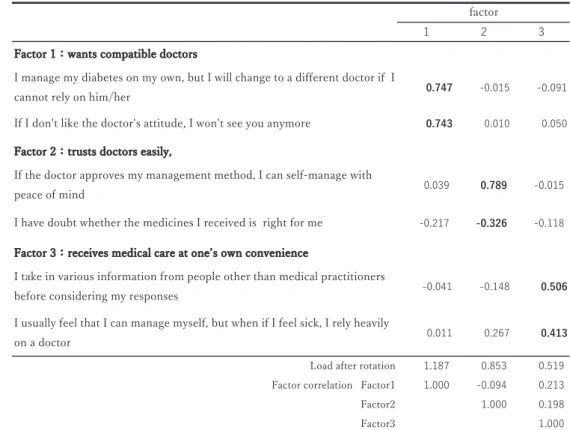
The Kaiser-Meyer-Olkin was 0.521, and Bartlett's sphericity test was significant (p < 0.001), indicating that factor analysis can be performed. Items with a factor loading of 0.3 or more were included. Factor analysis using promax rotation revealed three factors:
patients who want compatible doctors (factor 1), patients who want to trust doctors easily (factor 2), and patients who want to receive medical care at one’s own convenience (factor 3). As seen in Table 2, there
was no correlation between the factors. The cumulative contribution rate was 69.3%.
(2) Classification of state trust
As a result of cluster analysis using factor scores of 6 items and 3 subscales to measure the state of trust, 4 clusters could be created. The number of participants per cluster were as follows: 22 (19%) in cluster 1, 18 (16%) in cluster 2, 21 (19%) in cluster 3, and 52 (46%) in cluster 4.
Table 3 shows the mean scores and multiple comparison results of the factor scores of the subscales
1 2 3
0.747 -0.015 -0.091 0.743 0.010 0.050
0.039 0.789 -0.015 -0.217 -0.326 -0.118
-0.041 -0.148 0.506
0.011 0.267 0.413
Load after rotation 1.187 0.853 0.519 Factor correlation Factor1 1.000 -0.094 0.213
Factor2 1.000 0.198
Factor3 1.000
If the doctor approves my management method, I can self-manage with peace of mind
I have doubt whether the medicines I received is right for me Factor 3:receives medical care at oneʼs own convenience
I take in various information from people other than medical practitioners before considering my responses
I usually feel that I can manage myself, but when if I feel sick, I rely heavily on a doctor
Factor 2:trusts doctors easily,
factor
Factor 1:wants compatible doctors
I manage my diabetes on my own, but I will change to a different doctor if I cannot rely on him/her
If I don't like the doctor's attitude, I won't see you anymore
Table 2. Results of exploratory factor analysis of aspects of trust
N=113 n Min Max Mean(SD) [95%CI] F value Effect size(η2 ) Mean value difference wants compatible doctors
Cluster 1 22 0.14 2.07 0.96(0.60) [0.70,1.23]
Cluster 2 18 -1.40 0.06 -0.64(0.44) [-0.86,-0.42]
Cluster 3 21 -1.32 0.26 -0.98(0.41) [-1.17,-0.79]
Cluster 4 52 -0.84 1.76 0.21(0.56) [0.05,0.37]
trusts doctors easily
Cluster 1 22 -0.11 1.15 0.58(0.44) [0.39,0.78]
Cluster 2 18 -2.10 0.51 -0.78(0.84) [-1.20,-0.36]
Cluster 3 21 0.31 1.23 0.93(0.28) [0.80,1.05]
Cluster 4 52 -1.62 0.36 -0.35(0.50) [-0.49,-0.21]
receive medical care at oneʼs own convenience
Cluster 1 22 -0.60 1.81 0.26(0.57) [0.01,0.51]
Cluster 2 18 -2.11 0.48 -0.83(0.69) [-1.18-0.49]
Cluster 3 21 -0.98 1.38 0.20(0.68) [-0.11,0.51]
Cluster 4 52 -0.69 0.67 0.10(0.32) [0.01,0.19]
59.9*** 0.623† Cluster1>Cluster2,3.4***
Cluster4>Cluster2***
Cluster4>Cluster3***
51.3*** 0.586†
Cluster3>Cluster2,4***
Cluster1>Cluster2,4***
Cluster3>Cluster1*
18.8*** 0.342† Cluster1>Cluster2***
Cluster3>Cluster2***
Cluster4>Cluster2***
*p<0.05 ***p<0.001,†effect size (Large), one-way analysis of variance, multiple comparisons using Tukey's HSD Mean (SD) is the mean value (standard deviation)
Table 3. Differences in cluster scores and averages
of the state of trust for each of the four clusters. Figure 2 shows the characteristics of the confidence aspect for each cluster. Cluster 1 had high scores for factor 1 and factor 2, and the group’s state of trust can be interpreted as “Wants compatible doctors and trusts doctors easily.” Cluster 2 had low scores for factor 1 and factor 2, factor 3 scores, and the group’s state of trust can be interpreted as “Needs medical care but keeps their distance from medical practitioners.” Cluster 3 had a low score for factor 1, but not for factor 2, and the group’s state of trust can be interpreted as “Does not care about compatibility and trusts trusted doctors easily. “Cluster 4 had a lower score for factor 2 compared to factor 1, and the group’s state of trust can be interpreted as “Values compatibility with doctors.”
2 .Comparison of total points of recognition of uncertainty in illness in each cluster
The mean total score for recognition of uncertainty in illness was 54.5 (SD 11.7). For each of the four clusters for the state of trust, the mean total score of uncertainty in illness perception was not equally distributed, so we used Welch’s test and found a significant difference (p
< 0.0001). In the multiple comparison, p = 0.001 and d
= 1.20 between cluster 2 and cluster 4, and p < 0.0001 and d= 1.62 between cluster 3 and cluster 4, both of which were significantly different, and the effect was large. Thus, cluster 4 was shown to be much more aware of uncertainty in illness than clusters 2 and 3.
3. Comparison of implementation rates of self-care behavior in each cluster
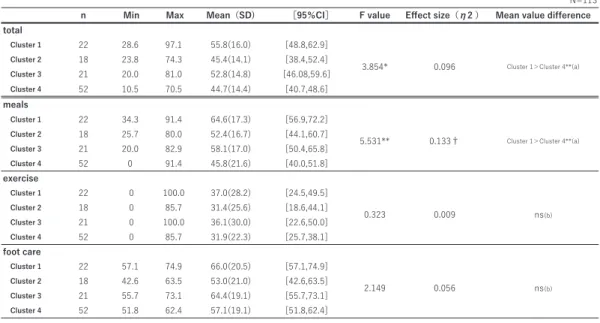
The mean value of self-care behavior was 52.8% (SD 20.4) for meal, 33.6% (SD 25.3) for exercise, 86.6% (SD 26.4) for blood glucose measurement, 96.8% (SD 10.7) for medication, and 59.5% (SD19.9) for foot care. Blood glucose measurements and medications were excluded from the analysis owing to high implementation rates and a large distribution bias.
The total rate of self-care behavior was the sum of meals, exercise, and foot care. Cluster 1 performed self-care behavior for all items more than the other clusters, followed by cluster 3. There was a significant difference between the mean values with p = 0.012, and a moderate effect size was observed with η
2= 0.096.
When multiple comparisons were made, there was a significant difference between cluster 1 and cluster 4, at p = 0.919.
Regarding meals, p = 0.001 and d = 0.92 were recognized between cluster 1 and cluster 4, indicating a significant difference and a large effect. Therefore, it was shown that there was a significant difference in the self-care behavior and meals between clusters 1 and 4 (Table 4).
Discussion
1 .State-of-trust questionnaire
To examine the state of trust (i.e., the relationships patients have with doctors and medical staff), a structured questionnaire was created from the results of qualitative research conducted prior to this study, and as the result of a factor search, six items and three factors were selected.
These three factors were named “to seek compatible doctors” “to leave to the doctors with peace of mind,”
and “to get medical care conveniently.” This supported the findings of previous research
8)indicating that patients view doctors as people who advise, and the basis is himself, “the doctor relies on” and “health care professionals are not involved because the patient is taking care of himself or herself based on his or her own beliefs.” Therefore, the three factors used in this study can be considered to have been quantitatively verified and obtained by exploratory factor analysis and were supported as factors constituting the state of trust.
Additionally, the three factors found using the state-
Figure 2 . Characteristics of the trust aspect for each clusterRelationships among the state of trust, recognition of uncertainty in illness, and self-care behavior in adults with type 2 diabetes
of-trust questionnaire were able to be combined to form four clusters. Significant differences were identified among the four clusters, confirming that the questionnaire was able to classify the aspect of trust.
Therefore, the characteristics of each cluster were clear from the scores of each factor, and each cluster could be interpreted from the characteristics. Cluster 1 was, “I want compatible doctors and trust doctors at ease,” cluster 2 was “I need medical care, but keep a distance from medical personnel,” cluster 3 was “I do not care about compatibility, so I trust doctors easily,”
and cluster 4 was “I value compatibility with doctors.”
2 .Clinical significance of the four clusters
The trust between patients and medical professionals is often expressed as an expectation that patients will receive safe treatments from medical professionals.
The importance has already been reported in the acute phase
17). In the present study, as a factor that constitutes the aspect of trust, “I leave it to the doctor with confidence” was extracted, and clusters 1 and 3 scored high for this factor. However, there was a cluster in which the factor of “find a compatible doctor” exceeded the factor of “let the doctor feel secure.” In the case of chronic illnesses, unlike acute illnesses, patients seem to incorporate the concept of compatibility into the relationship between patient and healthcare provider, particularly for the
physician. Regarding compatibility, two studies have reported on the narratives of cancer patients, and the findings indicated that compatibility with doctors is a determining factor for patients when deciding on a hospital or receiving treatment
18)19). There are reports that their relationship with doctors affects the quality of life of patients with type 2 diabetes
20). These findings are in line with those of the present study. Furthermore, this was presumed to be an important aspect of diabetes treatment, where discontinuation of treatment by patients is a major concern.
Among the four clusters, cluster 2 was different from the other clusters. Although it is rare to ask for compatibility with medical professionals, it is a factor that constitutes the state of trust. “Get medical care at your own convenience” was the factor with the lowest score. This finding represented a group with characteristics not found in previous studies.
3 .Clinical application of the state of trust
How the aspect of trust in patients with type 2 diabetes relates to their perception of uncertainty in illness and self-care behavior was considered. Among the four clusters, cluster 1 had the highest rate of self- care behavior, and the recognition of uncertainty in illness was almost average. In other words, in a state where the recognition of uncertainty in illness while living with diabetes is neither high nor low, individuals
N=113 n Min Max Mean(SD) [95%CI] F value Effect size(η2 ) Mean value difference total
Cluster 1 22 28.6 97.1 55.8(16.0) [48.8,62.9]
Cluster 2 18 23.8 74.3 45.4(14.1) [38.4,52.4]
Cluster 3 21 20.0 81.0 52.8(14.8) [46.08,59.6]
Cluster 4 52 10.5 70.5 44.7(14.4) [40.7,48.6]
meals
Cluster 1 22 34.3 91.4 64.6(17.3) [56.9,72.2]
Cluster 2 18 25.7 80.0 52.4(16.7) [44.1,60.7]
Cluster 3 21 20.0 82.9 58.1(17.0) [50.4,65.8]
Cluster 4 52 0 91.4 45.8(21.6) [40.0,51.8]
exercise
Cluster 1 22 0 100.0 37.0(28.2) [24.5,49.5]
Cluster 2 18 0 85.7 31.4(25.6) [18.6,44.1]
Cluster 3 21 0 100.0 36.1(30.0) [22.6,50.0]
Cluster 4 52 0 85.7 31.9(22.3) [25.7,38.1]
foot care
Cluster 1 22 57.1 74.9 66.0(20.5) [57.1,74.9]
Cluster 2 18 42.6 63.5 53.0(21.0) [42.6,63.5]
Cluster 3 21 55.7 73.1 64.4(19.1) [55.7,73.1]
Cluster 4 52 51.8 62.4 57.1(19.1) [51.8,62.4]
3.854* 0.096 Cluster 1>Cluster 4**(a)
5.531** 0.133† Cluster 1>Cluster 4**(a)
*<0.05 **<0.01 †effect size (Small)
(a)one-way analysis of variance, multiple comparisons using Tukey's HSD (b)one-way analysis of variance, multiple comparisons using the Games-Howell Mean (SD) is the mean value (standard deviation)
2.149 0.056 ns(b)
0.323 0.009 ns(b)
Table 4. Implementation rate and comparison of self-care action by cluster for each aspect of trust
engage in a lot of self-care behavior, leaving the doctors with good compatibility at ease.
Mishel's uncertainty in illness theory
9)posits that when uncertainty in illness is evaluated as an opportunity, the patient tries to maintain the uncertainty.
Cluster 1 considers the uncertainty of illness as an opportunity and its members perceive themselves as taking action to cope with their condition. Even without subjective symptoms, it is difficult for patients to realize they have diabetes, and by properly recognizing the uncertainties in life due to diabetes, patients are trying to build relationships with compatible and safe medical professionals. There is a view that the uncertainty in illness cannot be said to be bad.
21)There is a report of the type of relationship between patients and healthcare professionals that is most effective in promoting self- management.
22)Interdependence in the Japanese cultural context affects self-care behavior. For Japanese individuals, the relationship with medical professionals is important.
23)The findings of the present study also showed that cluster 4 had a high perception of uncertainty in illness and low performance of self-care behavior.
As for the aspect of trust in this category, “I value compatibility with doctors” had a lower factor score for
“Want compatible doctors” than the score for “Trust doctors easily.” Self-care behavior was also the lowest in this cluster compared to the other three clusters. In particular, a significant difference was observed in the implementation of self-care behavior when compared to cluster 1. It is thought that the uncertainty in illness should not be too high.
Moreover, regarding diet therapy in medical treatment, the type of this cluster classification was found to be significantly different in the degree of self- care. This suggested that dietary therapy, which is said
to be the most difficult to implement in diabetes care, can suggest the effectiveness of care with elements of trust and uncertainty. It was suggested that it is important in nursing to create a medical treatment environment that allows patients to have a certain amount of uncertainty and to feel, “I want compatible doctors and trust doctors easily.”
4 .Research limitations
This study was carried out in Japan; thus, the state of trust as presented in the present study is influenced by Japanese culture. Since the significance of classifying the aspect of trust was shown, it is necessary to verify the reliability and validity of the scale that classifies the aspect of trust.
Conclusion
There were four states of trust for adults with type 2 diabetes. It was found that having a compatible doctor and being able to trust the doctor easily could lead to self-care behavior, particularly in the implementation of dietary modifications. In addition, such a state of trust showed that the level of uncertainty of the disease was moderate. Those who sought a compatible doctor were found to be very aware of the uncertainty of the disease and did not frequently engage in self-care actions. Some patients did not care about the medical professionals.
Education for diabetes patients must consider their state of trust.
Acknowledgment
I thank the Division oh Health Science, Graduate of Medical, Pharmaceutical, and Health Science Kanazawa University of Japan for their support.
I express our gratitude to the hospitals and patients
for their cooperation.
Relationships among the state of trust, recognition of uncertainty in illness, and self-care behavior in adults with type 2 diabetes
References
1 ) Okudaira M, Uthigawa Y, Okada T, et al. (2003):
Influence of health checkup and previous intermittent treatment on diabetic complications, Japan Diab. Soc 46 (10), 781-785.
2 ) Murakami M, Umeki S, Hanada T (2009): The factors promoting and hindering the self-care of patients with diabetes, Journal of Japan Society of Nursing Research 32(4), 29-38.
3 ) Matsui K, Inagaki M (2007): Recognition of complications in type 2 diabetes mellitus patients undergoing hemodialysis, Journal of Japan Society of Nursing Research 30(5), 13-22.
4 ) Sugimoto H, Nakaishi Y, Isotani H, et al. (2013):
A multicritical study on the cessation of treatment for type 2 diabetic Patients, J. Japan Diab. Soc.
56(10), 744-752.
5 ) Honda K, Kohzuki M, Murase T, et al. (2004):
Follow-up study of type 2 diabetic outpatients after educational hospitalization, J. Japan Diab.Soc.
47(5), 355-361.
6 ) Yamaguchi Y (2008): The change and the problems of diabetes patient education, Bulletin of Nara Medical University School of Nursing 4, 1-8.
7 ) Struss AL, Corbin, Fagerhagh S, et al. (1984):
Chronic illness and quality of life, 2nd ed.
8 ) Maruyama I, Inagaki M (2014): Patients' talk about trust building during their treatment of type 2 diabetes, Bulletin of Fukushima Medical University School of Nursing (16), 47-55.
9 ) Mishel MH (1988): Uncertainty in illness, IMGE:
Journal of Nursing Scholarship 20(4), 225-232.
10) M i s h e l M H ( 1 9 9 0 ) : R e c o n c e p t u a l i z a t i o n Uncertainty in Illness Theory. IMGE: Journal of Nursing Scholarship 22(4), 256-262.
11) Mihel MH, Germino BB, Gil KM, et al. (2005):
Benefits from an uncertainty management intervention for African-American and Caucasian older long-term breast cancer survivors, Psycho- Oncology 14, 962-978.
12) Flemme I, Edvardsson N, Hinic H, et al. (2005):
Long-term quality of life and uncertainty patients living with an implantable cardioverter defibrillator, The Journal of Critical Care 34, 386-392.
13) Mccorkle R, Dowd M, Ercolano E, et al. (2009):
Effects of a nursing intervention on quality of life outcomes in post-surgical women with gynecological cancers, Psycho-Oncology 70, 62-70.
14) Mishel MH (1981): The measurement of uncertainty in illness, Nursing Research, 30( 4), 258-263.
15) Nogawa M (2004): Study on the reliability and validity of the Japanese-language Version of the Mishel Uncertainty in Illness Scale-Community Form, Journal of Japan Academy of Nursing Science 4(3), 39-48.
16) Daitoku M, Honda I, Okumiya A et al. (2006):
Validity and reliability of the Japanese Translated
“The Summary of Diabetes Self-care Activities Measure,” Journal of the Japan Diabetes Society 49(1), 1-9.
17) Hosomi H (1999): Patient’s right and medical professions position, Bulletin of Kanazawa University School of Medicine 23, 91-96.
18) Inomata K (2004): A nursing intervention with patients diagnosed of breast cancer at the outpatient clinic, and the require environment for this nursing intervention, J. Jpn. Acad. Nurs. Sci.
24(1), 30-36.
19) Yamanaka M, Kuroda S, Amijima H (2005): Self- care behavior and factor which influence the self- care behavior of hepatoma patients, Journal of Hiroshima Prefectural College of Health Science Humanity and Science 5(1),119-127.
20) Cheng Y Morris KT, Borkoles E, et al. (2015):
Modelling of diabetes knowledge, attitudes, self- management, and quality of life: a cross-sectional study with an Australian sample, Health and Quality of Life Outcomes 13 doi:10.1186/s12955- 015-0303-8.
21) Baxter, LA, Braithwaite, DO. (2009): Reclaiming uncertainty – The formation of new meanings in relationships, In T Afifi, W Afifli, Uncertainty, Information Management, and Disclosure Decision:
Theories and Applications, 26-44, Routledge, New York.
22) Alison K, Amy M, Katherine B, Kathryn Z. (2012):
What are the core elements of patient-centred care? A narrative review and synthesis of the literature from health policy, medicine and nursing JAN, 4-15.
23) Mano F, Ikeda K, Uchida Y, et al. (2018): Novel
psychosocial factor involved in diabetes self‐care
in the Japanese cultural context JDI10 (4), 1102-
1107, https://doi.org/10.1111/jdi.12983.
成人 2 型糖尿病患者の類型化した信頼の様相と病気の不確かさの認知および セルフケア行動の関連