熊本大学学術リポジトリ
Evaluation of Concrete Made from Recycled Coarse Aggregates by Pulsed Power Discharge
journal or
publication title
Digest of Technical Papers‑IEEE International Pulsed Power Conference
volume 2007
page range 748‑751
year 2007‑06
URL http://hdl.handle.net/2298/10318
doi: 10.1109/PPPS.2007.4345821
EVALUATION OF CONCRETE MADE FROM RECYCLED COARSE AGGREGATES BY PULSED POWER DISCHARGE
S. Narahara, T. Namihira, K. Nakashima, S. Inoue, S. Iizasa, S. Maeda, M. Shigeishi, M. Ohtsu and H. Akiyama
Graduate School of Science and Technology, Kumamoto University, 2-39-1 Kurokami, Kumamoto 860-8555, JAPAN
Abstract
In Japan, the most of waste concrete scraps have been reused as roadbed materials and the recycling ratio of waste concrete scraps has been kept over 95 % from 2000.
However, it is expected that the demands of waste concrete scraps as roadbed materials would decrease even though the waste concrete scraps increase with the pulling down buildings in next decade. These facts mean that the recycling of waste concrete scraps would be in the negative situation. Therefore, the development of new recycling technology of waste concrete scraps is paramount importance in Japan. In this work, the pulsed power discharges inside of waste concrete scraps immersed in water were used to reproduce the coarse aggregate. In the experiments, the Marx generator, which storages the energy of 6.4 kJ/Pulse, was used as pulsed power source and the point to hemisphere mesh electrode was immersed in water. The pulsed voltages with 400 kV of peak voltage were applied to the concrete scraps placed on hemisphere mesh and the reproduced coarse aggregates were evaluated after the repetitive discharge treatment. From the experimental results, it is found that the coarse aggregates reproduced by 40~60 pulsed discharge treatments have the enough qualities of the bone-dry density and the water absorption rate to satisfy JIS (Japan Industrial Standard) regulation (A 5005). In addition, the concretes consisted of the reproduced coarse aggregate also have the enough compressed strength and Young’s module to utilize as the construction material.
I. INTRODUCTION
In Japan, the most of waste concrete scraps have been reused as roadbed materials and the recycling ratio of waste concrete scraps has been kept over 95 % from 2000.
However, it is expected that the demands of waste concrete scraps as roadbed materials would decrease even though the waste concrete scraps increase with the pulling down buildings in next decade. These mean that the recycling of waste concrete scraps would be in the negative situation. The new method of crushing that described here allows the removal of clean, unmixed materials. This is the prerequisite of high level recycling of concrete in the future. The fragmentation with pulsed power discharge allows the separation of the aggregates from the composite material without damage. This
research establishes recycling technology collecting aggregate from a waste concrete lump with pulsed power technology, and aims at industrial application.
Table 1. Quality of aggregate
Coarse aggregate Recycled c. aggregate Absorption ratio
,
% < 3 < 3 Density in absolutelydry condition
,
g/cm3 > 2.5Table 2. Size distribution
Transmittance, %
Sieve size
,
mm 25 20 15 10 5Coarseand Recycled
coarse aggregates 100 90-
100 - 20-
55 0- 10
II. EXPERIMENTAL SET-UP AND PROCEDURES
The experimental consists of a DC power supply, a pulsed-power driving circuit, and a discharge treatment part.
A. Pulsed power generator
The device used for the experiments is the Marx generator. It is shown in Fig. 1. The Marx generator consists of 10 stages with capacitors of 0.8 µF per stage.
Each capacitor is charged to 40 kV by DC power supply.
Thus a 6.4 kJ pulsed voltage with a maximum amplitude of 400 kV is achieved. Typical voltage and current waveforms obtained by pulsed power generator are given in Fig. 2.
B. Discharge electrode
The structure of the output side is shown in Fig. 3. It consists of the electrode and the water-filled container for the processing of the concrete. An electrode is point-to- hemisphere. HV electrode is a copper wire. A diameter of copper wire is 5 mm. The material of the hemisphere electrode is stainless steel. The diameter of the hemispheres is 300 mm and hemisphere is mesh that size is 5 mm. The distance between electrodes changes between approximately 70~150 mm.
Figure 1. Marx generator
-100 0 100 200 300 400
-10 -5 0 5 10 15 20 25 30
0 4 8 12
Voltage [kV] Current [kA]
Time [us]
Voltage Current
Figure 2. Typical Waveforms of applied voltage and discharge current for concrete treatment
C. Discharge treatment of concrete
In the experiments, the Marx generator, which stores the energy of 6.4 kJ/Pulse, was used as pulsed power source and the point to hemisphere mesh electrode immersed in water was used as treatment chamber for concrete (150 mm, 150 mm, 75 mm). The concrete placed on hemisphere mesh were treated repetitively by the pulsed discharge. The mass of over 5 mm remains in the hemisphere mesh, and less than 5 mm is accumulated in
the bowl under the hemisphere mesh (Fig.4) and then coarse aggregates were recycled.
Figure 3. Electrode configuration
Figure 4. Schematic diagram of discharge treatment process of concrete
Over 5mm
HV
GND
water spring
concret
sieve bowl
749
20 shots 40 shots
60 shots 80 shots
100 shots Residual substances Figure 5. Appearance of discharge treated concrete
III. EVALUATION OF RECYCLED COARSE AGGREGATES
We performed a density examination and an absorption rate examination and a sieving examination to aggregate provided every 20 times of discharge processing and evaluated it. In Table 1,2, the ranges of values of the normal coarse aggregates are shown.
A. Density of aggregate
Density of aggregate is an index to judge general quality of aggregate. Fig. 6 shows number of discharge dependence of a density in absolutely dry condition. From this figure, follows that the density increases with increasing number of discharge. Because mortar separated from aggregate by electric discharge crush processing, density of aggregate increased. The JIS agreement was found when the concrete was treated 40 times.
B. Absorption ratio of aggregate
The absorption rate of aggregate expressed the quantity of water that dry aggregate absorbed in the aggregate inside at percentage for dry aggregate mass. Fig. 7 shows number of discharge dependence of an absorption ratio.
Absorption rate falls with increase of the number of discharge, and slope becomes gentle with after 80 times.
As a result of a density examination, it is thought that absorption rate of aggregate fell because separation of mortar advances by electric discharge crush processing. It
shared the absorption rate of the JIS that it showed by Table. 1 to fill with 60 times enough.
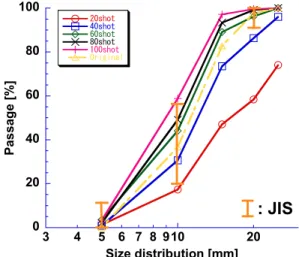
C. Size distribution of aggregate
The grain size of aggregate shows the rate that big and small grain of aggregate mixes. This value is the element that gives workability big influence. There is a sieving examination as an examination that judges this grain size.
Fig. 8 shows some of size distributions compared with the particle size distribution of the origin aggregates used in the concrete. By variation of the number of discharge the particle size distribution can be shifted to coarser or finer ranges. As the number of discharge increases, size distribution goes above. The best agreement was found if the material was treated about 50 times. For this reason, aggregate and mortar separate to 50 times effectively.
And after 50 times, aggregate size is creeping to the grain refining which aggregate crushed. In addition, a grain size is expressed at a fineness modulus. The larger this value is, the rougher the grain size. Fig. 9 shows number of discharge dependence of a fineness modulus. It is confirmed that this curve has two kind of leaning. It is thought that because the attached mortar is positively separated from the aggregate the first leaning is steep.
Because separation advances enough and there became decrease of quantity of adherent mortar, the secondary slope is gentle. Coarse aggregates obtained from the over 60shot show lower content of cement paste in the clear aggregates compared with reproduced aggregates crushed in 40 times (Fig. 5). These two straight lines are intersectional at about 50 times. Furthermore, a value of original aggregate almost accords with a value of this point. In this work, about 50 times shot treatment is the best condition.
2.4 2.5 2.6 2.7 2.8 2.9 3 3.1
0 20 40 60 80 100 120
Density in absolutely dry condition [g/cm3 ]
Number of discharge treatment
Figure 6. Dependence of aggregate density under absolutely dry condition on number of discharge treatment
: JIS
0 1 2 3 4 5 6
0 20 40 60 80 100 120
Absorption rate [%]
Number of discharge treatment
Figure 7. Dependence of aggregate’s absorption ratio on number of discharge treatment
0 20 40 60 80 100
3 4 5 6 7 8 910 20
20shot 40shot 60shot 80shot 100shot Original
Passage [%]
Size distribution [mm]
: JIS
Figure 8. Dependence of aggregate’s size distribution on number of discharge treatment
6.2 6.4 6.6 6.8 7 7.2 7.4
0 20 40 60 80 100 120
fineness modulus
Number of discharge treatment
Figure 9. Dependence of aggregate’s fineness modulus on number of discharge treatment
IV. EVALUATION OF REPRODUCED CONCRETE
The strength of concretes consisted of the reproduced coarse aggregate was evaluated. Fig. 10 shows the result.
The compressive strength of the concrete made by discharge treated coarse aggregates is lower than the original concrete. However, the recycled concrete has enough compressive strength and Young’s module to utilize as the construction material under the JIS.
Figure 10. Comparison of Compressive strength and Young's modulus between concretes made by original and discharge treated aggregate
V. CONCLUSION
The results show that it is possible to use pulsed power discharge as a tool for the processing of concrete.
・ The quality of coarse aggregate such as the density in absolutely dry condition and absorption rate was controlled by the number of discharge treatment.
・ In this work, 40-60 discharge treatments is better condition for recycling aggregate.
・ The concrete made by recycled aggregate has enough quality as construction material.
Topics of the further research will be the investigation of the process parameters, the optimization of the energy input and the influence of more concrete properties on separation.
VI. REFFERENCE
[1] H. Bluhm, W. Frey, H. Giese, P. Hoppe, C. Schultheib and R.
Strabner, “Application of pulsed HV discharges to material fragmentation and recycling”, IEEE Transactions on Dielectrics and Electrical Insulation, Vol.7, No.5, pp.625-636, 2000.
[2] Elske Linβ and Anette Mueller, “High-performance sonic impulses-an alternative method for processing of concrete”, International Journal of Mineral Processing, Vol.74, pp.199-208, 2004.
[3] Igor V. Timoshkin, John W. Mackersie, and Scott J.
MacGregor, “Plasma Channel Miniature Hole Drilling Technology”, IEEE Transactions on Plasma Science, Vol.32, No.5, pp.2055-2061, 2004.
0 10 20 30 40 50
original Pulsed power treatment Compressive strength [N/mm2] Young’s modulus [×104 N/mm2]
Original
: JIS
751