4
DOI: http://dx.doi.org/10.14246/irspsd.4.1_4
Copyright@SPSD Press from 2010, SPSD Press, Kanazawa
Analysis of spatial and temporal patterns of daily activities of suburban residents based on GPS data: A
case study of the Shangdi-Qinghe area of Beijing
Xue Zhang1*, Yanwei Chai1, Zifeng Chen1, Yiming Tan1
1.College of Urban and Envionmental Sciences, Peking University
* Corresponding Author, Email: [email protected] Received 3 Feburary, 2015; Accepted 25 July, 2015
Key words: Spatial and Temporal Pattern, Daily Activity, Suburban Residents, GPS Data, Beijing
Abstract: The rapid growth of urban populations in China, together with dramatic institutional transition, has led to the fast spread of urban space and a growing tendency toward residential suburbanization. Remarkable environmental changes have taken place in urban China, with large suburban residential areas emerging in big Chinese cities. As often observed in urban China, the dwelling environment of suburban areas is distinct from downtown areas with less job opportunities and insufficient facilities, resulting in longer distance in daily trips and disadvantages in residents′ accessibility. This study, based on a GPS- based activity-travel survey in Beijing in 2012, applies a time-geographic research framework to explore the activity pattern of suburban residents in both spatial and temporal dimensions as an attempt to reveal characteristics of suburban China. Emphasis is put on daily rhythms and time allocation of activities based on the activity-travel diaries and time space paths based on the GPS data. On the one hand, in the aspect of time, it is observed that the daily life of the suburban residents tends to be regular on weekdays, diversified and fragmented on weekends. On weekdays, working activities constitute a dominant part in time allocation, while on weekends, housework and leisure activities constitute a greater part of time use. On the other hand, in the aspect of space, it is found that the majority of the suburban residents are employed in the inner city and most of the non-work activities take place in suburbs with an exception of shopping activities on weekends. Travel on weekdays is "less time and multi-purpose" and on weekends is "multiple time and single- purpose". It could be concluded that the suburban areas in Beijing, while being gradually shifting from dwelling space to living space for suburban residents, still need further promotion in job opportunities and shopping facilities. The results from the study shed light on the weekly spatial and temporal patterns of suburban residents in China and provide beneficial implications for spatial planning and infrastructure construction in the suburban areas to enhance the quality of life in suburban China.
1. INTRODUCTION
Since suburbanization appeared in the 1920s in western countries, it set off a wave of suburbanization in developing countries and the impact of suburbanization has penetrated deep into people′s everyday activities. This is a new phenomenon after World War II as an important result of highly developed urbanization. The process of suburbanization has not only
reshaped the internal spatial structure of the city, forming a unique suburban built environment and landscape, but also promoted the reconstruction of the residents’ lifestyles and activity space (Zhang and Chai, 2011). Suburbs are the result of urban space evolution and also the product of residents' perceptions. It is a carrier of human daily activities and people's various life activities contributed to the further development of suburban refactoring (Clapson, 2003). Fava (1956) carried out a summary of the properties of the suburbs in the United States. She considered that suburban areas actually represent a way of life. So suburbanization is a hot topic in urban research and planning, in particular, real-life case studies of suburban residents gained extensive attention in the world. For example, studies have indicated that in America, population and industry suburbanization and social segregation have caused "spatial mismatch" between the residential places and the working places. This has led to ethnic groups and low-income groups in the central city being faced with declining employment accessibility, increasing unemployment rates and other austere challenges (Kain, 1992; Preston, et al., 1999). The phenomenon that white married women in American suburbs faced up to reduce employment is called the
"Space Trap" (England, 1993; Rapino, et al., 2011). In the United States and Japan, suburban married women with children often choose part-time work in the suburbs or even give up jobs due to time and space constraints as they cannot balance home care activities and long commuting distances (Kwan, 1999). In Japan, the suburban space of the big cities is the space of married women with children in the day because most men need to bear the long- distance commuting to go to the center city. Thus it forms a relatively fragmented activity space including housing in the suburbs and work places in the downtown (Okamoto, 1997 ). Behrens took a two day activity diary survey to study the travel pattern in the inner city and the suburbs in Cape Town. He discovered that residents travelled around eight times a day and about 30% of that was on foot. The travel numbers increased significantly after the suburban family bought a car, but in the inner city, the travel rate of families with cars and without cars are the same because in the inner city there is a high density of facilities so that people can complete activities smoothly (Behrens, 2002). Some studies take “the resident location” as a binary variable, analyzing the aiciticity characteristics between the inner city and the suburb(Schwanen, et al.,2002; Bromley, et al.,2003Schwanen et al., 2002;Bromley et al., 2003).
Although in recent years some suburban areas of big cities continue to develop into relatively comprehensive "suburban cores" or "suburb centers", with many localized large retail facilities and employment opportunities evolving, the living space of the suburbanites presents a localization trend, but the suburban living space and lifestyle is not the "suburb dream" as portrayed by early suburbanization (Zhang and Chai, 2011). The interaction between physical urban space in the suburbs and the human behavior needs to be reflected upon and city planners need to rethink suburban planning from a micro perspective of the residents’ needs.
In China, suburbanization is constantly evolving. Since the beginning of the 1980s, the policy of reform and opening up of the Chinese economy, the society and urbanization developed rapidly. As the capital city of China, Beijing constantly improves the progress of urbanization and urban functions have continued to be improved upon. With the rapid expansion of the urban population, the city has been expanding. As a result, a lack of land for urban development, traffic congestion, environmental pollution and other pressures have evolved. Under these pressures, the government has carried
out a series of policy reforms of the land use system, built highways, real property development, industrial structure adjustment and so on. During 1982 to 1990, Beijing entered the process of suburbanization (Zhou, 1996), however, the suburbanization of Beijing is different from in Western countries. The suburbs are still controlled by the central city, and the employment and facilities in suburbs has greatly lagged behind the pace of the development of housing, thus leading to the spread of urban spheres, post living dislocation, traffic congestion and a series of other problems (Song, 2007).The need to improve the quality of life is pressing. Residents living in suburbs desire a compact, efficient and convenient living space and their demands are increasingly strong. The living space in suburbs needs to be remodelled.
At the same time, China's economic and social development is facing a comprehensive restructuring. There are some changes in the paradigm of urban planning and management in China: from land-use based urban planning to individual based planning, turning to focus on optimization and adjustment, not large-scale new construction; from stable blue-print planning to dynamic and process-based management, the focus has been much on behavioural space, rather than physical and functional space. As a result, people-oriented urban planning has become the core issue of urban development. Quality of life and quality of urbanization is emphasized and application of space-time behavior research in urban planning and urban management has become increasingly important. In this context, space time behavior analysis of the residents has attracted tremendous attentions, but such research is still relatively undeveloped in China.
This study based on a GPS-based activity-travel survey in Beijing in 2012, applies a time-geographic research framework to explore the activity pattern of suburban residents in both spatial and temporal dimensions as an attempt to reveal the characteristics of suburban China. From the microscopic perspective, to analyze the problems of suburbanization development in Beijing, beneficial implications for spatial planning and infrastructure construction in the suburban areas can be provided addressing the quality of life in suburban China.
2. DATABASE AND THE CASE AREA 2.1 The case area
The case area is the Shangdi-Qinghe area in the middle-east part of Haidian District, between the North Fifth Ring and the North Sixth Ring of Beijing (Figure 1). Its total area is about 16 kilometers. It is crossed by an expressway and a light railway which connect it with another residential area in the north (the Huilongguan area) and an employment center to the south of the area (Zhongguancun Science Park), as well as the central city of Beijing. The resident population is about 24 million and the employment population is about 14 million. This area sporadically developed before 1949. Between the 1950s and 1970s, planned economy and industrialization promotion and productivity layout land expansion of industrial production in the region and the urban population increased, but the entire region’s land use is still mainly agricultural land. In the 1980s, along with rapid urbanization and dramatic transformation of the market, the region's rapid urban population growth and rapid reconstruction of urban space, the urban
population and the urban landscape have gradually replaced the rural population and rural landscape, forming a coexisting pattern of the traditional industries, new industries and large residential communities.
Despite the mixed land use, most housing in the area is unaffordable for the workers here and a large proportion of residents living in this area work in other areas of Beijing, which has led to a severe jobs-housing spatial mismatch. It can be said that the Shangdi-Qinghe area is a typical suburb area in the context of China’s rapid suburbanization.
Figure 1. The location of Shangdi-Qinghe district in Beijing
2.2 Database
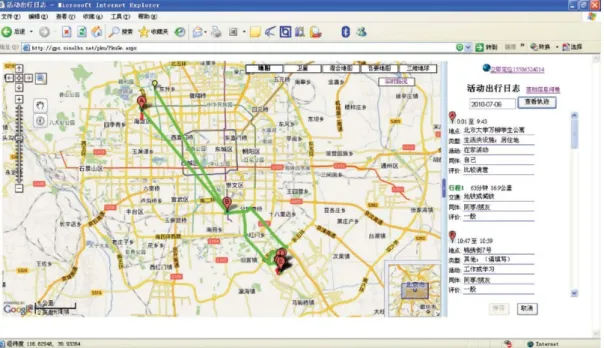
This study based on a GPS-based activity-travel survey in Beijing in 2012 was taken by the space-time behaviour group of Peking University in Beijing. The investigation was conducted in the Beijing Shangdi-Qinghe district, excluding villages and military compounds, it included 23 communities. The survey used GPS trackers (Figure 2), a survey website and interviews with participants to collect the data (Figure 3). Specifically, the GPS trackers were used to collect the tracking data and the survey website was applied to collect the activity-travel diary data and socio- demographic information of the participants. Both the GPS tracking data and activity-travel diary data were collected for a 7-day survey period. After the survey, the GPS tracking data were matched to the activity-travel diaries to create a GPS-based travel diary dataset. In the survey we provided a GPS tracker to each participant. The tracker is approximately the size of a cell phone and participants could carry the tracker at any time. The tracker logged the space-time coordinates of each participant every two minutes. It was powered by a built-in battery, which needed to be charged every day. A survey website was developed and used for collecting the activity-travel diary data and socio-demographic information. We provided each participant with a username and password to log in on the website and fill in the requested information. The website includes an interactive activity-travel diary interface for participants to fill out, a socio-demographic questionnaire interface for participants and a monitoring interface for survey administrators (Chai, et al.,2014). Ultimately, the effective sample was 480 and the effective sampling rate was 89.63%.
Figure 2. Activity and travel information filling interface for respondents
Figure 3. The GPS tracker used in the survey
2.3 Sample attribute analysis
Socio-economic attributes of the sample statistics are shown in Table 1.
The sex ratio of the survey sample is relatively balanced. 64.3% of the residents are under 40 years old. 89.4% of the individuals have Beijing registered permanent residence. 50.2% of the individuals have young children. 49.6% of the individuals have a college degree or above. In terms of employment, the highest proportion was for company employees. 58.5%
of the individuals’ monthly incomes are 4,000 yuan or below. 46.5% of the individuals have a driver's license.
Table 1. Socioeconomic characteristics of the samples Sample(N=480) Gender
female 52.3%
male 47.7%
Age
10~19 0.8%
20~29 17.5%
30~39 46.0%
40~49 22.9%
50~59 11.9%
>60 0.8%
Place of domicile
Beijing 89.4%
Have young
children 50.2%
Education high school or
below 20.9%
junior college 29.6%
undergraduate
college 33.3%
graduate or above 16.3%
Employment status
worker 5.0%
public servants 18.3%
company
employee 44.2%
individual
business 1.9%
service staff 14.6%
other employment 16.1%
monthly income
<1000 RMB 5.0%
1001~2000
RMB 15.0%
2001~4000
RMB 38.5%
4001~6000
RMB 20.0%
6001~10000
RMB 12.9%
>10001 RMB 8.6%
Driving license 46.5%
3. TIME RHYTHM AND TIME ALLOCATION FEATURE
3.1 The rhythm in workdays is homogenised and in weekends is diversiform
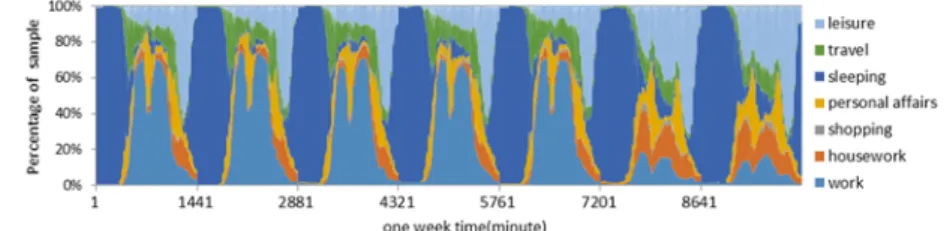
Time rhythm is viewed from the perspective of time to consider all kinds of activities people carried out. It is a way to visually recognize people`s one week time use laws. Shown in Figure 4, the horizontal axis represents 7 days’ time (in units of minutes), while the vertical axis represents the proportion of the individuals, expressed as the sample proportion, that do certain events at a certain time.
From the figure it can be found that on weekdays the working activities of residents showed typical "Twin Peaks" characteristics, namely in the morning from 9:00 to 11:30 and 13:00 to 17:00 pm; on rest days, two peak working activities still exist, but the proportion significantly declines and the
peak appears between 9:30 and 11:30 and from 13:00 to 16:30. Few leisure activities take place during the day, while the proportion rises from 20:00 to 21:00 in the evening (approximately 60%). On weekends, leisure activities appeared at three peaks respectively, from 9:00 to 10:00, 15:00 to 16:00 and 20:30 to 22:00. On weekdays, domestic activities have remained below 13%
of the proportion, mainly in the morning between 6:30 to 9:00, and from 17:00 the proportion gradually increased. Around 20:30 it peaks. On a Friday night, domestic activities continue for a relatively long time, until around 21:30. On weekends, the proportion of the activities significantly increased. From 8:30 to 11:00 it begins to peak (30%). From 14:00 to 22:00, domestic activities gradually ended. Shopping activities on weekdays is very fragmented and remains below 5% of the samples, while on weekends shopping activities are significantly increased and there are two peaks respectively, from 10:00 to 11:00 and 14:00 to 16:00. In addition, the travel peak on weekdays is from 6:30 to 8:00 in the morning, declining from 9:30;
the peak in the evening is from 16:30 to 18:00 and continues until 20:00. On weekends, the travel peak occurs at about 10:00, but the peak is significantly lower than on weekdays.
Overall, residents′ time schedules on weekdays are centered on work activities, followed by sleep-work-lunch-work-shopping, housework, meals, recreation, etc. The time schedules on weekends are around housework, leisure and other activities, followed by sleep-housework, leisure, shopping- lunch-housework, leisure, shopping-sleep. The rhythm on workdays is homogenised, and on weekends is diversiform.
Figure 4. The weekly activity patterns of the female residents in the study area
3.2 The time allocation of non-work activities increased significantly on weekends compared with workdays
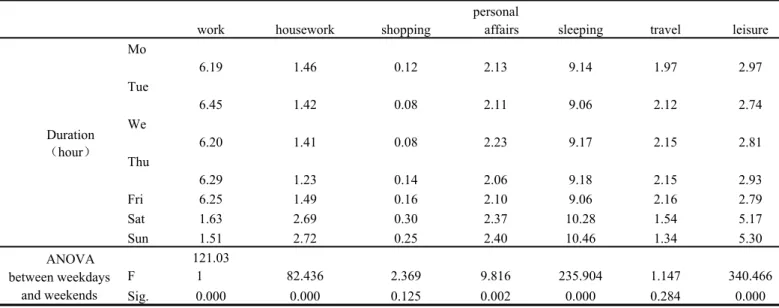
The results showed that there are significant differences in distribution between workdays and weekends in the time of work, housework, personal affairs, sleep and leisure activities (
work housework shopping
personal
affairs sleeping travel leisure
Duration
(hour) Mo
6.19 1.46 0.12 2.13 9.14 1.97 2.97
Tue
6.45 1.42 0.08 2.11 9.06 2.12 2.74
We
6.20 1.41 0.08 2.23 9.17 2.15 2.81
Thu
6.29 1.23 0.14 2.06 9.18 2.15 2.93
Fri 6.25 1.49 0.16 2.10 9.06 2.16 2.79
Sat 1.63 2.69 0.30 2.37 10.28 1.54 5.17
Sun 1.51 2.72 0.25 2.40 10.46 1.34 5.30
ANOVA F 121.03 82.436 2.369 9.816 235.904 1.147 340.466
). The average working hours of the suburban residents on weekdays is 6.27 hours and 1.57 hours on weekends. At the time of the survey, the distribution of household activities on weekdays averaged 1.41 hours of housework, while on weekends it is longer than 1.29 hours. The average leisure time on weekdays is about 2.85 hours and on weekends it is more than 2.39 hours. So work occupies the most significant part of their time on weekdays. This is accompanied by relatively fixed shopping, home, travel and leisure time. On weekends, the time allocated for housework and leisure are significantly increased.
Table 2. The time-use distribution of residents in the Shangdi-Qinghe district
4. MOBILITY FEATURES 4.1 Travel frequency and trip rate
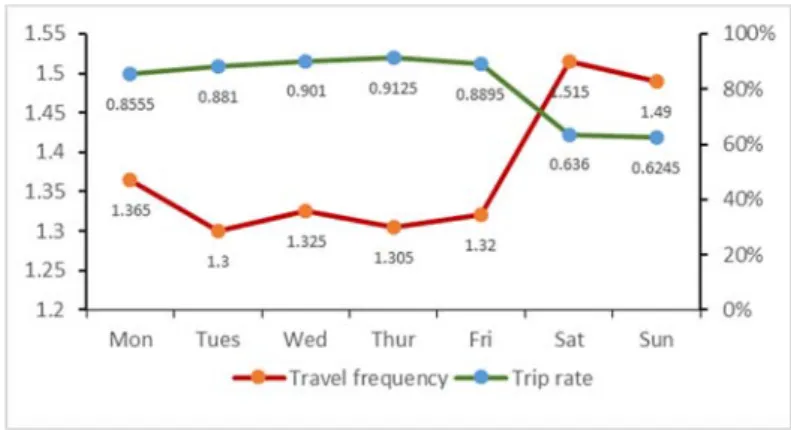
Travel frequency and trip rate reflects the level of life quality to some extent. Compared to weekdays, the trip rate decreased significantly on weekends (Figure 5). The number of trips per day on weekends was significantly higher than on weekdays. The proportion of multi-purpose trips declined on weekends, the proportion of shopping, leisure and other non- work activities rose on weekends (Table 3). Overall, on weekdays, suburbanites employ "less time, multi-purpose" travel, while on weekends
"multiple, single-purpose" travel.
between weekdays and weekends
1
Sig. 0.000 0.000 0.125 0.002 0.000 0.284 0.000
work housework shopping
personal
affairs sleeping travel leisure
Duration
(hour)
Mo
6.19 1.46 0.12 2.13 9.14 1.97 2.97
Tue
6.45 1.42 0.08 2.11 9.06 2.12 2.74
We
6.20 1.41 0.08 2.23 9.17 2.15 2.81
Thu
6.29 1.23 0.14 2.06 9.18 2.15 2.93
Fri 6.25 1.49 0.16 2.10 9.06 2.16 2.79
Sat 1.63 2.69 0.30 2.37 10.28 1.54 5.17
Sun 1.51 2.72 0.25 2.40 10.46 1.34 5.30
ANOVA between weekdays
and weekends F
121.03
1 82.436 2.369 9.816 235.904 1.147 340.466
Sig. 0.000 0.000 0.125 0.002 0.000 0.284 0.000
Figure 5. Travel frequency and trip rate of the samples Table 3. The percentage of trips by purpose
4.2 The activity space significantly deepened in the inner city on weekdays
With the three-dimensional space-time GIS visualization technology based on a time and geography framework, the activity pattern of the residents was visualized. The first two dimensions represent the Beijing urban space, while the third dimension represents time, and from bottom to top, it represents 0:00 to 24:00. The trajectory in three-dimensional space constitutes the space-time path. The line which is perpendicular to the spatial plane represents the time use of different activities. The podetium represents the different geographic range of the city in order to identify the residents' dependence on internal space. It can be found that on weekdays, as many residents need to commute to the inner city, the activity space is relatively large and was deeper in the inner city. At weekends, the paths of the individuals were very different in space and time and were deeper in the space of their communities and close surroundings (Figure 6).
multi-
purpose tour working stop shopping stop leisure stop home stop other stop
Mon 30.9% 37.9% 2.1% 6.2% 40.5% 13.4%
Tues 30.6% 37.6% 1.9% 6.3% 40.0% 14.3%
Wed 25.6% 37.6% 2.0% 5.2% 42.5% 12.8%
Thur 29.1% 37.6% 3.6% 5.6% 40.3% 12.9%
Fri 31.7% 35.8% 2.6% 6.8% 38.8% 16.1%
Sat 20.9% 14.0% 8.4% 13.0% 42.7% 22.1%
Sun 26.4% 11.0% 8.3% 12.7% 46.0% 22.2%
a. Space-time paths on weekdays
b. Space-time paths on weekends Figure 6. Space-time paths of the samples
4.3 "Semi-localization" type of working space, "near home" type of non-work activity space on weekdays
37% of the samples` commuting distance is within 2.5 km. 70%~80% of the residents work within a 10km range. About 10% of the residents need to work more than 15km, long-distance, from home. It shows that some suburbanites choose work in the inner city and some choose it in a local space, thus formed the "Semi-localization" type of working space. On weekdays, about 70% of the shopping activities occur within the range of 2.5km away from home and about 20% of the shopping activity occurs in the range of 5~15km away from the home. Beyond 15km little shopping activity occurs. On weekends, shopping activities occur within a 2.5km range, a slight decrease, and it decreased significantly for the 5~15km range, while outside the 15km range it increased significantly. As can be seen, on weekdays, residents shop in their own neighborhood or at work places. On weekends, the residents will choose to go to more distant shopping malls.
About 87% of the leisure activities occur within 2.5km from the home on weekdays and the proportion of leisure activities within a 2.5km range is slightly higher than that of the 20km distance proportion. The phenomenon of "near home" type of non-work activity space on weekdays is obvious (Figure 7).
a. Trip distance of work
b. Trip distance of shopping
c. Trip distance of leisure activities Figure 7. Trip distance of the activities
5. CONCLUSIONS AND DISCUSSION
With the rapid urbanization of China, urbanization has been human- oriented. The development of suburbs has gradually shifted from production,
0%
10%
20%
30%
40%
50%
60%
weekday weekend
0%
10%
20%
30%
40%
50%
60%
70%
weekday weekend
0%
10%
20%
30%
40%
50%
60%
70%
80%
90%
weekday weekend
space-oriented to living, space-oriented, from an emphasis on land function to the quality of residents’ lives. Through the analysis of suburban life time distribution and temporal characteristics of rhythm, we can explore the suburban life time planning. Through adjusting the opening hours of public facilities in the suburbs and the time schedule of the residents, urban planning and management can be refined and effective remedies can be found to the disadvantages in the existing urban planning system. Through the analysis of the spatial extent of suburbia, we can effectively analyze suburban living space structure and the utilization of different urban space areas as a starting point to build a suburban daily living space hierarchy.
Through the analysis of the daily activities, individual behavior planning can lead to innovation of the traditional planning system, for example providing personalized travel information services for the residents.
Over all, on the one hand, in the aspect of time, it is observed that the daily life of the suburban residents tends to be regular on weekdays, diversified and fragmented on weekends. On weekdays specifically, working activities constitute a dominant part of time allocation, while on weekends, housework and leisure activities constitute a greater part of time use. On the other hand, in the aspect of space, it is found that the majority of the suburban residents are employed in the inner suburban areas and most of the non-work activities take place in the suburbs, with the exception of shopping activities on weekends. Travel on weekdays is "less time and multi- purpose", while on weekends it is "multiple time, single-purpose". It could be concluded that the suburban areas in Beijing, while gradually shifting from dwelling space to living space for suburban residents, still need further promotion in job opportunities and shopping facilities. The results from the study shed light on the weekly space-time behavior pattern of suburban residents in China and provide beneficial implications for spatial planning and infrastructure construction in the suburban areas addressing the residents′ quality of life.
In the future, we will conduct further research. The day-to-day difference of behaviour patterns will be one directional. Using the detailed bahavior analysis, we can conduct pattern recognition and analyze the spatial- temporal variability and flexibility of travel behavior and activities. By combining the behaviour data to road network data, we can analyse the travel behaviour much further and calculate the potential activity area of the suburban Chinese residents. Also, the companionship between social networks and lifestyle is another direction for research. Activity analysis based on intra-household interaction and household task allocation can be conducted and transportation research using floating car data and IC card data can be done.Individual behaviour planning based on an activity-based approach is a planning application direction. In addition, living space planning, considering individual’s needs, can be focused on through physical and social space planning in communities with the aim of improving quality of life and reconstructing the lifestyles of communities. The third research direction is to influence time use planning in order to adjust the life rhythm of the city as well as affect the interactions of work and leisure, in order to build a more balanced life for individuals. Based on the above research, we want to contribute to the behavior aspect of urban transition theory in China and conduct a comparative study of suburban development between China and other countries from the perspective of behavior analysis.
ACKNOWLEDGEMENT
Thanks for the help of Wenbo Guo in terms of the writing process.
REFERENCES
Bromley, R., Tallon, A. R., et al.(2003). “Disaggregating the Space-Time Layers of City- Centre Activities and their Users”, Environment and Planning A ,35(10), 1831-1852.
Chai, Y.W., Chen, Z., et al. (2014). “Space-Time Behavior Survey for Smart Travel Planning in Beijing, China”, In: Rasouli, S.,&Timmermans, H.(Eds.) Mobile Technologies for Activity-Travel Data Collection and Analysis (pp. 79-90). Hershey, PA
Clapson, M.(2003). Suburban Century: Social Change and Urban Growth in England and the United States, Oxford,New York, Berg, 143-167.
England, K.V.L. (1993). “Suburban pink collar ghettos: the spatial entrapment of women?”.
Annals of the Association of American Geographers, 83(2), 225-242.
Fava, S. F.(1956). “Suburbanism as a Way of Life”,American Sociological Review,34-37.
Kain, J.F. (1992).“The spatial mismatch hypothesis: three decades late”, Housing policy debate, 3(2),371-460.
Kwan, M.P.(1999).“Gender the home-work link,and space-time patterns of non- employment activities”, Economic Geography, 75(4), 370-394.
Okamoto, K.(1997). “Suburbanization of Tokyo and the Daily Lives of Suburban People”, In:
Karan and Stapleton (eds.),The Japanese City, University Press of Kentucky, 79-105.
Preston, V. and McLafferty, S.(1999).“Spatial mismatch research in the 1990s: Progress and potential", Papers in Regional Science, 78(4), 387-402.
Rapino, M.A. and Cooke, T.J.(2011).“Commuting, gender roles, and entrapment: A national study utilizing spatial fixed effects and control groups”, The Professional Geographer, 63(2), 277-294.
Schwanen, T., Dijst, M., et al.(2002). “A Microlevel Analysis of Residential Context and Travel Time”, Environment and Planning A,34(8), 1487-1508.
Song, J.P., Wang, E.R., et al. (2007). “Housing suburbanization and employment spatial mismatch in Beijing”, Acta Geographica Sinica, 62(4),387-396.
Zhang, Y. and Chai, Y.W. (2011).“The Spatio-temporal Activity Pattern of the Middle and the Low-income Residents inBeijing,China”, Scientia geographica sinica,31(9),1056- 1064.
Zhou, Y.X. (1996). “On the suburbanization of Beijing”, Scientia Geographica Sinica, 16(3), 198-206.