Economics & Management Series EMS-2018-01
Does health insurance matter in the hospital? New evidence from patient-level medical records in Viet- nam
Lan Thi Thu Phan
Viet Duc University Hospital
Yusuke Jinnai
International University of Japan
September 2018
IUJ Research Institute
International University of Japan
These working papers are preliminary research documents published by the IUJ research institute. To facilitate prompt distribution, they have not been formally reviewed and edited. They are circulated in order to stimulate discussion and critical comment and may be revised. The views and interpretations expressed in these papers are those of the author(s). It is expected that the working papers will be published in some other form.
0
Does health insurance matter in the hospital?
New evidence from patient-level medical records in Vietnam
Lan Thi Thu Phan
1Yusuke Jinnai
2Abstract
Vietnam has achieved several Millennium Development Goals of the United Nations including child mortality reduction and maternal health improvement. The government of Vietnam aims to further improve health in Vietnam by expanding its public health insurance system originally introduced in 1993. Since health insurance is an essential tool to prepare for unexpected health shocks, the government plans to provide a public insurance system to cover eighty percent of its population by 2020. However, whether having health insurance is beneficial remains unclear and controversial. Some recent studies find positive impact of health insurance, while others argue that the quality of its services has been low due to limited coverage. In contrast to previous papers on Vietnam’s health policy that use data from nationwide Vietnam Household Living Standard Survey, this research uses more detailed, randomly-selected, patient-level medical records from Viet Duc University Hospital, the largest public surgical hospital in Vietnam. Using precise information on each patient’s treatment history and usage of health insurance, this paper provides new empirical evidence on the effect of health insurance.
Regression analysis shows that insurance helps patients stay 1.6 days longer in hospital and pay 48.6 percent less for their treatments than uninsured counterparts. This study also finds that financial burden between the insured and uninsured patients is larger in rural provinces than in the capital-city Hanoi, suggesting the significant advantages of health insurance for people in under-developed areas with fewer public hospitals. These new findings from patient-level information in Vietnam contribute to the growing literature on health insurance policies in developing countries and are particularly informative when governments plan to introduce nationwide public health-insurance systems.
Keywords: Health insurance, treatment, length of stay, out-of-pocket payment JEL Code: I13, I12, I10
1
Viet Duc University Hospital.
2
Corresponding author, International University of Japan, Email: [email protected], Tel: +81-
25-779-1401, Fax: +81-25-779-1187, Address: 777 Kokusai, Minami Uonuma, Niigata 949-
7277, Japan.
1 1. Introduction
Health care is a special service that contributes to the quality of life, and it has become the focus of considerable interest in both developed and developing countries over the past years. Especially in developing countries, health care is one of the most essential development strategies in addition to poverty reduction and economic growth.
In order to improve health care quality and health outcomes, the governments of a number of developing countries are trying to upgrade facilities, improve capabilities of medical staff, and provide better health insurance systems. However, introducing a nationwide public health insurance system is controversial, as it is costly and remains unclear whether the benefits exceeds the cost. Therefore, examining the differences between insured and uninsured patients is of particular policy interest, and the answers depend on each country’s health situation and insurance system.
Vietnam has achieved some of the United Nations’ Millennium Development Goals (MDG) including the target of MDG1 on poverty eradication (United Nations, 2012). Despite this accomplishment, health shocks still constitute a cause for poverty because people face financial burdens (World Bank, 2004). Therefore, together with a higher living standard, health has becomes an important factor for further development of the nation. Health insurance, in this regard, is helpful in reducing financial burden in case of health shocks (Wagstaff, 2005), and health insurance holders also have higher chances of accessing health care services.
According to a report from the Ministry of Health in 2011 (MOH, 2011), National
Health Insurance covered 50.8 million people or 58.2 percent of the total population in
Vietnam. This number increased to 61.8 million by the end of 2013 according to the
statistics of Vietnam’s Social Insurance (VSI, 2014), which was equivalent to almost 69
2
percent of Vietnamese population at the time. The government encourages health insurance and aims to cover 80 percent of population by 2020 (VSI, 2015).
However, questions have been raised on whether having health insurance results in better outcomes in the hospital. This issue has been controversial, as some papers such as Finkelstein (2012), Josep and Schmidt (2010), Ruiz (2009) find positive impacts of health insurance on treatment results, while others argue that quality of service, given to insured patients, is low and limited (Alkenbrack and Lindelow (2015), Cheng (2015)).
Vietnam is not out of this trend, and Palmer (2014) and Nguyen (2012) have evaluated the situation in Vietnam using the data from Vietnam Household Living Standard Survey.
This study attempts to fill the gap in answering whether health insurance matters in the hospital by examining the new patient-level medical records at Viet Duc University Hospital (VDUH), the largest public surgical hospital in Vietnam. With such detailed information, this paper expects to provide new empirical findings by using an actual hospital’s medical records to estimate the effects of health insurance.
In order to achieve this goal, this research randomly selected 1,393 medical
records out of the total inpatient records of VDUH in 2014 to construct a new data set
based on detailed administrative information and payment history of each patient. The
findings of this paper suggest that insured patients stay 1.6 days longer at the hospital and
pay 48.6 percent less than uninsured patients. Further analysis demonstrates that such
impact is larger in rural areas where few hospitals are available for local patients, pointing
to the significant advantages of health insurance. These findings contribute to the
literature particularly for the case of Vietnam, where the government is active in
introducing a nationwide public health insurance system.
3
The paper is organized as follows. The next section summarizes previous studies on the given topic; Section 3 provides background information on the health insurance system in Vietnam and introduces VDUH; Section 4 describes the patient-level dataset collected directly from VDUH; Section 5 explains the econometric model, Section 6 provides results and discussions, and Section 7 concludes with policy implications.
2. Literature review
A number of papers have discussed the impact of insurance on health outcome and health care utilization. It is an interesting but controversial topic especially when countries differ greatly in terms of standards of living and development level. Previous studies show that in some cases health insurance brings positive effects on health outcome and reduces out-of-pocket payment of patients but other findings show no significant impact on health utility or health care expenditure.
Insured patients may have more advantages in accessing health services as well
as improving health outcomes compared to uninsured patients. This mechanism has been
discussed in many studies across different countries. Finkelstein et al. (2012) evaluated a
higher health care utilization through the case of an Oregon health care experiment in the
United States. By using a lottery to give insurance to participants, they observed that after
the first year, insured group showed higher utilization in hospitalization, primary care and
preventive care as well. Furthermore, better physical and mental health was reported by
those in the insured group. Similarly, Doyle (2005) estimated the impact of insurance on
treatment process and mortality rate in cases of automobile accidents by using data from
hospitals in Wisconsin, U.S. His findings show that uninsured patients received 20
percent less care (amount of treatment) and faced a higher mortality rate than insured
4
patients. This was due to uninsured patients being more likely to be transferred to cheaper and less equipped hospitals. In another study for the case of Ghana, Josep and Schmidt (2010) show that health outcomes of women and neonatal babies have been improved thanks to a National Health Insurance Scheme. The health outcomes cover prenatal care for women, birth delivery at hospital with high professional attendance and less birth complications. Ruiz et al. (2007) also found that health insurance in Colombia has increased the health service utilization among patients in lower economic groups including ambulatory, inpatient services, and medication consumption. In addition, Keng and Sheu (2013) showed that National Health Insurance in Taiwan has reduced the rates of death by 16-48 percent for the least healthy group. The least healthy and female participants are the groups that benefited most. In the case of China, Wagstaff (2009) estimated the impact of subsidized health insurance applied in 2003 to poor people in rural areas and concluded that China’s New Cooperative Medical Scheme had increased both outpatient and inpatient medical service utilization. Investigating the impact of voluntary health insurance on health care utilization in Vietnam, Nguyen (2012) found that annual hospital visits of both inpatient and outpatient had increased by 45 percent and 70 percent respectively.
In discussions about financial burden, positive impact in reducing out-of-pocket
payment has been found in a number of papers such as Finkelstein et al. (2012, 2008),
Wagstaff (2011), Zhou (2009), and Sepehri (2006). On the other hand, several researches
have argued that insurance had no impact on out-of-pocket payment in particular and
health expenditure in general. Alkenbrack and Lindelow (2015) found that a community-
based insurance in Lao PDR had significant impact on health utilization, but no
significant impact on total out-of-pocket payment. Similarly, Cheng et al. (2015) also
5
reported that there was no evidence that out-of-pocket spending was reduced under New Cooperative Medical Scheme in China. For the case of Vietnam, using data from Vietnam Household Standard Survey in 2006 and 2008, Palmer (2014) showed that health insurance for children under six years old did not have significant impact on health care service expenditures per visit. In a previous study, which used the same data source from VHLSS in 2004 and 2006, Nguyen (2012) observed that voluntary health insurance had significantly increased the number of hospital visits but had no significant effect on out- of-pocket spending for health care services. These studies’ findings can be explained by the nature of the data source. Beside hospital fees, the reported out-of-pocket payments also included other expenses such as additional required medicine or nutrition, transportation, bonus for doctor, etc. (Nguyen, 2012).
Among the rich literature on the impact of health insurance, Doyle (2005) is one of a few unique papers that use data from a hospital to examine its impact for the case of automobile accidents in the United States. Following his approach, this current paper also examines the health-insurance effects based on the data from accurate medical records at a hospital, for the first time in Vietnam, and thus adds new empirical evidence to the literature.
3. Background of the study
3.1 Health insurance system in Vietnam
Vietnam’s Health Insurance Policy took effect in 1992 and has been regulated by
the Ministry of Health. The Health Insurance System has been established in all provinces
nationwide. Since January 1st, 2003, Vietnam’s Health Insurance (VHI) was moved to
Vietnam’s Social Insurance (VSI). Through two decades of development with three time
6
revisions, VHI has gradually changed its financial mechanism, health care policy, and contribution to health care services. Health Insurance Law officially took effect in July 2009 with the approval of Vietnam’s National Assembly.
According to the law, Vietnam’s health insurance encourages the entire population’s participation. Every citizen has the right to access health insurance. There are two types of health insurance: compulsory and voluntary health insurance.
Compulsory insurance is applicable to following groups: public servants, employers in private sector with a labor contract duration of more than three months, retired public staff, organ donator, the poor and other beneficiaries (war veterans, war heroes, people of merit, special target groups, children under six, and the poor), students (school) health insurance (for students in all levels), etc. Voluntary health insurance is for the rest of the population outside of the compulsory health insured group as mentioned above.
Vietnamese government has been trying to insure the whole population through
the national health insurance system. Figure 1 illustrates this progress of encouraging
different target groups to join the system over the past years. These applied changes aim
to give better benefits for insurance holders.
7 Health Insurance
Law
Employee’s
relatives, members of co-operative, others Decree
63 Students
Decree
58 Children under 6 years old, nearly poor
Decree 299
Employee in non-state owned enterprise (more than 1 employee), co-operative, legal organization, former veteran, poor people
Members of National Assembly, member of People Committee, kindergarten teachers, social policy groups, officer’s relatives
Public servant, employee in national enterprise, employee in foreign companies (>10 employees), retired officers, officers unable to work
1992 1998 2005 2009 2010 2012 2014
Figure 1: Insurance coverage process from 1992 – 2014 (Ministry of Health, 2011)
According to the 2010 annual report of Vietnam’s Social Insurance (VSI, 2010),
58.5 percent of the population was insured, 69.8 percent of the compulsory insurance’s
target group has joined compulsory insurance, while only 21.1 percent of the voluntary
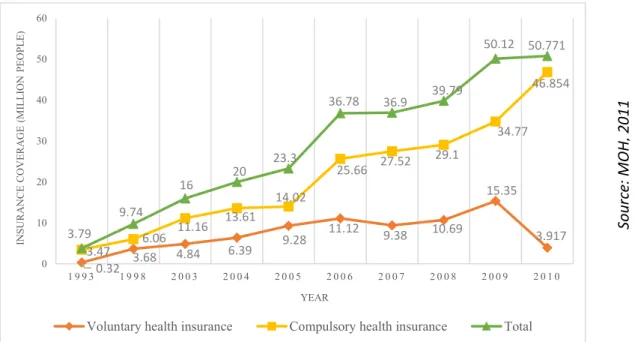
insurance’s target group has joined the insurance. Figure 2 demonstrates the increasing
coverage of health insurance from 1993 to 2010 in Vietnam. The number of insurance
participants has increased gradually over years. In 1993 when the health insurance was
first introduced, the number of participants was 3.89 million. After thirteen years of
8
operation, this number increased by ten times to 36. 8 million in 2006. Furthermore, four years later in 2010, 50.8 million people were covered by health insurance.
Figure 2: Insurance coverage by groups (1993-2010)
By the end of 2014, national health insurance covered 71.6 percent of the population (VSI, 2015). According to national strategy for health insurance coverage for the period 2015-2020 approved by National Assembly, VSI is implementing an action plan to reach a target of 80 percent coverage by 2020 (VSI, 2015). Health insurance is a government’s social policy to help its holders to share the risk and reduce the financial burden for health care services. However, the benefit of health insurance is still debatable, and according to Khiet (2008) many people blame it on the poor services. Based on Vietnam’s Household Living Standard Survey in 2006, 52 percent of annual outpatient service is paid with health insurance and around 60 percent of the insured group used health insurance when accessing health care services (Nguyen, 2012).
0.32 3.68 4.84 6.39 9.28 11.12 9.38 10.69
15.35
3.917 3.47 6.06 11.16 13.61
14.02
25.66 27.52 29.1
34.77 46.854
3.79
9.74
16 20 23.3
36.78 36.9 39.79
50.12 50.771
0 10 20 30 40 50 60
1 9 9 3 1 9 9 8 2 0 0 3 2 0 0 4 2 0 0 5 2 0 0 6 2 0 0 7 2 0 0 8 2 0 0 9 2 0 1 0
INSURANCE COVERAGE (MILLION PEOPLE)
YEAR
Voluntary health insurance Compulsory health insurance Total
Sou rce : M OH , 2 0 11
9
Based on the regulation of health insurance, when accessing the medical service in a partner hospital, upon displaying the insurance card at registration, the patient only pays the extra cost after insurance through a reimbursement scheme. The reimbursement scheme for insured patient is illustrated by Figure 3.
Reimbursement
scheme Insurance
(1) (2)
100%
- Police officer - People of merit - Social policy groups - Children under 6
- Consultation at village health station
95% - Loss-working-capacity support receivers
- Social support receivers
- The poor or Ethnic minorities in remote areas
80% - Others
70% - Consultation or treatment at hospital
level III (district level)
50% - Consultation or treatment at hospital
level II (provincial level)
30% - Consultation or treatment at hospital
level I, special level hospital (central level)
(1): Right way: Insured patient follows regulation of insurance from the registered health care station to higher level with reference of doctor
(2): Short way: Insured patient goes directly to higher level hospital than registered one.
Figure 3: Reimbursement scheme for insured patient by different levels
10
A premium for insurance is six percent of an individual’s monthly salary. The permanent member needs to renew his or her health insurance every year as required by the respective insurance institution. Nowadays, a health insurance card is accepted in both public and private healthcare providers but public providers are the main actor. According to Nguyen Minh Thao, Vice Director of VSI, in 2010, there were more than 7,600 public and 300 private healthcare clinics, centers, or hospitals accepting national health insurance (Dung, 2010). Among these, VHI has over 1,900 partner hospitals including both state and non-state owned which were mentioned in a later report of Ministry of Health (MOH, 2011). Furthermore, partners include more than eighty percent of health care stations at district level. This number has been increasing continuously thanks to the development strategies in health care system in Vietnam.
3.2 Viet Duc University Hospital
Viet Duc University Hospital (VDUH) is a state-owned hospital at the central level.
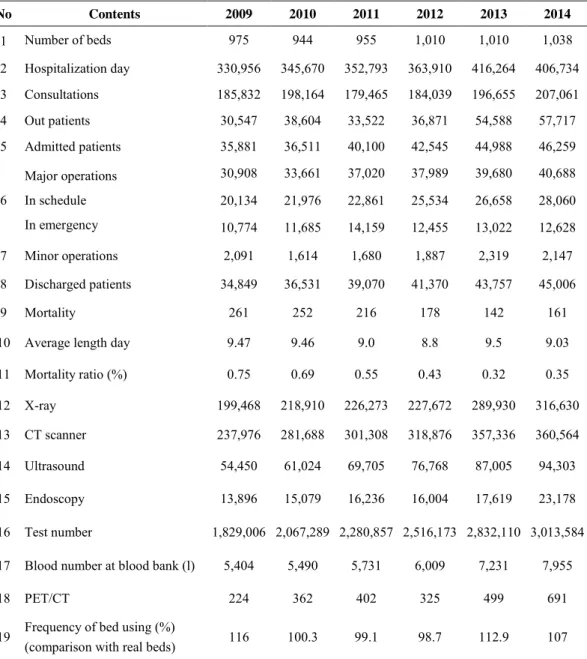
Although the hospital is located in Hanoi, the capital of Vietnam, VDUH’s patients come from over forty different provinces and cities. The annual average inpatient of VDUH is about 40,000 patients as shown in Table 1, which also provides the number of VDUH’s operations through 2009-2014. By the end of 2014, VDUH had 1,038 beds and plans to increase to 1,500 beds in the next three years.
Among inpatient cases, the number of insured patients has been increasing
gradually over the last decade. The proportion of insured and uninsured patients for the
past decade is demonstrated in Table 2.
11
Table 1: Statistics of VDUH’s service 2009-2014 (VDUH, 2015)
No Contents 2009 2010 2011 2012 2013 2014
1 Number of beds 975 944 955 1,010 1,010 1,038
2 Hospitalization day 330,956 345,670 352,793 363,910 416,264 406,734 3 Consultations 185,832 198,164 179,465 184,039 196,655 207,061
4 Out patients 30,547 38,604 33,522 36,871 54,588 57,717
5 Admitted patients 35,881 36,511 40,100 42,545 44,988 46,259
6
Major operations In schedule In emergency
30,908 33,661 37,020 37,989 39,680 40,688 20,134 21,976 22,861 25,534 26,658 28,060 10,774 11,685 14,159 12,455 13,022 12,628
7 Minor operations 2,091 1,614 1,680 1,887 2,319 2,147
8 Discharged patients 34,849 36,531 39,070 41,370 43,757 45,006
9 Mortality 261 252 216 178 142 161
10 Average length day 9.47 9.46 9.0 8.8 9.5 9.03
11 Mortality ratio (%) 0.75 0.69 0.55 0.43 0.32 0.35
12 X-ray 199,468 218,910 226,273 227,672 289,930 316,630
13 CT scanner 237,976 281,688 301,308 318,876 357,336 360,564
14 Ultrasound 54,450 61,024 69,705 76,768 87,005 94,303
15 Endoscopy 13,896 15,079 16,236 16,004 17,619 23,178
16 Test number 1,829,006 2,067,289 2,280,857 2,516,173 2,832,110 3,013,584 17 Blood number at blood bank (l) 5,404 5,490 5,731 6,009 7,231 7,955
18 PET/CT 224 362 402 325 499 691
19 Frequency of bed using (%)
(comparison with real beds) 116 100.3 99.1 98.7 112.9 107
Table 2: Insured and uninsured proportion in VDUH 2005-2015 (%) (VDUH, 2015)
Year 2005 2006 2007 2008 2009 2010 2011 2012 2013 2014
Insured 25.51 36.23 42.02 43.97 44.29 48.25 49.93 52.46 55.65 59.87
Uninsured 74.49 63.77 57.98 56.03 55.71 51.75 50.07 47.54 44.35 40.13
12
As a public hospital, VDUH has signed a contract with insurance companies to automatically deduct expenses from the insurance company when the insurance holders access the medical service at the hospital. Patients only have to show the insurance card at the registration desk for consultation or admission. The financial system records each patient’s detailed insurance profile. All the expenses covered by insurance will be automatically deducted when the patient is discharged from the hospital. Patients will only pay the extra expenses that are not covered by the insurance, as out-of-pocket payment or co-payment.
Since VDUH is the largest central surgical hospital with more than 1,000 beds as described above, it receives a large number of patients annually who are diversified by age, occupation, disease, living area, background, income, etc., which results in a large variation in the data used in this study.
4. Data
4.1 Data source and sample selection
This study uses individual-level data from the 2014 inpatient system of VDUH, which is a central surgical hospital receiving 40,000 inpatients on average every year.
From the data acquired from the financial system in VDUH, this number in 2014 was
43,246 patients which includes 59.9 percent of insured patients and 40.1 percent of
uninsured patients. Patients under 18 or over 70 years old were excluded as it is likely
that these patients were compulsory insured. Furthermore, sponsor treatment or special
care are also not the target of this study, hence patients with zero payment are also
excluded. After filtering out the above mentioned observations, the total sample includes
13
33,481 observations, of which 55.6 percent are insured patients and 44.5 percent are uninsured patients. However, the financial system does not provide all needed information for research purposes. The finance system and administration system maintain their own databases. Instead, we used the finance system’s database to randomly select 1,501 patients with information including their insurance status as well as payment details. Information about age, gender, career, address (district, city/province), length of stay, admitted time, emergency, operation, ICU and out-of-pocket payment after insurance of these 1,501 patients was collected from paper-based medical records.
Among these 1,501 cases, there were 89 patients with missing information, 3 cases outside of target age group (of 18 to 70), 4 non-residents and 12 patients with private insurance. Thus, we dropped these observations, and the final sample size was 1,393 observations that include 765 insured patients (54.9 percent) and 628 uninsured patients (45.1 percent) and no private insurance is included.
4.2 Summary of the data
Medical records are the most accurate and important documents at a hospital and are directly related to patients and treatment details. Hence, this research has an access to the most reliable data within this source. Table 3 shows the descriptive statistics of both insured and uninsured groups in the data set.
Table 3: Summary statistics of dummy variables
Variable
Insured group Uninsured group
(N=765) (N=628)
Observation % Observation %
Area
14
- Hanoi 193 25.23 186 29.62
- Red river delta area 220 28.76 234 37.26
- NE-coastal area 138 18.04 103 16.4
- Northern mountain 90 11.76 34 5.41
- Northern central 121 15.82 67 10.67
- Other areas 3 0.39 4 0.64
Female
- Female (1) 283 36.99 156 24.84
- Male (0) 482 63.01 472 75.16
Job
- Public officer 84 10.98 41 6.53
- Worker 53 6.93 78 12.42
- Farmer 234 30.59 196 31.21
- Free job 141 18.43 197 31.37
- Others 253 33.07 116 18.47
Income
- Good (1) 30 3.92 26 4.14
- Fair (2) 702 91.76 586 93.31
- Poor (3) 33 4.31 16 2.55
Result
- Recovery (1) 104 13.59 71 11.31
- Better (2) 633 82.75 531 84.55
- Unchanged (3) 16 2.09 14 2.23
- Worse (4) 12 1.57 11 1.75
- Died (5) 0 0 1 0.16
Emergency
- Yes (1) 261 34.12 391 62.26
- No (0) 504 65.88 237 37.74
Operation
- Yes (1) 611 79.87 491 78.18
- No (0) 154 20.13 137 21.82
ICU
- Yes (1) 13 1.7 11 1.75
- No (0) 752 98.3 617 98.25
Injury
- Yes (1) 196 25.62 410 65.29
- No (0) 569 74.38 218 34.71
Disease
- Head trauma 49 6.41 140 22.29
- Knee & lower leg injuries 47 6.14 67 10.67
- Biliary and pancreas 63 8.24 18 2.87
- Digestive organs 68 8.89 18 2.87
- Benign neoplasms 77 10.07 22 3.5
15
- Urinary calculus 54 7.06 33 5.25
- Hip and thigh injuries 18 2.35 26 4.14
- Abdomen back spine pelvis injuries 25 3.27 37 5.89
- Small bowel 31 4.05 17 2.71
- Multi-injuries 12 1.57 46 7.32
- Others 321 41.96 204 32.48
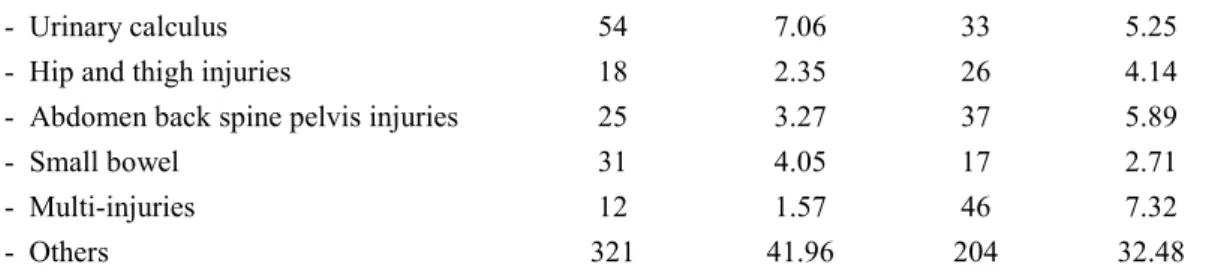
Table 3 shows comparable data in both groups by several variables. Regarding disease variable, medical records are kept in VDUH according to International Disease Code (IDC). The data set used in this study has 190 different disease codes by IDC (version 10). However, due to the purpose of the study, total diseases were grouped into top ten disease groups of VDUH in 2014, other diseases were put in “Others” group.
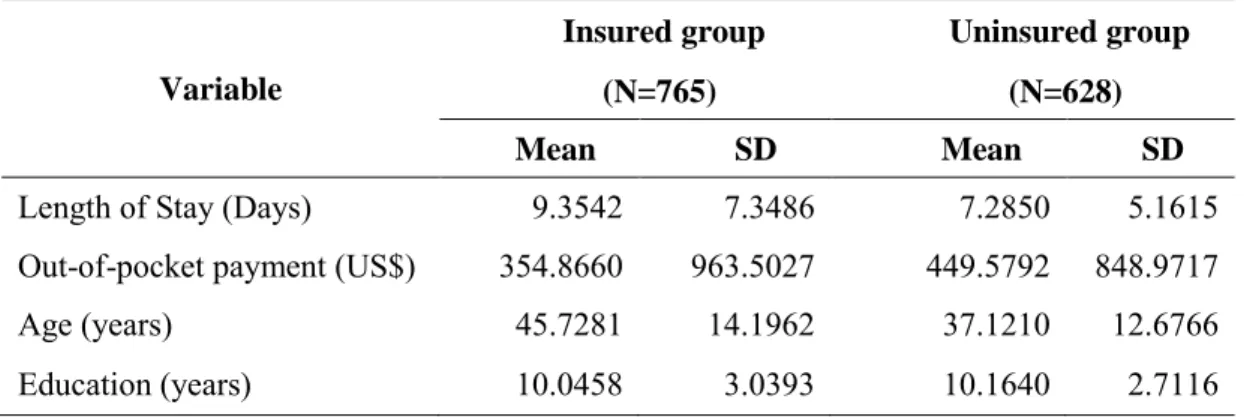
Table 4 below describes the discrete variables. Length of stay is the total number of days a patient is treated in hospital. The out-of-pocket payment is the co-payment from patient after insurance reimbursement which is collected and recorded in the hospital finance system. This payment has been converted from Vietnamese currency (VND) to US Dollar (US$). The patient’s age information is provided at registration (age in 2014).
Education is total years of patient’s education which is also provided at registration. The statistics above in Table 4 show a variety of observations with high standard deviations in all variables. The amount of out-of-pocket payment is high in comparison to the average GDP per capita of Vietnam in 2014, which is $2,052 (World Bank data, 2015).
This number is especially high for the control group (no insurance) with average co-
payment of about $450. The average length of stay is also long, which can be explained
by the situation of this specific hospital. As a central hospital, VDUH is a referral hospital
for serious cases from provincial hospitals. VDUH is also a referral hospital for surgery
16
in case of accidents. As a result, the length of stay at VDUH is expected to be longer than other regular, smaller hospitals.
Table 4: Summary statistics of discrete variables
Variable
Insured group Uninsured group (N=765) (N=628) Mean SD Mean SD
Length of Stay (Days) 9.3542 7.3486 7.2850 5.1615
Out-of-pocket payment (US$) 354.8660 963.5027 449.5792 848.9717
Age (years) 45.7281 14.1962 37.1210 12.6766
Education (years) 10.0458 3.0393 10.1640 2.7116
4.3 Dependent variables
The outcomes of this research are measured by two dependent variables: length of stay and out-of-pocket payment. First, length of stay is the number of days that a patient was admitted for treatment in VDUH. In the data set, the minimum stay is 1 day and the maximum is 62 days. In particular, Table 4 demonstrates that the mean value is 9.35 days for the treatment group and 7.28 days for the control group. Second, out-of-pocket payment is the amount of money that a patient pays after insurance reimbursement (in US$). This variable takes the mean value of $355 for the treatment group and $450 for the control group.
4.4 Independent variables
Other information of patients and treatment processes are recorded and used as
explanatory variables for estimation such as age, gender, region, income, education,
17
emergency, operation, ICU, disease etc. These variables are described under data summary (Table 3 and Table 4).
Beside the main variable of interest (insurance), the independent variables are grouped into two categories: personal characteristics and treatment characteristics.
Personal characteristics include all possible information about the patient through
registration: age, gender, region (by area, province and district level), income group and
education year. Treatment characteristics include all information regarding treatment in
hospital: whether the patient is in an emergency status or not (emergency), whether the
patient needs an operation or not, the total number of operations required, whether the
patient has an injury or not (injury status), which disease (disease code), whether the
patient needs intensive care or not (ICU).
18 5. Empirical strategy
To evaluate the impact of insurance on outcomes for patients, this study applies the following regression equation using information about the treatment of patients in the hospital.
Y
i= α + β
oInsurance
i+ β
1T
i+ β
2X
i+ u
i(1)
Y
iis the outcome for patient i which is measured by length of stay and out-of-pocket payment. Insurance
iis the dummy variable indicating health insurance status of patient i. T
iand X
iare other control variables where T
iis treatment characteristics given to patient i, and X
iis personal characteristics of patient i. Following the literature
3, this study also begins its analysis by using the Ordinary Least Square (OLS) model by controlling for key indicators of treatment and personal characteristics.
6. Results and discussion
The mean comparison of treatment outcomes in terms of length of stay and out-of- pocket payment (Table 4) shows that insured patients stay longer and pay less than the uninsured group. By using OLS and fully controlling for observed personal and treatment characteristics, the regression results are shown in Table 5 for both dependent variables.
3