L2日本語学習者にみられる『時の副詞節』の習得
journal or
publication title
Proceedings of the conference on second language research in Japan
year 1997‑03‑01
URL http://id.nii.ac.jp/1509/00000832/
Proceedings: The8'hInternational University of Japan Conference on SLR in Japan 1997
Acquisition of Japanese Temporal Clauses Yasuko Takata
Ohio University
Abstract
This study tests the One to One Principle (Andersen, 1984) in the adult JFL context, investigating the acquisition of Japanese temporal clauses. A one-to-one correspondence between form and aspect is observedin before- and after-clauses, but not in when-clauses in Japanese. Given the One to One Principle, itwashypothesized that before- and after-clauses would be acquired earlier than when-clauses. The results obtained from written and oral tasks with AmericanJFLlearners showed that even those who have mastered before- and after-clauses have not mastered when-clauses. Given the above assumption, it is concluded that the One to One Principle is operative in theJFLcontext. In addition, it is important to notice that the subjects in this study were taught when-clauses earlierthanbefore- and after- clauses. When-clauses were, however, acquired in the later stage. Thus, to the extent that before- and after-clauses are assumed to belong to a separate developmental stage from when-clauses, this study also supports the Teachability Hypothesis (Pienernann, 1984, 1989).
Furthermore, Pienernann (1985) proposes that L2 items should be taught in the order in which they are learnable. This study therefore suggests that a curriculum may be more effective ifbefore- and after-clauses are introduced earlierthanwhen-clauses.
1. INTRODUCTION 1.1 The One to One Principle
When acquiring a second language, learners attempt to produce a target language norm, constructing a separate language system from the preliminary analysis of their first language (Ll) and the second language (L2) (Selinker, 1969, 1972). This language system is understood as an interlanguage (IL), representing a continuum between the L 1 and the L2 and containing characteristics of both as well as features found in neither (Corder, 1971).
Inattempting to understand how interlanguage (IL) systems are constructed, Andersen (1984) proposes a principle called the One to One Principle. He claims that in the early stage of acquisition "an IL system should be constructed
insuch a way that an intended underlying meaning is expressed with one clear invariant surface form (or construction)" (Andersen, 1984, p. 79).
According to Andersen, the One to One Principle explains examples of IL constructions such as the negator placement. The studies of the acquisition of L2 English by Schumann (1978) and Stauble (1984) show that learners use
no V (no+. main verb) constructions
inthe first stage of acquisition of the English negative. Meisel (1983) also found in L2 German that learners place the negator immediatelybefore the constituent to be negated.
These findings suggest a tendency for the one possible position for the negator in early IL.
Considering the results of past studies like the above, Andersen claims that learners
attempt to maintain a one-to-one relationship between form and meaning in IL construction in
the early stage of second language acquisition (SLA); Since this principle is claimed to have
cross-linguistic validity (Andersen, 1984), it should apply to L2 Japaneseacquisition as well,
and in other grammatical constructs. This paper specifically examines the acquisition of
Japanese temporal adverbial clauses to test the One to One Principle.
1.2 Tense and Aspect in Japanese Temporal Adverbial Clauses
When we examine temporal adverbial clauses in English and Japanese, differences between the two languages are observed. The following are examples of before-clauses and after-clauses.
(1) a. Watashi-wa yuugohan-o taberu-mae-ni shukudai
-0suru.
I -top dinner -acc eat -before homework-ace do b. I do my homework before I eat dinner.
(2) a. Watashi-wa yuugohan-o taberu-mae-ni shukudai
-0shita.
I -top dinner -acc eat -before homework-ace did b. I did my homework before I ate dinner.
(3) a. Watashi-wa yuugohan-o tabeta-ato-ni shukudai
-0suru.
I -top dinner -acc ate' -after homework-ace do b. I do my homework after I eat dinner.
(4) a. Watashi-wa yuugohan-o tabeta-ato-ni shukudai
-0shita.
I -top dinner -acc ate -after homework-ace did b. I did my homework after I ate dinner.
In the above examples, one noticeable fact is the different usage of verb forms in temporal adverbial clauses in Japanese and English. In English, a present tense form is used in both a temporal and a main clause when a present habitual activity is mentioned, as in (1b) and (3b).
When a sentence describes a past (habitual) event, as in (2b) and (4b), a past tense form is used in both clauses. However, we see in the Japanese examples that the non-past form
taberu'eat' is used in the mae-ni 'before'-clause in both (la) and (2a). The former describes a present habitual activity with the non-past form matrix verb sum 'do,' while the latter describes a past (habitual) event with the past form matrix verb shita 'did.' On the other hand, the past form taheta 'ate' is used in the ato-ni 'after'-clause in both (3a) and (4a), although a present habitual activity is expressed in (3a) and a past (habitual) event in (4a).
To summarize the discussion so far, (1) to (4) exemplify the following facts of Japanese temporal clauses: regardless of whether the matrix verb is in a non-past or a past form, a non-past form verb should be used
ina mae-ni 'before'-clause and a past form verb in an ato-ni 'after'-clause. According to Nakau (1976), the simple past and the non-past tense forms of subordinate clause verbs function as indicators of present perfective and imperfective aspect, respectively, in Japanese. For example, in (2a), imperfective aspect, which is represented by the non-past form verb taberu 'eat,' indicates that the temporal clause event was not completed at the matrix event time. (3a) describes a temporal clause event which has been completed at the matrix event time because present perfective aspect is represented by the past tense form verb taheta 'ate.'
The perfect/imperfect contrast is also observed in Japanese toki-ni 'when'-clauses, as in (5)-(6).
(5) a. Watashi-wa Tokyo-e iku-toki-ni Tanaka-san-ni denwasuru.
I -top -to go -when -dat call
'I will call Ms. Tanaka when (=before) I go to Tokyo.'
b. Watashi-wa Tokyo-e itta -toki-ni Tanaka-san-ni denwasuru.
I -top
~towent-when -dat call
'I will call Ms. Tanaka when (=after) I arrive in Tokyo.' (6) a. Watashi-wa Tokyo-e iku-toki-ni Tanaka-san-ni denwashita.
I -top -to go -when -dat called
'I called Ms. Tanaka when (=before) I went to Tokyo.'
b. Watashi-wa Tokyo-e itta -toki-ni Tanaka-san-ni denwashita.
I -top -to went-when -dat called
'I called Ms. Tanaka when (=after) I arrived
inTokyo.'
As
we can see in the above examples, both non-past and past tense verbs can be used in
toki-ni'when'-clauses, depending on the meaning. The non-past and past tense verbs in
toki-ni'when'-clauses represent the imperfective and perfective aspect, respectively, as in
mae-ni'before'- and
ato-ni'after'-clauses (Nakau, 1976). For example, in (Sa), the non-past form of the verb
iku'go' indicates that the
toki-ni'when'-clause event "going to Tokyo" will not have been completed at the moment of the main clause event "calling Ms. Tanaka" in the future.
On the contrary, in (Sb), the past form verb
itta'went' means that the
toki-ni'when'-clause event will have been completed at the matrix event time.
In sum, a verb
ina
toki-ni'when'-clause represents the sequential time relationship
Ibetween the two events described by the
toki-ni'when'-clause and the main clause. The verb should be in a non-past form when the
toki-ni'when'-clause event follows the matrix event, and a past form verb is used when the
toki-ni'when'-clause event precedes the matrix event.
I
2. THE EXPERIMENTS 2.1 Hypothesis
We have seen that verbs
inJapanese temporal adverbial clauses have aspectual properties. (7) summarizes what has been presented in the previous section.
(7) non-past form (imperfective aspect) +
mae-ni'before' past form (perfective aspect) +
ato-ni'after' non-past form (imperfective aspect) \
+
toki-ni'when' past form (perfective aspect) /
As illustrated in (7), only one aspect is represented in
mae-ni'before'- and
ato-ni'after"-
clauses. The one-to-one relationship of form and aspect is observed in
mae-ni'before'- and
ato-ni'after'-clauses. On the contrary, either imperfective or perfective aspect is possible in
toki-ni'when' -clauses, Given Andersen's (1984) claim that learners tend to look for a one-to-
one relationship
~inIL construction, it is hypothesized that
JFLlearners will acquire
mae-ni'before'- 'and
ato-ni'after'-clauses before
toki-ni'when'-clauses. To test this hypothesis, two
grammaticality judgment tasks, written and oral, were conducted individually with American
JFLlearners.
2.2 Experiment 1: Written Task 2.2.1 Methodology
This experiment was conducted with 19 American students who were taking third and fourth year Japanese language courses at Ohio University. They were considered to be at least at the low-intermediate level of the ACTFL (American Council on the Teaching of Foreign Languages) proficiency scale. All of them had studied Japanese for at least two years at the university, with no previous experience in learning Japanese. The amount of instruction they had received was between 240 and 360 contact hours.
The written task consisted of 38 multiple choice questions with four choices. The questions and choices were written in Japanese scripts, with no English translation. Subjects were asked to fill in the, blank with the correct form of the verb to complete the temporal clause. (8) is a sample test item on a mae-ni 'before'-clause. For this question, subjects were expected to choose (a) because a mae-ni 'before'-clause requires the verb to be in a non-past form.
(8) Yamada-san-wa tenisu-o ( )-mae-ni tegami-o kaita.
-top tennis-ace -before letter -acc wrote 'Mr. Yamada wrote a letter before he ( ) tennis.'
a. suru 'play' b. shita 'played' c. either a or b d. none of the above
A sample test item on an ato-ni 'after'-clause is given in (9). Choice (b) was the correct answer for this question because the verb inside an ato-ni 'after' -clause should be in a past form.
(9) Suzuki-san-wa eiga
-0 ()-ato-ni baa-ni iku.
-top movie-ace -after bar-to go 'Miss Suzuki goes to a bar after she ( ) a movie.'
a. miru 'watch' b. mita 'watched' c. either a or b d. none of the above
(lO)
is a sample test item for a toki-ni 'when'-clause. Subjects were expected to choose (c) for this question because a toki-ni 'when'-clause can take either a non-past or a past tense form verb.
(10) Tanaka-san-wa gakkoo-ni ( )-toki-ni ongaku-o kiku.
. -top school-to -when music -acc listen 'Miss Tanaka listens to music when she ( ) to school.'
a. kuru 'come' b. kita 'came' c. either a or b d. none of the above
In addition to these types of questions, some questions were inserted as fillers to avoid
test effect. Two "different sets of task sheets, which contain the test sentences in different
orders, were also prepared to make sure that the order of questions would not have any
influence on the results.
2.2.2 Results
Table 1 shows the raw scores and correct response rate of the
mae-ni'before'- and
ato-ni'after'-clauses of each subject. The subjects were divided into two groups, with those who scored higher than 80% named as Group 1 and those who scored lower than 80% called Group 2.
Table 1
Raw scores and correct response rate of the
mae-ni-and
ato-ni-dlausesGroup 1 Group 2
..1"....
··2··· ··3····.. ··4··· ··5··· ··6··· ··7···if···· ··9·····"i"o···
··ff"" ···ii··"if"""i"4'" "is'" "iii'" "ii' '"is" ..1"9
8••••mae-nil 8 8 8 8 8 8 7 7 7 6 5 5 5 5 4 4 4 4 1
ato-ni /5
% 100 100 100 100 100 100 87.5 87.5 87.5 75 62.5 62.5 62.5 62.5 50 50 50 50 20 Perfect score=8.
·Subject No. 19 answered five questions out of eight.
As we can see in Table 1, nine subjects were placed in Group 1 according to their scores, and ten subjects in Group 2. The result of the t-test shows that there is a significant difference between these two groups
[t=8.11,
p <.001]. This means that there are two groups of subjects, those who had mastered and those who had not yet
masteredmae-ni'before'- and
ato-ni'after'-clauses.
In order to examine if the length of instruction has any influence on the results, the subjects were also divided into the group of third and fourth year students. Subjects 4,5,6,9, 11, 12, 14, 15, and 17 were third year students, and Subjects 1,2, 3, 7, 8, 10, 13, 16, 18, and 19 were fourth year students. The result of the t-test indicates that these groups are not significantly different
[t= 0.156]. Therefore, the length of instruction the subjects had received should not be considered in the analysis of the results.
Before discussing the results of the
toki-ni'when'-clauses, there is one point that needs to be mentioned. Let us consider (l0) again.
(10) Tanaka-san-wa gakkoo-ni ( )-toki-ni ongaku-o kiku.
-top school-to -when music -acc listen 'Miss Tanaka listens to music when she ( ) to school.'
a. kuru 'come' b. kita 'came' c. either a or b d. none of the above
Since a
toki-ni'when' -clause can take either non-past or past form, the expected correct answer for this question was choice (c). However, since no context was given as to whether the
toki-ni'when'-clause event had been completed or not, the sentence was ambiguous and the subjects were free to assign any context to the sentence. Therefore, we could not reject choices (a) [non-past form] and (b) [past form] as correct answers.
Table 2 presents the individual responses for
toki-ni'when' -clauses, categorizing
them into the six tense patterns. Because of the above stated reason, all of these patterns are
considered to be grammatical.
Table 2
Individual responses for toki-ni-clauses
Subjects Group 1 Group 2
Tense Patterns
Temporal verb Matrix verb ·T····..:i.....j....··4···· ··5···· ··6····..:;....
··s····
..g....··yo····iT··Tf" ·Tf···Y4"·· ··E·· ···i6···--cr·
··Y&"· ··Y9'··non-past non-past 0 2 2 2 0 2 2 2 0 1 1 2 0 0 2 2 0 1 1
past non-past 0 0 0 0 1 0 0 0 1 1 0 0 2 0 0 0 0 0 0
non-past past 0 1 1 2 1 0 0 1 0 0 0 0 0 0 1 1 0 0 0
past past 0 1 0 0 0 2 2 1 2 2 2 2 1 2 0 0 2 1 1
either non-past 2 0 0 0 1 0 0 0 1 0 1 0 0 0 0 0 2 1 0
either past 2 0 1 0 1 0 0 0 0 0 0 0 1 0 1 0 0 1 0
Total number of questions=4.
The numbers in the cells refer to the numbers of responses made by each subject.
As shown in Table 2, Subject No. 1 was the only subject who chose the answers we had expected. Since the test sentences were ambiguous, however, we cannot identify if the responses made by the subjects were the only correct answers available for them, because they may have made particular responses out of their preferences. For example, Subject No.
4 chose a non-past form for sentences whose matrix verb is in a non-past form. This does not mean, however, that he does not know that a verb can take a past form in a toki-ni 'when'- clause. He might have chosen a non-past form because he thought it was more appropriate in a particular context.
Thus, the results obtained from this task do not indicate that .the ' subjects had not completely acquired the usage of verbs in toki-ni 'when'-clauses, In order to test the subjects' knowledge on toki-ni 'when'-clauses more accurately, it was necessary to create a context in which toki-ni 'when' -clause sentences are disambiguated. For this purpose, the oral task was conducted as Experiment 2.
2.3 Experiment 2: Oral Task 2.3.1 Methodology
The subjects of Experiment 2 were the same 19 American students who participated in Experiment 1. The oral task consisted of 51 sentences accompanied by pictures. Four trial sentences were also added at the beginning of the experiment to familiarize the subjects with the format. All the sentences were recorded on tape beforehand.
In this task, a subject was asked to listen to the sentence which described a picture and to judge if it was correct or not. If the subject said it was incorrect, s/he was asked to give the reason and correct the error. By so doing, the possibility that the subject would give the right answer for the wrong reason, or simply guess, was avoided. A sample test item on a mae-ni 'before'-clause is given in (11). Subjects should have judged this sentence as ungrammatical, because the verb in themae-ni 'before'-clause is in the pastformshita'did,' rather than in the non-past suru 'do.'
(11) Tanaka-san-wa shukudai
-0shita-mae-ni terebi-o mita.
-top homework-ace did -before TV -ace watched 'Miss Tanaka watched TV before she did her homework.'
8:
00P'" 9:oop'"a ~1-.-
)
A
> (
~
Example (12), which contains a past form verb in the
ato-ni'after'-clause, is a grammatical item.
(12) Tanaka-san-wa terebi-o mita -ato-ni ongaku-o kiita.
-top TV -ace watched-after music -acc listened 'Miss Tanaka listened to music after she watched TV.'
As (11) and (12) show,
mae-ni'before'- and
ato-ni'after'-clause sentences have only one correct answer in Experiment 2 as well as in Experiment 1.
Now, let us turn to
toki-ni'when'-clause sentences. Because no context was given in Experiment 1, we could not judge the grammaticality of the choices made by the subjects. In Experiment 2, however, pictures create the context to the sentences, and thus we could test the subjects' knowledge on
toki-ni'when' -clauses. For example, subjects should have said that (13) was incorrect. The picture used in (13) indicates that the action "leaving her apartment" is completed. Therefore, the past form verb
deta'has left' should be used here to indicate the perfective aspect instead of the non-past
deru'leave,' which indicates the imperfective aspect.
(13) Tanaka-san-wa apaato
-0deru -toki-ni kagi-o otosu.
-top apartment-ace leave-when key -acc drop '(lit.) MissTanaka drops a key when she leaves her apartment.'
In addition to the above types of questions, fillers were randomly mixed to distract
subjects' attention to the target structures. Furthermore, as in the written task, two different
orders of the test sentences were prepared to avoid test effect.
2.3.2 Results
The number of correct answers was counted separately for the two types of questions:
those on
mae-ni'before'- and
ato-ni'after'-clauses and those on
toki-ni'when'-clauses. If a subject asked the experimenter to repeat a test sentence more than four times, the answer was counted as an incorrect answer. Judgments that were correct but for wrong reasons were also considered to be incorrect. Unexpected answers that were grammatical but different from the target structures were dropped and were not counted.
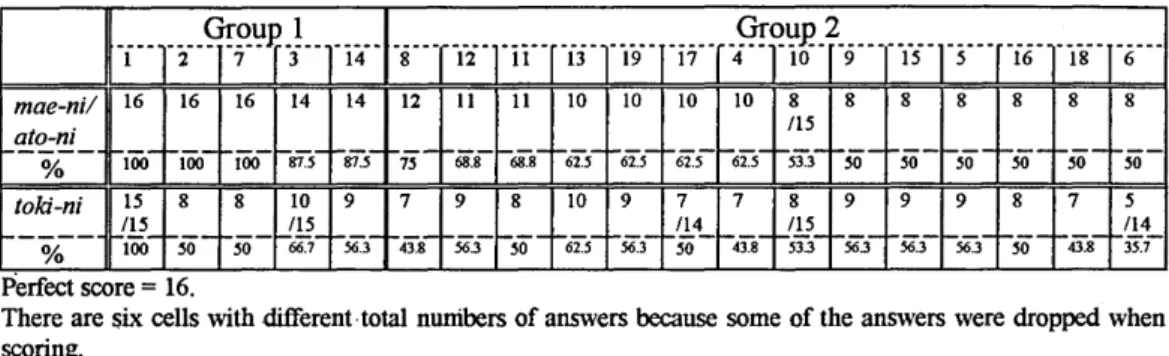
Table 3 shows the raw scores and correct response rate of each subject for each type of clause in the oral task.
Asin the previous task, subjects were divided into two groups, based on the percentage of correct answers in the
mae-ni'before'- and
ato-ni'after'-clauses.
Table 3
Raw scores and correct response rate of the oral task
....
9!"~1}£_!__
-8 ---i"i---'-9-·
_~~~.Q.2_________ .
-i6-
-is--
I 2 7 3 14 11 13 17 4 10 9 15 5 6
mae-nil 16 16 16 14 14 12 11 11 10 10 10 10 8 8 8 8 8 8 8
ato-ni /15
---
I-ioo- I-jOO----
-ru-.... ---
1-15-f-~--.--1-62:"s----
f - - -f - - -.... --
f - - ---- ---
1 - - -....--
f - - -% 100 87.S 68.8 68.8 62.5 62.5 62.S S3.3 50 50 50 50 50 50
toki-ni 15 8 8 10 9 7 9 8 10 9 7 7 8 9 9 9 8 7 5
/15 /15 /14 /15 /14
---
1--- 1 - - ----
1-66.7->-56".3-f-43.8- 1------
1-62:"r -56.3-1 - - -1-43.8-I-s"33-1-56'.3----
-56".3-1-50-1-43.8- 1-35:7% 100 50 50 56.3 50 50 56.3
Perfect score=16.
There are six cellswithdifferent- total nunibers of answers because some of the answers were dropped when scoring.
The five subjects who scored higher than 80% on
mae-ni'before'- and
ato-ni'after'-clauses were included in Group 1. The subjects in this group are considered to have mastered these clauses.
Incontrast, when examining the results of
toki-ni'when'-clauses, there seems to be no significant difference among the subjects, except for Subject No.1, who scored 100% on both types of questions.
When compared with the results of the written task presented in Table 1, we find that there are fewer subjects
inGroup 1 in the oral task. One particular point of interest is the fact that Subjects No.1, 2,3, and 7 placed
inGroup 1 in both of the tasks testing
mae-ni'before'- and
ato-ni'after'-clauses.
Subject No.5 and 9 were in Group 1 in the written task, but they scored only 50% on
mae-ni'before'- and
ato-ni'after'-clauses in the oral task. They judged that all the sentences were correct for the questions on these clauses. One possible explanation is that they might have judged by the content of the sentence and the picture, without paying much attention to the structure of the sentence.
Itis also conceivable that they happened to have guessed correctly in the written task.
In the analysis obtained from a split-plot design ANOVA, it was found that there is a
significant difference between the groups
[F(1, 17)
=41.70,
P=.000]. The data also indicate
that the questions on
mae-ni'before'- and
ato-ni'after'-clauses were easier for the subjects
than those on
toki-ni'when'-clauses
[F(1, 17) = 25.82,
P= .000]. A significant interaction of
Group x Condition (types of clauses) was found as well
[F(1, 17) = 9.76,
P= .006]. These
results are illustrated in Figure 1.
Figure 1
The interaction of Group x Types of clauses
100 90 80 70 60 50 40 30 20 10 _
0-,---,---,---,---,---,--===
mae-nilato-ni
Question Type
toki-ni
In both the written and the oral tasks, it was found that there are two groups of subjects, those who had acquired mae-ni 'before'- and ato-ni 'after'-clauses and those who had not. It has also been shown in the oral task that 18 subjects out of 19 have not yet mastered the use of verb forms intoki-ni 'when'-clauses.
These results indicate that mae-ni 'before'- and ato-ni 'after'-clauses are acquired earlier thantoki-ni 'when'-clauses. Because of the one-to-one relationship between form and aspect, mae-ni 'before'- and ato-ni 'after'-clauses are acquired earlier than toki-ni 'when'- clauses. We conclude that the One to One Principle is operative in the acquisition of Japanese temporal adverbial clauses.
3. DISCUSSION
3.1 The Teachability Hypothesis
Pienemann (1984, 1989) has proposed the Teachability Hypothesis, which states that
"the teachability of language is constrained by what the learner is ready to acquire"
(pienemann, 1989, p. 52) and that stages ofL2 development cannot be changed by instruction (see also earlier studies by Bailey, Madden, & Krashen, 1974; Dulay & Burt, 1973, 1974, Krashen, 1977, and others).
In his study on the acquisition of German as a second language (GSL), Pienemann (1984) examined the effect of instruction on GSL learners' interlanguage. The focus of his study was German word order. He presents the first four stages of the development of German word order as in (14), which is based on past longitudinal and cross-sectional studies by Clahsen (1980), Meisel, Clahsen, and Pienemann (1981), and Pienemann (1980).
(14) 1st stage: canonical word order (SVO) 2nd stage: adverb preposing (ADV) 3rd stage: particle shift (pARTICLE) 4th stage: [S-V] inversion (INVERSION)
(Pienemann, 1984, p. 190)
To examine the developmental stages of GSL word order, he conducted experiments with Italian children living in Germany. The children's speech was recorded in the forms of interviews and surreptitious recordings before and after the instructional periods so that the changes in their interlanguage could be investigated.
The results showed that a learner who was at the 2nd stage could not acquire 'INVERSION,' the item in the 4th stage, in spite of instruction. On the contrary, a learner who had acquired the item in the 3rd stage could learn 'INVERSION.' This means that the learner at the 3rd stage was ready to acquire the item in the 4th stage, whereas the learner at the 2nd stage was not.
Itindicates that instruction could not force the learner at the 2nd stage to skip the 3rd stage and learn the item in the 4th stage. The item in the 3rd stage is a prerequisite to acquiring an item in the 4th stage. Pienemann (1984) claims that a structure can only be learnable through instruction "if the learner's interlanguage has already reached a stage one step prior to the acquisition of the structure to be taught" (p. 186).
3.2 Implications
As presented in the previous section, it was found that
mae-ni'before' - and
ato-ni'after' -clauses are acquired before
toki-ni'when'-clauses. We observed that there were two groups of subjects: those who had not acquired either type of clause, and those who had acquired
mae-ni'before'- and
ato-ni'after'-clauses but not
toki-ni'when'-clauses (except for one subject). Table 4 summarizes the findings of this study.
Table 4
Summary of the findings
Group 2
mae-ni& ato-nitoki-ni
+=acquired, -=not acquired
: Group 1
r---
I Subject No. 1
>
+
>+
> - >
+
It is important to notice that the subjects in this study were taught
toki-ni'when'- clauses earlier than
mae-ni'before'- and
ato-ni'after' -clauses. In the Japanese program at Ohio University,
toki-ni'when'-clauses were taught during the first quarter of the second year, whereas
mae-ni'before'- and
ato-ni'after' -clauses were taught during the second quarter of the second year.. (15) illustrates the order in which these items were taught in the curriculum and the order in which they were acquired.
(15) Instruction
toki-ni
'when' Acquisition
mae-ni
'before'
& ato-ni
'after'
>
>
mae-ni
'before'
& ato-ni
'after'
toki-ni
'when'
As we can see in (15),
toki-ni'when'-clauses were acquired later regardless of the fact that
instruction was given on them earlier.
Thus, the results indicate that instruction was ineffective on
toki-ni'when'-clauses, and
mae-ni'before'-and ato-ni 'after'-clauses, which were taught later, were actually acquired earlier. Considering the results of both experiments, the subjects who had acquired
mae-ni'before'- and
ato-ni'after'-clauses but had not acquired
toki-ni'when'-clauses consist of five third-year and four fourth-year students. This means that the additional one-year instruction that the fourth-year students had received did not have influence on the results of
toki-ni'when'-clauses. The fact that some of the fourth-year students were more advanced than typical fourth-year students leads us to suggest that the difference in Japanese abilities between the third-year students and those fourth-year students was bigger than the difference that could be caused by this additional one-year instruction. If these three temporal clauses belong to the same developmental stage, it is not unnatural to expect that at least some of advanced fourth-year students had acquired
toki-ni'when'-clauses. However, the fact that none of those students had acquired
toki-ni'when'-clauses suggests that the time when
mae-ni'before'- and
ato-ni'after'-clauses are acquired is quite different from the time when
tokf-ni'when'-clauses are acquired.
Itis then reasonable to assume under Pienemann's framework that
mae-ni'before'- and
ato-ni'after'-clauses belong to a separate stage from
toki-ni'when'- clauses. To the extent that
mae-ni'before'- and
ato-ni'after'-clauses are in a separate developmental stage from
toki-ni'when'-clauses, the findings that
toki-ni'when'-clauses had not been acquired although the instruction was given earlier than
mae-ni'before'- and
ato-ni'after'-clauses can be taken as evidence supporting the Teachability Hypothesis.
As
an application of the framework of learnability It eachability, Pienemann (1985) made pedagogical recommendations, suggesting that items in a syllabus should be focused upon in the order in which they are learnable. In other words, we should follow the order of the developmental stages in' our syllabus design to make instruction most effective. With Pienemann's (1985) suggestion, the findings of the present study lead to the suggestion that
mae-ni'before'- and
ato-ni'after'-clauses should be introduced earlier than
toki-ni'when'- clauses in a Japanese language curriculum.
With this suggestion in mind, let us turn to the issue of textbooks which are currently available. It was mentioned earlier that
toki-ni'when'-clauses were taught earlier than
mae-ni'before'- and
ato-ni'after'-clauses in the curriculum at Ohio University. The same order of these items in the curriculum is observed in other textbooks on the market. Table 5 shows when they are introduced in three Japanese course books as well as in the original text (as yet unpublished) used at Ohio University.
Table 5
Comparison of Japanese textbooks
Ohio University Beginning Japanese
aYookosor Japanese for
original text (Jorden, (Tohsaku, Everyone
C(unpublished) 1963a, 1963b) 1994, 1995) (Nagara et aI., 1990)
toki-ni
Japanese 211 Part I: Book 1: Lesson 14
Grammar Point (16) Lesson 19 Chapter 7
mae-nil
Japanese 212 Part II: Book 2:
ato-ni
Grammar Point (2) Lesson 31 Chapter 1
"Lesson numbers areconsecutivethroughPartI andPartII in BeginningJapanese.
"BothYookoso! Book 1 and Book 2 consist of sevenchapters each.
cJapanese for Everyone consistsof 27 lessons.
We find in Table 5 that
toki-ni'when'-clauses are taught earlier than
mae-ni'before'- and
ato-ni 'after'-clauses in all these texts. In Japanese for Everyone (Nagara et al., 1990), only loki- nt 'when'-clauses are taught throughout the book, with no formal instruction given on mac-ni 'before'- and
ato-ni'after'-clauses.
The results of the present study question the effectiveness of the curricula which introduce
toki-ni'when'-clauses earlier than
mae-ni'before'- and
ato-ni'after'-clauses. We are now at the point where we need to reexamine the current curricula in Japanese language courses. This issue should be investigated in future research.
4. CONCLUSION
In this paper, I have examined the acquisition of Japanese temporal adverbial clauses, focusing on the aspectual properties of verbs. As claimed by Andersen (1984), my adult JFL learners searched for a one-to-one relationship between form and aspect in their interlanguage and the two Japanese temporal adverbial clauses which maintain the one-to-one relationship between form and aspect, i.e.,
mae-ni'before'- and
ato-ni'after'-clauses, were acquired earlier. We thus concluded that the One to One Principle is operative in the acquisition ofL2 Japanese.
When the order in which these clauses were taught was compared with the order in which they were acquired, it was found that
toki-ni'when'-clauses were acquired later although instruction was given on them earlier. This study supports the Teachability Hypothesis (pienemann, 1984, 1989) on the assumption that
mae-ni'before'- and
ato-ni'after'-clauses belong to a separate developmental stage from
toki-ni'when'-clauses. Based on Pienemann (1985), I have made a suggestion that we should introduce
mae-ni'before"- and
ato-ni'after'-clauses earlier than
toki-ni'when'-clauses in a syllabus.
Further studies are needed to strengthen the implications of this study. First, we need to examine whether the same results are obtained as this study from subjects using different textbooks and following different syllabi, since all of the subjects in this study were taught
toki-ni'when'-clauses earlier than
mae-ni'before'- and
ato-ni'after'-clauses, Experiments should be conducted with learners who use textbooks which (1) teach
toki-ni'when'-clauses earlier, (2) teach
mae-ni'before'- and
ato-ni'after'-clauses earlier, and (3) teach only
toki-ni'when'-clauses. Second, since the implications of this study were based on the assumption that
mae-ni'before'- and
ato-ni'after'-clauses and
toki-ni'when'-clauses would be found in separate developmental stages, we need to confirm that these clauses are acquired at different stages of acquisition. Moreover, it is necessary to specify which stages these temporal adverbial clauses belong to.
Furthermore, it is worth while examining this study based on the Processability Theory (pienemann, 1994), which Pienemann has developed within his earlier framework of teachability. This theory predicts which structures can be processed by the learner at a particular level of development. According to Pienemann (1994), the developmental sequence is determined by the sequence in which the processing prerequisites develop which are required to handle the L2 components. He proposes that learners can only acquire what they can process at a given time.
There seems to be a similarity between this theory and the One to One Principle,
because a one-to-one relationship of form and meaning is probably easy to process and thus it
is what learners look for in their early IL construction. The Processability Hypothesis might
therefore provide a more principled explanation for the One to One Principle. Thus, although
implications of this study could be ultimately and more definitively explained by the Processability Theory.
NOTES
*
This paper isbasedon an M.A thesis completed at Ohio University. To obtain the full version of this paper, please write to the following address: Department of Linguistics, Ohio University, Athens, Ohio 45701 USA*
I would like to express my deepest gratitude to my thesis committee members, Dr. Beverly Flanigan, Dr.Richard McGinn, and Dr. Yoichi Miyamoto, for their guidance and encouragement.
REFERENCES
Andersen, R. W. (1984). The one to one principle of interlanguage construction.
Language Learning, 34, 77-95.
Bailey, N., Madden, C, & Krashen, S. D. (1974). Is there a "natural sequence" in adult second language learning? Language Learning, 24, 235-243.
~Clahsen, H. (1980). Psycholinguistic aspects ofL2 acquisition: Word order phenomena in foreign workers' interlanguage. In S. W. Felix(Ed.), Second language development: Trends and issues (pp. 57-79). Tubingen: Gunter Narr.
Corder, S. P. (1971). Idiosyncratic dialectsand error analysis. International Review of AppliedLinguistics in Language Teaching, 9, 147-160.
Dulay, H. C., & Burt, M. K. (1973). Shouldwe teach children syntax? Language Learning.. 23, 245-258.
Dulay, H. C., & Burt, M. K. (1974) Natural sequences in child second language acquisition. Language Learning, 24, 37-53.
Jorden, E. H. (1963a). Beginning JapanesePart
I.New Haven, CT: Yale University Press.
Jorden, E. H. (1963b). Beginning JapanesePart n. New Haven, CT: Yale University Press.
Krashen, S. D. (1977). Some issues relating to the Monitor Model. In H. D. Brown, C. A. Yorio, & R. H. Crymes(Eds.), Teaching and learning Englishas a second language:
Trends in research and practice (pp. 144-158). Washington, D.C.: TESOL.
Meisel, J. M. (1983). Strategies of second languageacquisition: More than one kind of simplification.
InR. W. Andersen (Ed.), Pidginization and creolization as language acquisition (pp. 120-157). Rowley, MA: Newbury House.
Meisel, J. M., Clahsen, H., & Pienemann, M. (1981). On determining developmental stages in natural second language acquisition. Studiesin SecondLanguage Acquisition. 3, 109-135.
Nagara, S., Nakanishi, Y., Iguchi, A., Chino, N., Shimomura, A., Yokobayashi, H., Yamaura, Y., Hayashi, S., Hayashi, N., & Saito, A. (1990). Japanesefor everyone: A functional approach to dailycommunication. Tokyo: Gakken.
Nakau, M. (1976). Tense, aspect, and modality. In M. Shibatani (Ed.), Syntax and semantics: Vol. 5. Japanese generative grammar (pp. 421-482). New York: Academic Press.
Pienemann, M. (1980). The second languageacquisition ofimmigrant children. In S.
W. Felix (Ed.), Second language development: Trends and issues (pp. 41-56). Tubingen:
Gunter Narr.
Pienemann, M. (1984). Psychological constraints on the teachability oflanguages.
Studies in Second Language Acquisition. 6, 186-214.
Pienemann, M. (1985). Learnability and syllabus construction. In K. Hyltenstam & M.
Pienemann (Eds.), Modelling and assessing second language acquisition (pp. 23-75).
Clevedon, Avon: Multilingual Matters.
Pienemann, M. (1989). Is language teachable? Psycholinguistic experiments and hypotheses. Applied Linguistics, 10,52-79.
Pienemann, M. (1994). Towards a theory of processability in second language acquisition. Unpublished manuscript, Australian National University.
Schumann,J. H. (1978). The pidginization process: A model for second language acquisition. Rowley, MA: Newbury House.
Selinker,L. (1969). Language transfer. General Linguistics, 9, 67-92.
Selinker,L. (1972). Interlanguage. International Review of Applied Linguistics in Language Teaching, 10, 209-231.
Stauble, A. -M. (1984). A comparison ofa Spanish-English and a Japanese-English second language continuum: Negation and verb morphology. In R. W. Andersen (Ed.), Second languages: A cross-linguistic perspective (pp. 323-353). Rowley, MA: Newbury House.
Tohsaku, Y. (1994). Yookoso! Book 1:Aninvitation to contemporary Japanese. New York: McGraw-Hill.
Tohsaku, Y. (1995). Yookoso! Book 2: Continuing with contemporary Japanese. New York: McGraw-Hill.
APPENDIX A Experiment 1: Test Sentences ( ) = Question Number in Task Set (A) mae-ni'before'
(7) Tanaka-san-wa gakkoo-ni ( )-mae-ni koohii-o nomu.
-top school -to -before coffee-ace drink 'Miss Tanaka drinks coffee before she ( ) to school.' a. iku 'go' b. itta 'went' c. either a or b (10) Yamada-san-wa tenisu-o ( )-mae-ni tegami-o kaita.
-top tennis-ace -before letter -acc wrote 'Mr.Yamada wrote a letter before he ( ) tennis. '
a. suru 'play' b. shita ,'played' c. either a or b
d. none of the above
d. none of the above (17) Suzuki-san-wa Yamada-san-ni ( )-mae-ni depaato -ni iku.
-top -dat -before department store-to go 'Miss Suzuki goes to the department store before she ( ) Mr. Yamada.'
a. au 'meet' b. atta'met' c. either a or b d. none of the above (32) Suzuki-san-wa Honda-san-ga ( )-mae-ni keeki-o tabeta.
-top -nom -before cake -acc ate 'Miss Suzuki ate cake before Miss Honda ( ).'
a. kaeru 'return' b. kaetta'returned' c. either a or b d. none of the above
ato-ni
'after'
(1) Yamada-san-wa piza
-0 (j-ato-ni shukudai
-0shita.
-top pizza-ace -after homework-ace did 'Mr. Yamada did his homework after he ( ) pizza.'
a. taberu 'eat' b. tabeta 'ate' c. either a or b d. none of the above.
(21) Suzuki-san-wa eiga
-0 (j-aro-ni baa-ni iku.
-top movie-ace -after bar-to go 'Miss Suzuki goes to a bar after she ( ) a movie.'
a. miru 'watch' b. mita 'watched' c. either a or b d. none of the above (26) Tanaka-san-wa kurasu-ga ( )-ato-ni koohii-o nomu.
-top class -nom -after coffee-ace drink 'Miss Tanaka drinks coffee after the class ( ).'
a. owaru 'finish' b. owatta 'finished' c. either a or b d. none of the above (31) Honda-san-wa koohii-o ( )-ato-ni gakkoo-e itta.
-top coffee-ace -after school-to went 'Miss Honda went to school after she ( ) coffee.'
a. nomu 'drink' b. nonda 'drank' c. either a or b d. none of the above
toki-ni'when'
(5) Honda-san-wa resutoran
-0 ()-toki-ni tomodachi-ni atta.
-top restaurant-ace -when friend -dat met 'Miss Honda met her friend when she ( ) the restaurant.'
a. deru 'leave' b. deta 'left' c. either a or b d. none of the above (12) Ito-san-wa koronbasu-ni ( )-toki-ni hanbaagaa
-0taberu.
-top Columbus-to -when hamburger-ace eat . 'Miss Ito eats hamburger when she ( ) to Columbus.'
a. iku 'go' b. itta 'went' c. either a or b d. none of the above (22) Yamada-san-wa koronbasu-kara ( )-toki-ni Suzuki-san-ni denwashita.
-top Columbus-from -when -dat called 'Mr. Yamada called Miss Suzuki when he ( ) from Columbus.'
a. kaeru 'return' b. kaetta 'returned' c. either a or b d. none of the above (23) Tanaka-san-wa gakkoo-ni ( )-toki-ni ongaku-o kiku.
-top school -to -when music -acc listen 'Miss Tanaka listens to music when she ( ) to school.'
a. kuru 'come' b. kita 'came' c. either a or b d. none of the above
APPENDIXB Experiment 2: Test Sentences ( ) = Question Number in Task Set (A)
o =
grammatical item, X=
ungrammatical item mae-ni 'before'(2) 0
(7) X
(13) X
(18) 0
(24) X
(28) X
(42) 0
(51) 0
ato-ni 'after'
Tanaka-san-wa daigaku -ni iku-mae-ni rajio -0 kiita.
-top university-to go -before radio-ace listened 'Miss Tanaka listened to the radio before she went to school.' Tanaka-san-wa suupaa -ni itta -mae-ni tegami-o kaita.
-top supermarket-to went-before letter -acc wrote 'Miss Tanaka wrote a letter before she went to the supermarket.' Tanaka-san-wa yoru neta -mae-ni terebi-o miru.
-top night slept-before TV -acc watch 'Miss Tanaka watches TV before she goes to bed.'
Tanaka-san-wa tenisu-o suru-mae-ni denwa -0 shita.
-top tennis-ace play-before telephone-ace did 'Miss Tanaka made a phone call before she played tennis.' Tanaka-san-wa Suzuki-san-ni atta-mae-ni suupaa -ni iku.
-top -dat met-before supermarket-to go
'Miss Tanaka goes to the supermarket before she meets Miss Suzuki.' Tanaka-san-wa shukudai -0 shita-mae-ni terebi-o mita.
-top homework-ace did -before TV -acc watched 'Miss Tanaka watched TV before she did her homework.' Tanaka-san-wa benkyoosuru-mae-ni depaato -ni iku.
-top study -before department store -to go 'Miss Tanaka goes to the department store before she studies.' Tanaka-san-wa gakkoo-ni iku-mae-ni koohii -0 nomu.
-top school-to go -before coffee-ace drink 'Miss Tanaka drinks coffee before she goes to 'school.'
(1)
o
Tanaka-san-wa ongaku-o kiita -ato-ni tegami-o kaku.-top music -acc listened-after letter -acc write 'Miss Tanaka writes a letter after she listens to music.'
(4) X
(17) X
(22) 0
(25) 0
(30) 0
(38) X
(54) X
toki-ni 'when'
(5) X
(9) 0
(11) 0
(14) X
Tanaka-san-wa tegami-o kaku-ato-ni biiru-o nonda.
-top letter -ace write-after beer-ace drank 'Miss Tanaka drank beer after she wrote a letter.' Tanaka-san-wa hon -0 yomu-ato-ni terebi-o mita.
-top book-ace read -after TV -ace watched 'Miss Tanaka watched TV after she read a book.'
Tanaka-san-wa denwa -0 shita-ato-ni hon -0 yonda.
-top telephone-ace did -after book-ace read 'Miss Tanaka read a book after she made a phone call.' Tanaka-san-wa terebi-o mita -ato-ni ongaku-o kiita.
-top TV -ace watched-after music -ace listened 'Miss Tanaka listened to music after she watched TV.' Tanaka-san-wa shinbun -0 yonda-ato-ni daigaku -ni iku.
-top newspaper-ace read -after university-to go 'Miss Tanaka goes to school after she reads the newspaper.' Tanaka-san-wa benkyoosuru-ato-ni tegami-o kaku.
-top study -after letter -acc write 'Miss Tanaka writes a letter after she studies.'
Tanaka-san-wa eiga -0 miru -ato-ni gohan-o taberu.
. -top movie-ace watch-after meal -ace eat 'Miss Tanaka eats a meal after she watches a movie.'
Tanaka-san-wa koronbasu-ni iku-toki-ni shiidii-o katta.
-top Columbus -to go -when CD -ace bought '(lit.) Miss Tanaka bought a CD when she goes to Columbus.' Tanaka-san-wa daigaku -ni iku-toki-ni itsumo Suzuki-san-ni au.
-top university-to go -when always -dat meet '(lit.) Miss Tanaka always meets Miss Suzuki when she goes to school.' Tanaka-san-wa kyooshitsu-o deru -toki-ni pen-o otoshita.
-top classroom -ace leave-when -ace dropped '(lit.) Miss Tanaka dropped a pen when she leaves the classroom.' Tanaka-san-wa ie -ni kaetta -toki-ni itsumo Suzuki-san-ni au.
-top home-to returned-when always -dat meet '(lit.) Miss Tanaka always meets Miss Suzuki when she returned home.'
(23) 0
(26) X
(33) X
(37) X
(40) 0
(43) X
(45) X
(49) 0