1. Introduction
Butler (1980) originated a clear concept of the tourism area life cycle (TALC). His latest review of TALC mentioned the insufficiency of its theo- retical explanations (Butler (2009)) whereas almost a quarter of century has spent on inquiring tourism development from the TALC viewpoint. Accord- ing to him, this is not only due to the heterogeneity of tourism markets but also due to its vulnerability which a changing behavioural pattern of external agents exposes, and difficulties of the analytical tool will be predicted to overcome through new ideas to describe uncertainties of the economy.
As he mentioned, the tourism market determines a pattern of the tourism development. Like other goods and services, the demand for tourism servic- es meets the supply of tourism services such as accommodation, caterings,
商学論纂(中央大学)第55巻第3号(2014年3月) 347
A Dynamic Property of Tourism Area Life Cycle : Consumer Behaviour Perspectives
*Masahiro Y
ABUTAContents
1. Introduction
2. Characteristics of Tourism – Supply, Demand and the Market 3. Intuitive Explanation
4. Dimensions of Tourism Area Development - A Summary
* It is a great honour for me to dedicate this paper to Professor Kishi in com-
memoration of his achievements and all his kindness. I also wish him every
happiness and prosperity.
attractions, landscape and natural environment at the tourism market. How- ever, it is also true that various externalities such as natural or human-origi- nated disasters and public policy measures should have a striking effect on the tourism market. Accordingly, a complicated phase of tourism dynamics comes from various factors that affect the tourism demand, the supply-side to provide tourism services, the functions of the tourism market and the ex- ternal factors on tourism. Heterogeneity of tourism services can affect tour- ism development partly through a changing pattern of tourists ʼ behaviour.
Various restrictions such as the natural environment and cultural heritages affect the supply of tourism services. Moreover, a company to promote tour- ism in a specific site tends to increase the loss of economic social welfare due to its monopolistic power.
The major aim of this paper is to develop the TALC model by taking these complicated impacts of the tourism market into consideration. Chapter 2 ex- amines some specific features of the tourism market from demand, supply and market mechanism. Chapter 3 focuses a topic of the heterogeneity of the tourists ʼ behaviour that affects the demand of tourism services. At an early stage of the development of tourism destination might be not so popu- lar that only a few tourists are concerned about the destination. They visit because only a few visitors visit, meaning that they are snob type of consum- ers. As the more tourists visit and the tourism site develops, visitors tend to visit there, meaning that they are bandwagon type consumers. Chapter 4 shows how the changing pattern of visitors ʼ choice behaviour from ʻ snob ʼ to ʻ bandwagon ʼ affects a development pattern of tourism destination, mainly from the perspectives of the TALC.
2. Characteristics of Tourism – Supply, Demand and the Market
Regarding markets and their functions there are many resemblances be- tween tourism and other industries. Therefore, it should be more meaning- ful to focus on points of difference between them.
2.1 Supply
As far as the supply-side of tourism is concerned, its capability of produc-
( ) 349
tion or production technology is different from other goods and services.
Under certain circumstances, mass-production or mass supply of tourism services is impossible or very restricted due to a limited capability of a tour- ism site. Environmental aspects including congestion phenomenon could be the factors to restrict the tourism development. Moreover, infrastructures, such as transportation and water supply, connect more closely with tourism services. As far as a physical distribution system is concerned, demand-ori- ented logistics from factories to densely populated urban areas have devel- oped. As a result, developers have planned and managed efficiently the infra- structures of transportation logistics in order to gain the benefits of concentration and accumulation of the cities. In case of tourism services, however, the supply-oriented logistics from urban areas to local tourism sites have not made infrastructures develop efficiently. Hence, it is easy to see that infrastructures tend to be under-invested or inadequately invested for tourism development. Moreover, the tourism services generally form a com- plex of goods and services. Namely, a series of services from accommoda- tion to attractions is provided as a compound tourism service (i.e. an amal- gam by Vanhove (2005))
1). It may be possible at a tourism site that an increase of rooms of luxury resort hotel can lead to an increase of visitors at the attraction. Therefore, the tourism network among actors in a tourism site that also implies a complicated structure of supply side of tourism ser- vices should play an important role for tourism development. This implies that the theoretical framework of tourism development should include as- pects of connections or relationship among actors of supply-side.
2.2 Demand
In consuming the tourism services, tourists like other consumers behave as a utility maximiser. Under the budget and the time constraints, informa-
1) According to tourism satellite account (TSA), the tourism sector contains
the five main sectors ;
attraction sector, accommodation sector, transportation
sector, travel organizer sector and destination organization sector. Actors,
though some public organizations are included except for private companies,
are connected each other within and over domains of tourism site.
tion about relative prices allows tourists to choose what they want to con- sume. Consumers ʼ behaviour for the bland-name products or their heteroge- neity of the snob type or the bandwagon type can be analysed within an orthodox framework of microeconomics. However, there are a few distinc- tive features regarding the demand-side of tourism services. First, the tour- ism services are time-consuming so that an opportunity cost is more impor- tant when tourists decide how much they spend on tourism. This means that evaluation of leisure time relative to working time should be a key for tour- ists ʼ decision making, with a tendency to shorter working days, timesaving improvement of transportation or a changing lifestyle for sustainability lead- ing to an increase in tourism demand. Second, the tourism services should be on-site and locally provided. Then it is very natural to accept that tourists enjoy various tourism services at a certain tourism site but simultaneously they enjoy the tourism site itself. Accordingly, tourists can enjoy everything, which tourism sites provide including their geographic factors such as atmo- spheres, local climate and natural environment or even their historical fac- tors. Tourists could not manage their decision-making on tourism expendi- ture without considering the tourism site. Therefore such indivisibility between tourism services (or productions) and tourism sites where they are provided should be a conspicuous feature. This means that tourists ʼ choice of services should always entail their choice of destinations.
2.3 Market
The market structure of tourism services might be more complicated
than other sector not only because of their amalgamable attributes but also
because of indivisibility between services and their locality. There should be
at least two levels of market structure in tourism sector. One is the competi-
tions within a tourism site. Among a forest of high-rise hotels or among
some huge attractions, or between the coastal seaside and the hinterland at
Gold Coast tourism, businesses compete each other. The other concerns the
competitions among tourism sites. A destination should compete with other
destinations for struggling shares of tourists. Actors in Gold Coast, for ex-
ample, should compete not only with those in other famous costal resorts all
( ) 351
over the world but also with those in Sunshine Coast. Then an overall attrac- tiveness of each destination and the distance from tourists ʼ starting points might become important factors for them to determine tourism demand. Al- though any traditional procedures for analysing market structure such as monopoly, monopolistic competition and oligopoly apply to tourism industry, a new analytical framework may be needed for investigating how competi- tions among tourism destinations carry on.
Like other markets, the tourism market receives some discretional inter- ventions of public policy, which affect the market equilibrium. To eliminate some inefficient outcomes through the market failures, such as a monopoly with barriers to entry, an environmental deterioration by pollution, an insuf- ficient provision of public goods and an overuse of common pool resources, the government or related authorities should take actions. A restriction on the number of tourists at a natural tourism site is a typical policy to keep it sustainable and a de-regulation policy to induce competitions among compa- nies could reduce price to its competitive level. A characteristic feature of public policy of the tourism services is, if any, not in its variety but in its scope. Except for the mega-hotel chains or the worldwide aviation alliances, issues of imperfect competition at a tourism site may be insignificant be- cause the welfare loss cause by imperfect competition at a tourism site can be very limited and small. In a tourism site, tourists or residents may clearly recognize the welfare losses when the congestions occur in the main street, when the traffic jam pollutes the local air, or when an unusual building ruins a beautiful landscape. Accordingly, it is notable to conclude that as far as the tourism market is concerned, public policies should mainly focus on region- originated issues such as pollution, environmental preservation and re- source management.
3. Intuitive Explanation
3.1 Heterogeneity of tourist
As Butler (2009) regarded as important, the model analysis should intro-
duce the heterogeneity in both demand and supply. One of the established
procedures is to consider the heterogeneous consumers among whom there
are social interactions. These interpersonal effects among consumers have been analysed by Leibenstein (1950), Granovetter and Soong (1985), Corneo and Jeanne (1997a, 1997b) from the economics of consumer behaviour view- points. Although the heterogeneity of tourists ʼ behaviour plays an outstand- ing role for the tourism development, few researchers have investigated this issue. An exceptional paper is Cowan et al. (1997), which concerned the in- teractions among consumers and took the market of holiday resorts as a typ- ical example of interdependencies in consumption. They only gave a hint of the possible dynamics of a tourism site associated with the evolution process from the ʻ rich and famous ʼ area to ʻ mass and vulgar ʼ area, or ʻ a distinctive and select resort to downmarket ʼ . Although Cowan et al. (1997) mainly focused on the generation process of social norms, its application to consumption norms is useful to explain the actual consumer behaviours. Following Leibenstein (1950), they mentioned the consumption norms to give ʻ band- wagon ʼ and ʻ snob ʼ . In this case, consumers show a different pattern due to a different preference with respect to the consumption behaviour to others.
That is, whether a consumer buys goods and services depends on how many other consumers buy goods and services. In this regard, those who decide to buy because only a few others buy are referred to as ʻ snobs ʼ . On the contrary, those who determine to buy because many others buy are re- ferred to as ʻ bandwagons ʼ . The model analysis developed here assumes only this heterogeneity among tourists. In the words of tourism, tourists who keep away from a mass tourists ʼ destination and who enjoy a quiet site are ʻ snobs ʼ but those who rather choose the crowded tourism site are ʻ bandwag- ons ʼ . In this regard, Vigneron and Johnson (1999) reviewed a conceptual framework in which prestige-seeking consumer behaviours are analysed.
According to them, ʻ the prestige-seeking behaviour is the results of multiple motivations ʼ , which are determined by various phases of personal and soci- etal aspects. In their analytical framework, ʻ sobs ʼ are those who perceive prices as an indicators of exclusivity and avoid using popular brands with in- ner-directed consumption (Proposition 2)
2), and ʻ bandwagons ʼ are those who
2) In this regard, ʻVebleniansʼ are defined as those who also attach a greater im-
( ) 353
attach less importance to price but put a greater emphasis on the effect they make each other to compare with snobs (Proposition 3).
Assume that there is a maximum capacity of tourists that a tourism site could accept and it is 100 visitors. Two types of tourists may have different preferences with respect to the tourism site. A ʻ Snob ʼ has the largest margin- al utility (MU) when only one tourist visits there. However, his MU will be decreasing as the number of visitor increases. On the contrary, a ʻ bandwag- on ʼ has the smallest, or sometimes zero, MU when there is only one visitor.
His MU will be increasing as the number of visitors increases and will be the largest when 100 tourists visit (Figure 1).
portance to price as an indicator of prestige. They are very close to ʻsnobsʼ by definition, except for their objectives of behaviour to others. Veblenians
ʼobjec- tive is to impress others but snobsʼ objectives is to identify their self-conscious- ness. It is clear that both of them should have a large marginal willingness to pay for the branded consumption goods and services as far as the others con- sume them little. Therefore, there is little difference in their demand curves and, in this paper, we shall only focus on ʻsnobsʼ.
Figure 1 Heterogeneity of tourists Marginal Utility
Snobʼs MU
Bandwagonʼs MU
Bandwagonʼs MU
100 tourists
(with congestion)
OIt should be noted that it is assumed that there is no difference in prefer- ence among ʻ snobs ʼ or among ʻ bandwagons ʼ . Therefore, an increase in the number of ʻ snob ʼ , for example, will decrease MU that every snob receives.
For the snobs, it is important that only a few visitors enjoy the tourism site so that they will lose their welfare if many visitors share this tourism site. A sharp decline of MU in Figure 1 indicates this decline. On the other side, ev- ery ʻ bandwagon ʼ can enjoy more MU as more tourists visit the tourism site.
Their MU, however, might be decreasing when too more visitors cause con- gestions as shown by a dotted line in Figure 1. It is clear that the marginal utility, which means the marginal willingness to pay for a tourism service, in- dicate the demand curve for both types of tourists.
3.2 Heterogeneity of tourism sites
Similarly, the heterogeneity of the tourism sites attracts our interest from a supply-side viewpoint. Except for some luxury five-star resort hotels, the famous restaurants with super-executive chefs or the huge amusement parks with brand-values, the necessary paraphernalia for the tourism sites such as accommodations, restaurants and attractions seems to have devel- oped towards homogeneity rather than heterogeneity. The factors generat- ing the heterogeneity among tourism sites not only come from the geo- graphic aspects including the natural environments with flora and fauna, landscapes and climate, but also from historical aspects such as ancient monuments and cultural heritages. The mountain areas attract the mountain climbers and the seasides attract the marine-sports lovers. Those who wish to know about the lifestyle of people in 13
thcentury will visit a medieval tour- ism site.
When tourists make a decision on their destination, they mainly take the
heterogeneity among tourism sites into consideration because the heteroge-
neity itself shows the characteristic feature of the destinations. Even for the
packaging tours they choose, the decision lies with a peculiarity that destina-
tions have. In this regard, a hypothesis set up about the tourism destinations
is that the heterogeneity among tourism sites should determine the diversi-
fied patterns of tourists ʼ preference of both snobs and bandwagons. As men-
( ) 355
tioned above, the major factors that generate the heterogeneity among tour- ism sites include both geographical and historical factors so that there can be a permissible range of visitors at each tourism site. This leads to an as- pect of the economy of scale that a large-scale development, if possible, can reduce the marginal cost of tourism service and induce mass tourism through price effects. On the contrary, even if a potential capacity of devel- opment is large enough, only a small-scale development can be attained due to higher marginal costs when the infrastructures of transportations are pro- vided insufficiently and the transportation expenses are high. From a sup- ply-side viewpoint, the cost structures including the level of marginal cost of each service, the total cost that a tourist must expend to visit and stay in a tourism site should be important.
3.3 Market – Short run equilibrium
As noted above, the heterogeneity of a tourism site comes not only from the characteristic features related to its geographic and historical aspects but also from its own cost structures to reflect its geographical and econom- ic conditions. If the market in a tourism site is competitive, then the price can be equal to the marginal cost (MC, hereafter). The shape of MC can be increasing, constant or decreasing with respect to the scale. This should compose a supply function of the tourism service. On the other hand, two types of tourists, snobs and bandwagons, choose their destination according to their preference on the heterogeneity of tourism sites. The pattern of pref- erences of both tourists would vary site to site. Figure 2 in which the follow- ings are assumed shows a case : the potential capacity of the site is 100 tour- ists and MC is constant. As far as Figure 2-a is concerned, the number of tourists who actually visit is given by t
a, an intersection of MU and MC. In this case, tourists are only snobs.
On the other hand, the diminishing returns appear on the bandwagons in
Figure 2-b and MC is assumed to change downward somewhat around the
intersection of MU
Sand MU
B, that is MC = MC
*. As far as MC is greater
than MC
*, all tourists are snobs. However, if MC is reduced to less than
MC
*, then snobs disappear and all tourists are occupied by bandwagons.
Figure 2 -a The Market – Supply meets its Demand MU, MC
MU
SMU
BMC
O
t
a100 tourists
Figure 2 -b The Market – from snobs to bandwagons MU, MC
MU
Sp
sA MC
*MU
BO
t
st
0t
b100 tourists
( ) 357
Number of tourists will increase until t = t
bas far as MU
Bis greater than MC. Therefore, in a case of increasing MU
Bas shown in Figure 1, 100 visi- tors will be bandwagons.
(Market Segmentation)
In general, it might be hard to imagine that bandwagons share the same place and time with snobs in a tourism site because they have very different preferences. In this regard, it might be notable that the strategy to maximize the surplus from tourism is different from what the market produces. This is due to the separability or divisibility of the market within a tourism site. If the tourism site is composed of two zones, it may be more beneficial to sepa- rate the market into two areas, one for mainly snobs and the other for band- wagons. (This argument is close to the market segmentation). Moreover, as- sume that a monopolistic power determines both amount and price of supply in the area of snobs so that they can control price to maximize their reve- nues. In case of Figure 2-b, for example, t
sof snobs visit snobs ʼ zone where a monopolistic firm provides an expensive service at p
s. In this circumstance, if there are some demand-push procedures for bandwagons such as a spe- cial discount or coupon, from t
sto t
0and they succeed in increasing visitors, then the bandwagons increase to t
b. This occurs because the tourism area is completely divided in two zones, one of which is the zone for snobs and kept still, but the other tourism area is the zone for bandwagons with crowded fairs. Accordingly, in the tourism site, both the market segmentation and the products differentiation occur at the same time.
3.4 Dynamics
As indicated above, an intuitive observation about the market adjustment
process has already included a dynamic property of pricing and quantitative
changes whereas it is short-run dynamics, in which no growth or no change
in tourism capacities such as capital stocks, networks among stakeholders
and improving infrastructures occurs. Butler ʼ s model or Johnston ʼ s revised
model indicates a possible trend of the growth in a tourism site where the
development pattern is directed a posteriori so that it includes various as-
pects to be analysed, which affect the evolution process (Butler (2006) or Lagiewski (2006)). This means that there can be various patterns of develop- ment (or decline), which are different from what their models designate.
Lundtorp and Wanhill (2001), for example, developed a demand-oriented dy- namic model for TALC, which incorporates an interaction between tourists who have actually visited a tourism site and other tourists who only have in- formation about the site. They proved that theoretically the model analysis clearly fit well to original Butler ʼ s model, but also admitted that various ex- ternal factors, such as vulnerable changes of inbound tourists, could block its clear explanation. In this regard, Benedetto and Bojanic (1993) gave a re- gression analysis by introducing external factors, such as strategic and envi- ronmental factors. Revitalization process of attractions and development of the new attractions is also introduced so that totally their model proved fit well to TALC. Although their model was oriented only from supply-side, methods applied there may be appreciated. Moore and Whitehall (2005) ap- plied a stochastic auto-regression model to various tourism sites and proved that there was no common lifecycle relationship to them. Therefore, each tourism site should have a specific pattern of development and an individual empirical research procedure identifies its driving-forces for tourism devel- opment (or decline). Therefore, it is reasonable to accept that the forty-nine papers which Lagiewski (2006) surveyed actually proved that patterns and possibilities of TALC models were very different from place to place and from stage to stage. Moreover, it is notable that the factors, which cause the different patterns of development in a tourism site, also include a manage- ment system to plan and to coordinate the overall development of the tour- ism site.
The major indication of theoretical aspects of TALC of the Butler ʼ s original
model is as follows : The model framework of TALC includes all factors to
affect the process of tourism development. They are the economic factors of
market and demand-supply structures, the social factors of management sys-
tems, and the initial conditions of resources given to each tourism site as
natural or historical endowments. Too many factors should lead to a compli-
cated phenomenon of TALS. Therefore, it is clear that no simple framework
( ) 359
can prove such a complexity of tourism development.
3.5 ʻBungeʼ model of development
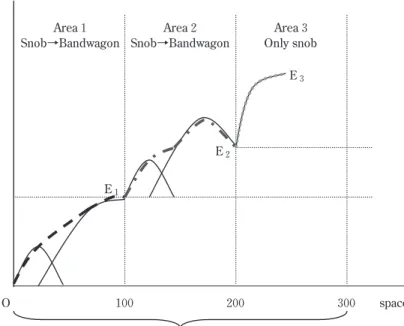
In spite of its complexity, many papers that have focused TALC concern Butler ʼ s model. In the words of Johnston (2001), Butler ʼ s TALC model fo- cused on “ what could be called a basic geographical process ” , which cap- tured the general sequence of the development of tourism destinations from the isolated areas to the developed resort towns. This process can be under- standable from an economics view as a typical example of the various pat- terns of ʻ returns to scale ʼ . This basic concept is about what happens in pro- duction when all input factors such as resources, labour forces and lands change proportionally. Hypothetically, an extension of the scale at a tourism site entails the spread of borders of tourism areas and their relocations with- in the tourism site. As a result, the development patterns of a tourism site should have two phases : one is the development mainly promoted by capac- ity building within a tourism area, and the other is development mainly due to the integration of the newly developed area into tourism site. In this re- gard, some tourism areas could link or unit together via networking to form an extended tourism site.
Figure 3 illustrates these two patterns of development. Hereafter, the do- main, which has a common (brand) name and is separated physically from other areas, is named ʻ tourism site ʼ . On the other hand, the areas in the tour- ism site, each of which has its own feature and is dependent with each other, is named ʻ tourism area ʼ . In short, the areas connected with each other geo- metrically through common socio-economic factors compose the tourism site. We shall refer to the development model of geographical extension in the tourism site, as the ʻ Bunge ʼ model after Bunge (1966)
3). Figure 3 as- sumed that there are only three developed tourism areas in a tourism site and each of them may have a different feature characterised by attractions and accommodations but the same limitation of capacity (100 tourists).
3
)Butler (2006) introduced this idea and illustrated a development pattern with
bo th time and space.
Moreover, the vertical axis measures the output of tourism services provid- ed in each tourism area.
After the development of Area 3, there is no more space (land) for a new extension of the tourism site. In this regard, it is notable to see what have happened to the output during the extension process from Area 1 to Area 3, and what will happen to the output after the tourism site reached its physical upper limit. The thick-dotted line in Figure 3 would indicate a growth pro- cess with respect to time line. If we make the time line longer, then there is no growth and the output is on the steady state unless any changes either in the market conditions including supply-side and demand-side or in the ca- pacity conditions occur. However, it is clear that any changes of them at any tourism areas affect the total output and, hence, the development pattern of
Figure 3
A Bunge model of tourism developmentDevelopment
Area 1 Area 2 Area 3 Snob
→Bandwagon Snob
→Bandwagon Only snob
E
3E
2E
1O 100 200 300 space
A tourism site (Snobs plus Bandwagons)
( ) 361
the tourism site.
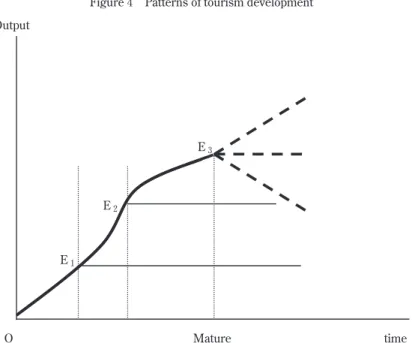
Figure 4 indicates how the development pattern varies enormously due to various factors, which are classified in two broad categories : the factors that affect the development pattern of each tourism area (Area Effects) and the factors that affect the patterns of inter-relationship among tourism areas (Site Effects)
4). In Figure 4, the former affects the overall change in output through a change of E
1, E
2or E
3. If there is a sectional renovation of Area 1, for example, then the output in Area 1 increase so that the overall output at E
3will shift upwards. On the other hand, the latter effects can be observable when a transport network among areas opens to traffic, for example. In this case, the overall output would increase due to an increase of output at each
4) It is possible for the tourism site to develop further by including newly develop- ment area. However, no area is assumed extendable in the tourism site in this example.
Figure 4
Patterns of tourism developmentOutput
E
3E
2E
1O Mature time
area, to varying degrees, as the transport networking brings benefits to all areas. As far as this example is concerned, Area 1 and Area 2 are the areas where there are only bandwagons but Area 3 is the area that mainly includes the snob type of consumers.
4. Dimensions of Tourism Area Development - A Summary
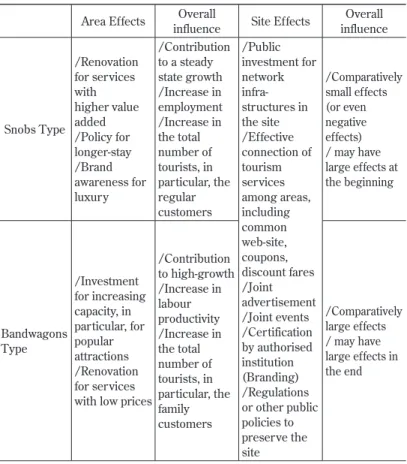
The characteristics of each tourism area are different each other due to a divergence of development patterns from snobs to bandwagons. According- ly, it is naturally acceptable that the development pattern of a tourism site is determined by not only how a changing pattern from snobs to bandwagons would occur but also what factors would cause the changing pattern of tour- ism development in a tourism site. Table 1 summarises the four dimensions that determine the development pattern of tourism site.
As shown in Table 1, it should be clear that not only the marketing strate- gy but also the public policies to cure environmental issues in a tourism site should take the heterogeneity of tourists into consideration, who finally de- termines the characteristic of the tourism areas as the demand-side of tour- ism market. Social planners should carefully consider the site effects, in par- ticular, when they develop the factors that have an overall effect on the tourism site.
As indicated by the ʻ Bunge ʼ model developed above, the process of tour-
ism development in a tourism site includes various patterns. We can observe
a typical pattern of tourism development in the tourism site when a small
number of ʻ snobs ʼ , who knows its true values, comes first but many ʻ band-
wagons ʼ , who only enjoy central attractions, come after some attractions and
infrastructures in the tourism site are newly developed or renovated. Then,
congestion and downgrading of tourism site occurs unless a suitable devel-
opment plan including properly zoning and quality-maintenance is designed
for each tourism area. This will lead to a decline of the tourism site. In this
regard, it is meaningful that Russo (2001) pointed out a possible risk for the
tourism sites, in particular the cultural heritage sites, to be seriously dam-
aged by the ʻ vicious circle ʼ of tourism development. ʻ Vicious circle ʼ means
here the declining process of attractiveness of the tourism site, mainly due
( ) 363
to a sharp change of tourism from a small number of tourists with profound understanding of the tourism site, to mass excursionists. The pattern of the ʻ vicious circle ʼ should be considered carefully with respect to the tourism de- velopment that Bunge model indicates.
(The author highly appreciates the financial supports from the Chuo Uni- versity Grant for Special Research in 2012)
Table 1 Dimensions to determine the development pattern Area Effects Overall
influence Site Effects Overall influence
Snobs Type
/Renovation for services with higher value added /Policy for longer-stay /Brand awareness for luxury
/Contribution to a steady state growth /Increase in employment /Increase in the total number of tourists, in particular, the regular customers
/Public investment for network infra- structures in the site /Effective connection of tourism services among areas, including common web-site, coupons, discount fares /Joint advertisement /Joint events /Certification by authorised institution (Branding) /Regulations or other public policies to preserve the site
/Comparatively small effects (or even negative effects) / may have large effects at the beginning
Bandwagons Type
/Investment for increasing capacity, in particular, for popular attractions /Renovation for services with low prices
/Contribution to high-growth /Increase in labour productivity /Increase in the total number of tourists, in particular, the family customers
/Comparatively
large effects
/ may have
large effects in
the end
References
Benedetto, C. A. and Bojanic, D. C. (1993)
“Tourism Area Life Cycle Extensions,
”An- nals of Tourism Research, 20, 557‑570.
Bunge, William. (1966) Theoretical geography. Vol. 1. Royal University of Lund, Dept.
of Geography ; Gleerup.
Butler, R. W. (2006)
“The Concept of a Tourist Area Cycle of Evolution :
Implications for Management of Resources,” The Tourism Area Life Cycle Vol.1 – Applications and Modifi cations, edited by R. W. Butler, Channel View Publications, Chapetr 1, 3‑12.
Butler, R. W. (2009)
“Tourism in the future :
Cycles, waves or wheels?
”Futures, 41, 346‑352.
Corneo, G. and Jeanne, O. (1997a)
“Snob, bandwagons, and the origin of social cus- toms in consumer behaviour,” Journal of Economic behaviour and Organization, 32, 333
‑347.
Corneo, G. and Jeanne, O. (1997b) “Conspicuous consumption, snobbism and con- formism,
”Journal of Public Economics, 66, 55
‑71.
Cowan, R. and Cowan,W. Swann, P. (1997) “A model of demand with interaction among consumers,
”International Journal of Industrial Organization, 15, 711
‑732.
Granovetter, M and Soong, R. (1985) “Threshold Models of Interpersonal Effects in Consumer Demand,
”Journal of Economic Behaviour and Organization, 7, 83
‑99.
Johnston, C. S. (2001) “Shoring the foundations of the destination life cycle model, part 1 :
ontological and epistemological considerations,
”Tourism Geographies, 3 (1), 2‑28.
Leibenstein, H. (1950)
“Bandwagon, Snob, and Veblen effects in the Theory of Con- sumersʼ Demand,” Quarterly Journal of Economics, 64, 183‑207.
Lagiewski, R. M. (2006)
“The Application of the TALC Model :
A Literature Survey,
”The Tourism Area Life Cycle Vol. 1 – Applications and Modifi cations, edited by R.
W. Butler, Chapter 3, Channel View Publications, 27
‑50.
Lundtorp, S. and Wanhill, S. (2001) “The Resort Lifecycle Theory,” Annals of Tourism Research, 28, No. 4, 947
‑964.
Moore, W. and Whitehall, P. (2005) “The tourism Area Lifecycle and Regime Switch- ing Models,
”Annals of Tourism Research, 32. No. 1, 112
‑126.
Russo, A. P. (2001) “The “Vicious Circle” of Tourism Development in heritage Cities,”
Annals of Tourism Research, 29, No. 1, 165
‑182.
Vanhove, N. (2005) The Economics of Tourism Destinations, Elsevier.
( ) 365