
in the Vijayanagara Kingdom in the Sixteenth Century
1)∂TA Nobuhiro
Introduction
It has already been pointed out by many researchers that n∑yakas played an important role in the political and military set-up of the Vijayanagara kingdom.2)But it can hardly be said that in terms of either quality or quantity there has been enough research on n∑yakas based on the analysis of contemporaneous inscriptions and other primary sources.
Consequently the present state of research is one in which even basic matters such as the financial foundations underpinning the political and military activities of n∑yakas, their relationship with the king, and also their family backgrounds remain by and large unelucidated. There is even no clear agreement among researchers regarding the definition of n∑yakas, that is, who should be counted as n∑yakas. Generally, people who have the honorific title “N∑yaka” as (the final) part of their name are all regarded as n∑yakas, but if we take n∑yaka in this sense of someone possessing the honorific title “N∑yaka,” then an extremely large number of n∑yakas appear even just in the extant inscriptions, and it would seem questionable whether it is possible to find any common trait among these large numbers of n∑yakas with respect to their positions or roles in the state system of the Vijayanagara kingdom.
In another article, I undertook a study of the power structure in southern Karnataka (roughly corresponding to present-day Mysore and Chamarajanagara Districts) under the Tul.uva dynasty (ca. 1505–1566), the third dynasty of the Vijayanagara kingdom. On the basis of contem- porary epigraphical sources, I concluded that the main institution of dy- nastic control over the provinces during the Tul.uva period was the allo- cation of land grants or fiefs called n∑yakatana by the king to his vassals, which was generally made with a territorial division called s∏meas an allo-
cation unit and that the n∑yakain the sense of someone who had been as- signed a n∑yakatana(literally, “n∑yaka-ship”), served as the cornerstone of the state ruling system.3) Another point which became clear from this study was that allocations of land grants to n∑yakas4) (n∑yaka-fiefs) were basically short-term and were frequently rotated. In other words, as far as the Tul.uva period is concerned, there was no evidence of any long-term close ties between n∑yakas and particular regions. In past research on n∑yakas, discussions have been premised on the assumption that n∑yakas were relatively independent of central kingship and exercised hereditary rule over their territories, but it could be said that these assumptions need to be reexamined.5)
In my previous article, I examined the nature of the allocation of n∑yaka-fiefs by focusing on a specific region within the Vijayanagara king- dom and tracing in a diachronical manner those who had been assigned n∑yaka-fiefs there. In this article I shall change my approach and take up for consideration particular n∑yaka families, and by elucidating changes in their n∑yaka-fiefs on the basis of contemporary epigraphical sources I hope to clarify certain aspects of the allocation of n∑yaka-fiefs and region- al rule by n∑yakas. The n∑yakafamilies that I shall take up for considera- tion are two families who were based at B∫lπru and Narasihhapura (pre- sent-day Hol.∫naras∏pura) respectively in the upper valley of the H∫m∑vat∏ river, a tributary of the K∑v∫ri river, and exercised hereditary rule over the surrounding areas from the time of the ≠rav∏3u dynasty (ca.
1566–1647), the fourth dynasty of the Vijayanagara kingdom. Using the names of the localities where they were based, I shall refer to them as the B∫lπru N∑yakas and Narasihhapura N∑yakas. The B∫lπru N∑yakas were driven out of B∫lπru by the Kel.adi N∑yakas in the 1650s and shifted their base to Aigπru. They subsequently came under pressure from two major forces in the shape of the Kel.adi N∑yakas and the Mysore kingdom, and their territory shrank to a small area adjoining the Western Ghats, but nonetheless they survived until their subjugation by Tipu Sultan of Mysore. After the end of the Fourth Anglo-Mysore War in 1799, the n∑ya- kaVehka]∑dri fought to recover their former lands, but he was captured by troops of the English East India Company and was put to death. The Narasihhapura N∑yakas, on the other hand, were overthrown by the Mysore kingdom in 1667, and the area under their rule was annexed to the kingdom’s territory.6)
If we take into account the rather inglorious history of these two n∑ya- ka families, caught between two major forces in the north and south in
the shape of the Mysore kingdom and the Kel.adi N∑yakas, it is hardly surprising that there has not been much research on them, and there would seem to be some crucial errors in previous accounts of their histo- ry. First, it has been pointed out that their rule over B∫lπru and Narasihhapura had its origins in the allocation of the B∫lπru region by K+ala R∑ya (r. 1509–30) of the Tul.uva dynasty. This allocation of land is mentioned in many inscriptions dating from the mid-seventeenth century onwards, but as will be demonstrated below, it does not accord with the facts. Second, it has also been claimed that these two n∑yakafamilies were kinsmen, with the person who was assigned the B∫lπru region by K+ala R∑ya being their common ancestor, but this too is at variance with the facts.7)In the following, I shall clarify as factually as possible on the basis of extant epigraphical sources the history of these two n∑yaka families from the Tul.uva period to the early ≠rav∏3u period with a focus on their n∑yaka-fiefs. In Section I, I shall reconsider their genealogy, a prerequisite for the elucidation of their history. It is an undeniable fact that in the study of South Indian history there are few substantial written source ma- terials such as chronicles, and therefore even in the case of powerful fam- ilies of the ruling élite the task of clarifying their genealogy and history entails considerable difficulties. In the following, I shall attempt to recon- struct the genealogies of the two n∑yakafamilies with whom we are here concerned on the basis of fragmentary genealogies recorded in inscrip- tions and praeasti, or verses and titles extolling their ancestors. While hereditary regional rule by n∑yakas and the dating of its commencement have been much discussed in past research, there have been almost no thorough examinations of the history of n∑yaka families themselves, in- cluding their genealogies. After having reconstructed the genealogies of these two n∑yakafamilies, I hope to show on the basis of these findings that there is a need to rethink the hereditary nature of regional rule by n∑yakas, which has in past discussions been taken virtually for granted.
The epigraphical sources used are as follows:
Epigraphia Carnatica, revised ed., 9 vols, Mysore, Institute of Kannada Studies, University of Mysore, 1972–90 (hereafter EC).
Epigraphia Carnatica, 19 vols, Bangalore, Mysore Archaeological Department, 1886–1965 (hereafter EC-o).
South-Indian Inscriptions, 26 vols, New Delhi, Archaeological Survey of India, 1890–1990 (hereafter SII).
Annual Report of Mysore Archaeological Department, Bangalore, Mysore
Archaeological Department, 1886–1946 (hereafter MAR).
Tirumalai Tirupati Devasthanam Inscriptions, 6 vols, repr., Delhi, Sri Satguru Publications, 1984 (hereafter TTDI).
Annual Report on Indian Epigraphy, New Delhi, Archaeological Survey of India, 1887– (hereafter AR).
0 100 200 300 400 500 (km)
Vijayanagara Ko]]=ru
Harihara Bil.icE3u
Penukol3a
Tirupati
Ceñji
Tañj5v=r
Madurai Kuhdurpi
Behgal.=ru L5htigr5ma
Lr9rahgapa]]ala Narasihhapura B5g=ru
Yaga]i H5sana
BAl=ru Vast5ri GElib9du Kel.adi
N∑yaka-fiefs of Bayyappa and his son K+alappa during the Tul.uva period
N∑yaka-fiefs of Era K+alappa and his son Vehka]∑dri during the Tul.uva period
Map. South India under the Vijayanagara kingdom in the sixteenth century
I. Reconstruction of Genealogies
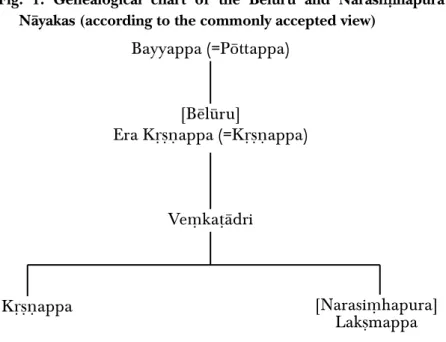
As has already been noted, it is widely believed that the B∫lπru N∑yakas and Narasihhapura N∑yakas were kinsmen. Vehka]∑dri, who ruled the B∫lπru region in the early ≠rav∏3u period, is said to have been their last common ancestor, and one of his sons, named Lakamappa, is said to have partitioned off the Narasihhapura region and inherited it (see fig. 1).8)But a comparison of the genealogies of the two families giv- en in inscriptions reveals that the ancestors down to Vehka]∑dri, who are supposed to have been the same, were in fact different. To state my con- clusion first, it is to be surmised that there was not just one Vehka]∑dri, but that there was at roughly the same time a person named Vehka]∑dri in the n∑yakafamilies of both B∫lπru and Narasihhapura. While there is a possibility that these two n∑yakafamilies had some shared background, they were not linked by any clear-cut genealogical relationship.
It has been taken for granted that there was only one Vehka]∑dri ac- tive in the early ≠rav∏3u period. For this reason, though it was sometimes pointed out that there were two versions of the names of Vehka]∑dri’s forefathers, these were regarded simply as scribal errors or as different names of the same persons. But if it is assumed that there were two men
Fig. 1. Genealogical chart of the B∫lπru and Narasihhhapura N∑yakas (according to the commonly accepted view)
Bayyappa (=PΩttappa)
[B∫lπru]
Era K+alappa (=K+alappa)
Vehka]∑dri
K+alappa [Narasihhapura]
Lakamappa
named Vehka]∑dri, the two different versions no longer present any sort of inconsistency. First, I wish to consider two genealogies recorded in in- scriptions of the second half of the sixteenth century, when
“Vehka]∑dri” and his children lived.
Vehka]∑dri N∑yaka, son of Era Krualapa N∑yaka, son of PΩta N∑ya- ka (EC 9, Bl-66, 1580)
V∫hka]∑dri N∑yaka, son of Yara K+alaya N∑yaka and grandson of PΩtappa N∑yaka (EC 9, Bl-219, 1583)
This gives family line (1): PΩtappa—Era K+alappa—Vehka]∑dri.
Vehka]∑dri N∑yakayya, son of Bayyappa N∑yaka’s [son] Krualappa N∑yaka (EC 5, Kn-104, 1577)
Lakamappa N∑yaka, son of Vehka]∑dri N∑yaka, son of K+alappa N∑yaka (EC 8, HN-12, 1588)
This gives family line (2): Bayyappa–K+alappa–Vehka]∑dri. Two differ- ences with family line (1) can be pointed out, namely, the name of Vehka]∑dri’s grandfather and the absence of the epithet “Era” prefixed to the name of his father K+alappa.
Of prime importance is the fact that the inscriptions recording family line (1) were discovered within the territory of the B∫lπru N∑yakas, while those recording family line (2) were discovered within the territory of the Narasihhapura N∑yakas. Thus, if one assumes that in the early ≠rav∏3u period there were two men named Vehka]∑dri who were based in B∫lπru and Narasihhapura respectively, there is no need to come up with reasons such as scribal errors or different names for the same person to explain the existence of the two genealogies. With respect to the father of “Vehka]∑dri,” K+alappa and Era K+alappa have been regarded as the same person in previous studies, but if one assumes that there were two men named Vehka]∑dri, it would be natural to regard them as dif- ferent people.
That the ancestors differed in the genealogies of the two n∑yakafami- lies can also be ascertained in seventeenth-century inscriptions. There exist several genealogies recorded in inscriptions relating to the Narasihhapura N∑yakas that begin with “Bayyappa’s [son] K+alappa”
(EC 8, HN-11; EC 8, HN-38; EC 8, HN-39; EC 8, HN-114; EC 8, HN-117).
In two copper-plate inscriptions of 1665 the three generations “ Lr∏giri —
Yarra— Timma” have been added before Bayyappa.9) In these inscrip- tions, it may be noted, the epithet “Era” has not been prefixed to the name of Vehka]∑dri’s father K+alappa.
Meanwhile, successive generations of the B∫lπru N∑yakas took the names Vehka]∑dri and K+alappa alternately. Accordingly, in the ge- nealogies recorded in inscriptions too the names Vehka]∑dri and K+alappa are repeated with regularity. Apart from these simple genealo- gies, worth noting in inscriptions from the mid-seventeenth century on- wards is the fact that special mention is made of Era K+alappa N∑yaka as the “great ancestor” (vr.ddhaprapit∑maha) and he is said to have been as- signed the B∫lπru region by K+ala R∑ya of the Tul.uva dynasty. As will be demonstrated below, this allocation of land is a fiction and does not accord with the facts. But precisely because it is a fiction, it could be said to show even more clearly that in the genealogical understanding of the B∫lπru N∑yakas themselves Era K+alappa was regarded as the family’s progenitor. As might be expected, there are no references to any alloca- tion of land by K+ala R∑ya to Era K+alappa in inscriptions relating to the Narasihhapura N∑yakas.10)
If one thus carefully follows the genealogies recorded in inscriptions, it becomes clear that the Narasihhapura N∑yakas and B∫lπru N∑yakas were separate families. That being so, why have past studies regarded them as kinsmen, even going so far as to overlook these differences in ge- nealogies or employ what could be described as far-fetched logic to iden- tify separate names as different names of a single person? One possible factor behind this is the fact that, apart from the (partially) identical names appearing in their genealogies, inscriptions of these two families have quite a number of elements in common. Of special importance among these are the official title had.apa, the claim of belonging to the K∑eyapa GΩtra, and a praeastithat includes the phrase “Lord of the excel- lent Malin∑gapura.”
The members of the two n∑yakafamilies who served the Tul.uva kings have sometimes prefixed to their names in inscriptions the title had.apa. Had.apa signifies a bag for holding betel nuts, a popular stimulant, and in the Vijayanagara kingdom it referred to someone whose duty it was to bear a betel-bag and attend on the king. N∑yakas who were had.apas ap- pear with comparative frequency in Tul.uva inscriptions. For instance, the ancestors of the Madurai N∑yakas, one of the three foremost n∑yakafami- lies in Tamil country, were also had.apas.11)
Further, in inscriptions of both the B∫lπru and Narasihhapura
N∑yakas it is stated that their gΩtra was the K∑eyapa GΩtra. A gΩtra is an exogamous group among the twice-born (dvija), and the K∑eyapa GΩtra is one of these. Although the origins of the two n∑yaka families are un- clear, it is doubtful whether they were “true” dvijas. In copper-plate in- scriptions of 1665 relating to the Narasihhapura N∑yakas (EC 8, Ag-16;
EC 8, Ag-20), it is stated that their legendary forebears had been “born into the Solar race” (ravikulejani). That they professed to belong to the K∑eyapa GΩtra ought to be understood in connection with this claim that they were descended from the ks.atriya Solar race. In the Pur∑las, the sage Kaeyapa is said to have been the father of the sun god. By professing to belong to the K∑eyapa GΩtra, descendants of the sage Kaeyapa, both the B∫lπru and Narasihhapura N∑yakas would have been laying claim to the status of ks.atriyas of the Solar race.
The B∫lπru and Narasihhapura N∑yakas also share the same pra
´sasti in some inscriptions. Their standard pra´sasti reads: “Sihdhu GΩvihda, Champion of white lustre (sitakaragam.d.a), Bh∏ma in pure war- fare (dhav∑l.∑hkabh∏ma), Lord of the excellent Malin∑gapura (man.in∑gapu- ravar∑dh∏´svara), Conqueror of the seven elements of the Barid Shahs (bar∏dasapt∑m.gaharan.a).” It has already been pointed out by others that this is partially identical with the pra´sasti of the Sinda dynasty, which ruled different parts of central and northern Karnataka from the tenth to thirteenth centuries. The phrase “Lord of the excellent Malin∑gapura”
too may be considered to have been modelled on the pra´sasti of the Sinda dynasty. The corresponding phrase in the pra´sastiof the Sinda dy- nasty is “Lord of the excellent BhΩg∑vat∏pura” (bhΩg∑vat∏pura var∑dh∏´svara).
BhΩg∑vat∏pura refers to the subterranean realm of n∑gas, or snake gods, and it comports with the fact that the Sinda dynasty claimed to be de- scendants of n∑gas (n∑ga vam.´sa). Malin∑gapura, which literally means
“capital of gem-holding n∑gas,” is probably a rephrasing of this BhΩg∑vat∏pura.12)
The identity of their gΩtra and pra´sastiwould suggest that the B∫lπru N∑yakas and Narasihhapura N∑yakas may have had a common family background. But this is no more than a possibility, and even if it were the case, it would not mean that the two families were kinsmen. To repeat, there are no suggestions whatsoever in the genealogies recorded in in- scriptions of either family that their forebears may have been genealogi- cally linked to each other.
Now, the three points cited as distinctive elements shared by inscrip- tions of both families —had.apa, K∑eyapa GΩtra, and “Lord of the excellent
Malin∑gapura”— are also found in the inscriptions of people surmised to have been the ancestors of the Ceñji (Gingee) N∑yakas, one of the three foremost n∑yakafamilies in Tamil country.13) Might there have been ge- nealogical ties between the Ceñji N∑yakas and either the B∫lπru N∑yakas or Narasihhapura N∑yakas? Next I wish to examine this point.
In previous works, mention has been made of Vaiyappa, who was ac- tive during the reigns of K+ala R∑ya and Acyuta R∑ya (r. 1530–42), and Sπrappa and K+alappa, who were active after the enthronement of Sad∑eiva R∑ya in 1543, as members of the very earliest Ceñji N∑yakas.14) K+alappa is said to have been succeeded by Kol3ama, and it has gener- ally been agreed in past research that K+alappa and Kol3ama were fa- ther and son. In contrast, there is no general consensus among re- searchers regarding the relationship between Vaiyappa, Sπrappa and K+alappa, although it is widely accepted that they were in some way ge- nealogically linked to each other. Of prime importance in connection with my arguments in this article is the fact that the name of K+alappa’s father is Vaiyappa. The father-son combination of Vaiyappa and K+alap- pa was also found in the genealogy of the Narasihhapura N∑yakas exam- ined earlier. (Bayyappa may be regarded as a variant spelling of Vaiyappa.) Further, in two copper-plate inscriptions of the seventeenth century (AR 1917, Nos. 860 & 861) there appears a person by the name of Lr∏giri N∑i3u, said to have been a semi-legendary forefather of the Ceñji N∑yakas.15)This squares with the reference to the ancestor Lr∏giri in the 1665 copper-plate inscriptions of the Narasihhapura N∑yakas mentioned earlier. When one takes into account these two correspon- dences in their genealogies in addition to the identical pra´sasti and gΩtra,16)it would be fairly safe to say that the n∑yakafamilies of Ceñji and Narasihhapura were one and the same family and that the former’s K+alappa, father of Kol3ama, was the same person as the latter’s K+alappa, father of Vehka]∑dri.
Next, let us consider Vaiyappa, who is given as the first of the Ceñji N∑yakas. As has already been noted, the name of K+alappa’s father was also Vaiyappa, but it is not clear whether or not they were both the same person. Inscriptions recording the deeds of the Vaiyappa regarded as the first of the Ceñji N∑yakas do not appear to record the names of his fore- fathers, and therefore it is not possible to ascertain the relationship be- tween the two on the basis of genealogical information. Meanwhile, Sπrappa, deemed to have been the next of the Ceñji N∑yakas after Vaiyappa, had a brother named Vaiyappa whose father was called
Pottappa. Since, as has already been mentioned, the name of the father of the Vaiyappa said to have been the first of the Ceñji N∑yakas is not known, it is again not possible to determine the relationship between this Vaiyappa and Sπrappa’s brother of the same name. However, as was not- ed above, the name of the father of K+alappa’s father Vaiyappa was Timmappa, and it is therefore evident that he was not the same person as Sπrappa’s brother Vaiyappa.
Now, the name of Sπrappa’s father was Pottappa, and, as was noted in our earlier examination of the genealogy of the B∫lπru N∑yakas, the father of their ancestor Era K+alappa was called PΩtappa. PΩtappa and Pottappa are orthographic variants due to differences between Kannada and Tamil, and they may be regarded as the same name, in which case Era K+alappa may possibly have been a brother of Sπrappa mentioned in inscriptions from the Ceñji region. In inscriptions pertaining to Era Fig. 2. Genealogical chart of the Ceñji, Narasihhhapura and B∫lπru N∑yakas
Giriyappa (Lr∏giri)
Yarra?
Timmappa Pottappa
Vaiyappa Sπrappa Era K+alappa
[B∫lπru]
Vehka]∑dri
K+alappa Vaiyappa (Bayyappa)
K+alappa
[Ceñji]
Kol3ama
[Narasihhapura]
Vehka]∑dri
Muttu K+alappa
Lakamappa
K+alappa and Sπrappa there are, however, no references to each other’s existence. Besides the title had.apa, the claim to belong to the K∑eyapa GΩtra, and the title “Lord of the excellent Malin∑gapura,” the only rea- son for regarding them as brothers is that their fathers had the same name.
There are thus insufficient grounds for asserting that they were brothers, but it could be said that there is a strong possibility that this was the case.
In the above I have considered the two n∑yakafamilies of B∫lπru and Narasihhapura on the basis of references found in extant epigraphical sources. Fig. 2 is a genealogical chart summarizing my findings. In addi- tion, among the three men considered by some researchers to have been Ceñji N∑yakas of the earliest period —Vaiyappa, Sπrappa and K+alappa
— K+alappa was the same person as the K+alappa of the Narasihhapura N∑yakas, and there is a possibility that Sπrappa was a brother of Era K+alappa of the B∫lπru N∑yakas. As for Vaiyappa, he may have been Sπrappa’s brother or K+alappa’s father, but we cannot be sure.
II. N∑yaka-fiefs during the Tul.uva Period
On the basis of the genealogies of the two n∑yaka families recon- structed in the previous section, in this section I shall examine their histo- ry during the Tul.uva period with a focus on their n∑yaka-fiefs. By means of this examination it should become clear that n∑yakas under the Tul.uva dynasty do not accord with their image as hereditary regional rulers hav- ing long-term close ties with particular regions, which has been assumed implicitly or explicitly in most previous accounts of n∑yakas. First, let us consider the case of the n∑yakafamilies of Ceñji and Narasihhapura.
In many studies on the Ceñji N∑yakas, Vaiyappa and Sπrappa ap- pearing in the Tul.uva inscriptions discovered in the Ceñji region are counted among the Ceñji N∑yakas. However, as is clear from our investi- gations in the previous section, Sπrappa was almost certainly not a mem- ber of the Ceñji N∑yakas. Although the genealogical ties of Vaiyappa and Sπrappa with the Ceñji N∑yakas have been sometimes called into question, these questions were “resolved” in some way or another, and it has been commonly accepted that the commencement of the rule of Ceñji by the Ceñji N∑yakas went back to the time of Vaiyappa. Behind this prevailing view about their origin, one can detect the hypothetical premise that it was usual for n∑yakas to rule a particular region hereditari- ly over a long period of time and that the n∑yakas who ruled the same area would have all belonged to the same family in many cases. Further,
when discussing the history of the Ceñji N∑yakas, most researchers have relied almost exclusively on epigraphical sources from the Ceñji region.
This is because it was tacitly assumed that their sphere of activity was lim- ited to this region. But as is indicated by the fact that the Narasihhapura N∑yakas were their kinsmen, in order to gain an overall grasp of their ac- tivities and history it will not suffice to examine only epigraphical sources from a particular limited region. As will be shown below, when one examines a broad range of epigraphical sources from throughout the Vijayanagara kingdom, there emerges a picture of n∑yaka families that differs from the past image of n∑yakas as hereditary rulers of a particular region.
First, I wish to examine briefly the date when their hereditary rule of the area around Ceñji began. As was mentioned earlier, Sπrappa was rul- ing over the area around Ceñji during the reign of Sad∑eiva R∑ya, but at that time K+alappa of the Ceñji N∑yakas had also been assigned a n∑ya- ka-fief in the vicinity of Ceñji. In the course of recording a donation of land made by K+alappa, an inscription of 1547 (AR 1925, No. 382) dis- covered at Vadasiruvalur, lying 22 kilometres east-northeast of Ceñji (in Tindivanam Taluk of old South Arcot District), mentions that he was granted by the king a territorial division (par-r-u). In view of the fact that this K+alappa claimed to belong to the K∑eyapa GΩtra and his father’s name was Vaiyappa, there can be little doubt that he was the K+alappa of the Ceñji N∑yakas.17) As far as can be judged from the geographical distribution and number of the Tul.uva inscriptions relating to K+alappa and Sπrappa, it is to be surmised that the n∑yaka-fief of K+alappa near Ceñji during the Tul.uva period corresponded to only a very small part of the area which came to be ruled by the Ceñji N∑yakas under the
≠rav∏3u dynasty, and a considerable portion of the remaining area was then ruled by Sπrappa.18)There remains much that needs to be elucidat- ed in future research concerning the extent of the n∑yaka-fiefs of K+alap- pa and Sπrappa around Ceñji during the reign of Sad∑eiva R∑ya, and al- so the political relationship between the two, but at the present stage it is to be surmised that the hereditary rule of the entire area around Ceñji by K+alappa’s family began around the time of the founding of the ≠rav∏3u dynasty and does not go back as far as the Tul.uva period.
Let us then examine the history of the family during the Tul.uva peri- od. As was stated earlier, it is not clear whether or not the Vaiyappa ap- pearing in inscriptions from the first half of the Tul.uva dynasty discov- ered in the Ceñji region was an ancestor of the Ceñji N∑yakas. On the
other hand, Bayyappa (Vaiyappa), who is very likely to have been K+alappa’s father, and also K+alappa himself appear in the Tul.uva in- scriptions discovered in other regions of the Vijayanagara kingdom.
Table 1 brings together references to Bayyappa and his son K+alappa in the Tul.uva inscriptions, most of which are written in Kannada, and arranges them by region. I have already mentioned that a 1547 inscrip- tion discovered in old South Arcot District, which is not included in this table, refers to K+alappa. In addition, a Vaiyappa who was a had.apaand claimed to belong to the K∑eyapa GΩtra and whose father was Timmappa appears in three inscriptions dating from the years 1519–38 that were discovered at Tirupati (TTDI 3, No. 135; TTDI 4, Nos. 53 &
110), and these too have not been included in the table.
As can be seen in Table 1, inscriptions in which Bayyappa figures have been discovered in the two regions of Kuhdurpi and Yaga]i. He was assigned the former region as a n∑yaka-fief during the reign of Acyuta R∑ya,19)and although it is not expressly stated in any inscription, it is to be surmised that he was assigned the latter region as a n∑yaka-fief during the earlier reign of K+ala R∑ya. Bayyappa’s name disappears from in- scriptions dating from the reign of Sad∑eiva R∑ya, and his son K+alappa appears instead. Like his father Bayyappa, he was assigned Kuhdurpi as
Table 1. N∑yaka-fiefs of Bayyappa and his son K++aallappa during the Tul.uva period (from left, date of inscription, gist of inscription, references to Bayyappa and K++aallappa, and source[s])
1-1 Yaga]i
1526 donation of a village in
≠sahdi-s∏me
donated for the merit of Timmappa N∑yaka, father of Bayyappa N∑ya- ka, a had.apaof K+ala R∑ya
EC-o 6, Kd-26
1527 remission of the marriage tax in Yaga]i-10,000-s∏me
remitted by Bayyappa N∑yaka MAR1943, No.2 1527 unreadable by the physi-
cal damage
mentioning an agent of J∏yappa [Bayyappa?] N∑yaka, a had.apa of K+ala R∑ya
EC-o 6, Kd-20
1533 establishment of an agrah∑ra in N∏ruguh- da-s∏me in the territory (val.ita) of Yaga]i
established by Acyuta R∑ya on the request of Bayyappa, son of Timma N∑yaka and a had.apa
EC-o 11, Hk-132
1-2 Kuhdurpi
1536 donation of villages in Kuhdurpi-s∏me
Kuhdurpi-s∏me assigned to Bayyappa N∑yaka as n∑yaka-fief
SII9, No.576 1537 donation of a village in
Bπdigumma-sthal.a in Kuhdurpi-s∏me
donated by an agent of Bayyappa N∑yaka for the merit of the latter
SII16, No.114
1541 confirmation of revenue- free lands in Yerragu3i in Bπdigumma-s∏me
confirmed by Bayyappa N∑yaka SII16, No.124
1545 donation of land in Yerragu3i in Bπdigum- ma-s∏me
donated by an agent of K+alappa N∑yaka
SII 16, No.146
1547 donation of paddies donated for the merit of Bayyappa N∑yaka’s K+alappa N∑yaka
SII 9, No.627 1558 donation of land donated for the merit of Bayyappa
N∑yaka’s K+alappa N∑yaka
EC-o 11, Cl-47 1561 unreadable by the physi-
cal damage
mentioning Bayyappa N∑yaka’s K+alappa N∑yaka
EC-o 11, Cl-48
1-3 Ko]]πru
1547 donation of a village in Rahgapura-sthal.a in Ko]]πru-s∏me
Ko]]πru-s∏me assigned by Sad∑eiva R∑ya to Bayyappa N∑yaka’s K+alappa N∑yaka
SII 9, No.626
1548 donation of a village in Ko]]πru-s∏me in the ter- ritory (val.ita) of KΩgal.i
Ko]]πru-s∏me in the territory of KΩgal.i belonging to K+alappa N∑yaka
SII 9, No.630
1550 donation of paddy and money to a temple in the territory (val.ita) of KΩgal.i
Ko]]πru-32,000 in the territory of KΩgal.i assigned to Bayyappa N∑ya- ka’s K+alappa N∑yaka, a had.apa, as n∑yaka-fief (amara m∑gan.i)
SII 9, No.640
1551 remission of sheep tax in Ko]]πru-s∏me in KΩgal.i- v∫h]heya (province)
Ko]]πru-s∏me assigned by Sad∑eiva R∑ya to K+alappa N∑yaka, a had.apa
SII 9, No.641
1552 donation of a village in Moraba-s∏me
Moraba-s∏me assigned to Bayyappa N∑yaka’s K+alappa N∑yaka as n∑ya- ka-fief (amara m∑gan.i)
SII 9, No.647
1-4 Bil.icΩ3u
1554 remission of sheep tax in Bil.icΩ3u-s∏me
remitted by an agent of Bayyappa N∑yaka’s K+alappa N∑yaka
EC-o 11, Jl-2
1561 donation of a village in Bil.icΩ3u-s∏me
donated by Bayyappa N∑yaka’s K+alappa N∑yaka
EC-o 11, Dg- 18
1-5 Harihara
1554 donation of a village pre- sumed to be in Harihara- s∏me
donated by Bayyappa N∑yaka’s K+alappa N∑yaka, a had.apa of Sad∑eiva R∑ya
EC-o 11, Dg-22
1562 donation of a village pre- sumed to be in Harihara- s∏me
donated by an agent of Bayyappa N∑yaka’s K+alappa N∑yaka, a had.apaof Sad∑eiva R∑ya
EC-o 11, Dg-83; EC-o 11, Dg-30
1-6 H∑sana
1548 donation of a village in H∑sana-s∏me
sanctioned by Bayyappa N∑yaka’s K+alappa N∑yaka, a had.apa
EC 9, Bl-37 1561 establishment of an
agrah∑ra in H∑sana- s∏me
established by Sad∑eiva R∑ya on the request of K+alappa N∑yaka, son of Bayyappa N∑yaka and a had.apa
EC 9, Hn-9
1562 donation of a village in H∑sana-s∏me
H∑sana-s∏me assigned by Al.iya R∑ma R∑ja to K+alappa N∑yaka, son of Bayyappa N∑yaka, as n∑yaka-fief
EC 8, Hn-122
1562 remission of tax on tem- ple-owned lands in H∑sana s∏me
H∑sana-s∏me assigned by Al.iya R∑ma R∑ja to K+alappa N∑yaka, son of Bayyappa N∑yaka, asn∑yaka- fief (amara m∑gan.i)
EC 8, Hn-79
1563 donation of a village in H∑sana-s∏me
H∑sana-s∏me assigned by Al.iya R∑ma R∑ja to K+alappa N∑yaka, son of Bayyappa N∑yaka, as n∑yaka- fief (amara n∑yakatana)
EC 8, Hn-2
a n∑yaka-fief, but in addition he was also assigned n∑yaka-fiefs in Ko]]πru, Bil.icΩ3u, Harihara, H∑sana, GΩlib∏3u and Narasihhapura. The fact that he was assigned more n∑yaka-fiefs than his father Bayyappa would sug- gest that his position in the Tul.uva state was higher than that of Bayyappa. A 1545 inscription (SII 15, No. 706) discovered at B∑d∑mi and not included in Table 1 is partially illegible because of damage, but it is thought to record the construction of a fort (durggam) by him.20) B∑d∑mi lies halfway between Vijayanagara and Bijapur, the capital of one of the Deccan Sultanates against whom the Tul.uva state fought inter- mittently. Distinguished services in fighting with the Deccan Sultanates may have been behind his political advancement. The lengths of time for which each of K+alappa’s n∑yaka-fiefs was assigned to him are not clear because of insufficient source materials, but as far as can be inferred from the dates of relevant inscriptions, the period during which he was assigned several n∑yaka-fiefs simultaneously would seem to have been quite long.
In the final years of the Tul.uva dynasty K+alappa seems to have been assigned several n∑yaka-fiefs throughout the kingdom, but only two of these remained in the hands of his family after the end of the Tul.uva dynasty. One, situated around Narasihhapura, was assigned to K+alap- pa’s son Vehka]∑dri, and thereafter his descendants became the heredi-
1-7 GΩlib∏3u
1566 remission of tax on an agrah∑ra in GΩlib∏3u- s∏me
remitted by Bukkappa N∑yaka for the merit of K+alappa N∑yaka
EC 8, Al-44
? reestablishment of an agrah∑ra in GΩlib∏3u- s∏me
reestablished by Bukkappa N∑yaka, an agent of K+alappa N∑yaka
EC 8, Al-48
1-8 Narasihhapura
1563 establishment of an agrah∑ra in the territory (val.ita) of Narasihhapura
the territory of Narasihhapura as- signed by the king (r∑yadatta) to K+alappa N∑yaka, son of Bayyappa N∑yaka and grandson of Timmappa N∑yaka and great-grandson of Giriyappa N∑yaka of K∑eyapa gΩtra
EC 8, HN-47
tary rulers of this region. The other, located in the vicinity of Ceñji, was enlarged probably by additional allocations to cover the entire region around Ceñji and was ruled over by K+alappa himself. This region was subsequently ruled hereditarily by another son, Kol3ama, and his de- scendants.
Next, let us consider the case of the B∫lπru N∑yakas. As was noted earlier, their rule of B∫lπru is said to have begun during the reign of K+ala R∑ya of the Tul.uva dynasty. But there emerges a different picture of their history when one examines epigraphical sources of the Tul.uva period discovered not just in the B∫lπru region, but throughout the king- dom. Table 2 brings together references to Era K+alappa and his son Vehka]∑dri in the Tul.uva inscriptions, most of which are written in Kannada, and arranges them by region. As was discussed earlier, Sπrap- pa, who ruled over the Ceñji region during the second half of the Tul.uva period, was very likely a brother of Era K+alappa. As for Era K+alappa’s father PΩtappa, there are to the best of my knowledge no contemporary epigraphical sources that can with any certainty be said to record his ac- tivities. As can be seen in Table 2, Era K+alappa makes his appearance during the reign of Sad∑eiva R∑ya as a n∑yaka with a n∑yaka-fief in B∑gπru. A 1543 inscription (SII 20, No. 237) discovered at B∑d∑mi and not included in Table 2 records that Sad∑eiva R∑ya’s had.apaEra K+alap- pa N∑yaka erected a bastion (kottal.a). There are, however, no inscriptions from the Tul.uva period indicating that he was assigned a n∑yaka-fief in the area around B∫lπru or was involved in ruling this region.
Era K+alappa disappears from inscriptions in the second half of the 1550s, and from around this time his son Vehka]∑dri begins to appear instead. Like his father, he was assigned B∑gπru as a n∑yaka-fief,21)and in addition he may also have been assigned Vast∑ri. After the establishment of the ≠rav∏3u dynasty, Vehka]∑dri not only retained (or acquired) Vast∑ri, but also newly acquired H∑sana and GΩlib∏3u to the south of Vast∑ri and made B∫lπru his base.22)
In this fashion, the ancestors of two n∑yakafamilies who were based in Ceñji, Narasihhapura and B∫lπru and exercised hereditary rule over the surrounding areas after the founding of the ≠rav∏3u dynasty were ac- tive as n∑yakas also during the Tul.uva period. But most of the n∑yaka-fiefs that they were assigned at that time were located in regions other than the areas over which they ruled during the ≠rav∏3u period.
Furthermore, even when both the father and son were active as n∑yakas, the size and location of their n∑yaka-fiefs differed considerably. The
Table 2. N∑yaka-fiefs of Era K++aallappa and his son Vehhka]]∑dri during the Tul.uva period (from left, date of inscription, gist of inscription, refer- ences to Era K++aallappa and Vehhka]]∑dri, and source[s])
2-1 B∑gπru
1543 donation of a village in B∑gπru-s∏me
B∑gπru-s∏me assigned to K+alappa N∑yaka, son of Ponappa [PΩtappa]
N∑yaka as n∑yaka-fief (amara m∑gan.i)
MAR 1941, No.3
1546 remission of tax on bar- bers in B∑gπru-s∏me
remitted by Era K+alappa N∑yaka EC-o 11, Hk-110 1552 donation of a village to
a temple at B∑gπru
donated by Era K+alappa N∑yaka EC-o 11, Hk-114 1554 donation of land (?) in
B∑gπru-s∏me
donated by a son of Era K+alappa N∑yaka
EC-o 6, Tr-91 1554 reconstruction of a mar-
ket
B∑gπru-s∏me administered (p∑ru- patya) by an agent of PΩtappa N∑ya- ka’s K+alappa N∑yaka
EC-o 11, Hk-112
1555 donation to a temple at B∑gπru
donated by K+alappa N∑yaka EC-o 11, Hk-118 1555 donation of villages to a
temple at B∑gπru
donated by an agent of K+alappa N∑yaka, son of Bomma N∑yaka and a had.apa
EC-o 11, Hk-113
1559 donation of a village in B∑gπru-s∏me
B∑gπru-s∏me assigned by Sad∑eiva R∑ya to Vehka]∑dri N∑yaka, son of Era K+alappa N∑yaka and a had.apa, as n∑yaka-fief (amara m∑gan.i)
EC-o 11, Hk-21
2-2 Vast∑ri
1558 gift of land presumed to be in Vast∑ri-s∏me
gifted by P∑pa Timma N∑yaka, an agent of Vehka]∑dri N∑yaka
EC 9, Bl-526
1569 donation of a village in Vast∑ri-s∏me
donated by Vehka]amma, daughter of P∑pa Timma N∑yaka being a had.apa of Vehka]∑dri N∑yaka of K∑eyapa gΩtra, son of Era K+alappa N∑yaka and a had.apaof Sad∑eiva R∑ya
EC 9, Bl-151;
EC 9, Bl-142
Note: The 1569 inscription has been cited only for reference.
length of time for which a region was assigned as a n∑yaka-fief cannot be accurately known because of a dearth of source materials, but it is thought to have been comparatively short. There were also instances in which several regions distant from each other were simultaneously as- signed as n∑yaka-fiefs. The two families preserved their status as n∑yakas from the Tul.uva period to the ≠rav∏3u period, but there were consider- able differences in the nature of their possession of n∑yaka-fiefs and their regional rule between the two periods.
III. The Creation of “History”
It was only after the founding of the ≠rav∏3u dynasty that the two families of the Ceñji/Narasihhapura and B∫lπru N∑yakas began to exer- cise hereditary rule over their respective territories. But according to the widely accepted view, their hereditary regional rule began during the Tul.uva dynasty. That this view is not supported by epigraphical sources dating from the Tul.uva period was demonstrated in the foregoing sec- tion. But in epigraphical sources of the post-Tul.uva period we find state- ments about the B∫lπru N∑yakas that clearly say that their hereditary rule of the B∫lπru region went back to the Tul.uva dynasty. In this sec- tion, I shall take these passages up for consideration and, after reconfirm- ing their fictitiousness, consider the background to the creation of state- ments that push the commencement of their hereditary rule back from when it actually began to the earlier Tul.uva period.
From the mid-seventeenth century onwards it is frequently stated in inscriptions of the B∫lπru N∑yakas that their land holdings were assigned by K+ala R∑ya to “our great ancestor” (namma vr.ddhaprapit∑maha) Era K+alappa (EC-o 5, Ag-9; EC 8, Ag-8; EC 9, Bl-180; EC 8, Ag-23; EC 8, HN-40; EC 1, 28; EC 9, Sl-2; EC 9, Sl-40; EC 9, Sl-3; EC 9, Sl-51; EC-o 14, TN-256; EC 9, Sl-52; EC 9, Sl-53; EC-o 14, TN-255; MAR 1938, No. 17).
The earliest of these inscriptions is one that bears a date from 1650 (EC 9, Sl-10).23)Further, in a document called “Cikkamagal.πru Kaiphiyattu,”
written around 1800, it is stated that K+ala R∑ya assigned B∫lπru to Era K+alappa N∑yaka as a jagir (jah∑g∏ru).24) This could be said to indicate that around 1800 K+ala R∑ya’s allocation of B∫lπru to Era K+alappa had become widely accepted as a historical fact. But as is shown by the in- scriptions relating to Era K+allappa examined earlier, he is mentioned for the first time in inscriptions dating from the reign of Sad∑eiva R∑ya, and the period when he was active as a n∑yaka does not overlap with
K+ala R∑ya’s reign. Furthermore, there is no evidence in extant inscrip- tions indicating that he was assigned a n∑yaka-fief in B∫lπru or the sur- rounding area. In light of these points, it would seem clear that there was no historical fact of his having been assigned the B∫lπru region by K+ala R∑ya. But here I wish to ascertain once again the fictitiousness of this al- location of land on the basis of the Tul.uva inscriptions from B∫lπru and the surrounding area.
Under the Tul.uva dynasty, the area surrounding B∫lπru was divided into Vast∑ri-s∏me in the north and H∑sana-s∏me in the south, with B∫lπru more or less on the border between the two. It should be mentioned that inscriptions from the Tul.uva period make no mention of any territorial divisions prefixed by the place-name B∫lπru. Under the ≠rav∏3u dynasty, the land holdings of the B∫lπru N∑yakas were composed of Vast∑ri-s∏me, H∑sana-s∏me and GΩlib∏3u-s∏me, while those of the Narasihhapura N∑yakas were composed of Narasihhapura-s∏me and L∑htigr∑ma-s∏me, and the important inscriptions referring either directly or indirectly to the allocation of these territorial divisions as n∑yaka-fiefs during the Tul.uva dynasty are given in Table 3. The last two s∏meare not directly re- lated to the B∫lπru N∑yakas, but they have been added for the sake of reference. As is evident from Table 3, the territorial divisons that would later make up the land holdings of the B∫lπru and Narasihhapura N∑yakas were during the Tul.uva period assigned as n∑yaka-fiefs to other n∑yakas. The fictitiousness of the allocation of n∑yaka-fiefs to Era K+alap- pa is demonstrated not only by the negative fact that there are no extant contemporary inscriptions referring to any such allocation, but also by the existence of contemporary inscriptions referring to the allocation of these divisions to other n∑yakas.25)
It was a fiction and not a historical fact that K+ala R∑ya of the Tul.uva dynasty granted the B∫lπru region as a land holding to Era K+alappa, the ancestor of the B∫lπru N∑yakas. Why, then, did this fic- tion come to be created in the middle of the seventeenth century and recorded in inscriptions? Although it is difficult to fully clarify the rea- sons for this, it is possible to draw certain inferences from examples of historical fictions created by other n∑yakas and from the historical back- ground.
Wagoner, who has analyzed the R∑yav∑cakamu, a work composed by a person associated with the court of the Madurai N∑yakas, has written as follows about the date of and background to its composition.26) The R∑yav∑cakamutakes the form of a report sent by an ambassador residing
at the court of K+ala R∑ya to his master, one of the Madurai N∑yakas, but it was actually composed towards the end of the sixteenth century, half a century after the time of K+ala R∑ya. Why, then, would a “spuri- Table 3. The allocation of n∑yaka-fiefs in the area around B∫lπru under the
Tul.uva dynasty (from left, date of inscription, relevant details, source[s]) 3-1 Vast∑ri
1524 Vast∑ri-s∏me assigned by K+ala R∑ya to Basavappa N∑ya- ka as n∑yaka-fief
EC 9, Bl-159;
EC 9, Bl-182 1539 Vast∑ri-s∏me assigned by Salaka Tirumala R∑ja (?) to
Raghupati R∑ya O3eya as n∑yaka-fief (amara m∑gan.i)
EC-o 6, Cm-80
3-2 GΩlib∏3u
1522 GΩlib∏3u-s∏me assigned to Sihgappa N∑yaka as n∑yaka- fief
EC 9, Bl-11
3-3 H∑sana
1516 H∑sana-sthal.a assigned to Dhanahjaya R∑ya O3eya, a dal.av∑yi (general) of K+ala R∑ya, as n∑yaka-fief (amarada pad.eya n∑yakatana)
EC 8, Hn-219
1531 H∑sana-s∏me assigned by Acyuta R∑ya to Cennappalla as n∑yaka-fief (amarada n∑yakatana)
EC 8, Hn-1
1535 H∑sana-s∏me assigned to M∑nahdi Raghupati R∑ja Mah∑arasu as n∑yaka-fief
EC 9, Bl-476
3-4 L∑htigr∑ma
1530 L∑htigr∑ma-s∏me administered (man.iha) by an agent of K+alappa N∑yaka, ruler (karta) of L∑htigr∑ma
EC-o 5, Cn-187
1532 L∑htigr∑ma-s∏me assigned by Acyuta R∑ya to Kereya Timmarasayya as n∑yaka-fief (amaradann∑yakatana)
EC 8, Hn-166
3-5 Narasihhapura
1516 Narasihhapura-s∏me ruled by B∑gπru Mallarasayya, a mah∑mam.tri(grand minister)
EC 8, HN-124
ous work” such as this have been written? In the late sixteenth century, the Madurai N∑yakas were in a state of intense conflict and tension with the ≠rav∏3u kings regarding the provision of tribute and military service.
For the Madurai N∑yakas, placed in a pressing political situation, it be- came necessary to seek legitimacy for their rule over their land holdings somewhere other than in their suzerain, that is, the ≠rav∏3u dynasty, with whom they were in conflict. In this context the authority of the Tul.uva dynasty was brought forth from the historic past, and a work stressing the ties between K+ala R∑ya, who created the golden age of the Tul.uva dy- nasty, and the Madurai N∑yakas was composed.
Prompted by a political situation marked by conflict between the
≠rav∏3u kings and themselves, some n∑yakas must have started to seek out measures to reinforce the legitimacy of their possession of territories in the late Vijayanagara kingdom. The creation of a “history” that em- phasized their ties with the regal authority of the former Tul.uva dynasty may have been one such measure. One can, I believe, detect in the fabri- cation of the allocation of land holdings to Era K+alappa by K+ala R∑ya this same intent on the part of n∑yakas of the ≠rav∏3u dynasty to justify their existence by invoking the authority of the Tul.uva dynasty. The B∫lπru N∑yakas were actually in a critical situation in the mid-seven- teenth century when their inscriptions came to mention this fictitious al- location. In 1647 Lr∏rahga R∑ya, the last ≠rav∏3u king, was driven from his final stronghold of Ceñji, and the Vijayanagara kingdom together with the ≠rav∏3u dynasty effectively came to an end. But Lr∏rahga R∑ya did not abandon the idea of rebuilding his kingdom and actively en- gaged in political activities in which the B∫lπru N∑yakas also became di- rectly embroiled. In 1658 the Kel.adi N∑yakas extended an invitation to Lr∏rahga R∑ya, who had been wandering from one region to another, and installed him in B∫lπru, which they had previously seized from the B∫lπru N∑yakas. There can be little doubt that the B∫lπru N∑yakas would have seen the Kel.adi N∑yakas and Lr∏rahga R∑ya, the former
≠rav∏3u king who had received the backing of the Kel.adi N∑yakas, as political threats endangering their very existence. It is to be surmised that, filled with a rising sense of crisis, the B∫lπru N∑yakas created the
“history” of the allocation of their land holdings by K+ala R∑ya of the Tul.uva dynasty, predecessor of the ≠rav∏3u dynasty, and thereby rein- forced and reconfirmed the legitimacy of their regional rule.
Concluding Remarks
While there is a possibility that the B∫lπru N∑yakas and Narasihhapura N∑yakas shared some family background, it is not possi- ble to clearly trace any genealogical ties between them. Era K+alappa, the father of the B∫lπru N∑yakas’ ancestor Vehka]∑dri, and K+alappa, the father of the Narasihhapura N∑yakas’ ancestor Vehka]∑dri, were two different people, and the latter was also the ancestor of the Ceñji N∑yakas. Having clarified these genealogies, in this article I have exam- ined the n∑yaka-fiefs held by these two n∑yaka families, chiefly on the ba- sis of contemporary Kannada epigraphical sources. As a result, I have made clear that both families were active as n∑yakas already during the Tul.uva period, having been assigned n∑yaka-fiefs in different parts of the kingdom, but their long-term close ties with the B∫lπru, Narasihhapura and Ceñji regions were born only after the establishment of the ≠rav∏3u dynasty. This tallies with the fact, which I have pointed out elsewhere, that no close ties are to be found between n∑yakas and particular regions during the Tul.uva period. The hereditary nature of regional rule by n∑yakas, a premise of past research, does not necessarily apply to the Tul.uva period.
Meanwhile, in later sources one occasionally finds statements that agree with the commonly accepted view that n∑yakas were exercising hereditary regional rule from the Tul.uva period. For instance, in connec- tion with the origins of the Ceñji N∑yakas a chronicle states that K+ala R∑ya of the Tul.uva dynasty dispatched an army with four commanders, one of whom was Vaiyappa, to put down a rebellion in northern Tamil country and subsequently made them rulers of the pacified area.27) In the case of the B∫lπru N∑yakas, attempts to claim a close relationship with K+ala R∑ya were made in the mid-seventeenth century, more than one century after his death, in the form of statements in inscriptions that he assigned land holdings to their ancestor Era K+alappa. Many re- searchers, influenced by these later sources, have taken the view that the process whereby n∑yakas became independent of the king as hereditary rulers of particular regions had begun already under the Tul.uva dynasty and that the dynastic change and the weakening of Vijayanagara king- ship accelerated this trend. A view that regarded powerful and semi-inde- pendent n∑yakas in the post-Tul.uva period as vestiges of the mighty Tul.uva dynasty and downplayed the positive role of the ≠rav∏3u dynasty in the development of n∑yakas into hereditary regional rulers has formed
the main current of research history. But this view is one that has been overly swayed by a fiction that was created by n∑yakas in order to assert their own independence from the ≠rav∏3u dynasty in the midst of rising tensions between themselves and the ≠rav∏3u dynasty.
NOTES
01) This article is a revised version of my Japanese article entitled “16 seiki Vijayanagara Ωkoku ni okeru n∑yaka ichizoku o megutte” 16世紀ヴィジャヤ ナガラ王國におけるナーヤカ一族をめぐって [A study of a few n∑yakafami- lies in the Vijayanagara empire during the sixteenth century], TΩyΩ GakuhΩ 東洋學報81-4 (2000), pp. 32–57.
02) Recent representative studies of n∑yakas include the following: Burton Stein, Peasant State and Society in Medieval South India (Oxford: Oxford University Press, 1980), chap. 8; Karashima Noboru, Towards a New Formation: South Indian Society under Vijayanagar Rule (Delhi: Oxford University Press, 1992).
03) It is to be surmised that while n∑yakas were permitted to collect and receive taxes from the territorial divisions that they were assigned as n∑yaka-fiefs, their duties to the king obliged them to provide military forces of a stipulat- ed size and to pay tribute of a stipulated amount. I hope to discuss this in detail in a separate article. In addition to n∑yakatana, terms such as m∑gan.i, amara m∑gan.i and amara n∑yakatanaare also used in inscriptions to refer to n∑yaka-fiefs. Since there would not appear to be any essential differences in the meaning of these terms, they have not been differentiated in this article, but this is a point that requires further examination.
04) Hereafter “n∑yaka” will be used in the sense of someone who was assigned a n∑yaka-fief in the Vijayanagara kingdom. N∑yakas do not necessarily bear the honorific title of “N∑yaka.”
05) For further details, see ∂ta Nobuhiro 太 田 信 宏, “Vijayanagara Ωkoku TuruvachΩki no chihΩ seiji kenryoku kΩzΩ ni kansuru ichi jirei kenkyπ” ヴ ィジャヤナガラ王國トゥルヴァ 期の地方政治 力構 に關する一事例 究 [A case study of the local political system under the Tul.uva dynasty of Vijayanagara], KyΩai Ronshπ共愛論集12 (1999), pp. 29–50.
06) B. Lewis Rice, Mysore: A Gazetteer Compiled for Government, rev. ed.
(Westminster: Archibald Constable and Co., 1897), vol. 2, p. 360.
07) For past research on these two n∑yaka families, see the following:
“Introduction,” in Epigraphia Carnatica, vol. 9, pp. cxix-cxxi; Satyan∑r∑yala,
“Maisπrina kiriya r∑javaheagal.u,” in K. S. Livalla (ed.), Karn∑t.aka Caritre, vol. 3 (Hahpi: Pras∑r∑hga, Kanna3a Vievavidy∑laya, 1997), pp. 446–448, 450–454; Kel.adi Guh3∑jΩyisa, “B∫lπru N∑yakaru,” in R∑j∑r∑m Hega3e and AeΩka Le]]ar (eds.), Malekarn∑t.akada Arasu Manetanagal.u (Hahpi:
Pras∑r∑hga, Kanna3a Vievavidy∑laya, 2001), pp. 284–307.
08) “Introduction,” in Epigraphia Carnatica, vol. 9, p. cxxi; Satyan∑r∑yala,

![Table 2. N∑yaka-fiefs of Era K ++ a al l appa and his son Ve h h ka ]] ∑dri during the Tul.uva period (from left, date of inscription, gist of inscription, refer-ences to Era K ++ a all appa and Ve hh ka ]] ∑dri, and source[s])](https://thumb-ap.123doks.com/thumbv2/123deta/6381316.2133377/18.772.123.655.223.911/table-fiefs-period-inscription-inscription-refer-ences-source.webp)
