Chapter VI The Critical Competence of Chinese Citizens: From Lodging
Complaints to Assessing Social Reality and Public Institutions
Isabelle THIREAU and HUA Linshan
1. Introduction
The reforms launched more than twenty years ago in the People’s Republic of China have been labelled as economical as if it was necessary to hide the transfor- mations having affected at the same time the ideological ambitions of Chinese authorities. Some of these transformations, however, such as turning away from the idea that determinant laws of historical necessity do exist, have had deep and often unanticipated consequences on Chinese society as well as on the articulation between state and society. By putting an end to the monopoly exercised by the CCP, in the name of superior and irresistible laws, on the identification of correct, fair or legitimate words and actions, these changes have actually meant no less than withdrawal from totalitarianism. Over the previous decades, such monopoly had indeed supported the attempts developed by the CCP to establish a total domina- tion over Chinese society and its members. It has justified the ostracism faced by many individuals as well as the influence detained by others on the meaning and degree of acceptability of the facts encountered, that is on the way social reality should be perceived. As one among many consequences of the new orientation adopted, normative plurality is back, and real tests of legitimacy have reappeared within Chinese society. Individuals, including officials, can no more justify their actions in the name of the absolute objectives to be achieved but rather need to demonstrate the relevance and validity of their decisions as compared to the situa- tions faced and the various interests and interpretations at stake. Words and actions, whatever their author, can be contested by others has unacceptable or incorrect, a situation deeply transforming relationships within society as between society and the Party.1
In other words, a new space has been set up, that one might briefly identify as the space of judgement where, despite the political constraints still remaining, unprecedented and diverse ways to oppose what “is” to what “should be” are expressed beyond the realm of individuals’ conscience or personal close ties. These normative statements and expectations are made explicit out of the necessity to
assign a meaning to the new situations faced after the economic reforms, to draw tentative boundaries between acceptable and unacceptable behaviour, to identify what can be reasonably expected from others. These issues are discussed not in the abstract but in a very concrete and daily manner. They are often linked to ideas of fairness, correctness or reasonableness, not because of some cultural inclination of Chinese society to moralism, but because of the need to ground mutual expectations and interpersonal relationships in some form of common references. They tend to stress the denunciation of unjust or unacceptable actions and situations rather then directly identify what is legitimate or acceptable, a phenomenon observed in many societies and which simply confirms that the sense of justice reveals itself first of all through the sense of injustice.2
The existence and transformation of such a space of judgment, and eventual- ly of moral judgment, has important social but also political implications. Such space supports indeed the reappearance of ethical principles, that is of shared ideas about right and wrong, correct and uncorrect, which are anterior and previous to political traditions and organisations.3 In other words, the way judgments are expressed today in China, the type of appreciation patterns that become more com- mon then others, the links established between individual and collective judgments as well as between moral appraisals and political expectations, reveal the type of critical competence being developed. Such critical competence cannot but influence the forms of political culture and institutions that will come into existence.
This paper aims at contributing to the analysis of such a critical competence by observing the recent developments of a specific space of judgment: that emerg- ing from the way a particular institution—the Letters and Visits Offices—is effec- tively used by members of Chinese society to express grievances and make sug- gestions to the county, municipal, provincial or national administration. This insti- tution is not a new one, since it has officially been created in 1951. It possesses bureaus, personnel, procedures and directives to guide its work. However, these administrative organs, bound to receive personal complaints under the seal of con- fidentiality, have been invested since the beginning of the eighties in a way that does not directly follow from their official objective but rather reflects the capaci- ty of individuals and groups to invest with a new aim places where social reality can be discussed. Far from being simply organs where grievances are aired, such offices or departments have indeed paved the way to a space where public decisions are evaluated and political authorities are called upon to account for their actions.
Focusing, to understand the type of critical competence demonstrated, on the way individuals and groups express their judgments when they mobilise the insti- tution at stake and thus stress their own legitimacy to assess the social facts encoun- tered, this paper will ignore important issues such as the mobilisation process of complainants and the patterns of escalation of the conflicts observed, or the analy- sis of the appeals’ outcome, that is of the administrative response to complainants.
This last question deserves indeed to be treated with some care, especially if mea- suring the political effectiveness of such appeals is at stake. To identify a success- ful complaint is a complex issue, since a letter may be apparently ignored by a Letters and Visits Office, leaving the personal situation of the complainant unchanged, while nonetheless having some form of political consequences.
Moreover, such analysis requires to select carefully the unit of observation: look- ing, for instance, at the group of complainants coming to Beijing to seek redress for issues which were ignored or badly managed by the local administration, or look- ing at the functioning of local bureaus, illuminate the same reality but from rather different perspectives. Finally, among many other important issues, that of the insti- tutional attitude adopted towards complainants and its evolution during the last years, ranging from repression to the tentative implementation of more administra- tive transparency through the enactment of new national provisions regarding xin- fangadministration, will also be ignored rather than be discussed here too briefly.4 In short, this paper is not about an institution nor about a specific form of collec- tive action, but about the ways a sense of injustice is expressed in this particular space and the links eventually established between moral indignation and political expectations.
The data used focus on three geographical areas: the Pearl river delta, includ- ing Guangzhou and Shenzhen, Beijing, and a municipality of Shanxi province here designated as H. city. They are mainly composed of interviews with complainants but also members of the Letters and Visits Departments, administrative documents or archives, and limited as well as fragmented corpus of written complaints.
2. A Brief Presentation of the Letters and Visits’ Offices
“From the day there was language, writing and a State in China, there was some form of Letters and Visits Offices”, argues an author in his introduction to a study bearing on the history of this institution.5He adds nonetheless very quickly that such administrative bodies, described as supporting “a social and political action through which social members express their wishes and needs to the administrative services managing society, and do so by way of letters sent or visits paid to these services”, have deeply changed over the different periods of Chinese history, indi- viduals facing all kinds of constraints to take full advantage of such opportunity until the CCP came into power.
According to various books tracing the creation of the present Letters and Visits Offices, these services were established out of the necessity to answer the growing number of letters sent by Chinese citizens to top national leaders just after the founding of the PRC, and meet the growing number of individuals who would come to Beijing to seek justice. While the Bureau of the Central Committee of the
CCP, for instance, received 4,457 letters in 1949, it received 26,219 and 346,865 letters during the two following years.6These letters provided comments and advice on economic and social issues; reflected the appeals of former army members for better treatment and job opportunities; provided denunciations of “counter-revolu- tionary elements” or disclosed cadres’ bad habits. Such diversity still characterizes the issues discussed today by those addressing Letters and Visits Offices, although their content has kept on changing during the previous decades. It calls for an understanding of this institution as a mediating space between state and society rather than merely as a complaining space. Such space expanded during the fifties from the national to the provincial, municipal and county levels. After two years during which the central departments in charge of “Letters and Visits” within the Party and the government underwent many changes and restructuring, an official decision was indeed taken in June 1951, requiring governments at the county level and above “to designate individuals in charge of responding the letters received from the masses and creating offices aiming at receiving the visiting masses.”7 Since then, Letters and Visits Offices have developed progressively although unevenly within Chinese administration, specific personnel and eventually services being assigned the task to enquire into the issues exposed and provide some form of response. During the past decades, the wider political situation has affected the official attention paid to this institution, ranging from relative indifference to the organization of national conferences aiming at reforming the system, such as those held in 1957, 1978 and 1982. It has also affected the way this institution has been mobilized by members of Chinese society. For instance, political campaigns between 1949 and 1979 have regularly supported an increase of the denunciations operated through this channel, transforming Letters and Visits Offices in a power- ful weapon of the proletarian dictatorship, while national disasters such as the Great Leap Forward induced many individuals to address the same institution in order to describe their terrible situation, disclose local abuses and ask for some form of assistance. Each stage of the collectivist period thus exhibits a specific combination of anonymous versus non anonymous, individual versus collective, orthodox—that is linked to ongoing official campaigns—versus less orthodox, local versus nation- al, forms of appeals and grievances.
The transformations launched at the end of the seventies triggered a new rise of letters and visits: class struggle had vanished, “progressive elements” had disap- peared, and complainants were mostly individuals seeking redress for past injus- tices and abuses. The number of complainants “making it to Beijing” was particu- larly high in January, April and August 1979, when more than 1,200 plaintiffs enter- ing the capital each day. The three years between 1979 and 1981 recorded the high- est number of annual letters and visits ever received by the institution at stake since the founding of the PRC.8As one among many consequences of this rise, from 1982 to 1995, while dealing with the new problems arising from the reforms such as the
rehabilitation of past political campaigns’ victims, local implementation of the new policies, commercial products’ quality, peasants’ burden, land disputes or corrup- tion, the Letters and Visits Offices underwent a period of restructuring which ended in 1995 with the promulgation by the Council of State Affairs of new directives regarding Letters and Visits Offices.
Article 2 of these directives which have been revised at the end of 2004 posits that xinfang“means any citizen, legal representative or organisation which, by way of mail, telephone, visit or any other procedure, addresses the various levels of peo- ple’s governments, or departments of people’s governments, at the level of the county or above (county, municipal, provincial or national levels), in order to express criticisms, advices and needs, and to whom an answer must be given by such departments and governments in conformity with the law.” Article 8 specifies that those turning to the related offices can do so in order to: 1. express criticisms, comments and advice to the people’s governments, their departments, and those working in it; 2. denounce the actions contrary to the law accomplished by mem- bers of such governments and departments; 3. denounce the illegal actions inflict- ed upon them; 4. others.
The national documents promulgated in 1995, aiming at clarifying the objec- tives assigned to the Letters and Visits Offices and enabling them to better serve the reforms, have not really succeeded in enhancing their coherence and homo- geneity during the last decade. The Letters and Visits administration is indeed still characterised today by its great diversity. A diversity of structures first of all:
grievances can be addressed through letters or visits to administrative services hav- ing no proper structure but only some personnel to deal with them, such complaints being usually ignored by official statistics. Formal offices, when they exist, vary a lot in size, internal organisation and material resources. Second, a diversity of inter- vening patterns: within people’s governments at various levels, a distinction and hierarchy exist, for instance, between the offices that can be qualified as general and which are directly headed by Party committees and People governments, and those located within specialized departments of local governments, such as the labour or education departments. Although the first ones enjoy a higher authority, they usually do not handle directly the cases received: they pass them on to rele- vant bodies, consider the solutions provided, ask for their revision when necessary, stress the importance of specific cases through the procedure of establishing a spe- cific file or li an, or lead inquiry teams gathering representatives of many depart- ments in case of complex issues. The second ones, on the contrary, are in charge of providing concrete responses to the cases addressed to them by complainants or by other administrative departments. For instance, the institutional response given to 123 written grievances received in 1996 and 1997 by the Labour department of the Shenzhen municipal government was that, after inquiry, the facts they disclosed were recognised as true or partly true in 40 per cent of cases, the employer being
asked to improve the conditions at stake or being fined ; alleged facts were found to be untrue in 3 per cent of cases ; the case was sent to an arbitration committee 2 per cent of the time ; the case was sent to a court 2 per cent of the time ; the case sent to mediation in 1.6 per cent of the case ; the case was sent to another admin- istrative unit 5 per cent of the time.9This non-exhaustive list shows that the offices concerned can resort to a diversity of administrative tools to solve the issues at stake including informing, convincing, mediating, inquiring and sanctioning. Such diver- sity in the type of authority assigned to Letters and Visits Offices and in the inter- vening means available to them is even more obvious when one considers the part played by the xinfangoffices linked to People’ Congresses at various levels or to specific bodies such as newspapers. National and local regulations governing these offices exhibit variations too, the Letters and Visits Office of the Beijing Party Committee and Beijing People’s Government, for instance, following its own reg- ulations which appreciably differ from those enacted by the Council of State Affairs on issues as important as the identification of xinfangren. The procedures followed and the classification adopted also vary from one place to the other. In Beijing, for instance, cases are classified along four categories,—chufang, zhongfang, xi fang and chanfang—, according to their position in the resolution process (these terms meaning respectively “the first exposure of a case”; a “repeated case,” that is a case submitted in less than one year time to the same office and having still not received a legal or satisfactory response; a “settled case”; and a “tangled case,” that is a case officially considered to be solved but where the complainant continues to address the office by way of letters of visits).10At the county level, cases are usually clas- sified in many provinces according to their content. Four main categories are here also distinguished. The first one is called fanying jianyiand includes cases where individuals or groups react to a situation and provide comments or advice; the sec- ond one is called jiefa konggaoand designate those cases where illegal actions and abuses, performed by members of the governmental administration or by other indi- viduals, are denounced by their victims (konggao) or by mere witnesses (jiefa) ; the third one, shensu, joins together all forms of appeals against legal or administrative decisions; while the last one, jiujue, is composed of demands for assistance to solve particular problems.11Finally, the diversity observed is also increased by the vari- ous initiatives and reforms which have been recently taken by local offices, such as creating xinfangnetworks below the county level; establishing a “green card” remit- ted to the complainants having jumped over an administrative level in order to encourage them to follow the regular procedures while stressing their legitimacy to be heard; developing a xiafangmovement of provincial cadres who pay visits to lower level xinfangoffices and listen directly to the complainants, or establishing complementary organs such as “centres against family violence” or “complaining hotlines.”12
Despite such diversity, Letters and Visits Offices have a number of elements
in common. Although they are required to act according to legal provisions, they are administrative and not legal organs. As a consequence, no screening process of the complaints received is involved and no procedure exists to allow acceptance or refusal of the cases. Turning to such institution is free of charge and everyone can do so: the members of Letters and Visits Offices interviewed often illustrate this point by stressing that even individuals with psychiatric problems, which they usu- ally claim to represent 4 or 5 % of the complainants, must be received. If written complaints may remain anonymous, visitors must nonetheless disclose their identi- ty. Moreover, similar to a much older procedure, that of appeals of cases during the Qing dynasty, complainants must first address the administration where the problem arouse, being allowed to turn to upper levels and eventually to bring their case to Beijing only if no answer, or no appropriate answer, has been provided by lower levels. It should be noticed, however, that compared to the institutions pre- vailing in the past, the offices here concerned are assigned a much more general task: they receive words of advice as well as words of accusation—with the vari- ety of figures that accusations can assume—; demands for justice or demands for assistance. In addition, whatever the locality concerned, the cases exposed to Letters and Visits Offices can receive today two forms of institutional responses. The first one is the rather immediate—a delay of one or two months is usually the rule nowa- days—and individualized response given to the complainant. Such response may range from, on one end of the continuum, inertia or referring the plaintiff to anoth- er department in order to shun from any obligation, a situation often described in the media and which partly explains the escalation process observed today and, on the other end, finding a solution deemed acceptable by the complainant, a possible outcome as attested by the administrative archives gathered and which also partly explains, paradoxically, the recent rise of complaints observed.13 The second response provided by the institution is deferred and general: Letters and Visits Offices must report to upper levels, on a regular basis and through all kinds of inter- nal documents and publications, information, analysis and suggestions related to the nature and frequency of the social problems or administrative dysfunctions dis- closed by the cases received. Finally, the objectives officially assigned to these offices, and which have not been changed by the new directives enforced since May 1st, 2005, are the same throughout the national territory: to enable public authori- ties to be informed about what is happening within society; to prevent major social troubles; to identify and eventually sanction abusive members of the administration;
to establish a close relationship between the government and the masses, similar to that existing between “flesh and blood”; and, lately, to grasp “social feelings and public opinion” as well as be aware of “citizens’ criticisms, remarks or suggestions in order to guide local or national policies.”14
3. Pushing Back the Frontiers of Letters and Visits Offices’ Mediating Space
Letters and Visits Offices’ formal guidelines and procedures thus exhibit specific constraints which cannot but influence the way individuals and groups mobilize such institution and the type of test of justice and legitimacy which will develop in such a space. Such a space is also supported by implicit principles which broadly delineate what will be considered as valid appeals or denunciations. Complaints, for instance, acknowledge the state’s legitimacy since they are addressed to its repre- sentatives and request their intervention. In addition, they rest on the belief that rulers and ruled share the same understanding of right and wrong, of just and unjust, and that the rulers are in charge of ensuring conformity to these shared principles.
However, these administrative bodies have been used during the last two decades by members of Chinese society in a way unanticipated by the political authorities, giving rise to a space where social reality is not simply lamented but rather debat- ed, assessed, and eventually contested by individuals and groups. This new space has been recently officially described as characterized by the growing frequency, intensity and collective dimension of the appeals, demands or complaints expressed.
In other words, it is now recognised that its frontiers have been pushed back much beyond the limits initially assigned to the institution at stake.
In March 2004, general -as opposed to specialized- Letters and Visits Offices at the national and provincial levels, received a total of 1 687 000 cases, the high- est monthly figure ever reached since the founding of the PRC.15Although calcu- lation procedures remain vague, such a record confirms that the trend observed dur- ing the last 11 years has still not been reversed. Since 1992, the number of letters and visits received each year by the relevant organs at the national, provincial, municipal and county level has indeed shown a regular increase estimated at 10%.16 In 2002, more than ten million complaints were thus put forward the main Letters and Visits Offices at the four levels concerned, that is, in relation to the mass of the population, a rough ratio of almost one per cent.17In 2003, this growing number of complaints concentrated on six major areas: labour and social benefits; legal dis- putes’ resolution process; land expropriation; cadres’ violations of legal provisions or disciplinary rules; urban demolitions and former inhabitants forced transfer to other parts of the city, and insecurity.18
To be sure, Letters and Visits Offices, as a mediating channel between state and society, have widened their scope since 1951 as compared to previous related institutions. They are indeed opened not only to victims but also to simple witnesses of the facts disclosed; they accept not only appeals of cases but also demands for assistance as well as comments and advice deemed to express the supervision of the masses on state administration; they are accessible to any ordinary citizen and not only to plaintiffs seeking redress. Yet, they were strictly framed during the previ- ous decades by the domination exercised by the state on the identity of those who
could effectively take the floor, as well as on the nature of the facts exposed and reasons put forward to ground such denunciations. Such framework has now dis- appeared, a situation which, combined with normative uncertainties, social rela- tionships and inequalities yesterday unknown but also with the lack of other easily accessible channels to denounce injustices and seek redress, contributes to the extended use made of this legitimate space of mediation. This paper will argue that such extension is also a consequence of the growing critical competence and activ- ity of ordinary Chinese citizens.
While such space is difficult to grasp because of its spectrum, its internal diversity and the difficulties faced to gather relevant data, it is possible to identify some of its recent trends thanks, first of all, to the official literature on the topic which laments the growing number of cases demonstrating an escalation of the complaining process. Four traditional administrative categories are used to attest such evolution. The first one concerns “collective complaints” expressed by means of either collective letters or visits. The present “xinfangwave” is indeed charac- terized by the increase of visits as compared to letters, and moreover, by the increase of collective visits that some estimate at 20 % per year during the past decade.19Although available figures are few and fragmented, collective complaints seem indeed to be rising more quickly than complaints as a whole. Echoing such a trend, a member of the visits department of the Beijing Party and Government Letters and Visits Office explains: “We just do not have much time to deal with individual visitors because collective complaints are too many. Therefore, com- plainants feel their action will be useless if they come alone, which triggers even more collective visits...”20Not only are collective visits, understood as gathering five persons or more, on the rise, but large size collective visits (da guimo jijis- hangfang), formed of at least fifty persons, are also on the rise. As far as Zhejiang province is concerned, for instance, there were 1151 such visits including 112 845 visitors paid at the provincial, municipal and county levels between July 2001 and June 2002, representing respectively 25.5 %, 49.3 % and 25 % of the total amount of “visitors” at each level.21Moreover, not only do ordinary citizens engage in such type of action but administrative personnel may also organise collective visits to the Letters and Visits Offices to contest given local reforms or conditions.22Observers also notice that recent collective visits “reveal a tendency to be more organized than in the past, and the number of visits embracing many localities or enterprises is on rise.”23As a consequence, the relevant administration has established a new proce- dure: the “joint visit” or qunti shangfang, where four representatives at most are designated by the complainants and received by the offices’ personnel. As another consequence, some offices try to repress such actions by labelling them as “trou- bles” or “illegal forms of association” (feifa chuanlian), using violence to prevent or stop them, and arresting their leaders.24The jail sentences eventually passed on those identified as collective petitions’ organisers, on the grounds that they violate
the Constitution or national provisions regarding Letters and Visits Offices, have been recently regularly denounced by complainants or journalists.25
The second category is that of “repeated” or chongfuletters or visits, whose number has also kept increasing over the past years according to the data disclosed during a national meeting concerning Letters and Visits Offices held on April 16, 2004. While the definition of “repeated case” varies from place to place, many offices identifying as such only the complaints addressed to them more than once between January 1st and December 31stof the same year, this increase is widely acknowledged. Moreover, its close association with that of collective visits is made explicit : for instance, 51.09 % of the large size collective visits paid in Zhejiang province from July 2001 to June 2002 at Letters and Visits Offices of provincial, city or county levels, had been preceded by written and oral complaints.26Not sur- prisingly, cases can be found characterized by the intense mobilisation and obsti- nacy of complainants, who may have sent hundreds of letters to relevant depart- ments or having been seeking redress for more than a decade.27
The third category is that of yuejicases, that is cases where complainants have not followed the traditional procedure requiring them to turn first of all to the local administrative level and then eventually to the immediate upper level if, and only if, no appropriate answer has been given to their claim or queries. They have instead jumped over a particular level of the county, city, province and nation hierarchy.
The recent increase of such pattern is officially attributed to administrative dys- functions but also to complainants’ prejudice and their belief in “many” rather than
“few” letters, in “going up” rather “going down”, in “visiting” rather than in “fil- ing legal suits.”28A diversity of local initiatives has been taken to prevent such trend. In Jilin province, for instance, campaigns are organised on a regular basis by provincial authorities at the city and county levels in order to identify and prevent yuejicollective visits to the province. Although the means used are not stated clear- ly, such campaigns are claimed to have prevented ten thousand yuejivisits group- ing 500,000 persons to the provincial authorities from 1998 to 2003. Other places target the local administration rather than complainants. In Qunzhou city of Hunan province, for instance, heads of local Letters and Visits Offices are given a “warn- ing card” and asked to improve their methods if “because of work habits, yuejiand collective xinfangincrease rather than decrease, complainants repeatedly yuejiand go to Beijing or engage in collective visits to Beijing or to the provincial capital...”29 As it is often the case, this type of pressure coming from above is met with a vari- ety of responses by local bureaus, which range from making efforts to increase offices’ efficiency to resorting to violence in order to prevent locals from turning to upper administrative levels.
Finally, the last trend observed and perceived as problematical is the growing number of visitors going to Beijing, part of them having accumulated all the actions blamed above: their grievances are collective, repeated, and have not been
expressed through the proper hierarchy.30As lamented by the organisers of the national conference held in April 2004, “for many reasons, we have recently wit- nessed an increase in the number of complainants coming to Beijing from some localities, and above all an increase of collective visits; the number of individuals participating to such collective visits has also been growing as has been expanding the duration of their stay in Beijing...” Many local surveys seem to attest such trend.
The Intermediate Court of Chaoyang qu, for instance, have been asked in 2002 to treat 65 cases directly addressed to Beijing by complainants dissatisfied with the resolution process of legal disputes. Among them, 4 persons lived in Beijing while 26 had gone to the capital on repeated occasions. Complainants had usually addressed more than one national administrative body, and some have joined com- plainants coming from other provinces. Such information arising from a very spe- cific and limited inquiry throw a light on the extent of this practice which, in addi- tion, tends to resemble an older trend: many petitioners arriving today in the capi- tal carry appeals related to legal disputes.31
Such evolution being perceived as undesirable, a diversity of measures aiming at controlling the number of complainants coming to Beijing have been adopted.
For instance, under the expression “shei jia de haizi, shei guan” often used within Chinese administration, members of provincial and city Letters and Visits Offices are regularly called to Beijing in order to take petitioners back home. They may do so once complainants have contacted the relevant national bodies, but they may also resort to all means to prevent them to reach the administration.32Moreover, impor- tant national meetings are often preceded by the arrest and sending back of peti- tioners having made it to the capital, and such would have been the fate of 36 000 complainants in October 2004.33
To complete this very hasty description anchored in the perspective of the institution concerned and its categories, one should add that visitors are today often described as expressing their grievances and dissatisfaction by resorting to means yesterday seldom seen. Some collective visits tend to resemble demonstrations, to such an extent that xinfangoffices may explicitly prohibit visitors to strike up slo- gans and unfurl banners. Others eventually lead to some form of violent actions.34 Suicides have been on the rise nearby public departments and main Letters and Visits offices in cities such as Taiyuan, Nanchang, Changsha, Hefei, Dalian and of course Beijing: on July 14, 2004, at least 20 disgruntled protesters threatened to jump off a Beijing building in a mass suicide bid unless the State Supreme Court agreed to hear their grievances35; on August 19, 2004, six women from Liaoning threatened to jump off a six-storey apartment block in the capital in a protest against the injustice they claimed they had received in their home province. Dressed in clothes emblazoned with the words “Liaoning” and “injustice,” they accused
“police, prosecutors and courts of making up criminal cases.”36
The fieldwork done in the Pearl River delta, in Beijing and in Shanxi confirms
such a description of Letters and Visits Offices overstepped by the number of com- plaints received, finding it exceedingly difficult to give a response or find an accept- able solution to first letters and visits, compelled to concentrate on collective and repeated grievances that might escalate into social trouble, bound to use part of their material and non material resources in order to handle yuejicases transmitted from above or organise the return of local complainants having made it to the capital.
As an example, let us consider the figures found in H. city, a locality of Shanxi province which administered in 2002 a population of about 3 million inhabitants distributed over nine counties and a town, and where the situation observed is much less intense than in the two other places under study.37
In 2001, 17,300 complainants had their grievances handled by the main Letters and Visits Offices located at the city and county levels: figures for 2002 and 2003 amounted respectively to 22,827 and 18,187.38For 2002, the proportion of com- plainants to the total population thus reached 0.76 %. The slight decrease observed in 2003 has been officially attributed to Sars, while the figures gathered for the first half of 2004 confirm that cases are on the rise as compared to 2002.
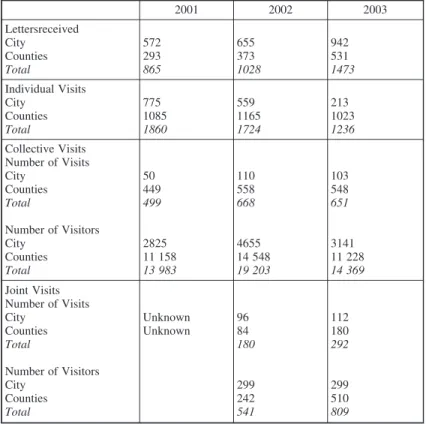
In 2002, the eleven persons working at the Letters and Visits Office associat- ed with both the Party committee and the People government received 655 letters, 593 complainants reflecting 559 personal grievances, 4,655 complainants involved in 110 collective grievances, and 299 representatives of 96 joint grievances.
Table 1 reveals the clear increase in the number of letters received, especially in 2003 as compared to the previous year, since letters addressed to the city bureau increased by 43.80 % and those addressed to the county level by 42.30 %. One should add that collective letters, whose figure do not appear in this table, repre- sented 4.80 % of all written complaints in 2002 and 7.3 % in 2003.
Individual visits remained rather stable at the county level but decreased at the city level, explaining the overall decline of such visits. Local authorities stressed in an internal report that letters and visits had clearly decreased during the first six months of 2003 as compared to situation observed during the same period in 2002 because of the Sars epidemy, which might explain the overall decline of individu- al visits to the city level.
Collective visits increased sharply in 2002 (120 % at the city level and 24 % at the county level), and remained rather stable, with a minor decline, in 2003. The average number of visitors per collective visit also remained stable in 2001 and 2002 (28 persons) and diminished in 2003 (22 persons). On the contrary, joint vis- its, that is visits headed by four persons at most representing the interests of a wider group, are clearly on the rise. Unknown in 2001, this procedure has gathered 292 visits headed by 809 representatives in 2003, an increase of 62 % and 49 % respec- tively as compared to 2002.
Finally, in 2003, complainants originating from H. city organised 28 collective visits gathering 622 to the provincial capital, and seven collective visits gathering
129 persons to Beijing, while 69 persons went to the capital to express their indi- vidual grievances.
Not only is the growing number of complainants lamented by the personnel of local Letters and Visits Offices, but the difficulty to deal with petitioners and sat- isfy their grievances is also clearly expressed even in this rather small, rural ori- ented, inner locality: “People today are not like in the past, they do not express their comments in a moderate manner... When xinfangis mentioned nowadays within the city government, officials feel nervous and anxious. Some even say that the best way to solve xinfangproblems is simply to close xinfangoffices ....”39
While the recent trends mentioned above are usually explained either by stress- ing organisational dysfunctions (such as offices’ inertia and passivity, administra- tive collusion and repression, exclusive concern for cases which put social order at risk), or by describing the consequent strategic moves adopted by petitioners in order to get round such obstacles and be heard, another factor of explanation may
Table 1 H. City (Shanxi)
Statistics of the Municipal and County Level Letters and Visits Bureaus
2001 2002 2003
Lettersreceived City
Counties Total
572 293 865
655 373 1028
942 531 1473 Individual Visits
City Counties Total
775 1085 1860
559 1165 1724
213 1023 1236 Collective Visits
Number of Visits City
Counties Total
Number of Visitors City
Counties Total
50 449 499
2825 11 158 13 983
110 558 668
4655 14 548 19 203
103 548 651
3141 11 228 14 369 Joint Visits
Number of Visits City
Counties Total
Number of Visitors City
Counties Total
Unknown Unknown
96 84 180
299 242 541
112 180 292
299 510 809
reside in the very content of the grievances, that is in the content and nature of the judgments expressed.
4. From Individual to Collective Grievances, from Particular to General Complaints
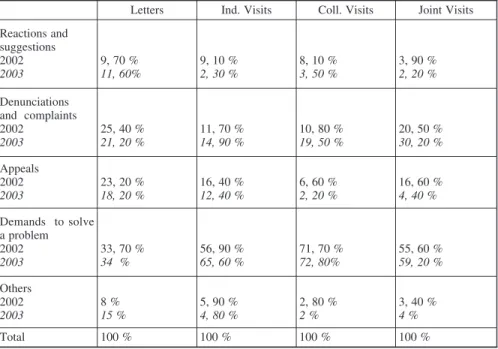
As official categories aiming at classifying the cases received according to their content, the four distinctions mentioned earlier and adopted in many Letters and Visits Offices throw a light on the content of the grievances expressed. National figures being unavailable, the figures collected in H. city are used to illustrate a pos- sible combination of such categories. The following table thus illustrates the way written and oral complaints were classified by the municipal and county xinfang offices in 2002 and 2003, the dominant topics of the grievances received in 2003 being: labour issues (unsolved problems linked to the restructuring of local enter- prises such as unpaid wages, retirement pensions or medical fees); village elections and rural cadres’ abuses in general; conflicts arising from the expropriation of cul- tivated land or urban buildings; civil disputes such as those linked to property rights
Table 2 H. City (Shanxi)
Official Classification of the Letters and Visits’ Content
Letters Ind. Visits Coll. Visits Joint Visits Reactions and
suggestions 2002 2003
9, 70 % 11, 60%
9, 10 % 2, 30 %
8, 10 % 3, 50 %
3, 90 % 2, 20 % Denunciations
and complaints 2002
2003
25, 40 % 21, 20 %
11, 70 % 14, 90 %
10, 80 % 19, 50 %
20, 50 % 30, 20 % Appeals
2002 2003
23, 20 % 18, 20 %
16, 40 % 12, 40 %
6, 60 % 2, 20 %
16, 60 % 4, 40 % Demands to solve
a problem 2002 2003
33, 70 % 34 %
56, 90 % 65, 60 %
71, 70 % 72, 80%
55, 60 % 59, 20 % Others
2002 2003
8 % 15 %
5, 90 % 4, 80 %
2, 80 % 2 %
3, 40 % 4 %
Total 100 % 100 % 100 % 100 %
or labour contracts, and finally problems linked to the assignment of cadres’ posi- tions to former military officials.
According to this table, “reactions and suggestions” represented almost 10%
of the cases received in 2002, not included joint visits which constituted by then a new procedure. H. city appears here to be on a par with national figures since 10
% of cases handled by all Letters and Visits Offices are said to belong to such cat- egory, which includes issues as varied as mentioning that some traffic light is out of order, exposing the expensive banquets held by local officials, or suggesting Beijing authorities to take the floor and explain that no consumers’ panic is justi- fied during the Sars epidemy. The specific worries associated with this last epide- my partly account for the fact that comments and advice were expressed through letters rather than through visits in 2003.
“Denunciations and complaints” have clearly been on the rise for individual, collective and joint visits in 2003, representing almost one third of this last type of visits. Such a category is nonetheless very broad, since it basically implies lodging a complaint against a specific accused, who may nonetheless be an ordinary citizen or a member of the administration. As a consequence, civil disputes linked, for instance, to property issues, but also administrative abuses and exactions, are here brought together.
“Appeals” lodged against legal or administrative decisions, which are more fre- quently exposed through letters or individual visits, have been decreasing in H. city.
However, complaints related to legal issues, such as denouncing the bad imple- mentation of legal procedures or judges’ misbehaviour, can also be included in other categories. Finally, “demands to solve a problematic situation” have been on the rise, representing as much as 72.8 % of the collective visits. The grievances exposed in this last category, whose efficiency seems to be considered as higher when relying on a face-to-face exchange with the administration representatives, are also rather diverse: they comprise indeed, likewise “denunciations and complaints,”
mistakes and wrongdoings accomplished by ordinary citizens or by officials and thus include a variety of situations. However, in jiefa konggaocases, the accused is usually clearly identified and his transgressions are stressed, while in jiujuecases, the accused may be a rather anonymous, collective group, and the unjust condition imposed as a consequence upon the victim tends to be privileged.
The above distinctions shed some light on the content of the utterances expressed by complainants. However, their internal diversity tends to conceal rather than disclose the forms of judgment mobilised by individuals and groups. Members of Letters and Visits Offices themselves put forward that such distinctions are rather vague and should be considered as mere indicators, a given complaint usually belonging to more than one of these categories. Therefore, the analysis of the cor- pus of written grievances collected, as limited and fragmented as it may be, offers a better approach to understand the type of critical competence demonstrated by
complainants than the classifications above.
Such analysis reveals, in the first place, the efforts made by those taking the floor to show that their situation, far from being particular bears some general reach, that is, is common to a wider group and should be of social concern. In other words, the injustice exposed is described as true but also as important, important meaning here a diversity of things such as the fact that the normative transgressions disclosed are major and not minor; that they affect extended groups of people rather than sin- gle individuals, or that they damage common rather than particular interests. It is because of this need to convince state administration that some action is required that appeals to Letters and Visits Offices are particularly interesting: they display the process through which ordinary citizens try to locate major social ills and wrongdoings; they disclose their efforts to identify and test possible legitimate cat- egories or principles, enabling to increase the scope and meaning of the facts denounced. In other words, such appeals support the expression of expectations regarding the type of relationships that should prevail among members of the same society, close or distant, as well as the effective content of concepts such as those of general interest or common good.
The effort of de-singularization observed in the written complaints collected usually relies on three different components: the nature of the facts encountered;
the identity of the parties at stake—mainly the victim and the accused—; and final- ly the type of norms, principles or rules said to be violated by the injustices observed.
It should be noticed, first of all, that Letters and Visits Offices are not a place where private issues, such as divorces or inheritance disputes, are exposed. In other words, they do not constitute an alternative to legal bodies for all types of conflicts but are used to handle issues which are considered to be linked, in one way or another, to the state responsibility. In other words, analysing the grievances expressed provides some understanding of the way Chinese citizens establish ten- tative distinctions today between private and public realms. What is not denounced in such a space, or what progressively ceased to be denounced is such a space, is almost as important as what is denounced.
Among the facts disclosed, some may be particular to a given individual, such as in the case of the visit paid by a woman named Deng Jincai, on November 25, 2002, to the Letters and Visits office of Cixi city (Zheijiang province), to describe the dramatic situation faced by her family after her husband became paralysed, their two children being unable to pay village school fees.40Her demand for assistance, which shows that the state is hold responsible for providing basic means of survival to all and cannot remain untouched by the extreme difficulties faced by some of the persons under its administration, was specific, as were specific the means found by the local government to alleviate this particular situation. However, the facts dis- closed to Letters and Visits Offices are often described by complainants as general
rather than particular. As far as the 123 letters collected in Shenzhen are concerned, for instance, only 32 are clearly related to particular and somehow exceptional events affecting individuals who ask for personal redress, all other grievances implying some form of generalization to widen their reach. Such process may nonetheless follow different patterns. The time dimension of the reality exposed may be used, for instance, to stress its scope. The facts denounced can indeed be recurrent rather than isolated, such as when a worker writes: “... We do from 4 to 8 hours overtime every day but we are never paid accordingly. Food is very bad and expensive. Water fees amount to 20 yuans per month. The boss has taken all our personal documents and we are thus been denied any freedom of movement...”
Authors eventually combine the description of their personal misadventures with that of the regular working conditions imposed upon their workmates: “I am a dagongmeicoming from Hunan and I implore your help. Having arrived in this place of Shenzhen close to Heaven three months ago, I had an argument with the head of the team and was fired. I left at the end of past month but they refuse to pay me any salary... I want also to speak about the situation of the other workers in this enterprise; their hearts are not quiet because the regulations are so harsh and the fines so many...”41In another use of time dimension, the reality exposed may be described as having lasted for a long time rather than being short-lived, as in the case of a retired worker writing to the xinfangbureau of H. city to claim rights that he had been unfairly deprived for more than two decades.
Space dimension can also be mobilised to stress the importance and the scope of the injustice caused. Another pattern of generalization is indeed linked to the exposure of facts described as bearing some incidence on a group rather than on a single individual: the treatment inflicted to all members of a factory in the case of the corpus gathered in Shenzhen, but also the unanticipated estate projects affect- ing all owners in a small neighbourhood, or the illegal elections damaging the inter- ests of all inhabitants of a same village. The legitimacy assigned to common or gongrather than particular or sigrievances, partly explains the high number of col- lective complaints mentioned above, that is of complaints directly affecting a high number of victims. As we shall see later, the question of the identity of the victims is a complex one and offers a variety of ways to widen the reach of the injustice exposed. Let us just notice here that a significant proportion of the grievances col- lected directly concern an extended group of people. Moreover, when only a few individuals are affected, complainants may still interpret the facts exposed as com- mon to many by stressing that they are typical, that is either exemplar of past sim- ilar injustices thus including them in a wider reality, or potentially shared since oth- ers might be confronted to similar problems in the future. In this last situation, peti- tioners will thus argue that the personal injustice they have faced is likely to hap- pen to others if nothing is done to prevent its repetition. In letter 6 of the Shenzhen corpus, for instance, a migrant describes how he has been cheated by a private
enterprise supposed to help him find a job, emphasising that he is not asking for any personal compensation but wants merely to protect “common interests.” Finally, petitioners may demonstrate the social relevance of their particular situation by link- ing it with issues officially recognised as social problems or public causes, such as sannong problems or migrant workers’ unpaid salaries. The concentration of grievances on some major issues thus reflects the extent to which these issues have become a commonplace in many localities, but also the capacity of complainants to anchor their dissatisfaction in questions of shared or public concern, to describe the injustices faced as exemplar of a type of situation already identified as prob- lematical by national authorities.
A second element showing complainants’ capacity to invest this space not only as a place to air private grievances but also as a place to discuss problems common to many, is related to the identification process of the two parties at stake, that is to the answers given to the following questions: in whose favour the denunciation is made? How is the accused identified? As mentioned above, many grievances are expressed by an individual describing his own personal difficulties. However, com- plaints expressed in the name of a wider group are also numerous, and collective initiatives definitely dominate visits paid to the institution observed. The ways avail- able to operate some form of generalization are nonetheless limited here by the con- straints faced to constitute formal associations in China and use official titles or mandates in order to speak on behalf of a collective entity. As a consequence, grievances including multiple complainants remain one of the most convenient and direct ways to show that a common problem is at stake, the joint visit procedure representing an official but rather ambiguous alternative to this choice since it amounts to creating “representatives” or “organizers.” Despite such restrictions, the patterns used to enlarge the reach of the denunciation by increasing the status of the victim are varied. One of the issues to be considered is the relationship established by complainants between the author of the denunciation and the victims said to be affected by the facts exposed. A person can indeed take the floor to speak for her- self and only for herself, or to speak on behalf of a wider group. For instance, 20 of the 91 letters collected in Shenzhen and which concern general working and liv- ing conditions, are written by a worker who took the initiative but who actually spoke on behalf of other workmates too (only 11 of them state their names). Such complainants often shift in their grievance from personal to shared situations and feelings, the subject in the same letter being alternately “I” or “we”, and speaking as members of a given category rather than as particular individuals. “I arrived from Sichuan to work in Shenzhen, and I have been working in Company Z for almost one year. The friends and workers who work with me, all share the same feeling:
it is impossible to go on like this!” or “We are all angry and this is why I write to you to denounce a situation that violates the Labour Law...”42 But the author of the grievance can also be a collective actor. Natural collective entities such as those
formed by the members of the same village or factory ground, as seen above, many complaints. Such collective actors may identify themselves through a diversity of means. For instance, in the Shenzhen corpus, 20 grievances bear the signatures of multiple authors working in the same factory (two to 75 names), four were written by individuals claiming to be official representatives of local workers, while in the remaining 47 cases, the letters ended with a general and anonymous collective for- mula such as “written by all the workers of company X” or “signed by many tens of workers of company Z.” But collective complaints can also gather individuals coming from a diversity of natural collective entities: in June 2003, for instance, 350 retired workers belonging to different enterprises of Shenzhen city organized a collective visit to the municipal Letters and Visits Office.43
In addition, the petitioners, whatever their size, may claim to be speaking on behalf of the wider entity composed by those who, although distant and anonymous, share the same status or situation. In other words they may include, although often very indirectly, those potentially victims of the same facts. This capacity of private complaints to mention, although often indirectly, the “other” beyond the sphere of mutual and direct acquaintance, points out to the attention explicitly paid to the rela- tionship to the third party, to the importance assigned to institutional mediations required to administer a community of citizens. Workers in the Shenzhen corpus thus sometimes refer to the wider group of dagongmeior dagongzai, expressing their gratitude, for instance, for what the xinfangpersonnel bureau has been doing or will tentatively do for the members of such groups.
Finally, another way for the complainants to make themselves greater and more legitimate is to mention the wider social categories they belong to, the last sentence of the letters collected often stressing in which capacity they are taking the floor and requesting the urgent intervention of the administration. Concepts offi- cially loaded with positive appraisals are then widely used: petitioners readily intro- duce themselves, for instance, as workers or labourers (utilizing words encompass- ing different meanings such as gongren, yuangong, laodongzhe); they are not reluc- tant to speak as representatives of very general but also valid categories such as those of renmin, laobaixingor “the masses” to assess their own social status.
Echoing such a trend, those hold responsible for the injustices denounced also undergo, at least in many of the cases observed, a generalization process. It should be noticed that the outcome observed might have been otherwise, complainants choosing rather to denounce the particular individuals hold responsible for their mis- fortune. While they do so when civil disputes are at stake, they tend whenever pos- sible to anchor the accused in a wider social group or to link him or her to a for- mal institution. The categories at stake are, for instance “Liang boss,” associating a particular identity to a given social position or the “heads of the enterprise,” stress- ing a structural distinction between the two parties at stake; categories more or less explicitly embedded in shared negative appraisals may be used such as “the foreign