平成29年度
京都大学大学院理学研究科
D3発表会アブストラクト
(平成30年1月22日)
物 理 学 第 二 分 野
1 . Probabilistic eccentricity evolution of stars around shrinking massive black hole binaries
岩佐 真生 (8:30)
2 . Critical behavior of the matrix models generating 3D random volumes
梅田 直弥 (8:50)
3 . Chiral Primordial Gravitational Waves Sourced by Axion-Gauge Couplings
小幡 一平 (9:10)
4 .
理研RIBFにおける重イオン衝突実験で探る 高密度原子核物質の対称エネルギー金子 雅紀 (9:30)
5 .
Study of Acceptance Improvement for K0 L
→π0
ννSearch
上路 市訓 (9:50)
6 . The study on quantum field theories from numerical approaches
川井 大輔 (10:10)
7 .
't Hooft anomaly, global inconsistency, and some of their applications菊池 勇太 (10:30)
8 .
核ガンマ線イメージングスペクトロスコピーの開拓 岸本 哲朗 (10:50)D3 発 表 会
日時 平成30年1月22日(月) 8時30分~
場所 理学研究科5号館 525号室 発表時間 15分+5分(質問)
《目 次》
―
9 .
ATLAS 実験における弱ボソン対に崩壊する共鳴状態の セミレプトニック終状態での探索救仁郷 拓人 (11:10)
10 . Study of the neutrino mass hierarchy with the
atmospheric neutrino data in Super-Kamiokande IV江 淼 (11:30)
11 . Deformation of N =4 SYM with space-time dependent couplings
崔 在旺 (11:50)
12 .
場の理論におけるエントロピーの数値計算法の開発と それに基づく相対論的重イオン衝突での熱化機構の 解析築地 秀和 (12:40)
13 .
高強度レーザー照射による金属ワイヤー導波路上への テラヘルツ表面波発生寺本 研介 (13:00)
14 .
J—PARC KOTO実験におけるKL
→π0
νν崩壊探索の 背景事象の研究中桐 洸太 (13:20)
15 .
ニュートリノ振動におけるニュートリノ反応モデルの 系統誤差の評価と振動パラメータの精密測定仲村 佳悟 (13:40)
16 .
加速膨張宇宙とブレーンワールドモデル 西 雅人 (14:00)17 .
Black hole microstates with a new constituent 朴 敏奎 (14:20)18 . Toward a precision cosmological test of gravity from redshift-space bispectrum based on perturbation theory
橋本 一彦 (14:40)
午 後
19 .
反ミューオンニュートリノと核子のパイ中間子の 生成を伴わない荷電カレント反応断面積の測定林野 竜也 (15:00)
20 . Simulating Extreme Spacetimes on the Computer
FEDROW,Joseph Mathew
(15:20)
21 .
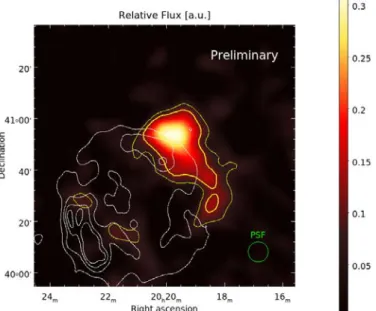
超新星残骸γ-Cygniからのガンマ線放射の観測 増田 周 (15:40)22 .
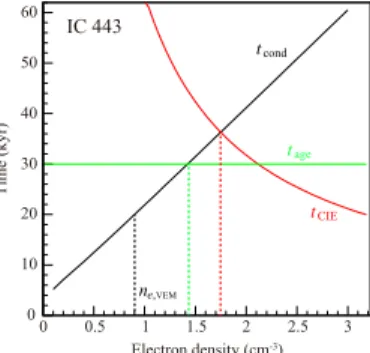
Investigation of the Formation Process of Recombining Plasmas in the Galactic Supernova Remnants with Suzaku X-ray Observatory松村 英晃 (16:00)
23 .
連星中性子星合体GW170817は rプロセス元素の起源となりえるか?松本 達矢 (16:20)
24 .
Analysis of Λ(1405) based on chiral SU(3) dynamics 宮原 建太 (16:40)25 .
ΛcN interaction from lattice QCD and its application to Λc hypernuclei宮本 貴也 (17:00)
26 .
MAIKoアクティブ標的を用いた巨大双極子共鳴領域に おける4
He光分解反応の断面積測定村田 求基 (17:20)
27 .
Role of axial anomaly and nesting in the inhomogeneouschiral phase
吉池 遼 (17:40)
28 .
Scrambling and Complexity in AdS/CFT and Black Holes渡邊 賢人 (18:00)
Probabilistic eccentricity evolution of stars around shrinking massive black hole binaries
天体核研究室 岩佐真生
Abstract Based on the secular perturbation theory, we study how shrinking massive black hole binaries affect the orbital evolution of star clusters. We find that the eccentricity of stars could show the sharp transitions, depending on initial conditions.
© 2018 Department of Physics, Kyoto University
Massive black hole (MBH) binaries are considered to be formed after mergers of galaxies, and are one of the most important targets for the laser interferometer space antenna (LISA). By detecting gravitational waves from MBH binaries, we will be able to examine gravitational theories in the strong field regime, in addition to astrophysical information related to galaxy formation and evolution. Meanwhile, a MBH is expected to have associated star clusters. It has been pointed out that the infall rates of stars would be significantly enhances for MBH binaries, compared with single MBHs. The infalling stars also emit gravitational waves and electro magnetic waves, and will work as key probes to study MBHs. Here, the Lidov-Kozai mechanism may play an important role.
The Lidov-Kozai mechanism is a well-known process in celestial mechanics, and works for inclined hierarchical triple systems. In the present case, a MBH and a near by star form the inner binary and the secondary MBH is the outer perturber. In the Lidov-Kozai mechanism, the inclination and the inner eccentricity oscillate due to the exchange of angular momenta between the inner and outer orbits. We call this the Lidov-Kozai mechanism. In some cases, the inner eccentricity of the star can be excited to ~ 1, and stars can closely approach MBHs.
The Lidov-Kozai mechanism is caused by the tidal force of the outer perturber, and the resultant inner apsidal precession is crucially important. But, non-Keplerian potentials can suppress the Lidov-Kozai mechanism by generating additional apsidal precessions. Therefore, if the outer body is far away, and the apsidal precession is dominated by other non-Keplerian potentials, the inner eccentricity could not be amplified appreciably.
For our hierarchical triple systems involving MBH binaries, general relativistic corrections and the potential of nuclear star clusters around each MBH correspond to such non-Keplerian potentials. In the long run, the distance between two MBHs will shrink due to dissipative effects such as dynamical friction, scattering of stars and gravitational wave emissions. Therefore, though initially suppressed, the Lidov-Kozai mechanism could be gradually effective, competing with other non-Keplerian potentials. However, this transition has not been investigated adequately.
In my talk, we examine how the "slow" contraction of the outer massive black hole affects the star cluster. Based on the secular theory, we find that the eccentricities of the stars could show sharp transitions, depending strongly on their initial conditions. By examining the phase-space structure of an associated Hamiltonian, we show that these characteristic behaviors are partly due to a probabilistic bifurcation at a separatrix crossing.
References
[1] Mao Iwasa & Naoki Seto, 2017, MNRAS, 472, 1600.
[2] Mao Iwasa & Naoki Seto, 2016, Phys Rev D, 93, 124024.
Critical behavior of the matrix models generating 3D random volumes
素粒子論研究室 梅田直弥
Abstract We propose a new class of models that generate three-dimensional random volumes, where each configuration consists of triangles glued together along multiple hinges. The models have the sign problem for numerical study, and we develop the generalized Lefschetz thimble method by implementing the parallel tempering algorithm.
© 2018 Department of Physics, Kyoto University
The worldvolume theory of membrane is mathematically equivalent to three-dimensional quantum gravity coupled to matter fields corresponding to the target space coordinates of embedded membrane. We propose a class of models, "triangle-hinge models", that generate three-dimensional random volumes, where each configuration consists of triangles glued together along multiple hinges [1]. Although most of the diagrams represent configurations which are not manifolds, we show that the set of possible diagrams can be drastically reduced such that only (and all of the) three-dimensional manifolds with tetrahedral decompositions appear, by introducing a color structure and taking an appropriate large-N limit. We further introduce matter degrees of freedom to the models by coloring simplices in a way that they have local interactions [2]. We also define unoriented membrane theories in terms of tetrahedral decompositions, and then realize them as triangle-hinge models [3].
Triangle-hinge models can be redefined so that they give finite free energies without changing the original perturbation series. We study the phase structure of the models numerically, but the restriction of the diagrams to tetrahedral decompositions makes the action complex-valued, and the complexified model suffers from the sign problem in the large-N limit. We use the generalized Lefschetz thimble method [4], which is one of the promising methods to solve the sign problem. However, this method is known to suffer from a multimodal problem, and thus we improve it by implementing the parallel tempering method, where the flow time of an antiholomorphic gradient flow is used as a tempering parameter [5]. We then study the phase structure of the complexified triangle-hinge model. Our parallel tempering algorithm works well, but it turns out that a large amount of computational cost is still required to make a definite statement on the phase structure of the model.
In order to reduce the computational cost, it is generally important to carefully choose the set of tempering parameters. We define for a given Markov chain Monte Carlo algorithm a distance between two configurations that quantifies the difficulty of transition in the configuration space [6]. The distance enables us to make the above adjustment in a geometrical way. We also argue that an anti-de Sitter-like geometry naturally emerges when we consider highly multimodal action with a large number of degenerate vacua.
References
[1] M. Fukuma, S. Sugishita and N. Umeda, JHEP 1507 (2015) 088
[2] M. Fukuma, S. Sugishita and N. Umeda, PTEP 2016 (2016) no.5, 053B04 [3] M. Fukuma, S. Sugishita and N. Umeda, PTEP 2016 (2016) no.7, 073B01
[4] A. Alexandru, G. Basar, P. F. Bedaque, G. W. Ridgway and N. C. Warrington, JHEP 1605, 053 (2016) [5] M. Fukuma and N. Umeda, PTEP 2017, no. 7, 073B01 (2017)
[6] M. Fukuma, N. Matsumoto and N. Umeda, JHEP 1712 (2017) 001
Chiral Primordial Gravitational Waves Sourced by Axion-Gauge Couplings
天体核研究室 小幡 一平
Abstract We study a cosmological mechanism of generating parity-violating primordial gravitational waves sourced by gauge fields coupled to a string axion during the inflationary period. We develop several models of axionic inflation with gauge fields which predict chiral gravitational waves potentially observable with future gravitational wave detectors [1][2]. © 2018 Department of Physics, Kyoto University
In the conventional inflationary scenario, primordial gravitational waves are produced by vacuum fluctuations of space-time being stretched out and getting classicalized across the Hubble horizon during inflation. This
mechanism is common on the relevant scales discussed at inflationary age, so its amplitude has almost statistically scale-invariant and parity symmetric features. However, cosmic microwave background (CMB) observations so far show no evidence of primordial gravitational waves through the imprint of polarization of B-mode in CMB photons. Based on this fact, its amplitude should be tiny even on smaller scales where gravitational wave interferometers are going to probe, if the dominant contributions of gravitational waves are vacuum fluctuations.
In addition to that, we might not be able to obtain sufficient information to search for fundamental physics in the early universe only by means of the amplitude and scale dependence of tensor modes.
After giving a short review of above standard inflationary pictures, we suggest another possibility to alter those pessimistic situations by developing an axionic inflation with gauge fields, in the case of both Abelian and non-Abelian gauge groups. The key phenomenon to understand is that the rolling axion amplifies one helicity mode of gauge particles via its parity-violating interaction, and hence particle production of gauge field occurs.
Remarkably, the enhanced gauge field creates the parity-violating tensor power spectrum during inflation.
Firstly, we study the mechanism of generating chiral primordial gravitational waves sourced by U(1) gauge field at its quantum loop effect, and explore the possibility of their detection with future laser interferometers or pulsar timing array missions. There, we show that particle production of the gauge field also amplifies scalar modes and then leads to an overproduction of primordial black holes in our present universe. We propose a model which avoids such observational constraints by introducing many U(1) gauge sectors coupled to an axion.
Next, we also develop an axionic inflation with SU(2) gauge field called “Chromo-Natural inflation”, and find that this scenario predicts chiral gravitational waves sourced by gauge field at linear level, while they are produced too much to satisfy the current CMB data. In order to mend this conflict, we finally extend a model of Chromo-Natural inflation by introducing the dilatonic field which is kinematically coupled with gauge field. We discuss the possibility of Chromo-Natural inflation which provides testable chiral primordial gravitational waves at intermediate scales planned to observe by gravitational wave detectors, with satisfying the consistency with large scale CMB observations.
References
[1] I. Obata and J. Soda, Phys. Rev. D 93, no. 12, 123502 (2016).
[2] I. Obata, JCAP 1706, no.06, 050 (2017).
.
理研 RIBF における重イオン衝突実験で探る 高密度原子核物質の対称エネルギー
原子核・ハドロン物理学研究室 金子雅紀
Abstract Charged π meson from intermediate energetic heavy-ion collisions is proposed as a good probe to investigate the nuclear symmetry energy at supra-saturation densities. At RIKEN-RIBF, we measured charged particles and neutrons emitted from four kinds of Sn+Sn isotopic reactions at 270 MeV/A. In this presentation, analysis status will be presented.
© 2018 Department of Physics, Kyoto University
核物質の状態方程式(EOS)は中性子星の内部構造や超新星爆発ダイナミクスなどといった、原子核物 質のバルクな性質を記述する上で重要である。特に、中性子過剰な環境における寄与が大きい対称エネ ルギーは、状態方程式を決定する上で大きな不定性を持つ要素の一つである。絶対零度極限における EOS の表式は、核子数密度
ρ=ρ
n+ρ
pとアイソスピン非対称度δ=(ρ
n-ρ
p)/ρ
を変数として、1 核子あたりの エネルギーを以下のような展開形で表す。E (⇢, ) = E (⇢, ⇠ 0) + S (⇢) 2 + O ( 4 )
ここで、
ρ
n(p)は中性子(陽子)数密度であり、δ
の二次の係数として現れるS(ρ)が対称エネルギーである。現在のところ、原子核飽和密度(
ρ
0~0.16 /fm3)以下の領域では主に原子核実験により制限が与えられて いるが、高密度領域では不定性が大きい[1]。理論的には、数百 MeV/核子における重イオン衝突からの 荷電π中間子比が高密度領域における対称エネルギーの有用なプローブとなることが Bao-An Li らによ り指摘されている[2]。しかしながら、中間エネルギー重イオン衝突における核子やクラスターの運動、π中間子生成・吸収プロセスの取り扱いは特有の難しさがあり、対称エネルギーに対する感度はモデル 依存性が非常に大きい。そのため、複数の輸送モデル計算による比較検討が進められている[3]。また、
高密度核物質をプローブする実験的取り組みとして、ドイツ GSI において複数種類の同種核衝突系から の荷電π中間子比が測定された[4]が、クーロン力の影響が混入しているために対称エネルギーの寄与を 正しく引き出せているかどうかは議論の余地がある。
我々は理研 RIBF により供給される様々な種類のスズ同位体ビームを用いることで、132Sn+124Sn、
108Sn+112Sn、112Sn+124Sn、124Sn+112Sn といった中性子数のみが異なる衝突系を比較する系統的測定を行 なった。本測定はクーロン力の影響をキャンセルすることで、対称エネルギーに対してより高い感度を 持つことが期待される。特に、π中間子は核子-核子衝突により生じるΔ(1232)の崩壊を通して生成され るため、データ取得トリガーにより中心-準中心衝突事象を選択することで高統計の測定を目指した。ビ ームエネルギーはいずれの衝突系も 270 MeV/核子であり、想定される衝突時の到達密度はおよそ 2ρ0 である。衝突事象から放出される荷電粒子は、SAMURAI スペクトロメータ内に S
π
RIT-TPC[5]を設置 して運用することで粒子のエネルギー損失-運動量分析を行い識別する。また、中性子は前方 30 の位置 に設置した NeuLAND demonstrator[6]によって検出する。今後は衝突径数に対する測定感度を決定し た上で、荷電π中間子比の導出を目指す。本発表では、本実験の概要と解析の現状について報告する。References
[1] M. B. Tsang et al., Phys. Rev. C 86, 015803 (2012).
[2] B. A. Li et al., Phys. Rev. C 71, 014618 (2005).
[3] J. Xu et al., Phys. Rev. C 93, 044609 (2016).
[4] W. Reisdorf et al., Nucl. Phys. A 781, 459 (2007).
[5] R. Shane et al., Nucl. Instrum. Methods Phys. Res., Sect. A 784, 513 (2015).
[6] K. Boretzky et al., GSI Rep. 2015-1, 200-202 p. (2015).
Study of Acceptance Improvement for K 0 L →π 0 νν
_
Search
高エネルギー物理学研究室 上路市訓
Abstract A new analysis method is proposed to improve the signal acceptance in the KOTO experiment searching for the K
0L→π
0ν ν _ decay. In the experiment, acceptance loss caused by the high rate operation of the detectors for background suppression limits the experimental sensitivity.
© 2018 Department of Physics, Kyoto University
The KOTO experiment aims to observe a rare neutral kaon decay, K
0L→π
0ν ν _ . The decay is well suppressed in the Standard Model of elemental particle physics, whose branching fraction is estimated to be (3.00±0.30)×10
-11with small theoretical uncertainty of 1% [1]. Figure 1 shows the detection principle of K
0L→π
0ν ν _ . The π
0immediately decays into two photons, hitting an electromagnetic calorimeter composed of undoped cesium iodide (CsI) crystals. Since the neutrinos cannot be detected, only the two photons are detectable, where their center of mass has finite transverse momentum. Other decays of K
0Lsuch as K
0L→π
+π
-π
0would be possible backgrounds (Fig. 2), which can be rejected by catching extra particles with the detectors surrounding the decay region, called “veto counters”.
Since any signal in veto counters is assumed to be associated with a background event, accidental activities on the veto counters lead to a signal loss, called “accidental loss”, which is estimated to be 76% for the data taken in 2015. The accidental loss is proportional to the hit probability in veto counters determined by a product of counting rate and time window for synchronization with the CsI calorimeter (“veto window”). To maximize the acceptance of K
0L→π
0ν ν _ by reducing the accidental loss, the veto window should be set as narrow as possible.
Narrower veto window can increase detection inefficiency caused by overlapped pulses of signal waveforms in the veto counters, called “masking inefficiency”. Figure 3 shows an example, where a preceding pulse outside the veto window hides the second pulse inside the veto window. To reduce the masking inefficiency, a new analysis method has been developed, where each overlapped pulse (the black dotted graph in Fig. 4) is decomposed into multiple single pulses (the red and green graphs in Fig. 4).
In this talk, the analysis status of acceptance improvement for the K
0L→π
0ν ν _ search in the KOTO experiment will be presented. The main topic is the development of the waveform decomposition method and its pulse finding performance for the suppression of masking inefficiency with narrower veto window.
References
[1] A. J. Buras, D. Buttazzo, JHEP 1511, 033 (2015).
Figure 1 Principle of KOTO experiment
Figure 2 Example of background event
Figure 3 Example of masking inefficiency Figure 4 Example of waveform decomposition
The study on quantum field theories from numerical approaches
素粒子論研究室 川井 大輔
Abstract We present two studies of quantum field theory with numerical computations. In the study on lattice QCD, the method to obtain the phase shift of ππ scattering in I = 1 channel from the combination of the HAL QCD method and LapH smearing is considered. With the method, we extracted the signal of ρ resonance from the HAL QCD method for the first time. For the study of the chaotic solution in the classical string and BMN matrix model. We show there are chaotic solutions in these theories, and discuss the possible indication for the gauge theories in the strong coupling.
© 2018 Department of Physics, Kyoto University
Since the most of the study on the quantum field theory today needs non-perturbative approach, the good command on the numerical computations is being more and more important.
Moreover, due to the improvement on the computational resource such as high performance CPU and large volume memories, the numerical simulation is available in the situation very close to the real world. In this sense, numerical simulation is no longer a supportive tool for the study but an important branch of science. In this thesis, we consider two studies on quantum field theory with numerical computations : (1) the phase shift of the ππ scattering and extraction of ρ resonance signal and (2) chaotic solution of superstring theory and M-theory.
These studies cannot be conducted without numerical simulations. In the study of scattering phase shift, the method to obtain the phase shift in I = 1 channel from the combination of the HAL QCD method and Laplacian-Heaviside (LapH) smearing is considered. Before we try this method for the ππ scattering in I = 1 channel, we investigated the scheme independence of the HAL QCD potentials at pion mass m
π= 870 MeV. It is found the local potentials calculated from the combination of the HAL QCD method and LapH smearing have scheme dependence while the scheme independence in the HAL QCD method is proved if non-local potential is employed. We found that the scheme dependence of the physical observables such as phase shift, resonant state mass and decay width can be reduced by considering next-to-leading (NLO) order term in derivative expansion [1]. With this knowledge, we computed the scattering phase shift of ππ scattering in I = 1 channel. Since the NLO potential cannot be extracted because of insufficient number of configuration, the phase shift quantitatively deviates from the one obtained from Lüscher’s finite volume method. However, the phase shift have the sign of ρ resonance. The signal of mesonic resonant state is obtained from HAL QCD method for the first time [2].
In the study of the chaotic solution in the superstring theory and M-theory, we show there are chaotic solutions in a near Penrose limit of AdS
5×T
1,1and BMN matrix model with the knowledge of non-linear dynamics. According to the AdS/CFT correspondence, there is an operator in gauge theory side which is dual to the chaotic solutions in the classical string.
We discuss the possible indication for the gauge theories in the strong coupling [3,4].
References
[1] D. Kawai et al.(the HAL QCD Collaboration), arXiv : 1711.01883 [hep-lat].
[2] D. Kawai (for the HAL QCD Collaboration), accepted in EPJ Web of Conference.
[3] Y. Asano, D. Kawai and K. Yoshida, JHEP 06 (2015) 191.
[4] Y. Asano, D. Kawai, H. Kyono and K. Yoshida, JHEP 08 (2015) 60.
’t Hooft anomaly, global inconsistency, and some of their applications
Nuclear Theory Group Yuta Kikuchi
Abstract We study the ’t Hooft anomaly and global inconsistency, which are obstructions to gauging the global symmetry, involving discrete symmetries and higher-form symmetries.
Their consequences are discussed in detail via the UV/IR matching argument. Several exam- ples are given aiming at extracting nonperturbative data of infrared structure of QCD.
Department of Physics, Kyoto University c
The ’t Hooft anomaly, an obstruction to promoting global symmetries to local gauge symmetries, is one of the most powerful tools to study the infrared properties of the quantum field theories [1]. The UV/IR anomaly matching condition claims that, provided the global symmetry has an ’t Hooft anomaly in the ultraviolet theory, the infrared theory reached via renormalization group flow must reproduce the same ’t Hooft anomaly, and particularly, the realization of the symmetric gapped state without topological order is strictly forbidden in the infrared theory. Thus, the existence of ’t Hooft anomalies, combined with the anomaly matching condition, imposes strong constraints on the low-energy effective theories. Recent remarkable developments enable us to deal with ’t Hooft anomalies for wider class of global symmetries such as discrete symmetries and higher-form symmetries [2,3].
We present ’t Hooft anomalies and global inconsistencies, the latter of which are other type of obstructions to gauging the global symmetry, involving discrete symmetries and higher-form symmetries. Consequences of the ’t Hooft anomaly and global inconsistency are discussed in detail via the UV/IR anomaly matching argument. Several examples are given in increasing difficulty but desirability for the purpose of extracting nonperturbative data of infrared structure of quantum chromodynamics (QCD). To be specific, we deal with quantum mechanical models, the pure Yang-Mills and bifundamental gauge theories with the theta angles, and QCD and QCD-like theories at finite temperatures following our recent papers [4,5,6]. The various quantum mechanical models serve as pedagogical illustrations of ’t Hooft anomalies, global inconsistencies, and their UV/IR matching arguments. Their consequences manifest themselves as level degeneracies in energy spectra, that are protected from symmetry-preserving perturbations. While the pure Yang-Mills and bifundamental gauge theories with topological terms share a lot of features in common with the quantum mechanical models, additional concepts are introduced with a tricky global symmetry: the center symmetry, which is nowadays understood as a discrete one-form symmetry [7]. To derive the ’t Hooft anomaly and global inconsistency involving the center symmetry, we describe the generalized global symmetry along with certain types of topological quantum field theories. Combining all these ingredients together, we finally attack the ’t Hooft anomaly in QCD. Also, massless QCD with twisted boundary conditions at finite temperatures T and chemical potentials µ is discussed, in which, despite the appearance of anomalies in the vacuum, its existence at finite temperatures is totally nontrivial because of the circle compactification in the imaginary- time direction. The outcome is quite remarkable: the symmetric gapped phase is strictly excluded in so called massless Z
N-QCD, that is the QCD with flavor-twisted boundary condition in the imaginary time direction, at any temperature and chemical potential, i.e., the persistent order is realized for this theory at finite (T, µ).
Furthermore, it turns out that an ’t Hooft anomaly and a global inconsistency for certain global symmetry are responsible for the Roberge-Weiss transition at finite imaginary chemical potential.
References
[1] G. ’t Hooft, Recent Developments in Gauge Theories. Proceedings, Nato Advanced Study Institute, Cargese, France, August 26 - September 8, 1979, vol. 59, pp. 135–157. 1980.
[2] A. Kapustin and R. Thorngren, Phys. Rev. Lett. 112 no. 23, (2014) 231602.
[3] D. Gaiotto, A. Kapustin, Z. Komargodski, and N. Seiberg, JHEP 05 (2017) 091.
[4] Y. Tanizaki and Y. Kikuchi, JHEP 06 (2017) 102.
[5] Y. Kikuchi and Y. Tanizaki, PTEP 2017 (2017) 113B05.
[6] Y. Tanizaki, Y. Kikuchi, T. Misumi, and N. Sakai, arXiv:1711.10487 [hep-th].
[7] D. Gaiotto, A. Kapustin, N. Seiberg, and B. Willett, JHEP 02 (2015) 172.
核ガンマ線イメージングスペクトロスコピーの開拓
宇宙線研究室 岸本哲朗
Abstract Nuclear gamma-rays are a good probe for astrophysics. However, difficulties in sub-MeV/MeV gamma-ray astronomy hindered successful observation. Therefore, we have developed an
Electron-Tracking Compton Camera to overcome the difficulties. We report the result of a beam test in which we performed to check the capability of nuclear gamma-ray imaging spectroscopy.
© 2018 Department of Physics, Kyoto University
核ガンマ線は、超新星爆発における元素合成などを調べるための良いプローブになるためこれまで も観測が試みられてきた。しかしながら、その観測領域となる
sub-MeV/MeV
領域においては、これまで 主として利用されてきたコンプトン法に問題があり、方向決定精度が低くなってしまっていた。このた め、放射化した検出器からのガンマ線や、視野外から漏れこむ信号など、多量の雑音を除去できず、十 分な有意度での観測をするには至っていない。そこで我々はこれらの困難を克服するために電子飛跡検 出型コンプトンカメラ(以後、ETCC)を開発し、他のエネルギー領域と同様な幾何光学に基づくイメージ ング法を世界で初めて確立し、定量性、低雑音を実現した[1]。ETCCはガスTPC
とシンチレータを組み 合わせたコンプトンカメラであり、粒子識別能力及びイメージング能力を有する。我々はこれらの特性 を利用すれば宇宙のような高雑音環境下でも、核ガンマ線の正確なイメージング分光が可能になると考 え、その可能性を探ってきた。第一歩として我々は
2013
年に大阪大学RCNP
にて試験を行った。140 MeVの陽子ビームと水ターゲッ トを利用し、高雑音環境を作り、その環境下でガンマ線源(Cs137 0.8 MBq@1m)からのガンマ線を検出す ることに成功している[2]。また鉄ターゲットに利用し、核ガンマ線の観測を試み、その兆候を得るこ とに成功している。第二歩として我々は
2016
年10
月に再び大阪大学RCNP
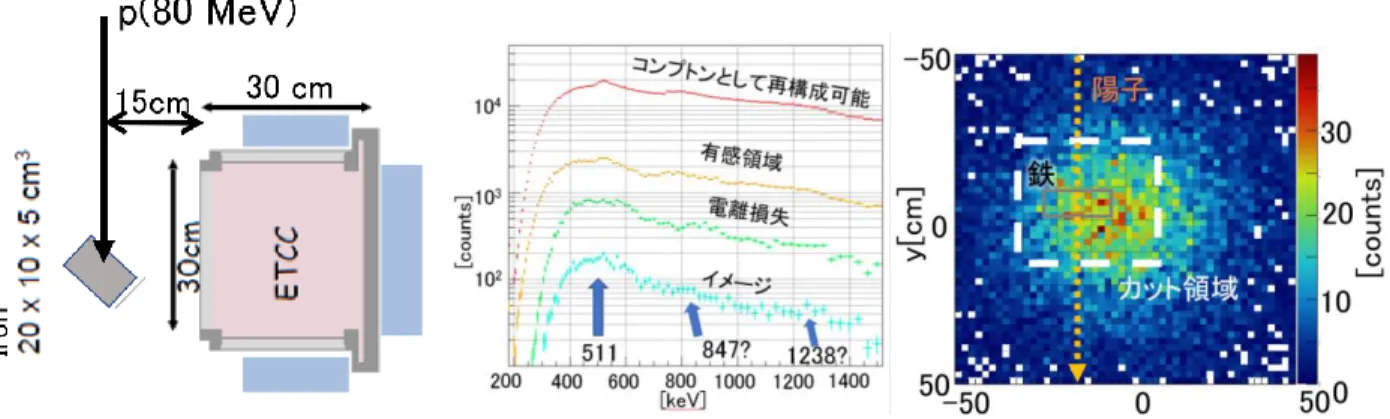
にて試験を行った。2013年からは検出器自体 の有効面積の増大が図られたほか、飛跡解析の改善によりイメージング能力が向上している。また前回 はターゲットが遠すぎたためイメージングの検証としては問題があったので大幅に近づけた。セットアップを
Fig. 1
に示す。我々は実際の天体を模擬すべく、鉄ターゲットを検出器正面に配置し、そこに80 MeV
の陽子ビームを照射した。これにより鉄からの核ガンマ線ガンマ線のスペクトル(Fig. 2)およびイメージ(Fig. 3)を得ることに成功している。今回はその結果について報告する。
References
[1] T. Tanimori et al., ApJ, 810 (2015) 28.
[2] Y. Matsuoka et al., 2015 JINST 10 C01053
Fig. 1. Setup of the experiment. Fig. 2. Spectrum of gamma-rayss from Fe. Fig. 3. Reconstructed image of gamma-rays.
ATLAS 実験における弱ボソン対に崩壊する共鳴状態の セミレプトニック終状態での探索
高エネルギー物理学研究室 救仁郷拓人
Abstract Many theories proposed for extensions to the Standard Model predict diboson resonances. We present a search for a charged or neutral diboson resonance in the semileptonic final channel. The search makes use of a series of data-driven calibrations to the hadronically decaying W/Z bosons that are highly-boosted to improve sensitivity.
© 2018 Department of Physics, Kyoto University
標準模型における未解決の問題を解決するために提案されている多くの理論のうち、例えば複合ヒッ グスモデルや余剰次元のモデルなどにおいて、2つの弱ボソンに崩壊する新粒子が予言されている。モ デル毎に新粒子の崩壊モードやスピンなどが異なるため、ATLAS, CMS 実験では考えられる多くの終状 態において包括的な探索を行っているが、今のところ新粒子による弱ボソン対共鳴は見つかっていない。
本講演では、WW または WZ ボソン対に崩壊する共鳴状態のうち、片方の W ボソンがレプトン崩壊を し、もう片方の W または Z ボソンがハドロン崩壊をするセミレプトニック終状態の解析結果について 発表する。大きい質量の共鳴状態では W/Z ボソンは高い運動量を持っており、そのハドロン崩壊から 生じる2つのクォークは近接する。この場合は2つのクォークを別々のジェットとして再構成すること が困難なため、1つの大半径ジェットとして再構成する。小さい質量ではクォーク間は十分に離れてい るため、2本の小半径ジェットとして再構成する。このように、WW/WZ 対の質量によって2つのモード に分けて 300 GeV から 5 TeV までを探索した。講演者は、ATLAS 実験で 2015, 2016 年に取得した重 心系エネルギー 13 TeV、積分ルミノシティ 36.1 fb-1 のデータを用いた解析を行い、セミレプトニッ ク終状態における弱ボソン対共鳴状態探索の最新結果を発表した [1]。新粒子に起因する顕著なイベン トの超過は見つからず、系統誤差を削減することで新粒子の発見感度を向上することを目指した。
高い質量の共鳴状態探索において支配的な系統誤差は、バックグラウンドのモデリングに起因する誤 差と、W/Z ボソンのハドロン崩壊により生じる大半径ジェットのエネルギー測定精度に起因する誤差で ある。新粒子の発見感度を改善するために実データを用いた大半径ジェットのエネルギー較正(in-situ calibration) を進めており [2]、これによって系統誤差を削減できる。本講演では、大半径ジェット のエネルギーを精度良く測定したことで弱ボソン対共鳴探索の解析に見込まれる改善についても発表 する。
References
[1] ATLAS Collaboration, “Search for WW/WZ resonance production in lνqq final states in pp collisions at
√s = 13 TeV with the ATLAS detector”, CERN, 2017, arXiv: 1710.07235 [hep-ex].[2] ATLAS Collaboration, “In-situ measurements of the ATLAS large-radius jet response in 13 TeV pp collisions”, tech. rep. ATLAS-CONF-2017-063, CERN, 2017, url: https://cds.cern.ch/record/2275655.
Fig. 1. Schematic view of the reconstruction of
a hadronically decaying W/Z boson. In the hadronic decay of a highly-boosted W/Z boson, the opening angle between the quarks is low, thus both quarks can be identified as a single large-R jet.
Fig. 2. Observed and expected cross-section upper limits at the 95% confidence level for WW production as a function of the resonance mass [1].
W q
+g q
g
g g
¯ t
t
¯ b W
b
W
+
g
g g
¯t
t
¯b
W
b
W
+
W/Z W/Z
W q
+g q
g
g g
¯ t
t
¯b W
b
W
+
g
g g
¯ t
t
¯b W
b
W
+
q
10
q
1q
20
q
2/q
2W W/
Z W
W/ Z
X
小半径ジェット大半径ジェット
R ⇠ 2M
p
TBOOST
m(Z´) [TeV]
0.5 1 1.5 2 2.5 3 3.5 4 4.5 5
WW) [pb]→Z´→(ppσ
10-3
10-2
10-1
1 10 102
103
ATLAS
= 13 TeV, 36.1 fb-1
s
qq Category ν
l q ggF/q HVT model Z´
Observed 95% CL upper limit Expected 95% CL upper limit
) σ 1
± Expected limit (
) σ 2
± Expected limit (
v=1 WW) HVT Model A, g
→ Z´
→ (pp σ
v=3 WW) HVT Model B, g
→ Z´
→ (pp σ
Study of the neutrino mass hierarchy with the atmospheric neutrino data in Super-Kamiokande IV
高エネルギー物理学研究室 江 淼
Abstract A study of the neutrino mass hierarchy with the atmospheric neutrino data reconstructed by new algorithm in Super-Kamiokande IV is presented. The event selection is optimized for sensitivity to the neutrino mass hierarchy. Current analysis status and prospect will be presented.
© 2018 Department of Physics, Kyoto University
Super-Kamiokande(Super-K, SK) is a large underground water Cherenkov detector located in the Kamioka mine in Mt. Ikenoyama, Gifu Prefecture, Japan. The detector consists of a water tank holding 50 kt of ultra-pure water, and the photomultiplier tubes (PMT) lining the tank interior detect the Cherenkov radiation which is produced by charged particles which propagate in the water.
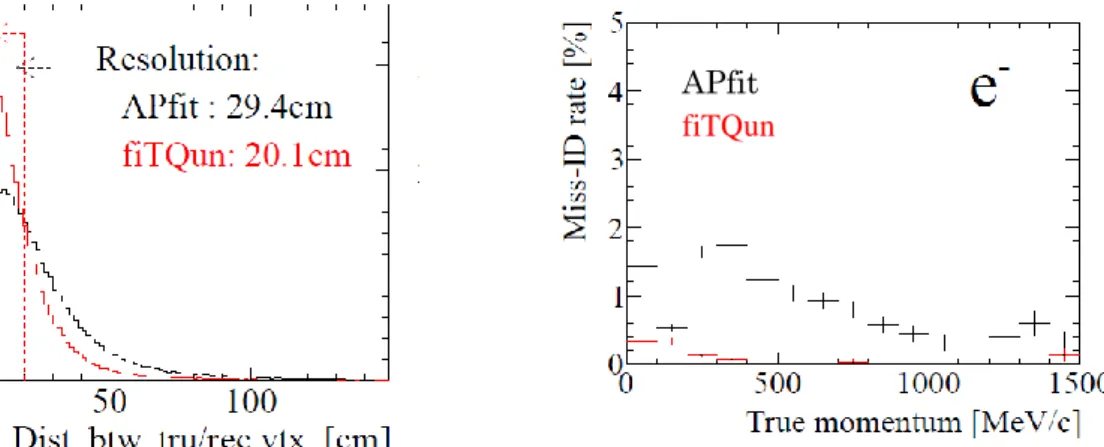
A new algorithm, named fiTQun, employs a maximum likelihood method using the charge and time information that is observed by the PMTs to reconstruct particle types and kinematics in the detector. The algorithm is based on the methods which are developed for the MiniBooNE experiment [1]. Comparing with the conventional reconstruction algorithm: APfit, fiTQun shows better performance including vertex resolution (Fig.1), PID (Fig. 2) etc.[2]
A study of the neutrino mass hierarchy (MH) with the atmospheric neutrino data reconstructed by fiTQun in Super-Kamiokande IV will be discussed in this talk. The new reconstruction algorithm fiTQun helps improve the sensitivity to mass hierarchy from two aspects: the purity of samples and statistics. Thanks to better PID ability of fiTQun, the purity of corresponding interaction channels in each subsample is increased. As for the statistics, the fiducial volume (FV) is expanded from 22.5 kton to 29.7 kton by changing the FV cut using fiTQun. In this talk, the effect of fiTQun and FV expansion on the sensitivity to MH would be discussed in detail.
References
[1] R. B. Patterson et al., The extended-track reconstruction for MiniBooNE". Methods in Physics Research, A608:206, (2009).
[2] S. Tobayama. “An Analysis of the Oscillation of Atmospheric Neutrinos”. Ph. D. Thesis, University of British Columbia, 2016
Fig. 1 Vertex resolution of single-ring electron Fig. 2 Miss PID rate of single-ring electron APfit
fiTQun
Deformation of N =4 SYM
with space-time dependent couplings
基礎物理学研究所 素粒子論グループ 崔在旺
Abstract We study deformation of N=4 SYM to have space-time dependent couplings preserving supersymmetry. This system can be interpreted as non-Abelian world-volume theory of D3-branes in general BPS background. We obtain some conditions to preserve supersymmetry with varying couplings, and apply the conditions to specific examples.
© 2018 Department of Physics, Kyoto University
場の理論には様々なパラメータがある。計量やゲージ結合定数、質量、湯川結合定数、θパラメータ など、多くの種類がある。しかし、計量が時空に依存する場の理論、即ち曲がった時空での場の理論、
に比べて他の結合定数が時空依存性を持つ場合はあまり研究されていない。結合定数が位置依存性を持 つ場の理論は珍しく思われるかもしれないが、超弦理論の観点からは自然に実現される。例えば、10 次元の
typeⅡB
の超重力理論で、[p,q]7-brane がD3-brane
と交差している系を考えると、複素化し たゲージ結合定数τにモノドロミが生じるため、τが定数はありえないことがわかる。従って、D3-brane
上の有効作用は、N =4
超対称ヤン・ミルズ理論(N =4 SYM)からポアンカレ対称性を破り、ゲ
ージ結合定数が位置依存性を持ちながら超対称性を保つように変形した理論になるはずである[1]。ま た、(p,q) 5-braneと交差しているD3-brane
の有効作用に対応して超対称性を保ちながら結合定数が1
つの方向の位置依存性を持つようなN =4 SYM
変形の形を求めた先行研究がある[2]。本研究では、上記の例をより一般化し、結合定数が
4
次元の時空の全ての方向に依存性を持ちながら 超対称性を保つようなN =4 SYM
の変形を調べる[3]。また、超重力理論における一般的な背景でのD3-brane
上の有効作用を求め、比較することで弦理論的観点からその対応関係の解析をする[4]。我々は
N =4 SYM
にありうるゲージ不変で繰り込み可能な項を時空に依存する結合パラメータと一緒に加え、同じように拡張した超対称性変換で作用が不変になるための条件を求めた。そして、この条件を より詳しく調べるため、具体的なグローバル対称性がある系を調べた。その例として、時空の対称性が
ISO(1,1)で R
対称性がSO(3)×SO(3)である場合、同様に ISO(1,1)×SO(2)×SO(4)、ISO(3)、ISO(2)×
SO(6)の場合について超対称性を持つための条件の微分方程式の解を求めた。特に、ISO(1,1)×SO(3)×
SO(3)の例では様々な解のクラスを発見し、それが[1]と[2]の解を含んでいるより大きな解になってい
ることを示した。また、複数枚重ねたD3-brane
が超重力理論の一般的な背景に置かれている場合に対 応して非可換ゲージ群を持つD3-brane
の有効作用を求めた。これを用いて(p,q) 5-brane背景、D3-brane
背景がある時に複数枚のD3-brane
上の有効作用を求めた結果、グローバル対称性が同じになる例として、それぞれ場の理論で解析した[2]の
supersymmetric Janus configuration
と[3]のSO(1,1)×SO(2)×SO(4)場合
の解析結果を再現することを確認した。References
[1]E. I. Buchbinder, J.Gomis, and F. Passerini, “Holographic gauge theories in background fields and surface operators”, JHEP 04, 018 (2008) , arXiv: 0709.1482[hep-th].
[2]D. Gaiotto and E. Witten, “Janus Configurations, Chern-Simon Couplings, And The theta-Angle in N=4 Super Yang-Mills theory”, JHEP 06, 097 (2010), arXiv: 0804.2907[hep-th].
[3]J. Choi, J. J. Fernandez-Melgarejo, and S. Sugimoto, “Supersymmetric Gauge Theory with Space-time Dependet Couplings” PTEP (accepted), arXiv: 1710.09792[hep-th].
[4]J. Choi, J. J. Fernandez-Melgarejo, and S. Sugimoto, (In preparation).
場の理論におけるエントロピーの数値計算法の開発と それに基づく相対論的重イオン衝突での熱化機構の解析
原子核理論研究室 築地秀和
Abstract We explore thermalization in relativistic heavy ion collisions in terms of en- tropy production. We propose numerical methods for the semi-classical time evolution of the Husimi-Wehrl entropy in Yang-Mills field theory and show the entropy production occurs around 1 fm/c from the phenomenological initial condition mimicking glasma in the static box.
⃝ c 2018 Department of Physics, Kyoto University
量子色力学
(Quantum Chrome Dynamics)
の漸近的自由性は高エネルギー領域においてクォークとグ ルーオンが閉じ込めから解放されたクォーク-
グルーオンプラズマ(Quark Gluon Plasma: QGP)
の存在 を予言する。RHIC(Relativistic Heavy Ion Collider, BNL)
とLHC (Large Hadron Collider, CERN)
における相対論的重イオン衝突実験ではQGP
生成の様々なシグナルが観測されており、現象論的な解析 の一つである流体模型は実験結果をよく再現することが知られている。そのインプットパラメータである 初期時刻は衝突後0.6 − 1.0fm/c
程度の時間で系が局所熱平衡に達することを示唆し、粒子の衝突によっ て熱化するというボトムアップシナリオでは説明できないほど早いことが指摘された。これは「早い熱化」の問題として多くの関心を集め
(
レビュー[1]
を参照)
、盛んに研究がなされているが未だ解決には至って いない。この問題に対するアプローチの一つは古典場の持つ不安定性に注目するものである。衝突直後には多 数のグルーオンがコヒーレント状態を形成しており、第一近似として古典ヤン
-
ミルズ場としての扱いが よいと考えられている。この古典ヤン・ミルズ場の現象論的な初期配位は非等方になっており、初期の量 子揺らぎに対して不安定性を持つことが知られている。この不安定性によって熱化が引き起こされるとい うシナリオは有力であり、ゆらぎから生じる永年項を再総和する手法である古典統計近似によって熱化の 指標の一つと考えられている圧力の早い等方化が示された[2]
。近年では文献[2]
を超えた研究がなされて おり、場ではなく粒子的な取り扱いをするものと、等方化以外の熱化の指標に注目するものの二つの方向 性が検討されている。本発表では半古典近似に基づいた手法を用いて、エントロピーを解析することで系 の局所熱平衡化を直接議論することで早い熱化の問題に取り組むことにする。そこで注目するのが伏見
-
バール(Husimi-Wehrl)
エントロピーという粗視化されたエントロピーであ る。伏見-
バールエントロピーは伏見関数から定義されるエントロピーであり、伏見関数は量子力学にお ける密度行列の「位相空間」での定式化であるウィグナー関数をガウス関数で粗視化することで得られ る。物性と素粒子の分野では基礎物理学的な興味から孤立量子系における熱化の指標として様々な粗視化 されたエントロピーが調べられており、その中でも伏見-
バールエントロピーは「位相空間」での伏見関 数の広がりを特徴づけるため、熱化の古典的な描像である非局在性が明確である。また、ウィグナー関数 は初期条件として重イオン衝突初期の量子揺らぎを自然に取り入れることができ、その半古典的な時間発 展も古典方程式を解くことで与えられるため、重イオン衝突初期において有効な枠組みを提供する。本発表ではウィグナー関数の半古典的な時間発展を利用して伏見
-
バールエントロピーの計算手法を開 発する。まず、量子力学系における簡単な試験計算を行い、そこでの解析で開発手法の有効性と特徴を議 論する[3]
。次に、その手法を場の理論へ拡張し、数値計算結果の収束をよくするために積近似(product
ansatz)
を用いた上で、ランダムな初期条件からのエントロピー生成が記述できることを示す[4]
。さらに、静止系において衝突直後に妥当であると考えられているグラズマ
(Glasma)
配位を似せた配位をつ くり、そのまわりのコヒーレント状態を初期条件とした場合に解析し、伏見-
バールエントロピー生成が1fm/c
程度で起こることを示す[5]
。圧力などの他の物理量との比較も行い、「早い熱化」についての議論を行う。
Reference
[1] P. F. Kolb and U. W. Heinz, In *Hwa, R.C. (ed.) et al.: Quark gluon plasma* 634-714.
[2] T. Epelbaum and F. Gelis, Phys. Rev. Lett. 111, 232301 (2013).
[3] H. Tsukiji, H. Iida, T. Kunihiro, A. Ohnishi, and T. T. Takahashi, Prog. Theor. Exp. Phys.
083A01 (2015).
[4] H. Tsukiji, H. Iida, T. Kunihiro, A. Ohnishi, and T. T. Takahashi, Phys. Rev. D 94, 091502(R) (2016).
[5] H. Tsukiji, T. Kunihiro, A. Ohnishi, and T. T. Takahashi, to be published in Prog. Theor. Exp.
Phys., [arXiv: 1709.00979].
高強度レーザー照射による金属ワイヤー導波路上への テラヘルツ表面波発生
レーザー物質科学分科 寺本研介
Abstract It is possible to generate intense terahertz surface waves of MV/cm class by irradiating an intense laser pulse on a metal wire. We have investigated the characteristics of surface waves generated by time domain spectroscopy in detail.
© 2018 Department of Physics, Kyoto University
近年、短パルスレーザー技術の発展により単一サイクルテラヘルツ波の発生が可能となっている。特 に高強度レーザー生成プラズマは高強度テラヘルツ波源として期待されている。一方でテラヘルツ波の 導波技術はテラヘルツ波応用にとって非常に重要である。テラヘルツ導波路にはテラヘルツ帯全域で低 損失でありかつ、単一サイクルテラヘルツ波を歪みなく伝送するために無分散が求められる。金属ワイ ヤーはこれらの特徴を併せ持つ優れたテラヘルツ導波路として利用可能である [1]。テラヘルツ波は金 属ワイヤー導波路上で軸対称な偏光を持つ表面波として伝搬し、テーパー状のワイヤーを用いることで テラヘルツ波をワイヤー先端で極小集光することが可能である。しかし、空間を伝搬するテラヘルツ波 の金属ワイヤーへのカップリング効率が悪いという欠点がある。このため、高強度なテラヘルツ波の伝 送には課題があった。我々は金属ワイヤーに高強度レーザーを照射することで高強度テラヘルツ表面波 を生成・伝送することに成功している [2]。高強度レーザーによって加速された高速電子が真空中に放 射されることによって金属ワイヤーと電子の間に準静的な電場が発生し、テラヘルツ帯の表面波が誘起 する。表面波はピーク電場が
MV/cm
級の半サイクルパルスであった。このように高強度レーザー照射 によって、金属ワイヤー導波路に高強度テラヘルツ波を発生させることが可能であるが、表面波の波形 や電場分布、レーザーエネルギー依存性などの詳細は十分に調べられていない。筆者らはテラヘルツ時 間領域分光法(THz-TDS)によって、レーザー生成テラヘルツ表面波の電場を直接測定し、表面波の詳 細な特性を調べた。実験では銅ワイヤー(直径
300 µm)に高強度レーザー(波
長810nm、集光強度 1.8×10
18W/cm
2、パルスエネルギー20mJ、パルス幅 40 fs)を照射した。発生するテラヘルツ表面
波のワイヤー径方向の電場を電気光学効果によって測定 し、プローブ光の光学遅延を変化させることで表面波の電 場波形を測定した。電気光学結晶は
GaP
(厚さ300 µm)を
使用した。図1
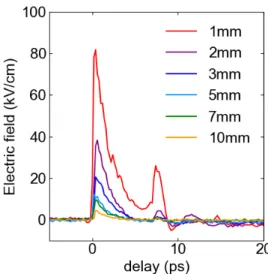
に電場測定位置を径方向(r = 1~10 mm)に 動かしたときに得られた波形を示す。表面波の波形はいず れもフェムト秒で鋭く立ち上がり、その後数ピコ秒で減衰 している。ピーク電場はハンケル関数でr
方向に減衰して おり、表面波モードの理論的な空間分布と一致している。今回の計測では、ワイヤー表面でのピーク電場が
0.55
MV/cm、パルス幅 2 ps
程度の表面波が発生していることが分かった。
References
[1] K. Wang and D. M. Mittleman, Nature 432, 376 (2004).
[2] S. Tokita, S. Sakabe, T. Nagashima, M. Hashida, and S. Inoue, Sci. Rep. 5, 8268 (2015).
Fig. 1. Waveform for various distance r.
J—PARC KOTO 実験における K L →π 0 νν崩壊探索の 背景事象の研究
高エネルギー物理学研究室 中桐 洸太
Abstract The KOTO experiment aims to study the K
L→π
0νν
--decay at J-PARC, which is a rare direct CP-violating decay. The status of the analysis on the data taken in 2015 will be presented focusing on the background study.
© 2018 Department of Physics, Kyoto University
CP 対称性の破れの存在は素粒子標準理論では確立されているが、物質優勢宇宙を定量的に説明するに は破れの程度が小さく、標準理論を超えた CP 非保存過程が必要とされている。KL→π0νν 崩壊は CP を直接的に破る崩壊であり、未知の CP 非保存機構が存在すると崩壊分岐比が標準理論予測値からずれ を生じうる。未だ観測されていないこの崩壊は標準理論での崩壊分岐比が 3×10⁻¹¹と小さく、理論的不 定性も 1%と小さい[1]ため、CP 破れを引き起こす新物理の効果を見る良いプローブである。
KOTO 実験は J—PARC において行われている KL→π0νν探索実験である。KOTO 実験では 30 GeV 陽子ビ ームを固定標的に当てて生成した KL中間子をコリメーターによって細いビームとして検出器領域まで 輸送する。検出器はビーム軸を囲うように設置されており、下流エンドキャップ部分の CsI カロリーメ ータでπ0から生じる 2 光子を捕え、かつ他の検出器で検出可能な粒子がないことをもって信号事象の 候補とする(Fig. 1)。
KOTO 実験は 2013 年に初めての物理ランを行い、先行実験と同等の感度(1.28×10⁻⁸、標準理論崩壊分 岐比を仮定するとシグナル期待値 0.002 に相当する感度)を達成した[2][3]。しかしビーム外縁部に分 布するハロー中性子がカロリーメータに当たってハドロンシャワーを作り、さらにそこで生じた中性子 がカロリーメータ中を通過し、離れたところでハドロンシャワーを起こして 2 つのクラスターを作る“ハ ドロンクラスター事象”が全背景事象予測値 0.34 の内 0.18 を占める大きな寄与を持つことが判明した。
2015 年に物理ランを行い、2013 年に行ったランの約 20 倍の統計量のデータを収集した。このデータ をもって 2013 年の一桁上の 1×10⁻⁹の感度で KL→π0νν崩壊探索を行う。統計量に伴って増大する背景 事象を抑制することが必須であるので、上記のハドロンクラスター事象の研究のためのコントロールサ ンプルの取得も行った。
本発表では 2015 年に取得したデータの解析状況について、特に背景事象の研究に重点をおいて報告 する。
Fig. 1. A cross-sectional view of the KOTO detector and a conceptual view of the signal detection.
References
[1] A. J. Buras, et al. , Journal of High Energy Physics 11, 033 (2015).
[2] J. K. Ahn et al., Phys. Rev. D, 81, 072004 (2010).
[3] J. K. Ahn et al., PTEP, 021C01 (2017).
ニュートリノ振動におけるニュートリノ反応モデルの 系統誤差の評価と振動パラメータの精密測定
高エネルギー物理学研究室: 仲村 佳悟
Abstract: T2K experiment is a long baseline neutrino oscillation experiment searching for CP violation in lepton sector with neutrino oscillation. In the neutrino oscillation analysis, understanding of neutrino-nucleus interaction modeling and its uncertainties are important to predict number of events at the far detector precisely.
We will report the evaluation of the systematics uncertainties on the oscillation parameters estimation from neutrino interaction modeling. The oscillation analysis results used the data until 2017 summer will also be reported in this presentation.
© 2018 Department of Physics, Kyoto University
T2K
実験は茨城県東海村にあるJ-PARC
でニュートリノビームを生成し、岐阜県飛騨市神岡町にあるスーパーカミオカンデで測定する長基線ニュートリノ振動実験である。ニュートリノと反ニュートリノ での振動確率の違いを調べることでレプトンにおける
CP
対称性の破れの観測を目指して実験を行って いる。ニュートリノ振動はPMNS
行列で記述でき、電子ニュートリノ出現から(θ13,δ
CP)、μニュート
リノ消失から(θ23,Δm
223)のパラメータの測定ができる。T2K
実験ではこれらのモードと反ニュートリ ノでの電子ニュートリノ出現、μニュートリノ消失を同時に解析することでこれらのパラメータの測定 を行っている。現在のニュートリノ振動解析で問題になっているのはニュートリノ-原子核反応のモデルとその不定 性による系統誤差である。ニュートリノ反応モデルの違いによって、予測されるスーパーカミオカンデ でのエネルギースペクトラムやイベント数が異なってくるためニュートリノ振動パラメータの測定に 多大な影響を及ぼす。
そこでニュートリノ振動解析における反応モデルの影響を調べるために、異なった構造関数モデル
[2][3]や原子核効果の計算が異なるモデル[4][5]等様々な反応モデルを模したシミュレーションデー
タを用いて、振動パラメータ測定における反応モデルの違いによる系統誤差を調べた。CP
位相に於いてはニュートリノ反応モデルの影響はCP
位相の信頼区間を2%程度しか変化させないこ とを確認し、2017年夏までのデータを用いて振動解析を行い2σの信頼度で CP
対称性が破れているこ とを確認した。一方(θ23
,Δm
223)パラメータについては反応モデルによってシミュレーションから予想される不定
性に対して最大で
0.5σ程度のズレが現れることがわかった。これらのパラメータは T2K
実験が最大混合(θ23
=45°)を示唆しているのに対しアメリカで行なわれている NOvA
実験は2.6σで最大混合を棄却
しており、系統誤差の正確な見積もりが必要になっている。そのため現在反応モデルに起因する不定性 を考慮に入れた解析を行っている。
本発表ではこれらのニュートリノ振動解析結果と現状について報告する。