Category of Europe : Roman Mosaic
Collections Discovered in Zeugma, Southeast Turkey
著者(英) Eisuke Tanaka
journal or
publication title
Senri Ethnological Studies
volume 81
page range 149‑168
year 2013‑01‑31
URL http://doi.org/10.15021/00002481
149
Edited by Akiko Mori
Cultural Heritage Issues in Turkey and the Category of ‘Europe’:
Roman Mosaic Collections Discovered in Zeugma, Southeast Turkey
Eisuke Tanaka
Fukuoka Jo Gakuin University
1. Introduction
Turkey is one of the countries where the protection of objects seen as ‘heritage’ attracts public attention. Anatolia (Asia Minor), which constitutes most of the territory of the Republic of Turkey, has been considered archaeologically ‘rich’ (Özdoğan 1998: 113) because it has been inhabited at different times by settlers from both the East and the West. Turkish journalist Özgen Acar (2002: 12) describes the situation as follows:
As archaeologists dig deeper into the history of Turkey, they uncover traces of different civilizations every day. They have found that following the pre-historic period, 42 separate civilizations lived in Anatolia and left traces of existence during the pre-Ottoman period.
The Turkish mass media frequently raise issues surrounding cultural heritage such as the restitution of archaeological and historical materials illegally removed from the country and the destruction of historical and archaeological sites through state development projects (cf. Tanaka 2010). However, it is important to note that Turkish media attention to these issues is often stimulated by the Euro-American mass media.
Recent anthropological and sociological studies on Turkey have examined the country’s relations with the rest of the world, especially focusing on its location between Europe and the Orient. In exploring modernity, consumer culture, nationalism, state secularism and religion, many scholars have discussed the shifting complexities of the politics of Turkish national identity (e.g. Bozdoğan and Kasaba 1997; Çınar 2005;
Kandiyoti and Saktanber 2001; Keyder 1999; Navaro-Yashin 2002; Özyürek 2006). These studies suggest that national and local debates about socio-cultural issues in Turkey cannot be explored without looking at the country’s connections with those other issues.
Likewise, this paper attempts to show the elaboration of heritage in Turkey in relation to various actors beyond its borders, particularly to those from Europe. While Turkey is often associated with the non-European side of the East/West divide, the country is said to have maintained a modernisation policy since its establishment in the 1920s, modelled on western Europe. Moreover, the Turkish state has been applying for membership in the European Union for more than ten years.
However, this paper avoids the conventional way of describing Turkey as a distinct
cultural entity differentiated from that of ‘Europe’ (cf. Navaro-Yashin 2002). Rather, it focuses on the idea of Europe as a category mobilised for certain political ideals. In particular, looking at cases from Turkey is useful in examining the ways in which the meaning of ‘Europe’ acquires saliency. This is because the country is located on the margins of Europe—a place where the demarcation of ‘Europe/non-Europe’ in terms of groups of people and their everyday practices clearly matters (Goddard, Llobera and Shore 1994: 26). It is in this way, I argue, that such a case study of Turkey contributes to the research on Europe from an anthropological point of view.
Based on this viewpoint, the paper explores how issues concerning heritage are related to the category of ‘Europe’ in Turkey, particularly in the way the importance of protecting ‘heritage’ is articulated in relation to this category. This leads in turn to looking at the way in which the idea of Europe is constructed, contested and consumed in the context of heritage protection in the country. For this purpose, this paper focuses on debates about salvaging the well-preserved Roman mosaics discovered in Zeugma near Gaziantep, southeast Turkey. In analysing the media coverage of the controversy over the protection of these mosaics, this paper examines what it means to ‘protect’
things considered ‘heritage’ for different groups involved in this case, such as Euro- American and Turkish media, Turkish state agencies, archaeologists and the locals, and how in each case they lay claim to the importance of the protection of the Roman mosaics found at Zeugma.
First, this paper looks at the concept of cultural heritage and its protection. Second, it briefly reviews the construction of the modern Turkish national identity in relation to traces of the various aspects of the Anatolian past and issues surrounding state development projects and cultural heritage protection. This is followed by an analysis of the way in which Turkish interests in the Zeugma mosaics emerged in the context of the rescue excavations and in response to international media attention. I argue that the category of ‘Europe’ is associated with a ‘civilised’ attitude towards things marked as heritage, and this category is adopted and adapted by those claiming to protect Turkey’s important heritage.
2. The concept of cultural heritage and the idea of protection
Discussions on the ownership of heritage (Handler 1988; Brown 2003; 2004) have suggested that the notion of heritage is mobilised in the discourse about protecting manifestations of a ‘culture’. ‘Encompass[ing] all manifestations of an individual culture, both material and intangible’ (Brown 2004: 53), it works to reify the culture as if it were a thing to be owned. In turn, this reification requires a group, usually a nation or an ethnic group, as the owner of culture. The significance of cultural heritage is articulated by evoking the necessity for protection, through conservation and the restoration of historic sites, monuments and artefacts, the preservation of cultural landscapes, and the safeguarding of ‘traditional’ practices (such as rituals and music) and ‘indigenous’
knowledge. Protection, that is the bid to save cultural heritage from destruction, provides
a focal point in discussions over cultural resource management and other cultural heritage
related phenomena matters (e.g. Carman 2002; Daifuku 1968; Renfrew 2000; Tubb 1995).
First, protection is the primary objective of national and international legislation concerning cultural heritage (Magness-Gardiner 2004: 27). Once objects are marked as cultural heritage, often acquire a particular symbolic value for the nation or ethnic group that owns them, and, as such, they are considered inseparable from the group of people who claim them as their ‘heritage’. It is in this context that nation-states formulate laws and regulations for the protection of cultural heritage, thereby exerting their rights of ownership. For example, the Turkish legislative framework defines the role of the state in protecting historical and archaeological materials found within its territory (see Tanaka 2010). Moreover, the idea of owning culture allows nation-states to make claims for the restitution of cultural objects ‘illegally’ removed from their country of origin (e.g. the Parthenon Marbles debates).
However, the threat of destruction of cultural heritage, due to inadequate maintenance, lack of financial and/or human resources, state development projects, armed conflict and political change is often recognised as being beyond the scope of nation- states’ protective legislation. International regulation is thus considered paramount (Magness-Gardiner 2004: 27), since the protection of culture as ‘common heritage’ is explicitly spelled out in all UNESCO’s heritage-related conventions. Moreover, some international non-governmental organisations have raised the alarm about the risks of destroying cultural heritage sites. Since 2000, the International Council on Monuments and Sites (ICOMOS)
1)has published reports on historic monuments and sites in danger of destruction (e.g. ICOMOS 2007). Sometimes these entail criticism of the policies of certain nation-states, stating that they are causing the destruction of cultural heritage. In September 2005, the president of ICOMOS sent an official letter to Recep Tayyip Erdoğan, the current Turkish Prime Minister, to protest against a dam project that would affect Allianoi, an archaeological site in western Turkey where a unique Roman bath complex had been discovered (Petzet 2005).
2)In addition, it is those from ‘Europe’ who often urge the protection of cultural manifestations as the ‘heritage of humanity’. The European Union had formulated a framework to support heritage management programmes outside Europe as part of its foreign policy (e.g. Euromed Heritage as part of Euro-Mediterranean partnership programme funded by the European Union, see EUROMED 2011). Moreover, some European non-governmental organisations concerned with protecting heritage often protest against development projects inside and outside Europe, which would cause the
‘destruction’ of historical and archaeological sites considered ‘heritage of humanity’ (e.g.
Europa Nostra 2011).
Thus, the political and symbolic significance of cultural heritage in relation to its
protection can be seen from different perspectives. Marilyn Strathern (2004) points out
that the debates over the ownership of scientific knowledge draw on contrasting Euro-
American conceptions of property and the commons. ‘Knowledge belongs to (can be
claimed by) communities near and far’: one being the community of scientists that
produced it (the near), and the other being ‘mankind’ (Strathern 2004: 91-92). Similarly,
cultural manifestations are also considered to belong to ‘near’ and ‘far’ collective entities.
Cultural heritage is both the ‘heritage’ of a particular community and the ‘heritage of humanity’. As ‘heritage of humanity’, cultural objects are accessible to a much wider community (the community far) as a ‘non-exclusive, distributable resource’, while the community near restricts the use, or more precisely, the commodification of cultural heritage by claiming it as ‘their’ own (Strathern 2004: 92). The significance of protecting cultural heritage is articulated from both these points of view.
In this respect, the idea of protection does not simply mean safeguarding cultural heritage from destruction, it is also articulated as part of an ownership claim. In general, ownership of cultural manifestations presumes their protection by their lawful owner, often nation-states. However, the notion of protection also denotes the protection of the owner’s right to control cultural heritage, as distinct from protecting the property itself.
What is often at stake in debates about cultural heritage is where and by whom cultural objects should be protected, and who will decide where and how objects are protected.
The discussions above indicate that the concept of cultural heritage is elaborated through the interactions between those who claim control of cultural objects. Control of a nation’s heritage by ‘others’ raises serious issues of identity and ownership. However, it is often claimed that nations and ethnic groups should not be able to dispose of ‘their’
cultural heritage just as they wish. In fact, once archaeological and historical objects are marked as cultural heritage, many consider that they must be handled with special care.
Because of this, even the nation or the ethnic group that is the ‘rightful’ owner can, when failing to handle heritage correctly, be accused of its destruction from outside. Agencies at local and national levels also make their claim about the protection of ‘their’ heritage in response to such discourses on heritage protection at the international levels. As is discussed later in this paper, controversies over the very well-preserved Roman mosaics found in Zeugma, southeast Turkey is one of the examples in which attention from
‘Europe’ has affected Turkish interests in protecting heritage found in the country.
However, before examining the case of the Zeugma mosaics, this paper briefly looks at the relationship between Turkish nationhood and the traces of the classical Greek and Roman past found in Anatolia as a background.
3. Construction of a Turkish national identity in relation to ‘European’
heritage in Anatolia
As mentioned in the introduction, Anatolia is considered to be at a major crossroad between Europe and the Orient. Of the huge number of sites of archaeological, historical and national interest, many are held as evidence of Turkey being ‘Oriental’ and, therefore, rooted in ‘non-European’ traditions, of which Islam is the most significant. However, there are also a number of classical remains in Turkey. What is especially intriguing is that, in modern Greek nationalism, traces of the classical past are seen as part of the
‘European’ heritage as opposed to the ‘Oriental’, or more precisely ‘Turkish’, cultural
elements. They are used to claim the European identity of modern Greece (cf. Herzfeld
1982; 1987).
Turkish state authorities have attempted, from the late Ottoman period to the present, to strictly regulate the movement of archaeological and historical materials of Anatolian origin beyond state boundaries. Such attempts at regulation were an Ottoman response to the determination of Europeans in the eighteenth and nineteenth century to collect artefacts of ancient civilisations, and the subsequent wave of European archaeological expeditions to ‘the cradle of civilisation’ (Gosden 1999: 24; Marchand 1996; Shaw 2003). Archaeology was introduced in the early nineteenth century when the Ottoman state initiated its Westernisation reforms (Özdoğan 1998: 111-112). More recently, especially since the 1980s, the Turkish state has actively begun to make claims for the repatriation of antiquities taken from the country following unauthorised excavations. The archaeological and historical objects now claimed by the Turkish state include classical objects that are usually associated with ‘Greekness’ and thus with ‘Europeanness’.
However, my previous papers have suggested that the close link between archaeological materials and Turkey is articulated in the construction of the modern Turkish national identity (see Tanaka 2007; 2008). I have shown that once marked as cultural heritage, the value of archaeological and historical objects is emphasised in relation to Turkey as their place of origin. Traces of various Anatolian pasts, including those that are not straightforwardly associated with ‘Turkishness’, are considered to belong to the Turkish homeland. Based on the harmonious link between Turkish national identity, cultural objects and Turkey as their place of origin, Turkish claims for their ownership of ‘European’ objects of Anatolian origin are justified.
4. State development projects and heritage protection in Turkey
In Turkey, a number of archaeological and historical sites have been submerged due to dam construction, and many more are to be affected by the construction of new dams planned by the Turkish state. Such cases are found throughout the country, but particularly in its southeast regions, where a number of dams have been constructed in the basins of the Tigris and the Euphrates rivers as part of the Southeast Anatolia Project (GAP, Güneydoğu Anadolu Projesi in Turkish), which started in the late 1970s. This is because the southeast part of Turkey was long been considered a backward and underdeveloped region (Southeast Anatolia Project Regional Development Administration 2011a). By the end of the 1980s, the project had expanded into a large-scale regional development project involving the construction of 22 dams and 19 hydro power plants on the Euphrates and the Tigris, as well as an irrigation network in southeast Anatolia (Southeast Anatolia Project Regional Development Administration 2011a; 2011b).
In response to the expansion of the GAP and the additional dam construction plans
in the Tigris and Euphrates basins in the late 1980s, a team of foreign and Turkish
archaeologists conducted a field survey to identify the archaeological sites that would be
affected (Algaze 1989: 241-242). Known as the Tigris-Euphrates Archaeological
Reconnaissance Project, it was supported by the Turkish Ministry of Culture and various
other institutions, both Turkish and foreign (Algaze 1989: 242; 1992: 4). The survey
report confirmed the archaeological importance of the sites found in the future reservoir
areas, and argued for the necessity of further and more intensive archaeological excavations (Algaze 1989: 254).
However, during the 1990s, the issue of protecting the historical sites that would be affected by the construction of the GAP dams attracted further archaeological attention (Siiler 2000: 3). The journal Arkeoloji ve Sanat raised this issue in 1992, and Nezih Başgelen, the editor of this journal, and Guillermo Algaze summarised the results of The Tigris-Euphrates Archaeological Reconnaissance Project (Algaze 1992). Algaze expressed his concern that ‘the continuing plans for the economic development of south eastern Anatolia, necessary as they may be, will unfortunately also result in the loss of important cultural information in areas that remain virtually unknown to archaeology’ (Algaze 1992: 4). Zeugma is one of such archaeological sites affected by the construction of the dams upon the Euphrates, and at least some Turkish archaeologists perceived the need for excavation.
5. Discovery of one of the best Roman collections in the world
Zeugma was a Hellenistic and Roman city,
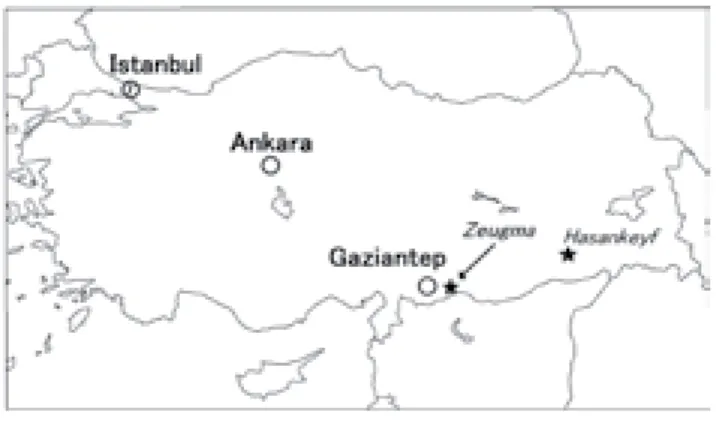
3)whose remains are today found in the village of Belkıs on the Euphrates, 60 km east of Gaziantep, the largest city in the southeast region of Turkey (see Figure 1). In the early 20th century, Zeugma was already known to the people living around the site and to some Europeans who visited the area as a place where Roman mosaics and inscriptions had been discovered (Ergeç 2000: 20). By the 1960s, some locals had become aware of the monetary value of the mosaics and are said to have been involved in clandestine excavations for the international art market (Ergeç 2000: 20). The mosaics excavated from Zeugma at that time found their way to museums in Turkey as well as in Europe and the United States. Some also ended up in private Euro-American collections (Kennedy 1998: 13).
In fact, archaeologists who have excavated at Zeugma report that many of the mosaics were damaged by non-archaeological excavations (e.g. Campbell and Ergeç 1998; Ergeç 2000: 21). One notable example is the mosaic that depicts the wedding of
Figure 1 Map of the Republic of Turkey and the location of Zeugma
Dionysus and Ariadne. In 1992, a locally hired guard at Zeugma noticed a tunnel that led to the remains of a Roman villa. Archaeologists based at the Gaziantep Museum excavated the site and uncovered a mosaic depicting the wedding of Dionysus and Ariadne (Başgelen and Ergeç 2000: 18). They decided to preserve it in situ. Archaeologist Rıfat Ergeç, who was the director of Gaziantep Museum between 1989 and 1999, notes that Zeugma first became known to people in Gaziantep following news coverage about the discovery of this mosaic (Ergeç 2005: 52). As a result, villagers living near Zeugma started visiting the site and showing their interest in the Dionysus and Ariadne mosaic.
Some adapted the motifs of the mosaic for the designs of their handicrafts, such as carpets (Ergeç 2000: 52). However, a large piece of the mosaic was cut out by looters on 15th 1998 (Acar 2000: 7) and has been missing ever since.
As mentioned in the previous section, the need for archaeological excavation at Zeugma was perceived in the late 1980s (see also Table 1). However, archaeological rescue excavation projects by the Gaziantep Museum staff and some foreign archaeologists commenced in the late 1990s. Moreover, accounts of the excavations suggest that the need for rescue work did not attract much attention before 1996 when construction of the Birecik Dam started (Acar 2000: 7; Başgelen 2000a: 13-14; Ergeç 2000: 22-23). In 1994, the Gaziantep Museum made its first appeal to both foreign and Turkish archaeologists to help with the rescue excavations at Zeugma, but only Catherine Abadie-Reynal, a French archaeologist who was sent by the French Ministry of Foreign Affairs, started working with the museum (Ergeç 2000: 22). It was not until the late
Year Events
1986 Construction of the Birecik Dam on the Eurphrates planned by the Turkish Government.
1988 Tigris-Euphrates Archaeological Reconnaissance Project (a field survey of the archaeological sites to be affected by the dam reservoir).
1994 First international call for the rescue excavation of Zeugma (French archaeologist Catherine Abadie-Reynal responds and starts excavating the following year).
1996 Commencement of construction of the Birecik Dam.
Rescue excavation in areas to be affected by the dam reservoir (until September 2000).
1998 Looters remove central part of the Dionysus and Ariadne mosaic.
March 2000 Rescue excavation and discovery of well-preserved Roman mosaics first featured in Cumhuriyet, a Turkish national newspaper.
April 2000 The Economist publishes article about rescue excavation at Zeugma.
Completion of the Birecik Dam construction.
May 2000 Stephen Kinzer’s article about Zeugma appears in the New York Times.
Turkish media coverage focuses on the rescue excavation at Zeugma (until June).
June 2000 The US returns Roman mosaic panels of Metiochos and Parthenope.
Packard Humanity Institute (in the US) decide to provide financial support for the rescue excavation and conservation work of mosaics discovered at Zeugma.
September 2000 Dam waters inundate areas where the rescue excavation was conducted.
‘Encounter between Dams and Cultural Heritage (Barajlar ve Kültürel Miras Buluşması)’
conference held in Gaziantep by Turkish History Organisation.
Table 1 Time-line of the construction of the Birecik Dam and the rescue excavation at Zeugma
1990s, and particularly in 2000 when the dam construction had been completed, that the issues over the excavation of this site attracted much wider public attention.
What made Zeugma so well-known was the discovery of a number of well-preserved Roman mosaics during last-minute salvage excavations. The excavations only became intensive after construction of the Birecik Dam started. Although archaeological excavations are usually conducted over the summer in Turkey, archaeologists at Zeugma continued their work throughout the winter of 1998-1999 (Başgelen and Ergeç 2000: 34).
As a result of this work, a large number of well-preserved Roman mosaics and frescos were discovered and later housed in the Gaziantep Museum. The findings included a mosaic panel that most likely depicts a woman’s face, which came to be called ‘Gypsy Girl (Çingene Kız)’ (Figure 2).
After construction of the Birecik Dam was completed in April 2000, the rescue excavation at Zeugma was featured by the various Turkish national and local newspapers (Hürriyet, Milliyet, Cumhuriyet, Radikal et al). A large number of articles about the rescue excavation were published between mid-May and June 2000, and between late September and early October 2000 when parts of the site were inundated.
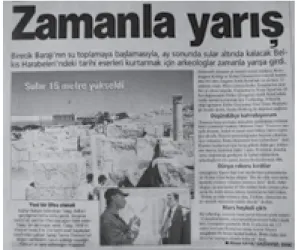
Using many coloured photographs of the finds, especially of the Roman mosaics, these newspapers reported on excavation developments at the site, and emphasised their significance of the objects uncovered by the excavation (Figure 3). In the intense Turkish media coverage, the discoveries of the archaeological remains were described ‘as if historical objects were gushing out from Zeugma as they dig through the soil (Toprağa dokundukça Zeugma’dan tarih eser fıskırıyor adeta)’ (Hürriyet 2000b). Similar expressions are also found in the titles of the articles in the several Turkish national newspapers such as ‘History Is Gushing Out of Everywhere (Tarih Her Yerden Fışkırıyor)’ and ‘Treasure Is Overflowing from a City That Is Being Flooded (Boğulan Şehirden Hazine Fışkırıyor)’ (Şahin 2000; Milliyet 2000).
Moreover, in addition to the development of the rescue excavation, the Turkish media also featured the return of the Roman mosaic panels of Metiochos and Parthenope
Figure 2 ‘Gypsy Girl (Çingene Kız)’, one of the mosaics discovered during the
rescue excavation at Zeugma.
from the United States in June 2000 (e.g. Cumhuriyet 2000a). The mosaic panels in question were said to have been smuggled from the site and taken abroad, probably in the 1960s. In 1993, a team of archaeologists, led by Australian David Kennedy, discovered a polychrome mosaic, but it had been damaged by looters who had cut out much of its centre. The missing part was later identified as two pieces of mosaic in the Menil Collection at Rice University in Houston. The Turkish government requested restitution of these mosaic panels in the mid-1990s (see Başgelen and Ergeç 2000:
30-31).
4)6. The role of foreign press in focusing Turkish attention on the Zeugma mosaics
As mentioned above, the rescue excavation at Zeugma began to attract Turkish media attention. Arguably, however, Turkish interest in the excavations was stimulated by the foreign coverage of the salvaging excavation at Zeugma. After construction of the Birecik Dam was completed in April 2000, feature articles on Zeugma began to appear in publications such as The Economist and The New York Times. Emphasising that significant cultural heritage for humanity as well as Turkey would be destroyed as a consequence of the state development projects, these articles criticised Turkey’s attitude towards the protection of cultural heritage. Journalist Özgen Acar points out that foreign press coverage awakened the Turkish media to this issue. He wrote that, ironically, foreign press coverage ‘shook the world first, and strangely then shook the Turkish media, intellectuals, the Ministry of Culture, and politicians, like a big earthquake’ (Acar 2000: 8).
On 27th April 2000, an article entitled ‘Watery Grave’ was published in The Economist on the rescue excavation at Zeugma (The Economist 2000: 109-110). The article singled out bureaucratic inertia and a lack of financial support from the Turkish
Figure 3 Article about the rescue excavation at Zeugma in 2000.
Ministry of Culture as major problems, and said that the government had ‘allowed so many of Turkey’s riches to disappear’ (The Economist 2000: 109). It also emphasised that ‘Zeugma has attracted little international attention over the years; few Turks, let alone foreigners, are even aware that it exists’ (The Economist 2000: 109).
Moreover, the article contrasted the situation in Zeugma with that of Hasankeyf, which, it said, had been internationally publicised (The Economist 2000: 110). Hasankeyf is a town on the Tigris, with a significant number of architectural remains dating from medieval times (Algaze 1992: 6). Kurdish activists outside Turkey and British environmentalist groups protested against the planned construction of the Ilısu Dam, in part because the area that was to be inundated, which included Hasankeyf, was considered to ‘lie within the Kurdish heartland’ (The Economist 2000: 110). Calls for the protection of Hasankeyf as a symbol of Kurdish ethnic identity appeared in the international press from the late 1990s (The Economist 2000: 110). Since a British-led consortium was involved in the dam construction project, which was dependent on the British government’s export credits, the project aroused particularly fierce controversy in Britain concerning the government’s foreign policy (e.g. Shukman 2000; Chapman 2000;
Young 2000). As a consequence, the British government demanded that Turkey reconsider the dam project and put forward a plan to protect the historical remains of Hasankeyf (The Economist 2000: 110).
5)Thus, The Economist’s article links the rescue excavation projects at Zeugma to the controversy over the Ilısu Dam and the protection of historical remains in Hasankeyf. It cites a senior Turkish state official about the state’s efforts to preserve Hasankeyf as ‘a matter of our [Turkish] national pride’. But it questions the sincerity of this statement and criticises the Turkish state’s attitude towards the protection of cultural heritage. It notes that the comment by the Turkish state official ‘is not true of Zeugma’ (The Economist 2000: 110).
On 7th May 2000, Stephen Kinzer wrote a front-page article for The New York Times entitled ‘Dam in Turkey May Soon Flood a “2nd Pompeii’’. Alongside his article was a photograph of a mosaic discovered at Zeugma depicting Perseus and Andromeda.
His article specifically focuses on the Roman mosaics (Kinzer 2000). It describes Zeugma as ‘a real tragedy’ and ‘a huge shame’, given that the site was soon to be flooded without proper salvaging work taking place (Kinzer 2000). Kinzer cites comments made by Mehmet Önal, a Turkish archaeologist based at the Gaziantep Museum, who was involved in the rescue excavation, highlighting the quantity and quality of the mosaics compared with other Roman mosaic collections within and outside Turkey:
‘We’ve only excavated two villas, and we found 12 beautiful mosaics. There are hundreds of villas under the earth, so you can imagine what remains to be found. The scale of what we have here is really unbelievable’.
‘If we can have four months, we can pass the Antakya Museum, and if we have two years
we can pass the one in Tunis’. Mr. Onal said. The museum in the Turkish city of Antakya,
which was known in antiquity as Antioch, has this region’s finest collection of ancient
mosaics, and the one in Tunis is considered the finest in the world (Kinzer 2000).
In contrast to The Economist article, Kinzer does not explain the situation at Zeugma in relation to Hasankeyf.
6)Rather, he compares efforts to excavate the Zeugma mosaics with Turkish attempts to reclaim archaeological objects of Anatolian origin, which are taken to Euro-American museums and private collectors. He thus uses the idea that cultural heritage ought to be protected in order to argue that Turkey’s ill treatment of the Zeugma mosaics contradicts its claims to the ownership of cultural objects whose place of origin is Turkey, but which have been taken abroad. On 9th May 2000, the Editorial Desk of The New York Times stated:
Countries like Turkey have a legitimate interest in seeking to reclaim their cultural patrimony, but they also have an obligation to protect that patrimony. In this case Turkey is betraying its own history by allowing a site of priceless value to be destroyed. Cultural institutions around the world may doubt Turkey’s claim to value its cultural inheritance if it sacrifices so rich a treasure (Editorial Desk 2000).
The articles on the rescue excavation at Zeugma that appeared in The Economist and The New York Times were written in consideration of public interest in the countries where these newspapers are based. The Economist focuses on British involvement in the controversy over the inundation of Hasankeyf while The New York Times article relates the preservation of Zeugma to the issues surrounding the Turkish claims for repatriation of cultural heritage.
Thus, the same item (the Zeugma mosaics) is contextualised in different ways, which is understandable given the fact that the mass media plays a role in producing a sense of ‘the nation’ within a particular framework of national time-space (see Anderson 1991[1983]). In the case of both The Economist and The New York Times, we actually see how the media works to produce a ‘national’ interest in the cultural heritage of other nations by relating foreign issues to the nation primarily served by each publication.
Turkish media coverage of the Zeugma mosaics also shows how ‘national’ interests were shaped in response to the foreign media coverage. This interest in protecting the mosaics as Turkey’s cultural property emerged from outside Turkey’s national time-space as well as within. In particular, the articles about Zeugma published in the Euro- American mass media were considered evidence of the value of these Roman mosaics and Euro-American attention towards them. In fact, some of the articles about the rescue excavations at Zeugma published in the Turkish national newspapers referred to such foreign press coverage as evidence of less Turkish attention to the Roman mosaics compared to Europe and the United States. For example, the Hürriyet newspaper published an article on 12th May 2000 saying that ‘describing Zeugma as a Second Pompeii, The New York Times, one of the influential newspapers in the United States, reported on its front page that the site would soon be flooded’ (Hürriyet 2000a).
However, the article did not mention Kinzer’s accusation about Turkey’s ‘betrayal’ of its
history, which would result in the destruction of its cultural heritage. What the Hürriyet
article emphasised was simply the fact that the rescue excavation at Zeugma had been
covered by an influential foreign newspaper.
In contextualising the rescue excavation at Zeugma, the Turkish media emphasised the ‘destruction’ and ‘erasure’ of heritage, which was caused by Turkish ‘indifference’ to the protection of such objects found in the country. One example is an article headlined
‘Zeugma Is a Victim of Indifference (Zeugma İlgisizlik Kurbanı)’, which appeared in the Cumhuriyet newspaper on 12th June and cited comments made by Ahmet Tırpan, the chairperson of the Archaeology and Archaeologists Society of Turkey (Figure 4). The article opened with Tırpan’s comment that it was impossible to conduct underwater archaeological research at Zeugma. It continued:
Calling attention to the fact that magnificent objects were discovered at the crossing point between Syria and Anatolia, Tırpan said ‘We are destroying a very important [cultural]
centre for Anatolia and world history because of indifference. […]’ (Cumhuriyet 2000b).
Moreover, some journalists referred to the foreign press coverage on Zeugma to contrast this Turkish ‘indifference’ to cultural heritage in the country. Journalist Özgen Acar (2000: 8) writes that, ironically, the articles which appeared in the Euro-American media ‘shook the world first, and strangely then Turkish media, intellectuals, the Ministry of Culture, and politicians as if [it were] a big earthquake’ (Acar 2000: 8). In a similar vein, columnist Zeynep Öral wrote an article entitled ‘What Would Be Learned from Zeugma (Zeugma’dan Alınacak Ders...)’ in Milliyet on 28th September:
In the scope of the GAP, the construction of the Birecik Dam is in any case a 30-year project. The dam has been under construction since 1996. The plan has been in front of us.
And we, after it became too late, begin to regret, saying “Ah, Zeugma! Oh, Zeugma!” (Öral 2000).
Figure 4 Headlines ‘Zeugma is a Victim of Indifference (Zeugma İlgisizlik Kurbanı)’.
Finally, the international media coverage of the rescue excavation at Zeugma not only stimulated Turkish national attention, but also attracted financial support for the excavation project from outside Turkey. The Packard Humanities Institute (PHI) in the United States proposed to support the salvage excavation in May 2000, and an agreement was made between the PHI and the administration office of the GAP on 7th June 2000 (Başgelen and Ergeç 2000: 46). The PHI provided $5,000,000 for a three-month archaeological operation from July to the beginning of October 2000. It also agreed to support post-excavation work such as the construction of a laboratory for conservation of the finds. One hundred twenty specialists from Turkey, Britain, France and Italy were involved in the rescue project, which was directed by the Ministry of Culture in coordination with the GAP administration
7).
7. Protecting cultural heritage and the category of ‘Europe’
Those who were concerned with heritage in Turkey such as archaeologists and conservation experts claimed the need for raising public awareness of the destruction of heritage through development projects in the country. The inundation of Zeugma was perceived by many as the ‘destruction’ of cultural heritage. Titled ‘This Is an Archaeological Disaster (Bu Arkeolojik Bir Felaket)’, an interview with Catherine Abadie-Reynal, who had worked at Zeugma since the mid-1990s, appeared in Hürriyet on 18th June (Tözer 2000). Asked if Turkish media coverage had exaggerated the issue of Zeugma, Abadie-Reynal answered:
I think this is an archaeological disaster. […] However, there is nothing to be done. What I think is sad is that everyone should have started [the rescue excavation] five years earlier.
It was already known five years ago that this would happen. [...] In the first stage, we worked at the area which was due to be flooded to excavate whatever we could find.
During that time, nobody acted to stop [the dam construction]. The only thing I know is that what we are going to destroy is very, very important. [...] This is a unique city in the sense that it was a product of the connection between many civilisations (Tözer 2000 translated by the author).
In a similar vein, Oktay Ekinci, a Turkish architect and writer, published an article in Cumhuriyet on 7th June 2000. Referring to the United Nation’s World Environment Day on the fifth of June, he wrote that the loss of the natural and cultural richness (doğal ve kültür zenginliği) of the Euphrates basin would be ‘remembered in history as the least sincere (en samimiyetsiz), the most spiritless (en ruhsız), the least humanistic (en insanlık duygusundan uzak) and the most heedless (en büyük aymazlık) of this century’ (Ekinci 2000).
Taking up the case of Zeugma, archaeologists attempted to raise public ‘awareness’
of the issues surrounding the state development project and the cultural heritage
protection in Turkey. For example, Başgelen (2000b: 7) observes that ‘possessing a rich
cultural and natural heritage brings with it responsibility for recognizing, understanding,
and protecting it’. For him, such an attitude towards cultural heritage is ‘an indisputable sign of a civilized nation’ (Başgelen 2000b: 7).
While admitting that development projects like the construction of dams and motorways were necessary for the country, these intellectuals also emphasised the need to formulate a model in order to coordinate the protection of heritage in the development projects. Significantly, in order to make claims against the destruction of heritage sites through the development projects, they compared the Turkish situation with the cases from Europe, and criticised Turkish indifference to the significance of cultural heritage.
On 24th September 2000, the Turkish History Organisation held a conference entitled
‘Encounter between Dams and Cultural Heritage (Barajlar ve Kültürel Miras Buluşması)’
in Gaziantep. The main event of the conference was a panel discussion where Turkish archaeologists and journalists discussed the issues of dam construction and heritage conservation (Türkiye Ekonomik ve Toplumsal Tarih Vakfı 2000). Many panellists compared cases from European countries with the situation in Turkey. For example, one of the panellists, Ayşe Ezran, mentioned a case from Portugal in which a dam construction plan was cancelled because the planned dam would have affected important prehistoric archaeological sites (Türkiye Ekonomik ve Toplumsal Tarih Vakfı 2000: 9).
Pointing out the differences in understanding the importance of cultural heritage and its protection between ‘European’ countries and Turkey, they claimed that Turkey should follow the ‘European’ standard for the heritage protection. In such arguments, these intellectuals used heritage management policies of European countries as a model, from which Turkey should learn ‘better’ ways to protect cultural heritage found in the country.
The category of ‘Europe’ is associated with a ‘civilised’ attitude in this respect.
Moreover, Turkish attention to Zeugma stimulated by the Euro-American media has also entailed a shift in Turkish attitudes towards the protection of the discovered mosaics.
Recognising that the Zeugma mosaics could be regarded as one of the finest in the world both in size and in quality, the Turkish state now assigns special importance to the protection, conservation, tourism, and related promotion of the cultural heritage of the GAP region (Southeast Anatolia Project Regional Development Administration 2011c).
Highlighting the significance of the Zeugma mosaics as national heritage, the local government in Gaziantep also uses images of the excavated objects as one of the city’s symbols. Thus, the significance of the Zeugma mosaics as the ‘heritage of humanity’
emphasised by Euro-American media became the basis for local claims and attempts for the protection of the mosaics as Turkey’s important national heritage.
However, the category of ‘Europe’ is also associated with the destruction of cultural
heritage. As mentioned above, archaeologists reported that some of the Zeugma mosaic
panels were damaged by looting. Such looted mosaics are believed to have been sold on
the international antiquities market, of which Euro-American private collectors are
important customers. In Turkey, the demands of these collectors for archaeological and
historical objects are strongly criticised by Turkish archaeologists as well as in the media
in the country (Tanaka 2010). ‘Europe’ in such cases is considered to be implicated in
the illegal transaction of archaeological and historical artefacts, which causes the
destruction of Turkey’s cultural heritage. The aspect of the ‘heritage of a particular
community’ is emphasised in this context. Thus, the category of Europe is not always the sign of a ‘civilised nation’ in the discourse. Rather, an ambiguity exists that allows different groups of people to mobilise this category according to their political interests.
8. Conclusion
This paper has explored the ways in which importance of protecting heritage is elaborated in Turkey in association with the category of ‘Europe’. Recognised as one of the finest Roman mosaic collections in the world and thus as a ‘heritage of humanity’, the mosaics discovered at Zeugma have become considered as Turkey’s important national heritage. However, this paper has shown that the interest in protecting the Zeugma mosaics as Turkey’s national heritage emerged from outside Turkey’s national time-space as well as from within. In this context, ‘Europe’ is mobilised by those who are concerned with the protection of the Zeugma mosaics.
In particular, emphasizing the aspect of the Zeugma mosaics as a ‘heritage of humanity’, Turkish journalists and archaeologists have used the notion of ‘Europe’ as a cultural category that represents a community of ‘civilised’ or ‘advanced’ nations with strong interests in the protection of remains of the past as the ‘heritage of humanity’.
Linking Turkey with the category of ‘Europe’ suggests that the notion of ‘Europe’ is reified by such objects as a wider community to which heritage belongs. From this point of view, emphasis on Turkish ‘indifference’ to the protection of heritage implies that Turkey has not been a part of this community. Moreover, ‘Europe’ is used to emphasise the importance of protecting the ‘heritage of humanity’. Paradoxically, the value of the Zeugma mosaics as such is used by those involved in Turkey to formulate their arguments for protecting the heritage of the Turkish nation. However, it should be noted that, in a different context such as that of illicit antiquities trade, ‘Europe’ has come to represent those who destroy Turkey’s national heritage.
In this particular case, the category of ‘Europe’ has been linked to the idea of protection to emphasise both aspects of the concept of heritage. The idea of protecting
‘heritage’ has not only worked to make a connection between Turkey and the ‘civilised’
community represented by the category of ‘Europe’, but also to produce a kind of boundary between these two.
Notes
1) ICOMOS defines itself as ‘an international non-governmental organization of professionals, dedicated to the conservation of the world’s historic monuments and sites’ (ICOMOS 2011).
2) Despite the campaigns to save Allianoi from the dam construction, the Turkish authorities decided to cover the site with sand and started filling the reservoir in 2010.
3) In the 3rd Century BC, Seleucus I Nicator, one of the commanders of Alexander the Great and
founder of the Seleucid Empire, established twin towns on the Euphrates: Seleucia, on its west
bank, named after himself, and the other on the east bank, which was named Apamea, after his
queen (Kennedy 1998: 11). Since these towns were connected by a bridge over the Euphrates, Seleucia came to be known as ‘Zeugma’, which means ‘span’ or ‘bridge’ (Kennedy 1998: 11).
As a junction linking Syria and Mesopotamia, Zeugma consequently gained military as well as economic importance, especially under Roman domination in the 1st century. For two centuries, it was one of the most important military posts on the eastern border of the Roman Empire, and was also a cultural centre for the region. Its prosperity came to an end, however, by the 3rd century AD (Kennedy 1998: 11). Zeugma was abandoned and disappeared from the historical record in the Middle Ages. By the 18th century, when European travellers came to explore the region, its exact location had been forgotten by the people living nearby (Kennedy 1998: 12-13).
4) After their return to Turkey in June 2000, restoration work was done and the re-united mosaic panel of Metiochos and Parthenope has been on exhibit in the Zeugma Congress, Culture, and Museum Centre since May 2011.
5) In 2002, the British-led consortium withdrew from the project.
6) Kinzer (2000) only briefly refers to Hasankeyf, saying that it attracted international protest 7) According to Rob Early from the Oxford Archaeology Unit, a UK-based private agency that
undertakes archaeological heritage management, the PHI made a contract with the Oxford Archaeology Unit in order to coordinate excavation works, and it undertook post-excavation works until 2003 (the interview with Early was conducted in April 2005). The PHI also sent a team led by Roberto Nardi from the Centro di Conservazione Archeologica in Rome to carry out conservation work on the excavated mosaics and frescos.
References
Acar Ö.
2000 Yıllardır Devam Eden Zeugma Trajedisi. Arkeoloji ve Sanat 98: 6-9.
2002 Protecting Our Common Heritage 3. Turkish Times, 1-14 January: 12-15.
Algaze, G.
1989 A New Frontier: First Results of the Tigris-Euphrates Archaeological Reconnaissance Project, 1988. Journal of Near Eastern Studies 48(4): 241-281.
1992 Güneydoğu Anadolu Projesinin Kültürel Yanları. The Cultural Aspects of the Güneydoğu Anadolu Projesi. Arkeoloji ve Sanat 56/57: 3-16.
Anderson, B.
1991[1983] Imagined Communities: Reflections on the Origin and Spread of Nationalism [Revised Edition]. London and New York: Verso.
Başgelen, N.
2000a Fırat Üzerindeki Seleukeia’dan Zeugma/Belkıs’a. Arkeoloji ve Sanat 98: 11-19.
2000b The Future of Our Past. In N. Başgelen and R. Ergeç (eds.) Belkıs/Zeugma, Halfeti, Rumkale: A Last Look at History, pp.6-9. Istanbul: Archaeology and Art Publications.
Başgelen, N. and Ergeç, R. (eds.)
2000 Belkıs/Zeugma, Halfeti, Rumkale: A Last Look at History. Istanbul: Archaeology and
Art Publications.
Bozdoğan, S. and R. Kasaba (eds.)
1997 Rethinking Modernity and National Identity in Turkey. Seattle and London: University of Washington Press.
Brown, M.
2003 Who Owns Native Culture? Cambridge; Massachusetts: Harvard University Press.
2004 Heritage as Property. In K. Verdery and C. Humphrey (eds.) Property in Question:
Value Transformation in the Global Econom, pp.49-68. Oxford and New York: Berg.
Campbell, S. and Ergeç, R.
1998 New Mosaics. In D. Kennedy (ed.) The Twin Towns of Zeugma on the Euphrates:
Rescue Work and Historical Studies. Journal of Roman Archaeology Supplement 27:
109-127.
Carman, J.
2002 Archaeology and Heritage: An Introduction. London and NewYork: Continuum.
Cumhuriyet
2000a Çalınan Mozaik Geri Geliyor, 8 June: 20.
2000b Zeugma İlgisizlik Kurbanı, 12 June: 20.
Çınar, A.
2005 Modernity, Islam, and Secularism in Turkey: Bodies, Places, and Time. Minneapolis:
University of Minnesota Press.
Daifuku, H.
1968 The Significance of Cultural Property. In UNESCO(ed), The Conservation of Cultural Property with Special Reference to Tropical Conditions (Museums and mounments 11) 11, pp.19-26. Paris: UNESCO.
Ekinci, O.
2000 Zeugma ve Dünya Çevre Günü. Cumhuriyet, 7 June: 20.
Ergeç, R.
2000 “Bekıs/Zeugma 1992-1999/2000” Çalışmalar, Araştırmalar ve Kazılar. Arkeoloji ve Sanat 98: 20-29.
2005 Zeugma Gerçeği ve Gaziantep’te Çağdaş Müzecilik. Genç Çizgi 16: 52-54.
Goddard, V. A., J. R. Llobera and C. Shore
1994 Introduction: The Anthropology of Europe In V. A. Goddard, J. R. Llobera and C.
Shore (eds.) The Anthropology of Europe: Identities and Boundaries in Conflict, pp.1- 40. Oxford and Washington D.C.: Berg.
Gosden, C.
1999 Anthropology and Archaeology: A Changing Relationship. London and New York:
Routledge.
Handler, R.
1988 Nationalism and the Politics of Culture in Quebec. Madison: The University of Wisconsin Press.
Herzfeld, M.
1982 Ours Once More: Folklore, Ideology, and the Making of Modern Greece. Austin:
University of Texas Press.
1987 Anthropology through the Looking-Glass: Critical Ethnography in the Margins of
Europe. Cambridge: Cambridge University Press.
Hürriyet
2000a İkinci Pompei ABD Basınında. 12 May: 4.
2000b Sezer Devrede Zeugma’ya Ek Süre. 5 June: 6.
Kandiyoti, D. and A. Saktanber (eds.)
2001 Fragments of Culture: The Everyday of Modern Turkey. London: Tauris.
Kennedy, D.
1998 Zeugma, the Southeast Anatolia Development Project, and Fieldwork on the Turkish Lower Euphrates. Journal of Roman Archaeology Supplement 27: 11-18.
Keyder, Ç. (ed.)
1999 Istanbul: Between the Global and the Local. Lanham: Rowman & Littlefield Publishers, Inc.
Kinzer, S.
2000 Dam in Turkey May Soon Flood: A ‘2nd Pompeii’. New York Times, 7 May: 1.
Magness-Gardiner, B.
2004 International Conventions and Cultural Heritage Protection. In Y. Rowan and U. Baram (eds.) Marketing Heritage: Archaeology and the Consumption of the Past, pp.27-39.
Walnut Creek: Artamira Press.
Marchand, S. L.
1996 Down from the Olympus: Archaeology and Philhellenism in Germany, 1750-1970.
Princeton: Princeton University Press.
Milliyet
2000 Boğulan Şehirden Hazine Fışkırıyor, 14 May: 4.
Navaro-Yashin, Y.
2002 Faces of the State: Secularism and Public Life in Turkey. Princeton and Oxford:
Princeton University Press.
Öral, Z.
2000 Zeugma’dan Alınacak Ders.... Milliyet 28 September: 10.
Özdoğan, M.
1998 Ideology and Archaeology in Turkey. In L. Meskell (ed.) Archaeology under Fire:
Nationalism, Politics and Heritage in the Eastern Mediterranean and Middle East, pp.111-123. London and New York: Routledge.
Özyürek, E.
2006 Nostalgia for the Modern: State Secularism and Everyday Politics in Turkey. Durham and London: Duke University Press.
Renfrew, C.
2000 Loot, Legitimacy and Ownership: The Ethical Crisis in Archaeology (Duckworth Debates in Archaeology). London: Duckworth.
Shaw, W. M. K.
2003 Possessors and Possessed: Museums, Archaeology, and the Visualization of History in the Late Ottoman Empire. Berkeley: University of California Press.
Siiler, O.
2000 Giriş In Türkiye Ekonomik ve Toplumsal Tarih Vakfı (ed.) Zeugma Yalnız Değil:
Türkiye’de Barajilar ve Kültürel Miras, pp.3-4. Istanbul: Tarih Vakfı.
Strathern, M.
2004 Transactions: an Analytical Foray. In E. Hirsch and M. Strathern (eds.) Transactions and Creations: Property Debates and the Stimulus of Melanesia, pp.85-109. Oxford:
Berghahn Books.
Şahin, B.
2000 Tarih Her Yerden Fışkırıyor. Cumhuriyet, 16 May: 9.
Tanaka, E.
2007 ‘Greek’ Objects on Turkish Soil: A Link between the Inalienability of ‘Cultural Property’ and Notions of Place in the Context of Turkish Claims for Repatriation. In C.
Norton (ed.) Nationalism, Historiography and the (Re)construction of the Past, pp.61- 78. Washington: New Academia Publishers,.
2010 The Idea of Place in the Protection of Cultural Heritage: The Case of Claims against the Illicit Transaction of Antiquities from Turkey. Japanese Review of Cultural Anthropology 11: 25-46.
Tanaka, E.
(田中英資)2008 The Modern Turkish Nation and Ancient Anatolian Heritage: The Heterogeneity of Mapping ‘Homeland’ and Heritage. Cultural Resource Studies 7: 27-40. (in Japanese)
(「トルコ人と古代アナトリア文化遺産」『文化資源学』