高次高調波発生と アト秒科学
high-order harmonic generation
& attosecond science
Advanced Radiation Engineering
放射線応用工学E
Kenichi Ishikawa (石川顕一)
http://ishiken.free.fr/english/lecture.html http://www.atto.t.u-tokyo.ac.jp
2014/10/29 No.
Advanced Radiation Application (Kenichi ISHIKAWA) for internal use only (Univ. of Tokyo)
2
High-harmonic generation
高次高調波発生
2014/10/29 No.
Advanced Radiation Application (Kenichi ISHIKAWA) for internal use only (Univ. of Tokyo)
3
高次高調波発生
High-harmonic generation (HHG)
新しい極端紫外・軟エックス線光源として注目される。
New extreme ultraviolet (XUV) and soft X-ray source
discovered in 1987
Highly nonlinear optical process in which the frequency of laser light is converted into its integer multiples. Harmonics of very high orders are generated.
-2 -1 0 1 2
Fundamental optical cycle
-3 -2 -1 0 1 2 3
Phaser shift difference (rad)
-10 -5 0 5 10
Pulse width (fs)
Intense femtosecond
laser pulse High-order short-
wavelength pulse
gas jet
2014/10/29 No.
Advanced Radiation Application (Kenichi ISHIKAWA) for internal use only (Univ. of Tokyo)
Harmonic spectrum 高調波スペクトル
4 How high orders?
Wahlström et al., Phys. Rev. A 48, 4709 (1993)
1015 W/cm2
was raised up to 26 mJ, a maximal output energy exceeding 7 mJ was achieved at the signal wavelength near 1.4 !m.
Temporal characterization of amplified OPA pulses was performed using a single-shot autocorrelation !AC" tech- nique. A typical AC trace is shown in the inset of Fig. 2.
Assuming a Gaussian pulse shape, the pulse width of 1.4 !m pulse was evaluated to be 40 fs in full width at half maxi-
mum !FWHM", the energy of which corresponds to the red
filled circles in Fig. 3. The solid red line depicts the Fourier- transform-limited AC trace obtained from the amplified OPA spectrum. The measured pulse width was almost transform limited and the signal pulse width was shorter than 65 fs over the entire tuning range.
Using the developed high-energy 1.4 !m OPA pulses, we have performed a proof-of-principle experiment on soft x-ray harmonic generation from an Ar gas target under a nonionized medium condition to exhibit the performance of our developed IR source. The 1.4 !m IR pulses were fo- cused with f=250 mm CaF2 lens and delivered into the tar- get vacuum chamber through a thin CaF2 window. The Ar gas target was supplied by a 2 mm synchronized gas jet op- erating at 10 Hz. We used an imaging spectrometer set 530 mm away from the Ar gas target to measure the spec- trograph of the HH beam. The blue profile in Fig. 4 shows the measured HH spectrum of Ar driven by a 1.4 !m pulse with a backing pressure of 10 atm. The focusing intensity was fixed to be 1.5"1014 W/cm2 at the interaction region in order to use a neutral Ar gas condition. Thus, the pump en- ergy of the 1.4 !m pulse was set at 2 mJ with a beam diam- eter of 5 mm. We have generated 105 eV harmonics in the neutral Ar gas condition. We found an intensity minimum at around 50 eV in Ar spectrum. This minimum point matches closely the minimum observed in the photon ionization cross section of Ar due to the Cooper minimum.18As shown in the inset of Fig. 4, the almost perfect Gaussian profile of the HH suggests that there is no density disturbance due to ionization in the interaction region7. The white profile in the inset indi- cates the far-field spatial profile of a 90 eV harmonic beam.
The output beam divergence was measured to be #5 mrad FWHM. This good beam quality indicates that a phase
matching condition would be substantially satisfied on the propagation axis of the pump pulse. The red profile shows the Ar harmonic spectrum driven by a 0.8 !m pulse of which cutoff energy was measured to be approximately 48 eV. HH spectrum driven by a 1.4 !m pulse was roughly two order magnitudes lower than that of driven by a 0.8 !m pulse. The measured HH spectrum driven by a 1.4 !m pulse shows a significant cutoff extension compared with that obtained with the 0.8 !m driving field. This result reveals that the 1.4 !m field generates photons having approximately two times higher energy than the 0.8 !m field with the same intensity.
This photon energy’s difference is in good agreement with a predicted value from the cutoff formula.
In conclusion, we have developed a high-energy IR sources based on OPA to generate higher photon energy har- monic beams. Output energy exceeding 7 mJ with 40 fs pulse width was achieved at a signal wavelength near 1.4 !m. Total output energy of 12 mJ was recorded with
#45% conversion efficiency. In addition, the measured Ar HH spectrum driven by a 1.4 !m shows a significant cutoff extension exceeding 100 eV while the harmonic spatial pro- file is almost perfectly maintained. Our developed IR source is attractive not only for extending the HHG energy toward the kiloelectronvolts region but also for examining the en- ergy scaling of HHG under the phase matching condition.7
1M. Hentschel, R. Kienberger, C. Spielmann, G. A. Reider, N. Milosevic, T. Brabec, P. Corkum, U. Heinzmanns, M. Dreschers, and F. Krausz, Na-
ture !London" 414, 509 !2001".
2T. Sekikawa, A. Kosuge, T. Kanai, and S. Watanabe, Nature !London"
432, 605!2004".
3G. Sansone, E. Benedetti, F. Calegari, C. Vozzi, L. Avaldi, R. Flammini, L.
Poletto, P. Villoresi, C. Altucci, R. Velotta, S. Stagira, S. D. Silvestri, and M. Nisoli, Science 314, 443!2006".
4P. Tzallas, D. Charalambidis, N. A. Papadogiannis, K. Witte, and G. D.
Tsakiris,Nature !London" 426, 267!2003".
5Y. Nabekawa, T. Shimizu, T. Okino, K. Furusawa, H. Hasegawa, K. Ya- manouchi, and K. Midorikawa, Phys. Rev. Lett. 96, 083901!2006".
6Y. Nabekawa, H. Hasegawa, E. J. Takahashi, and K. Midorikawa, Phys.
Rev. Lett. 94, 043001!2005".
7E. Takahashi, Y. Nabekawa, T. Otsuka, M. Obara, and K. Midorikawa, Phys. Rev. A 66, 021802 !2002".
8E. Takahashi, N. Nabekawa, and K. Midorikawa, Opt. Lett. 27, 1920
!2002".
9P. B. Corkum, Phys. Rev. Lett. 71, 1994!1993".
10V. S. Yakovlev, M. Ivanov, and F. Krausz,Opt. Express 15, 15351!2007".
11E. Constant, D. Garzella, P. Breger, M. Mevel, C. Dorrer, C. L. Blanc, F.
Salin, and P. Agostini, Phys. Rev. Lett. 82, 1668 !1999".
12J. Tate, T. Auguste, H. G. Muller, P. Salieres, P. Agostini, and L. F. Di- Mauro,Phys. Rev. Lett. 98, 013901 !2007".
13P. Colosimo, G. Doumy, C. I. Blaga, J. Wheeler, C. Hauri, F. Catoire, J.
Tate, R. Chirla, A. M. March, G. G. Paulus, H. G. Muller, P. Agostini, and L. F. DiMauro, Nat. Phys. 4, 386!2008".
14C. P. Hauri, R. B. Lopez-Martens, C. I. Blaga, K. D. Schultz, J. Cryan, R.
Chirla, P. Colosimo, G. Doumy, A. M. March, C. Roedig, E. Sistrunk, J.
Tate, J. Wheeler, L. F. DiMauro, and E. P. Power, Opt. Lett. 32, 868
!2007".
15C. Vozzi, F. Calegari, E. Benedetti, S. Gasilov, G. Sansone, G. Cerullo, M.
Nisoli, S. D. Silvestri, and S. Stagira, Opt. Lett. 32, 2957 !2007".
16T. Fuji, N. Ishii, C. Y. Teisset, X. Gu, T. Metzger, A. Baltuska, N. Forget, D. Kaplan, A. Galvanauskas, and F. Krausz, Opt. Lett. 31, 1103 !2006".
17M. Nisoli, S. D. Silvestri, V. Magni, O. Svelto, R. Danielius, A. Piskars- kas, G. Valiulis, and A. Varanavicius, Opt. Lett. 19, 1973!1994".
18J. A. R. Samson and W. C. Stolte, J. Electron Spectrosc. Relat. Phenom.
123, 265!2002".
FIG. 4. !Color online"Experimentally obtained harmonic spectra in Ar. Red and blue profile depict the spectra with #0=0.8!m pump and#0=1.4 !m pump, respectively. Both HH spectra are normalized to the peak intensity.
The laser focused intensity is adjusted to generate HH under a neutral con- dition for both wavelengths. The inset shows a measured two dimensional harmonic spectrum image driven by 1.4 !m pump.
041111-3 Takahashi et al. Appl. Phys. Lett. 93, 041111 !2008"
Downloaded 04 Sep 2008 to 134.160.214.76. Redistribution subject to AIP license or copyright; see http://apl.aip.org/apl/copyright.jsp
Takahashi et al., Appl. Phys. Lett. 93, 041111 (2008)
800 nm, 1.6×10¹⁴ W/cm2
Simulation
10-8 10-7 10-6 10-5 10-4 10-3 10-2 10-1 100 101 102
Harmonic intensity (arb. unit)
50 40
30 20
10 0
Harmonic order
800÷31= 26 nm
Only odd orders
奇数次のみ2014/10/29 No.
Advanced Radiation Application (Kenichi ISHIKAWA) for internal use only (Univ. of Tokyo)
Plateau(プラトー)- remarkable feature of high-harmonic generation
5
Wahlström et al., Phys. Rev. A 48, 4709 (1993)
1015 W/cm2 Simulation
プラトー(plateau):Efficiency does NOT decrease with increasing harmonic order. 次数が上がっても強度が落ちない。
カットオフ(cutoff):Maximum energy of harmonic photons
•
摂動論的には解釈できない(non-perturbative)plateau
cutoff
plateau
cutoff
ponderomotive energy Ec Ip + 3Up Up(eV) = e2E02
4m 2 = 9.3 10 14I(W/cm2) 2(µm)
800 nm, 1.6×10¹⁴ W/cm2
10-8 10-7 10-6 10-5 10-4 10-3 10-2 10-1 100 101 102
Harmonic intensity (arb. unit)
50 40
30 20
10 0
Harmonic order
2014/10/29 No.
Advanced Radiation Application (Kenichi ISHIKAWA) for internal use only (Univ. of Tokyo)
高次高調波発生のメカニズム = 3 step model Mechanism of HHG = 3 step model
基底状態
電離 ionization
€
!ω
€
!ω
€
!ω
仮想準位
€
3!ω
摂動論的高調波 perturbative
高次高調波(非摂動論的)
HHG(non-perturbative)
6 レーザー電場
電子 トンネル 電離
電場中の古典 的運動
再結合→
発光
tunneling ionization
recombination
photon emission (HHG) Laser field
Semiclassical electron motion electron
virtual state
ground state
Paul B. Corkum, Phys. Rev. Lett. 71, 1994 (1993)
3-step model
2014/10/29 No.
Advanced Radiation Application (Kenichi ISHIKAWA) for internal use only (Univ. of Tokyo)
7
高次高調波発生のメカニズム = 3 step model Mechanism of HHG = 3 step model
-3 -2 -1 0 1 2 3
-1.0 -0.8 -0.6 -0.4 -0.2 0.0 0.2 0.4
2014/10/29 No.
Advanced Radiation Application (Kenichi ISHIKAWA) for internal use only (Univ. of Tokyo)
高次高調波発生の3ステップモデル 3-step model of HHG
Paul B. Corkum, Phys. Rev. Lett. 71, 1994 (1993)
ωt0 = φ0 Ionization at
z = E0
ω2 [(cos φ − cosφ0) + (φ − φ0) sinφ0] Ekin = 2Up(sinφ − sinφ0)2
Recombination at φ = φret(φ0) z = 0
350 300 250 200 150 100 50 0
Phase of recombination (phi_r)
150 100
50 0
Phase of electron release (phi0)
8
E(t) = E0 cosωt レーザー電場
電子 トンネル 電離
電場中の古典 的運動
再結合→
発光
tunneling ionization
recombination
photon emission (HHG) Laser field
Semiclassical electron motion electron
, which satisfies
2014/10/29 No.
Advanced Radiation Application (Kenichi ISHIKAWA) for internal use only (Univ. of Tokyo)
高次高調波発生の3ステップモデル 3-step model of HHG
Paul B. Corkum, Phys. Rev. Lett. 71, 1994 (1993)
9
2014/10/29 No.
Advanced Radiation Application (Kenichi ISHIKAWA) for internal use only (Univ. of Tokyo)
高次高調波発生の3ステップモデル 3-step model of HHG
10
3
2
1
Electron kinetic energy (in U)p 0
360 270
180 90
0
Phase (degrees)
-1 0 1 Field (in E0)
ionization recombination
short
long short long
field
Simple explanation of the cutoff law
カットオフ則のシンプルな説明Ec = Ip + 3.17Up
There is the maximum kinetic energy which is classically allowed.
There are two pairs of ionization and recombination times which contribute to
the same harmonic energy.
Short and long trajectories
2014/10/29 No.
Advanced Radiation Application (Kenichi ISHIKAWA) for internal use only (Univ. of Tokyo)
Even up to 1.6 keV, > 5000 orders
11
(almost) x-ray!
a new type of laser-‐‑‒based radiation source レーザーをベースにした新しいタイプの放射線源
Popmintchev et al., Science 336, 1287 (2012)
2014/10/29 No.
Advanced Radiation Application (Kenichi ISHIKAWA) for internal use only (Univ. of Tokyo)
What happens if the fundamental laser pulse is very short? では、超短パルスレーザ ーによる高次高調波はどんな感じ?
12
Light emission takes place only once.
光の放出は1回だけ
Attosecond (10
-18sec) pulse
アト秒パルス!"# #$#%&#'(# )* + ,-.*#$/),#()'0 1-2,# *%)$ "3&" "+%$)'3(
&#'#%+/3)' 3' /"# *#45(6(2# %#&3$# 4+, ()%%).)%+/#0 .6 '-$#%3(+2 ,3$-2+/3)', )* )-% 75%+6 ,)-%(# 43/" + ()$1-/#% ()0#89: !"3, ()0#
,)2;#0 <+=4#22>, 4+;# #?-+/3)', 3' /"%## 03$#',3)', +'0 ()$1-/#0 /"# %+03+/3)' )* /"# ,/%)'&2650%3;#' +/)$3( 031)2#, -,3'& + &#'#%+25 3@+/3)' )* /"# ?-+'/-$ /%#+/$#'/ )* %#*: 8A: !"#,# ,3$-2+/3)', 63#20 + BCD5+, 75%+6 1-2,# '#+% /"# 1%)1+&+/3)' +=3, 3' /"# *+% E#20 43/"3' + B5#F ,1#(/%+2 %+'&# '#+% GD #F H*-22 23'# 3' I3&: JKL +(()$1+'3#0 .6 + *#4 ,$+22 ,+/#223/# 1-2,#,: !"# +11#+%+'(# )* ,+/#223/#, ,#1+%+/#0 .6
!!DMN *%)$ /"# (#'/%+2 1-2,# 2#+0, /) + ,1#(/%+2 $)0-2+/3)' 43/" + 1#%3)0 )* /43(# /"# 2+,#% 1")/)' #'#%&6L +, %#;#+2#0 .6 /"# (+2(-2+/#0 ,1#(/%-$ H*-22 23'#K 3' /"# 3',#/ )* I3&: J: !"# 0#1/" )* /"3,
$)0-2+/3)' 1%);30#, + ,#',3/3;# $#+,-%# )* ,+/#223/# ()'/#'/: !"#
$#+,-%#0 ,1#(/%-$ )* /"# "+%$)'3( 75%+6 1-2,# %#O#(/#0 .6 )-%
<)MP3 $-2/32+6#% H0)//#0 23'# 3' /"# 3',#/ )* I3&: JK ,#/, + ,+*# -11#%
23$3/ )* 8DQ /) /"# /)/+2 ,+/#223/# O-#'(# %#2+/3;# /) /"# /)/+2 75%+6 O-#'(# 43/"3' + B5#F %+'&# +%)-'0 GD #F:
!"# +&%##$#'/ )* /"# $#+,-%#0 75%+6 1-2,# 0-%+/3)' 43/" /"+/
)./+3'#0 *%)$ )-% '-$#%3(+2 (+2(-2+/3)',8JH43/"3' /"# #=1#%3$#'5 /+2 #%%)%K ,")4, /"+/ /"# /3$3'& R3//#% )* /"# 75%+6 1-2,# %#2+/3;# /) /"# ;3,3.2# 23&"/ E#20 3, $-(" ,$+22#% /"+' 8 *,: S' )/"#% 4)%0,L )-%
#=1#%3$#'/ ,")4, /"+/ /"# ,-.*#$/),#()'0 75%+6 1-2,# 3, 2)(T#0 /) /"# (+%%3#% 4+;# )* 3/, &#'#%+/3'& *#45(6(2# 23&"/ 1-2,# 43/" +//)5 ,#()'0 1%#(3,3)': !"3, 3, ,-%1%3,3'&L &3;#' /"+/ /"# U+.,)2-/#> 1"+,#! )* /"# 4+;# H0#E'#0 3' /"# (+1/3)' )* I3&: JK 43/" %#,1#(/ /) /"#
+$123/-0# #';#2)1# 3, %+'0)$ 3' )-% 2+,#% 1-2,#,CL ,23&"/26 $)03*65 3'& /"# #;)2-/3)' )* /"# #2#(/%3( E#20 *%)$ 1-2,# /) 1-2,#: !"#
+//),#()'0 /3$3'& ,/+.323/6 )* )-% ,-.*#$/),#()'0 75%+6 1-2,# /) 3/,
*#45(6(2# 0%3;#% 3, 0-# #3/"#% /) + H,-%1%3,3'&K %).-,/'#,, )* /"#
"3&"5"+%$)'3( &#'#%+/3)' 1%)(#,, +&+3',/ /"#,# $)03E(+/3)',L )%
H$)%# 23T#26K /) + ,-.,/+'/3+226 %#0-(#0 75%+6 63#20 *)% ;+2-#, )*! )/"#% /"+' /"# )1/3$-$ +,,-$#0 3' I3&: J: S' /"# 2+//#% (+,#L )'26 +
*%+(/3)' )* +22 2+,#% 1-2,#, 4)-20 1%);30# +' +11%#(3+.2# ()'/%3.-5 /3)' /) /"# 0#/#(/#0 1")/)#2#(/%)' 63#20: S* /"3, 3, /%-#L *#45(6(2#
0%3;#% 1-2,#, 43/" ,/+.323@#0 +.,)2-/# 1"+,# 4)-20 $+%T#026 3$1%);# /"# 0+/+ +(?-3,3/3)' %+/# 3' /"# 1%#,#'/ +'0 %#2+/#0 #=1#%35
$#'/,:
!"#$%&' (%')*+,-(. #/0%((1*%#&/
V3/" 3/, 0-%+/3)' #=/%+(/#0 *%)$ /"# (#'/%+2 1+%/ )*""H#0KL /"# 75
%+6 1-2,# (+' ')4 .# -,#0L +, + E%,/ +1123(+/3)'L /) 1%).# /"#
#;)2-/3)' )* /"# #2#(/%3( E#20 3' /"# 23&"/ 1-2,#: !"# ,4##1 )* /"#
3',/+'/+'#)-, (+%%3#% *%#?-#'(6 #3',/ H)% 4+;#2#'&/" $3',/K 3' /"#
;3,3.2# 23&"/ 1-2,# (+' .# #;+2-+/#0 *%)$ ""H#0K .6 E//3'& + ,3'-,)30+2 ),(322+/3)' )* +0R-,/+.2# 1#%3)0 /) /"# 0+/+ 3' I3&: B:
!"# 0)/, 3' I3&: 9 ,")4 /"# (+%%3#% *%#?-#'(6 ,4##1 #;+2-+/#0 3' /"3,
$+''#%L %#;#+23'& + 06'+$3( .2-# ,"3*/ *%)$ + (+%%3#% 4+;#2#'&/" )*
!9BD '$ /) ,)$# BBD '$: !) -'0#%,/+'0 /"3, 1"#')$#')'L 4#
"+;# /) %#$#$.#% /"+/ /"# 23&"/ 1-2,# -,#0 "#%# 3, 0#%3;#0 *%)$ /"#
)'# &#'#%+/3'& /"# 75%+6 1-2,# HI3&: NK: W2,) ,")4' 3' I3&: 9 3, /"#
(+2(-2+/#0 *%#?-#'(6 ,4##1 )* /"# 2+,#% 1-2,# 2#+;3'& /"# '#)'5&+, 75%+6 ,)-%(#:
!"# $#+,-%#0 06'+$3( *%#?-#'(6 ,"3*/ +/ /"# (#'/%# )* /"# 1-2,# 3, 2+%&#% /"+' 1%#03(/#0 .6 )-% '-$#%3(+2 ,/-06L .-/ %#O#(/, ?-+23/+5 /3;#26 /"# 1%#03(/#0 .#"+;3)-%: !"# ?-+23/+/3;# +&%##$#'/ ,-&&#,/, /"+/ /"# ).,#%;#0 .2-# ,"3*/ (+' .# +//%3.-/#0 /) 3)'3@+/3)'53'0-(#0
!"#$%&'(
)*+ XW!YZ[\F]^ _8_\NG X]F[<`[Z NDD8\444:'+/-%#:()$
Delay, td (fs)
–6 –4 –2 0 2 4 6
ΔW – ΔWca (eV)
–2 0 2 4 6 8
–1 0 1 2
–2 0 2
τx = 500 as, 650 as, 800 as
2%'3"- 4!"#$%&'( )*+%,"!-. %,# /& 0"",-%-#(#$%&-1 2"#$%&' '2 ' .31$%*-1 -.#+4 5,#
+-%2 &#"#1% %,# -2$*(('%*16 $-7"-1#1% -. %,# 2"#$%&'( )*+%,8"!!"!$'9#+:8 ),#&#
"!$'9#+: 2%'1+2 .-& %,# $;$(#<'=#&'6#+ ='(3# -."!9#+:4 5,# .3(( &#+ (*1# *2 %,# (% -.
2*73('%*-12 >'2#+ -1 %,# ?3'2*<$('22*$'( %,#-&; -. %)-<$-(-3& @<&'; ",-%-*-1*A'%*-1 >;
'2237*16 ' B4C<.28 BCD<17 (*1#'&(; "-('&*A#+ (*6,% E#(+ -. C"FDFGH $7!I"#'J *1%#12*%;
'1+ ' KCD<'28 LD<#M 6'322*'1 @<&'; "3(2#4 5,# 7-+#( (*6,% "3(2# *1$(3+#2 ' 6'322*'1 .&#?3#1$; 2)##" '% %,# "3(2# "#'J 23"#&*7"-2#+ -1 ' )#'J ?3'+&'%*$ $-7"-1#1%4 N12#%8
$-(-3&#+ (*1#2 2,-) %,# (% -. %,# 2'7# 2*73('%*-1 .-& +*..#% "3(2# +3&'%*-12 1#'&
#+O D4 5,# $-12"*$3-32 '2;77#%&; *1 %,# $'($3('%#+ '1+ 7#'23&#+"!9#+: '>-3%#+O D
*2 +3# %- ' $,'16# -. %,# (*6,% $'&&*#& .&#?3#1$; -$$3&&*16 -1 ' %*7#2$'(#$D4 P-12#?3#1%(;8 %,# 2(-)(; ='&;*16 )'=# '""&-Q*7'%*-1 >&#'J2 +-)1 '1+ %,# E1'( 2%'%# -.
%,# #(#$%&-1 >#$-7#2 +#"#1+#1% -1 %,# '$%3'( #=-(3%*-1 -. %,# (*6,% E#(+4 5,#
23>2%&3$%3&# *1 %,# $3&=#2 *2 '1 '&%#.'$%8 (%*16 .&-7 %,# 2%'%*2%*$'( *1*%*'( $-1+*%*-12 *1 -3& 2*73('%*-124
Time (fs)
–6 –4 –2 0 2 4 6
X-ray intensity (arbitrary units)
0 2 4 6 8
Energy (eV)
86 90 94
τx = 530 as
Laser electric field (arbitrary units)
2%'3"- 5P'($3('%#+ .'&<E#(+8 1#'&<'Q*2 %#7"-&'( *1%#12*%; "&-E(# -. ' 2-.%<@<&'; "3(2#4 5,# @<&'; "3(2# *2 "&-+3$#+ *1 ' G<77<(-16 IDD<7>'& 1#-1 6'2 =-(37# >; ' B<.28 BCD<
17 6'322*'1 ('2#& "3(2# )*%, '1 -1<'Q*2 "#'J *1%#12*%; -. L"FDF0H $7!I4 R-& %,#
#(#$%&*$ E#(+ -. %,# ('2#& "3(2#8%9#:!#Q"9!#IS%IT:$-29&D#U!: )*%,!O D 9$-2*1# "3(2#:8 ),#&#%T*2 %,# "3(2# +3&'%*-18&D*2 %,# '163('& $'&&*#& .&#?3#1$; '1+!*2 %,# V'>2-(3%#W
",'2#4 5,# +'2,#+ (*1# 2,-)2 %,# -1<'Q*2 #(#$%&*$ E#(+ -. %,# ('2#& "3(2# (#'=*16 %,#
*1%#&'$%*-1 *-14 5,# $'($3('%#+ @<&'; &'+*'%*-1 *2 2#(#$%#+ )*%,*1 ' C<#M 2"#$%&'( &'16#
1#'& LD #M4 N12#%8 $'($3('%#+ 9.3(( (*1#: '1+ 7#'23&#+ 9+-%%#+ (*1#: @<&'; "3(2# 2"#$%&37 2#(#$%#+ >; %,# X-S!* &#Y#$%-&8 2,-)*16 %,'% '>-3% LDZ -. %,# %-%'( Y3#1$# *2 )*%,*1 ' C<#M &'16# '&-31+ LD #M4
© 2001 Macmillan Magazines Ltd
Hentschel et al. (2001)
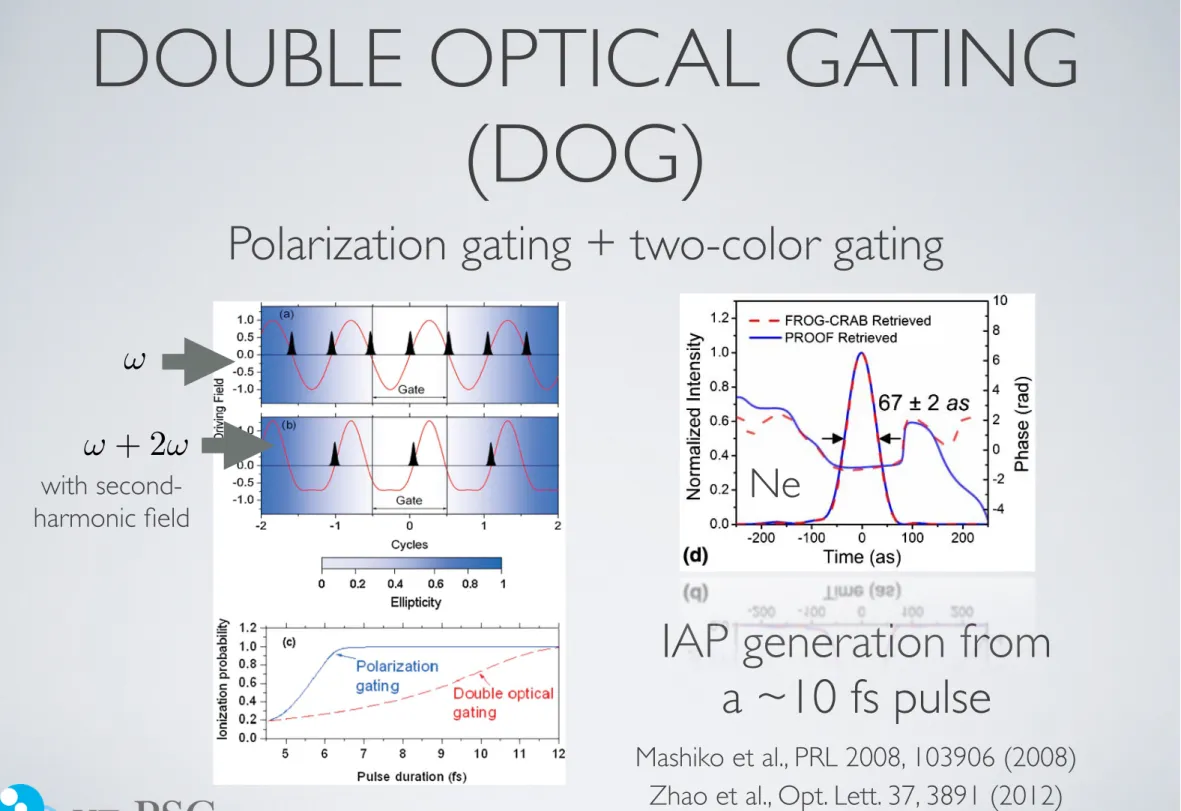
Zhao et al.
(2012)
by a 300 mm focal length lens. The diameter of the center spot of the focused Bessel streaking beam was 55 μm.
The delay between the XUV and NIR pulses was con- trolled by a piezo-electric transducer (PZT). A 532 nm la- ser beam co-propagating through both arms was used to stabilize the Mach-Zehnder interferometer [12].
The continuous XUV spectra generated with DOG mea- sured by the MBES without streaking are shown in Fig. 2.
By tuning the Ne pressure in the gas cell from 0.03 to 0.33 bar, the cutoff photon energy was reduced from 160 to 120 eV, which corresponds to Ip ! 2.6Up to Ip ! 1.8Up. The calculated single-atom cutoff is 190 eV.
The spectrum with pressure below 0.03 bar was not mea- sured due to the low count rate. The observed cutoff re- duction with increasing generation gas pressure is qualitatively consistent with previous experiments with XUV pulse trains [8,9]. Finally, the pressure of 0.2 bar in the generation cell was chosen for the streaking experi- ment, where the entire spectrum, from 55 to 130 eV, was confined within the low-energy part of the Zr transmis- sion window where the filter GDD is negative.
The attosecond pulses were retrieved from the streak- ing trace shown in Fig. 3(a) using both the PROOF (phase retrieval by omega oscillation filtering) [13] and FROG-CRAB (frequency-resolved optical gating for com- plete reconstruction of attosecond bursts) [14,15] techni- ques. Whereas the FROG-CRAB technique requires the bandwidth of the photoelectron spectrum to be small compared to its central energy, PROOF is applicable to much broader spectra [13]. Here, we apply the princi- pal component generalized projections algorithm to PROOF [16], which is more robust than the method developed in [13]. In the limit of low streaking intensi- ties, Up < ωL, the streaking spectrogram is given by S"v; τ# ≈ I0"v# ! IωL"v; τ# ! I2ωL"v; τ#, where IωL and I2ωL oscillate with the streaking laser frequency,ωL, and twice the frequency, respectively [13], τ is the delay between the XUV and laser pulses, and v is the photoelectron speed. Since the spectrum and phase information of the attosecond pulses are completely encoded in IωL, the amplitude and phase of the XUV pulse are guessed
in PROOF to match the modulation depth and phase angle of IωL.
The streaking trace was obtained at a low streaking intensity, 2.5 × 10¹¹ W ∕cm2, to satisfy the requirements of PROOF. Two methods are used to confirm the correct- ness of the phase retrieval. The first is to compare the photoelectron spectrum obtained experimentally to the retrieved ones. This criterion was used in the past [17], and is a necessary condition of an accurate retrieval. An- other criterion is the agreement between the filtered IωL trace from the measured spectrogram and the retrieved one. It is a much stricter requirement than the first one, because the modulation depth and phase angle of IωL are determined by both the spectrum and phase, whereas the first method compares a quantity that is dominated by
I0"v#, the unstreaked component of the spectrogram.
Our retrieval meets both criteria very well, as shown in Figs. 3(c) and 3(b), respectively. Both the FROG-CRAB and PROOF retrievals yield nearly identical temporal profiles with a pulse duration of 67 $ 2 as, as shown in Fig. 3(d), close to the transform-limited value of 62 as.
The error bar was obtained following the treatment in [1], by taking each delay slice in the final guessed spectro- gram as a separate measurement of the pulse duration.
The experiment was repeated at a higher streaking inten- sity (5 × 10¹¹ W∕cm2) and yielded the same result. With the intrinsic and Zr phase, we calculated a pulse duration of 68 as with the experimental spectrum, in agreement with our retrieved result. At generation gas pressures sig- nificantly lower than 0.2 bar, the count rate was not suf- ficient for obtaining streaking traces with satisfactory signal to noise ratio. Streaking was also performed at higher pressures, which yielded longer pulses due to the reduced spectral bandwidth. For instance, at 0.36 bar, the retrieved pulse duration was 88 as.
Both PROOF and FROG-CRAB assume that only photoelectrons emitted in a small angle in the streaking
Fig. 2. (Color online) XUV continuum generated by DOG in Ne gas at six pressures. The length of the gas cell is 1 mm.
The peak intensity at the center of the polarization gate is 1 × 10¹⁵ W∕cm2.
Fig. 3. (Color online) Characterization of a 67 as XUV pulse.
(a) Streaked photoelectron spectrogram obtained experimen- tally. (b) Filtered IωL trace (left) from the spectrogram in (a) and the retrieved IωL trace (right). (c) Photoelectron spec- trum obtained experimentally (thick solid) and retrieved spec- tra and spectral phases from PROOF (solid) and FROG-CRAB (dashed). (d) Retrieved temporal profiles and phases from PROOF (solid) and FROG-CRAB (dashed).
3892 OPTICS LETTERS / Vol. 37, No. 18 / September 15, 2012
2014/10/29 No.
Advanced Radiation Application (Kenichi ISHIKAWA) for internal use only (Univ. of Tokyo)
From femtosecond to attosecond
13
10
-15sec 10
-18sec
10-2 10-1 100 101 102 103 104 105
Pulse width (fs)
2010 2000
1990 1980
1970 1960
Year
10-2 10-1 100 101 102 103 104 105
Pulse duration (fs)
2000 1990
1980 1970
1960
Year
-6 -4 -2 0 2 4 6
fs FWHM 5 fs (λ=800 nm)
FWHM 500 as (λ=13 nm)
8 18
3 10 m/s 1 as 10 sec
0.3 nm c
dt c dt
−
= ×
= =
= Molecular rotation Molecular vibration Electronic dynamics
Single cycle at 800 nm
K. L. Ishikawa
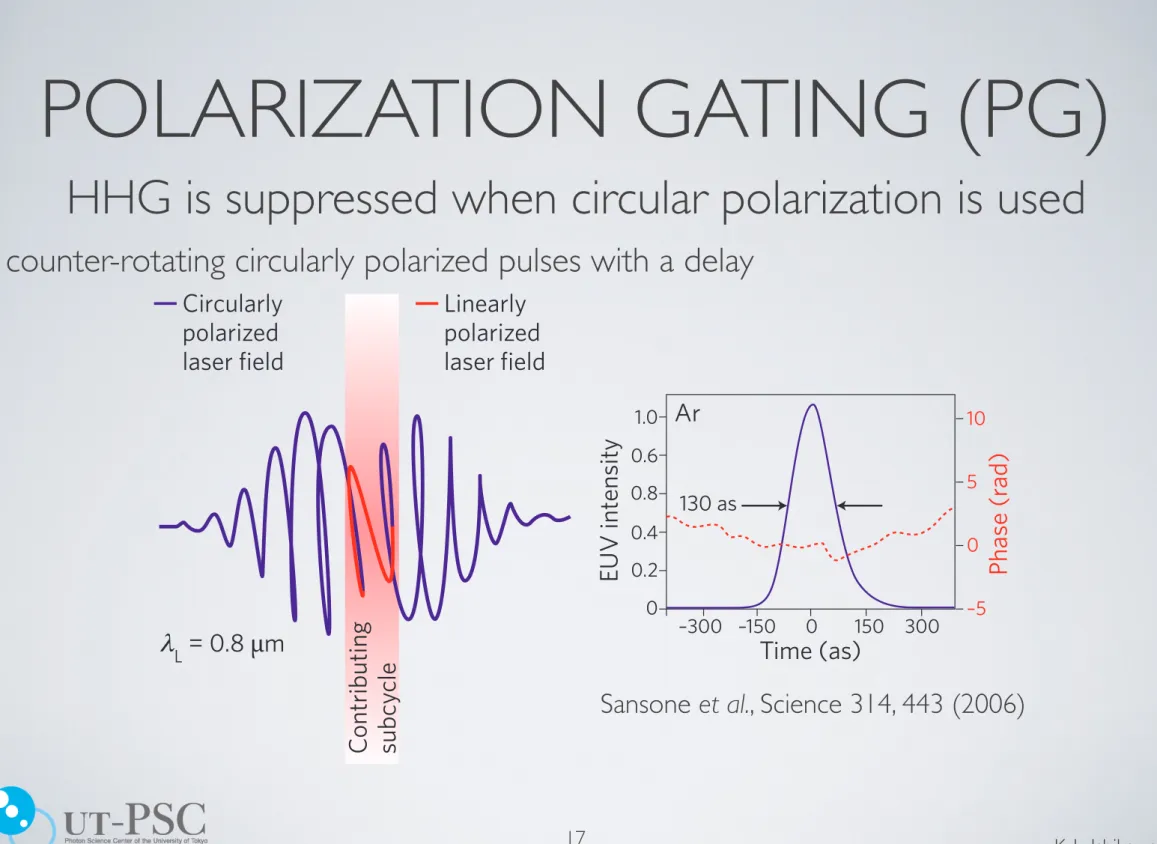
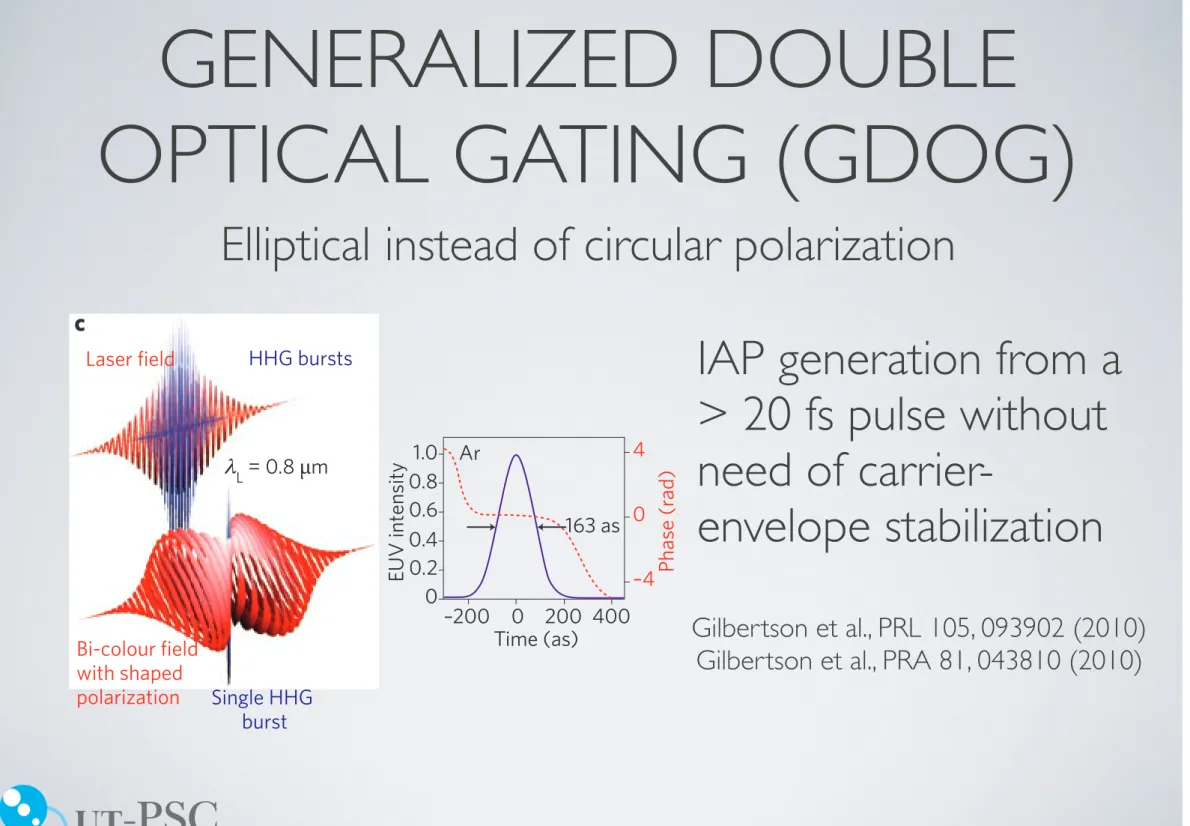
How to generate IAP
14
K. L. Ishikawa
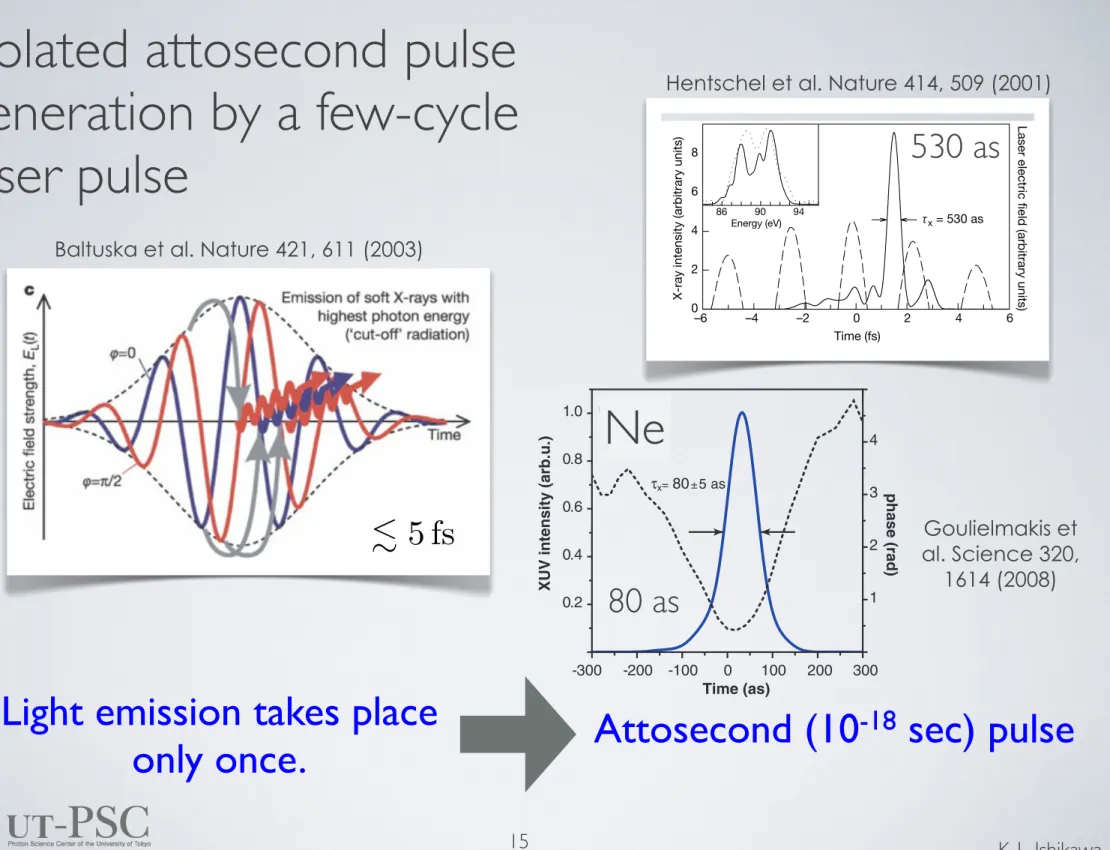
Isolated attosecond pulse generation by a few-cycle laser pulse
Light emission takes place
only once. Attosecond (10
-18sec) pulse
!"# #$#%&#'(# )* + ,-.*#$/),#()'0 1-2,# *%)$ "3&" "+%$)'3(
&#'#%+/3)' 3' /"# *#45(6(2# %#&3$# 4+, ()%%).)%+/#0 .6 '-$#%3(+2 ,3$-2+/3)', )* )-% 75%+6 ,)-%(# 43/" + ()$1-/#% ()0#89: !"3, ()0#
,)2;#0 <+=4#22>, 4+;# #?-+/3)', 3' /"%## 03$#',3)', +'0 ()$1-/#0 /"# %+03+/3)' )* /"# ,/%)'&2650%3;#' +/)$3( 031)2#, -,3'& + &#'#%+25 3@+/3)' )* /"# ?-+'/-$ /%#+/$#'/ )* %#*: 8A: !"#,# ,3$-2+/3)', 63#20 + BCD5+, 75%+6 1-2,# '#+% /"# 1%)1+&+/3)' +=3, 3' /"# *+% E#20 43/"3' + B5#F ,1#(/%+2 %+'&# '#+% GD #F H*-22 23'# 3' I3&: JKL +(()$1+'3#0 .6 + *#4 ,$+22 ,+/#223/# 1-2,#,: !"# +11#+%+'(# )* ,+/#223/#, ,#1+%+/#0 .6
!!DMN *%)$ /"# (#'/%+2 1-2,# 2#+0, /) + ,1#(/%+2 $)0-2+/3)' 43/" + 1#%3)0 )* /43(# /"# 2+,#% 1")/)' #'#%&6L +, %#;#+2#0 .6 /"# (+2(-2+/#0 ,1#(/%-$ H*-22 23'#K 3' /"# 3',#/ )* I3&: J: !"# 0#1/" )* /"3,
$)0-2+/3)' 1%);30#, + ,#',3/3;# $#+,-%# )* ,+/#223/# ()'/#'/: !"#
$#+,-%#0 ,1#(/%-$ )* /"# "+%$)'3( 75%+6 1-2,# %#O#(/#0 .6 )-%
<)MP3 $-2/32+6#% H0)//#0 23'# 3' /"# 3',#/ )* I3&: JK ,#/, + ,+*# -11#%
23$3/ )* 8DQ /) /"# /)/+2 ,+/#223/# O-#'(# %#2+/3;# /) /"# /)/+2 75%+6 O-#'(# 43/"3' + B5#F %+'&# +%)-'0 GD #F:
!"# +&%##$#'/ )* /"# $#+,-%#0 75%+6 1-2,# 0-%+/3)' 43/" /"+/
)./+3'#0 *%)$ )-% '-$#%3(+2 (+2(-2+/3)',8JH43/"3' /"# #=1#%3$#'5 /+2 #%%)%K ,")4, /"+/ /"# /3$3'& R3//#% )* /"# 75%+6 1-2,# %#2+/3;# /) /"# ;3,3.2# 23&"/ E#20 3, $-(" ,$+22#% /"+' 8 *,: S' )/"#% 4)%0,L )-%
#=1#%3$#'/ ,")4, /"+/ /"# ,-.*#$/),#()'0 75%+6 1-2,# 3, 2)(T#0 /) /"# (+%%3#% 4+;# )* 3/, &#'#%+/3'& *#45(6(2# 23&"/ 1-2,# 43/" +//)5 ,#()'0 1%#(3,3)': !"3, 3, ,-%1%3,3'&L &3;#' /"+/ /"# U+.,)2-/#> 1"+,#! )* /"# 4+;# H0#E'#0 3' /"# (+1/3)' )* I3&: JK 43/" %#,1#(/ /) /"#
+$123/-0# #';#2)1# 3, %+'0)$ 3' )-% 2+,#% 1-2,#,CL ,23&"/26 $)03*65 3'& /"# #;)2-/3)' )* /"# #2#(/%3( E#20 *%)$ 1-2,# /) 1-2,#: !"#
+//),#()'0 /3$3'& ,/+.323/6 )* )-% ,-.*#$/),#()'0 75%+6 1-2,# /) 3/,
*#45(6(2# 0%3;#% 3, 0-# #3/"#% /) + H,-%1%3,3'&K %).-,/'#,, )* /"#
"3&"5"+%$)'3( &#'#%+/3)' 1%)(#,, +&+3',/ /"#,# $)03E(+/3)',L )%
H$)%# 23T#26K /) + ,-.,/+'/3+226 %#0-(#0 75%+6 63#20 *)% ;+2-#, )*! )/"#% /"+' /"# )1/3$-$ +,,-$#0 3' I3&: J: S' /"# 2+//#% (+,#L )'26 +
*%+(/3)' )* +22 2+,#% 1-2,#, 4)-20 1%);30# +' +11%#(3+.2# ()'/%3.-5 /3)' /) /"# 0#/#(/#0 1")/)#2#(/%)' 63#20: S* /"3, 3, /%-#L *#45(6(2#
0%3;#% 1-2,#, 43/" ,/+.323@#0 +.,)2-/# 1"+,# 4)-20 $+%T#026 3$1%);# /"# 0+/+ +(?-3,3/3)' %+/# 3' /"# 1%#,#'/ +'0 %#2+/#0 #=1#%35
$#'/,:
!"#$%&' (%')*+,-(. #/0%((1*%#&/
V3/" 3/, 0-%+/3)' #=/%+(/#0 *%)$ /"# (#'/%+2 1+%/ )*""H#0KL /"# 75
%+6 1-2,# (+' ')4 .# -,#0L +, + E%,/ +1123(+/3)'L /) 1%).# /"#
#;)2-/3)' )* /"# #2#(/%3( E#20 3' /"# 23&"/ 1-2,#: !"# ,4##1 )* /"#
3',/+'/+'#)-, (+%%3#% *%#?-#'(6 #3',/ H)% 4+;#2#'&/" $3',/K 3' /"#
;3,3.2# 23&"/ 1-2,# (+' .# #;+2-+/#0 *%)$ ""H#0K .6 E//3'& + ,3'-,)30+2 ),(322+/3)' )* +0R-,/+.2# 1#%3)0 /) /"# 0+/+ 3' I3&: B:
!"# 0)/, 3' I3&: 9 ,")4 /"# (+%%3#% *%#?-#'(6 ,4##1 #;+2-+/#0 3' /"3,
$+''#%L %#;#+23'& + 06'+$3( .2-# ,"3*/ *%)$ + (+%%3#% 4+;#2#'&/" )*
!9BD '$ /) ,)$# BBD '$: !) -'0#%,/+'0 /"3, 1"#')$#')'L 4#
"+;# /) %#$#$.#% /"+/ /"# 23&"/ 1-2,# -,#0 "#%# 3, 0#%3;#0 *%)$ /"#
)'# &#'#%+/3'& /"# 75%+6 1-2,# HI3&: NK: W2,) ,")4' 3' I3&: 9 3, /"#
(+2(-2+/#0 *%#?-#'(6 ,4##1 )* /"# 2+,#% 1-2,# 2#+;3'& /"# '#)'5&+, 75%+6 ,)-%(#:
!"# $#+,-%#0 06'+$3( *%#?-#'(6 ,"3*/ +/ /"# (#'/%# )* /"# 1-2,# 3, 2+%&#% /"+' 1%#03(/#0 .6 )-% '-$#%3(+2 ,/-06L .-/ %#O#(/, ?-+23/+5 /3;#26 /"# 1%#03(/#0 .#"+;3)-%: !"# ?-+23/+/3;# +&%##$#'/ ,-&&#,/, /"+/ /"# ).,#%;#0 .2-# ,"3*/ (+' .# +//%3.-/#0 /) 3)'3@+/3)'53'0-(#0
!"#$%&'(
)*+ XW!YZ[\F]^ _8_\NG X]F[<`[Z NDD8\444:'+/-%#:()$
Delay, td (fs)
–6 –4 –2 0 2 4 6
ΔW – ΔWca (eV)
–2 0 2 4 6 8
–1 0 1 2
–2 0 2
τx = 500 as, 650 as, 800 as
2%'3"- 4!"#$%&'( )*+%,"!-. %,# /& 0"",-%-#(#$%&-1 2"#$%&' '2 ' .31$%*-1 -.#+4 5,#
+-%2 &#"#1% %,# -2$*(('%*16 $-7"-1#1% -. %,# 2"#$%&'( )*+%,8"!!"!$'9#+:8 ),#&#
"!$'9#+: 2%'1+2 .-& %,# $;$(#<'=#&'6#+ ='(3# -."!9#+:4 5,# .3(( &#+ (*1# *2 %,# (% -.
2*73('%*-12 >'2#+ -1 %,# ?3'2*<$('22*$'( %,#-&; -. %)-<$-(-3& @<&'; ",-%-*-1*A'%*-1 >;
'2237*16 ' B4C<.28 BCD<17 (*1#'&(; "-('&*A#+ (*6,% E#(+ -. C"FDFGH $7!I"#'J *1%#12*%;
'1+ ' KCD<'28 LD<#M 6'322*'1 @<&'; "3(2#4 5,# 7-+#( (*6,% "3(2# *1$(3+#2 ' 6'322*'1 .&#?3#1$; 2)##" '% %,# "3(2# "#'J 23"#&*7"-2#+ -1 ' )#'J ?3'+&'%*$ $-7"-1#1%4 N12#%8
$-(-3&#+ (*1#2 2,-) %,# (% -. %,# 2'7# 2*73('%*-1 .-& +*..#% "3(2# +3&'%*-12 1#'&
#+O D4 5,# $-12"*$3-32 '2;77#%&; *1 %,# $'($3('%#+ '1+ 7#'23&#+"!9#+: '>-3%#+O D
*2 +3# %- ' $,'16# -. %,# (*6,% $'&&*#& .&#?3#1$; -$$3&&*16 -1 ' %*7#2$'(#$D4 P-12#?3#1%(;8 %,# 2(-)(; ='&;*16 )'=# '""&-Q*7'%*-1 >&#'J2 +-)1 '1+ %,# E1'( 2%'%# -.
%,# #(#$%&-1 >#$-7#2 +#"#1+#1% -1 %,# '$%3'( #=-(3%*-1 -. %,# (*6,% E#(+4 5,#
23>2%&3$%3&# *1 %,# $3&=#2 *2 '1 '&%#.'$%8 (%*16 .&-7 %,# 2%'%*2%*$'( *1*%*'( $-1+*%*-12 *1 -3& 2*73('%*-124
Time (fs)
–6 –4 –2 0 2 4 6
X-ray intensity (arbitrary units)
0 2 4 6 8
Energy (eV)
86 90 94
τx = 530 as
Laser electric field (arbitrary units)
2%'3"- 5P'($3('%#+ .'&<E#(+8 1#'&<'Q*2 %#7"-&'( *1%#12*%; "&-E(# -. ' 2-.%<@<&'; "3(2#4 5,# @<&'; "3(2# *2 "&-+3$#+ *1 ' G<77<(-16 IDD<7>'& 1#-1 6'2 =-(37# >; ' B<.28 BCD<
17 6'322*'1 ('2#& "3(2# )*%, '1 -1<'Q*2 "#'J *1%#12*%; -. L"FDF0H $7!I4 R-& %,#
#(#$%&*$ E#(+ -. %,# ('2#& "3(2#8%9#:!#Q"9!#IS%IT:$-29&D#U!: )*%,!O D 9$-2*1# "3(2#:8 ),#&#%T*2 %,# "3(2# +3&'%*-18&D*2 %,# '163('& $'&&*#& .&#?3#1$; '1+!*2 %,# V'>2-(3%#W
",'2#4 5,# +'2,#+ (*1# 2,-)2 %,# -1<'Q*2 #(#$%&*$ E#(+ -. %,# ('2#& "3(2# (#'=*16 %,#
*1%#&'$%*-1 *-14 5,# $'($3('%#+ @<&'; &'+*'%*-1 *2 2#(#$%#+ )*%,*1 ' C<#M 2"#$%&'( &'16#
1#'& LD #M4 N12#%8 $'($3('%#+ 9.3(( (*1#: '1+ 7#'23&#+ 9+-%%#+ (*1#: @<&'; "3(2# 2"#$%&37 2#(#$%#+ >; %,# X-S!* &#Y#$%-&8 2,-)*16 %,'% '>-3% LDZ -. %,# %-%'( Y3#1$# *2 )*%,*1 ' C<#M &'16# '&-31+ LD #M4
© 2001 Macmillan Magazines Ltd
Hentschel et al. Nature 414, 509 (2001)
XUV pulse duration, (ii) improved signal-to-noise (S/N) ratio due to the increased XUV photon flux, and (iii) stronger streaking before the onset of the NIR field–induced ionization in attosecond streaking (2) or enhanced S/N ratio due to a reduced number of tunneling steps in attosecond tunneling spectroscopy (14).
Figure 1 summarizes results of the modeling of the single-cycle interaction of ionizing NIR radiation with an ensemble of neon atoms (17). In Fig. 1A, the left panels plot possible NIR elec- tric waveforms,ELðtÞ ¼ E0aLðtÞe−iðwLtþϕÞ þcc (whereccstands for complex conjugate) derived from our streaking measurements (as presented in the next sections) for different settings of the carrier-envelope (CE) phase, ϕ. Here, E0 is the peak electric-field strength, aL(t) is the normal- ized complex amplitude envelope, andwLis the carrier frequency. The probability of ionization outside the central cycle is more than two orders of magnitude lower than that at the field maxi- mum and hence is negligible.
The spectra of XUVemissions originating from the individual recollisions (18) are predicted to differ by tens of electron volts in cut-off energy and by up to orders of magnitude in intensity as a con- sequence of the single-cycle nature of the driving field. The strong variation of emission energies and intensities within a single wave cycle creates ideal conditions for isolated sub-100-as pulse genera- tion. Indeed, filtering radiation with the bandpass depicted by the dashed-and-dotted line is predicted to isolate XUV radiation with more than 90% of its energy delivered in a single attosecond pulse for a range of CE phases as broad as 30°≤ϕ≤90° (Fig.
1B). In contrast, with few-cycle-driven harmonic generation resulting in isolated subfemtosecond pulses over only a relatively narrow range of the CE phase nearϕ ≈0° (3), single-cycle excitation appears to permit robust isolated attosecond pulses for a variety of driver waveforms, ranging from near-cosine– to sine-shaped ones, owing to the order-of-magnitude variation of the ionization probability within a single wave cycle.
We used phase-controlled sub-1.5-cycle laser pulses carried at a wavelength of lL= 2pc/wL= 720 nm (19) to generate XUV harmonics in a neon gas jet up to photon energies of ~110 eV (fig. S1). The emerging XUV pulse—following a spectral filtering through a bandpass (dashed- and-dotted line in Fig. 1A) introduced by metal foils and a Mo/Si multilayer mirror (fig. S2)—
subsequently propagates, along with its NIR driv- er wave, through a second jet of neon atoms in which the XUV pulse ionizes the atoms in the presence of the NIR field. The freed electrons with initial momenta directed along the electric- field vector of the linearly polarized NIR field are collected and analyzed with time-of-flight spec- trometry (17).
The variation of the measured photoelectron spectra versus CE phase shows good agreement with the predictions of our simulations (Fig. 2, A and B). Figure 2, C to E, shows plots of electron spectra corresponding to the CE phase
Photoelectron energy (eV)
40 50 60 70
20 40 60 80 100 120 140 160
1
ϕ = 70°
1
ϕ = 130°
30 40 50 60 70 80
0 1
ϕ = 170°
A
B
C
D
E
Carrier-envelope phase (deg)
Electron counts (arb. u.)
0 1
Photoelectron energy (eV) 0
0
40 50 60 70
Fig. 2. Control of bandpass-filtered XUV emission with the waveform of monocycle light. Measured (A) and simulated (B) (17) photoelectron spectra versus CE phase, with the delay increased in steps of
~11° (p/16 rad). (C to E) Spectra measured at the CE phase setting closest to the values selected in Fig. 1A. The zero of the CE phase scale in (A) was set to yield the best agreement with the modeled spectra in (B).
Delay (fs)
Photoelectron energy ( eV)
−4 −2 0 2 4
30 40 50 60 70 80 90
Delay (fs)
−4 −2 0 2 4
30 40 50 60 70 80 90
0.1 0.2 0.3 0.4 0.5
A B 0.6
40 50 60 70 80 90 100 110 0.2
0.4 0.6 0.8 1.0
-3 0 phase (rad)
Photon energy (eV) -300 -200 -100 0 100 200 300
0.2 0.4 0.6 0.8 1.0
Time (as)
1 2 3 4
phase (rad)
τx=80±5 as
C D
Photoelectron energy ( eV) XUV spectral intensity (arb.u.)
XUV intensity (arb.u.)
φ″=(1.5 ± 0.2)×103 as2
Fig. 3. Sub-100-as XUV pulse retrieval. (A) Measured ATR spectrogram compiled from 126 energy spectra of photoelectrons launched by an XUV pulse with a bandwidth of ~28 eV (FWHM) and recorded at delay settings increased in steps of 80 as. Here, a positive delay corresponds to the XUV pulse arriving before the NIR pulse. The high flux of the XUV source allows this spectrogram to be recorded within ~30 min. (B) ATR spectrogram reconstructed after ~103iterations of the FROG algorithm (17).
(C) Retrieved temporal intensity profile and spectral phase of the XUV pulse. The intrinsic chirp of the XUV emission (Fig. 4B) is almost fully compensated by a 300-nm-thick Zr foil introduced into the XUV beam between the attosecond source and the ATR measurement. Arrows indicate the temporal FWHM of the XUV pulse. (D) XUV spectra evaluated from the measurement of the XUV-generated photoelectron spectrum in the absence of the NIR streaking field (blue dashed line) and from the ATR retrieval (blue solid line). The black dotted line indicates the retrieved spectral phase.
www.sciencemag.org SCIENCE VOL 320 20 JUNE 2008 1615
REPORTS
on August 19, 2009 www.sciencemag.orgDownloaded from
Goulielmakis et al. Science 320,
1614 (2008)
15 Baltuska et al. Nature 421, 611 (2003)
5 fs
Ne
530 as
80 as