arXiv:nucl-th/0506021v1 8 Jun 2005
Medium modifications of nucleon electromagnetic form factors
T. Horikawa
Department of Physics, School of Science, Tokai University Hiratsuka-shi, Kanagawa 259-1292, Japan
W. Bentz
∗Department of Physics, School of Science, Tokai University Hiratsuka-shi, Kanagawa 259-1292, Japan
Abstract
We use the Nambu-Jona-Lasinio model as an effective quark theory to investigate the medium modifications of the nucleon electromag- netic form factors. By using the equation of state of nuclear matter derived in this model, we discuss the results based on the naive quark - scalar diquark picture, the effects of finite diquark size, and the me- son cloud around the constituent quarks. We apply this description to the longitudinal response function for quasielastic electron scattering.
RPA correlations, based on the nucleon-nucleon interaction derived in the same model, are also taken into account in the calculation of the response function.
PACS numbers: 12.39.Fe; 12.39.Ki; 13.40.Gp; 14.20.Dh; 14.65.-q
Keywords: Chiral quark theories, Nucleon form factors, Medium modifica- tions
∗Correspondence to: W. Bentz, E-mail: [email protected]
1 Introduction
The structure of the nucleon and its modifications in the nuclear medium is a very active field of experimental and theoretical research. The basic quanti- ties, which reflect the charge and current distributions in the nucleon, are the electromagnetic form factors [1], which are currently investigated in elastic electron- nucleon scattering experiments from intermediate to very high en- ergies [2]. The knowledge of the nucleon form factors is also inevitable to un- derstand the electromagnetic structure of nuclei. Electron-nucleus scattering experiments under quasielastic kinematic conditions, like the measurement of inclusive response functions in the intermediate energy region [3, 4] and recent measurements of polarization transfer in semi-exclusive knock-out pro- cesses [5], are ideal places to study the form factors of a nucleon bound in the nuclear medium. Because the structure of the quark core and the surround- ing meson cloud may be different for a bound nucleon and a free nucleon, one expects medium modifications of the nucleon form factors[6], and the explo- ration of these effects is an important subject at current electron accelerator facilities [7].
On the theoretical side, effective quark theories are the ideal tools to
describe the electromagnetic form factors of the nucleon. Much progress for
the case of the free nucleon has been made in Faddeev type descriptions based
on the Schwinger-Dyson method [8]. An important point which still has to
be implemented in these calculations is the role of the pion cloud around the
nucleon, and the recently developed method of chiral extrapolations of lattice
results [9] provides important hints. On the other hand, the calculation
of form factors at finite nucleon density requires also a description of the
equation of state of the many-nucleon system, and here progress has been
made by using the Nambu-Jona-Lasinio (NJL) model [10] as an effective
quark theory: Recent works have shown how to account for the saturation properties of nuclear matter in this model [11], and when combined with the quark-diquark description of the single nucleon[12] this provides a successful description of both nucleon and nuclear structure functions for deep inelastic scattering [13, 14]
1.
The purpose of this paper is to discuss the results for the nucleon form factors obtained in the simple quark-scalar diquark description of the nucleon at finite density in the NJL model. We have to note from the beginning that this can only be a first step toward a realistic description, because it is known that axial vector diquarks are important for spin-dependent quantities[17, 14], and the pion cloud is important for magnetic moments and the size of the nucleon[9, 18]. While the axial diquarks could be included in a further step like it was done for the structure functions[14], a reliable description of pion cloud effects makes it necessary to go beyond the standard ladder approximation scheme. However, like the simple quark-scalar diquark model of Ref.[13] served as a basis for the more elaborate description of structure functions [14], it will also be the basis of a more realistic description of form factors including axial diquarks and the pion cloud. To provide this basis is the main intention of the present paper.
In Sect. 2 we will briefly review the model for the nucleon and the nuclear matter equation of state. Sect. 3 is devoted to the nucleon form factors at finite density, and in Sect.4 we discuss the numerical results. As an applica- tion, we discuss the response function for quasielastic electron scattering in Sect.5. For this purpose we will also elucidate the nucleon-nucleon interac- tion in our model in order to include the correlations within the relativistic RPA. A summary will be presented in Sect. 6.
1Recently the model has been extended to describe the equation of state at high densities[15, 16].
2 The model
In this work, we use the NJL model as an effective quark theory to describe the nucleon as a quark-diquark bound state, and nuclear matter (NM) in the mean field approximation. The details are explained in Refs. [11, 15], and here we will only briefly summarize those points which will be needed for our calculations.
The NJL model is characterized by a chirally symmetric 4-fermi interac- tion between the quarks[19]. Any such interaction can be Fierz symmetrized and decomposed into various qq channels [20]. Writing out explicitly only those channels which are relevant for our present discussion, we have
L = ψ (i 6 ∂ − m) ψ + G
π
ψψ
2−
ψ(γ
5τ )ψ
2
− G
ωψγ
µψ
2+ . . . (2.1) where m is the current quark mass. In a mean field description of the isospin symmetric nuclear matter ground state |ρi, the Lagrangian can be expressed as
L = ψ (i 6 ∂ − M −6 V ) ψ − (M − m)
24G
π+ V
µV
µ4G
ω+ L
I, (2.2) where M = m − 2G
πhρ|ψψ|ρi and V
µ= 2G
ωhρ|ψγ
µψ|ρi, and L
Iis the normal ordered interaction Lagrangian. The effect of the mean scalar field is thus included in the density-dependent constituent quark mass M, and the effect of the mean vector field is to shift the quark momentum according to p
µ= p
µQ+ V
µ, where p
µQis the kinetic momentum. The propagator of the constituent quark therefore has the following dependence on the mean vector field
2: ˜ S(k) = S(k
Q).
2In this section, Green functions in the presence of the mean vector field are denoted by a tilde, and those without the vector field have no tilde. In the loop integrals for the electromagnetic form factors in Sect.3, however, it is always possible to eliminate the vector field by a shift of the integration variable, and therefore the tilde-Green functions do not appear in later sections.
One can use a further Fierz transformation to decompose L
Iinto a sum of qq channel interaction terms [20]. For our purposes we need only the interaction in the scalar diquark (J
π= 0
+, T = 0, color 3) channel:
L
I,s= G
sψ (γ
5C) τ
2β
Aψ
Tψ
TC
−1γ
5τ
2β
Aψ
, (2.3) where β
A=
q3/2 λ
A(A = 2, 5, 7) are the color 3 matrices and C = iγ
2γ
0. The coupling constant G
swill be determined so as to reproduce the free nucleon mass.
The reduced t-matrix in the scalar diquark channel is given by [11]
˜
τ
s(q) = 4iG
s1 + 2G
sΠ ˜
s(q) = τ
s(q
D) (2.4) with the scalar qq bubble graph
Π ˜
s(q) = 6i
Z
d
4k
(2π)
4tr
D[γ
5S(k)γ
5S (−(q − k))] = Π
s(q
D) . (2.5) Here q
Dµ= q
µ− 2V
µis the kinetic momentum of the diquark.
The relativistic Faddeev equation in the NJL model can been solved nu- merically for the free nucleon[20], but here we restrict ourselves to the static approximation[21], where the momentum dependence of the quark exchange kernel is neglected. The solution for the quark-diquark t-matrix then takes the simple analytic form
T ˜
N(p) = 3 M
1
1 +
M3Π ˜
N(p) = T
N(p
N) , (2.6) with the quark-diquark bubble graph given by
Π ˜
N(p) = −
Z
d
4k
(2π)
4S(k) ˜ ˜ τ
s(p − k) = Π
N(p
N) , (2.7)
where p
µN= p
µ− 3V
µis the kinetic momentum of the nucleon. The nucleon
mass M
Nis defined as the pole of (2.6) at 6 p
N= M
N, and the positive energy
spectrum has the form p
0= ǫ
p≡ E
N p+ 3V
0with E
N p=
qM
N2+ p
2. The nucleon vertex function in the non-covariant normalization is defined by the pole behavior of the quark-diquark t-matrix:
T
N(p) → Γ
N(p) Γ
N(p) p
0− ǫ
pas p
0→ ǫ
p. (2.8)
From this definition and Eq.(2.6) one obtains Γ
N(p) =
s
−Z
NM
NE
N pu
N(p
N) , (2.9)
where u
Nis a free Dirac spinor for mass M
Nnormalized as u
Nu
N= 1. The normalization factor Z
Nis easily obtained from this definition and will be given in Eq.(2.14) below. We note that with this normalization the vertex function satisfies the relation
Γ
N(p) ∂ Π
N(p)
∂p
µ!
Γ
N(p) = p
µE
N p(2.10) In the numerical calculations of this paper, we will approximate the quantity τ
sby a “contact+pole” form:
τ
s(q) → 4iG
s− i g
sq
2− M
s2≡ 4iG
s− ig
s∆
F s(q). (2.11) Here ∆
F s(q) is the Feynman propagator for a scalar particle of mass M
s, which is defined as the pole of τ
sof Eq.(2.4). The residue at the pole (g
s) will be given in Eq. (2.13) below.
In the calculation of the nucleon form factors, we will also consider the effects of the pion cloud around the constituent quarks. In this case, the propagator S(p) of the quark involves an additional self energy correction from the pion cloud (Σ
Q). Here we will use a simple pole approximation for S(p):
S(p) = Z
QS
F(p) , Z
Q−1= 1 − ∂Σ
Q∂ 6 p
!
6 p
=M, (2.12)
where S
Fis the Feynman propagator of a constituent quark with mass M . In this approximation, the pion effects can be renormalized by ψ →
qZ
Qψ and a redefinition of the four fermi coupling constants G
α→ G
α/Z
Q2, see Ref.([12]). For the calculation of the form factors, however, we will keep the factor Z
Qexplicitly for clarity
3. Introducing (2.12) and (2.11) into the expressions (2.5) and (2.7) for the bubble graphs shows that the diquark and nucleon normalization factors can be written as
g
−s1= 1
2 − ∂Π
s(q)
∂q
2!
q2=Ms2
= 1
2 Z
Q2− ∂ Π ˆ
s(q)
∂q
2!
q2=Ms2
≡ Z
Q2g ˆ
s−1(2.13) Z
N−1= − ∂Π
N(p)
∂6p
!
6 p
=MN= Z
Qg
s− ∂ Π ˆ
N(p)
∂ 6 p
!
6p
=MN≡ Z
Qg
sZ ˆ
N−1, (2.14) where ˆ Π
sand ˆ Π
Nare defined in terms of the pole parts only:
Π ˆ
s(q) = 6i
Z
d
4k
(2π)
4tr
D[γ
5S
F(k)γ
5S
F(−(q − k))] (2.15) Π ˆ
N(p) = i
Z
d
4k
(2π)
4S
F(k) ∆
F s(p − k) (2.16) The equation of state of NM in the NJL model can be derived in a formal way [15] from the quark Lagrangian (2.2) by using hadronization techniques, but in the mean field approximation the resulting energy density of isospin symmetric NM has the simple form [11]
E = E
V− V
024G
ω+ 4
Z
d
3p
(2π)
3Θ (p
F− |p|) ǫ
p, (2.17) where the vacuum contribution (quark loop) is
E
V= 12i
Z
d
4k
(2π)
4ln k
2− M
2+ iǫ
k
2− M
02+ iǫ + (M − m)
24G
π− (M
0− m)
24G
π. (2.18)
3We also note that such a renormalization procedure is no longer possible when one considers the pion cloud effects around the nucleon, which goes beyond the simple ladder approximation on the quark level.
Here M
0the constituent quark mass for zero nucleon density. The condition
∂E /∂V
0= 0 leads to V
0= 6 G
ωρ, and we can eliminate the vector field in (2.17) in favor of the baryon density. The resulting expression has then to be minimized with respect to the constituent quark mass M for fixed density.
For zero density this condition becomes identical to the familiar gap equation of the NJL model[10], and for finite density the nonlinear M -dependence of the nucleon mass M
Nis essential to obtain saturation of the binding energy per nucleon [11].
In order to fully define the model one has to specify a cut-off procedure.
In the calculations in this paper we will use the proper time regularization scheme [22, 11], where one evaluates loop integrals over a product of propa- gators by introducing Feynman parameters, performing a Wick rotation and replacing the denominator (A) of the loop integral according to
1
A
n→ 1 (n − 1)!
Z 1/Λ2IR
1/Λ2UV
dτ τ
n−1e
−τ A(n ≥ 1), (2.19) where Λ
IRand Λ
UVare the infrared and ultraviolet cut-offs, respectively.
The infrared cut-off plays the important role of eliminating the unphysical thresholds for the decay of the nucleon and mesons into quarks [22], thereby taking into consideration a particular aspect of confinement physics.
3 Nucleon electromagnetic form factors
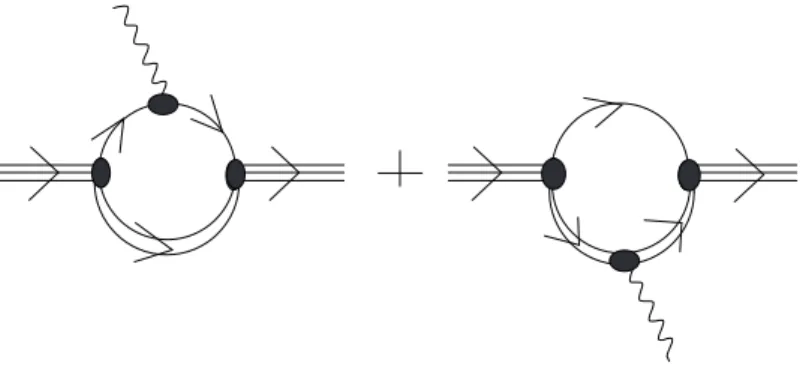
The electromagnetic current of the nucleon in the quark-diquark model is represented by the Feynman diagrams of Fig.1 and given by
j
Nµ(q) = Γ
N(p
′)
Z
d
4k (2π)
4h
S(p
′− k)Λ
µQS(p − k)
τ
s(k)
+i (τ
s(p
′− k)Λ
µDτ
s(p − k)) S(k)] Γ
N(p) . (3.1)
Here Λ
µQand Λ
µDare the electromagnetic vertices of the quark and the
scalar diquark, both depending on the final and initial particle momenta. It
Figure 1: Feynman graphs for the evaluation of the nucleon electromagnetic current in the quark-diquark model. The double line represents the diquark t-matrix, the solid line the constituent quark propagator, and the black areas are the vertex functions and electromagnetic vertices.
is an easy task to use the Ward-Takahashi identities [23] for the quark and diquark vertices
q
µS(ℓ
′)Λ
µQS(ℓ)
= −Q
Q(S(ℓ
′) − S(ℓ)) (3.2) q
µ(τ
s(ℓ
′)Λ
µDτ
s(ℓ)) = iQ
D(τ
s(ℓ
′) − τ
s(ℓ)) (3.3) to show the current and charge conservation for the nucleon:
q
µj
Nµ(q) = Q
NΓ
N(p
′) (Π
N(p
′) − Π
N(p)) Γ
N(p) = 0 (3.4) j
µ(0) = Q
Np
µE
N p, (3.5)
where the electric charge of the nucleon Q
N= Q
Q+ Q
Dis the sum of the quark and diquark electric charges.
The electromagnetic vertices in (3.1) describe the finite extension of the
constituent quarks and the diquark. In general, they should be calculated
off-shell consistently with the propagators τ
sand S, using Feynman diagrams
or some ansatz which satisfies the Ward identities[8]. In the present work,
however, our principal aim is to investigate the medium effects in a simple
model calculation. For this purpose, we limit the complications caused by
the quark and diquark sizes to a minimum, and use an on-shell (or pole) approximation for the quark and diquark currents appearing in Eq.(3.1):
S(ℓ
′) Λ
µQS(ℓ)
−→ Z
QS
F(ℓ
′) ˆ Λ
µQS
F(ℓ)
(3.6) (τ
s(ℓ
′) Λ
µDτ
s(ℓ)) −→ −g
s∆
F s(ℓ
′) ˆ Λ
µD∆
F s(ℓ)
, (3.7) where the on-shell (o.s.) vertices are denoted by a hat and given by the pole residues of the full quantities by
Λ ˆ
µQ≡ Z
QΛ
µQo.s.
≡ γ
µF
1Q(q
2) + iσ
µνq
ν2M F
2Q(q
2) (3.8) Λ ˆ
µD≡ g
s(Λ
µD)
o.s.≡ (ℓ
′+ ℓ)
µF
D(q
2). (3.9) Here we introduced the quark and diquark form factors which satisfy F
1Q(0) = Q
Q, F
D(0) = Q
D.
To understand (3.6) and (3.7), we note that in general the on-shell approx- imation for a vertex function Λ
µ(ℓ
′, ℓ) can be formulated only if it appears between pole parts of Green functions, because only in this case one can ap- proximate it by its value for on-shell momenta ℓ
′, ℓ
4. This is why in Eq.(3.6) and (3.7) we have replaced the propagators left and right to the vertex func- tions by their pole parts (see (2.11) and (2.12)), which is also essential in order to have charge conservation with the vertices (3.8) and (3.9).
We now can write down the form of the nucleon current (3.1) which will be used in the further calculations:
j
Nµ(q) =
s
M
NE
N pM
NE
N p′u
N(p
′)
O
Cµ+ O
µQ+ O
Dµu
N(p) . (3.10) Here the first and second terms denote the contributions of the contact term and the pole term of the diquark t-matrix to the quark diagram (first diagram
4This approximation is the basis of the standard convolution formalism to calculate quark light-cone momentum distributions and structure functions.
of Fig.1), and the third term is the contribution from the diquark diagram:
O
Cµ= − 4iG
sˆ g
sZ ˆ
NZ
d
4k
(2π)
4S
F(p
′− k)
γ
µF
1Q(q
2) + iσ
µνq
ν2M F
2Q(q
2)
S
F(p − k) (3.11) O
Qµ= i Z ˆ
NZ
d
4k
(2π)
4S
F(p
′− k)
γ
µF
1Q(q
2) + iσ
µνq
ν2M F
2Q(q
2)
S
F(p − k)∆
F s(k) (3.12) O
µD= i Z ˆ
NF
D(q
2)
Z
d
4k
(2π)
4∆
F s(p
′− k) (p + p
′− 2k)
µ∆
F s(p − k) S
F(k) . (3.13) (For the contact term, we replaced G
s→ G
s/Z
Q2, so that G
sin (3.11) is the renormalized coupling in the sense explained in Sect.2.) By using the elementary Ward-Takahashi identities 6q = S
F−1(ℓ
′) − S
F−1(ℓ) and ℓ
′2− ℓ
2=
∆
−F s1(ℓ
′)−∆
−F s1(ℓ) and the fact that on the nucleon mass shell Π
N(p) = Π
N(p
′), it is easy to check that the 3 parts in (3.10) satisfy current conservation separately
5. Similarly, charge conservation can be checked by using the el- ementary Ward identities γ
µ= ∂S
F−1(ℓ)/∂ℓ
µand 2ℓ
µ= ∂∆
−F s1(ℓ)/∂ℓ
µ, as well as F
1Q(0) = Q
Q, F
D(0) = Q
D. It has to be noted, however, the general Ward-Takahashi identity for an off-shell nucleon (the first equality in Eq.(3.4) without the nucleon spinor) is not valid in this approximation scheme.
It is not very difficult to evaluate the three loop integrals in (3.11)-(3.13), and in Appendix A the results are given in terms of the Dirac-Pauli form factors F
1Nand F
2N, which are defined by
j
Nµ=
s
M
NE
N pM
NE
N p′u
N(p
′)
γ
µF
1N(q
2) + iσ
µνq
ν2M
NF
2N(q
2)
u
N(p) . (3.14) In the following we will discuss various steps in the calculation of the nucleon form factors.
5These formal manipulations involve shifts of the integration variables. In the actual calculations based on our regularization scheme, however, we always checked that current and charge conservation are satisfied exactly. (Therefore, the explicit expressions given in the Appendices all satisfy the charge conservation.)
3.1 Naive quark-diquark model
The simplest approximation consists in assuming point couplings of the quarks and diquarks to the photon, i.e., replacing F
1Q→ Q
Q= 1
6 + τ
32 , F
2Q→ 0, F
D→ Q
D= 1
3 in Eqs. (3.11)-(3.13). This approximation will be called the
“naive quark-diquark model”, and the detailed expressions can be found in Appendix A.
3.2 Effects of finite diquark size
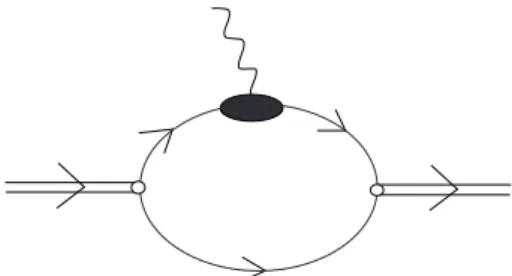
Figure 2: Graphical representation of the diquark form factor. The white circles denote the diquark vertex functions, and the black area is the quark electromagnetic vertex. (There is a second diagram where the photon couples to the other quark, but also an overall symmetry factor
12.)
Here we consider the effect of the diquark form factor F
D, which has been defined in (3.9). The vertex Λ
µDis shown graphically in Fig.2, where the quark-diquark vertex functions are those appearing in the Lagrangian(2.3).
We obtain
Λ ˆ
µD= i g
sZ
d
4k (2π)
4n
Tr
hγ
5S(p
′+ k)Λ
µQS(p + k)γ
5S(k)
io, (3.15)
where the trace refers to color, isospin and Dirac indices. Using the on-
shell approximation (3.6), the definition of quark form factors (3.8), and also
(2.12) and (2.13), we obtain Λ ˆ
µD= 6i ˆ g
sZ
d
4k (2π)
4n
F
1Q(0)(Q
2)Tr
D[γ
5S
F(p
′+ k)γ
µS
F(p + k)γ
5S
F(k)]
+ F
2Q(0)(Q
2)Tr
D
γ
5S
F(p
′+ k) iσ
µνq
ν2M S
F(p + k)γ
5S
F(k)
. (3.16) Here F
1Q(0)and F
2Q(0)are the isoscalar parts of the quark form factors F
1Qand F
2Q. The resulting diquark form factor F
Dis given in Appendix A.
3.3 Effects of meson cloud around constituent quarks
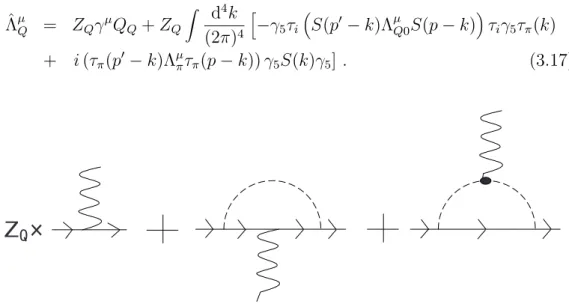
Here we consider the quark form factors arising from the pion cloud and vector mesons. For the pion cloud, we obtain from the definition (3.8) and the Feynman diagrams of Fig.3,
Λ ˆ
µQ= Z
Qγ
µQ
Q+ Z
QZ
d
4k (2π)
4h
−γ
5τ
iS(p
′− k)Λ
µQ0S(p − k)
τ
iγ
5τ
π(k) + i (τ
π(p
′− k)Λ
µπτ
π(p − k)) γ
5S(k)γ
5] . (3.17)
Figure 3: Pion cloud contributions to the quark electromagnetic vertex. Z
Qis the quark wave function renormalization factor, and the dashed line rep- resents the t-matrix in the pion channel. (This figure actually refers to the expression (3.25), where the factor Z
Qremains only for the “bare” term.)
Here τ
πis the reduced qq t-matrix is the pion channel, which can be
approximated in the same way as the diquark t-matrix (2.11):
τ
π(k) = −2iG
π1 + 2G
πΠ
π(k
2) −→ −2iG
π+ ig
πk
2− M
π2≡ −2iG
π+ ig
π∆
F π(k) . (3.18) The bubble graph in the pion channel is Π
π= Π
s(see (2.5)), and the residue g
πwill be given in Eq.(3.24) below.
The expression (3.17) is formally similar to the nucleon current (3.1). The presence of the first term simply expresses the fact that in the NJL model the (bare) quarks are present from the beginning, and the factor Z
Qgives the probability of having a constituent quark without its pion cloud. It has been expressed in Eq.(2.12) in terms of the self energy
Σ
Q(p) = −3
Z
d
4k
(2π)
4(γ
5S(p − k)γ
5) τ
π(k) . (3.19) The quark electromagnetic vertex Λ
µQ0in (3.17) will be approximated by its point form after processing the renormalization factor Z
Q, and the pion electromagnetic vertex Λ
µπ≡ τ
iΛ
µπ,ijτ
jis similar to the diquark vertex of Fig.2, but with point quark-photon couplings, as will be specified below.
We now follow the same steps as for the calculation of the nucleon current:
We use the on-shell approximation for the quark and pion vertices
S(ℓ
′) Λ
µQ0S(ℓ)
−→ Z
QS
F(ℓ
′) ˆ Λ
µQ0S
F(ℓ)
(3.20) (τ
π(ℓ
′) Λ
µπτ
π(ℓ)) −→ −g
π∆
F π(ℓ
′)ˆ Λ
µπ∆
F π(ℓ)
, (3.21) where the on-shell vertices are defined by
Λ ˆ
µQ0≡ Z
QΛ
µQ0o.s.
≡ γ
µQ
Q(3.22)
Λ ˆ
µπ,ij≡ g
πΛ
µπ,ijo.s.
≡ (ℓ
′+ ℓ)
µ(−iǫ
ij3) F
π(q
2) . (3.23) Using S(k) = Z
QS
F(k) in the expression for Π
π, we get
g
π−1= − ∂Π
π(q)
∂q
2!
q2=Mπ2
= Z
Q2− ∂ Π ˆ
π(q)
∂q
2!
q2=Mπ2
≡ Z
Q2ˆ g
π−1, (3.24)
with the renormalized bubble graph ˆ Π
π= ˆ Π
s, see (2.15). Then Eq. (3.17) becomes
Λ ˆ
µQ= Z
Qγ
µQ
Q− iˆ g
π1
2 (1 − τ
3)
Z
d
4k
(2π)
4γ
5(S
F(p
′− k)γ
µS
F(p − k)) γ
5∆
F π(k)
− 2i τ
3ˆ g
πF
π(q
2)
Z
d
4k (2π)
4∆
F π(p
′− k) (p
′+ p − 2k)
µ∆
F π(p − k)
γ
5S
F(k)γ
5. (3.25) Here we note that the contribution of the contact term (2iG
π) to the quark
diagram has been dropped in order to avoid double counting: Because we always assume that our interaction Lagrangians are Fierz symmetric, it is easy to see that this contribution can be incorporated into the vector meson channel, which will be separately considered below. By using S = Z
QS
Fin the self energy (3.19) and in the expression for Z
Qof Eq.(2.12), we see that
Z
Q= 1 + ∂ Σ ˆ
Q∂ 6 p
!
6 p
=M, (3.26)
where the renormalized quark self energy is given by Σ ˆ
Q(p) = −3iˆ g
πZ
d
4k
(2π)
4(γ
5S
F(p − k)γ
5) ∆
F π(k) . (3.27) The further evaluation of the loop integral (3.25) is left to Appendix B, where the contributions to the quark form factors F
1Qand F
2Qare given. The pion electromagnetic vertex is evaluated from the definition (3.23) and a Feynman diagram similar to Fig.2 for an external pion, but with a point quark-photon coupling:
Λ ˆ
µij= (−i ǫ
ij3) 6i g ˆ
πZ
d
4k
(2π)
4Tr
D[γ
5S
F(p
′+ k)γ
µS
F(p + k)γ
5S
F(k)] . (3.28)
The explicit form of F
π(q
2) is given in Appendix B.
Finally, we consider the corrections of the quark electromagnetic vertex arising from vector mesons, similar to vector meson dominance (VMD) mod- els. If our original interaction Lagrangian contains terms of the form
L
I,v= −G
ωψγ
µψ
2− G
ρψγ
µτ ψ
2, (3.29) then the point-like quark-photon vertices in the diagrams of Fig.3 and the pion vertex Λ
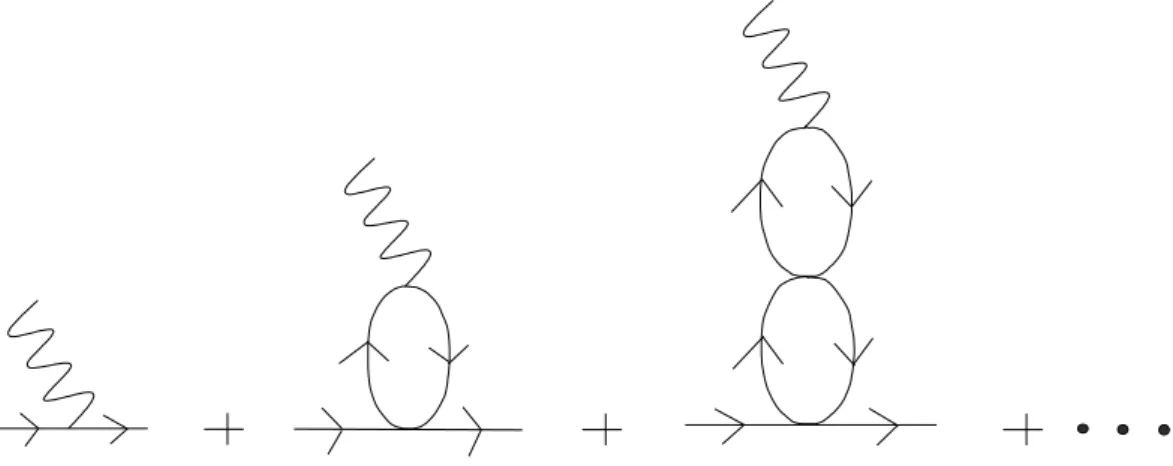
µπare replaced by the VMD vertex shown in Fig.4.
Figure 4: The corrections to the quark electromagnetic vertex arising from vector meson dominance. Here the 4-fermi interactions refer to the vector channel (see Eq.(3.29)), i.e., terms with tensor coupling to the external quark are not included.
Because of the transverse structure of the bubble graphs in the vector channel, this leads to the following renormalization:
γ
µQ
Q−→ 1 6
"
γ
µ− 2G
ωΠ ˆ
V(q
2)
1 + 2G
ωΠ ˆ
V(q
2) γ
µ− q
µ6 q q
2!#
(3.30) + τ
32
"
γ
µ− 2G
ρΠ ˆ
V(q
2)
1 + 2G
ρΠ ˆ
V(q
2) γ
µ− q
µ6 q q
2!#
, (3.31) where the form of ˆ Π
Vis given in Appendix B. Because our quark-photon ver- tex in (3.8) is defined for on-shell quarks, the terms ∝ q
µ6 q
q
2do not contribute.
Therefore the isoscalar (or isovector) parts in the quark electromagnetic ver- tex should be multiplied by a form factor
6F
ω(q
2) (or F
ρ(q
2)), where
F
α(q
2) = 1
1 + 2G
αΠ ˆ
V(q
2) (α = ω, ρ) . (3.32)
4 Results for the nucleon form factors
In this section we will show our results for the nucleon form factors. First we discuss our model parameters and particle masses. The parameters are the same as in Refs.[11, 15]: The IR cut-off Λ
IRis fixed as 0.2 GeV, the constituent quark mass at zero nucleon density is M
0= 0.4 GeV, and G
π, Λ
UVare determined so as to reproduce M
π= 0.14 GeV and f
π= 93 MeV.
This gives G
π= 19.60 GeV
−2and Λ
UV= 0.6385 GeV. The coupling constant G
sis determined so as to reproduce M
N0= 0.94 GeV, which gives the ratio G
s/G
π= 0.508. The coupling constant G
ωis determined so that the curve for the NM binding energy per nucleon (E
B/A) as a function of the density passes through the empirical saturation point
7(ρ, E
B/A) = (0.16 fm
−3, 15 MeV), which gives the ratio G
ω/G
π= 0.37. Finally, for the VMD form factors (3.32) we also need the coupling constant G
ρ, which is determined by reproducing the empirical symmetry energy coefficient a
4= 35 MeV at the density ρ = 0.16 fm
−3, which gives G
ρ/G
π= 0.091
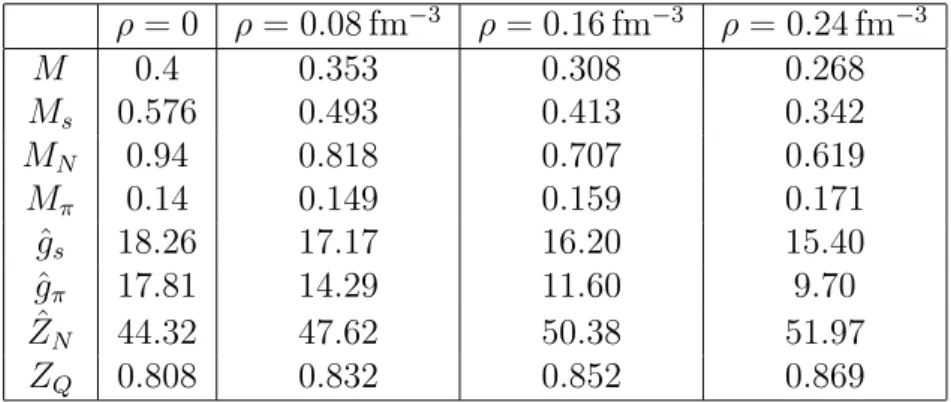
In Table 1 we list the effective quark, diquark, nucleon and pion masses for the densities ρ = 0, 0.08, 0.16, and 0.24 fm
−3. Concerning the pion mass in the medium, we use a general result based on chiral symmetry [25], which for the NJL model implies that the product M
π2·M is a constant independent
6Because the scalar diquark has isospin zero, this eventually also holds for the nucleon electromagnetic vertex.
7We recall from Ref.[11] that, in this simple NJL model, we cannot adjust both the empirical binding energy and saturation density at the same time. Therefore, although the binding energy curve passes through the empirical saturation point, its minimum is at a different point, (ρ, EB/A) = (0.22 fm−3, 17.3 MeV).
of density, see Eq.(2.58) of Ref.[11]. We therefore use
8M
π2= M
π02· M
0/M . Also listed in Table 1 are the values of ˆ g
s, ˆ g
π, ˆ Z
Nand Z
Q.
ρ = 0 ρ = 0.08 fm
−3ρ = 0.16 fm
−3ρ = 0.24 fm
−3M 0.4 0.353 0.308 0.268
M
s0.576 0.493 0.413 0.342
M
N0.94 0.818 0.707 0.619
M
π0.14 0.149 0.159 0.171
ˆ
g
s18.26 17.17 16.20 15.40
ˆ
g
π17.81 14.29 11.60 9.70
Z ˆ
N44.32 47.62 50.38 51.97
Z
Q0.808 0.832 0.852 0.869
Table 1: Effective masses for the quark, the diquark, the nucleon and the pion (all in GeV), and pole residues ˆ g
s, ˆ g
π, ˆ Z
Nand Z
Qfor four values of the density.
We will discuss our results for the nucleon form factor in terms of the Dirac-Pauli form factors defined by Eq.(3.14). In the discussion of medium effects, in particular the effects of the reduced nucleon mass (M
N< M
N0), we will also refer to an equivalent parametrization in terms of the “orbital form factor” G
Land the “spin form factor” G
S:
j
Nµ=
s
M
NE
N pM
NE
N p′u
N(p
′)
"
(p
′+ p)
µ2M
N0G
L(q
2) + iσ
µνq
ν2M
N0G
S(q
2)
#
u
N(p) (4.1) The relations to the Dirac-Pauli form factors are
G
L= M
N0M
NF
1N, G
S= M
N0M
N(F
1N+ F
2N) . (4.2)
8More precisely, this pion mass is defined at zero momentum, and includes nucleonic (Z-graph and contact) terms, which are important in order to guarantee the Goldstone nature of the pion in the medium. We note that these nucleonic contributions to the scalar diquark (or sigma) mass at normal densities are numerically small compared to the qq (orqq) polarizations, although they become important for smallM and guarantee the stability of the system w.r.t. variations inM, see Ref.([11]) for details.
We introduce these form factors here, because F
1and F
2do not directly reflect the enhancement of the nucleon orbital current (j
N,orb) arising from the reduced nucleon mass (enhanced nuclear magneton)
9. Moreover, the parametrization (4.1) for the space part of the current has more connection to the traditional calculations of nuclear magnetic properties [28], because the values of these form factors at q = 0 reduce to the orbital and spin g-factors: g
L= G
L(0), g
S= G
S(0).
Here we would like to point out that these different ways to discuss the medium modifications of the nucleon current remind us that the form factors of a nucleon in the medium are not directly observable quantities: Ultimately the current j
Nµhas to be used in a nuclear structure calculation of observable cross sections. Our current j
Nµreflects only those effects which are not taken into account in nuclear structure calculations, i.e., the effects of the nuclear mean fields on the internal motion of quarks in the nucleon. Other effects, which explicitly depend on the density and have their origin in the Pauli principle on the level of nucleons, must be considered in the nuclear part of the calculation
10. As an example of such a calculation for the case of nuclear matter, we will consider the response function for quasielastic electron scattering in Sect.5.
For the zero density (single nucleon) case, it is possible to define a Breit frame where q
0= 0, and in this frame the nucleon current can be expressed in terms of the familiar electric and magnetic form factors
G
E(q
2) = F
1(q
2) + q
24M
N2F
2(q
2) (4.3) G
M(q
2) = F
1(q
2) + F
2(q
2) . (4.4)
9Note that the appearance of the medium modified nucleon mass (MN) in the Pauli term of (3.14) is a mere definition ofF2.
10This is also evident from the fact that the full current of a nucleon in the medium, including the explicitly density dependent parts, cannot be parametrized in the Lorentz invariant forms (3.14) or (4.1).
We will compare our calculated form factors for zero density with the empir- ical dipole form factors, defined by
G
Ep= G
M p/µ
p= G
M n/µ
n= 1
1 − q
2/0.71 GeV
22F
1n= 0 . (4.5)
For a nucleon moving in the medium, however, one cannot define a Breit frame, and consequently the combinations (4.3) and (4.4) do not enter nat- urally in the expressions for nuclear observables, like response functions or elastic form factors. For the finite density case we will therefore discuss our results in terms of the form factors F
1and F
2, or G
Land G
S.
The results for the form factors at zero density (free nucleon case) are shown in Figs.5-8. There we plot (i) the results of the naive quark-diquark model (see Sect.3.1) without (dotted lines) and with (dashed lines) the con- tact term contribution to the quark diagram of Fig.1, (ii) the results obtained by including in addition the effects of the diquark form factor (dash-dotted lines), and (iii) the total result including also the pion and VMD effects.
Fig. 5 shows that in the naive quark-diquark model the electric size of the proton is too small and the form factors F
1pand G
Epfall off too slowly. The situation improves when the diquark form factor is included, and also the pion cloud gives some positive contribution to the electric size of the proton
11
. The total result for F
1pstill lies above the empirical dipole form factor, but we can expect that the further inclusion of axial vector diquarks and pion cloud effects around the nucleon will lead to a satisfactory description.
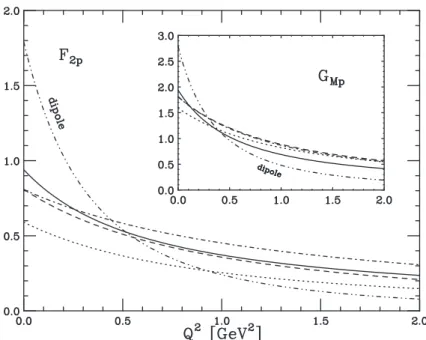
Fig. 6 shows that the proton magnetic moment in the naive quark-diquark picture is too small, which is expected and also well known[17, 24]. The finite
11We obtain < r2E >p= 0.421 fm2+ 0.062 fm2 = 0.483 fm2, where the two terms come from the Dirac (F1) part and the anomalous (F2) part. The fact that this is too small compared to the experimental value of 0.74 fm2is partially because the magnetic moment is too small, but also because the slope ofF1is too small.
Figure 5: The form factor F
1pfor zero density. The dotted line is the result of the naive quark-diquark model without the contact term, to which the other contributions are successively added as follows: Dashed line: including contact term; dash-dotted line: including diquark form factor; solid line:
full results including pion and vector meson contributions. The dash-double dotted line labeled “dipole” shows the dipole parametrization. The insert shows the form factor G
Ep, with the same meaning of the lines.
size effects of the scalar diquark do not contribute much in this case. The inclusion of the contact term in the quark diagram of Fig.1 improves the situation somewhat. By using a Fierz transformation, this term is actually seen to be equivalent to a vector meson contribution (like shown in Fig.4 for the quark), but with a tensor coupling (∝ σ
µνq
ν) to the nucleon. Also the pion cloud, which leads to anomalous magnetic moments of the constituent up and down quarks
12, gives a positive contribution to the proton magnetic moment, but the total result is still too small. It is, however, known that the
12We obtainµu= 23+ 0.061,µd=−13−0.123 for the magnetic moments of u,d quarks in the free nucleon.
Figure 6: Same as Fig. 5 for the form factors F
2p(main part) and G
M p(insert) for zero density.
axial vector diquark and the pion cloud around the nucleon give large contri- butions to the magnetic moment and the associated form factors, and Fig.6 shows how far one can go in the simple quark - scalar diquark description.
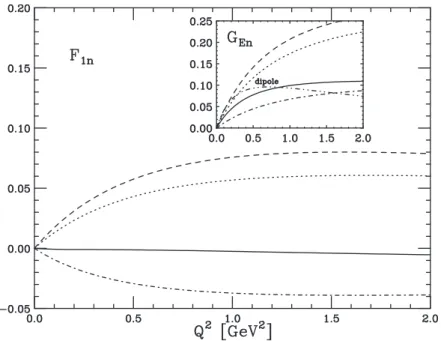
The importance of the diquark form factor is also seen for the neutron form factors F
1nand G
En, which are shown in Fig. 7. The naive quark- diquark model gives an electric form factor which is too large in comparison to the experimental one (note that the experimental G
Enis smaller than the “dipole form factor” shown in Fig. 7), and the diquark form factor, which suppresses the (positive) contribution from the second diagram of Fig.1 relative to the (negative) first one, is essential to obtain reasonable values.
The electric size of the neutron is somewhat too small in magnitude, but this is because the absolute value of the magnetic moment is too small
13.
13We obtain< rE2 >n= 0.003 fm2−0.072 fm2=−0.069 fm2, where the two terms come
In this connection, it is interesting to observe that the result for F
1n, and in particular its contribution to the electric radius, is very small, and therefore the electric size of the neutron is almost entirely due to the “Foldy term”
[26].
Figure 7: Same as Fig. 5 for the form factors F
1n(main part) and G
En(in- sert) for zero density. The dipole parametrization of F
1nis zero by definition and therefore not indicated here.
The situation for the form factors F
2nand G
M nshown in Fig. 8 is similar to the case of the proton (Fig. 6), i.e., the contact term and the pion cloud around the constituent quarks give some improvements of the magnetic mo- ment, but the total result is still too small. This, and the fact that the form factors fall off too slowly, again points out the necessity to include the axial
from the Dirac (F1) part and the anomalous (F2) part. The fact that this is too small in magnitude compared to the experimental value of−0.12 fm2is because the absolute value of the magnetic moment is too small. For discussions on the role of these two contributions to the neutron electric radius, see for example [26].
vector diquark channel.
Figure 8: Same as Fig. 5 for the form factors F
2n(main part) and G
M n(insert) for zero density.
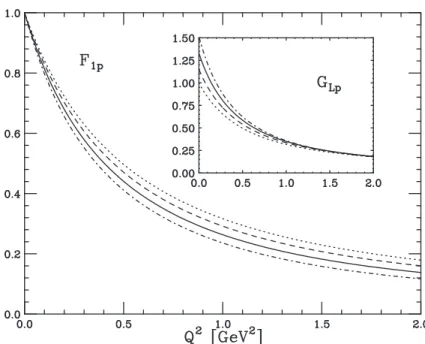
The medium modifications of the nucleon form factors are shown in Figs.
9-12, where we plot the results for ρ = 0 (dotted lines), ρ = 0.08 fm
−3(dashed lines), ρ = 0.16 fm
−3(solid lines), and ρ = 0.24 fm
−3(dash-dotted lines).
The result for F
1pof Fig. 9 indicates that the electric size of the proton in the medium is somewhat enhanced. The orbital form factor G
Lpshown in the insert of Fig.9 demonstrates the enhancement of the orbital current (j
N,orb) due to the reduced effective nucleon mass, see Eq.(4.2). We have to remind, however, that the isoscalar part of this enhancement is in a sense spurious, because in an actual nuclear calculation it is canceled by the “backflow”
effect[27], which in our language arises from Z-graphs, i.e., the Pauli blocking part of the NN excitation piece (see the detailed discussions in Ref.[28, 29]
on the backflow in relativistic meson-nucleon theories). Namely, the proton
Figure 9: The form factor F
1pfor the cases ρ = 0 (dotted line), ρ = 0.08 fm
−3(dashed line), ρ = 0.16 fm
−3(solid line), ρ = 0.24 fm
−3(dash-dotted line).
The insert shows the proton orbital form factor G
Lpdefined in Eq.(4.1) with the same meaning of the lines.
orbital g-factor, which is roughly M
N0/M
Nin a Hartree calculation, becomes approximately
12(1 + M
N0/M
N) after the inclusion of the backflow, where the first term is the isoscalar and the second one the isovector piece
14.
Fig. 10 shows that the medium effects tend to decrease the “intrinsic”
anomalous magnetic moment of the proton, but when combined with the en- hancement of the nuclear magneton, the spin g-factor is enhanced, as shown in the insert of Fig.10. It is interesting that a very similar result has been obtained also in hadronic models[18]. Therefore, the quark effects considered here do not lead to a quenching of the spin g-factor, as would be desirable to explain the missing quenching of isovector nuclear magnetic moments [28],
14It is well known that the pion effects further enhance the isovector piece[28].
Figure 10: Same as Fig.9 for the form factor F
2p(main part) and the proton spin form factor G
Spdefined in Eq.(4.1) (insert).
but rather to an enhancement
15. The figure also shows that the magnetic size of the proton becomes somewhat larger in the medium.
The results for the neutron form factor F
1nin Fig. 11 show that the effect of finite diquark size, which was very important for the zero density case (Fig.7) to reduce F
1nto reasonable values, increases with increasing density. That is, the diquark form factor at finite density further suppresses the positive contribution of the diquark diagram in Fig.1. The orbital form factor G
Lnshown in the insert of Fig.11 again demonstrates the enhancement of the nuclear magneton, but we have to keep in mind that the backflow effect will change the neutron orbital g-factor from the present value 0 to roughly
1
2
(1 − M
N0/M
N) < 0, and that effects of the pion cloud around the nucleon
15This is in contrast to the quenching of the axial vector coupling constant observed in the quark-diquark calculations of Ref.[14] including the axial vector diquark, and in hadronic models [30].