• 検索結果がありません。

Extension of Comparative Analysis of Estimation Methods for Dirichlet Distribution Parameters Halid M.A. and Akomolafe A.A.

N/A
N/A
Protected

Academic year: 2021

シェア "Extension of Comparative Analysis of Estimation Methods for Dirichlet Distribution Parameters Halid M.A. and Akomolafe A.A."

Copied!
12
0
0

読み込み中.... (全文を見る)

全文

(1)

Extension of Comparative Analysis of Estimation Methods for Dirichlet Distribution Parameters Halid M.A. and Akomolafe A.A.

*

Department of Statistics, Federal University of Technology, Akure, Nigeria

* [email protected]

Abstract: The Dirichlet distribution is a generalization of the Beta distribution. This research deals with the estimation of scale parameter for Dirichlet distribution with known shapes. We examined three methods to estimate the parameters of Dirichlet distribution which are Maximum Likelihood Estimator, Method of Moment Estimator and Quasi- Likelihood Estimator. The performance of these methods were compared at different sample sizes using Bias, Mean Square Error, Mean Absolute Error and Variance criteria, an extensive simulation study was carried out on the basis of the selected criterion using statistical software packages as well as the application of the criterion to real life data, all these were done to obtain the most efficient method. The simulation study and analysis revealed that Quasi- Likelihood Estimator perform better in terms of bias while Method of Moment Estimator is better than the other two methods in terms of variance; the Maximum Likelihood Estimation was the best estimation method in terms of the Mean square Error and Mean Absolute Error; while Quasi- Likelihood Estimation method was the best estimation method with real life data.

[Halid M.A. and Akomolafe A.A. Extension of Comparative Analysis of Estimation Methods for Dirichlet Distribution Parameters. Academ Arena 2020;12(9):1-12]. ISSN 1553-992X (print); ISSN 2158-771X (online).

http://www.sciencepub.net/academia. 1. doi:10.7537/marsaaj120920.01.

Keywords: Dirichlet Distribution, Parameter Estimation, Maximum Likelihood Estimator, Method of Moment Estimator and Quasi- Likelihood Estimator

1. Introduction

In Bayesian Statistics, the Dirichlet distribution is a popular conjugate prior for multinomial distribution. The Dirichlet distribution has a number of applications in various fields. Samuel S. Wilk (1962), gave an example, where he applied the Dirichlet distribution in deriving the distribution of order statistics. Again Kenneth Lange (1995), also used the Dirichlet distribution in biology to demonstrate and to compute forensic match probabilities from several distinct populations. In addition, Brad N (2009), used the Dirichlet distribution to model a player`s abilities in Major League Baseball. It is shown that the Dirichlet distribution can be used to model consumer behavior Gerald et al (1984). Dirichlet Distribution can be extended to various fields of study such as biology, astronomy, text mining and so on. The Dirichlet Distribution (DD) is usually employed as a conjugate prior for the multinomial modeling and Bayesian analysis of complete contingency tables (Agresti (2002)). Gupta and Richards (1987, 1991, and 1992) extended the Dirichlet Distribution to the Liouville distribution. Fang, Kotz and Ng (1990) gave an extensive exposition of the Liouville family and its ramifications.

The problem of estimating the parameters which determine a mixture has been the subject of diverse studies (Redner and Walker 1984). During the last two

decades, the method of maximum likelihood (ML) (Bishop. C.M.1995) and (Rao. P. 1987) has become the most common approach to this problem. Of the variety of the iterative methods which has been subjected as an alternative to optimize the parameters of a mixture, the one most likely used is the expectation maximization (EM). EM was originally proposed by Dempster et al 1977 for estimating the maximum likelihood estimator (MLE) of stochastic models. This algorithm gives an iterative procedure and the practical form is usually simple and easy to implement. The EM algorithm can be viewed as an approximation of the Fisher scoring method (Ikeda. S.

(2000). In this research we showed that the Dirichlet

distribution can be a very good choice for modeling

data, MLE was used to estimate the parameters of the

Dirichlet Mixture Model alongside with EM

algorithm. This mixture decomposition algorithm

incorporates a penalty term in the objective function to

find the number of components required to model the

data. This algorithm suffers some set back: the need to

specify the number of components each time, which

will be determine by selected criterion functions such

as AIC, BIC, MDL which has been in existence to

validate the model and justify the more efficient one.

(2)

This research centered on studying how the different estimators of the unknown parameters of a Dirichlet distribution can behave for different sample sizes. Here, we are mainly comparing the Maximum Likelihood Estimator, Method of Moment Estimator and Quasi- Likelihood Estimator with respect to efficiency, bias, mean absolute error and variance using extensive simulation techniques as well as application of the estimation methods to real life data set.

2. Literature Review

The Dirichlet model describes patterns of repeat purchases of brands within a product category. It models simultaneously the counts of the number of purchases of each brand over a period of time, so that it describes purchase frequency and brand choice at the same time. It assumes that consumers have an experience of the product category, so that they are not influenced by previous purchase and marketing strategies; for this reason, consumer characteristics and marketing-mix instruments are not included in the model. As the market is assumed to be stationary, these effects are already incorporated in each brand market share which influences other brand performance indexes calculated by the model. The market is also assumed to be unsegmented. The theory and development of the model is fully described in Ehrenberg (1972). Goodhardt, Ehrenberg and Chatfield (1984), summarise the situation by stating that the Dirichlet model makes explicit that there are simple, general and rather precise regularities in a substantial area of human behaviour where this has not always been expected. In setting the context for this particular approach to the modeling of consumer behaviour viz. the largely explanatory models of consumer behaviour, Ehrenberg (1988) claims that it describes how consumers behave, rather than why, and takes into account only those factors necessary for an adequate description.

Many aspects of buyer behaviour can be predicted simply from the penetration and the average purchase frequency of the item, and even these two variables are interrelated (Ehrenberg, 1988, pg. ii).

The Dirichlet model integrates the reported regularities, and predicts many aggregate brand performance measures. These measures are the distribution of purchases for a brand, the proportion of a brand's buyers buying that brand only, and the proportion of people purchasing a brand, given that they have previously purchased that brand. When these predictions are compared with observed figures, Ehrenberg claims that it is not unreasonable to expect to obtain correlations in the order of 0.9 and sometimes much higher, (Ehrenberg 1975, Ehrenberg and Bound 1993).

Applications and theory can be used to provide norms for examining brand performance, or diagnostic information for the "health" of a brand. In addition, the Dirichlet model can provide interpretative norms for evaluating situations where some trend in sales has occurred, say after a promotion or advertising scheme.

Ehrenberg also claims that the Dirichlet model provides valuable insights into the nature and implications of brand-loyalty (e.g., Ehrenberg and Uncles 1995; Ehrenberg and Uncles 1999). The use of likelihood theory to estimate the parameters of the Dirichlet model, providing an alternative to the standard procedure based on the method of zeros and ones and on marginal moments (Rungie 2003b). In order to write the likelihood function, the data should be in the form of joint frequencies, like those contained in a contingency table with n-rows, representing the number of consumers, and g columns, for the number of brands. Alternatively, the iterative procedures based on the approach that computations are easy to use, and require only aggregated data as input, as access to original panel data is not necessary as proposed by Goodhardt, Ehrenberg and Chatfield (1984). Raw panel data cannot always be used since panel operators who measure sales and household consumption provide information only in some aggregate format such as market share, penetration, and average purchase rate with reference to the various brands (Wright et al. 2002). In these situations, the only way to estimate the Dirichlet model is to use the traditional method. Dirichlet modeling continues to be a successful and influential approach, and is increasingly being used to provide norms against which brand performance can be interpreted ( Uncles et al. 1995; Bhattacharya 1997; Ehrenberg et al. 2000).

Dirichlet model is useful for the provision of norms for stationary markets, to supply baselines for interpreting change (i.e., non-stationary situations) without having to match the results against a control sample, to help strategic decision-making, and to understand the nature of markets.

There are diverse ways of applying the distribution, where the Dirichlet has proved to be particularly useful is in modeling the distribution of words in text documents [9]. If we have a dictionary containing k possible words, then a particular document can be represented by a probability mass function [pmf] of length k- produced by normalizing the empirical frequency of its words. A group of documents produces a collection of pmfs, and we can fit a Dirichlet distribution to capture the variability of these pmfs.

3. Methodology

Deriving the Dirichlet Distribution

(3)

Let be a random variable from the Gamma distribution ( , 1), = 1, … , , and let , … , be independent. The joint pdf of , … , is

Let

= + + ⋯ + , = 1,2, … , − 1 and

= + + ⋯ + .

By using the change of variables technique, this transformation maps = {( , … , ): 0 < < ∞, = 1, … , } onto = {( , … , , ): > 0, = 1, … , − 1, 0 < < ∞, + ⋯ + < 1}. The inverse functions are = , = , … , = , = (1 − − ⋯ − ). Hence, the Jacobian is

=

0 …

0 …

⋮ ⋮ ⋮

0 0

⋮ ⋮

0 0 …

− − … − (1 − ) − ⋯ −

=

Then, the joint pdf of , … , , is

( , … , , ) = … (1 − − ⋯ − )

Г( ) … Г( )

By integrating out , the joint pdf of , … , is ( , … , ) = + ⋯ +

Г( ) … Г( ) … (1 − − ⋯ − ) ,

where > 0, + ⋯ + < 1, = 1, … , − 1. The joint pdf of the random variables , … , is known as the pdf of the Dirichlet distribution with parameters , … , . Furthermore, it is clear that has a Gamma distribution G (∑ , 1) and is independent of , … , . Robert V Hogg and Allen T Craig.1970.

3.1. Moment generating function

The moment generating function of = [ , … , ]. Let = ( , … , ) ∈ ℜ . The moment generating function of at is = ∫ … ∫ ( ) …

= ∫ … ∫ ∑

!

( ) … (1)

= ∑

!

∫ … ∫( ) ( ) … (2)

Step (a)

= 1

!

… !

! ! … !

× ( ) ( ) …

= 1

!

1

!

!

! ! … !

( )

= ∑

!

!

! !… !

∏ ( ) ×

Г( )

Г( ⋯ )

Г( )

Г( )

. (3)

In step (a), we apply the multinomial theorem

(4)

( + + ⋯ + ) = ∑

!

! !… !

∏ (4)

for any positive integer and any non-negative integer . 3.2 Maximum Likelihood Estimation

The ML estimation method concerns choosing parameters to maximize the joint density function of the sample (likelihood function). Therefore, we consider

max ( | ) (5)

with constraints ∑ ( ) = 1 and ( ) > 0 for = 1,2, … , . We can consider ( ) as prior probabilities under these constraints. Now suppose we have a sample that contains random vectors , which are i.i.d.,

= 1, … , . We maximize the following function with respect to and Λ

ϕ x , Θ, Λ = Θ ( ) + Λ 1 − ( ) + ( ) ln ( ) (6)

The first term of equation 8 is the log-likelihood function. Λ is the Lagrange multiplier in the second term. In the last term of eq. 8, we use an entropy-based criterion. Also, μ is the ratio of the first term to the last term in of each iteration t by Nizar Bouguila, Djemel Ziou, and Jean Vaillancourt (2004)

μ(t) =

Θ ( )

∑ ( ) ( ( )

, (7)

In order to optimize (8), we need to solve the following equations:

Θ ( , Θ, Λ) = 0 Λ ( , Θ, Λ) = 0 It is shown that the estimator of the prior probability p (j) is

p(j) =

( ) ( )

∑ ( ) ( )

, = 1,2, … , . (8)

Note that μ is defined by (4.3) and ( | , Θ ) is the posterior probability where , Θ =

( )

, = 1, … , , = 1,2, … , . (9)

Now we want to estimate the parameters , = 1,2, … , . The Fisher scoring method is used to find these estimates. Denote as one element of the parameter vector for each component = 1,2, … , . The derivative of ( , Θ, Λ) with respect to is

( , Θ, Λ) = ∑ ( | , ) (ln ) + − 0 ∑ , , (10)

= 1, … , , = 1, … , ,

where ψ(. ) is the Digamma function. However, can become negative during iterations. In order to keep strictly positive, set = . is any real number. Then, the derivative of ( , Θ, Λ) with respect to is

( , Θ, Λ) = [∑ , (ln ) + [ − ] ∑ ( | , )], (11)

= 1, … , , = 1, … , . By using the iterative scheme of the Fisher scoring method, we obtain

⋮ = ⋮ +

… ,

⋮ ⋱ ⋮

, …

×

⎜ ⎜

( , Θ, Λ)

⋮ ( , Θ, Λ)

⎟ ⎟

(12)

= 1, … , .

Note that the variance-covariance matrix is obtained by the inverse of the Fisher information matrix I and

I = − ( , Θ, Λ) . (13)

4. Analysis And Results

In this chapter, the results of the simulation study on the basis of the entire criterion at different sample

sizes are presented and Performance of parameter

estimation method in terms of Bias as the sample size

and parameter dimension varies was discussed.

(5)

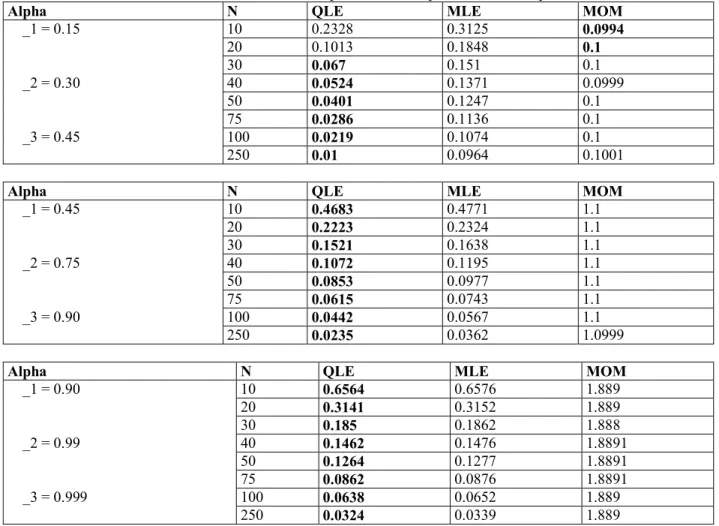
Table 1: Results of the Bias at different alpha level as sample size varies are presented below:

Alpha N QLE MLE MOM

_1 = 0.15

 10 0.2328 0.3125 0.0994

20 0.1013 0.1848 0.1

30 0.067 0.151 0.1

_2 = 0.30

 40 0.0524 0.1371 0.0999

50 0.0401 0.1247 0.1

75 0.0286 0.1136 0.1

_3 = 0.45

 100 0.0219 0.1074 0.1

250 0.01 0.0964 0.1001

Alpha N QLE MLE MOM

_1 = 0.45

 10 0.4683 0.4771 1.1

20 0.2223 0.2324 1.1

30 0.1521 0.1638 1.1

_2 = 0.75

 40 0.1072 0.1195 1.1

50 0.0853 0.0977 1.1

75 0.0615 0.0743 1.1

_3 = 0.90

 100 0.0442 0.0567 1.1

250 0.0235 0.0362 1.0999

Alpha N QLE MLE MOM

_1 = 0.90

 10 0.6564 0.6576 1.889

20 0.3141 0.3152 1.889

30 0.185 0.1862 1.888

_2 = 0.99

 40 0.1462 0.1476 1.8891

50 0.1264 0.1277 1.8891

75 0.0862 0.0876 1.8891

_3 = 0.999

 100 0.0638 0.0652 1.889

250 0.0324 0.0339 1.889

Based on the above table, it was observed that the level of alpha the Quasi-likelihood estimator (QLE) has the least value of Bias as the sample size

increases and performs better compared with the Method of Moment and Maximum likelihood estimator.

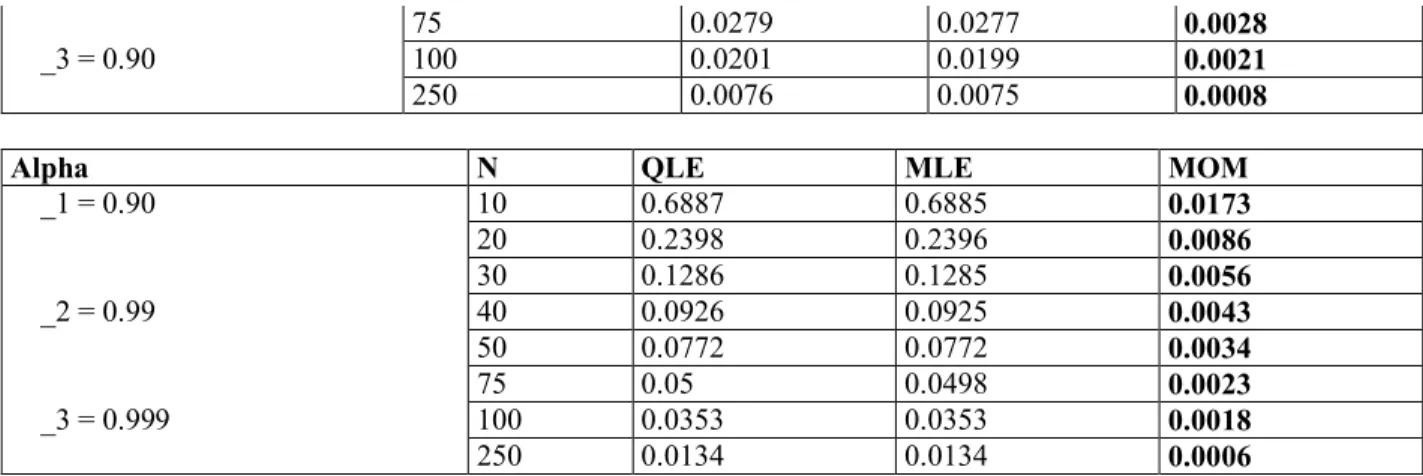
Table 2: Results of the Variance at different alpha level as sample size varies are presented

Alpha N QLE MLE MOM

 _1 = 0.15 10 0.108 0.1167 0.0325

20 0.0355 0.0379 0.0158

30 0.0187 0.02 0.0103

_2 = 0.30

 40 0.0139 0.0148 0.0082

50 0.0108 0.0116 0.0065

75 0.0063 0.0067 0.0041

_3 = 0.45

 100 0.0048 0.0051 0.0033

250 0.0018 0.0019 0.0013

Alpha N QLE MLE MOM

_1 = 0.45

 10 0.4132 0.4128 0.0207

20 0.144 0.1444 0.0101

30 0.0863 0.0858 0.0071

_2 = 0.75

 40 0.0565 0.0563 0.0051

50 0.043 0.0426 0.004

(6)

75 0.0279 0.0277 0.0028 _3 = 0.90

 100 0.0201 0.0199 0.0021

250 0.0076 0.0075 0.0008

Alpha N QLE MLE MOM

_1 = 0.90

 10 0.6887 0.6885 0.0173

20 0.2398 0.2396 0.0086

30 0.1286 0.1285 0.0056

_2 = 0.99

 40 0.0926 0.0925 0.0043

50 0.0772 0.0772 0.0034

75 0.05 0.0498 0.0023

_3 = 0.999

 100 0.0353 0.0353 0.0018

250 0.0134 0.0134 0.0006

Based on the above table and appendix 2, it was observed that the performance of parameter estimation method in terms of Variance, as the sample size

increases Method of Moment performs better compared with the Quasi-likelihood estimator and Maximum likelihood estimator.

Table 3: Results of the Mean Absolute Error (MAE) at different alpha level as sample sizes varies are presented below

Alpha N QLE MLE MOM

_1 = 0.15

 10 0.3652 0.3982 0.2668

20 0.2171 0.2484 0.1915

30 0.1671 0.2003 0.1633

_2 = 0.30

 40 0.1438 0.1792 0.1512

50 0.1262 0.1626 0.1396

75 0.0995 0.1396 0.1233

_3 = 0.45

 100 0.0873 0.1292 0.1181

250 0.052 0.104 0.1043

Alpha n QLE MLE MOM

_1 = 0.90

 10 1.0665 1.0665 1.8917

20 0.6602 0.6601 1.889

30 0.4866 0.4865 1.889

_2 = 0.99

 40 0.4212 0.4211 1.8891

50 0.3827 0.3825 1.8891

75 0.3059 0.3057 1.8891

_3 = 0.999

 100 0.2622 0.2622 1.889

250 0.1588 0.1588 1.889

Alpha n QLE MLE MOM

_1 =

 0.45 10 0.7774 0.7778 1.1001

20 0.486 0.4859 1.1

30 0.3818 0.3815 1.1

_2 = 0.75

 40 0.3138 0.3147 1.1

50 0.2748 0.2748 1.1

75 0.2216 0.2225 1.1

_3 = 0.90

 100 0.186 0.1863 1.1

250 0.1157 0.1168 1.0999

Performance of parameter estimation method in terms of Mean Absolute Error (MAE) as the sample size increases, Maximum likelihood estimator

performs better than Quasi-likelihood estimator and

Method of moment as shown in table 3.

(7)

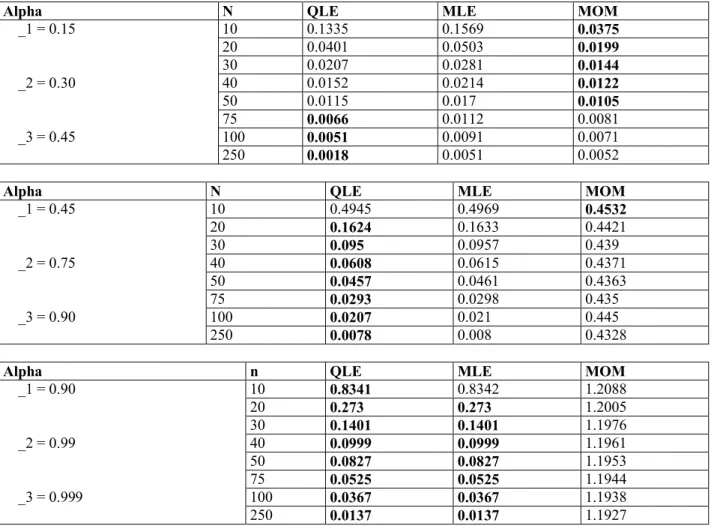
Table 4: Results of the Mean Square Error (MSE) at different alpha level as sample sizes varies are presented below

Alpha N QLE MLE MOM

_1 = 0.15

 10 0.1335 0.1569 0.0375

20 0.0401 0.0503 0.0199

30 0.0207 0.0281 0.0144

_2 = 0.30

 40 0.0152 0.0214 0.0122

50 0.0115 0.017 0.0105

75 0.0066 0.0112 0.0081

_3 = 0.45

 100 0.0051 0.0091 0.0071

250 0.0018 0.0051 0.0052

Alpha N QLE MLE MOM

_1 = 0.45

 10 0.4945 0.4969 0.4532

20 0.1624 0.1633 0.4421

30 0.095 0.0957 0.439

_2 = 0.75

 40 0.0608 0.0615 0.4371

50 0.0457 0.0461 0.4363

75 0.0293 0.0298 0.435

_3 = 0.90

 100 0.0207 0.021 0.445

250 0.0078 0.008 0.4328

Alpha n QLE MLE MOM

_1 = 0.90

 10 0.8341 0.8342 1.2088

20 0.273 0.273 1.2005

30 0.1401 0.1401 1.1976

_2 = 0.99

 40 0.0999 0.0999 1.1961

50 0.0827 0.0827 1.1953

75 0.0525 0.0525 1.1944

_3 = 0.999

 100 0.0367 0.0367 1.1938

250 0.0137 0.0137 1.1927

Performance of parameter estimation method in terms of Mean Square Error (MSE) as the sample size increases the Quasi- likelihood estimator and Maximum likelihood estimator performs better as compare to Method of Moment. as shown in table 4.

Conclusively , the best method for each criterion was based on the modal class for the entire criterion as summarized in table 5 below

Table 5: Shows the Count of Quasi- likelihood estimator, Maximum likelihood estimator and Method of Moment using Bias, Variance, Mean absolute error and Mean square error.

Count Best Method

Criterion QLE MLE MOM

Bias 77 0 2 QLE

MSE 57 35 11 QLE

MAE 34 48 6 MLE

VAR 4 11 66 MOM

GRAPHICAL RERESENTATION OF THE CRITERION

(8)

Fig 1: The graph above shows the Bias of the estimator of QLE, MLE, MOM at different sample sizes.

The graph shows the Bias of the estimator of QLE, MLE, MOM at different sample sizes. Judging by the bias criterion, the Quasi Likelihood method

(QLE) was the best for the lower and medium level of alpha, but for the higher level of alpha, Method of moment performs better.

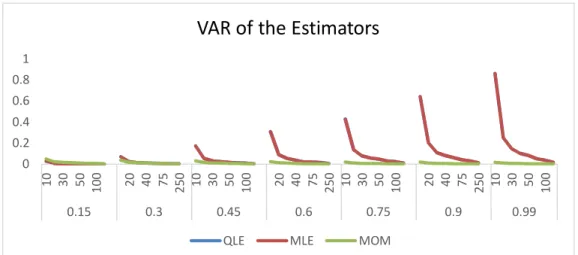
Fig 2: The graph above shows the Variance of the estimator of QLE, MLE, MOM at different sample sizes.

The graph shows the Variance of the estimator of QLE, MLE, MOM at different sample sizes. From the graph, Method of moment consistently performed

better across the alpha (parameter) level which implies that the method of Moment is the best method.

0 0.5 1 1.5 2 2.5

10 30 50100 20 40 7525010 30 50100 20 40 7525010 30 50100 20 40 7525010 30 50100

0.15 0.3 0.45 0.6 0.75 0.9 0.99

Bias of the Estimators

QLE MLE MOM

0 0.2 0.4 0.6 0.8 1

10 30 50 10 0 20 40 75 25 0 10 30 50 10 0 20 40 75 25 0 10 30 50 10 0 20 40 75 25 0 10 30 50 10 0

0.15 0.3 0.45 0.6 0.75 0.9 0.99

VAR of the Estimators

QLE MLE MOM

(9)

Fig 3: The graph above shows the Mean Absolute Error (MAE) of the estimator of QLE, MLE, MOM at different sample sizes.

The graph shows the Mean Absolute Error (MAE) of the estimator of QLE, MLE, MOM at different sample sizes. The Quasi Likelihood method (QLE) outperformed the other methods for lower level of alpha but as the alpha level increases (medium level

and above) the Maximum Likelihood method (MLE) and the QLE has just a slight difference in their estimates. Out of the three methods considered, the method of Moment consistently gives the higher estimate of Mean Absolute Error.

Fig 4: The graph above shows the Mean Square Error (MSE) of the estimator of QLE, MLE, MOM at different sample sizes.

The graph shows the Mean Square Error (MSE) of the estimator of QLE, MLE, MOM at different sample sizes. QLE method was the best for lower level of alpha, but as for the medium and higher level of alpha the QLE and the MLE does not give a

significant different estimate. While on the other hand, the MOM gives a consistently higher estimate of Mean square error.

REAL LIFE DATA RESULTS 0

0.5 1 1.5 2 2.5

10 30 50 10 0 20 40 75 25 0 10 30 50 10 0 20 40 75 25 0 10 30 50 10 0 20 40 75 25 0 10 30 50 10 0

0.15 0.3 0.45 0.6 0.75 0.9 0.99

MAE of the Estimators

QLE MLE MOM

0 0.2 0.4 0.6 0.8 1 1.2 1.4

10 30 50 10 0 20 40 75 25 0 10 30 50 10 0 20 40 75 25 0 10 30 50 10 0 20 40 75 25 0 10 30 50 10 0

0.15 0.3 0.45 0.6 0.75 0.9 0.99

MSE of the Estimators

QLE MLE MOM

(10)

Fitting Dirichlet Model to Data Containing Selected Agricultural Products in Nigeria (2008-2017) Table 6: Parameter Estimation (QLE)

Coefficients Estimate Std. Error

1

0.2260442 0.1438496

2

0.1729296 0.1390305

3

0.2410169 0.1453349

From the table above, we obtained the estimates of the mean and standard error of Millet, millet rice, Sorghum.

The parameter estimate of millet rice is more efficient due to its lowest standard error as compared to others.

Table 7: Parameter Estimation (MLE)

Coefficients Estimate Std. Error

1

0.03325620 0.455928

2

0.02179287 0.401919

3

0.03987597 0.471691

From the table above, we obtained the estimates of the mean and standard error of Millet, millet rice, Sorghum.

The parameter estimate of millet rice is more efficient due to its lowest standard error as compared to others.

Table 8: Parameter Estimation (MOM)

Coefficients Estimate Std. Error

1

0.04000534 0.4591688

2

0.01302276 0.309861

3

0.05461017 0.4750334

From the table above, we obtained the estimates of the mean and standard error of Millet, millet rice, Sorghum. The parameter estimate of millet rice is more efficient due to its lowest standard error as compared to others.

Conclusively, the quasi-likelihood estimator performs the best as compared to others.

5. Conclusion

The Dirichlet distribution is a multivariate generalization of the Beta distribution. In this research, we introduced three methods of estimation for Dirichlet distribution which are maximum likelihood estimator (MLE), Method of Moment (MOM) and Quasi-likelihood estimator. This was done in other to obtain the most efficient method. An extensive simulation study was carried out on the basis of selected criterion (Bias, Variance, Mean absolute error and Mean square error) considering various sample sizes, also the methods were subjected to real life data.

The performance of these methods were compared at different sample sizes it shows that the Quasi- likelihood estimator performs better in terms of Bias, than the other methods, while Method of Moment performs better in terms of Variance, than the other methods. Maximum likelihood estimator performs

better in terms of Mean Absolute Error (MAE) and (MSE) than the other methods. The real life result shows that Quasi-likelihood estimator performs better as compared to Method of moment and Maximum likelihood estimator, also the Bayes factor of Dirichlet distribution gives 57.95215, which implies a very strong evidence of the Goodness of fits. Hence, The Dirichlet distribution is efficient based on what we have done with higher precision and more adequacies in the estimate of the model, also the estimate of the model should be used in taking any prospective decision and can be reliable if large samples is involved.

References

1. Aitkin, M. and Rubin, D. (1985). Estimation and hypothesis testing in finite mixture models.

Journal of the Royal Statistical Society B 47, 67–

75.

2. Akaike, H. (1973). Information theory and an extension of the maximum likelihood principle.

In Second international symposium on information theory. 267–281. MR0483125.

3. Andrieu C, Doucet A (2001) Recursive Monte

Carlo algorithms for parameter estimation in

general state-space models. In: pp. 14–17.

(11)

4. Antoniak C E. Mixtures of Dirichlet processes with applications to Bayesian nonparametric problems. Annals of Statistics, 1974, 2(6): 1152- 1174.

5. Banfield, J. D. and Raftery, A. E. (1993). Model- based Gaussian and non-Gaussian clustering.

Biometrics 49, 803–821. MR1243494.

6. Biernacki, C., Celeux, G., and Govaert, G.

(1999). An improvement of the NEC criterion for assessing the number of clusters in a mixture model. Pattern Recognition Letters 20, 267–272.

7. Biernacki, C., Celeux, G., and Gold, E. M.

(2000). Assessing a mixture model for clustering with the integrated completed likelihood. IEEE Transactions on Pattern Analysis and Machine Intelligence 22, 719– 725.

8. Kai Wang Ng, Guo-Liang Tian, and Man-Lai Tang. Dirichlet and related distributions: Theory, methods and applications, volume 888, chapter 1, 2. John Wiley & Sons, 2011.

9. Kass, R. E. and Raftery, A. E. (1995). Bayes factors. Journal of the American Statistical Association 90, 773–795.

10. Ken Aho, DeWayne Derryberry, and Teri Peterson. Model selection for ecologists: the worldviews of AIC and BIC. Ecology, 95(3):631–636, 2014.

11. Koyejo S.O., Akomolafe A.A., Awogbemi C.A., Oladimeji O.O. (2020). Extension of Comparative Analysis of Estimation.

12. Methods for Frechet Distribution Parameters.

International Journal of Research and Innovation in Applied Science (IJRIAS) | Volume V, Issue IV,|ISSN 2454-6194.

13. Liu Z, Almhana J, Choulakian V, McGorman R (2005) Online EM algorithm for mixture with application to internet traffic modeling. Comput Stat Data Anal 50:1052–1071.

14. Mario A. T. Figueiredo and Anil K. Jain.

Unsupervised learning of finite mixture models.

IEEE Transactions on Pattern Analysis and Machine Intelligence, 24(3):381–396, 2002.

15. Maitra, R. (2009). Initializing partition- optimization algorithms. IEEE/ACM Transactions on Computational Biology and Bioinformatics 6, 144–157.

16. Marlin, B. (2004). Collaborative filtering: A machine learning perspective. Master’s thesis, Univ. Toronto.

17. Maitra, R. and Melnykov, V. (2010a). Assessing significance in finite mixture models. Tech. Rep.

10-01, Department of Statistics, Iowa State University.

18. Maitra, R. and Melnykov, V. (2010b).

Simulating data to study performance of finite mixture modeling and clustering algorithms.

Journal of Computational and Graphical Statistics, in press.

19. McLachlan, G. and Krishnan, T. (1997). The EM Algorithm and Extensions. Wiley, New York.

MR1417721.

20. M. D. Escobar and M. West. Bayesian density estimation and inference using mixtures. Journal of the American Statistical Association, 90:577–

588, 1995.

21. Narayanaswamy Balakrishnan and Valery B Nevzorov. A primer on statistical distributions, chapter 27. John Wiley & Sons, 2004.

22. Neal R M. Bayesian mixture modeling. In Proc.

the 11

th

International Workshop on Maximum Entropy and Bayesian Methods of Statistical Analysis, Seattle, USA, June, 1991,pp.197-211.

23. Nicholas T Longford. A fast scoring algorithm for maximum likelihood estimation in unbalanced mixed models with nested random effects. Biometrika, 74(4):817–827, 1987.

24. Nizar Bouguila and Djemel Ziou. A hybrid SEM algorithm for high dimensional unsupervised learning using a finite generalized Dirichlet mixture. IEEE Transactions on Image Processing, 15(9):2657–2668, 2006.

25. Nizar Bouguila, Djemel Ziou, and Jean Vaillancourt. Unsupervised learning of a finite mixture model based on the Dirichlet distribution and its application. IEEE Transactions on Image Processing, 13(11):1533–1543, 2004.

26. Pearson, K. (1894). Contribution to the mathematical theory of evolution. Philosophical Transactions of the Royal Society 185, 71–110.

27. Roeder, K. and Wasserman, L. (1997). Practical Bayesian density estimation using mixtures of normals. Journal of the American Statistical Association 92, 894–902. MR1482121.

28. Ray, S. and Lindsay, B. (2008). Model selection in high dimensions: a quadratic-risk-based approach. Journal of Royal Statistical Society (B) 70, 95–118. MR2412633.

29. Sato M, Ishii S (2000) On-line EM algorithm for the normalized Gaussian network. Neural Comput 12:407–432.

30. SC Choi and R Wette. Maximum likelihood estimation of the parameters of the gamma distribution and their bias. Technometrics, 11(4):683–690, 1969.

31. Schwarz, G. (1978). Estimating the dimensions of a model. Annals of Statistics 6, 461–464.

MR0468014.

32. S. MacEachern. Dependent nonparametric

processes. In Proceedings of the Section on

Bayesian Statistical Science. American Statistical

Association, 1999.

(12)

33. Sethuraman J, Tiwari R C. Convergence of Dirichlet Measures and the Interpretation of Their Parameter. Statistical Decision Theory and Related Topics, III, Gupta S. S, Berger J O (eds.), London: Academic Press, Vol.2, 1982, pp.305-315.

34. Yeung, K. Y., Fraley, C., Murua, A., Raftery, A.

E., and Ruzzo, W. L. (2001), “Model-based clustering and data transformations for gene expression data,” Bioinformatics, 17, 977–987.

35. Zivkovic Z, van der Heijden F (2004) Recursive unsupervised learning of finite mixture models.

IEEE Trans Pattern Anal Mach Intell 26:651–

656.

36. Zoran Zivkovic and Ferdinand van der Heijden.

Recursive unsupervised learning of finite mixture models. IEEE Transactions on Pattern Analysis and Machine Intelligence, 26(5):651–656, 2004.

37. Zoubin Ghahramani. Unsupervised learning. In Advanced lectures on machine learning, pages 72–112. Springer, 2004.

8/18/2020

Table 1: Results of the Bias at different alpha level as sample size varies are presented below:
Table 3: Results of the Mean  Absolute  Error  (MAE) at different alpha level as sample sizes varies are presented  below
Table  4:  Results  of  the  Mean  Square  Error  (MSE)  at  different  alpha  level  as  sample  sizes  varies  are  presented  below
Fig 2: The graph above shows the Variance of the estimator of QLE, MLE, MOM at different sample sizes
+3

参照

関連したドキュメント

Nevertheless, when the turbulence is dominated by large and coherent structures, typically strongly correlated, the ergodic hypothesis cannot be assumed and only a probability

As with subword order, the M¨obius function for compositions is given by a signed sum over normal embeddings, although here the sign of a normal embedding depends on the

In solving equations in which the unknown was represented by a letter, students explicitly explored the concept of equation and used two solving methods.. The analysis of

The maximum likelihood estimates are much better than the moment estimates in terms of the bias when the relative difference between the two parameters is large and the sample size

In particular, we consider a reverse Lee decomposition for the deformation gra- dient and we choose an appropriate state space in which one of the variables, characterizing the

Transirico, “Second order elliptic equations in weighted Sobolev spaces on unbounded domains,” Rendiconti della Accademia Nazionale delle Scienze detta dei XL.. Memorie di

While conducting an experiment regarding fetal move- ments as a result of Pulsed Wave Doppler (PWD) ultrasound, [8] we encountered the severe artifacts in the acquired image2.

In [7, Sections 8–10] we established the intersection and embedding properties of our spheres for all s ∈ [s − ǫ, s), using a perturbative argument. However, we couldn’t get