• 検索結果がありません。

Rare and Threatened Pteridophytes of Asia 2. Endangered Species of India — the Higher IUCN Categories

N/A
N/A
Protected

Academic year: 2021

シェア "Rare and Threatened Pteridophytes of Asia 2. Endangered Species of India — the Higher IUCN Categories"

Copied!
29
0
0

読み込み中.... (全文を見る)

全文

(1)

Rare and Threatened Pteridophytes of Asia 2. Endangered Species of India — the Higher IUCN Categories

Christopher Roy Fraser-Jenkins

Student Guest House, Thamel. P.O. Box no. 5555, Kathmandu, Nepal E-mail: [email protected]

(Received 19 July 2012; accepted 26 September 2012)

Abstract A revised list of 337 pteridophytes from political India is presented according to the six higher IUCN categories, and following on from the wider list of Chandra et al. (2008). This is nearly one third of the total c. 1100 species of indigenous Pteridophytes present in India. Endemics in the list are noted and carefully revised distributions are given for each species along with their estimated IUCN category. A slightly modified update of the classification by Fraser-Jenkins (2010a) is used. Phanerophlebiopsis balansae (Christ) Fraser-Jenk. et Baishya and Azolla filiculoi- des Lam. subsp. cristata (Kaulf.) Fraser-Jenk., are new combinations.

Key words : endangered, India, IUCN categories, pteridophytes.

The total number of pteridophyte species pres- ent in India is c. 1100 and of these 337 taxa are considered to be threatened or endangered (nearly one third of the total). It should be realised that IUCN listing (IUCN, 2010) is organised by countries and the global rarity and endangerment of species is therefore often some- what masked in an area where the floras are inti- mately related. This particularly applies to the two major groups of Sino-Himalayan and S. E.

Asian/Malesian elements present in India which extend across the eastern borders into China, Myanmar etc. It also applies to the Lankan/

Indian peninsular element in the south, which contains the highest number of Indian endemics.

A list of Asian globally threatened species of nar- row distribution is given by Ebihara et al. (2012) for which the 76 Indian, Nepalese and Bhutanese species listed have been extracted from the pres- ent paper.

The present list is reduced compared to that of 414 threatened pteridophytes given by Chandra et al. (2008) as it concerns only the top six IUCN categories, EX (Extinct), EW (Extinct in the wild), CR (Critically endangered), EN (Endan-

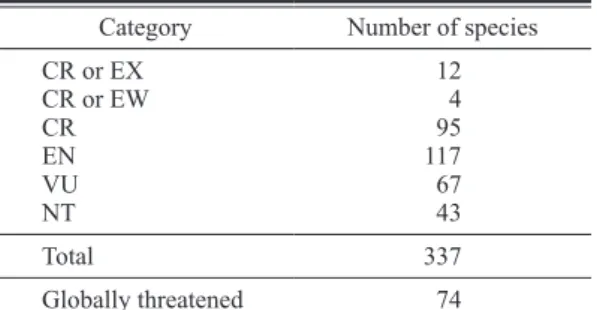
gered), VU (Vulnerable) and NT (Near threat- ened), whereas Chandra et al.ʼs list was a more preliminary one which did not set out to follow the IUCN categories until more information became available. The IUCN categories given here apply to political India only. Table 1 shows a statistic summary of the categorised threatened species.

In addition more information about the status of species in Arunachal Pradesh has become available (Fraser-Jenkins and Benniamin, 2010;

Fraser-Jenkins, 2010b; Fraser-Jenkins, Baishya, Benniamin and Rawat, in prep.) and has revealed that a number of species that are very rare else-

Table 1. The numbers of Indian pteridophytes belonging to different IUCN categories

Category Number of species

CR or EX 12

CR or EW 4

CR 95

EN 117

VU 67

NT 43

Total 337

Globally threatened 74

(2)

where in India are much more common in the far North-East in Arunachal Pradesh and some other North-Easternmost States of India. Adjustment has also been made to the status of a number of species, either taxonomically, or for IUCN cate- gory, now that more information from Indian herbaria, particularly CAL, BSA and LWG, has become available to the author.

A few of the species that have now been excluded for taxonomic or other reasons have been listed here for explanatory reasons, but in square brackets and without categories.

Many other species previously estimated to be Endangered and Endemic have been elucidated taxonomically by Fraser-Jenkins (1997, 2008a, 2008b) and Chandra et al. (2008) and excluded.

The classification of Fraser-Jenkins (2010a) has been used in the list, with some modifica- tions according to more recent work. In general this is similar to that of Kramer and Green (1990) and Smith et al. (2006). But it is less sim- ilar to two molecular cladonomy lists recently produced by Christenhusz et al. (2011) and Roth- fels et al. (2012), which are seen here as being insufficiently taxonomically based and to recog- nise too many groups that have no possible mor- pho-taxonomic significance. They also split many other groups that have been more success- fully sunk into recognisable categories of more major value. Their schemes are therefore not accepted here as being applicable to taxonomic classification and are seen as being of less use to Botanists. While the former was used by Ebihara et al. (2012) in an editorial decision as being more recent and appearing more up-to-date, its drawbacks are considered too great for it to be used here.

List of endangered species with total distributions and IUCN category Lycopodiaceae

1. Huperzia cancellata (Spring) Trevis. — N.E.

India (Arunachal Pradesh; very rare); Tibet;

China; Myanmar. VU.

2. Huperzia carinata (Desv.) Trevis. — Indian

Islands (Nicobar Islands; very rare); China;

Taiwan; Japan; Myanmar; Thailand; Vietnam;

Malaysia; Indonesia; Philippines; Australia;

Polynesia. Also reported from S. India (Tamil Nadu) by Dixit (1984, 1987, following Baker), but requiring confirmation and probably in error. VU.

3. Huperzia ceylanica (Spring) Trevis. (?syn.:

H. lajouensis Ching) — Sri Lanka; S. India (Tamil Nadu, Parampure Swamp, Anamalai, 7500 ft. C. E. C. Fischer 3317, 2.4.1912, but no teeth; very rare); ?E. Nepal (A. Zimmer- mann, BM; very rare); N.E. India (Arunachal Pradesh; Meghalaya; very scattered and rare);

?Tibet, rare. Reported by IUCN (1998) as indeterminate. Listed from Java by Dixit (1984, 1987) in error. NT.

4. Huperzia nilagirica (Spring) R. D. Dixit (syn.: H. hilliana (Nessel) Holub) — S. India (Kerala; Tamil Nadu; very rare). Endemic to S. India. VU; Globally threatened.

5. Huperzia nummulariifolia (Blume) Jermy — Indian Islands (Nicobars; very rare); Thailand;

Malaysia; Indonesia; Philippines; Polynesia.

EN.

6. Huperzia vernicosa (Hook. et Grev.) Trevis. — ?Sri Lanka; S. India (Kerala; Tamil Nadu; very rare). Endemic to Sri Lanka and S.

India. Reported by Spring from Sri Lanka, but requiring confirmation of the identity of the specimen he cited at Kew; not listed from Sri Lanka by Sledge (1982). CR; Globally threatened.

7. Lycopodium dendroideum Michx. — Bhu- tan, very rare; N.E. India (Arunachal Pradesh;

very rare); China; Taiwan; Japan; E. Siberia;

N. America. CR.

8. Lycopodium annotinum L. subsp. alpestre (Hartm.) Ǻ. Löve et D. Löve (syn.: L. zonatum Ching) — N.W. India (Uttarakhand; very rare); Nepal, very rare; N.C. India (Sikkim;

very rare); Bhutan, very rare; N.E. India (Arunachal Pradesh; very rare)); Tibet; China;

Taiwan; Japan; Myanmar. EN; Globally

threatened.

(3)

Selaginellaceae

9. ?Selaginella agustyamalayana R. Antony, S.

Khan et G. S. Nair — S. India (Tamil Nadu;

very rare). ?Endemic to South India. Perhaps a synonym of S. cataractarum Alston, requir- ing further study. CR.

[Selaginella adunca subsp. adunca — N.W.

India (Himachal Pradesh; Uttarakhand; locally abundant); W. Nepal, rare. Listed by IUCN (1998) as Endangered, in error. Alstonʼs (1945) record from “Kashmir” was in error for Sri- nagar, Garhwal, Uttarakhand].

10. Selaginella aitchisonii Hieron. — Tien Shan;

Sinkiang; Afghanistan; N. W. Pakistan, very rare; India (Jammu & Kashmir; very rare).

Turkestan was also listed by Dixit (1992a). It appears that this is not just an ecotype of S. sanguinolenta, but a separate species. EN;

Globally threatened.

11. Selaginella cataractarum Alston — S. India (Tamil Nadu; very rare and partly extinct).

Reported in error from Kerala and Orissa by Dixit (1984, 1992a). Listed as endangered by IUCN (1998). CR; Globally threatened.

12. Selaginella kurzii Baker — N.E. India (Mizoram; very rare); Myanmar; Thailand;

Malaysia. Reported in error from Nepal, and in a wide sense from “Assam”, but meaning Mizoram. CR.

13. Selaginella miniatospora (Dalzell) Baker (syn.: S. blatteri Bole et M. R. Almeida; type not found at BLAT by the author) — S. India (Maharashtra; Goa; Karnataka; rare and very restricted). Endemic to S.W. India. Its rela- tionship to the similar N. Indian etc. species, S. tenuifolia Spring, requires study. NT; Glob- ally threatened.

14. Selaginella pulvinata (Hook. et Grev.) Maxim. — N. W. India (Uttarakhand, Pithor- agarh; very rare); N. W. Nepal, very rare; N.E.

India (“Assam, herb. Kew (K)” (Alston 1945), presumably a collection from Mishmee, north- ern Arunachal Pradesh, by W. Griffith); Myan- mar (Mandalay; reported erroneously from Moulmein); Tibet; China, widespread. EN.

15. Selaginella wattii Baker — N.E. India

(Manipur; very rare, known only from the type); ?Myanmar. ?Endemic to N.E. India.

Reported from Myanmar by Dixit (1984, 1992a) but without details, and requiring con- firmation, and not so reported by Alston (1945); reported from Mizoram, Nagaland and Bangladesh by Ghosh et al. (2004) in error for S. chrysorrhizos. CR; Globally threatened.

[Several specimens described as new species by Dixit have been lost from CAL herbarium and the types are also not present in ASSAM, BSA, BSD, ARUN, BSHC, BSI, MH, LBG, DD, K or BM. If they are also not present in BSJO, CH or BURD they would appear to have been lost or destroyed, but they may be expected to have been dubious or erroneous, with the possible exception of S. nayarii, which might perhaps be distinct. These are: S.

ganguliana, S. keralensis, S. nayarii and S.

panchganiana.]

Isoetaceae

Many taxa have been described from India as new species, but the status of most of them as species is uncertain or dubious. Recent discus- sion between the author and Prof. G. K. Srivas- tava appears to lead towards a tentative conclu- sion that there are three major taxa present in India, which probably represent the species level, with other described taxa probably representing local variation within them. Despite the extinc- tion of some populations representing various types, two of the three are apparently not under threat.

16. Isoetes sahyadriensis Mahabale (syn.: I.

dixitii Shende) — C. India (Maharashtra, Mad- hya Pradesh; very rare). Endemic to C. India.

The type specimen is not present at CAL, BSA, AHMA, BSI or Pune University and appears to have been lost, which would best be dealt with by neotypification. IUCN (1998) listed its synonym, I. dixitii, as extinct. CR or EX; Globally threatened.

[Isoetes sampathkumaranii L. N. Rao — C. India

(Madhya Pradesh; Karnataka). Listed by

IUCN (1998) as Extinct, but has several syn-

(4)

onyms, including I. panchananii D. D. Pant et G. K. Srivastava and I. reticulata Gena et Bhardwaja, which are not threatened.

Endemic to C. and S. India].

[Isoetes bilaspurensis Panigrahi — listed by IUCN (1998) as Rare, but is a synonym of the widespread I. coromandelina L. f. subsp. coro- mandelina from Australia and India etc.].

Equisetaceae

17. Equisetum palustre L. — N. America; Europe;

N. Asia; Afghanistan; N. Pakistan, very rare;

N. W. India (Jammu & Kashmir; very rare);

Tibet; China; Japan. CR.

Psilotaceae

18. Psilotum complanatum Sw. — C. and S.

America; Indian Islands (Nicobar Islands; very rare); Thailand; Malaysia; Indonesia; Philip- pines; Australasia; Polynesia. EN.

Ophioglossaceae

19. Botrychium simplex E. Hitchc. subsp. sim- plex — N. America; N. Europe; N.C. India (Sikkim; very rare, Thangu, B. S. Kholia 35481, BSHC, det. CRFJ); Tibet. EN.

20. Botrychium virginianum (L.) Sw. — N.

America; N. Europe; N. Asia; N. Pakistan, very rare; N.W. India (Jammu & Kashmir;

Himachal Pradesh; Uttarakhand; very rare);

?W. Nepal; N.E. India (Meghalaya; very rare);

China; Korea; Japan. VU.

21. ?Ophioglossum eliminatum Khand. — C.

India (Madhya Pradesh; very rare). Said to be endemic to C. India. This taxon remains incompletely known and has neither been clearly described nor properly illustrated, while the type is either lost or unavailable.

Repeated requests for photographs of multiple specimens in the field or on a herbarium-sheet failed to produce results. VU.

22. Ophioglossum gramineum Willd. — S. Amer- ica; Africa; S. India (Tamil Nadu; ?Kerala;

Karnataka; Andhra Pradesh; very rare); N.W.

India (Uttarkhand; very rare); W. India (Rajas- than; very rare); C. India (Maharashtra; Mad-

hya Pradesh, Uttar Pradesh; very rare); N.E.

India (Meghalaya; ?Tripura; very rare); Myan- mar; Thailand, very rare; Vietnam; Malaysia;

Philippines; Australasia; New Guinea. NT.

23. Ophioglossum lusitanicum L. (probable syn.: O. indicum B. L. Yadav et Goswami, B.

L. Yadav 3011 [Herb. MLV Gov Coll., Bhil- wara, Rajasthan, Herb. Bionature, Bhopal, TNS VS-1110445]) — N. and S. America; W.

Europe; Africa; Macaronesia; S. India (Tamil Nadu; very rare); ?W. India (?Rajasthan; very rare); C. India (Madhya Pradesh; very rare);

Australasia. EN.

24. Ophioglossum pendulum L. — Madagas- car; Mascarenes; Seychelles; Sri Lanka; Indian Islands (Nicobar Islands; very rare); N.E. India (Assam State; very rare); Thailand; Malaysia;

Indonesia; Philippines; New Guinea; Austra- lia; Polynesia; China; Taiwan; Japan. NT.

Marattiaceae

25. Christensenia aesculifolia (Blume) Maxon (syn.: C. assamica (Griff.) Ching) — N.E.

India (Arunachal Pradesh; Assam State;

Meghalaya; very rare); Bangladesh, very rare;

?Myanmar; Thailand; Malaysia; Indonesia.

IUCN (1998) listed C. assamica from China and N.E. India as Vulnerable. EN.

Osmundaceae

26. Osmunda cinnamomea L. subsp. asiatica (Fernald) Fraser-Jenk. — Bhutan; N.E. India (Arunachal Pradesh; very rare); Myanmar;

Thailand; Vietnam; China; Taiwan; Korea;

Japan; E. Siberia. EN.

27. Osmunda javanica Blume — N.E. India (Arunachal Pradesh, Siang; very rare); Myan- mar; Malaysia; Indonesia. Reported from S.

India and Sri Lanka by Chandra (2000) in error. CR.

Gleicheniaceae

28. Gleichenia (Diplopterygium) blotiana C.

Chr. — N.E. India (Arunachal Pradesh; very rare); Thailand; Vietnam; China; Taiwan;

Malaysia. NT.

(5)

Schizaeaceae

29. Anemia schimperiana C. Presl subsp.

wightiana (Gardner) Fraser-Jenk. — S. India (Tamil Nadu; very rare and restricted). Sub- species endemic to S. India. EN.

[?Lygodium giganteum Tagawa et K. Iwats. — N.E. India (Assam State; Nagaland; Manipur;

and Mizoram). This species was reported by Singh and Panigrahi (1984) as a new record for India. But as described by them it was sig- nificantly dissimilar to the description and specimens of Tagawa and Iwatsuki, being much smaller in its parts and considerably less hairy on the axes, though bearing similar small scattered hairs on the indusium and with some segment base joints similarly swollen. At least the Indian material they cited appears to be L. flexuosum, which can often have some slightly swollen segment-base joints, though normally not so, and their record therefore requires confirmation].

30. Lygodium longifolium (Willd.) Sw. (proba- ble syn.: L. altum (C. B. Clarke) Alderw.) — Sri Lanka; S. India (Kerala; very rare); N.E.

India (Manipur; Meghalaya; very rare); Myan- mar; China; Malaysia. NT.

31. Lygodium polystachyum Wall. ex T.

Moore — N.E. India (Assam State; Manipur;

very rare); Myanmar; Thailand; Laos; Cambo- dia; Vietnam; China. EN.

32. Schizaea dichotoma (L.) Sm. — Indian Islands (Nicobar Islands; rare); S. India (Ker- ala; very rare or extinct); Malaysia; Indonesia;

Philippines; Australasia; Polynesia; Mascarene Islands; C. and S. America. VU.

33. Schizaea digitata (L.) Sw. — Indian Islands (Andaman Islands; Nicobar Islands; very rare); S. India (Kerala; very rare); N.E. India (Assam State; Meghalaya; very rare); Bangla- desh (probably extinct); Sri Lanka; Malaysia;

Indonesia; Philippines; New Guinea; Austral- asia; Polynesia. Beddome (1883) reported it from Sri Lanka and N.E. India in a confusion with S. dichotoma localities. EN.

Polypodiaceae

34. Arthromeris cyrtomioides S. G. Lu et C. D.

Xu (syn.: A. notholaenoides V. K. Rawat et Fraser-Jenk.) — N.E. India (Arunachal Pradesh;

very rare); China. EN; Globally threatened.

35. Arthromeris tomentosa W. M. Chu — Bhu- tan, very rare; N.E. India (Arunachal Pradesh;

very rare); Tibet; China. VU.

36. Drynaria bonii Christ — N.E. India (Mani- pur; very rare); Thailand; Vietnam; China.

Listed from Manipur by IUCN (1998) as Vul- nerable. EN.

[Drynaria meeboldii listed from Manipur by IUCN (1998) as vulnerable is delisted here as it is common in Bhutan and Arunachal Pradesh.]

[D. parishii (Bedd.) Bedd. — listed with doubt by Roos (1985) from “Assam?” was in error for a specimen from Myanmar, as communi- cated by M. Roos to P. H. Hovenkamp, and thence to the author].

[?Goniophlebium persicifolium (Desv.) Bedd. — listed without details from “Assam” in a wide sense by Rödl-Linder (1990), but appears to be an error, not now confirmable, and partly referred to G. argutum from Nepal].

37. Lemmaphyllum microphyllum C. Presl — N.E. India (Arunachal Pradesh; very rare);

China; Taiwan; Korea; Japan. VU.

38. Lepisorus miyoshianus (Makino) Fraser- Jenk. et Subh.Chandra — N.E. India (Arunachal Pradesh; very rare (first reported by Dixit and Nair (1975), sub Drymotaenium miyoshianum (Makino) Makino, including partly in error for Vittaria linearifolia Ching); China; Japan. CR.

39. Lepisorus sordidus (C. Chr.) Ching — N.E.

India (Arunachal Pradesh; Nagaland; Manipur;

very rare); China; Myanmar. VU; Globally threatened.

40. Lepisorus subconfluens Ching — ?E. Nepal (reported by Iwatsuki (1975, 1988), but proba- bly in error for L. contortus or L. loriformis);

?N.C. India (Sikkim, listed by Ghosh et al.

(2004), but probably in error); ?Bhutan

(reported by Tagawa and Iwatsuki (1989), but

requiring confirmation as no specimens seen

(6)

from Bhutan); N.E. India (Arunachal Pradesh;

very rare); China; Myanmar; ?Thailand. VU.

[Leptochilus metallicus (Bedd.) C. Chr. — reported by Nampy and Madhusoodanan (1998) from S. India (Kerala; very rare if present), but requiring confirmation of identity. Sri Lanka.

Endemic to Sri Lanka.]

41. Leptochilus minor Fée (syn.: L. minutulus Fée; but not Nistarika bahupunctika B. K.

Nayar, Madhus. et Molly, as synonymised by Nooteboom (1997), which is a synonym of Leptochilus axillaris, nor the other species of Leptochilus he synonymised in error) — N.E.

India (Meghalaya; very rare); Malaysia (Malaya; Borneo); Philippines. Not present in Sri Lanka, as reported by Nooteboom. Listed from N.E. India by IUCN (1998) as Endan- gered. Distribution in S. E. Asia not fully known due to confusion with other species by Nooteboom. EN.

[Leptochilus thwaitesianus Fée — synonym of L.

lanceolatus Fée — Sri Lanka; S. and C. India, common.]

42. Loxogramme grammitoides (Baker) C. Chr.

(misapplied name: L. lankokiensis sensu auct.

Ind., non (Rosenst.) C. Chr.) — N.C. India (Darjeeling; very rare); N.E. India (Arunachal Pradesh; very rare); China; Taiwan; Japan.

EN.

43. Microgramma mauritiana (Willd.) Tardieu (misapplied name: M. lycopodioides sensu Fraser-Jenkins in Chandra et al. (2008), non (L.) Copel.) — Africa; Mascarenes; Sri Lanka, very rare or extinct; S. India (Tamil Nadu;

very rare, or extinct). CR or EW.

44. Microsorum (?Neocheiropteris) fortunei (T. Moore) Ching (excluding the larger, wider- fronded and commoner M. chinense (Mett. ex Kuhn) Fraser-Jenk.) — N.E. India (Arunachal Pradesh; very rare); Tibet; China; Taiwan. EN.

45. Neocheiropteris ensata (Thunb.) Ching — N.E. India (Manipur; Meghalaya; very rare);

China; Taiwan; Korea; Japan; Vietnam. EN.

46. Phymatosorus longissimus (Blume) Pic.

Serm. — ?Sri Lanka (Tagawa and Iwatsuki 1989); Indian Islands (Nicobar Islands; very

rare, Dixit and Sinha (2001)); S. India (Kerala;

very rare); N.E. India (Assam State; very rare and decreasing due to drainage); Bangladesh;

Myanmar; Thailand; Vietnam; Malaysia; Indo- nesia: Philippines; Polynesia; China; Taiwan.

VU.

47. Pichisermollodes connexa (Ching) Fraser- Jenk. — N.E. India (Arunachal Pradesh; Mani- pur; very rare); China. EN.

48. Pichisermollodes erythrocarpa (Mett. ex Kuhn) Fraser-Jenk. — N.W. India (Himachal Pradesh; very rare); Nepal, rare; N.C. India (Darjeeling; Sikkim; very restricted and rare);

Bhutan; ?N.E. India (?Arunachal Pradesh, listed by Ghosh et al. (2004), but no specimen seen by the author in CAL or elsewhere);

Tibet. NT.

49. Pichisermollodes nigrovenia (Christ) Fra- ser-Jenk. — N.W. India (Uttarakhand, Garh- wal, Ramri, J. F. Duthie 5179, CAL, BM; very rare); Nepal, rare; N.C. India (Darjeeling; Sik- kim, very rare); Bhutan, very rare; N.E. India (Arunachal Pradesh; very rare); Tibet; China.

NT.

50. Pichisermollodes tibetana (Ching et S. K.

Wu) Fraser-Jenk. — Nepal, very rare; N.C.

India (Sikkim; very rare); Tibet; China. CR.

51. Pichisermollodes sp. ?near Phymatopteris albopes (C. Chr. et Ching) Pic.Serm. (fronds±

like a larger and robust P. crenatopinnata, wid- est at base, with undulate-lobed lowest pinnae, but rhizome rather thicker, scales black with mid-brown edges, lanceolate with attenuated apices and no fringe-hairs; intermediate towards P. ebenipes?) — N.E. India (Arunachal Pradesh, Kameng, Lum La, 2520 m., A. K.

Baishya 90548, 13.7.1987, ASSAM; very rare). CR.

52. Platycerium wallichii Hook. — N.E. India (Manipur; very rare); Myanmar; Thailand;

Malaysia; China. Erroneously mentioned by Chandra et al. (2008) from the Andaman and Nicobar Islands due to a mistaken transposi- tion of typed text. CR.

[?Polypodiodes dielsiana (C. Chr.) Fraser-Jenk.

Reported and mapped by Rödl-Linder (1990)

(7)

from N.E. India (Meghalaya, coll. J. D.

Hooker, K), but its presence in India is very doubtful and requires confirmation; no such record exists in her card-index at L]

[?Polypodiodes manmeiense (Christ) Fraser- Jenk. — ?N.E. India (Meghalaya; listed as from “Assam” sens. lat., without details by Rödl-Linder (1990), presumably following Chingʼs (1933) report from “Shillong, H. Z.

Darrah [name probably incorrect], 1888”, which was perhaps in error, not shown in her map or card-index, its presence in India requires confirmation). Reported in error for P.

microrhizoma from the W. Indo-Himalaya (Pithoragarh) by Pande and Pande (2002), and from Darjeeling etc. by Bir, Trikha and Vasudeva (1974) and Satija and Bir (1985);

and mentioned by Ghosh et al. (2004) in error for Thylacopteris papillosa from Meghalaya, with its very thin rhizome. Distinguished from P. microrhizoma by the rhizome nearly twice as thick and veins free.]

53. Polypodiodes simonsiana Fraser-Jenk. sp.

nov. in prep. (misapplied name: Polypodiodes wattii sensu Fraser-Jenkins (2008b) etc., non (Bedd.) Ching [=P. niponicum] — N.E. India (Arunachal Pradesh; Manipur; Meghalaya;

very rare); Myanmar. Similar to P. niponicum, but larger, often with a curved rachis and mid and lower pinnae backward-deflexed and very acutely pointed. VU; Globally threatened.

54. Polypodiodes niponicum (Mett.) Ching (syn.: P. wattii (Bedd.) Ching, non sensu Fra- ser-Jenkins (2008b) etc., nec in Chandra et al.

(2008)) — N.E. India (Arunachal Pradesh;

Nagaland; Manipur; Meghalaya; very rare);

Tibet; China; Taiwan; Japan; Myanmar; Viet- nam. Not present in N.W. India as reported by Chandra (2000) in error. NT.

55. Pyrrosia boothii (Hook.) Ching — N.C.

India (Sikkim; very rare); Bhutan; N.E. India (Arunachal Pradesh; very rare); Myanmar;

Tibet. VU; Globally threatened.

56. Pyrrosia ceylanica (Giesenh.) Sledge — Sri Lanka; S. India (Karnataka; Kerala; Tamil Nadu; very rare though probably overlooked).

Endemic to Sri Lanka and S. India. EN;

Globally threatened.

57. Pyrrosia drakeana (Franch.) Ching — N.E.

India (Arunachal Pradesh; very rare); Tibet;

China. VU.

58. Pyrrosia laevis (J. Sm.) Ching — N.E.

India (Meghalaya; very rare); Myanmar; Tibet;

China. EN.

[?Pyrrosia longifolia (Burm.f.) C. V. Morton —

?N.E. India (Arunachal Pradesh, reported from a single collection from Changlang District by Singh and Panigrahi (2005), but with morpho- logical differences mentioned and very proba- bly in error for P. adnascens, specimen taken to Singhʼs house in Dehra Dun so not available for proper reidentification; presence in India very doubtful); S. Myanmar (Moulmein);

Thailand; Laos; Cambodia; Vietnam; S. China;

Malaysia; Indonesia; Philippines; New Guinea; Australia; Polynesia. Absent from Nepal, which was reported to be doubtful by Hovenkamp (1986)].

59. Pyrrosia rasamalae (Racib.) K. H. Shing (misapplied name: P. floccigera) — N.E. India (Arunachal Pradesh; very rare); Myanmar;

Thailand; Malaysia; Indonesia; Philippines.

VU.

60. Pyrrosia stigmosa (Sw.) Ching — N.E.

India (Arunachal Pradesh, Debang Valley, Mayodia Pass, A. Benniamin 28757, 12.12.2011, ASSAM, det CRFJ; very rare);

Myanmar; Thailand; Vietnam; Cambodia;

Malaysia; Indonesia; Tibet; China. Widely misreported from India by Mehra (1939), Panigrahi (1960), Satija and Bir (1985) etc. in error for P. costata, thus previously unknown from India. CR.

61. Pyrrosia subfurfuracea (Hook.) Ching — Bhutan, very rare; N.E. India (Arunachal Pradesh; Nagaland; Manipur; very rare);

Myanmar; Tibet; China. NT.

62. Selliguea chrysotricha (C. Chr.) Fraser- Jenk. — Bhutan; N.E. India (Arunachal Pradesh;

very rare); Myanmar; China. EN.

63. Selliguea engleri (Luerss.) Fraser-Jenk. —

N.E. India (Arunachal Pradesh; Mizoram; very

(8)

rare); China; Taiwan; Korea; Japan. EN.

64. Selliguea majoensis (C. Chr.) Fraser- Jenk. — N.E. India (Nagaland; Meghalaya; very rare); Tibet; China. EN.

65. Selliguea subsparsa (Baker) Hovenkamp — N.E. India (Arunachal Pradesh; very rare);

?Thailand; Malaysia; Sumatra. First reported from India by Dixit and Nair (1977) as Holco- sorus bisulcatus (i.e. Selliguea bisulcata) in error. This species may perhaps be conspecific with S. enervis (Cav.) Ching. IUCN (1998) listed Holcosorus bisulcatus from Arunachal Pradesh as Endangered. CR.

66. Selliguea tricuspis (Hook.) Fraser-Jenk. — N.C. India (Darjeeling, ?extinct; Sikkim; very rare); Thailand; Vietnam; Malaysia; S. China.

CR or EW.

67. Selliguea trisecta (Baker) Fraser-Jenk. — N.E. India (Assam State, Pynursla on Megha- laya border; very rare); Myanmar; Tibet;

China. CR.

68. Thylacopteris papillosa (Blume) Kunze ex J. Sm. — N.E. India (Arunachal Pradesh; Megha- laya, det. CRFJ; very rare); Malaysia; Indone- sia; Philippines. Reported from Meghalaya by Ghosh et al. (2004) sub Metapolypodium man- meiense in error, specimen in CAL! CR.

Grammitidaceae

69. Ctenopterella blechnoides (Grev.) Parris — Sri Lanka; S. India (Tamil Nadu; ?extinct);

Malaysia; Indonesia; Australia; Polynesia. CR or EX.

70. Oreogrammitis attenuata (Kunze) Parris — Sri Lanka; S. India (Tamil Nadu; very rare).

Endemic to Sri Lanka and S. India. EN;

Globally threatened.

71. Oreogrammitis austroindica (Parris) Par- ris — S. India (Tamil Nadu; known from a single 19

th

Century collection, probably extinct). Endemic to S. India. CR or EX;

Globally threatened.

72. Oreogrammitis pilifera (Ravi et J. Joseph) Parris (misapplied name: Grammitis medialis sensu auct. Ind.) — S. India (Kerala; Tamil Nadu; very rare). Endemic to S. India. VU;

Globally threatened.

73. Prosaptia alata (Blume) Christ — Sri Lanka; S. India (Tamil Nadu; very rare or

?extinct), Thailand; Malaysia; Indonesia; Phil- ippines; Polynesia. CR or EX.

74. Prosaptia contigua (G. Forst.) C. Presl — Sri Lanka; S. India (Kerala; Tamil Nadu; very rare); Thailand; Malaysia; Indonesia; Philip- pines; Australasia; Polynesia; China; Taiwan.

CR.

75. Prosaptia khasyana (Hook.) C. Chr. et Tar- dieu — N.E. India (Meghalaya; very rare);

Myanmar. Records of this species from else- where, including S. China and S.E. Asia refer to P. barathrophylla (Baker) M. G. Price. (per- sonal communication from B. S. Parris, May 2012). CR; Globally threatened.

76. Prosaptia obliquata (Blume) Mett. — Sri Lanka; S. India (Kerala; Tamil Nadu; very rare); Thailand; Vietnam; Malaysia; Indonesia;

Philippines; New Guinea; China; Taiwan. EN.

77. Scleroglossum sulcatum (Kuhn) Alderw. — Sri Lanka, very rare; N.E. India (Meghalaya;

very rare); Thailand; Vietnam; Malaysia; Indo- nesia; Philippines; Polynesia; China; Taiwan.

CR.

78. Tomophyllum perplexum (Parris) Parris (misapplied name: Ctenopteris subfalcata sensu auct. austr.-Ind.) — Sri Lanka; S. India (Tamil Nadu; very rare). Endemic to Sri Lanka and S. India. CR; Globally threatened.

Hymenophyllaceae

79. Hymenophyllum acanthoides (Bosch.) Rosenst. — S. India (Kerala; very rare); Thai- land; Malaysia; Indonesia; Philippines; New Guinea; Taiwan. A report from N.E. India by Ghosh (1982), repeated by Dixit (1984) was in error for H. denticulatum, but the species and report were not mentioned at all, nor corrected by Ghosh et al. (2004). CR.

80. Hymenophyllum barbatum (Bosch) Baker — N.E. India (Meghalaya; Mizoram; very rare);

Myanmar; Thailand; Vietnam; China; Taiwan;

Japan. EN.

[?Hymenophyllum edentulum (Bosch) C. Chr. —

(9)

N.E. India (Meghalaya; apparently very rare, Dixit (1984), as from “Assam” sens. lat.);

Malaysia; Indonesia. This is a dubious taxon in addition to its identification from India being unsure.]

81. Hymenophyllum levingei C. B. Clarke — N.C. India (Sikkim; high altitude, very restricted and rare); Bhutan; Tibet; China. NT;

Globally threatened.

82. ?Trichomanes agasthianum (Madhus. et C.

A. Hameed) C. A. Hameed, K. P. Rajesh et Madhus. (syn.: T. lunulatum (Madhus. et C. A.

Hameed) C. A. Hameed., K. P. Rajesh et Mad- hus) — S. India (Tamil Nadu; Kerala; very rare). Apparently Endemic to S. India. How- ever the lamina-lobes extending slightly beyond the sori are similar to Sledgeʼs descrip- tion of T. kurzii, based on the type (and not to Hameed et al.ʼs description and illustration of T. kurzii). EN.

83. ?Trichomanes apiifolium C. Presl — Indian Islands (Nicobar Islands; very rare); Thailand;

Malaysian Islands; Indonesia; Philippines;

New Guinea; Polynesia; Taiwan; Japan.

Reported from the Nicobars by Tagawa &

Iwatsuki (1979), but not since; its presence requires confirmation. It may be the same as the “Nesopteris grandis” (Copel.) Copel.

reported from the Nicobar Islands by Dixit and Sinha (2001) and Dixit, Ghosh and Ghosh (1997). CR.

84. Trichomanes exiguum (Bedd.) Baker — Sri Lanka, uncommon; S. India (Karnataka; Ker- ala; Tamil Nadu; very rare); Thailand; Malay- sia; Australia. EN.

[?Trichomanes grande Copel. — Indian Islands (Nicobar Islands; very rare); Philippines; Poly- nesia. See T. apiifolium, above]

85. Trichomanes henzaianum Parish ex Hook. — S. India (Karnataka; very rare); Myanmar;

Thailand; Vietnam; Malaya. EN.

86. Trichomanes latemarginale D. C. Eaton — N.E. India (Meghalaya; very rare); China; Tai- wan; Japan; Vietnam; Malaysia. VU.

87. Trichomanes maximum Blume (syn.: T.

indicum S. R. Ghosh, nec al.) — Indian

Islands (Nicobar Islands; very rare); N.E. India (Arunachal Pradesh; very rare); Myanmar;

Thailand; Vietnam; Malaysia; Indonesia; Poly- nesia; Taiwan; Japan. EN.

88. ?Trichomanes mindorense Christ — ?S.

India (Kerala; very rare, Hameed, Rajesh and Madhusoodanan (2003), but may require con- firmation); Malaysia, Philippines; New Guinea; Australia; Polynesia. CR.

[?Trichomanes motleyi (Bosch) Bosch — Sri Lanka; ?Indian Islands (Andaman Islands;

reported by Dixit (1984), with T. henzaianum in synonymy, but both omitted without expla- nation by Dixit and Sinha (2001)); Myanmar;

Vietnam; China; Taiwan; Japan; Thailand;

Malaysia; Indonesia; Philippines; Australia;

Polynesia.]

89. Trichomanes parvifolium (Baker) Copel. — Nepal, very rare; N.C. India (Sikkim; very rare); N.E. India (Arunachal Pradesh; Megha- laya; very rare); Myanmar; Thailand. EN.

90. Trichomanes sublimbatum Müll. Berol. — N.E. India (Arunachal Pradesh; Meghalaya;

very rare); S. India (Kerala; very rare); Myan- mar; Thailand; S.E. Asia; China; New Guinea.

VU.

Cyatheaceae

91. Cyathea albosetacea (Scott. ex Bedd.) Copel. — Indian Islands (Nicobar Islands;

very rare). Endemic to the Nicobar Islands.

IUCN (1998) listed it as Vulnerable. EN;

Globally threatened.

92. Cyathea contaminans (Wall. ex Hook.) Copel. N.C. India (only known for certain from a single Indian collection, from Rungbee Valley, below Mongpo, Darjeeling, W. Bengal, and perhaps either extinct or requiring confir- mation re identity); Thailand; China; Malay- sia; Indonesia; Philippines. Other mistaken records mostly referred to C. brunoniana (Wall. ex Hook.) C. B. Clarke et Baker. ?CR or EX.

93. Cyathea crinita (Hook.) Copel. — Sri

Lanka; S. India (Kerala; Tamil Nadu; very

rare). Endemic to Sri Lanka and S. India. EN.

(10)

94. ?Cyathea nicobarica N. P. Balakr. et R. D.

Dixit — Indian Islands (Nicobar Islands; very rare). Described as endemic to the Nicobar Islands from a single, sterile and unidentifiable pinna of a Cyathea listed by Holttum as not being C. albosetacea. Quite probably a known Sumatran species. CR or EX.

[Cyathea nilgirensis Holttum — South India (Ker- ala; Tamil Nadu; not particularly rare). Errone- ously listed by IUCN (1998) as endangered.]

Dennstaedtiaceae

95. Dennstaedtia wilfordii (T. Moore) Christ ex Ching — Pakistan; N. W. India (Jammu and Kashmir; very rare, perhaps extinct?); China;

Japan. This highly disjunct occurrence in India is based only on a very few older collections of this species around a small area on both sides of the Pakistan/Indian border in the Jhelum Valley, Kashmir, and has not been seen for some 40 years since the reports of Stewart (1945, 1972). It also occurred a little further west in the lower Kagan Valley, in Pakistan, so is not an adventive species. A similar large dis- junction occurs with Dryopteris dickinsii. CR or EX.

96. Hypolepis sp. ?near brooksiae Alderw. — N.E. India (Arunachal Pradesh; very rare). H.

brooksiae is from Malaysia; Indonesia. The Indian plant is only very tentatively and not finally identified, being near H. polypodoides with alternate pinnae, but with thorny axes as in H. brooksiae. EN.

97. Microlepia calvescens (Wall. ex Hook.) C.

Presl — N.E. India (Arunachal Pradesh; Mani- pur; Meghalaya; rare); Myanmar; Thailand;

Vietnam; China; Taiwan; Java. Reported from the W. Himalaya in error, over-reported from N.E. India and Nepal in error for M. marginata (Houte ex Panz.) C. Chr. NT.

98. Microlepia caudigera T. Moore (syn.: M.

uropinnata Panigrahi et A. Das [=A. Biswas], nom. superfl.) — Bhutan; N.E. India (Arunachal Pradesh; ?Meghalaya; very rare); China. VU;

Globally threatened.

99. Microlepia kurzii (C. B. Clarke) Bedd. —

N.E. India (Manipur; very rare); Myanmar;

Thailand; China. The Indian plant was errone- ously separated as var. manipurensis A.

Biswas et T.Sen, now sunk here into the syn- onymy of M. kurzii. M. kurzii was erroneously excluded from India by Fraser-Jenkins (2008) due to confusion as to which specimen Dixit was referring to. CR; Globally threatened.

100. Microlepia majuscula (E. J. Lowe) T.

Moore—Sri Lanka; S. India (Kerala; Tamil Nadu; very rare); Myanmar. EN.

101. Microlepia trichocarpa Hayata — Nepal, very rare; N.C. India (Darjeeling; very rare);

N.E. India (Manipur; Meghalaya; rare); China;

Taiwan. EN.

102. Pteridium brownseyi Fraser-Jenk. — Paki- stan; far N.W. India (Jammu and Kashmir;

very rare). VU.

103. Pteridium semihastatum (Wall. ex J. Agardh) S. B. Andrews — N.E. India (Arunachal Pradesh;

very rare); Myanmar; Thailand; China; Viet- nam; Malaysia; Indonesia; Philippines; New Guinea; Australia. A report from N.W. India (Uttarakhand) was due to one of Wallichʼs rather numerous confusions and mislabellings of a Singapore collection as if collected by R.

Blinkworth in Kumaon, due to his sorting some unclearly labelled collections less than critically by general appearance. This is a good species with fully formed spores, not the same as the very similar, but sterile hybrid P. x yarrabense (Domin) Wakef. from Austra- lia. CR.

Lindsaeaceae

[?Lindsaea bouillodii Christ — ?Indian Islands (Andaman and Nicobar Islands, sub L. tenera (Ghosh and Dixit 1978, Dixit and Ghosh 1982, Dixit and Sinha 2001; very rare); S. India (Tamil Nadu, Tinevelly (Dixit 1984, sub L.

bouillodii); very rare); Thailand; Vietnam; S.

China; Malaysia. L. bouillodii was misre- ported by Dixit (1984) from Sri Lanka.

Although Dixit subsequently separated L.

bouillodii as a distinct species, perhaps cor-

rectly, Kramer (1972) had had doubts whether

(11)

it were truly distinct from L. tenera. Further taxonomic investigation is required).

104. Lindsaea chienii Ching — Indian Islands (?Nicobar Islands (Dixit and Sinha 2001), may require reidentification; very rare); N.E. India (Manipur; very rare); Myanmar; Thailand;

Vietnam; China; Taiwan; Japan. EN.

105. Lindsaea commixta Tagawa — Sri Lanka;

Indian Islands (Andaman Islands; very rare);

S. India (Tamil Nadu; very rare); Nepal, very rare; N.E. India (Meghalaya; very rare);

Myanmar; Vietnam; Malaysia; Indonesia;

Philippines; China; Taiwan; Japan. Misre- ported from Uttarakhand (Mussoorie) on the basis of a mislabelled specimen of R. L. Flem- ing Sr., actually collected from the single S. C.

Nepalese locality at Andhi Khola. EN.

106. Lindsaea gueriniana (Gaudich.) Desv. — Indian Islands (Andaman Islands; Nicobar Islands; very rare); Malaysia; Philippines;

New Guinea; Polynesia. EN.

107. Lindsaea javanensis Blume — N.E. India (Assam State; Arunachal Pradesh; Meghalaya;

very rare); Myanmar; Thailand; Malaysia;

China; Taiwan; Japan. VU.

108. Lindsaea malabarica (Bedd.) Baker — S.

and C. India (Karnataka; Kerala; Tamil Nadu;

?Andhra Pradesh; Madhya Pradesh; very rare).

Endemic to peninsular India. NT; Globally threatened.

109. Lindsaea malayensis Holttum — Indian Islands (Nicobar Islands; very rare); Thailand;

Malaysia.VU.

110. Lindsaea oblanceolata Alderw. — Indian Islands (Nicobar Islands; very rare); Thailand;

Malaysia; Indonesia. EN.

111. Lindsaea obtusa J. Sm. ex Hook. (syn.: L.

andamanica R. D. Dixit et B. Ghosh) — Indian Islands (Andaman Islands; very rare);

China; S.E. Asia; Australasia. NT.

112. Lindsaea parasitica (Roxb.) Hieron. — Indian Islands (Andaman Islands; Nicobar Islands; very rare); Thailand; Malaysia. NT.

113. Lindsaea tenera Dryand. — Indian Islands (Andaman Islands; Nicobar Islands; very rare).

?Endemic to the Andaman and Nicobar

Islands, unless L. bouillodii is not a distinct species. Taxonomically somewhat uncertain as to whether it is really specifically distinct from L. bouillodii. NT; Globally threatened.

114. Lindsaea tetragona K. U. Kramer — Indian Islands (Nicobar Islands; very rare); Indone- sia; Polynesia. NT.

115. Lindsaea venusta Kaulf. ex Kuhn — Sri Lanka; S. India (Kerala; Tamil Nadu; very rare). Endemic to Sri Lanka and S. India. EN;

Globally threatened.

116. Lindsaea walkerae Hook. (syn.: L. rutland- ica [“rutlandia”] R. D. Dixit et B. Ghosh) — Sri Lanka; Indian Islands (Andaman Islands; very rare); S.E. Asia; Australasia. EN.

117. Tapeinidium pinnatum (Cav.) C. Chr. — S.

India (Tamil Nadu; very rare or extinct); Thai- land; Malaysia; Philippines; Taiwan; Japan.

Reported from the E. Himalaya by Dixit (1984) in error. CR or EW.

Pteridaceae (syn.: Adiantaceae, Sinopteridaceae, Cheilanthaceae, Taenitidaceae, Cryptogram- maceae, Parkeriaceae)

118. Acrostichum speciosum Willd. — Indian Islands (Andaman Islands; Nicobar Islands;

very rare); Thailand; Australia. VU.

119. Adiantum flabellulatum L. — N.E. India (Assam State; Manipur; Meghalaya; very rare); Bangladesh, ?extinct; Malaysia; Indone- sia; China; Taiwan; Japan. VU.

120. Adiantum myriosorum Baker — Nepal;

N.C. India (Sikkim; restricted and rare); Bhu- tan; N.E. India (Arunachal Pradesh, very rare);

Tibet; China; Taiwan. NT.

121. Adiantum soboliferum Wall. ex Hook. —

?S. India (Tamil Nadu, listed by Dixit (1984), Ghosh et al. (2004) and Chandra, Fraser-Jen- kins et al. (2008), but details required for con- firmation that it was not a misidentification);

N.E. India (Assam, listed by the above authors, details required, including from BM, in case “Assam” was reported in a wide sense, in error for Nagaland; Nagaland; very rare).

[?Adiantum stenochlamys Baker — ?Andaman CR.

(12)

Islands (reported by Dixit (1992b) and thence Dixit and Sinha (2001) from a single specimen at CAL, but no material of it found in CAL, and its identity therefore requires confirma- tion); Malaysia; Indonesia; Philippines.]

122. Aleuritopteris argentea (S. G. Gmel.) Fée — ?N.C. India (?Sikkim, J. D. Hooker;

very rare); Bhutan; ?N.E. India (?Meghalaya, J. D. Hooker, locality and/or identity doubtful, perhaps in error for A. tamburii, or perhaps actually from Sikkim — to see material at K/

BM; Arunachal Pradash; very rare); China;

Taiwan; Japan; Korea; E. Siberia. Reported from Uttarakhand (Pithoragarh) by Punetha et al. (2008) in error. CR.

123. Aleuritopteris duclouxii (Christ) Ching — N.E. India (Arunachal Pradesh, Namdapha, Shirong to Hunung, c. 1100 m., B. K. Shukla 88207, 7.2.1986, ASSAM, sub “C. anceps” in error, not previously noticed in India, tenta- tively reported by Fraser-Jenkins and Dulawat (2009) as possibly being the similar species, A.

shensiensis Ching, in error; very rare). See Fraser-Jenkins and Benniamin (2010). CR.

124. Aleuritopteris duthiei (Baker) Ching — N.W. India (Uttarakhand; very rare); Nepal;

Bhutan; Tibet. CR; Globally threatened.

125. Aleuritopteris scioana (Chiov.) Fraser- Jenk. et Dulawat — E. Africa; Socotra; S. Ara- bia; W. India (Rajasthan; very rare). CR.

126. Aleuritopteris subargentea Ching ex S. K.

Wu — Nepal; N.C. India (N. Sikkim; very rare); Tibet; China; Taiwan. CR.

127. Aleuritopteris tamburii (Hook.) Ching (syn.: A. punethae Kholia, Bakhuni et Richa) — N.W. India (Uttarakhand, misidentified by Punetha et al. (2008) as A. argentea, and then subsequently as a new species, A. punethae, by Kholia et al. (2011), with two different dates cited, but the origin probably requires confir- mation and is now said to have been destroyed (Kholia personal communication, 2012)); W., C. and E. Nepal; N.C. India (Sikkim; very rare); N.E. India (Arunachal Pradesh, Anjaw, Di Chu Gorge, 4500′. F. Kingdon-Ward 19362, 30.6.1950, BM!; Meghalaya; very

rare); Tibet; China. Despite having been prop- erly identified for them beforehand as a typical small A. tamburii and not A. argentea by the present author, A. punethae was erroneously described and published without informing him, but is now accepted as A. tamburii by its author and awaits correction by them (B. S.

Kholia personal communication, April 2012).

EN.

128. Aleuritopteris(?) thwaitesii (Mett. ex Kuhn) Saiki (syn.: Cheilanthes keralensis N.

C. Nair et S. R. Ghosh) — Sri Lanka; S. India (Tamil Nadu; very rare). Endemic to Sri Lanka and S. India. The S. Indian plant was described as C. keralensis, but was actually from Tamil Nadu, not Kerala; it may still require further comparison with Cheilanthes belangeri. The genus is rather uncertain and might be Cheilanthes Sect. Cheilosoria. CR;

Globally threatened.

129. Anogramma leptophylla L. — Europe; W.

Asia; Afghanistan; N.W. Pakistan; C. India (Maharashtra; rare); S. India (Tamil Nadu;

very rare). Records from the Indian W. Hima- laya and Nepal refer to A. reichsteinii Fraser- Jenk., but the single Nepalese record of that species (Chapagaon, Kathmandu, R. L. Flem- ing 2231, MICH) is due to a locality-label confusion and came from Mussoorie in Uttara- khand, N.W. India. EN.

130. Cheilanthes bhutanica Fraser-Jenk. et Tandi (syn.: Pellaea yunnanensis Ching) — N.C. India (N. Sikkim; very rare, CAL); Bhu- tan; Tibet; China. CR.

[?Cheilanthes trichophylla Baker — ?N.C. India (?Sikkim, Kyangnos la, S. C. Verma, specimen lost but recorded by Verma from memory;

very rare indeed if correct); China.]

131. Cryptogramma brunoniana Wall. ex Hook. et Grev. subsp. raddeana (Fomin) Fra- ser-Jenk. — Georgia (Caucasus); ?N.W. Nepal;

N.E. India (Arunachal Pradesh, Upper Siang, Teetapuri, N. of Tuting, c. 3000 m., M.K.

Pathak 73006, in 2009, CAL, det. CRFJ, 12.2011; very rare); Tibet; China. EN.

132. Doryopteris ludens (Wall. ex Hook.) J.

(13)

Sm. — N.E. India (Assam State; Manipur;

Nagaland; Tripura; Mizoram; very rare); E.

India (Orissa, very rare); Bangladesh; Myan- mar; Thailand; Vietnam; Malaysia; Indonesia;

Philippines; New Guinea; Australasia. NT.

133. Notholaena borealisinensis (Kitag.) Fra- ser-Jenk. (syn.: Gymnopteris borealisinensis Kitag.; Paragymnopteris bipinnata (Christ) K.

H. Shing var. auriculata (Franch.) K. H.

Shing; a mistyping by Fraser-Jenkins (2008b:

134) appears to say that the bipinnate species, Paragymnopteris bipinnata (Christ) K. H.

Shing [syn.: Paraceterach bipinnatum (Christ) R. M. Tryon], is a synonym of N. borealisi- nensis, however the word “and” before var.

auriculata is an overlooked typing error and should have been removed — Bhutan; N.E.

India (Arunachal Pradesh; very rare); Tibet;

China. The genus for this species and N. him- alaica Fraser-Jenk. is unclear as it differs from Notholaena (type: N. marantae — J. Smithʼs apparent typifications in Historia Filicum (1875) are not typifications as he meant the word type in a different sense, sometimes cit- ing more than one species, or none of the orig- inal species) in having hairs instead of scales and might perhaps belong to Paraceterach. N.

dipinnata Fraser-Jenk. was reported by Fraser- Jenkins in Chandra et al. (2008) from N.E.

India (Arunachal Pradesh, Lohit) in error for a rather folded up specimen of N. borealisinen- sis. EN.

134. Notholaena delavayi (Baker) C. Chr. — N.W. India (Uttarakhand; very rare); Nepal;

Bhutan. Erroneously reported from Himachal Pradesh. EN.

135. Notholaena lanuginosa (Desf.) Desv. ex Poir. subsp. bivalens Reichst. (syn., or perhaps correct name: Cosentinea vellea (Aiton) Tod.

subsp. bivalens (Reichst.) Rivas Mart et Salvo) — Europe; N. Africa; W. Asia; Pakistan;

N.W. India (Himachal Pradesh; very rare). EN.

136. ?Onychium fragile S. C. Verma et Khullar — N.W. India (Uttarakhand, Mus- soorie; very rare). Probably a synonym of the very similar species, O. tenuifrons. O. fragile

is only certainly known from the single small

type-specimen with two leaves, which though

fertile, but immature, appears probably to rep-

resent semi-sterile frond-morphology. Khullar

and Verma (2012) placed the two taxa into

different groups, which is not accepted here as

both are actually precisely intermediate

between the two groups, of O. japonicum and

O. cryptogrammoides. Despite their statement

to the contrary, both species have thinly herba-

ceous fronds and fragile stipes and the veins in

O. tenuifrons are not always raised above,

especially in immature plants. They described

the rhizome of O. fragile as short-creeping in

its protologue, repeated in this paper, as also

for O. tenuifrons, but then in contradiction tab-

ulated the former as long-creeping, which

however cannot be seen in the specimen itself,

and did not appear to them to be so when they

initially wrote the protologue. Any possible

differences in rhizome length are not actually

known as yet and need to be studied in both

species. They also said that O. tenuifrons has a

different rhizome anatomy, yet admitted that it

matched that of O. fragile in one of the speci-

mens of O. tenuifrons studied for them in

China. Another important difference is that

they said that O. tenuifrons has a pale stramin-

eous stipe-base whereas O. fragile always has

a black base (that is, always in the single spec-

imen available). However the dark stipe-base

in many, though not all specimens of O. tenui-

frons as well is clearly visible in two of their

photographs of it (5b and 9), as also in much

more copious material of it seen by CRFJ in

PE, and the mid and upper stipe in O. tenui-

frons is similarly green, drying pale or stra-

mineous. From study of O. tenuifrons in BM

and of a population-collection of O. fragile

collected at Mussoorie (CRFJ 18602, 18605,

Oct. 1991, E) and verified by Khullar, the

spores of both species are also generally very

similar in morphology and size, though one

specimen with smaller spores, investigated for

Khullar and Verma (2012) as O. tenuifrons,

may suggest that specimen might have been

(14)

misidentified; but only a white, immature spore of O. fragile was illustrated by Khullar and Verma (2012), from which conclusions cannot be drawn. Finally both are triploid apo- mict, a fact that was not accepted by Khullar because as stated by Kato to CRFJ and thence informed to Khullar, the counts on O. tenui- frons from China were mitotic root-tip counts.

However in the whole body of literature on the cytology of pteridophytes world-wide no sin- gle instance of a triploid plant with good, non- hybrid type spores, as here (apart from two sterile voucher-specimens), has ever been reported except in apomicts and it is obvious that O. tenuifrons is inescapably also triploid apomict, even though it needs more chromo- some-counts and spore-checking.

As so far known the only obvious difference between them, but one not noticed by Khullar and Verma (2012), is that the pinnae in the type of O. fragile are wider-based than in most O. tenuifrons, but narrow pinnae are not con- sistent in Chinese O. tenuifrons and may per- haps be a feature of the semi-sterile type of morphology that the type of O. fragile appears to have, as some of CRFJʼs fully mature col- lections of it from Barlowganj, Mussoorie, also have rather elongated, narrowish pinnae.

While remaining uncertain (as pointed out by Fraser-Jenkins in Thapa (2002), but misquoted as being Thapaʼs comment by Khullar in Khul- lar and Verma), it remains possible that O.

fragile may well be a synonym of O. tenui- frons, as first suggested and then concluded by Fraser-Jenkins in various publications over time. But it requires further re-investigation before a final conclusion can be made, particu- larly considering pinna-width and spore-size.

No more is yet known of the range of O.

fragile, but O. tenuifrons occurs in W. Nepal and Arunachal Pradesh (correctly reported by Biswas and Ghosh (1983), which was not mentioned by Khullar and Verma), and the Flora of China (Flora Reipublicae Popularis Sinicae 1990) gives its Chinese range as Yun- nan, Szechuan and Kweichow, while naturally

being unaware of its range in the Indo-Hima- laya. Even excluding O. fragile, it is not con- fined to Yunnan, as stated by Khullar and Verma (2012). ?VU.

137. Onychium tenuifrons Ching (probable syn.: O. fragile S. C. Verma et Khullar) —

?N.W. India (Uttarakhand; very restricted);

Nepal, very rare; N.E. India (Arunachal Pradesh; very rare); China. VU.

138. Pellaea boivinii Hook. — Sri Lanka; S.

India (Kerala; Tamil Nadu; very rare); Mas- carenes; Madagascar. IUCN (1998) listed it from Sri Lanka only as indeterminate. VU.

139. Pellaea calomelanos (Sw.) Link — Paki- stan, very rare; N.W. India (Himachal Pradesh;

Uttarakhand; very rare); W. Nepal; W. Europe (Spain); Macaronesia (Azores, ?introduced);

Africa; Madagascar; Mascarenes. EN. This African element has a typical ancient W.

Himalayan range in India.

140. Pellaea falcata R. Br. (syn.: P. seticaulis (Hook.) S. R. Ghosh) — Sri Lanka; S. India (Tamil Nadu; very rare); Malaysia; Austral- asia. NT.

141. Pellaea longipilosa Bonap. (syn.: P. mala- barica B.K.Nayar et Geev.) — E. Africa; S.

India (Kerala; very rare). CR.

142. ?Pteris amoena Blume — N.E. India (Assam State, Cachar, G. Mann; very rare);

Indonesia. The Assam collection might do with comparison with a subjuvenile P. termi- nalis. The Meghalaya collection also cited by Ching (coll. H. H. Godwin-Austen, K) is a specimen of P. terminalis. A report from Kash- mir (“Cashmea”) by Ghosh et al. (2004) was an error for Cachar. CR.

143. Pteris barbigera Ching — N.C. India (Darjeeling, Rungbi valley; very rare or extinct, not seen again after the original collec- tion of H. F. Blanfordʼs); China. CR or EX.

144. Pteris geminata Wall. ex J. Agardh (syn.:

P. kleiniana Christ) — S. India (Tamil Nadu;

very rare). Endemic to South India. EN;

Globally threatened.

145. Pteris griffithii Hook. — N.E. India

(Arunachal Pradesh; very rare); Myanmar;

(15)

?China. Reported by Dixit and Sinha (2001) from the Andaman Islands in error (see below); reported by Pasha and Chakraborty (1984) and thence Mirza and Rahman (1997) from Chittagong, Bangladesh, in error for the adventive far E. Asian species P. multifida.

CR; Globally threatened.

146. Pteris hookeriana J. Agardh (syn.: Idiop- teris hookeriana (J. Agardh) T. G. Walker) — Sri Lanka; S. India (Kerala; very rare).

Endemic to Sri Lanka and S. India. CR;

Globally threatened.

147. Pteris inaequalis Baker — N.E. India (Arunachal Pradesh, Kameng; very rare);

China. CR.

148. Pteris mertensioides Willd. — Sri Lanka;

Indian Islands (Andaman Islands; very rare);

S. India (Tamil Nadu; Kerala; very rare);

Myanmar; Thailand; Malaysia; Philippines;

Polynesia. Reported from N.E. India and Bhu- tan in error for P. taiwanensis Ching (a segre- gate of P. wallichiana with much narrower segments, but distinguishable from P. merten- sioides by its anastomosing basal veinlets, if sometimes hard to observe due to the very nar- row wing between lobes). CR.

149. Pteris quadriaurita Retz. — Sri Lanka; S.

India (Tamil Nadu; very rare or extinct). Non- apiculate, but toothed pinnules. Endemic to Sri Lanka and S. India. As P. quadriaurita has apparently not been collected in S. India since Koenigʼs type collection, its presence there and the identity of the type may now need further consideration since its initial identification by Walker (1960). It is possible that it could be a specimen of P. otaria Bedd. with no reduced areas of lamina, and pinnae with the full com- pliment of pinnules. If so the name P. quadri- aurita would apply to P. otaria and the Sri Lankan plant referred by Walker to P. quadri- aurita would be an undescribed species, as originally proposed by Walker (1956) in his Ph.D. thesis, but later abandoned. The name P. quadriaurita has been and continues to be misapplied widely to quite different members of the P. aspericaulis aggregate in C. and N.

India etc. A further species with smooth black stipes amd toothed segment-apices, misre- ported by Dixit and Sinha (2001) as “P.

quadriaurita” from the Andaman Islands is as yet unidentified, though very distinct, but is quite common. ?CR; Globally threatened.

150. Pteris reptans T. G. Walker — Sri Lanka;

S. India (Kerala; very rare). Endemic to Sri Lanka and S. India. CR; Globally threatened.

151. Pteris tricolor Linden — N.E. India (Manipur; Tripura; very rare); Myanmar; S.W.

China. Misreported from Sikkim in error for a white-variegated P. subquinata. EN.

152. Pteris tripartita Sw. — Sri Lanka; Indian Islands (Andaman Islands; Nicobar Islands;

very rare); S. India (Tamil Nadu, very rare, partly reported sub P. wallichiana by Man- ickam, Benniamin et al. (2004) in error and corrected after reidentification by the present author by Benniamin (2011)); N.E. India (Arunachal Pradesh, Siang; ?Manipur, in CAL; very rare); China; Taiwan; Myanmar;

Thailand; Malaysia; Indonesia; Philippines;

Australasia; Polynesia; Africa; Madagascar.

EN.

153. Pteris venulosa Blume — N.E. India (Manipur; Mizoram; very rare); ?Thailand;

Malesia; Indonesia. Frequently misreported from N.E. India in error for P. pseudopellu- cida, misreported from S. India by Nayar and Geevarghese (1993) in error for P. pellucida/P.

venusta. CR.

154. Pteris sp. (sub “P. pluricaudata” sensu Dixit and Sinha (2001), non Copel. [from the Philippines]) — Indian Islands (Andaman Islands; very rare). Specimen at CAL requires reidentification. CR.

155. Pteris sp. (sub “P. griffithii” sensu Dixit and Sinha (2001), non Hook. — Indian Islands (Andaman Islands; very rare). Specimen at PBL requires reidentification. CR.

156. Syngramma alismifolia (C. Presl) J. Sm. — Indian Islands (Nicobar Islands; very rare (Dixit and Sinha 2001)); Thailand; Vietnam;

Malaysia; Indonesia; Philippines. CR.

157. Taenitis blechnoides (Willd.) Sw. — Sri

(16)

Lanka; Indian Islands (Nicobar Islands; very rare); S. India (type, very rare); N.E. India (Meghalaya, Sohra; very rare), mistakenly stated by Fraser-Jenkins in Chandra et al.

(2008) as being from Arunachal Pradesh);

Bangladesh, ?extinct; China; Myanmar; Thai- land; Vietnam; Malaysia; Indonesia; Philip- pines; Australasia; Polynesia. Transposed by typographical mistake in Chandra et al. (2008) to Lindsaeaceae. EN.

Vittariaceae

158. Antrophyum parvulum Blume — Indian Islands (Nicobar Islands (Dixit and Sinha, 2001); very rare); N.C. India (Sikkim; very rare); N.E. India (Meghalaya; very rare);

Myanmar; Thailand; China; Taiwan; Malaysia;

Indonesia; Philippines; Japan. EN.

159. Vittaria microlepis Hieron. — Sri Lanka; S.

India (Tamil Nadu; very rare). Endemic to Sri Lanka and S. India. EN; Globally threatened.

160. Vittaria ensiformis Sw. (syn.: V. montana Manickam) — Mascarene Islands; Sri Lanka;

S. India (Tamil Nadu; very rare). Reported by Dixit and Sinha (2001) from the Nicobar Islands in error for V. elongata. VU.

Aspleniaceae

161. Asplenium affine Sw. — Sri Lanka; S.

India (Tamil Nadu; very rare); Mascarenes;

Malaysia; Indonesia. EN.

162. Asplenium auritum Sw. — Madagascar;

Mascarenes; S. India (Tamil Nadu; very rare);

C. and S. America. VU.

163. Asplenium batuense Alderw. — Indian Islands (Nicobar Islands; very rare); Thailand;

Malaysia; Indonesia. CR.

164. ?Asplenium daghestanicum Christ subsp.

hunzanum (Reichst. et Fraser-Jenk.) Fraser- Jenk. — N. Pakistan, very rare; ?N.W. India (Uttarakhand, Nanda Devi, BSD, but identity uncertain; very rare). CR; Globally threat- ened.

165. Asplenium delavayi (Franch.) Copel. — W. Nepal, very rare; N.C. India (Sikkim; very rare); Bhutan; N.E. India (Manipur; very rare);

Myanmar; Thailand; Vietnam; China. EN.

166. Asplenium exiguum Bedd. subsp. exiguum — S. India (Kerala; Tamil Nadu; very rare). Sub- species endemic to S. India. EN; Globally threatened.

167. Asplenium grevillei Wall. ex Hook. et Grev. — S. India (Kerala; very rare); N.E. India (Arunachal Pradesh; Meghalaya; very rare);

Myanmar; Thailand; Laos; Vietnam. VU.

168. Asplenium hondoense N.Murak. et Hatan.

(syn.: Hymenasplenium hondoense) — S.

India (Kerala; Tamil Nadu; very rare); C.

Nepal, rare; N.E. India (Mizoram; very rare);

China; Japan. Misidentified by Fraser-Jenkins in Chandra et al. (2008) as A. apogamum N.

Murak. et Hatan., when first recognised in India. NT.

169. Asplenium hymenophylloides Fée — W.

and E. Africa; W. India (Rajasthan, Mt. Abu;

very rare). EN.

170. Asplenium khasianum Sledge — N.E. India (Assam State; Arunachal Pradesh; Manipur;

Meghalaya; very rare); Myanmar; Thailand.

NT.

171. Asplenium macrophyllum Sw. — Africa;

Madagascar; Mascarenes; N.E. India (W. Ben- gal, Rangeet valley; Assam State; Nagaland;

very rare); Myanmar; Thailand; Vietnam;

Malaysia; Indonesia; Philippines. NT.

172. Asplenium mysorense Roth (syn.: A. lak- shmananii M. B. Viswan.; A. bipinnatum (Sledge) Philcox, non al.) — Sri Lanka; S.

India (Karnataka; Kerala; Tamil Nadu; very rare); Malaysia. Misreported from many other countries by Dixit (1984) in error for A. poly- odon and A. falcatum (see Salgado and Fraser- Jenkins (in press) re A. falcatum). NT.

173. Asplenium paucivenosum (Ching) Bir — N.C. India (W. Bengal; rare); China. Octaploid sexual, and much rarer than the closely related and larger tetraploid sexual A. magnificum Ching (from Uttarakhand to Arunachal Pradesh; Nepal; Bhutan; Tibet; China). VU.

174. Asplenium pellucidum Lam. — E. Africa;

Madagascar; Mascarenes; Sri Lanka; N.C.

India (Sikkim; very rare); Myanmar; Thailand;

Table  1.  The  numbers  of  Indian  pteridophytes  belonging to different IUCN categories

参照

関連したドキュメント

We prove a generalization of a theorem of Iwaniec, Sbordone and Lewis on higher integrability of very weak solutions of the A -harmonic equation onto a case of subelliptic

bottarga, butternut pumpkin, Mie “Tiger tail” green chilli, Italian parsley, Goto Islands' fish

[r]

Toyotsu Rare Earths India Private Limited、Toyota Tsusho Gas E&P Trefoil Pty Ltd、. Toyota Tsusho

In this paper, we will study the “islands” (geodesic balls with all sectional curvatures bounded from below by a positive constant) at infinity on complete Riemannian manifolds

In this section, we study the tail distribution of the number of occurrences of a single word H 1 in a random text T.. In [RS97a], a large deviation principle is established by

“Indian Camp” has been generally sought in the author’s experience in the Greco- Turkish War: Nick Adams, the implied author and the semi-autobiographical pro- tagonist of the series

Amount of Remuneration, etc. The Company does not pay to Directors who concurrently serve as Executive Officer the remuneration paid to Directors. Therefore, “Number of Persons”